


 Скачать презентацию The Entity-Relationship Model Chapter 2 1 Overview
8a4ac4e5b237d0de7ff0781e9c159b9b.ppt
- Количество слайдов: 40
 The Entity-Relationship Model Chapter 2 1
 Overview of Database Design Ø Conceptual design: (ER Model is used at this stage. ) – What are the entities and relationships in the enterprise? – What information about these entities and relationships should we store in the database? – What are the integrity constraints or business rules that hold? – A database “schema” in the ER Model can be represented pictorially (ER diagrams). – We can map an ER diagram into a relational schema. Ø Schema Refinement: (Normalization) – Check relational schema for redundancies and anomalies. Ø Physical Database Design and Tuning: – Consider typical workloads and further refine the db design. 2
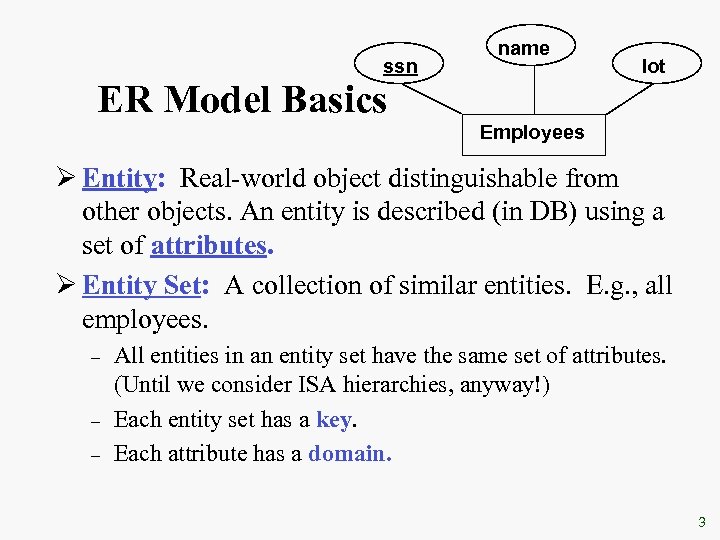 ssn name ER Model Basics lot Employees Ø Entity: Real-world object distinguishable from other objects. An entity is described (in DB) using a set of attributes. Ø Entity Set: A collection of similar entities. E. g. , all employees. – – – All entities in an entity set have the same set of attributes. (Until we consider ISA hierarchies, anyway!) Each entity set has a key. Each attribute has a domain. 3
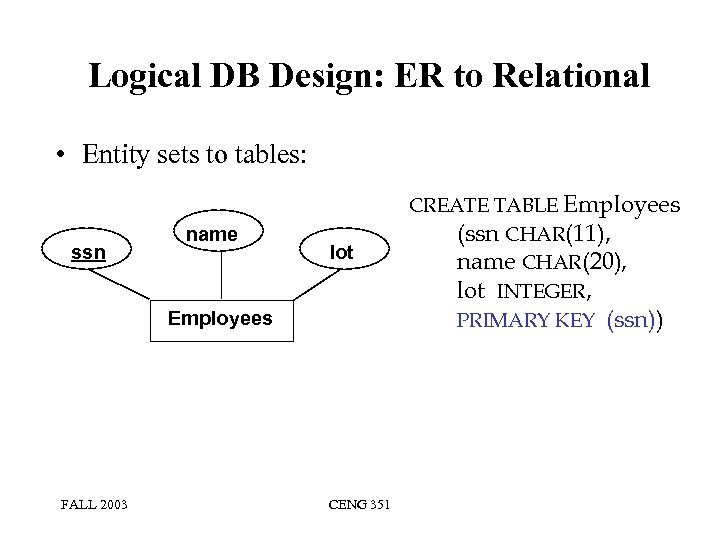 Logical DB Design: ER to Relational • Entity sets to tables: ssn name lot Employees FALL 2003 CENG 351 CREATE TABLE Employees (ssn CHAR(11), name CHAR(20), lot INTEGER, PRIMARY KEY (ssn))
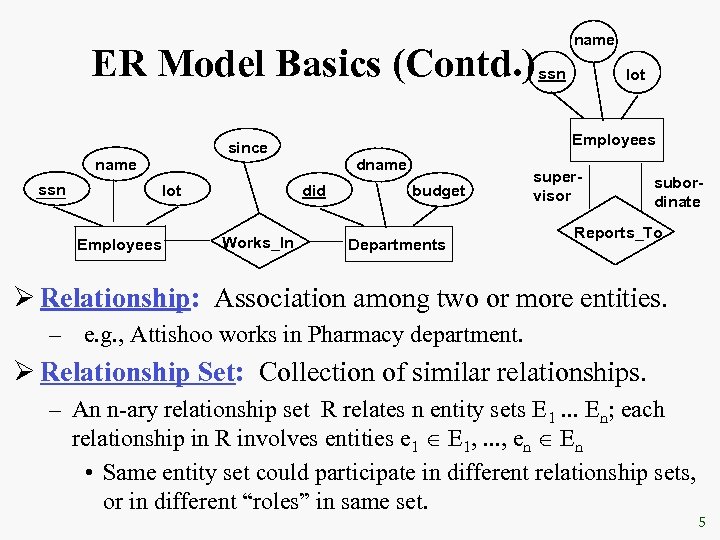 ER Model Basics (Contd. ) ssn lot Employees dname did Works_In ssn lot Employees since name budget Departments supervisor subordinate Reports_To Ø Relationship: Association among two or more entities. – e. g. , Attishoo works in Pharmacy department. Ø Relationship Set: Collection of similar relationships. – An n-ary relationship set R relates n entity sets E 1. . . En; each relationship in R involves entities e 1 E 1, . . . , en En • Same entity set could participate in different relationship sets, or in different “roles” in same set. 5
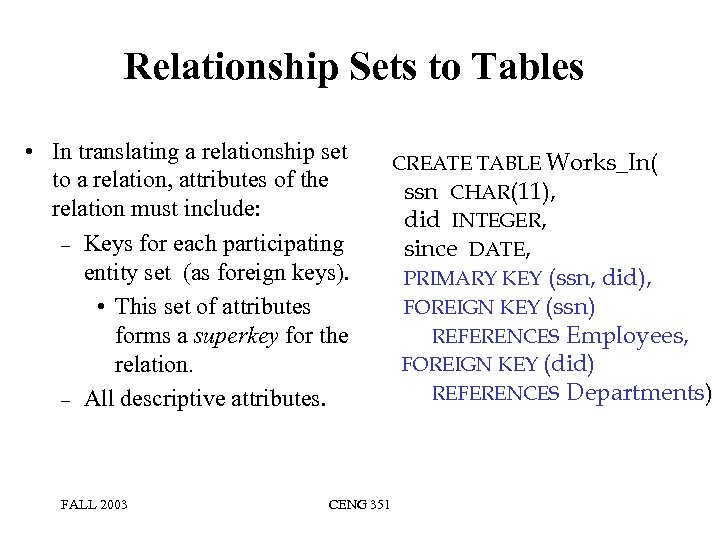 Relationship Sets to Tables • In translating a relationship set to a relation, attributes of the relation must include: – Keys for each participating entity set (as foreign keys). • This set of attributes forms a superkey for the relation. – All descriptive attributes. FALL 2003 CENG 351 CREATE TABLE Works_In( ssn CHAR(11), did INTEGER, since DATE, PRIMARY KEY (ssn, did), FOREIGN KEY (ssn) REFERENCES Employees, FOREIGN KEY (did) REFERENCES Departments)
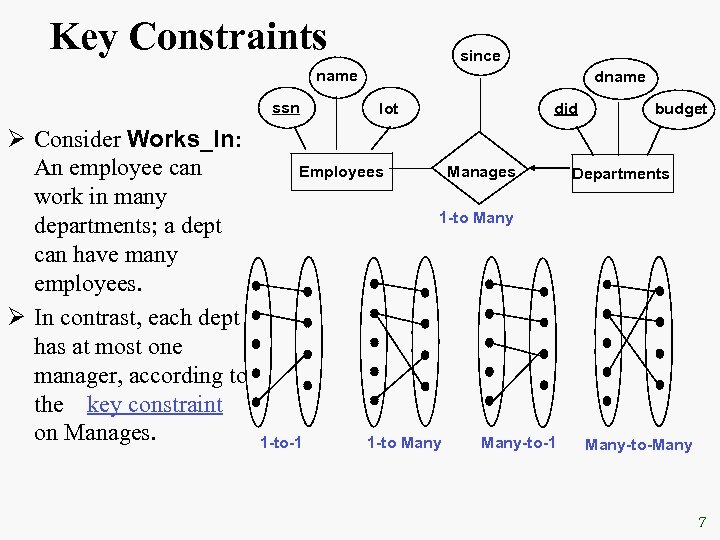 Key Constraints since name ssn Ø Consider Works_In: An employee can work in many departments; a dept can have many employees. Ø In contrast, each dept has at most one manager, according to the key constraint on Manages. dname lot did Employees Manages budget Departments 1 -to Many 1 -to-1 1 -to Many-to-1 Many-to-Many 7
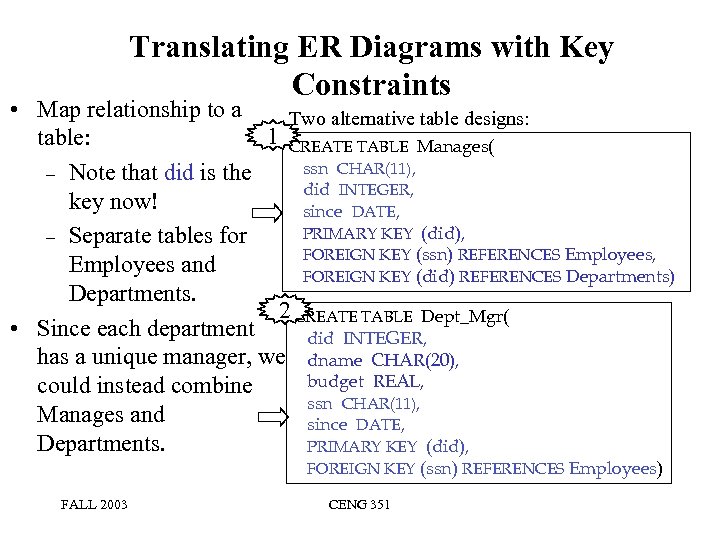 Translating ER Diagrams with Key Constraints • Map relationship to a Two alternative table designs: 1 CREATE TABLE Manages( table: ssn CHAR(11), – Note that did is the did INTEGER, key now! since DATE, PRIMARY KEY (did), – Separate tables for FOREIGN KEY (ssn) REFERENCES Employees, Employees and FOREIGN KEY (did) REFERENCES Departments) Departments. 2 CREATE TABLE Dept_Mgr( • Since each department did INTEGER, has a unique manager, we dname CHAR(20), budget REAL, could instead combine ssn CHAR(11), Manages and since DATE, Departments. PRIMARY KEY (did), FOREIGN KEY (ssn) REFERENCES Employees) FALL 2003 CENG 351
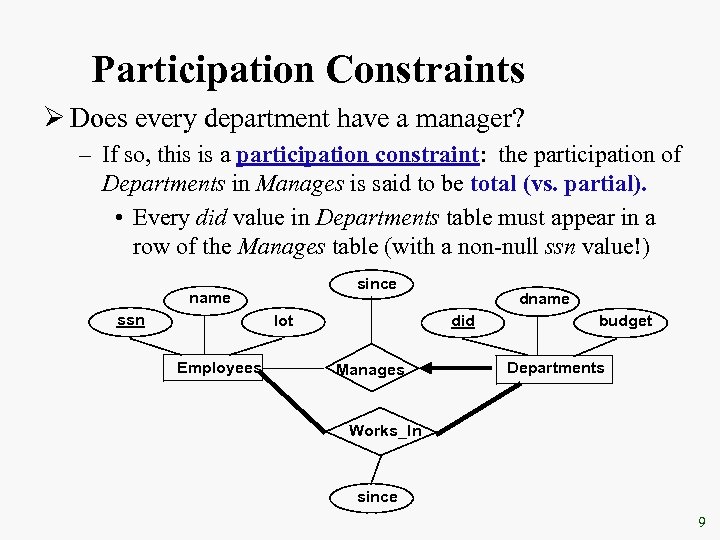 Participation Constraints Ø Does every department have a manager? – If so, this is a participation constraint: the participation of Departments in Manages is said to be total (vs. partial). • Every did value in Departments table must appear in a row of the Manages table (with a non-null ssn value!) since name ssn did lot Employees dname Manages budget Departments Works_In since 9
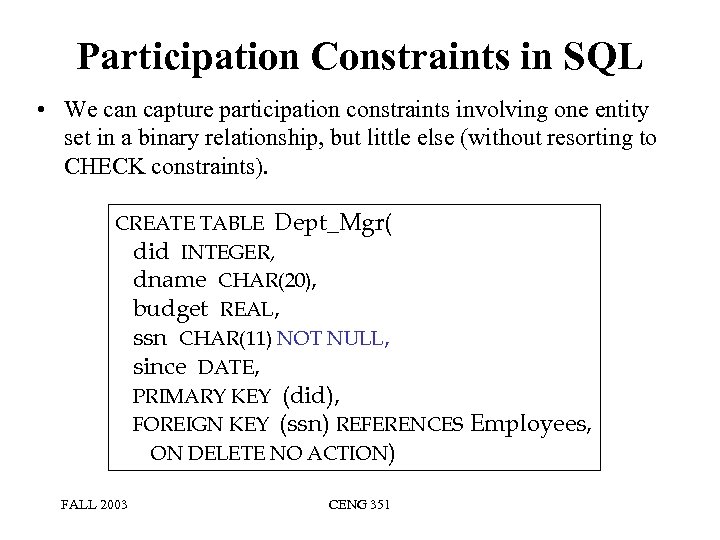 Participation Constraints in SQL • We can capture participation constraints involving one entity set in a binary relationship, but little else (without resorting to CHECK constraints). CREATE TABLE Dept_Mgr( did INTEGER, dname CHAR(20), budget REAL, ssn CHAR(11) NOT NULL, since DATE, PRIMARY KEY (did), FOREIGN KEY (ssn) REFERENCES ON DELETE NO ACTION) FALL 2003 CENG 351 Employees,
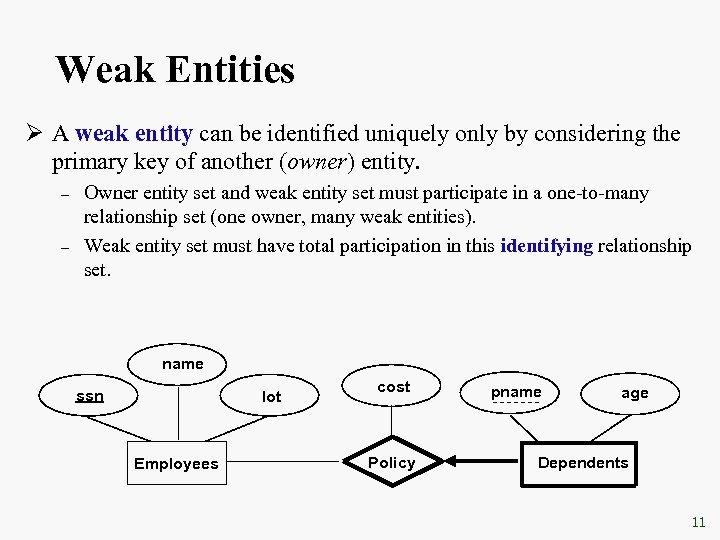 Weak Entities Ø A weak entity can be identified uniquely only by considering the primary key of another (owner) entity. – – Owner entity set and weak entity set must participate in a one-to-many relationship set (one owner, many weak entities). Weak entity set must have total participation in this identifying relationship set. name ssn lot Employees cost Policy pname age Dependents 11
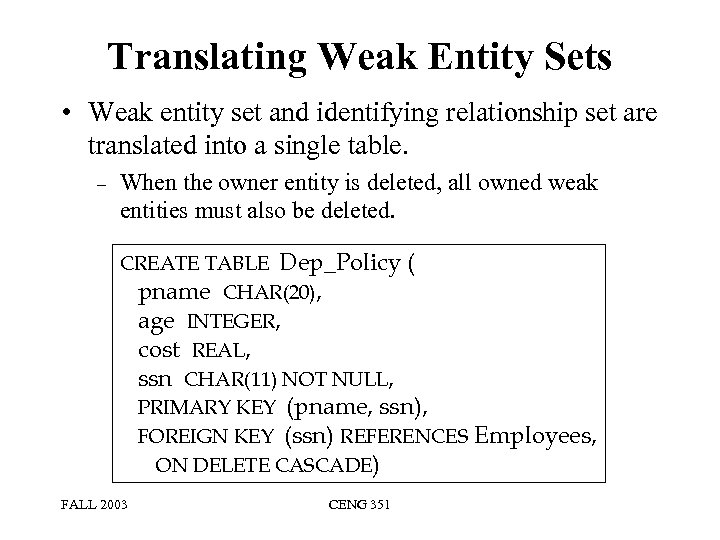 Translating Weak Entity Sets • Weak entity set and identifying relationship set are translated into a single table. – When the owner entity is deleted, all owned weak entities must also be deleted. CREATE TABLE Dep_Policy ( pname CHAR(20), age INTEGER, cost REAL, ssn CHAR(11) NOT NULL, PRIMARY KEY (pname, ssn), FOREIGN KEY (ssn) REFERENCES ON DELETE CASCADE) FALL 2003 CENG 351 Employees,
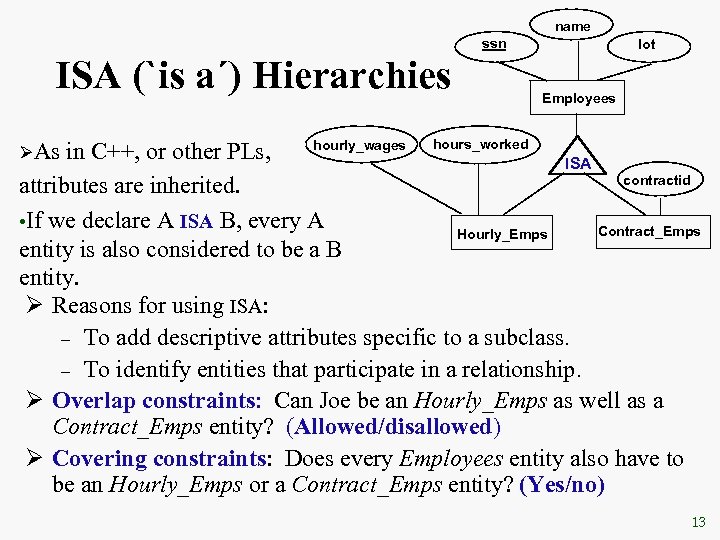 name ssn ISA (`is a´) Hierarchies lot Employees hours_worked hourly_wages in C++, or other PLs, ISA contractid attributes are inherited. • If we declare A ISA B, every A Contract_Emps Hourly_Emps entity is also considered to be a B entity. Ø Reasons for using ISA: – To add descriptive attributes specific to a subclass. – To identify entities that participate in a relationship. Ø Overlap constraints: Can Joe be an Hourly_Emps as well as a Contract_Emps entity? (Allowed/disallowed) Ø Covering constraints: Does every Employees entity also have to be an Hourly_Emps or a Contract_Emps entity? (Yes/no) ØAs 13
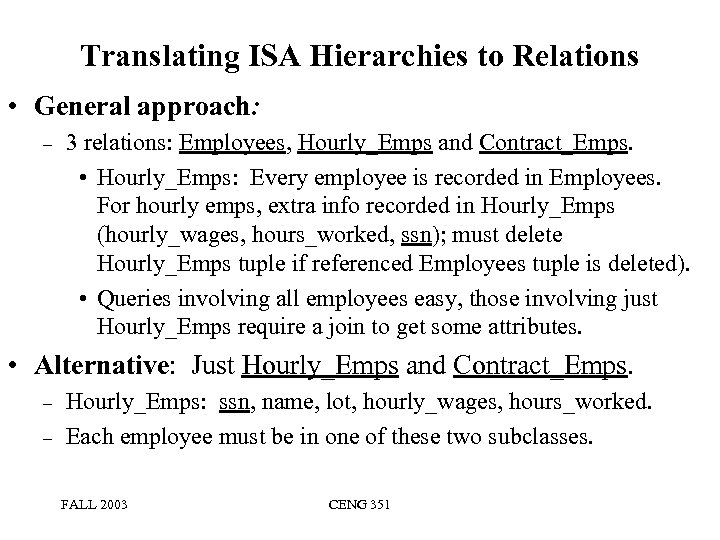 Translating ISA Hierarchies to Relations • General approach: – 3 relations: Employees, Hourly_Emps and Contract_Emps. • Hourly_Emps: Every employee is recorded in Employees. For hourly emps, extra info recorded in Hourly_Emps (hourly_wages, hours_worked, ssn); must delete Hourly_Emps tuple if referenced Employees tuple is deleted). • Queries involving all employees easy, those involving just Hourly_Emps require a join to get some attributes. • Alternative: Just Hourly_Emps and Contract_Emps. – – Hourly_Emps: ssn, name, lot, hourly_wages, hours_worked. Each employee must be in one of these two subclasses. FALL 2003 CENG 351
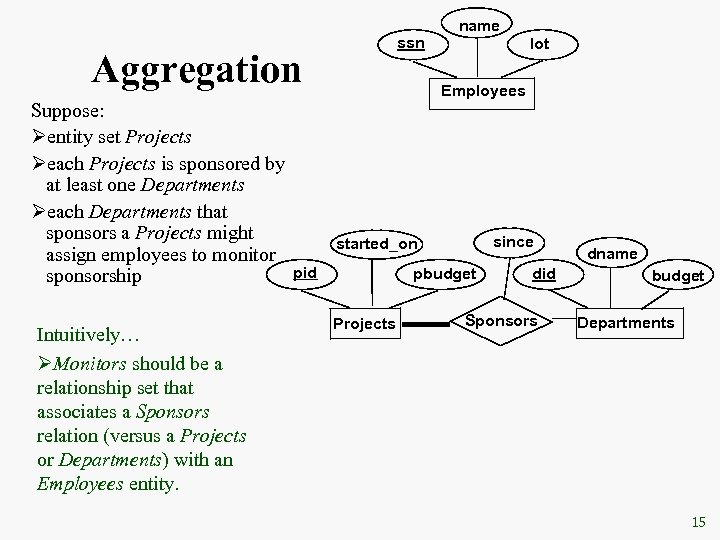 ssn Aggregation Suppose: Øentity set Projects Øeach Projects is sponsored by at least one Departments Øeach Departments that sponsors a Projects might assign employees to monitor sponsorship Intuitively… ØMonitors should be a relationship set that associates a Sponsors relation (versus a Projects or Departments) with an Employees entity. name lot Employees since started_on pid pbudget Projects did Sponsors dname budget Departments 15
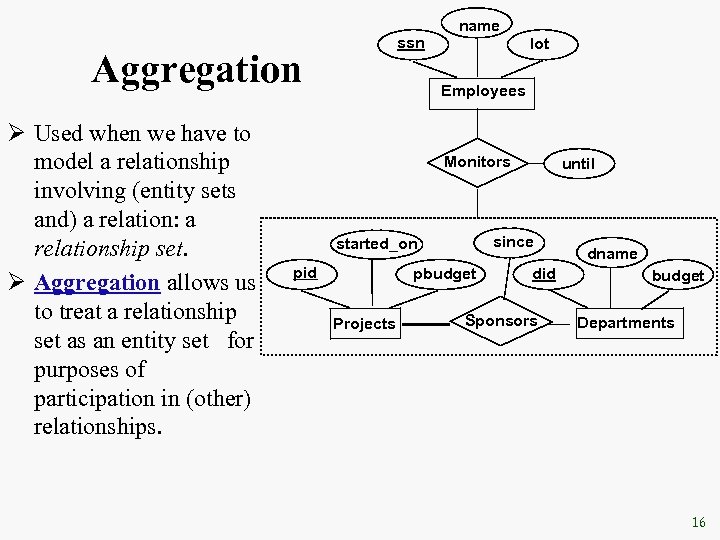 ssn Aggregation Ø Used when we have to model a relationship involving (entity sets and) a relation: a relationship set. Ø Aggregation allows us to treat a relationship set as an entity set for purposes of participation in (other) relationships. name lot Employees Monitors since started_on pid pbudget Projects until did Sponsors dname budget Departments 16
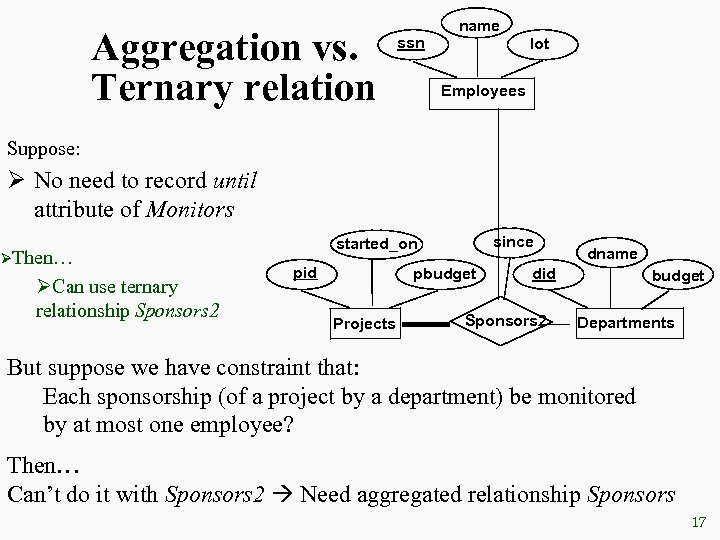 Aggregation vs. Ternary relation ssn name lot Employees Suppose: Ø No need to record until attribute of Monitors ØThen… ØCan use ternary relationship Sponsors 2 since started_on pid pbudget Projects dname did Sponsors 2 budget Departments But suppose we have constraint that: Each sponsorship (of a project by a department) be monitored by at most one employee? Then… Can’t do it with Sponsors 2 Need aggregated relationship Sponsors 17
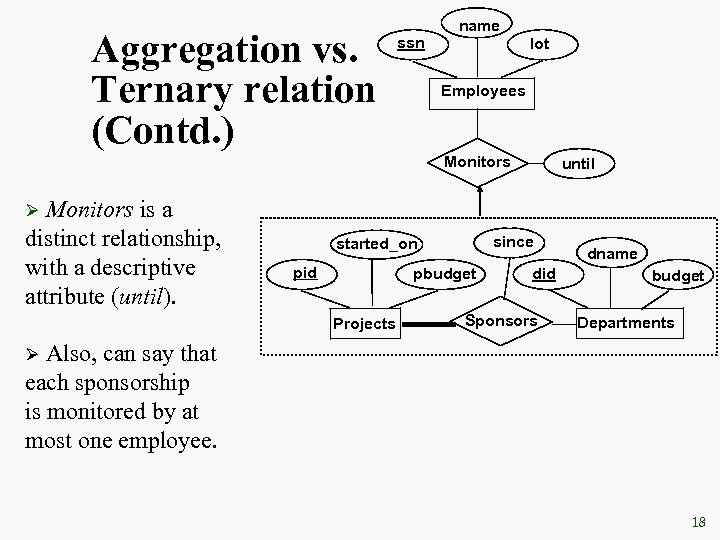 Aggregation vs. Ternary relation (Contd. ) ssn name lot Employees Monitors is a distinct relationship, with a descriptive attribute (until). until Ø since started_on pid pbudget Projects did Sponsors dname budget Departments Also, can say that each sponsorship is monitored by at most one employee. Ø 18
 Conceptual Design Using the ER Model Ø Design choices: – Should a concept be modeled as an entity or an attribute? – Should a concept be modeled as an entity or a relationship? – Identifying relationships: Binary or ternary? Aggregation? Ø Constraints in the ER Model: – A lot of data semantics can (and should) be captured. – But some constraints cannot be captured in ER diagrams. 19
 Entity vs. Attribute Ø Should address be an attribute of Employees or an entity (connected to Employees by a relationship)? ØDepends upon the use we want to make of address information, and the semantics of the data: • If we have several addresses per employee, address must be an entity (since attributes cannot be set-valued). • If the structure (city, street, etc. ) is important, e. g. , we want to retrieve employees in a given city, address must be modeled as an entity (since attribute values are atomic). 20
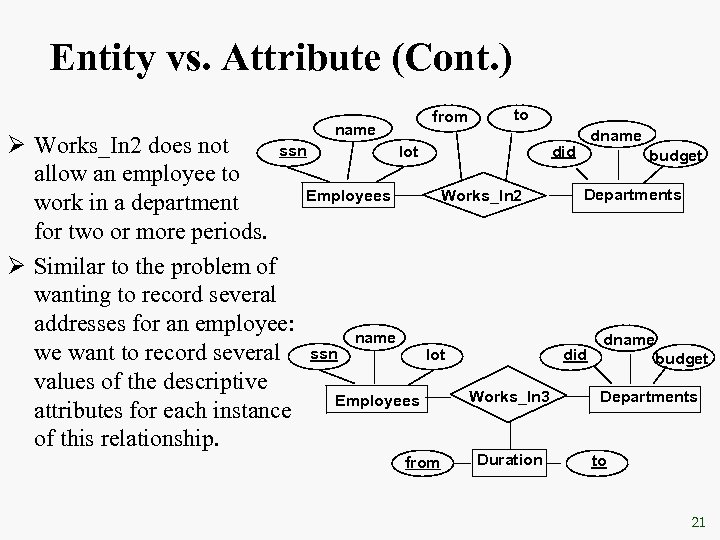 Entity vs. Attribute (Cont. ) name from to dname Ø Works_In 2 does not ssn lot did budget allow an employee to Departments Works_In 2 Employees work in a department for two or more periods. Ø Similar to the problem of wanting to record several addresses for an employee: name dname ssn we want to record several lot did budget values of the descriptive Works_In 3 Departments Employees attributes for each instance of this relationship. from Duration to 21
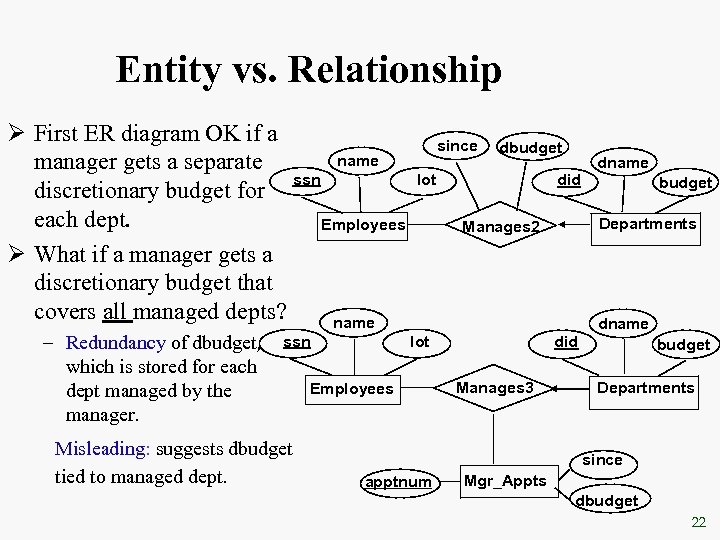 Entity vs. Relationship Ø First ER diagram OK if a name manager gets a separate ssn discretionary budget for each dept. Employees Ø What if a manager gets a discretionary budget that covers all managed depts? name – Redundancy of dbudget, which is stored for each dept managed by the manager. ssn Misleading: suggests dbudget tied to managed dept. since dbudget lot did dname budget Departments Manages 2 dname lot Employees did Manages 3 budget Departments since apptnum Mgr_Appts dbudget 22
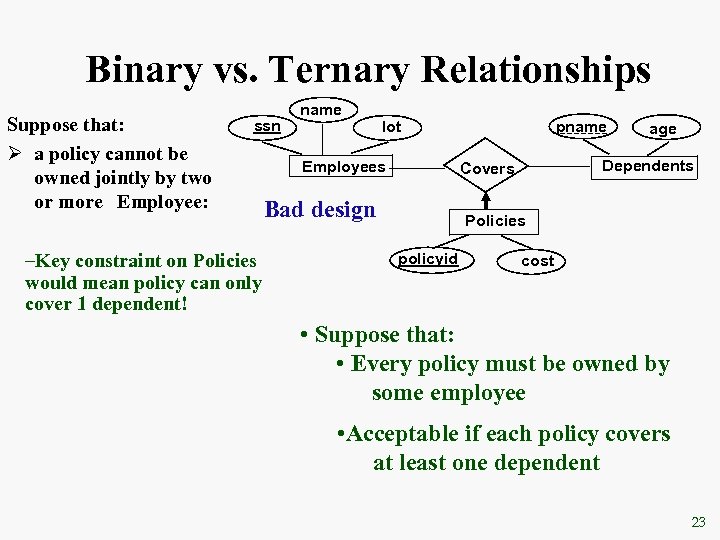 Binary vs. Ternary Relationships Suppose that: Ø a policy cannot be owned jointly by two or more Employee: ssn –Key constraint on Policies would mean policy can only cover 1 dependent! name pname lot Employees Dependents Covers Bad design age Policies policyid cost • Suppose that: • Every policy must be owned by some employee • Acceptable if each policy covers at least one dependent 23
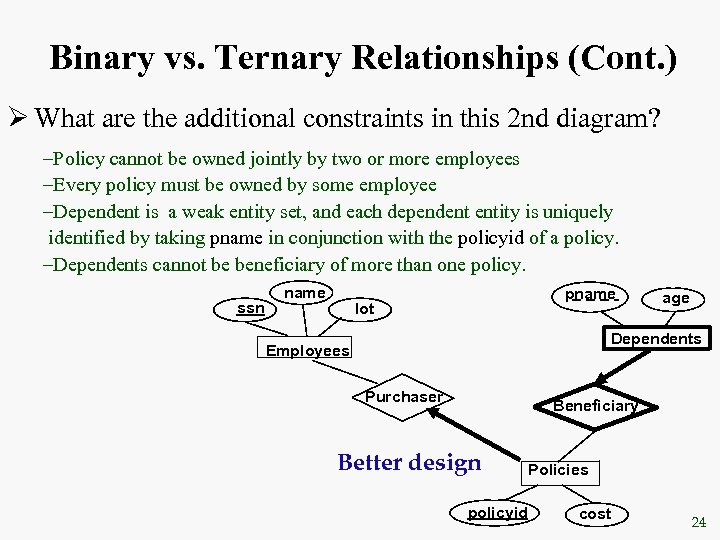 Binary vs. Ternary Relationships (Cont. ) Ø What are the additional constraints in this 2 nd diagram? –Policy cannot be owned jointly by two or more employees –Every policy must be owned by some employee –Dependent is a weak entity set, and each dependent entity is uniquely identified by taking pname in conjunction with the policyid of a policy. –Dependents cannot be beneficiary of more than one policy. ssn name pname lot age Dependents Employees Purchaser Beneficiary Better design policyid Policies cost 24
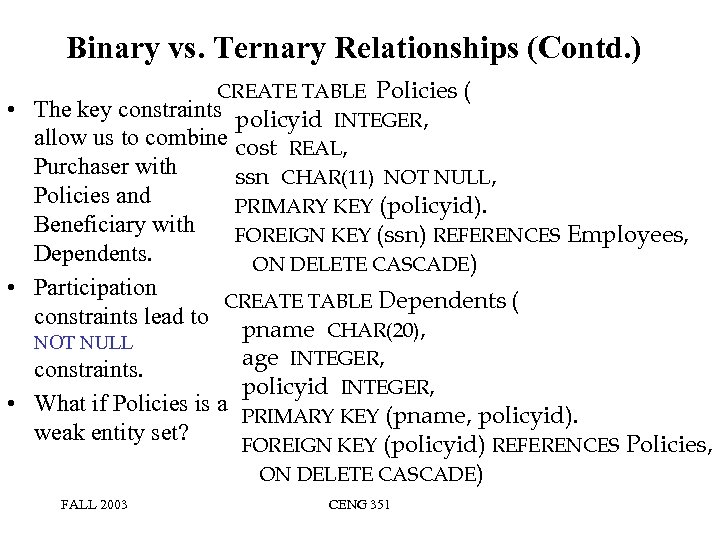 Binary vs. Ternary Relationships (Contd. ) • CREATE TABLE Policies ( The key constraints policyid INTEGER, allow us to combine cost REAL, Purchaser with ssn CHAR(11) NOT NULL, Policies and PRIMARY KEY (policyid). Beneficiary with FOREIGN KEY (ssn) REFERENCES Dependents. ON DELETE CASCADE) Employees, • Participation CREATE TABLE Dependents ( constraints lead to pname CHAR(20), NOT NULL age INTEGER, constraints. policyid INTEGER, • What if Policies is a PRIMARY KEY (pname, policyid). weak entity set? FOREIGN KEY (policyid) REFERENCES Policies, ON DELETE CASCADE) FALL 2003 CENG 351
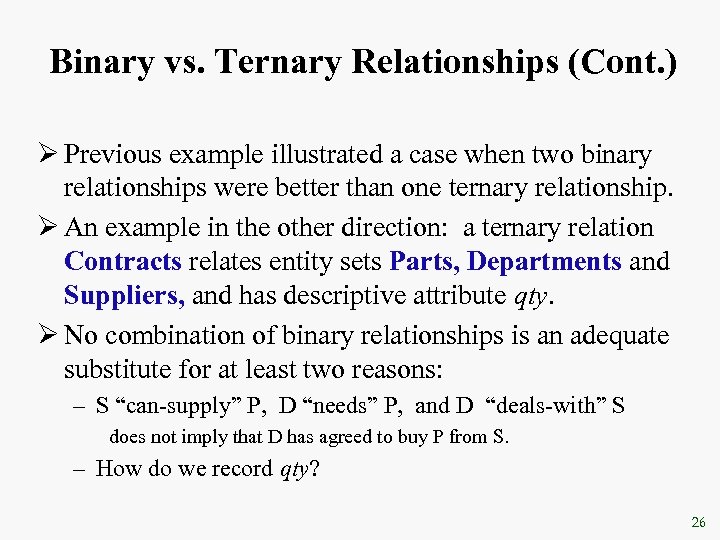 Binary vs. Ternary Relationships (Cont. ) Ø Previous example illustrated a case when two binary relationships were better than one ternary relationship. Ø An example in the other direction: a ternary relation Contracts relates entity sets Parts, Departments and Suppliers, and has descriptive attribute qty. Ø No combination of binary relationships is an adequate substitute for at least two reasons: – S “can-supply” P, D “needs” P, and D “deals-with” S does not imply that D has agreed to buy P from S. – How do we record qty? 26
 Summary of Conceptual Design Ø Conceptual design follows requirements analysis, – Yields a high-level description of data to be stored Ø ER model popular for conceptual design – Constructs are expressive, close to the way people think about their applications. Ø Basic constructs: entities, relationships, and attributes (of entities and relationships). Ø Some additional constructs: weak entities, ISA hierarchies, and aggregation. Ø Note: There are many variations on ER model. 27
 Summary of ER (Contd. ) Ø Several kinds of integrity constraints can be expressed in the ER model: key constraints, participation constraints, and overlap/covering constraints for ISA hierarchies. Some foreign key constraints are also implicit in the definition of a relationship set. – Some constraints (notably, functional dependencies) cannot be expressed in the ER model. – Constraints play an important role in determining the best database design for an enterprise. 28
 Summary of ER (Contd. ) Ø ER design is subjective. There are often many ways to model a given scenario! Analyzing alternatives can be tricky, especially for a large enterprise. Common choices include: – Entity vs. attribute, entity vs. relationship, binary or n-ary relationship, whether or not to use ISA hierarchies, and whether or not to use aggregation. Ø Ensuring good database design: resulting relational schema should be analyzed and refined further. FD information and normalization techniques are especially useful. 29
 Example Ø A University database contains information about professors (identified by social security number, or SSN) and courses (identified by courseid). Professors teach courses. Ø Each of the following situations concerns the Teaches relationship set. For each situation, draw an ER diagram that describes it (assuming that no further constraints hold). 30
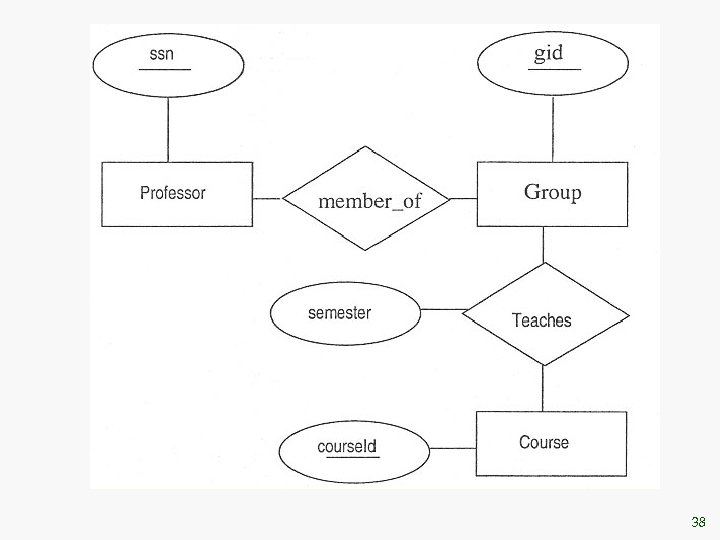
 Example (cont’) 1) Professors can teach the same course in several semesters, and each offering must be recorded. 2) Professors can teach the same course in several semesters, and only the most recent such offering needs to be recorded. (Assume this condition applies to all subsequent questions. ) 3) Every professor must teach some course 4) Every professor teaches exactly one course (no more, no less). 5) Every professor teaches exactly one course (no more no less), and every course must be taught by some professor. 6) Now assume that certain courses can be taught by a team of professors jointly, but it is possible that no one professor in a team can teach the course. Model this situation introducing additional entity sets and relationship sets if necessary. 31
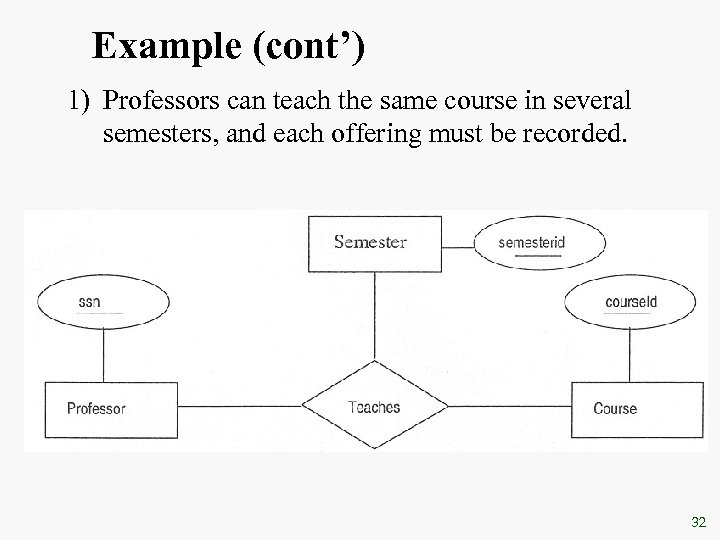 Example (cont’) 1) Professors can teach the same course in several semesters, and each offering must be recorded. 32
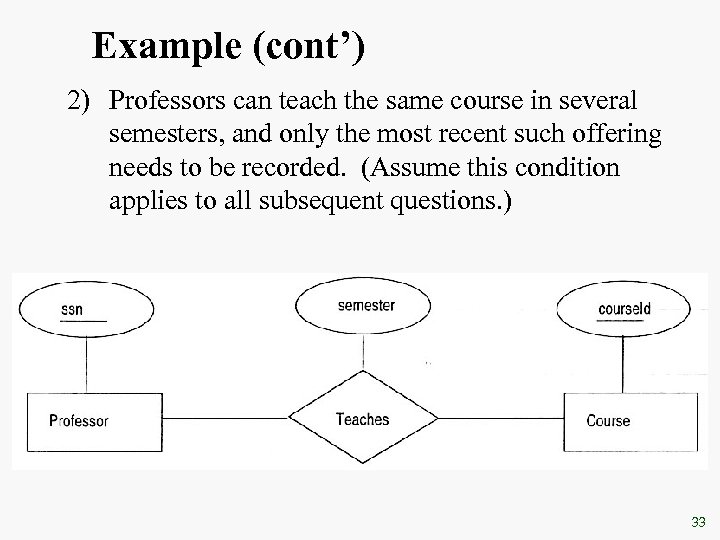 Example (cont’) 2) Professors can teach the same course in several semesters, and only the most recent such offering needs to be recorded. (Assume this condition applies to all subsequent questions. ) 33
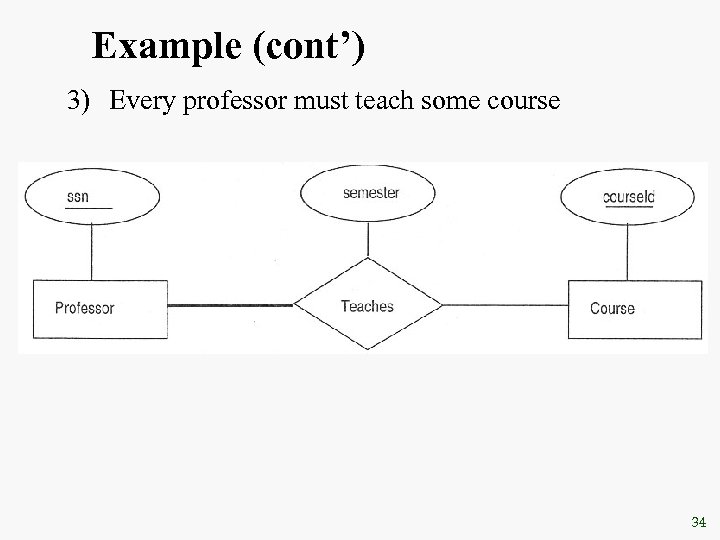 Example (cont’) 3) Every professor must teach some course 34
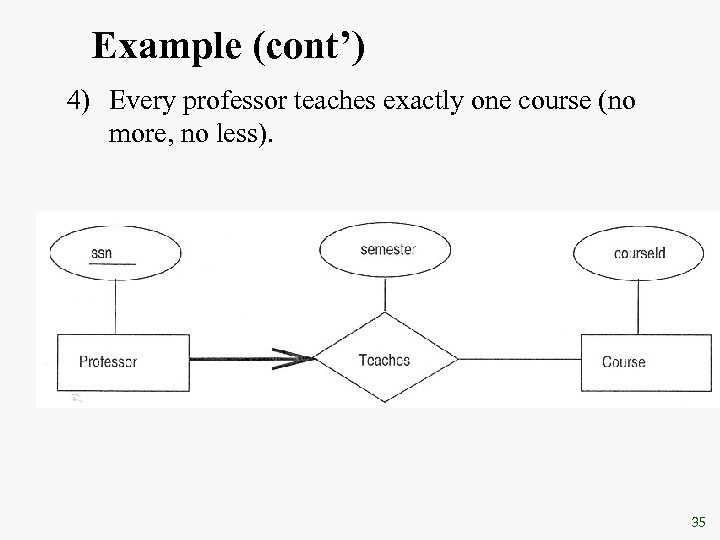 Example (cont’) 4) Every professor teaches exactly one course (no more, no less). 35
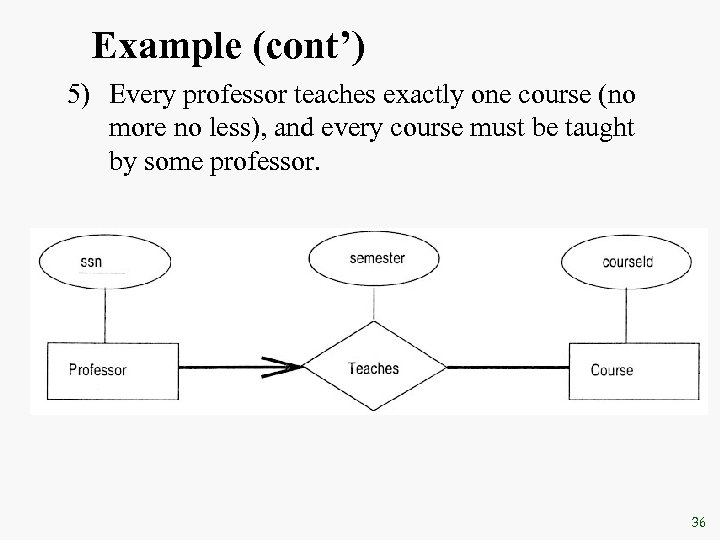 Example (cont’) 5) Every professor teaches exactly one course (no more no less), and every course must be taught by some professor. 36
 Example (cont’) 6) Now assume that certain courses can be taught by a team of professors jointly, but it is possible that no one professor in a team can teach the course. Model this situation introducing additional entity sets and relationship sets if necessary. 37
 38
38
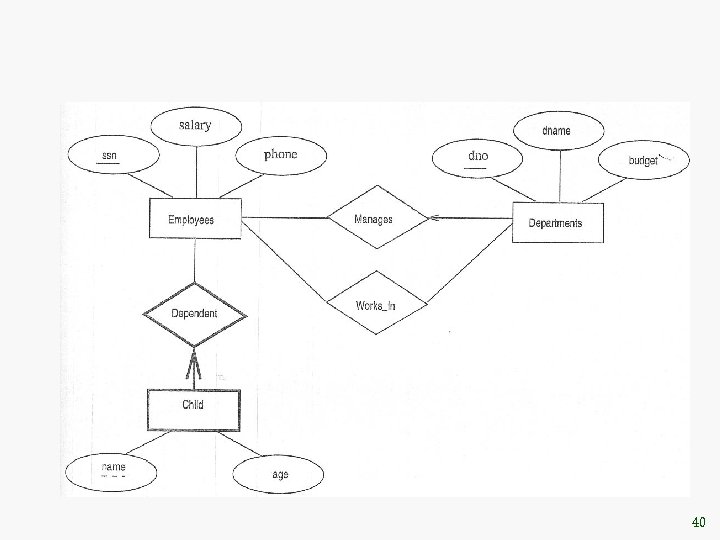
 Example Ø A company database needs to store information about employees (identifyied by ssn, with salary and phone as attributes); departments (identified by dno, with dname and budget as attributes); and children of employees (with name and age as attributes). Employees work in departments; each department is managed by an employee; a child must be identified uniquely by name when the parent (who is an employee; assume that only one parent works for the company) is known. We are not interested in information about a child once the parent leaves the company. 39
 40
40