


 Скачать презентацию The entirely re-written Section 102 would create a
400e85795621e2d767c861fd2a370009.ppt
- Количество слайдов: 32
 The entirely re-written Section 102 would create a bar to patentability if “the claimed invention was patented, described in a printed publication, or in public use, on sale, or otherwise available to the public” prior to the filing of the patent application (the ‘effective date’). The rule would also encompass 102(e) prior art, so long as the prior art filing was prior to the effective date.




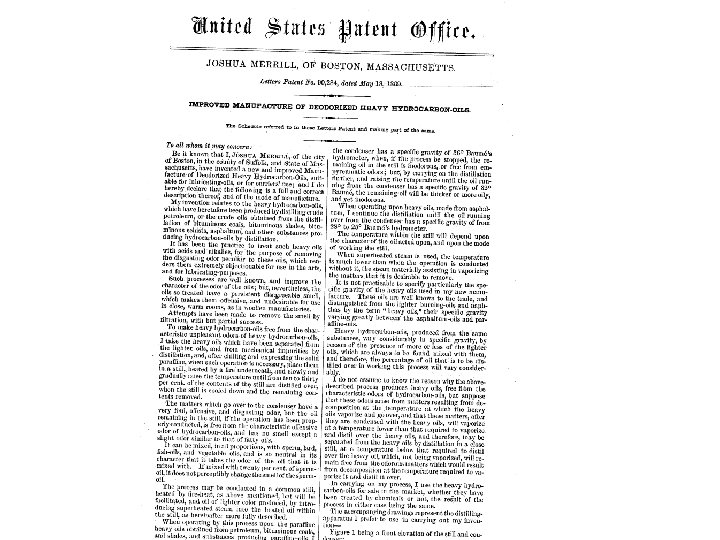
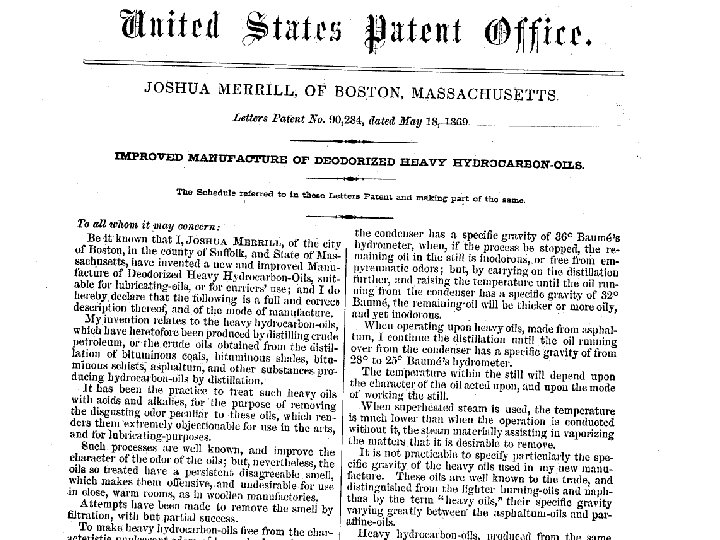
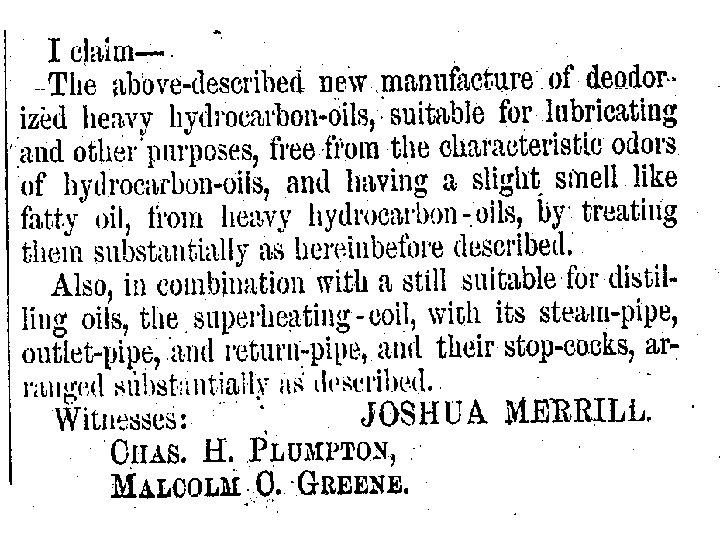
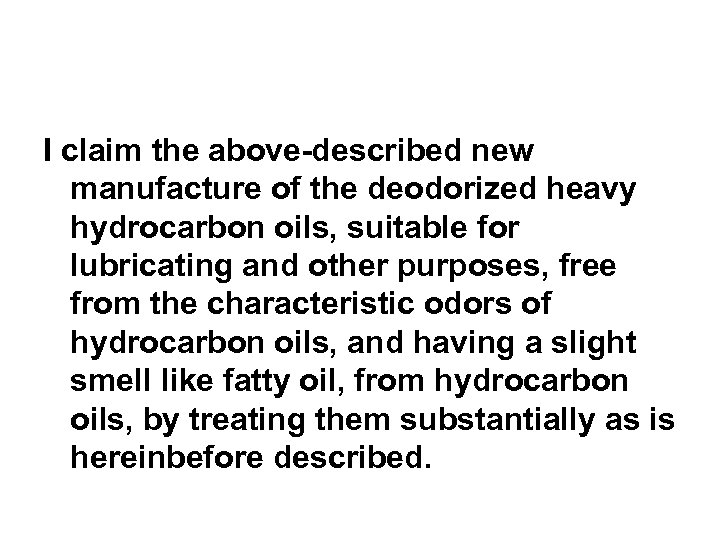 I claim the above-described new manufacture of the deodorized heavy hydrocarbon oils, suitable for lubricating and other purposes, free from the characteristic odors of hydrocarbon oils, and having a slight smell like fatty oil, from hydrocarbon oils, by treating them substantially as is hereinbefore described.





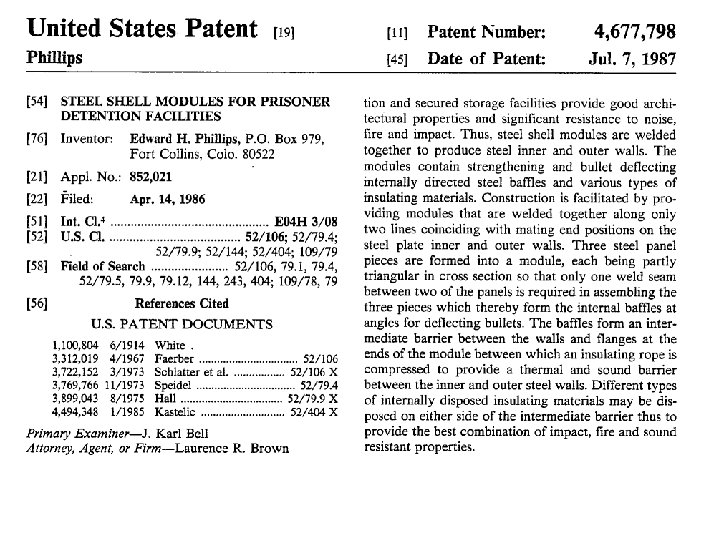









![[T]here will still remain some cases in which it will be hard to determine](https://present5.com/presentation/400e85795621e2d767c861fd2a370009/image-26.jpg "[T]here will still remain some cases in which it will be hard to determine") [T]here will still remain some cases in which it will be hard to determine whether a person of skill in the art would understand the embodiments to define the outer limits of the claim term or merely to be exemplary in nature. While that task may present difficulties in some cases, we nonetheless believe that --
[T]here will still remain some cases in which it will be hard to determine whether a person of skill in the art would understand the embodiments to define the outer limits of the claim term or merely to be exemplary in nature. While that task may present difficulties in some cases, we nonetheless believe that --



![[T]he court noted that “every textual reference in the Specification and its diagrams show](https://present5.com/presentation/400e85795621e2d767c861fd2a370009/image-30.jpg "[T]he court noted that “every textual reference in the Specification and its diagrams show") [T]he court noted that “every textual reference in the Specification and its diagrams show baffle deployment at an angle other than 90 [degree] to the wall faces” and that “placement of the baffles at such angles creates an interm ediate interlocking, but not solid, internal barrier. ”
[T]he court noted that “every textual reference in the Specification and its diagrams show baffle deployment at an angle other than 90 [degree] to the wall faces” and that “placement of the baffles at such angles creates an interm ediate interlocking, but not solid, internal barrier. ”

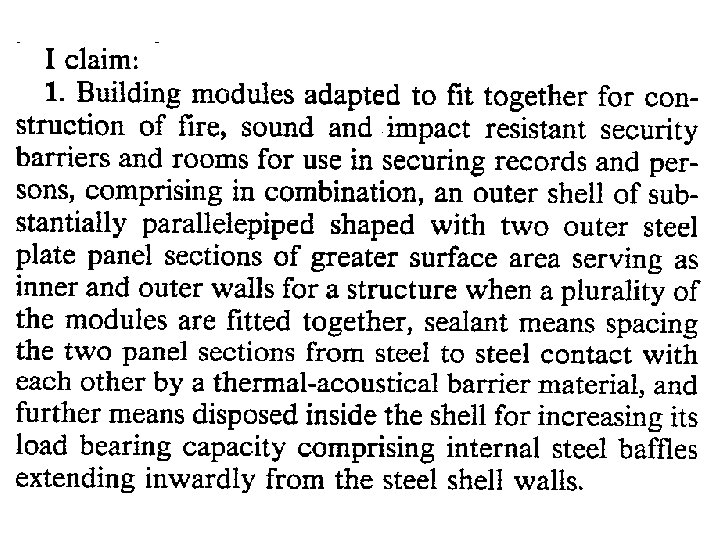
 Although deflecting projectiles is one of the advantages of the baffles of the ’ 798 patent, the patent does not require that the inward extending structures always be capable of performing that function. Accordingly, we conclude that a person of skill in the art would not interpret the disclosure and claims of the ’ 798 patent to mean that a structure extending inward from one of the wall faces is a “baffle” if it is at an acute or obtuse angle, but is not a “baffle” if it is disposed at a right angle. – 799 -800