


 Скачать презентацию THE ENLIGHTENMENT A HISTORICAL CHALLENGE TO RELIGIOUS TRADITIONS
f34f0ac3138a51625fee564769139644.ppt
- Количество слайдов: 8
 THE ENLIGHTENMENT: A HISTORICAL CHALLENGE TO RELIGIOUS TRADITIONS Paul Forgasz Australian Centre for Jewish Civilisation Monash University paul. forgasz@monash. edu
 Definition • A Western & Central European intellectual movement • Immanuel Kant, What is the Enlightenment? (1784): the “enlightenment” as humankind's release from its self-incurred immaturity: Immaturity is the inability to use one's own understanding without the guidance of another • Some defining themes
 TIME FRAME OF THE ENLIGHTENMENT: • Mid 17 th century (1650) is a common a starting point • Until the 1650 s • After 1650, everything, no matter how fundamental or deeply rooted, was questioned in the light of philosophic reason – Jonathan Israel, Radical Enlightenment • Francis Bacon and Rene Descartes • Key figures of the early Enlightenment: Baruch Spinoza, John Locke, Pierre Bayle, Isaac Newton • Key figures of the C 18 th: Voltaire, Montesquieu, Rousseau, Diderpt, Hume, Holbach, Kant. • Jonathan Israel: the overarching influence from 1650 to 1750, of Spinoza • 1790– 1800: endpoint of the Enlightenment *** Was the enlightenment opposed to religion?
 PRECURSORS TO THE ENLIGHTENMENT From the broad spectrum of Western history, several traditions flowed into the Enlightenment: the rational spirit born in classical Greece, the Stoic emphasis on natural law that applies to all human heings, and the Christian belief that all individuals are equal in God's eyes. A more immediate influence on the Enlightenment was Renaissance humanism, which focused on The individual and worldly human accomplishments and which criticized medieval theology-philosophy for its preoccupation with questions that seemed unrelated to the human condition. In many ways, the Enlightenment grew directly out of the Scientific Revolution Marvin Perry, Sources of the Western Tradition
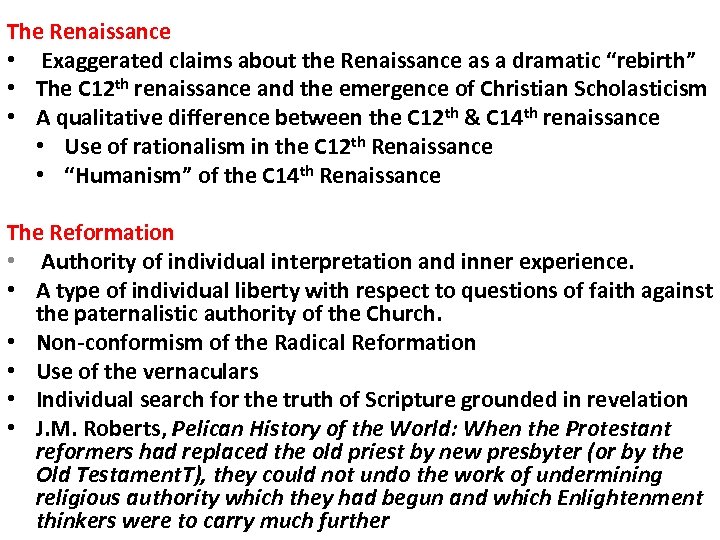 The Renaissance • Exaggerated claims about the Renaissance as a dramatic “rebirth” • The C 12 th renaissance and the emergence of Christian Scholasticism • A qualitative difference between the C 12 th & C 14 th renaissance • Use of rationalism in the C 12 th Renaissance • “Humanism” of the C 14 th Renaissance The Reformation • Authority of individual interpretation and inner experience. • A type of individual liberty with respect to questions of faith against the paternalistic authority of the Church. • Non-conformism of the Radical Reformation • Use of the vernaculars • Individual search for the truth of Scripture grounded in revelation • J. M. Roberts, Pelican History of the World: When the Protestant reformers had replaced the old priest by new presbyter (or by the Old Testament. T), they could not undo the work of undermining religious authority which they had begun and which Enlightenment thinkers were to carry much further
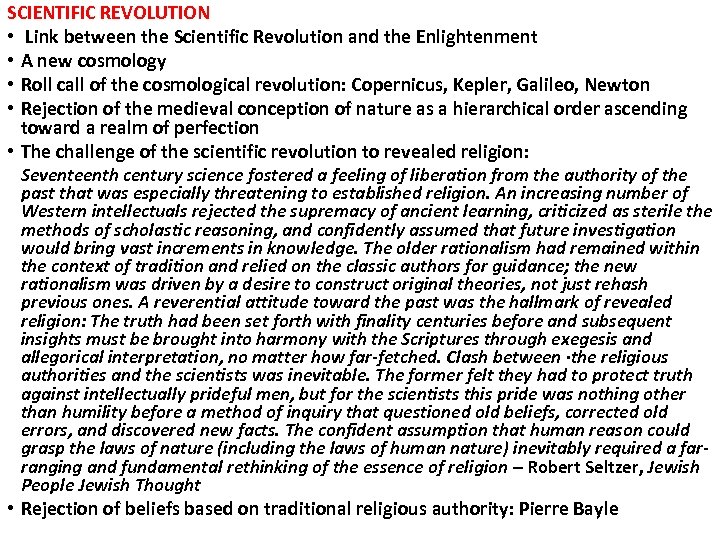 SCIENTIFIC REVOLUTION • Link between the Scientific Revolution and the Enlightenment • A new cosmology • Roll call of the cosmological revolution: Copernicus, Kepler, Galileo, Newton • Rejection of the medieval conception of nature as a hierarchical order ascending toward a realm of perfection • The challenge of the scientific revolution to revealed religion: Seventeenth century science fostered a feeling of liberation from the authority of the past that was especially threatening to established religion. An increasing number of Western intellectuals rejected the supremacy of ancient learning, criticized as sterile the methods of scholastic reasoning, and confidently assumed that future investigation would bring vast increments in knowledge. The older rationalism had remained within the context of tradition and relied on the classic authors for guidance; the new rationalism was driven by a desire to construct original theories, not just rehash previous ones. A reverential attitude toward the past was the hallmark of revealed religion: The truth had been set forth with finality centuries before and subsequent insights must be brought into harmony with the Scriptures through exegesis and allegorical interpretation, no matter how far-fetched. Clash between ·the religious authorities and the scientists was inevitable. The former felt they had to protect truth against intellectually prideful men, but for the scientists this pride was nothing other than humility before a method of inquiry that questioned old beliefs, corrected old errors, and discovered new facts. The confident assumption that human reason could grasp the laws of nature (including the laws of human nature) inevitably required a farranging and fundamental rethinking of the essence of religion – Robert Seltzer, Jewish People Jewish Thought • Rejection of beliefs based on traditional religious authority: Pierre Bayle
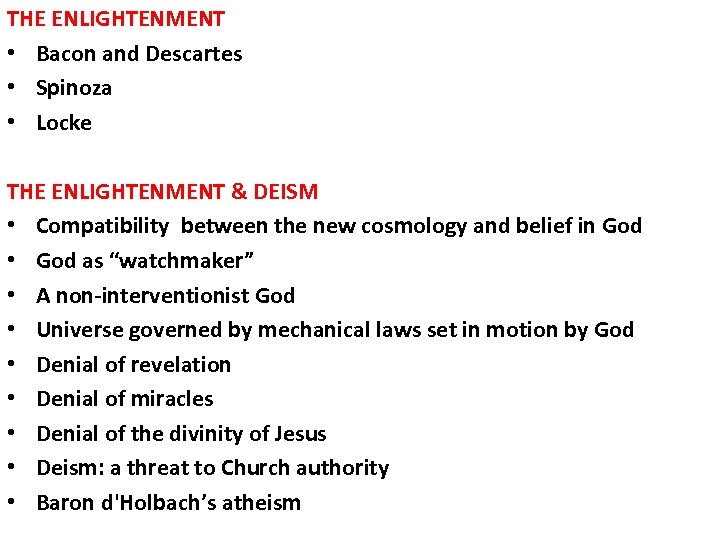 THE ENLIGHTENMENT • Bacon and Descartes • Spinoza • Locke THE ENLIGHTENMENT & DEISM • Compatibility between the new cosmology and belief in God • God as “watchmaker” • A non-interventionist God • Universe governed by mechanical laws set in motion by God • Denial of revelation • Denial of miracles • Denial of the divinity of Jesus • Deism: a threat to Church authority • Baron d'Holbach’s atheism
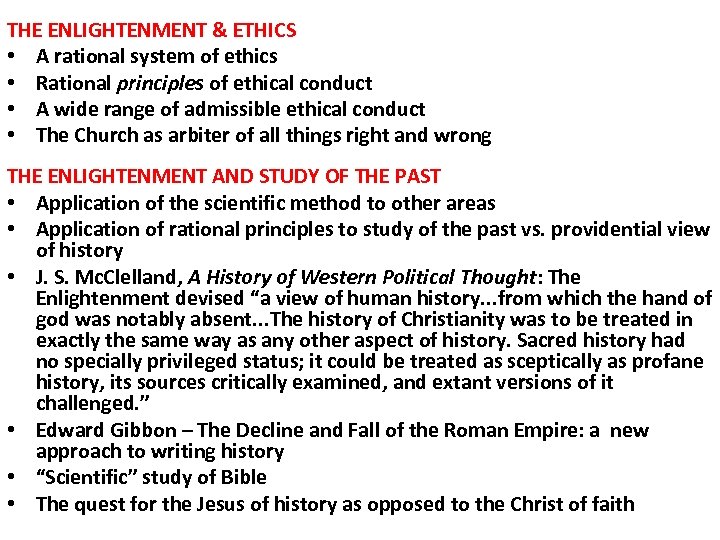 THE ENLIGHTENMENT & ETHICS • A rational system of ethics • Rational principles of ethical conduct • A wide range of admissible ethical conduct • The Church as arbiter of all things right and wrong THE ENLIGHTENMENT AND STUDY OF THE PAST • Application of the scientific method to other areas • Application of rational principles to study of the past vs. providential view of history • J. S. Mc. Clelland, A History of Western Political Thought: The Enlightenment devised “a view of human history. . . from which the hand of god was notably absent. . . The history of Christianity was to be treated in exactly the same way as any other aspect of history. Sacred history had no specially privileged status; it could be treated as sceptically as profane history, its sources critically examined, and extant versions of it challenged. ” • Edward Gibbon – The Decline and Fall of the Roman Empire: a new approach to writing history • “Scientific” study of Bible • The quest for the Jesus of history as opposed to the Christ of faith