


 Скачать презентацию The Enigma of Power in Nonprofit Organizations Kelley
03df1e0c593c7bf115e1cf599dc545b2.ppt
- Количество слайдов: 23
 The Enigma of Power in Nonprofit Organizations Kelley A. Conrad Doctoral Program Faculty for IO Psychology School of Advanced Studies University of Phoenix Merry Fennesy UPS Store Owner/Manager Tucson, Arizona April 21, 2017
 Inspiration for Study NPOs are a significant economic force 1. 8 Million NPOs in the US with 3 Trillion in assets Retirement of baby boomers Creating acute shortage of NPO leaders 3 out of 4 current NPO leaders planning to leave (Dewey & Kaye Study for Looking Glass Institute, 2008) Next generation unsure about wanting promotion to leadership Learning about Power Linda Kohanov’s The Power of the Herd: A Nonpredatory Approach to Social Intelligence Personal connection with Goodwill led to interest in study and access to transitioning managers
 Leadership and Power Many definitions of Leadership Neuberger (2002) listed 39 different definitions Power like Leadership can have rippling effects on organizations (Andersen, 2010) and is often a dimension in leadership models Also considerable disagreements over definition of power We used Weber (1980) Every opportunity existing within a social relationship, which permits one to carry out one’s own plan, even against resistance, regardless of the basis on which the opportunity rests. Linda Kohanov’s The Power of the Herd: A Nonpredatory Approach to Social Intelligence Robins and Judge (2015) – Ability to cause change in others French and Raven (1960) – Five Power Bases
 Power French and Raven (1960) –Power a component in all social relationships Reward Power – based on S’s perception that P has ability to mediate rewards Coercive Power – based on S’s perception that P has the ability to mediate punishments Legitimate Power – based on S’s perception by S that P has a legitimate right to prescribe behavior Referent Power – Based on S’s identification with P Expert Power – based on the perception that P has some special knowledge or expertness S = Subordinate Actor P = Powerful Actor
 General Problem The general problem was to formally study leadership transitions within an international retail nonprofit network. It was desirable to understand how newly assigned leaders develop and use power as they move into new positions.
 Specific Problem It was not clearly understood how new, transitioning leaders develop and use power at Goodwill Industries of Southern Arizona, a retail nonprofit organization.
 Purpose Develop a grounded theory for Goodwill Industries to improve leadership development of newly promoted managers.
 Goodwill – International • 179 Branches o 165 in the U. S. and Canada o 14 International • HQ in Rockville, MD • Mission - dedicated to helping youths, seniors, veterans, disabled people, criminal offenders, and those with barriers to employment find work.
 Goodwill Industries of Southern Arizona • Part of the GII Network • 22 Locations in Southern Arizona o 18 Retail Stores o 2 Boutiques o 2 Outlets o 1 Auction / 1 Salvage Store • Over 500 Employees
 Grounded Theory Birks and Mills (2011) claimed grounded theory is the most appropriate approach when - Little is known about a subject - An explanatory theory is the desired result of the research - Grounded theory methods are capable of producing valid findings • Glasarian Grounded Theory - Constant Comparative Inductive • Constructivist Grounded Theory – Theory constructed following a specified framework of Causes, Intervening conditions, &Consequences No study existed for Goodwill Industries of Southern Arizona
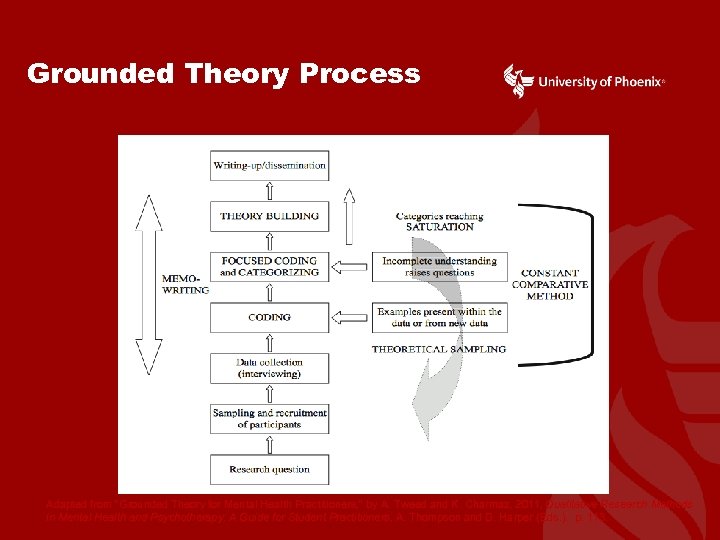 Grounded Theory Process Adapted from “Grounded Theory for Mental Health Practitioners, ” by A. Tweed and K. Charmaz, 2011, Qualitative Research Methods in Mental Health and Psychotherapy: A Guide for Student Practitioners, A. Thompson and D. Harper (Eds. ). p. 113.
 Key Research Question What do nonprofit leaders who are moving into a new leadership position think about effective power use?
 Analysis Categories Leadership § • • • Desirable and Undesirable Leadership attributes Lessons learned Style Thoughts about leadership • • Awareness of power Implications of power Questions about power What power means Rewards & discipline Position Power Relationship Power Success • Perceptions of Success • Perceptions of Failure Transitions
 Sample Interview Comments Leadership § § § We ask why and what they think, what they are doing, why they are doing it. Everybody here is respected because they jump in to help. What I found works best is trial and error. Knowing the person, earning respect, and giving respect you get more done that way. Desirable Attributes – Respect, Fairness, Comfort, Fun, Self Improvement Undesirable Attributes – Relations outside of work, Unfairness, Micromanaging, Not listening, Overreacting. Power § Before they promote someone to a position of power, they often don’t have a very good idea of what style of management the person uses. § I don’t call it power, I call it making a decision. § It’s a duty or responsibility of management. § You can use power to create their lives better, however, I like to be on the same level with everybody.
 Interviews Discovered Looking Glass Institute - Dewey & Kaye Research • Competency Model for NPO Leadership Development • Four key leadership Development Experiences • Personal Life experiences • Change in scope or role • Overcoming hardships • Relations with significant others – mentors, bosses, peers Follow up interviews with 5 CEOs of different NPOs • In 5 different U. S. States • Florida • West Virginia • District of Columbia • California • Wisconsin
 Follow up Interviews Leadership Development • We use professionally developed programs but ask the trainers to tailor comments to the organization • Our consultants encourage discussions about leadership that bring up the key areas of importance • Our people like taking the training that is similar to that of other organizations Power • Our leaders are aware of power issues but, other than in a general sense our program does not directly address it. • Our program emphasizes transformational leadership which down plays power in favor of establishing a balanced relationship • The transformational leadership program emphasizes giving power to followers to motivate them and help them feel important to the organization • Trust and integrity are more important than power • We have an active listening piece that emphasizes identifying individual and team needs
 Enigma – Using For Profit Leader Training Misses some NPO Skills All organizations reported using some standard leadership training but had problems Lack of focus on needed technical or hard NPO relevant skills (fundraising, financial skills, defined development plan) Programs developed for profit making businesses less effective for NPOs – Focus was off Leadership Learned by experience – Many NPOs use new job assignments but without specific transition training or assistance Missing specific Skills Needed by NPO Leaders Strategic agility Client focus more than profit motive Setting non-profit priorities (respect & fairness) Delegation based on service motives Motivating others – Organization too hierarchical
 Enigma – Use of Power Endorsed in Training Discouraged in NPO Practice The participants did not possess a common understanding of the concept of power. This lack of knowledge made discussions about power challenging • The culture at the GISA nonprofit is to dissuade the formation of personal relationships between leaders and followers. • Power seen in negative light – Took issue with use of word “Power” n. Senior managers were apprehensive with use of term power • Awareness of Power, Implications of Power, How to Discipline and Reward, When to Discipline and Reward, Position Power, and Relationship Power • Participants disliked the concept of power • Prescribed discipline procedures exist with little flexibility • No specific procedures for rewards
 Recommendations n n Every NPO Including Goodwill Industries of Southern Arizona should develop an effective leadership development program n Capitalize on personal motivations and life experiences of emerging leaders n Tailor for profit programs to be NPO specific Foster relationships with significant other people (Leaders in the parent organization and other NPOs, coaches, peers) n Assign challenging jobs but provide guidance and support n Provide regular, detailed, objective feedback (360 degree process) n Check specifically for feelings of isolation and vulnerability Implement a formal transition program n Address effective leadership and power employment n Create an in-house expert-led forum for transitioning leaders n Institute a 90, 180, 365 day check-in
 Questions?
 Thank You
 Important References Birks, M. , & Mills, J. (2011). Grounded theory: A practical guide. Thousand Oaks, CA: Sage Publications. Charmaz, K. (2014). Constructing grounded theory: A practical guide through qualitative analysis (2 nd ed. ). Thousand Oaks, CA: Sage Publications. French, J. , & Raven, B. (1959). The bases of social power. In D. Cartwright (Ed. ). Studies in social power (150 -167). Ann Arbor, MI: Institute for Social Research. Looking Glass Institute, & Dewey & Kaye. (2009). Nonprofit leadership development: A model for identifying and growing leaders within the nonprofit sector. Pittsburgh, PA: Authors. Goodwill Industries of Southern Arizona. (2011). The Goodwill of Southern Arizona. Retrieved from http: //www. goodwilltucson. org
 Important References Tweed, A. , & Charmaz, K. (2011). Grounded theory for mental health practitioners. In A. Thompson & D. Harper (Eds. ), Qualitative research methods in mental health and psychotherapy: A guide for student and practitioners. London, England: John Wiley and Sons. Watkins, M. (2013). The first 90 days: Proven strategies for getting up to speed faster and smarter. Boston, MA: Harvard Business Review Press. Weber, M. (trans. 1980). Wirtschaft und Gesellschaft (5 th ed. ). Tubingen, Germany: Mohr Sieback.