


 Скачать презентацию THE ENGLISH LANGUAGE Zaitceva Anastusiya Tichonenkova Anna DGL-201
the english language.pptx
- Количество слайдов: 11
 THE ENGLISH LANGUAGE Zaitceva Anastusiya Tichonenkova Anna DGL-201
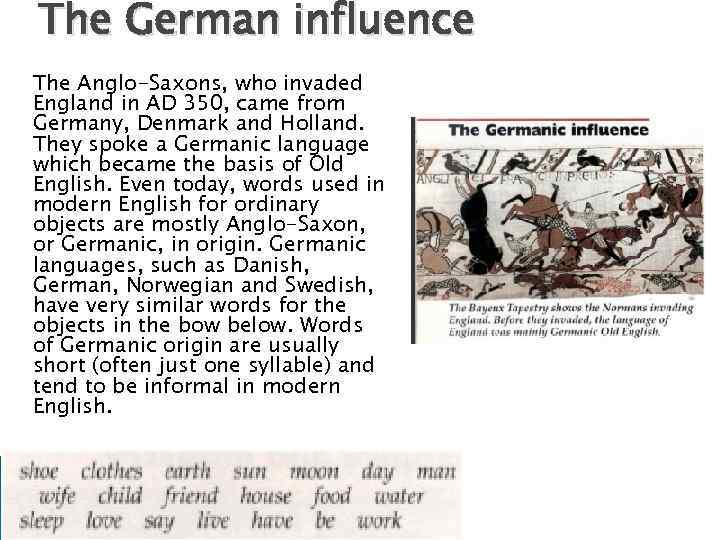 The German influence The Anglo-Saxons, who invaded England in AD 350, came from Germany, Denmark and Holland. They spoke a Germanic language which became the basis of Old English. Even today, words used in modern English for ordinary objects are mostly Anglo-Saxon, or Germanic, in origin. Germanic languages, such as Danish, German, Norwegian and Swedish, have very similar words for the objects in the bow below. Words of Germanic origin are usually short (often just one syllable) and tend to be informal in modern English.
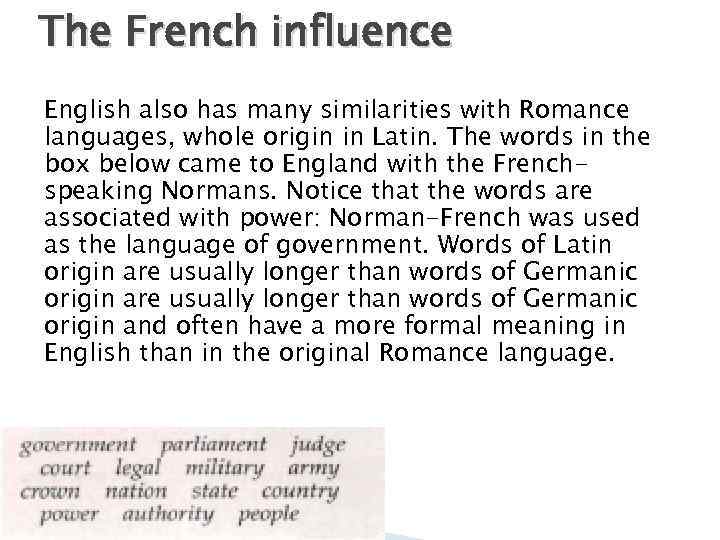 The French influence English also has many similarities with Romance languages, whole origin in Latin. The words in the box below came to England with the Frenchspeaking Normans. Notice that the words are associated with power: Norman-French was used as the language of government. Words of Latin origin are usually longer than words of Germanic origin and often have a more formal meaning in English than in the original Romance language.
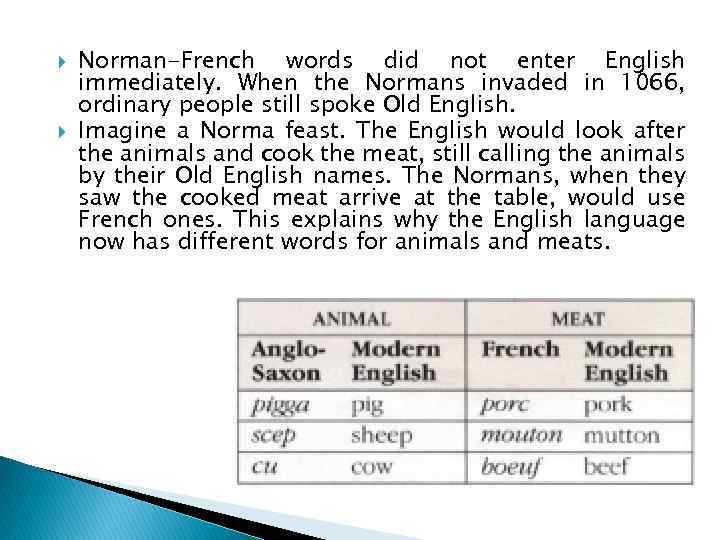 Norman-French words did not enter English immediately. When the Normans invaded in 1066, ordinary people still spoke Old English. Imagine a Norma feast. The English would look after the animals and cook the meat, still calling the animals by their Old English names. The Normans, when they saw the cooked meat arrive at the table, would use French ones. This explains why the English language now has different words for animals and meats.
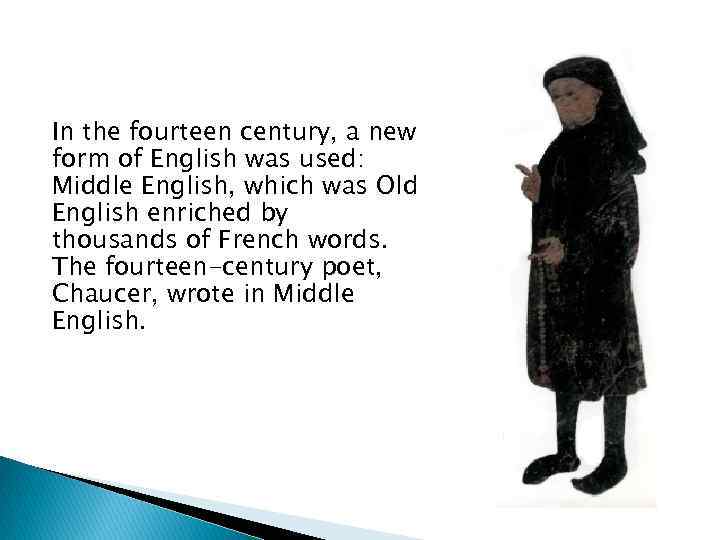 In the fourteen century, a new form of English was used: Middle English, which was Old English enriched by thousands of French words. The fourteen-century poet, Chaucer, wrote in Middle English.
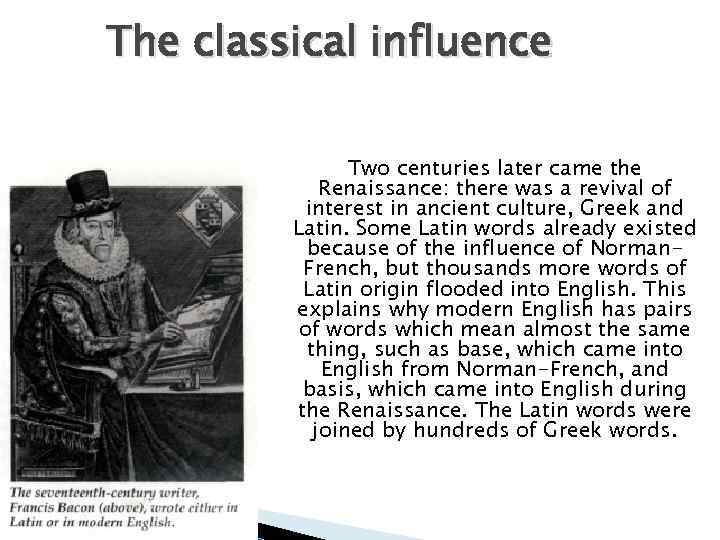 The classical influence Two centuries later came the Renaissance: there was a revival of interest in ancient culture, Greek and Latin. Some Latin words already existed because of the influence of Norman. French, but thousands more words of Latin origin flooded into English. This explains why modern English has pairs of words which mean almost the same thing, such as base, which came into English from Norman-French, and basis, which came into English during the Renaissance. The Latin words were joined by hundreds of Greek words.
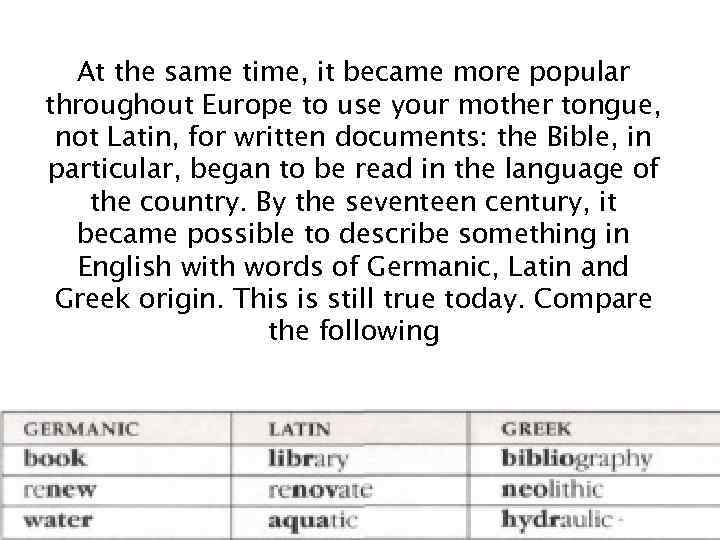 At the same time, it became more popular throughout Europe to use your mother tongue, not Latin, for written documents: the Bible, in particular, began to be read in the language of the country. By the seventeen century, it became possible to describe something in English with words of Germanic, Latin and Greek origin. This is still true today. Compare the following
 The expansion of learning The period from the Renaissance to the present day has seen many new ideas and inventions, especially in science and technology. As new things are invented, new words have to be created. Often these new words are created from existing Greek or Latin words put together in new ways.
 When someone invented an instrument for speaking to another person at a distance, it was called a telephone, from the Greek words tele (=far) and phone (=sound). There are now thousands of such words in English. Just think of television, microscope, psychology and thermometer.
 The colonial influence Words from foreign countries have entered English as a result of trade and colonial expansion: alcohol and algebra come from Arabic; divan and khaki from Persian; chocolate and tomato from native American languages; bungalow and cot from Gujerati; tea and tycoon from Chinese.
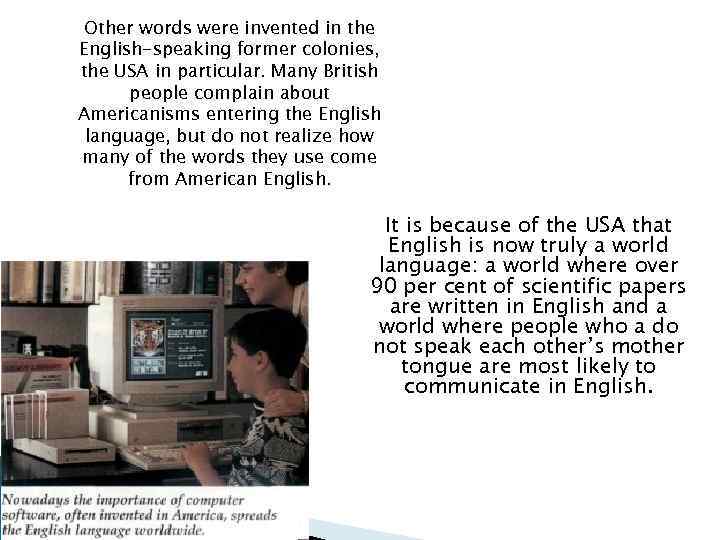 Other words were invented in the English-speaking former colonies, the USA in particular. Many British people complain about Americanisms entering the English language, but do not realize how many of the words they use come from American English. It is because of the USA that English is now truly a world language: a world where over 90 per cent of scientific papers are written in English and a world where people who a do not speak each other’s mother tongue are most likely to communicate in English.