 Скачать презентацию The Empirical Economics of Public-Private Partnerships PPP
990d9b2de87518e371f15928b115381c.ppt
- Количество слайдов: 66



The (Empirical) Economics of Public-Private. Partnerships (PPP) CONTRACTS Jose Luis Guasch Former Head of the World Bank Global Expert Group on PPP Professor Emeritus of Economics, University of California, San Diego Senior Adviser, The Growth Dialogue, George Washington University, Washington DC guaschjl@gmail. com Ajaccio, Corsica, France May 2016 1
What are PPPs? Ø PPP or “Public Private Partnerships” is a generic term for a contractual and long term relation between the public sector and a private operator granting to the private operator the right to provide the service and receive compensation via tariffs or government payments. Ø The term PPP describe a range of contractual agreements –such as design, construction, financing, operations, maintenance and rehabilitation, management etc. 2
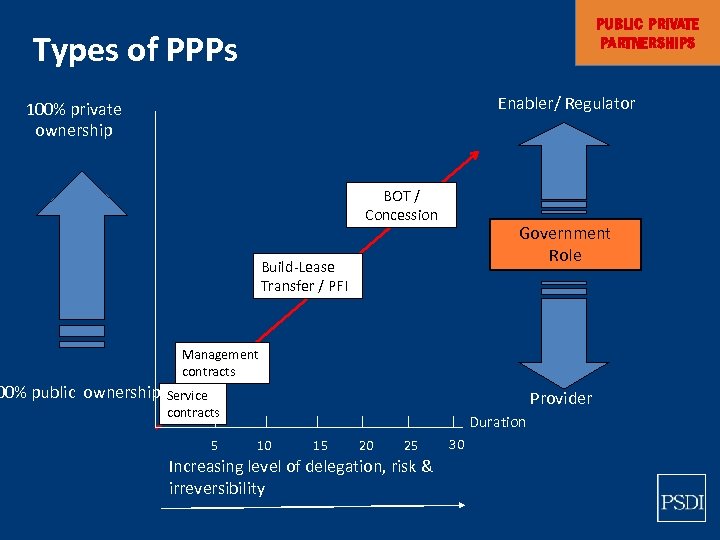
PUBLIC PRIVATE PARTNERSHIPS Types of PPPs Enabler/ Regulator 100% private ownership 00% public ownership BOT / Concession Government Role Build-Lease Transfer / PFI Management contracts Provider Service contracts 5 Duration 10 15 20 25 Increasing level of delegation, risk & irreversibility 30
Tipology of PPP: Ø Management Contracts or Leasing (financing done by the public sector), the private operator manages and operates the service Ø Brownfield Projects: – Existing project: Construction (light), Rehabilitation, Maintenance, Operation, Small Investments Ø Greenfield Project: – New Project: Design, Construction, Operation, Maintenance, (en general). Large Investment 4
Main Characteristics of PPP Ø Long term contract: 10 to 30 years (so long term financing required) Ø Usually financed by private sector-fiscal space Ø Bundling of activities: construction, financing, operacions, rehabilitation and maintenance etc Ø Ownership of assets remains with the State (few exceptions) Ø Risk sharing with the private operator Ø Cost/Investment recovery by private party, trough tariffs or government payments or a mixture of both Ø Private operator has the right/obligation to provide the service for the duration of the contract. His only asset oversees and regulate the implementation of the project and insures compliance with contract Ø Contract establishes all conditions, rights and obligations of both parties Ø At the end of the concession period, the service and assets reverts back to the Government without compensation (in general) 5
Drivers of PPP Ø Fiscal constraints in countries Ø Severe infrastructure Gaps and unmet needs Ø Weak capacity of government to design and implement projects 6
Virtues of PPPs Ø Private firms tend to be more efficient: – Build faster and underestimate costs by less – Economies of scope in designing, building and maintenance – Less bureaucratic – Capital markets impose discipline – Agency problems are less severe - same firm in charge of construction and maintenance – Risk gives stronger incentives – More accurate demand projections
Benefits of PPPs § PPP can generate significant benefits: efficiency, cost reductions, social inclusion, aditionality of financing improve welfare quality of service – Accelerate investment program and levels of service, coverage – Improve the quality of service, reliability and extent – Increase access to public services – Relief fiscal pressure and provide fiscal space with the additionality of financing – Bundling effect: solves the maintenance and rehabilitation problem by internalizing it: improves quality of stock and service – Transfer of risks to private operatorduccion de costos y demoras en construcion – Cost reductions and reduction of construction delays – Improved transparency of investment – Focus on level of service rather than getting physical assets – But is not automatic-requires knowledge and commitment- capacities, processes, filters, institutions, fiscalization and use of best practices to design contracts and efective regulation
Weaknesses of PPP Ø Lenghtier project preparation time Ø Significant higher costs (than public works option) of project preparation and even more costs of project supervision/regulation-both construction and operations phase Ø Require more and better and project studies and analysis than public works Ø Vulnerable to aggressive bids Ø Vulnerable to renegotiations and conflicts Ø Issue of financing-long term Ø Unsolicited Proposals Ø Contingent liabilities-fiscal issue 9
Key Vulnerability of PPPs: Post Contract Award Management: Managing Change: Renegotiation of Contracts Ø Ø Ø Ø Critical and often ignored or treated lightly or as a residual Why? Long term contract 15 -30 years Issues do and will come up, not able to be detailed in contract Creates opportunities for abuse Need to be prepared: diffuse, pre-empt and address Contract needs to address a fair amount specifically or trough guidelines Critical risk matrix and risk allocation: set in stone-revisiting with care and period bound
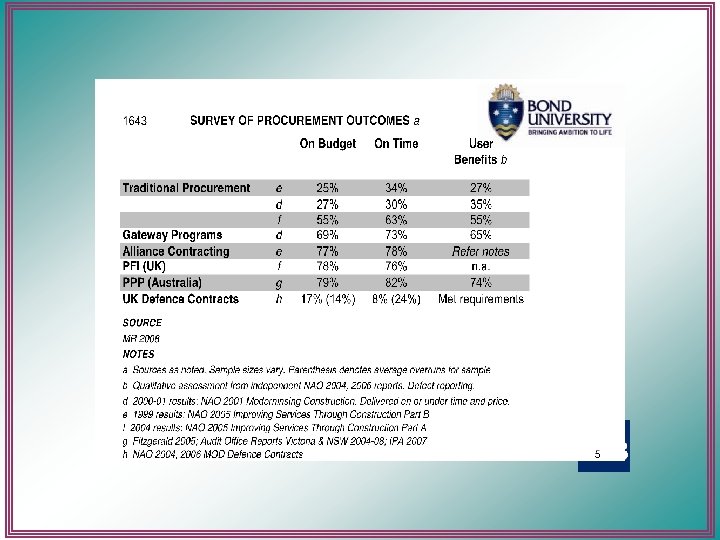
But how about public works-the alternative to PPPs, if there is public financing…? Ø With levels of costs overruns from 40 to 150% of original costs (average 85%) and incidence of delays 70% of projects on average Ø KEY: And that risks and costs are taken by the State (while in the PPP a large part of that risk and costs is trasfered to the private operator) Ø And how about maintenance and rehabilitation? And the quality of the stock of infrastructure?
PPP Versus Traditional Public Works Ø Have PPP performed better? Ø Strenghts and Weaknesses 12
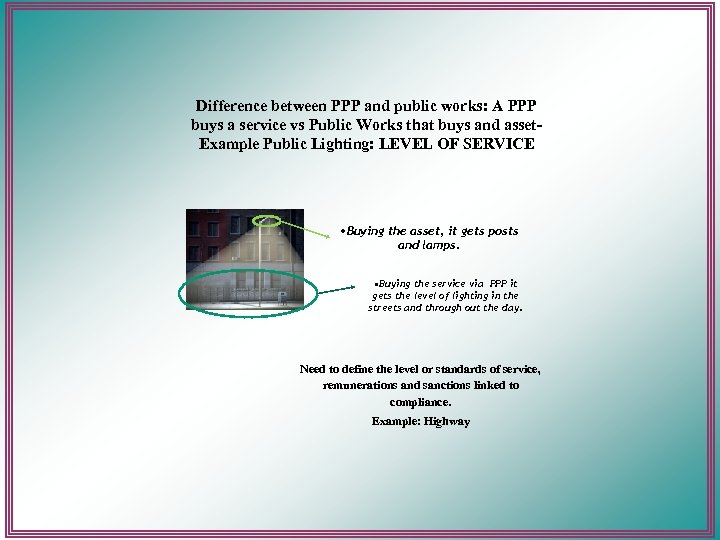
Difference between PPP and public works: A PPP buys a service vs Public Works that buys and asset. Example Public Lighting: LEVEL OF SERVICE • Buying the asset, it gets posts and lamps. • Buying the service via PPP it gets the level of lighting in the streets and through out the day. Need to define the level or standards of service, remunerations and sanctions linked to compliance. Example: Highway
International Experience with PPPs Ø Well structured PPPs provide Value for Money Ø When PPP projects fail, this is typically due to: – Inadequate project preparation / risk allocation – Non-transparent procurement – Lack of credibility of the tendering agency Ø PPPs are not “free” nor the answer to all infrastructure needs Ø In UK and Australia, PPPs represent only 1015% of total infrastructure investment
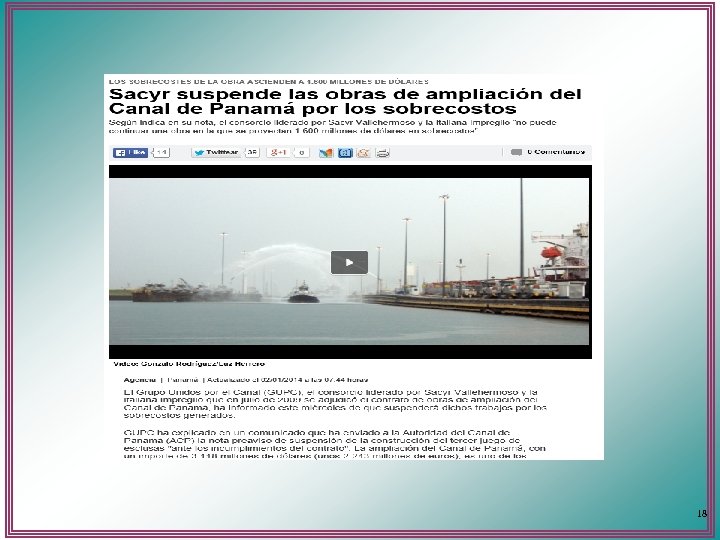
SOME EXAMPLES OF COSTS OVERRUNS AROUND THE WORLD 15
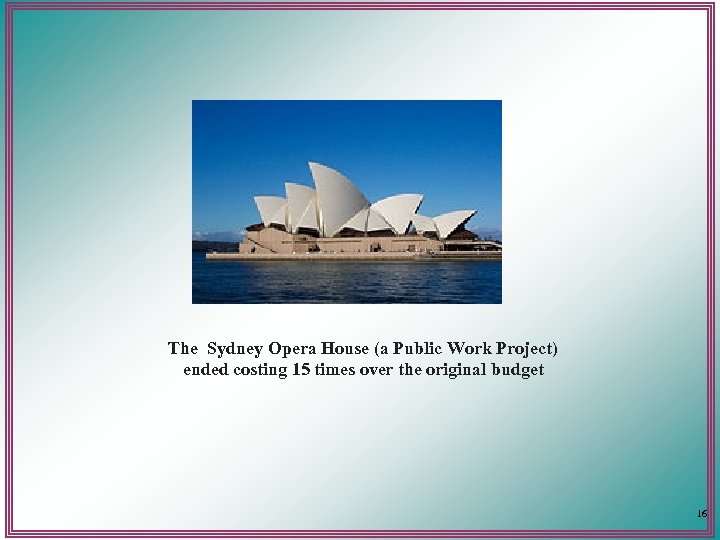
The Sydney Opera House (a Public Work Project) ended costing 15 times over the original budget 16
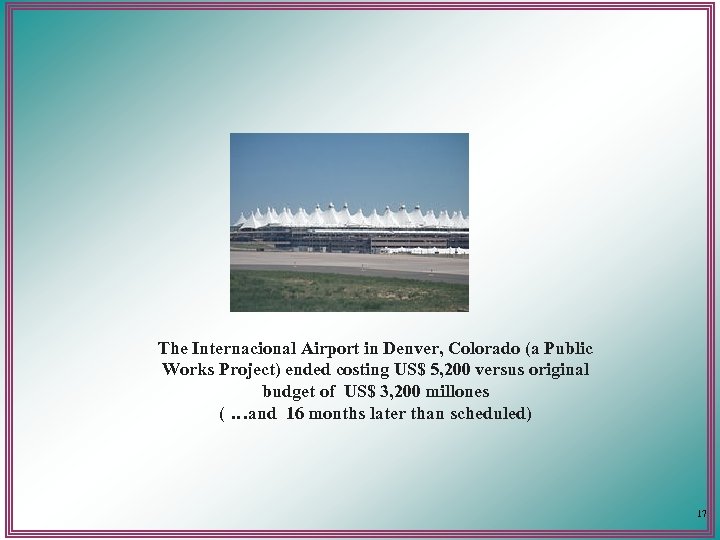
The Internacional Airport in Denver, Colorado (a Public Works Project) ended costing US$ 5, 200 versus original budget of US$ 3, 200 millones ( …and 16 months later than scheduled) 17
18
PPPs: 1990 -2016 Ø Over 25 years of experience and data Ø Quality of data and accessibility improving Ø Near 8, 000 PPP implemented around the world 19
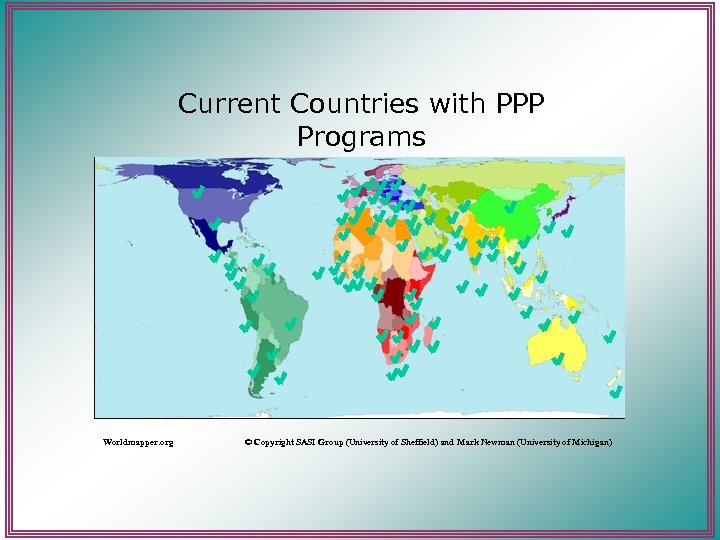
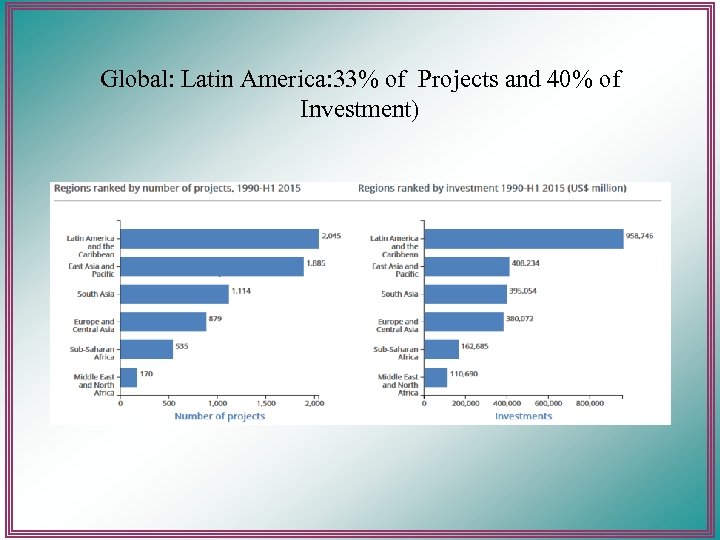
PPP have become widespread Ø PPPs have become widespread: 136 low and middle income countries have implemented some form of PPPs in the past twenty years, and at national and sub-national levels Ø PPPs saw 100% p. a. growth in Europe from 20032010 Ø “Mixed financing” PPPs, as well have been widely adopted in many developing countries 20
Current Countries with PPP Programs Worldmapper. org © Copyright SASI Group (University of Sheffield) and Mark Newman (University of Michigan)
Global: Latin America: 33% of Projects and 40% of Investment)
Top ten countries in: projects and investments
PPP investment in developing countries, 1990– 2011 a Source: World Bank-PPIAF PPI database. • The table lists the 10 developing countries with the most investment. • Projects in this sector do not fit our definition for PPPs, because they correspond to infrastruc- ture that is privatized and regulated as a natural monopoly. U. S. dollars million Transport Country Energyb Argentina Telecommunicationsb Water and sewage Total 30. 623 34. 513 14. 105 8. 176 87. 417 Brazil 131. 903 138. 312 48. 327 4. 796 323. 338 China 42. 903 14. 518 49. 456 9. 735 116. 324 India 126. 618 85. 343 60. 453 Indonesia 18. 241 28. 726 4. 041 1. 020 52. 028 Malaysia 14. 518 12. 637 16. 805 10. 144 54. 104 Mexico 12. 360 64. 984 29. 239 2. 683 109. 266 Philippines 25. 482 16. 809 3. 931 8. 098 54. 320 Russia 45. 074 64. 237 9. 587 1. 885 120. 783 Turkey 31. 901 33. 637 9. 858 355 942 272. 768 76. 338
Where and in which themes have PPP being implemented?
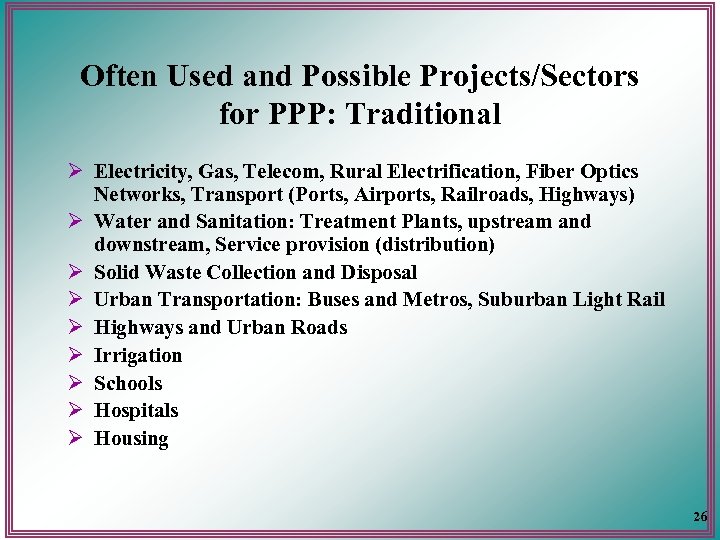
Often Used and Possible Projects/Sectors for PPP: Traditional Ø Electricity, Gas, Telecom, Rural Electrification, Fiber Optics Networks, Transport (Ports, Airports, Railroads, Highways) Ø Water and Sanitation: Treatment Plants, upstream and downstream, Service provision (distribution) Ø Solid Waste Collection and Disposal Ø Urban Transportation: Buses and Metros, Suburban Light Rail Ø Highways and Urban Roads Ø Irrigation Ø Schools Ø Hospitals Ø Housing 26
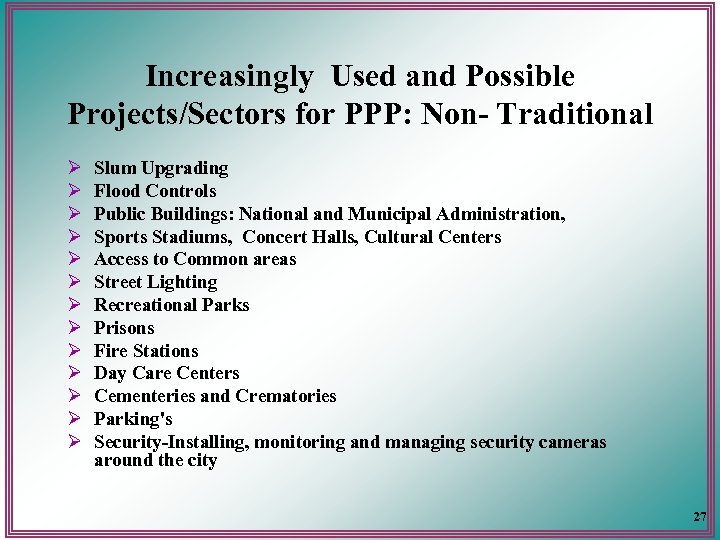
Increasingly Used and Possible Projects/Sectors for PPP: Non- Traditional Ø Ø Ø Ø Slum Upgrading Flood Controls Public Buildings: National and Municipal Administration, Sports Stadiums, Concert Halls, Cultural Centers Access to Common areas Street Lighting Recreational Parks Prisons Fire Stations Day Care Centers Cementeries and Crematories Parking's Security-Installing, monitoring and managing security cameras around the city 27
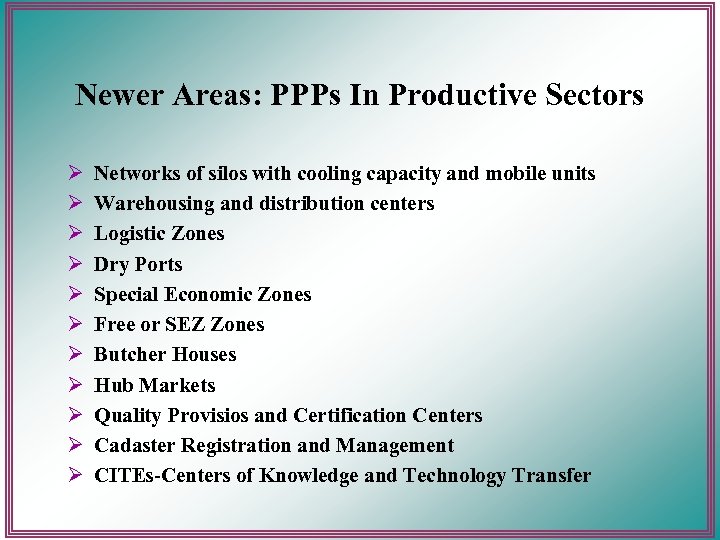
Newer Areas: PPPs In Productive Sectors Ø Ø Ø Networks of silos with cooling capacity and mobile units Warehousing and distribution centers Logistic Zones Dry Ports Special Economic Zones Free or SEZ Zones Butcher Houses Hub Markets Quality Provisios and Certification Centers Cadaster Registration and Management CITEs-Centers of Knowledge and Technology Transfer
Project Selection: “Quasi” White Elephants Ø An example of a country with numerous white elephants is Belgium, where the political pressures to replicate spending on both sides of the linguistic divide led to a category of projects denominated grands travaux inútils. These include several kilometers of abandoned subway tunnels, almost-empty light rail lines, and many unused viaducts and bridges (see Le Petit Guide des Grands Travaux Inutiles, Jean-Claude Defossé (1990) and EFG (2014) ). Ø 29
The Economics of PPP Ø A contract between the public sector and the private operator, where the public sector is expected to reap the benefits of the project and the private sector to earn its fair share of return to capital Ø A number of factors drive the success of that undertaking: legal, institutional, procedural, regulatory, political, financial, competitiveness/markets, risks etc Ø Start with project identification, to project preparation, and contract design, procuring the project and ending with the oversight of project implementation 30
Where Do We Stand? Good News and maybe “Quasi” Good News Ø Plenty of Theory Research on PPP mostly adapted from the Contract Theory Literature Ø Relatively little empirical research on PPP Ø And plenty of open questions on PPP to be addressed empirically: ripe for research work Ø Data, often the problem, is improving and so is accessibility to that data, and ample heterogeneity very useful to tests hypothesis Ø Needs proactivity and creativity 31
Bibliography: Generic I Ø The Economics of Public-Private Partnerships: A User Guide de Eduardo Engel, Ronald Fischer y Alexander Galetovic, Cambridge University Press, 2014 Ø Eduardo Engel, Ronald Fischer and Alexander Galetovic. 2010. “The economics of infrastructure finance: Public Private Partnerships versus public provision, ” EIB Papers, 15, 41– 69, 2010. Ø José Luis Guasch. 2004, 2016. Granting and Renegotiating Infrastructure Concessions: Doing it Right. Washington: The World Bank Press. 32
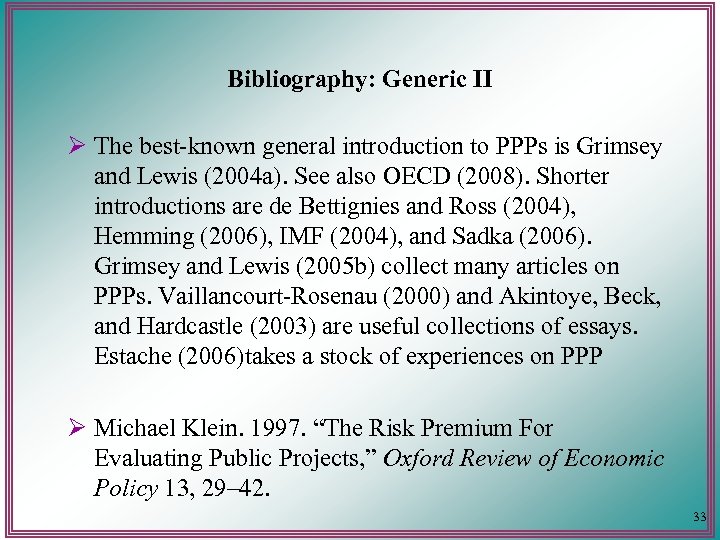
Bibliography: Generic II Ø The best-known general introduction to PPPs is Grimsey and Lewis (2004 a). See also OECD (2008). Shorter introductions are de Bettignies and Ross (2004), Hemming (2006), IMF (2004), and Sadka (2006). Grimsey and Lewis (2005 b) collect many articles on PPPs. Vaillancourt-Rosenau (2000) and Akintoye, Beck, and Hardcastle (2003) are useful collections of essays. Estache (2006)takes a stock of experiences on PPP Ø Michael Klein. 1997. “The Risk Premium For Evaluating Public Projects, ” Oxford Review of Economic Policy 13, 29– 42. 33
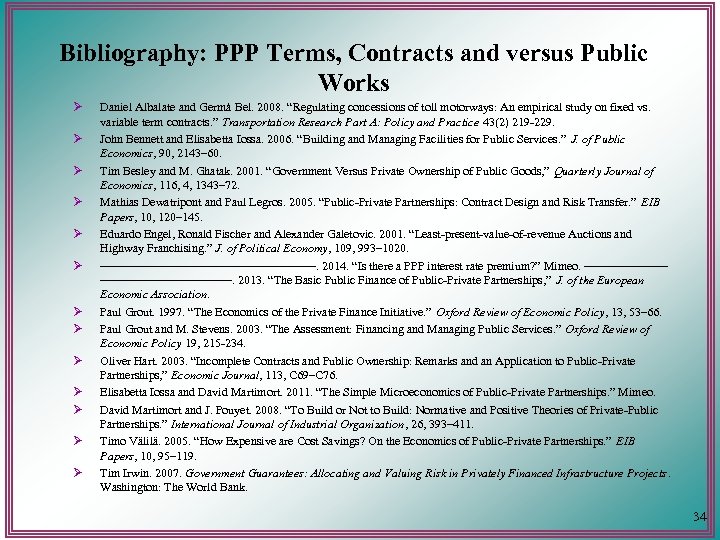
Bibliography: PPP Terms, Contracts and versus Public Works Ø Ø Ø Ø Daniel Albalate and Germá Bel. 2008. “Regulating concessions of toll motorways: An empirical study on fixed vs. variable term contracts. ” Transportation Research Part A: Policy and Practice 43(2) 219 -229. John Bennett and Elisabetta Iossa. 2006. “Building and Managing Facilities for Public Services. ” J. of Public Economics, 90, 2143– 60. Tim Besley and M. Ghatak. 2001. “Government Versus Private Ownership of Public Goods, ” Quarterly Journal of Economics, 116, 4, 1343– 72. Mathias Dewatripont and Paul Legros. 2005. “Public-Private Partnerships: Contract Design and Risk Transfer. ” EIB Papers, 10, 120– 145. Eduardo Engel, Ronald Fischer and Alexander Galetovic. 2001. “Least-present-value-of-revenue Auctions and Highway Franchising. ” J. of Political Economy, 109, 993– 1020. —————————. 2014. “Is there a PPP interest rate premium? ” Mimeo. ———————————. 2013. “The Basic Public Finance of Public-Private Partnerships, ” J. of the European Economic Association. Paul Grout. 1997. “The Economics of the Private Finance Initiative. ” Oxford Review of Economic Policy, 13, 53– 66. Paul Grout and M. Stevens. 2003. “The Assessment: Financing and Managing Public Services. ” Oxford Review of Economic Policy 19, 215 -234. Oliver Hart. 2003. “Incomplete Contracts and Public Ownership: Remarks and an Application to Public-Private Partnerships, ” Economic Journal, 113, C 69–C 76. Elisabetta Iossa and David Martimort. 2011. “The Simple Microeconomics of Public-Private Partnerships. ” Mimeo. David Martimort and J. Pouyet. 2008. “To Build or Not to Build: Normative and Positive Theories of Private-Public Partnerships. ” International Journal of Industrial Organization, 26, 393– 411. Timo Välilä. 2005. “How Expensive are Cost Savings? On the Economics of Public-Private Partnerships. ” EIB Papers, 10, 95– 119. Tim Irwin. 2007. Government Guarantees: Allocating and Valuing Risk in Privately Financed Infrastructure Projects. Washington: The World Bank. 34
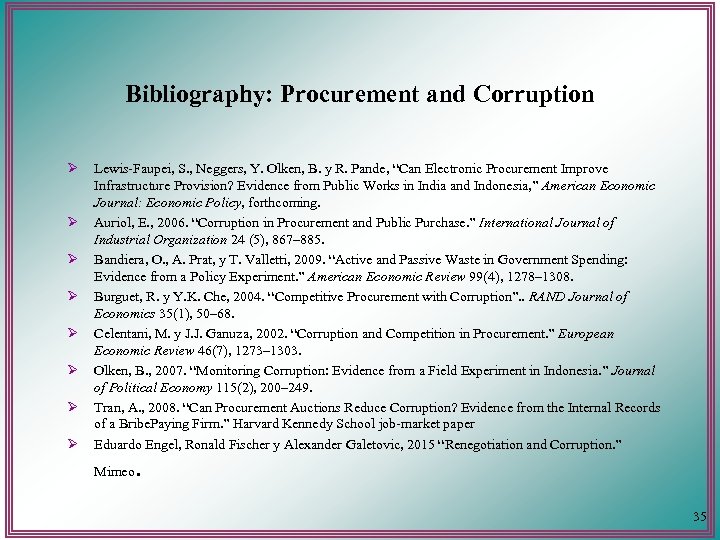
Bibliography: Procurement and Corruption Ø Ø Ø Ø Lewis-Faupei, S. , Neggers, Y. Olken, B. y R. Pande, “Can Electronic Procurement Improve Infrastructure Provision? Evidence from Public Works in India and Indonesia, ” American Economic Journal: Economic Policy, forthcoming. Auriol, E. , 2006. “Corruption in Procurement and Public Purchase. ” International Journal of Industrial Organization 24 (5), 867– 885. Bandiera, O. , A. Prat, y T. Valletti, 2009. “Active and Passive Waste in Government Spending: Evidence from a Policy Experiment. ” American Economic Review 99(4), 1278– 1308. Burguet, R. y Y. K. Che, 2004. “Competitive Procurement with Corruption”. . RAND Journal of Economics 35(1), 50– 68. Celentani, M. y J. J. Ganuza, 2002. “Corruption and Competition in Procurement. ” European Economic Review 46(7), 1273– 1303. Olken, B. , 2007. “Monitoring Corruption: Evidence from a Field Experiment in Indonesia. ” Journal of Political Economy 115(2), 200– 249. Tran, A. , 2008. “Can Procurement Auctions Reduce Corruption? Evidence from the Internal Records of a Bribe. Paying Firm. ” Harvard Kennedy School job-market paper Eduardo Engel, Ronald Fischer y Alexander Galetovic, 2015 “Renegotiation and Corruption. ” Mimeo . 35
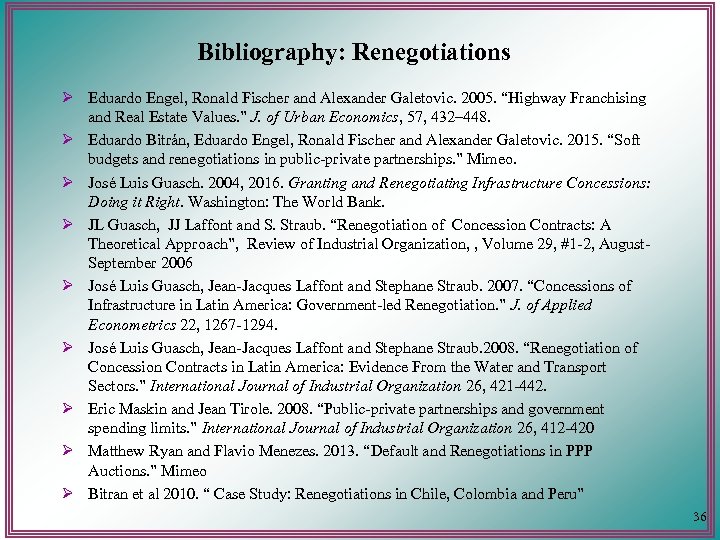
Bibliography: Renegotiations Ø Eduardo Engel, Ronald Fischer and Alexander Galetovic. 2005. “Highway Franchising and Real Estate Values. ” J. of Urban Economics, 57, 432– 448. Ø Eduardo Bitrán, Eduardo Engel, Ronald Fischer and Alexander Galetovic. 2015. “Soft budgets and renegotiations in public-private partnerships. ” Mimeo. Ø José Luis Guasch. 2004, 2016. Granting and Renegotiating Infrastructure Concessions: Doing it Right. Washington: The World Bank. Ø JL Guasch, JJ Laffont and S. Straub. “Renegotiation of Concession Contracts: A Theoretical Approach”, Review of Industrial Organization, , Volume 29, #1 -2, August. September 2006 Ø José Luis Guasch, Jean-Jacques Laffont and Stephane Straub. 2007. “Concessions of Infrastructure in Latin America: Government-led Renegotiation. ” J. of Applied Econometrics 22, 1267 -1294. Ø José Luis Guasch, Jean-Jacques Laffont and Stephane Straub. 2008. “Renegotiation of Concession Contracts in Latin America: Evidence From the Water and Transport Sectors. ” International Journal of Industrial Organization 26, 421 -442. Ø Eric Maskin and Jean Tirole. 2008. “Public-private partnerships and government spending limits. ” International Journal of Industrial Organization 26, 412 -420 Ø Matthew Ryan and Flavio Menezes. 2013. “Default and Renegotiations in PPP Auctions. ” Mimeo Ø Bitran et al 2010. “ Case Study: Renegotiations in Chile, Colombia and Peru” 36
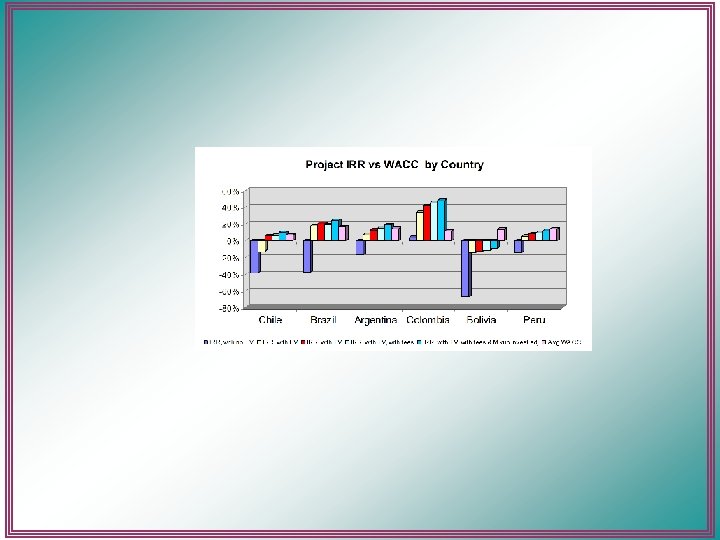
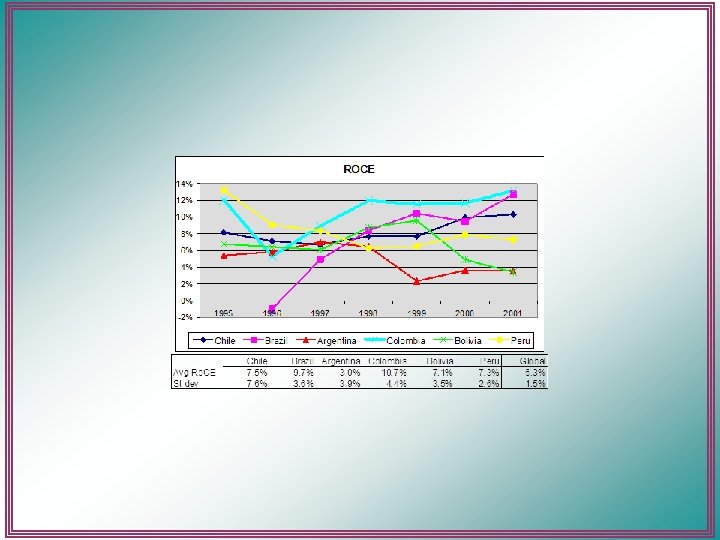
Ø Profitability of Firms: – “How Profitable Are Private Infrastructure Concessions in Latin America? : Empirical Evidence and Regulatory Implications”, The Quaterly Review of Economics and Finance 45, 380 -402, 2005, (with Sophie Sirtaine, Maria Elena Pinglo and Vivien Foster). 37
Impact of Regulation (varios aspects) on Performance Ø The Impact of Private Sector Participation in Infrastructure in Latin America: Lights and Shadows and the Road Ahead, The World Bank Press, 2008, (J. L. Guasch, L. Andres, T. Haven and V. Foster) Ø Uncovering the Drivers of Utility Performance, World Bank Press, Washington DC, USA 2013 ( J. L Guasch, L. Andres and Jordan Schwartz) 38
Empirical Economics on PPP Ø Plenty of (research and policy) open questions: 39
Empiricism I Ø PPP vs Traditional Public Works Ø Realized Return to Investors Ø Value for Money-Public-Private Sector Comparator: Methodology Ø Definition and Measurement of success Ø Competitive/Procurement Criteria: – LPVR, Fees, Tariffs (single vs polynomial) – Reverse envelope opening – Aggressive offers/bids Ø Valuations of risk premiums on risk transferred to private Ø Service levels/quality vs other 40
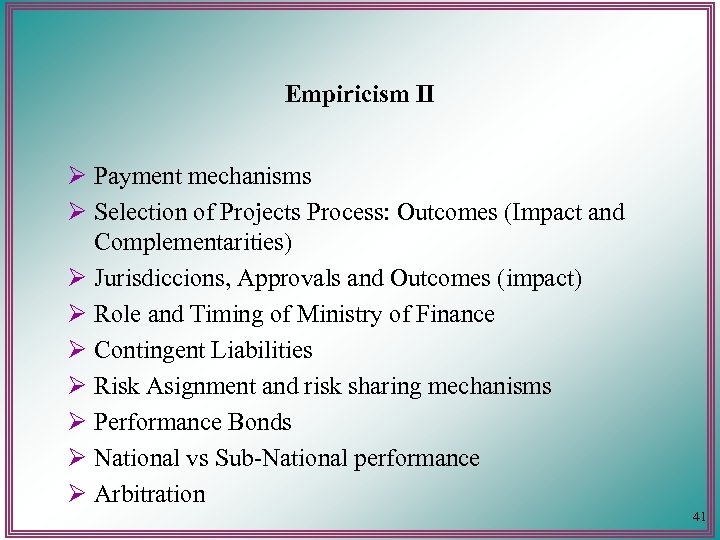
Empiricism II Ø Payment mechanisms Ø Selection of Projects Process: Outcomes (Impact and Complementarities) Ø Jurisdiccions, Approvals and Outcomes (impact) Ø Role and Timing of Ministry of Finance Ø Contingent Liabilities Ø Risk Asignment and risk sharing mechanisms Ø Performance Bonds Ø National vs Sub-National performance Ø Arbitration 41
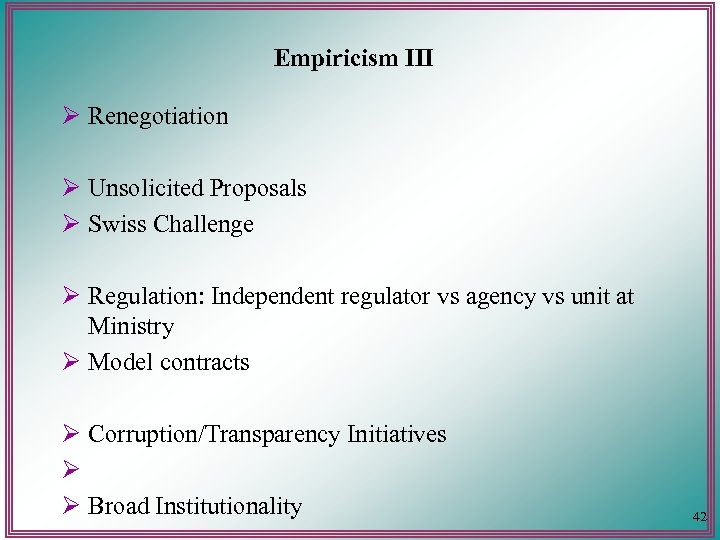
Empiricism III Ø Renegotiation Ø Unsolicited Proposals Ø Swiss Challenge Ø Regulation: Independent regulator vs agency vs unit at Ministry Ø Model contracts Ø Corruption/Transparency Initiatives Ø Ø Broad Institutionality 42
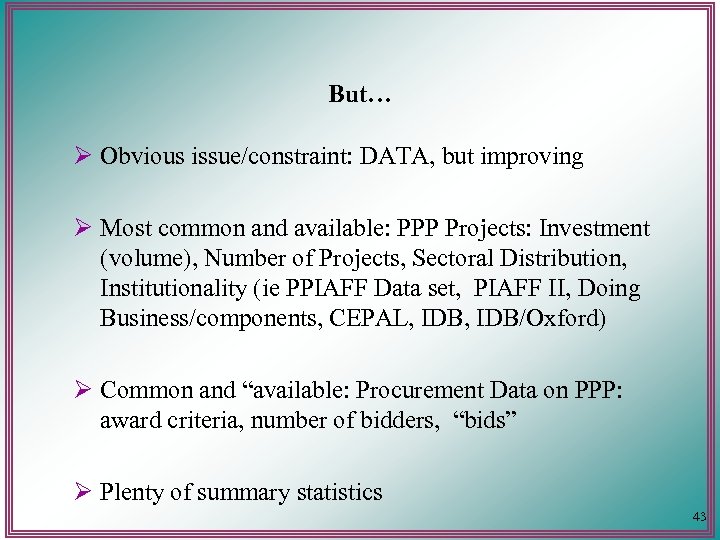
But… Ø Obvious issue/constraint: DATA, but improving Ø Most common and available: PPP Projects: Investment (volume), Number of Projects, Sectoral Distribution, Institutionality (ie PPIAFF Data set, PIAFF II, Doing Business/components, CEPAL, IDB/Oxford) Ø Common and “available: Procurement Data on PPP: award criteria, number of bidders, “bids” Ø Plenty of summary statistics 43
From summary statistics to correlations to causality to policy… 44

SOME EXAMPLES 45
United Kingdom New Approahes to PPP Programs From PFI to PF 2
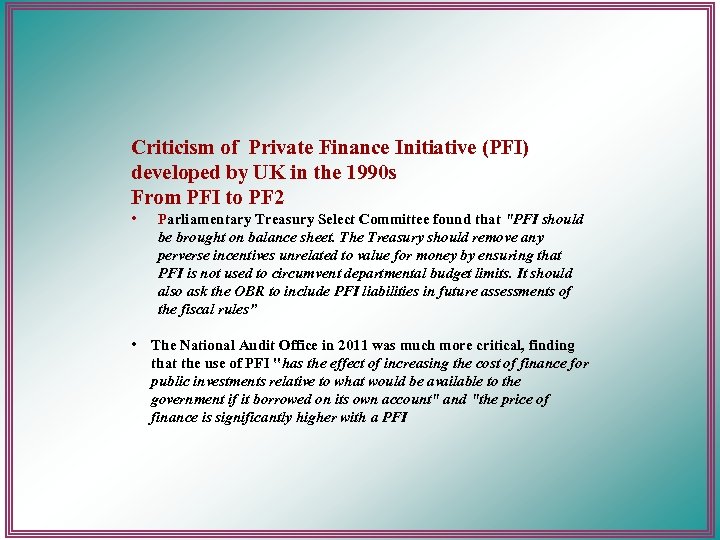
Criticism of Private Finance Initiative (PFI) developed by UK in the 1990 s From PFI to PF 2 • Parliamentary Treasury Select Committee found that "PFI should be brought on balance sheet. The Treasury should remove any perverse incentives unrelated to value for money by ensuring that PFI is not used to circumvent departmental budget limits. It should also ask the OBR to include PFI liabilities in future assessments of the fiscal rules” • The National Audit Office in 2011 was much more critical, finding that the use of PFI "has the effect of increasing the cost of finance for public investments relative to what would be available to the government if it borrowed on its own account" and "the price of finance is significantly higher with a PFI
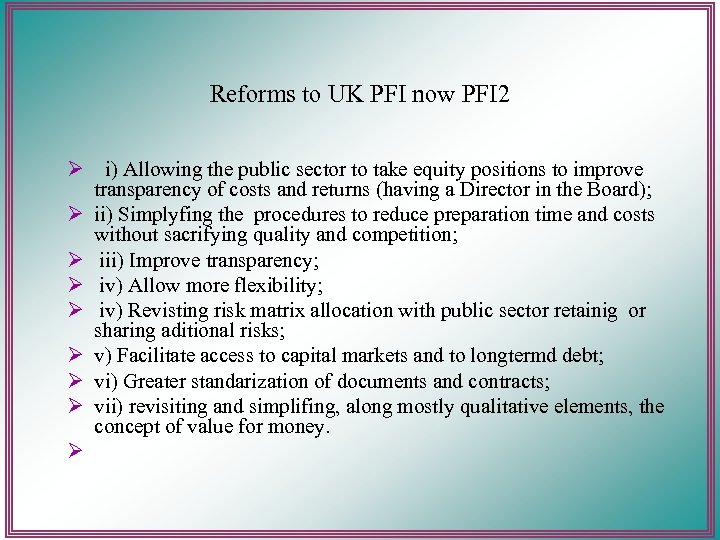
Reforms to UK PFI now PFI 2 Ø i) Allowing the public sector to take equity positions to improve transparency of costs and returns (having a Director in the Board); Ø ii) Simplyfing the procedures to reduce preparation time and costs without sacrifying quality and competition; Ø iii) Improve transparency; Ø iv) Allow more flexibility; Ø iv) Revisting risk matrix allocation with public sector retainig or sharing aditional risks; Ø v) Facilitate access to capital markets and to longtermd debt; Ø vi) Greater standarization of documents and contracts; Ø vii) revisiting and simplifing, along mostly qualitative elements, the concept of value for money. Ø
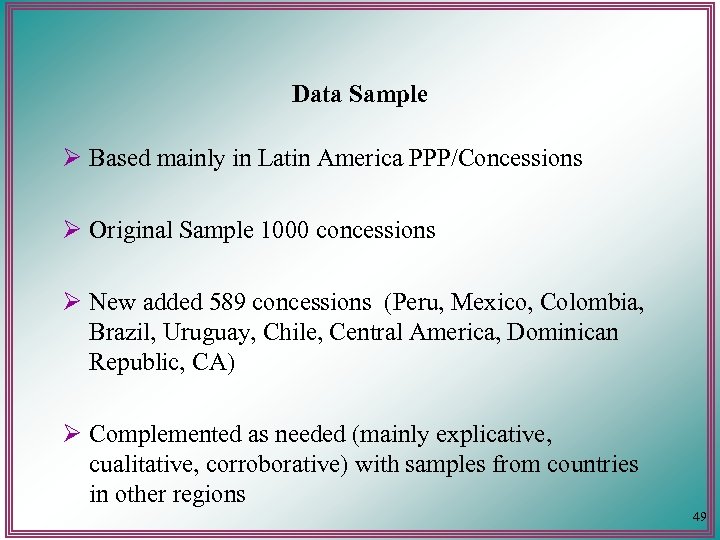
Data Sample Ø Based mainly in Latin America PPP/Concessions Ø Original Sample 1000 concessions Ø New added 589 concessions (Peru, Mexico, Colombia, Brazil, Uruguay, Chile, Central America, Dominican Republic, CA) Ø Complemented as needed (mainly explicative, cualitative, corroborative) with samples from countries in other regions 49
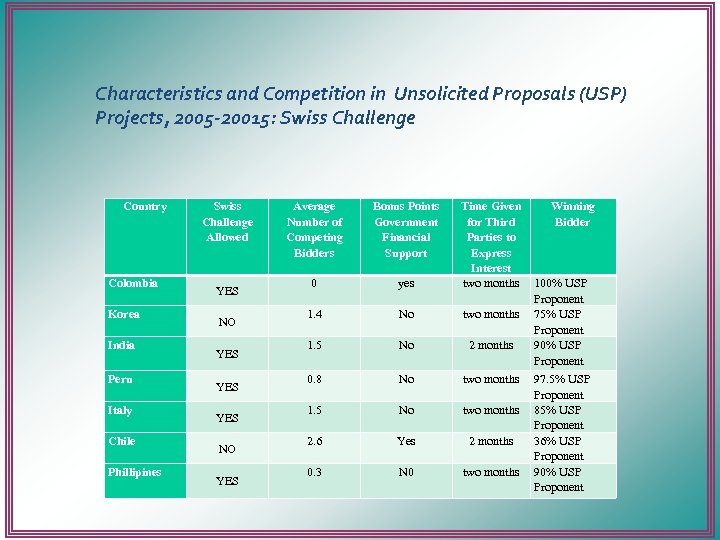
Characteristics and Competition in Unsolicited Proposals (USP) Projects, 2005 -20015: Swiss Challenge Country Colombia Korea India Peru Italy Chile Phillipines Swiss Challenge Allowed YES NO YES Average Number of Competing Bidders Bonus Points Government Financial Support Time Given Winning for Third Bidder Parties to Express Interest two months 100% USP Proponent two months 75% USP Proponent 2 months 90% USP Proponent 0 yes 1. 4 No 1. 5 No 0. 8 No two months 1. 5 No two months 2. 6 Yes 2 months 0. 3 N 0 two months 97. 5% USP Proponent 85% USP Proponent 36% USP Proponent 90% USP Proponent
Average concession returns by countries (Guasch et al 2006) Source: own calculations, based on concessions’ historical financial statements and the authors’ growth assumptions
¿What is a Renegotiation? Ø A renegotiation is a modifications of the contract not foreseen in it Ø i) Mainly by a change in the risk assignment matrix or of its extent Ø ii) By a change in the scope of the project-so called complementary contracts, additionality of investment/works etc (but even then it depends whether it was foreseen and guided in the contract, …) Ø iii) By other changes (derived) on the contract conditions (such as duratión/term, schedule and timing of investment, investment levels, tariff structure, service levels, performance indicators, etc)* iv) By clarifying or corrective changes in the contract-often of reduced impact Ø Clarification: Compensations to operator for the occurrence of specific events are not renegotiations, when it is specified in the contract. They do add to the costs of the contract, and do have adverse fiscal consequences. And they do generate conflicts on two accounts: On assessing the causality of the eventwho is responsible and on determining the proper level of compensation
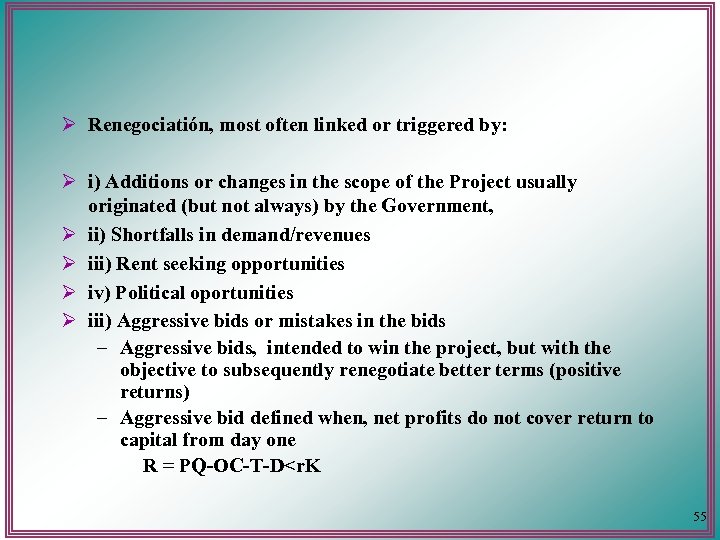
Ø Renegociatión, most often linked or triggered by: Ø i) Additions or changes in the scope of the Project usually originated (but not always) by the Government, Ø ii) Shortfalls in demand/revenues Ø iii) Rent seeking opportunities Ø iv) Political oportunities Ø iii) Aggressive bids or mistakes in the bids – Aggressive bids, intended to win the project, but with the objective to subsequently renegotiate better terms (positive returns) – Aggressive bid defined when, net profits do not cover return to capital from day one R = PQ-OC-T-D<r. K 55
Costs associated with disputes, conflicts and renegotiations are: Ø Time and financial resources: to address and resolve the conflict. Ø Social and Political: Since conflicts tend to be highly visible and have great coverage of the media, leading to disenchantment of citizens, the PPP model tends to lose credibility and public support, and it may weaken or kill the program. Ø Financial/Fiscal: Often the results of the negotiation have a fiscal cost to the government. Ø Economic and Social: Users tend to be adversely affected by the results of conflicts, particularly renegotiations (in terms of reduced access, higher or lower prices and delays in service quality) Ø On average, those costs range from 2 to 30% of investment Ø Ø Overall pricing of uncertainty on that account is around 2 -4 percentage points of cost of capital
Why Renegotiation is an important issue? Implications Ø Eliminate the competitive effect of the auction including transparency: questioning the credibility of the model/program Ø Voids value for money analysis. Outcomes usually adverse to users, government and welfare overall Ø Asymmetric information and lack of transparency of bilateral negotiations and skills of public sector to renegotiate the contract: Ø Distortion in public tender, in that the most likely winner is not the most efficient operator but the most expert/qualified in renegotiations Ø Decreases the benefits/advantages of PPP and the welfare of users, and usually it has a fiscal impact by increasing liabilities to the government Ø Confirms rational expectations of operators Ø While some can be efficient, many of them are opportunistic Ø Contrast with PPP adjudicated trough non-competitive biddind, trough bilateral negotiations
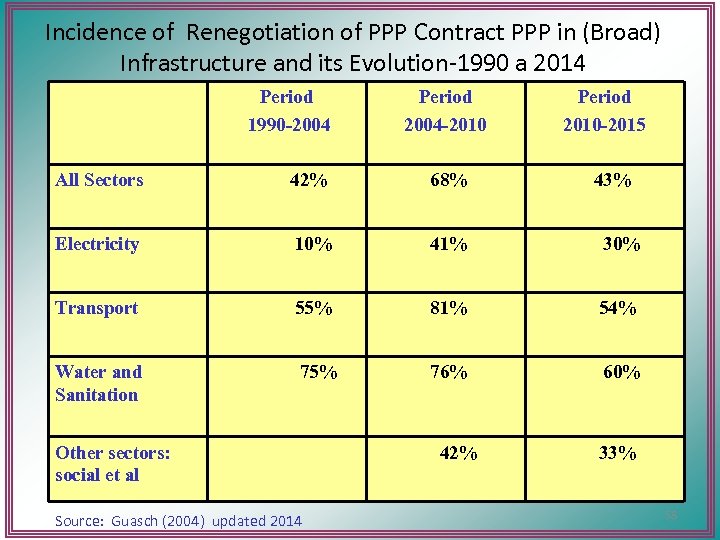
Incidence of Renegotiation of PPP Contract PPP in (Broad) Infrastructure and its Evolution-1990 a 2014 Period 1990 -2004 Period 2004 -2010 Period 2010 -2015 All Sectors 42% 68% 43% Electricity 10% 41% 30% Transport 55% 81% 54% Water and Sanitation 75% 76% 60% 42% 33% Other sectors: social et al Source: Guasch (2004) updated 2014 58
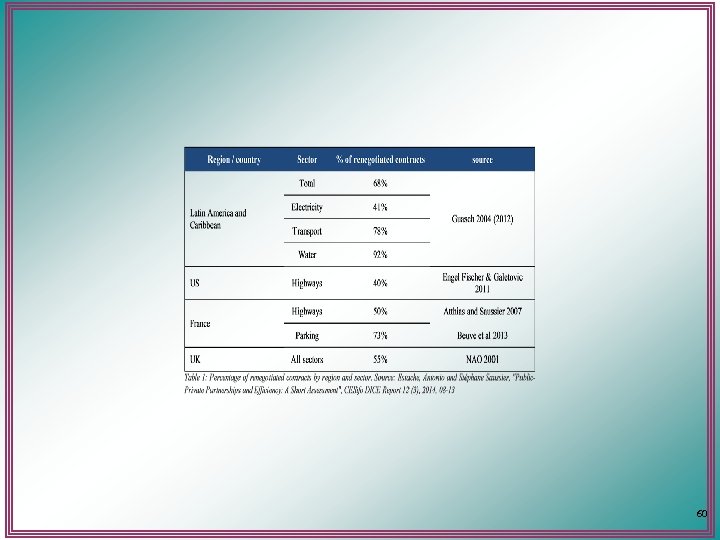
Not an Exclusivity of Emerging Countries: Renegotiations also take place in Developed Countries 59
60
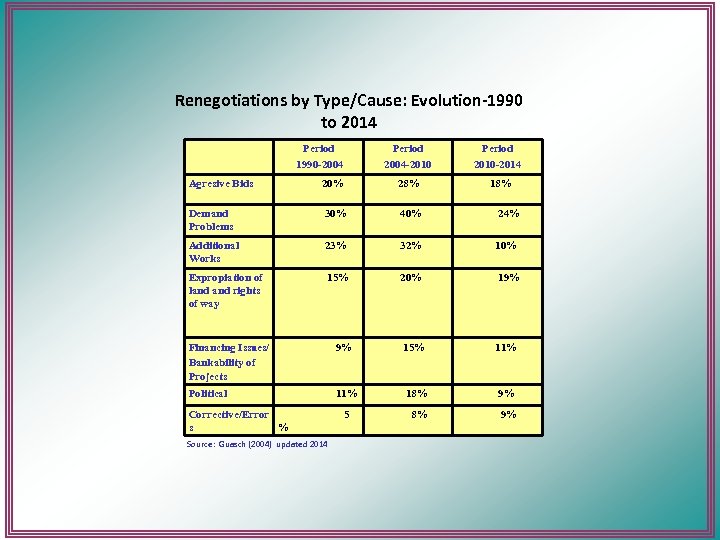
Renegotiations by Type/Cause: Evolution-1990 to 2014 Period 1990 -2004 Period 2004 -2010 Period 2010 -2014 Agresive Bids 20% 28% 18% Demand Problems 30% 40% 24% Additional Works 23% 32% 10% Expropiation of land rights of way 15% 20% 19% Financing Issues/ 9% Bankability of Projects 15% 11% Political 11% 18% Corrective/Error 5 s % Source: Guasch (2004) updated 2014 8% 9% 61
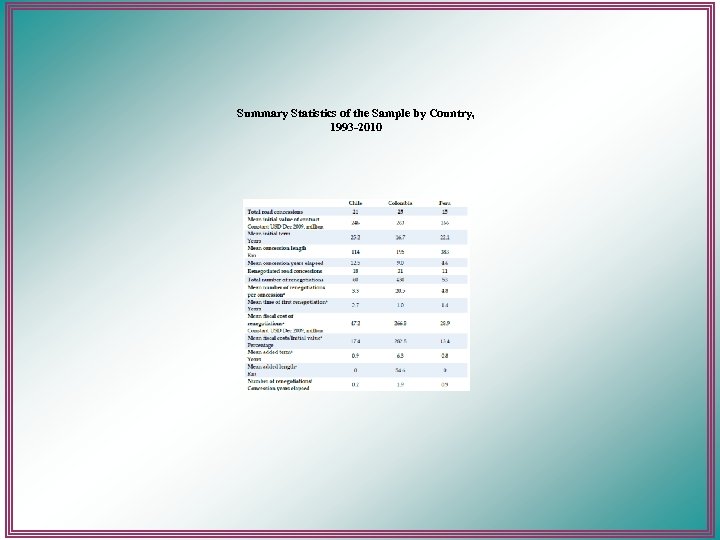
Summary Statistics of the Sample by Country, 1993 -2010
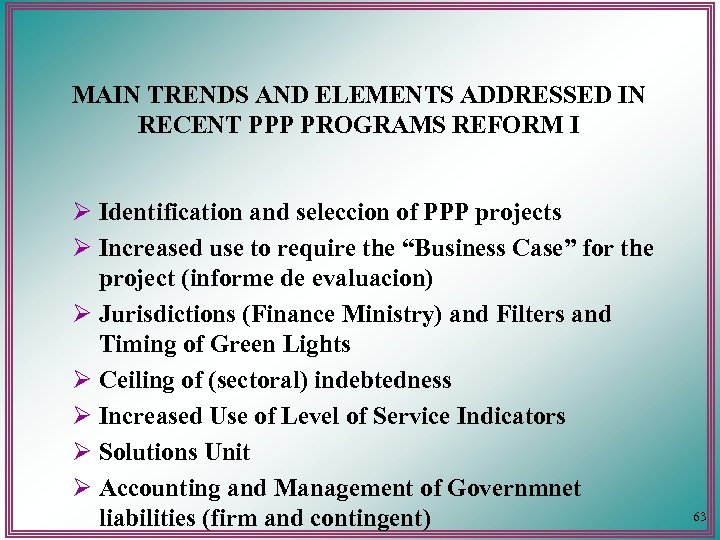
MAIN TRENDS AND ELEMENTS ADDRESSED IN RECENT PPP PROGRAMS REFORM I Ø Identification and seleccion of PPP projects Ø Increased use to require the “Business Case” for the project (informe de evaluacion) Ø Jurisdictions (Finance Ministry) and Filters and Timing of Green Lights Ø Ceiling of (sectoral) indebtedness Ø Increased Use of Level of Service Indicators Ø Solutions Unit Ø Accounting and Management of Governmnet liabilities (firm and contingent) 63
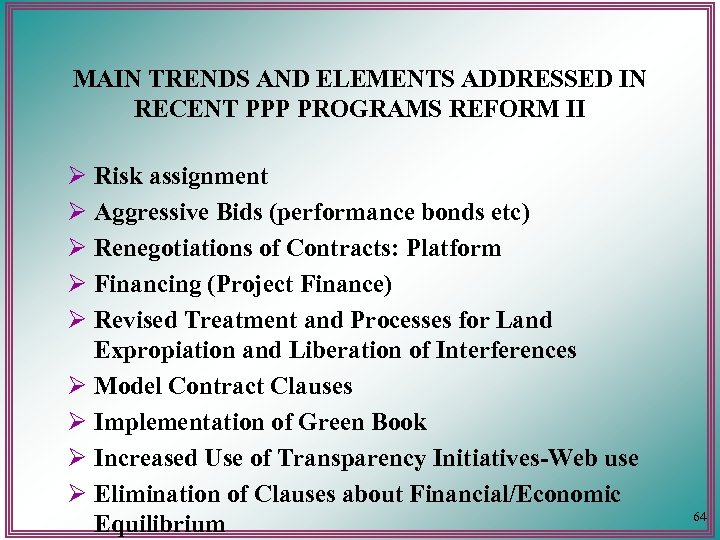
MAIN TRENDS AND ELEMENTS ADDRESSED IN RECENT PPP PROGRAMS REFORM II Ø Risk assignment Ø Aggressive Bids (performance bonds etc) Ø Renegotiations of Contracts: Platform Ø Financing (Project Finance) Ø Revised Treatment and Processes for Land Expropiation and Liberation of Interferences Ø Model Contract Clauses Ø Implementation of Green Book Ø Increased Use of Transparency Initiatives-Web use Ø Elimination of Clauses about Financial/Economic Equilibrium 64
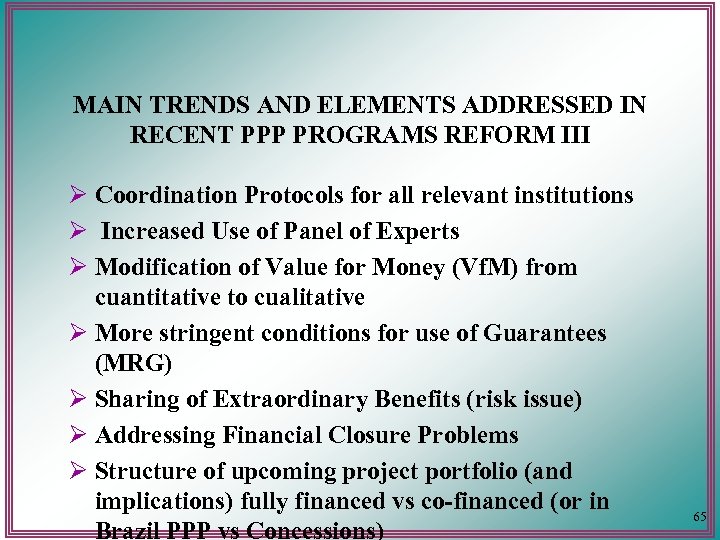
MAIN TRENDS AND ELEMENTS ADDRESSED IN RECENT PPP PROGRAMS REFORM III Ø Coordination Protocols for all relevant institutions Ø Increased Use of Panel of Experts Ø Modification of Value for Money (Vf. M) from cuantitative to cualitative Ø More stringent conditions for use of Guarantees (MRG) Ø Sharing of Extraordinary Benefits (risk issue) Ø Addressing Financial Closure Problems Ø Structure of upcoming project portfolio (and implications) fully financed vs co-financed (or in Brazil PPP vs Concessions) 65

THANK YOU 66
Скачать презентацию The Empirical Economics of Public-Private Partnerships PPP
990d9b2de87518e371f15928b115381c.ppt