


 Скачать презентацию The emerging paradigm for lifelong learning quantitative and
39efaf5fb2e331c712598037ea9a7157.ppt
- Количество слайдов: 20
 The emerging paradigm for lifelong learning, quantitative and qualitative data from: The IEA Second International Technology in Education Study (SITES) by Hans Pelgrum, University Twente
 Content of presentation l l Professional background Background of current ICT studies l l l Role of ICT in education The information society, education and ICT Need for (curriculum) indicators and deeper insight into innovations SITES Modules 1, 2, 3: overview SITESM 2006 and EU-policies Conclusions
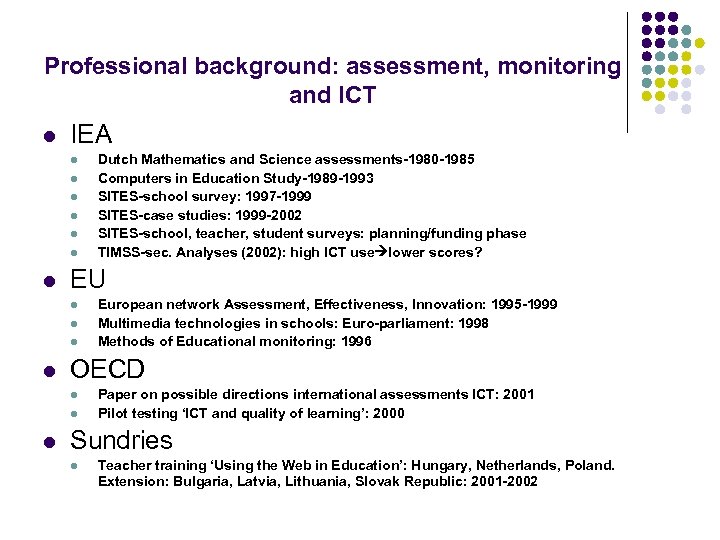 Professional background: assessment, monitoring and ICT l IEA l l l l EU l l European network Assessment, Effectiveness, Innovation: 1995 -1999 Multimedia technologies in schools: Euro-parliament: 1998 Methods of Educational monitoring: 1996 OECD l l l Dutch Mathematics and Science assessments-1980 -1985 Computers in Education Study-1989 -1993 SITES-school survey: 1997 -1999 SITES-case studies: 1999 -2002 SITES-school, teacher, student surveys: planning/funding phase TIMSS-sec. Analyses (2002): high ICT use lower scores? Paper on possible directions international assessments ICT: 2001 Pilot testing ‘ICT and quality of learning’: 2000 Sundries l Teacher training ‘Using the Web in Education’: Hungary, Netherlands, Poland. Extension: Bulgaria, Latvia, Lithuania, Slovak Republic: 2001 -2002
 Background/Context of current international ICT studies l Role of ICT in education l The information society, education and ICT l Need for (curriculum) indicators and insight in realistic possibilities for innovation
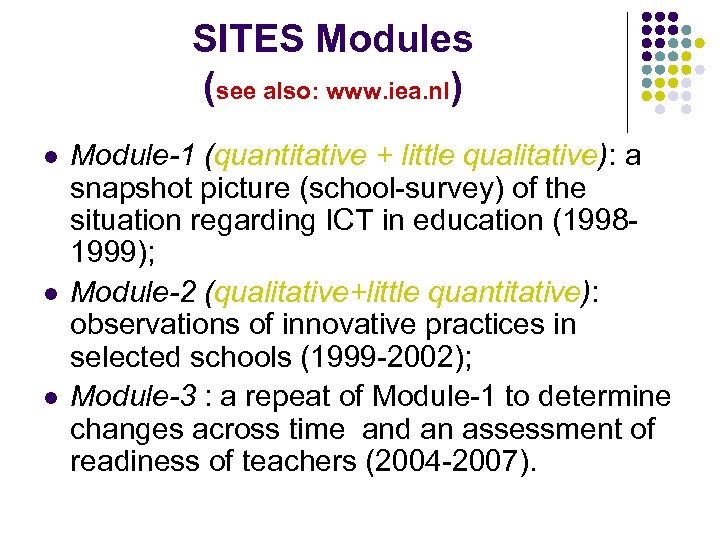 SITES Modules (see also: www. iea. nl) l l l Module-1 (quantitative + little qualitative): a snapshot picture (school-survey) of the situation regarding ICT in education (19981999); Module-2 (qualitative+little quantitative): observations of innovative practices in selected schools (1999 -2002); Module-3 : a repeat of Module-1 to determine changes across time and an assessment of readiness of teachers (2004 -2007).
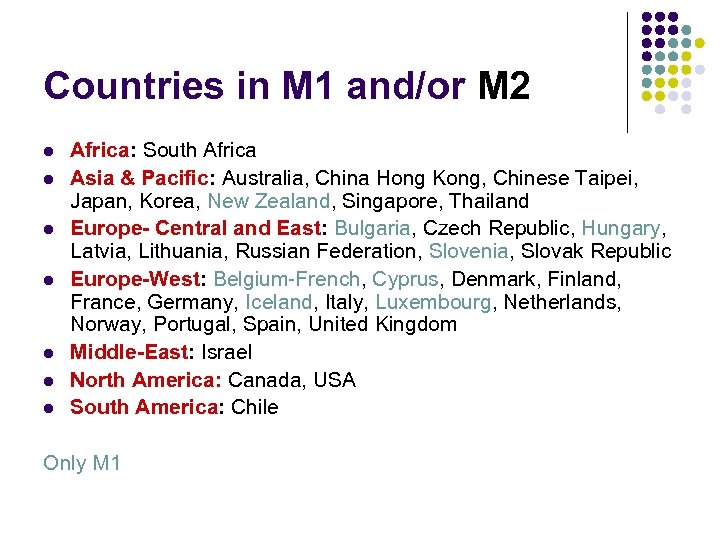 Countries in M 1 and/or M 2 l l l l Africa: South Africa Asia & Pacific: Australia, China Hong Kong, Chinese Taipei, Japan, Korea, New Zealand, Singapore, Thailand Europe- Central and East: Bulgaria, Czech Republic, Hungary, Latvia, Lithuania, Russian Federation, Slovenia, Slovak Republic Europe-West: Belgium-French, Cyprus, Denmark, Finland, France, Germany, Iceland, Italy, Luxembourg, Netherlands, Norway, Portugal, Spain, United Kingdom Middle-East: Israel North America: Canada, USA South America: Chile Only M 1
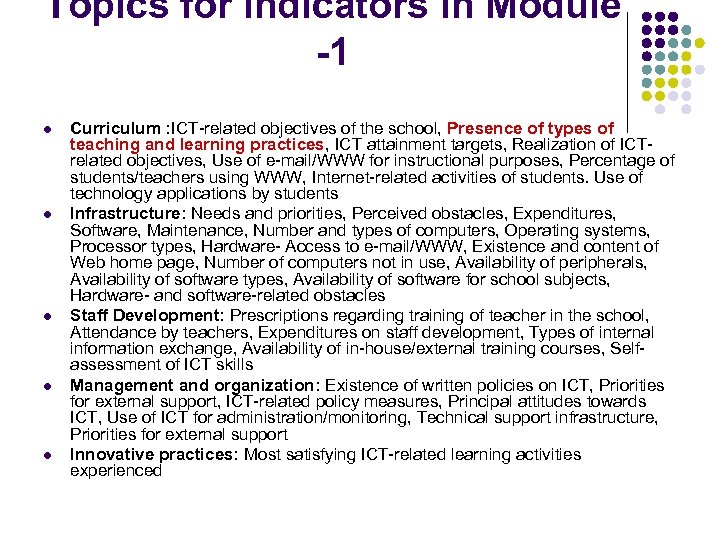 Topics for indicators in Module -1 l l l Curriculum : ICT-related objectives of the school, Presence of types of teaching and learning practices, ICT attainment targets, Realization of ICTrelated objectives, Use of e-mail/WWW for instructional purposes, Percentage of students/teachers using WWW, Internet-related activities of students. Use of technology applications by students Infrastructure: Needs and priorities, Perceived obstacles, Expenditures, Software, Maintenance, Number and types of computers, Operating systems, Processor types, Hardware- Access to e-mail/WWW, Existence and content of Web home page, Number of computers not in use, Availability of peripherals, Availability of software types, Availability of software for school subjects, Hardware- and software-related obstacles Staff Development: Prescriptions regarding training of teacher in the school, Attendance by teachers, Expenditures on staff development, Types of internal information exchange, Availability of in-house/external training courses, Selfassessment of ICT skills Management and organization: Existence of written policies on ICT, Priorities for external support, ICT-related policy measures, Principal attitudes towards ICT, Use of ICT for administration/monitoring, Technical support infrastructure, Priorities for external support Innovative practices: Most satisfying ICT-related learning activities experienced
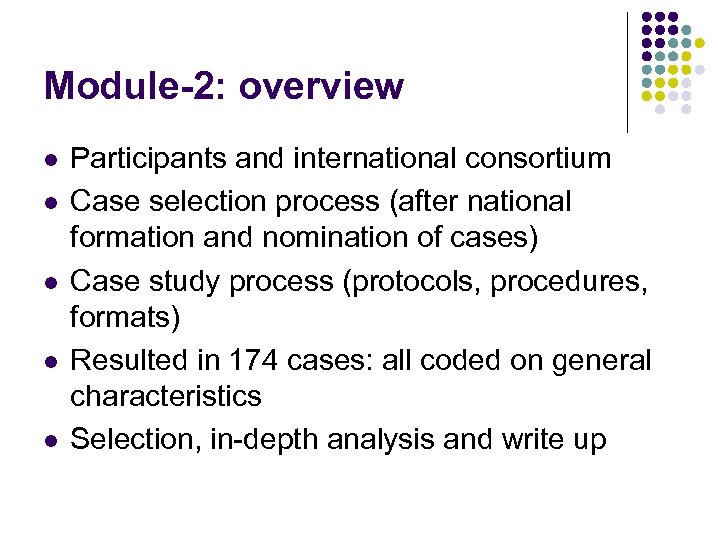 Module-2: overview l l l Participants and international consortium Case selection process (after national formation and nomination of cases) Case study process (protocols, procedures, formats) Resulted in 174 cases: all coded on general characteristics Selection, in-depth analysis and write up
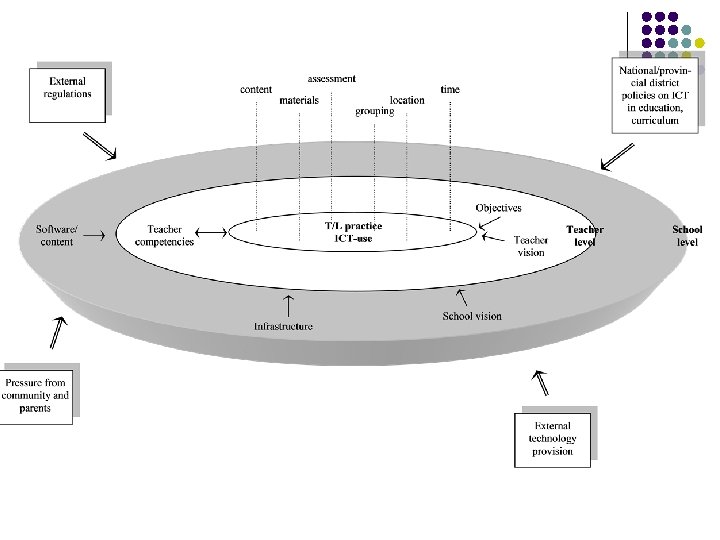
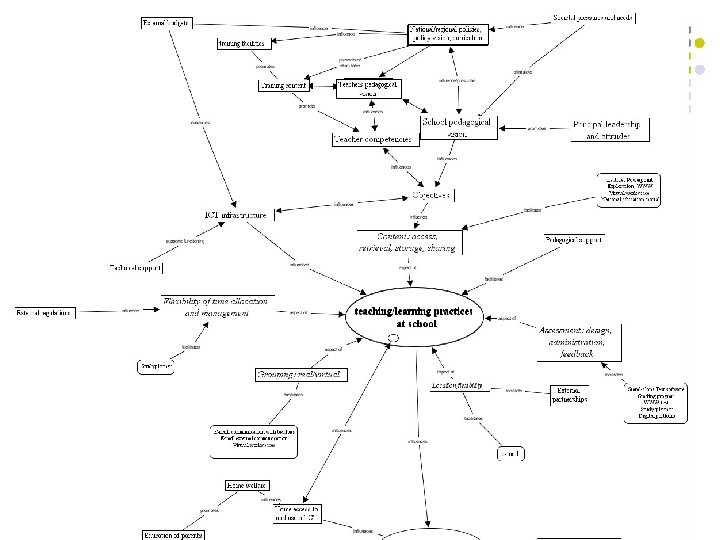
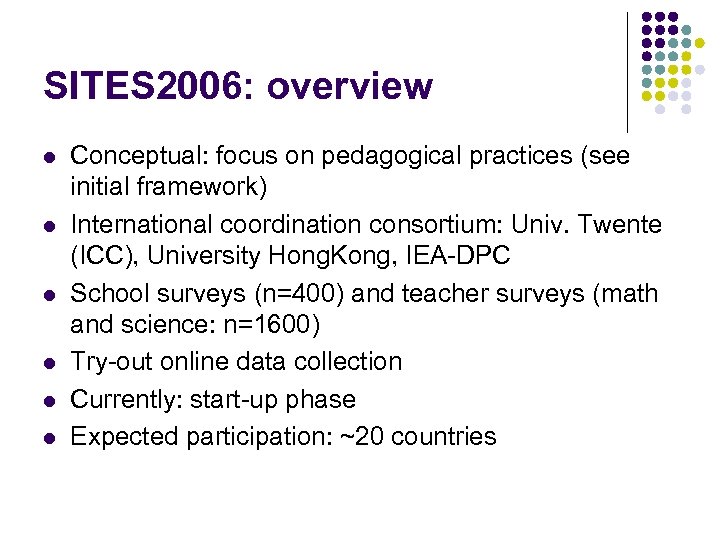 SITES 2006: overview l l l Conceptual: focus on pedagogical practices (see initial framework) International coordination consortium: Univ. Twente (ICC), University Hong. Kong, IEA-DPC School surveys (n=400) and teacher surveys (math and science: n=1600) Try-out online data collection Currently: start-up phase Expected participation: ~20 countries
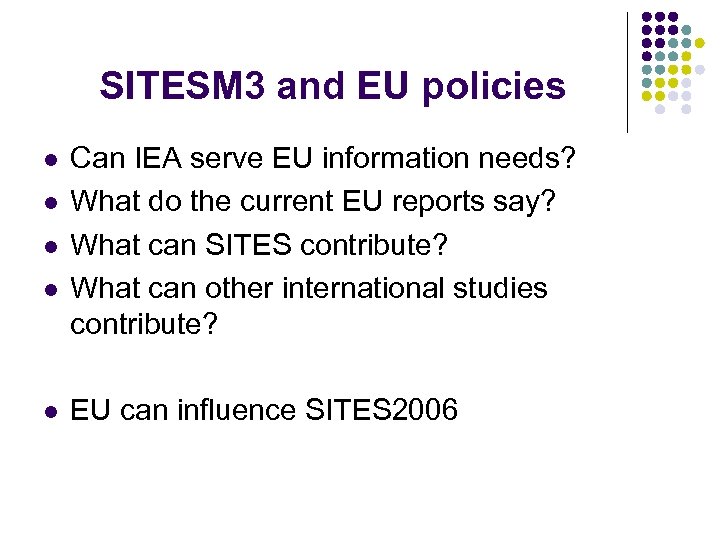 SITESM 3 and EU policies l l l Can IEA serve EU information needs? What do the current EU reports say? What can SITES contribute? What can other international studies contribute? EU can influence SITES 2006
 Conclusions • Case reports: examples of best practices • Short term: also use PISA, TIMSS, PIRLS • Optimize M 3 to inform EU policies regarding, e. g. : – Infrastructure – Curriculum reform and quality – Training – Equity issues
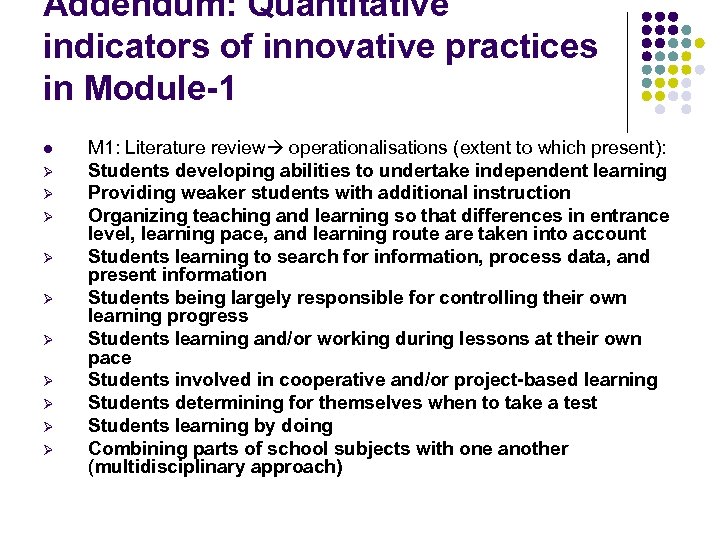 Addendum: Quantitative indicators of innovative practices in Module-1 l Ø Ø Ø Ø Ø M 1: Literature review operationalisations (extent to which present): Students developing abilities to undertake independent learning Providing weaker students with additional instruction Organizing teaching and learning so that differences in entrance level, learning pace, and learning route are taken into account Students learning to search for information, process data, and present information Students being largely responsible for controlling their own learning progress Students learning and/or working during lessons at their own pace Students involved in cooperative and/or project-based learning Students determining for themselves when to take a test Students learning by doing Combining parts of school subjects with one another (multidisciplinary approach)
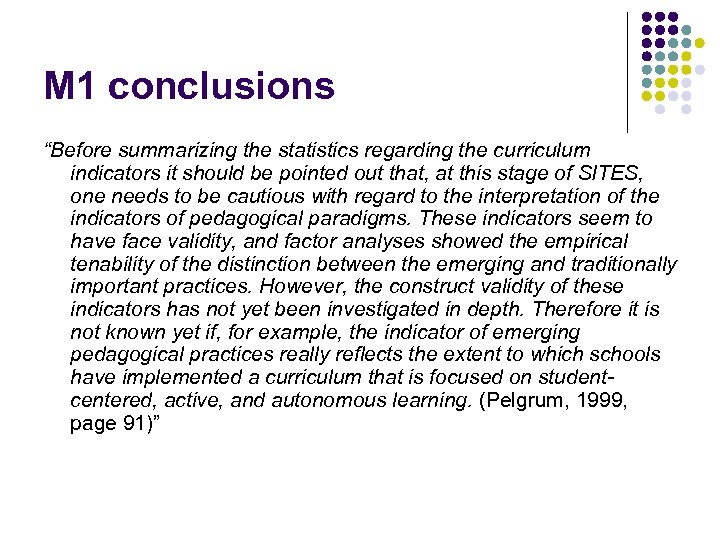 M 1 conclusions “Before summarizing the statistics regarding the curriculum indicators it should be pointed out that, at this stage of SITES, one needs to be cautious with regard to the interpretation of the indicators of pedagogical paradigms. These indicators seem to have face validity, and factor analyses showed the empirical tenability of the distinction between the emerging and traditionally important practices. However, the construct validity of these indicators has not yet been investigated in depth. Therefore it is not known yet if, for example, the indicator of emerging pedagogical practices really reflects the extent to which schools have implemented a curriculum that is focused on studentcentered, active, and autonomous learning. (Pelgrum, 1999, page 91)”
 Addendum: Questions l l How can M 2 help in understanding validity of M 1 -indicator? Is it possible to increase the measurement range by adding items?
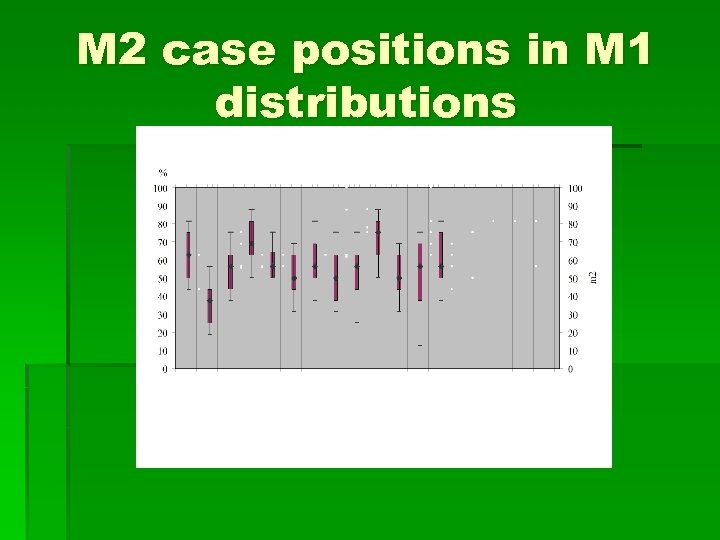 M 2 case positions in M 1 distributions
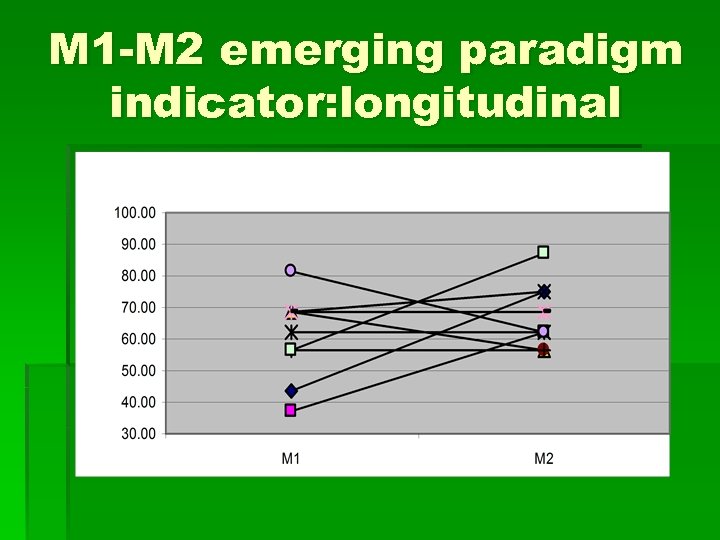 M 1 -M 2 emerging paradigm indicator: longitudinal
 Addendum: New items l l l Students learn search strategies to find diverse types of relevant information Students learn to assemble, organize and integrate information Students learn to critically evaluate the validity and worth of information obtained from their searches Students present work using several forms of presentation, e. g. , text, visual, verbal, and electronic Students involved in collaborative activities where the outcomes are based upon interdependent work Students assigned projects that require several persons working together for an extended period of time Students have some authority to decide what topics to study Teachers assign problems where student selects types of evidence and appropriate reasoning for the solution Students engage in intellectual discourse to exchange information and jointly solve problems. Students learn to critically evaluate the bases of knowledge and the logical structure of deductions and inferences made about this knowledge Students are encouraged to engage in self-reflection about the consequences of the research strategies they use
 Addendum: Conclusions • Many innovative cases available for analysis • This set of cases will provide insight in best practices from Europe, Asia and North America • M 2 very valuable for providing input to M 3