 Скачать презентацию The Elizabethan Theatre Shakespeare and Macbeth Coach Mc
425c459271426707d9e8e86158ca8591.ppt
- Количество слайдов: 23



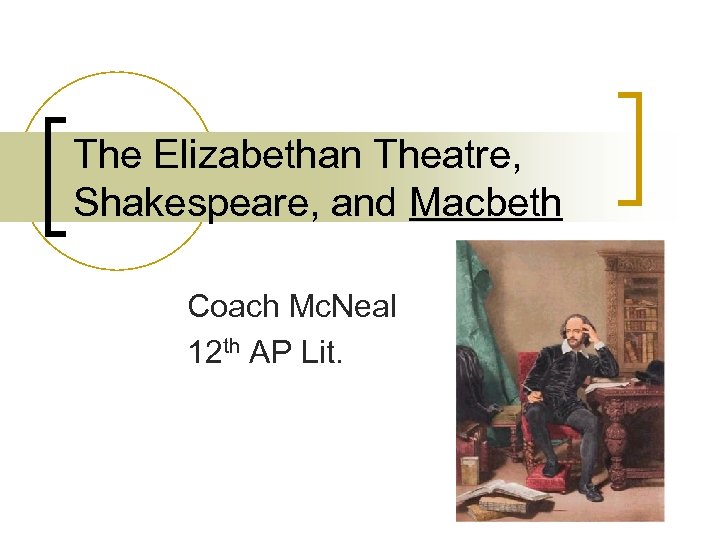
The Elizabethan Theatre, Shakespeare, and Macbeth Coach Mc. Neal 12 th AP Lit.
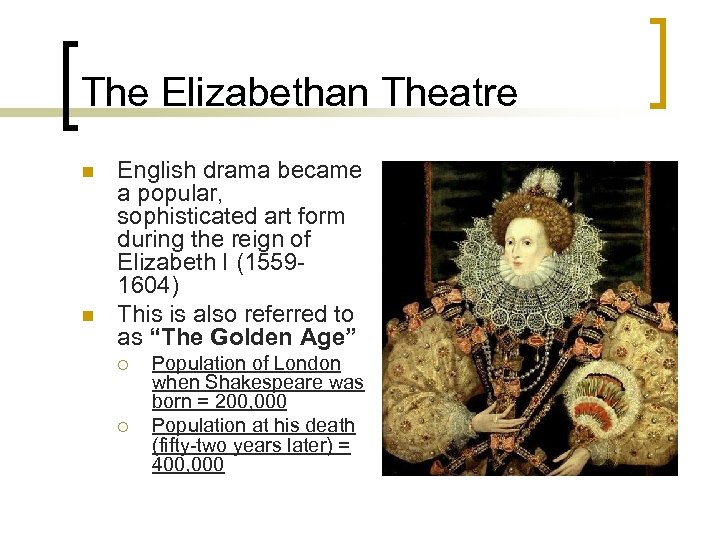
The Elizabethan Theatre n n English drama became a popular, sophisticated art form during the reign of Elizabeth I (15591604) This is also referred to as “The Golden Age” ¡ ¡ Population of London when Shakespeare was born = 200, 000 Population at his death (fifty-two years later) = 400, 000
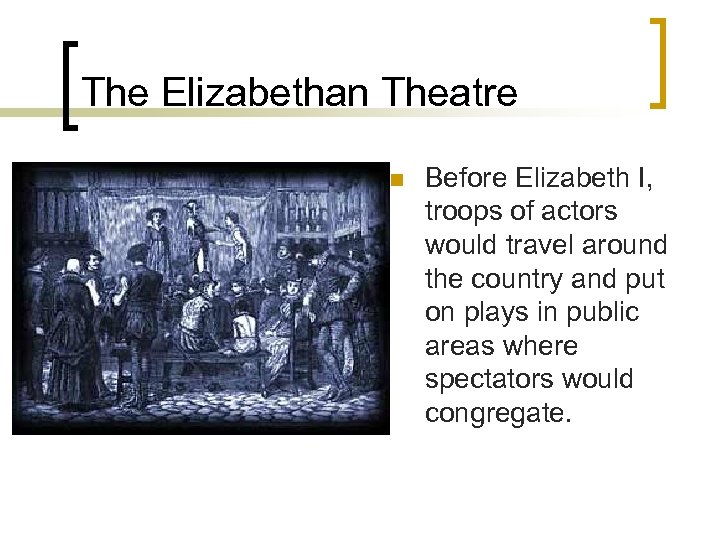
The Elizabethan Theatre n Before Elizabeth I, troops of actors would travel around the country and put on plays in public areas where spectators would congregate.
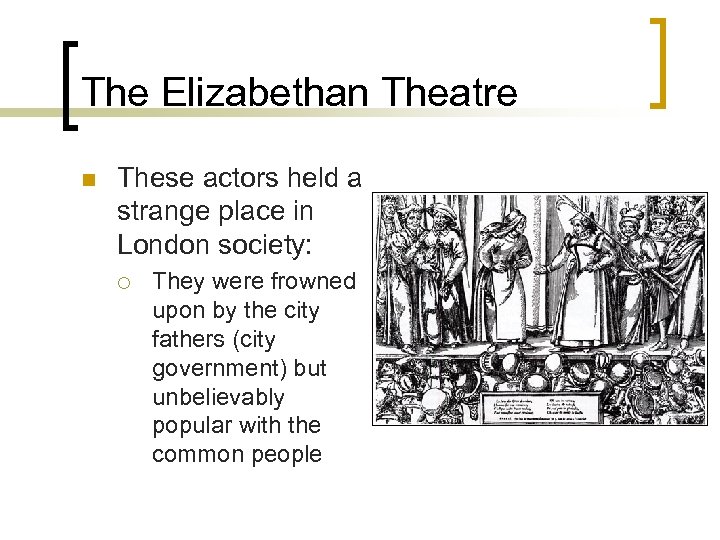
The Elizabethan Theatre n These actors held a strange place in London society: ¡ They were frowned upon by the city fathers (city government) but unbelievably popular with the common people
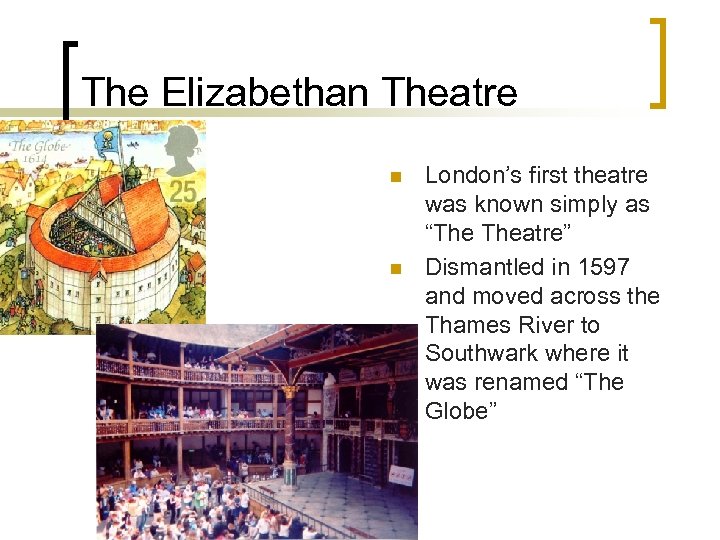
The Elizabethan Theatre n n London’s first theatre was known simply as “The Theatre” Dismantled in 1597 and moved across the Thames River to Southwark where it was renamed “The Globe”
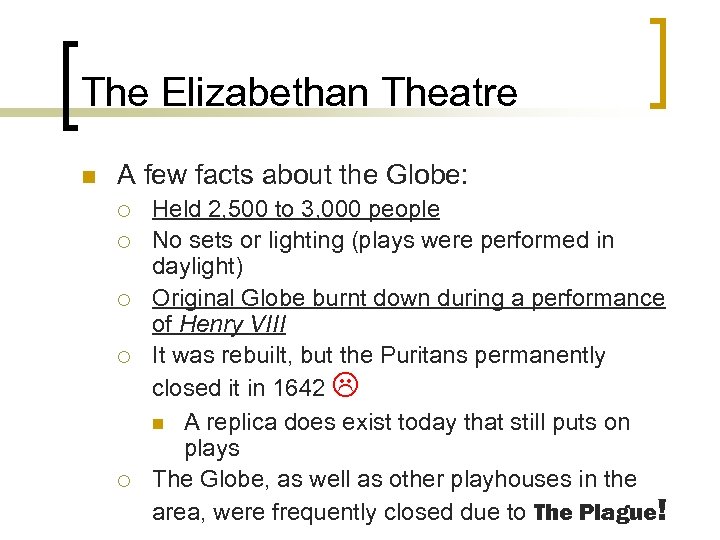
The Elizabethan Theatre n A few facts about the Globe: ¡ ¡ ¡ Held 2, 500 to 3, 000 people No sets or lighting (plays were performed in daylight) Original Globe burnt down during a performance of Henry VIII It was rebuilt, but the Puritans permanently closed it in 1642 n A replica does exist today that still puts on plays The Globe, as well as other playhouses in the area, were frequently closed due to The Plague!
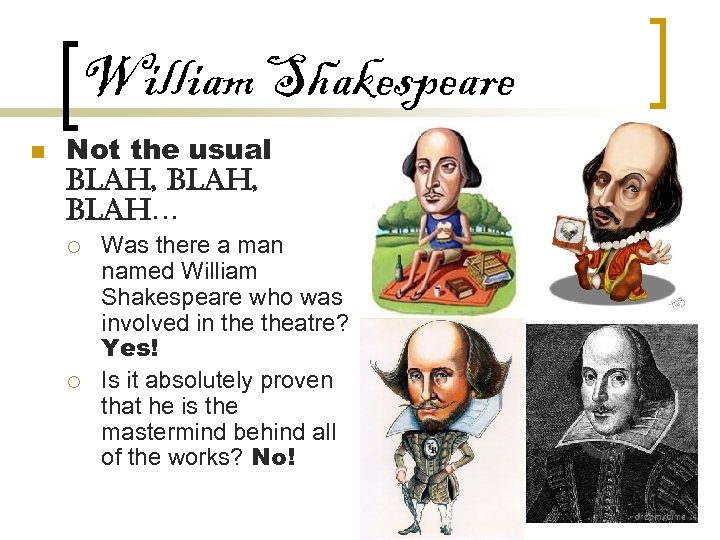
William Shakespeare n Not the usual BLAH, BLAH… ¡ ¡ Was there a man named William Shakespeare who was involved in theatre? Yes! Is it absolutely proven that he is the mastermind behind all of the works? No!
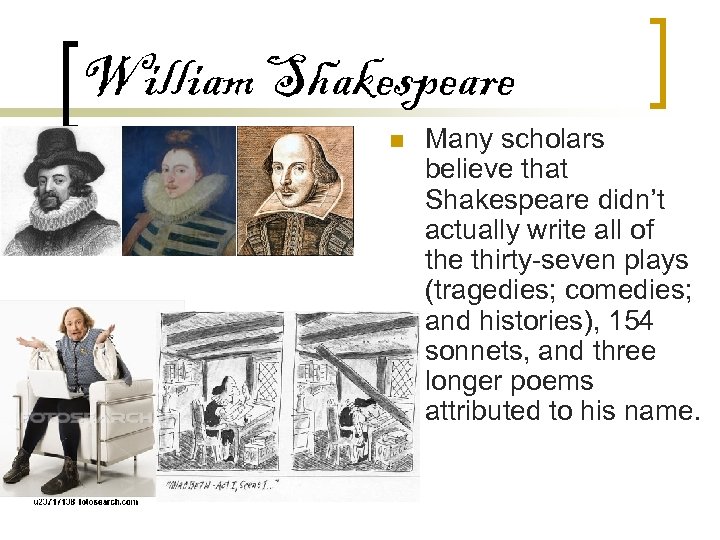
William Shakespeare n Many scholars believe that Shakespeare didn’t actually write all of the thirty-seven plays (tragedies; comedies; and histories), 154 sonnets, and three longer poems attributed to his name.
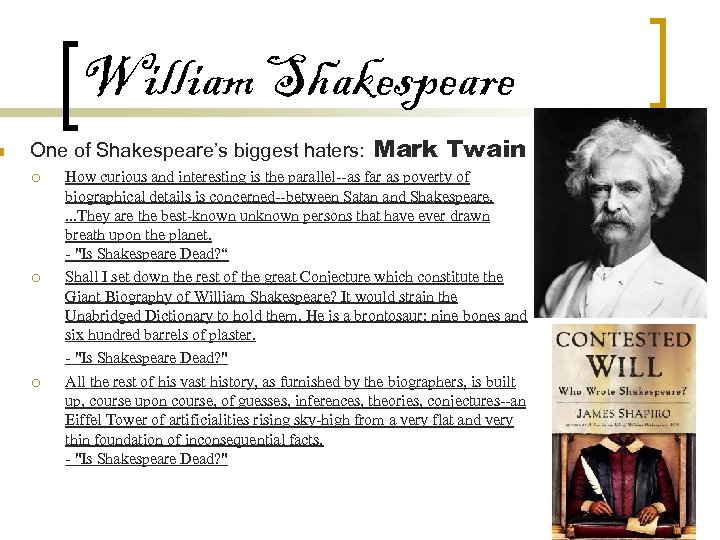
n William Shakespeare One of Shakespeare’s biggest haters: ¡ ¡ ¡ Mark Twain How curious and interesting is the parallel--as far as poverty of biographical details is concerned--between Satan and Shakespeare. . They are the best-known unknown persons that have ever drawn breath upon the planet. - "Is Shakespeare Dead? “ Shall I set down the rest of the great Conjecture which constitute the Giant Biography of William Shakespeare? It would strain the Unabridged Dictionary to hold them. He is a brontosaur: nine bones and six hundred barrels of plaster. - "Is Shakespeare Dead? " All the rest of his vast history, as furnished by the biographers, is built up, course upon course, of guesses, inferences, theories, conjectures--an Eiffel Tower of artificialities rising sky-high from a very flat and very thin foundation of inconsequential facts. - "Is Shakespeare Dead? "
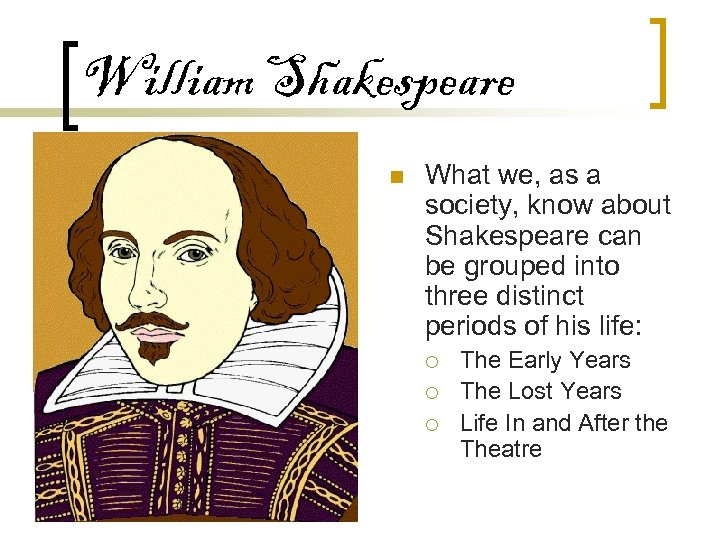
William Shakespeare n What we, as a society, know about Shakespeare can be grouped into three distinct periods of his life: ¡ ¡ ¡ The Early Years The Lost Years Life In and After the Theatre
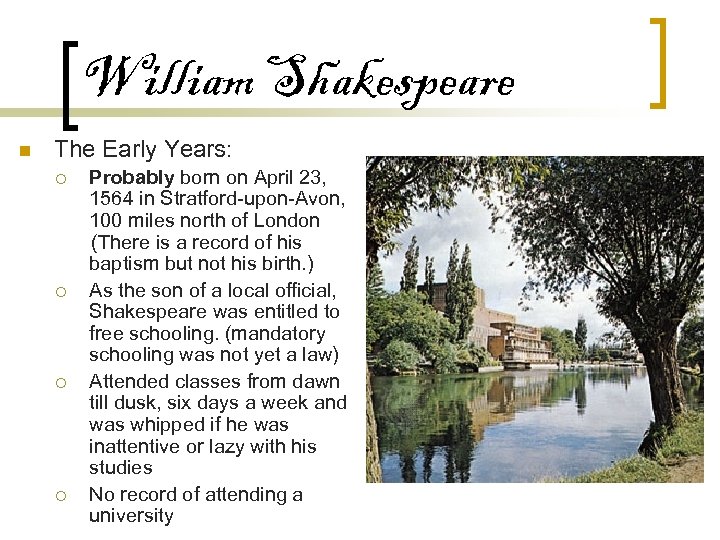
William Shakespeare n The Early Years: ¡ ¡ Probably born on April 23, 1564 in Stratford-upon-Avon, 100 miles north of London (There is a record of his baptism but not his birth. ) As the son of a local official, Shakespeare was entitled to free schooling. (mandatory schooling was not yet a law) Attended classes from dawn till dusk, six days a week and was whipped if he was inattentive or lazy with his studies No record of attending a university
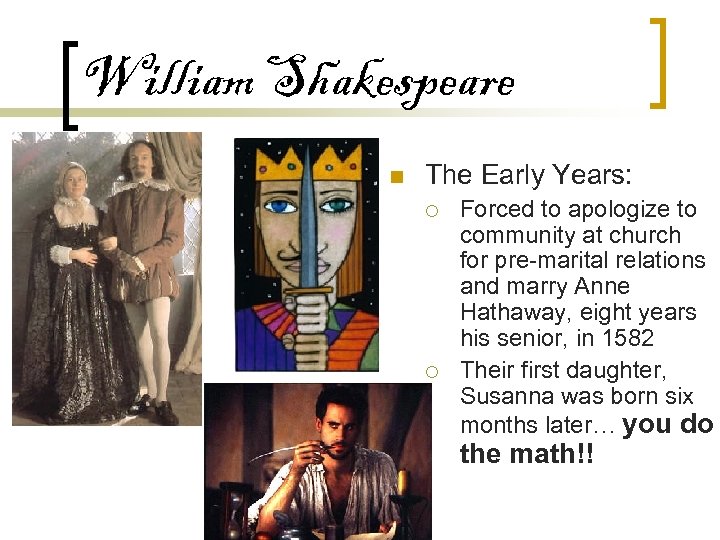
William Shakespeare n The Early Years: ¡ ¡ Forced to apologize to community at church for pre-marital relations and marry Anne Hathaway, eight years his senior, in 1582 Their first daughter, Susanna was born six months later… you do the math!!
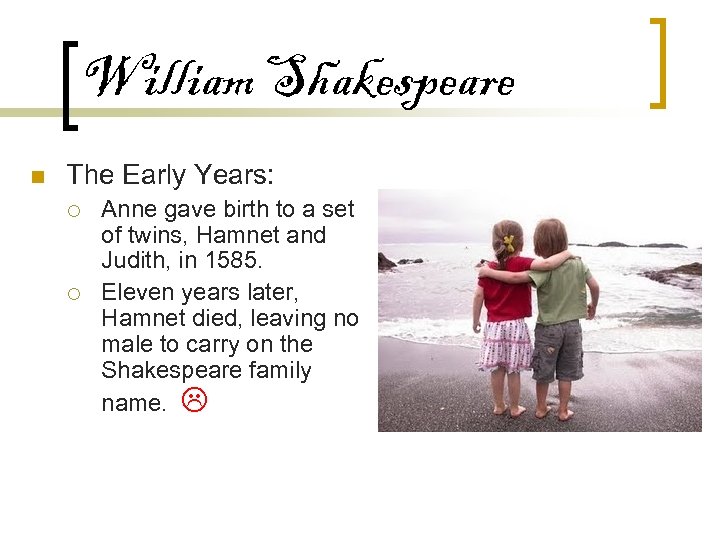
William Shakespeare n The Early Years: ¡ ¡ Anne gave birth to a set of twins, Hamnet and Judith, in 1585. Eleven years later, Hamnet died, leaving no male to carry on the Shakespeare family name.
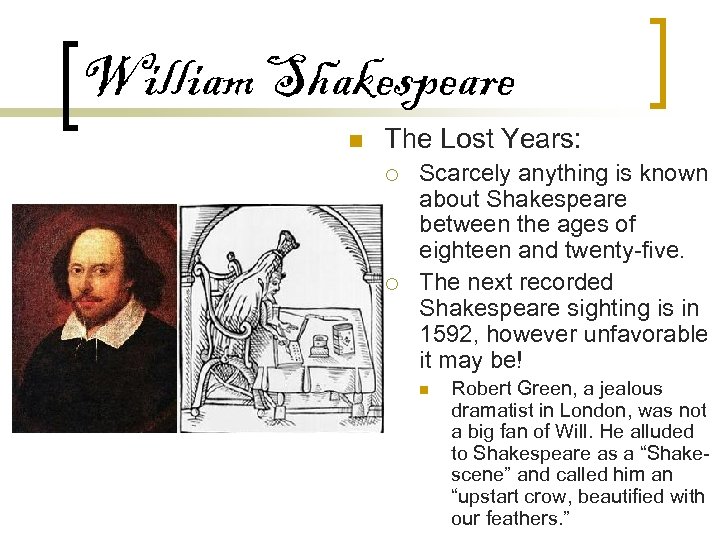
William Shakespeare n The Lost Years: ¡ ¡ Scarcely anything is known about Shakespeare between the ages of eighteen and twenty-five. The next recorded Shakespeare sighting is in 1592, however unfavorable it may be! n Robert Green, a jealous dramatist in London, was not a big fan of Will. He alluded to Shakespeare as a “Shakescene” and called him an “upstart crow, beautified with our feathers. ”
William Shakespeare n Theories about The Lost Years: ¡ ¡ ¡ Schoolmaster Sailed around the world Had to flee due to poaching deer Glove maker like his father Left with a group of actors Fled to get away from nagging wife n I agree with this one…more on why later!
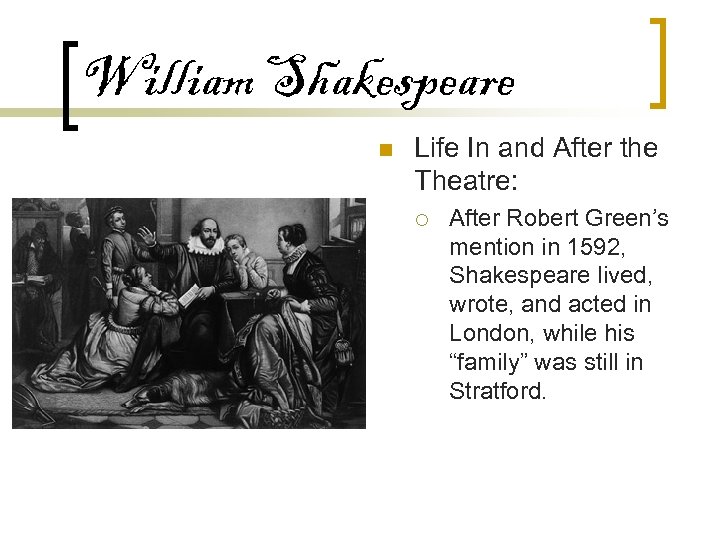
William Shakespeare n Life In and After the Theatre: ¡ After Robert Green’s mention in 1592, Shakespeare lived, wrote, and acted in London, while his “family” was still in Stratford.
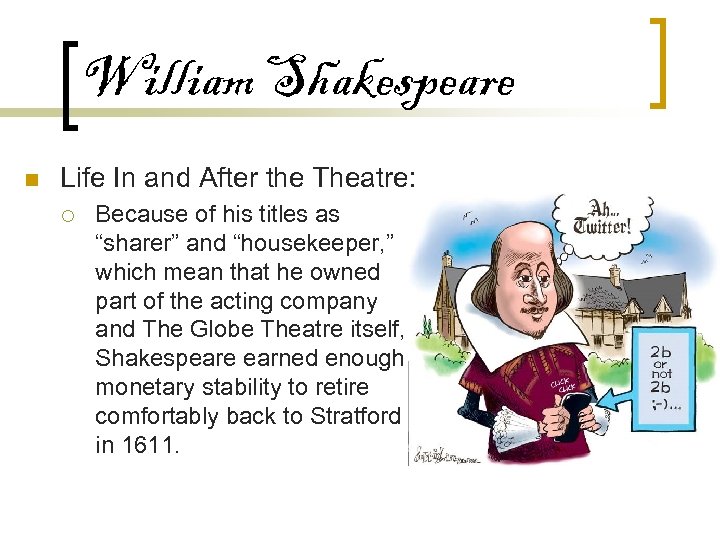
William Shakespeare n Life In and After the Theatre: ¡ Because of his titles as “sharer” and “housekeeper, ” which mean that he owned part of the acting company and The Globe Theatre itself, Shakespeare earned enough monetary stability to retire comfortably back to Stratford in 1611.
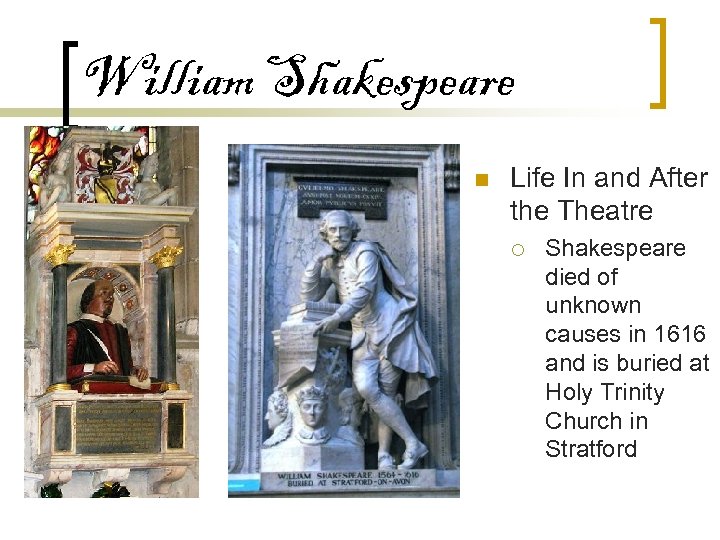
William Shakespeare n Life In and After the Theatre ¡ Shakespeare died of unknown causes in 1616 and is buried at Holy Trinity Church in Stratford
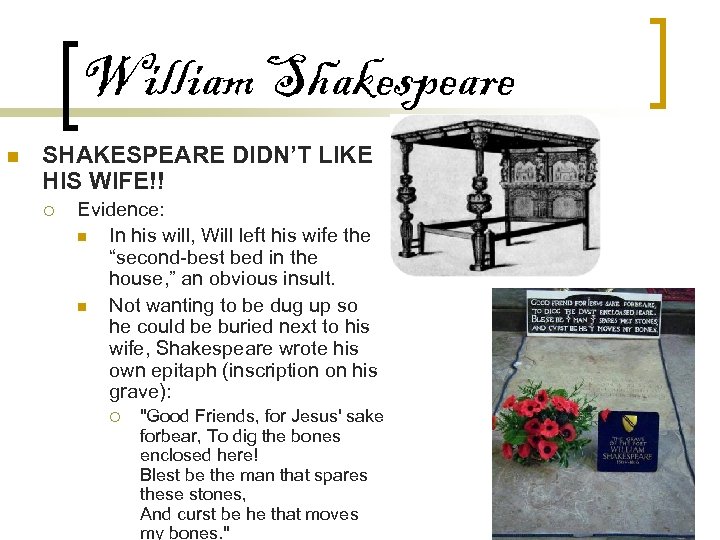
William Shakespeare n SHAKESPEARE DIDN’T LIKE HIS WIFE!! ¡ Evidence: n In his will, Will left his wife the “second-best bed in the house, ” an obvious insult. n Not wanting to be dug up so he could be buried next to his wife, Shakespeare wrote his own epitaph (inscription on his grave): ¡ "Good Friends, for Jesus' sake forbear, To dig the bones enclosed here! Blest be the man that spares these stones, And curst be he that moves my bones. "
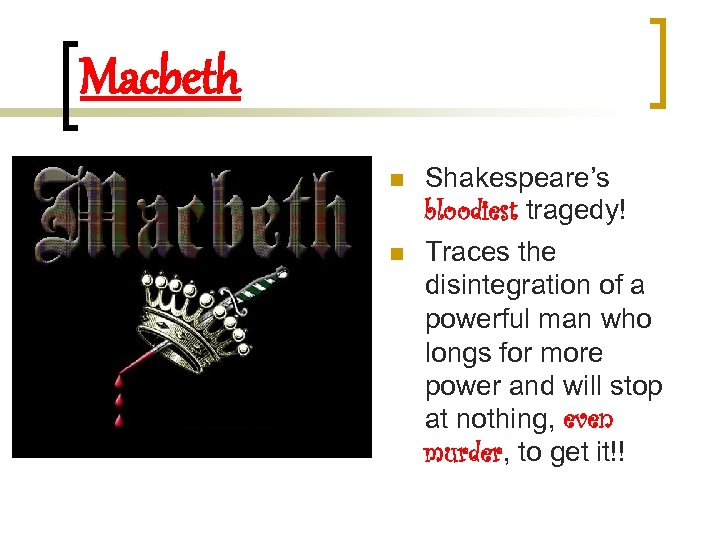
Macbeth n n Shakespeare’s bloodiest tragedy! Traces the disintegration of a powerful man who longs for more power and will stop at nothing, even murder, to get it!!
Macbeth n Interesting fact: ¡ In theatre lore, no actor actually calls Macbeth by its given name. It is called instead, “The Scottish Play” because it has been associated with bad luck over the centuries. The curse began, it is said, with the first performance of the play when the boy actor playing Lady Macbeth collapsed, apparently from a fever, and died before the play had finished.
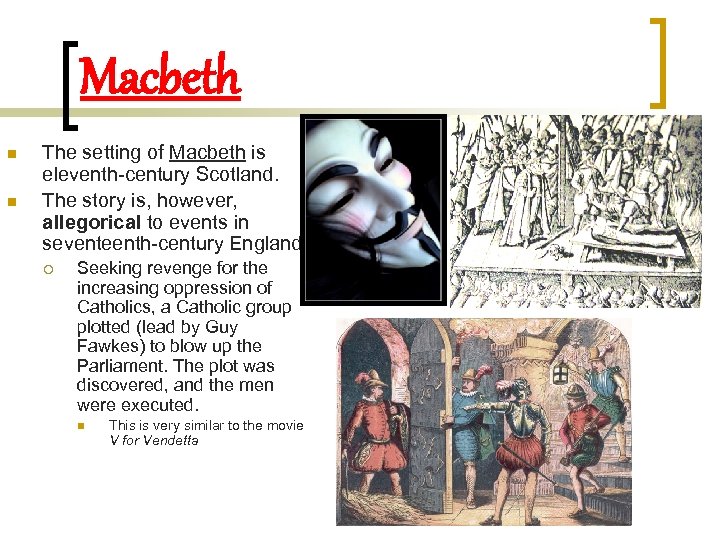
Macbeth n n The setting of Macbeth is eleventh-century Scotland. The story is, however, allegorical to events in seventeenth-century England. ¡ Seeking revenge for the increasing oppression of Catholics, a Catholic group plotted (lead by Guy Fawkes) to blow up the Parliament. The plot was discovered, and the men were executed. n This is very similar to the movie V for Vendetta
Questions/Comments/Concerns n If you have any questions, comments, or concerns, write them down and ask me tomorrow.
Скачать презентацию The Elizabethan Theatre Shakespeare and Macbeth Coach Mc
425c459271426707d9e8e86158ca8591.ppt