 Скачать презентацию The Election Process Influenced by one or more
eb93be92b35d3fccd1a2d21720950a20.ppt
- Количество слайдов: 41



The Election Process Influenced by one or more of the following: • Constitutional Qualifications • Federal and/or State Election Laws • Political Parties Copyright © 2011 Pearson Education, Inc. Publishing as Longman
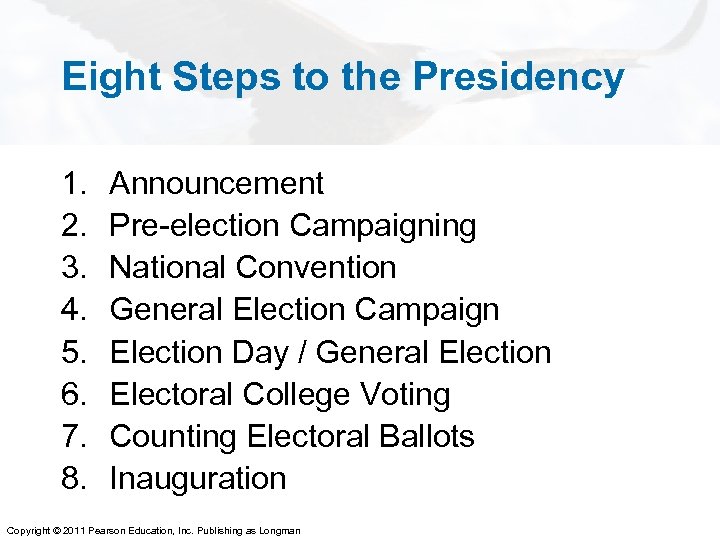
Eight Steps to the Presidency 1. 2. 3. 4. 5. 6. 7. 8. Announcement Pre-election Campaigning National Convention General Election Campaign Election Day / General Election Electoral College Voting Counting Electoral Ballots Inauguration Copyright © 2011 Pearson Education, Inc. Publishing as Longman
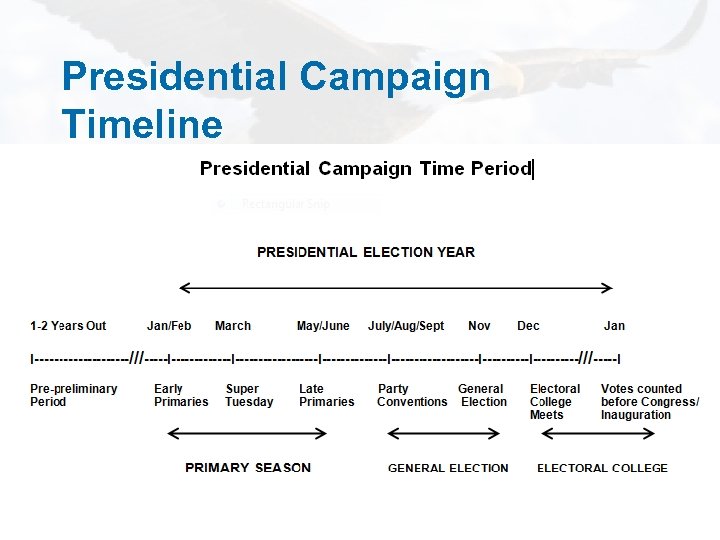
Presidential Campaign Timeline Copyright © 2011 Pearson Education, Inc. Publishing as Longman
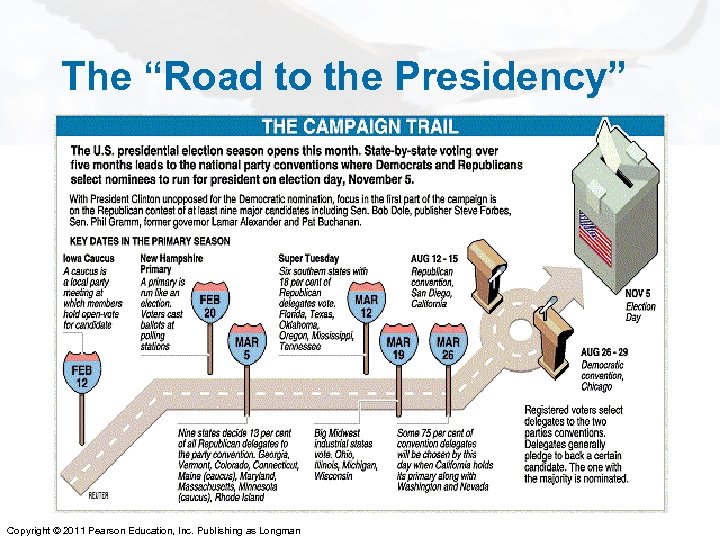
The “Road to the Presidency” Copyright © 2011 Pearson Education, Inc. Publishing as Longman
The Nomination Game Step One: Announcement LO 9. 1 • Deciding to Run • A presidential candidacy in the United States needs to be either announced or an “open secret” for at least a year before the election. • Barack Obama made clear his intention to run for president in January 2007. To Learning Objectives Copyright © 2011 Pearson Education, Inc. Publishing as Longman
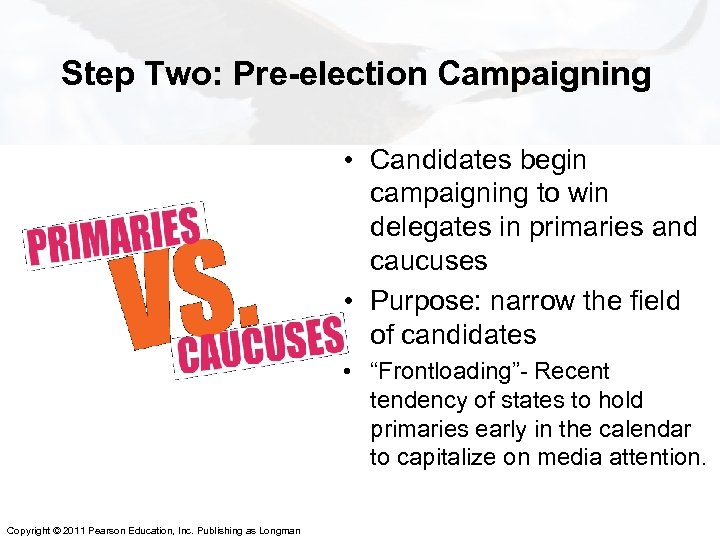
Step Two: Pre-election Campaigning • Candidates begin campaigning to win delegates in primaries and caucuses • Purpose: narrow the field of candidates • “Frontloading”- Recent tendency of states to hold primaries early in the calendar to capitalize on media attention. Copyright © 2011 Pearson Education, Inc. Publishing as Longman
LO 9. 1 The Nomination Game • Competing for Delegates • Caucus - A system for selecting convention delegates used in about a dozen mostly rural states in which voters must show up at a set time and attend an open meeting to express their presidential preference. To Learning Objectives Copyright © 2011 Pearson Education, Inc. Publishing as Longman
SUPER TUESDAY • The States that have their primaries & caucuses early, have an advantage. • They receive a lot of attention from the candidates. • Most of the candidates are still in the race. • Several southern States, including Texas, moved their primaries/caucuses to the second week in March-Super Tues. Copyright © 2011 Pearson Education, Inc. Publishing as Longman
LO 9. 1 The Nomination Game • Competing for Delegates (cont. ) • Evaluating the Primary and Caucus System – Disproportionate attention goes to early ones; prominent politicians do not run; money plays too big a role; participation is low and unrepresentative; and too much power goes to the media. To Learning Objectives Copyright © 2011 Pearson Education, Inc. Publishing as Longman
The Nomination Game LO 9. 1 • Nomination • The official endorsement of a candidate for office by a political party. • Success in the nomination game requires momentum, money, and media attention. • Campaign Strategy • Master game plan that guides a candidate’s electoral campaign. To Learning Objectives Copyright © 2011 Pearson Education, Inc. Publishing as Longman
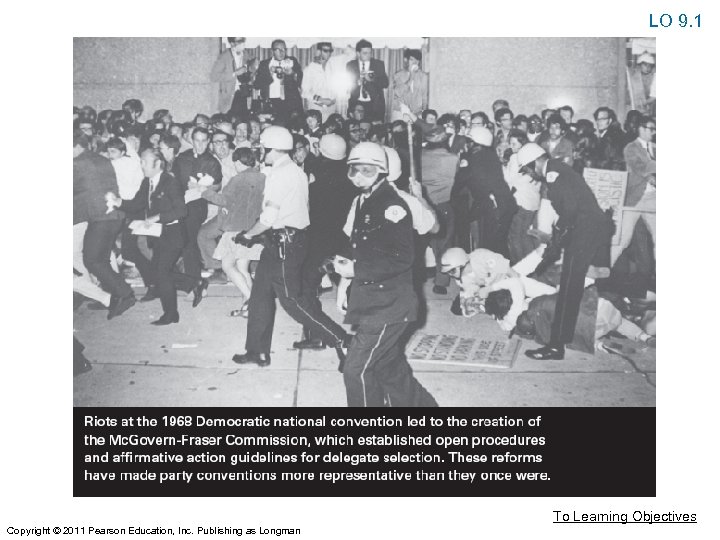
The Nomination Game Step Three: National Convention LO 9. 1 • Competing for Delegates • National Party Convention – The supreme power within each party. • Mc. Govern-Fraser Commission – In response to demands for reform by minority groups and others seeking better representation. • Super-delegates – Party leaders automatically get delegate slot at national party convention. To Learning Objectives Copyright © 2011 Pearson Education, Inc. Publishing as Longman
LO 9. 1 To Learning Objectives Copyright © 2011 Pearson Education, Inc. Publishing as Longman
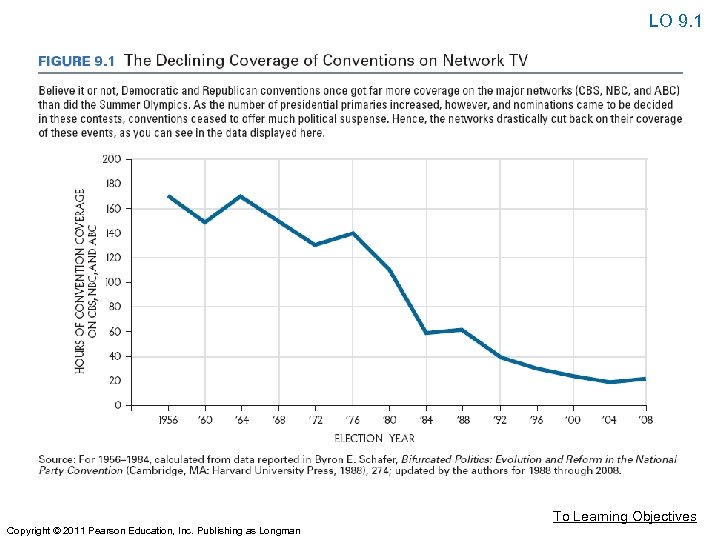
LO 9. 1 The Nomination Game • The Convention Send-Off • Rallying point for parties. • Key note speaker on first day of Convention. • Party platform (2 nd day) – Goals and policies for next 4 years. • Formal nomination of president and vicepresident candidates on third and fourth days. To Learning Objectives Copyright © 2011 Pearson Education, Inc. Publishing as Longman
LO 9. 1 To Learning Objectives Copyright © 2011 Pearson Education, Inc. Publishing as Longman
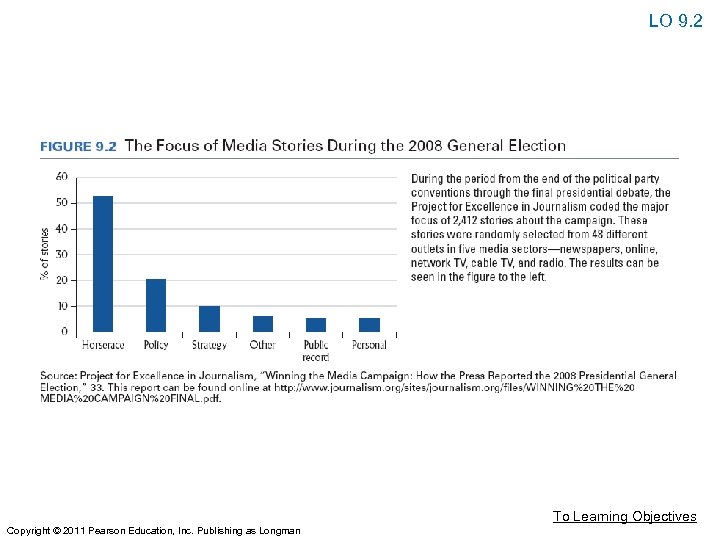
LO 9. 2 The Campaign Game • The High-Tech Media Campaign • Direct mail used to generate support and money for candidate. • Get media attention through ad budget and free news coverage. • The emphasis is on marketing a candidate because news stories focus more on the horse race than substantive policy issues. To Learning Objectives Copyright © 2011 Pearson Education, Inc. Publishing as Longman
LO 9. 2 To Learning Objectives Copyright © 2011 Pearson Education, Inc. Publishing as Longman
LO 9. 2 The Campaign Game • Organizing the Campaign • Get a campaign manager, a fund-raiser, and a campaign counsel. • Hire media and campaign consultants. • Assemble staff, plan logistics, and get research staff, policy advisors, pollsters, and a good press secretary. • Establish a website. To Learning Objectives Copyright © 2011 Pearson Education, Inc. Publishing as Longman
LO 9. 3 Money and Campaigning • The Maze of Campaign Finance Reforms • Federal Election Campaign Act of 1974 created Federal Election Commission; provided public financing for presidential primaries and general elections; limited presidential campaign spending; required disclosure; and limited contributions. To Learning Objectives Copyright © 2011 Pearson Education, Inc. Publishing as Longman
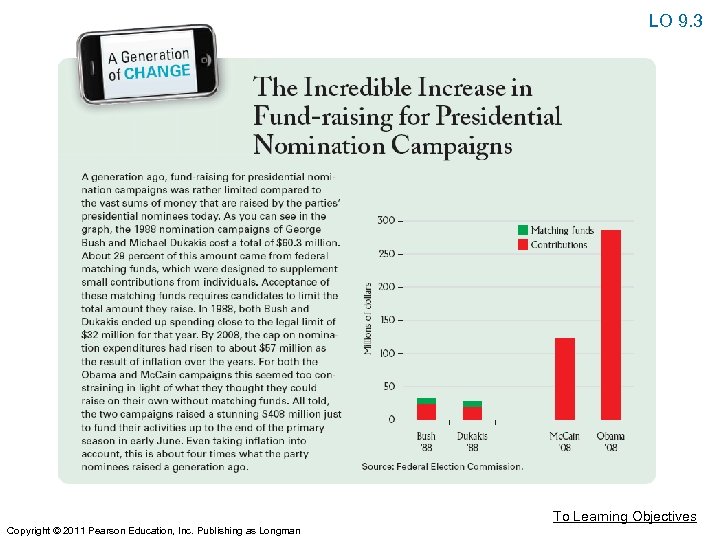
LO 9. 3 To Learning Objectives Copyright © 2011 Pearson Education, Inc. Publishing as Longman
LO 9. 3 Money and Campaigning • The Maze of Campaign Finance Reforms (cont. ) • Soft Money – Contributions for party building expenses or generic party advertising not subject to contribution limits. • Mc. Cain-Feingold Act (2002) bans soft money, increased amount of individual contributions, and limited issue ads. To Learning Objectives Copyright © 2011 Pearson Education, Inc. Publishing as Longman
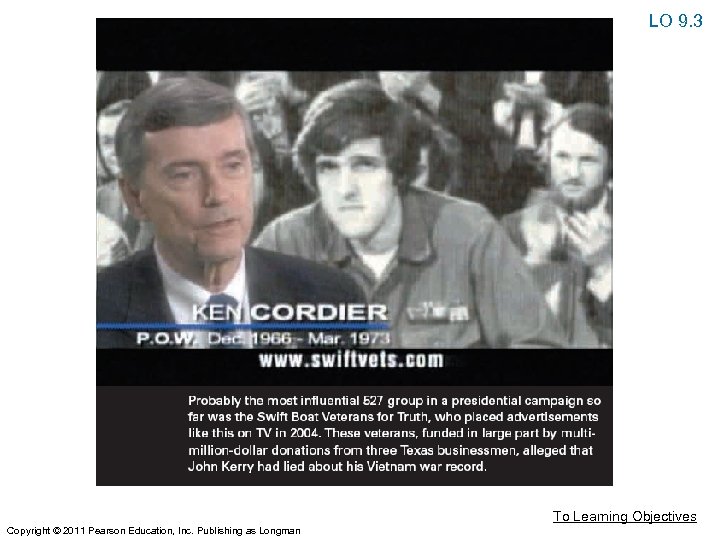
LO 9. 3 Money and Campaigning • The Maze of Campaign Finance Reforms (cont. ) • 527 Groups – Independent groups seek to influence the political process but are not subject to contribution limits because they do not directly seek election of particular candidates. • The name 527 Groups comes from Section 527 of the federal tax code by which they are governed. To Learning Objectives Copyright © 2011 Pearson Education, Inc. Publishing as Longman
LO 9. 3 To Learning Objectives Copyright © 2011 Pearson Education, Inc. Publishing as Longman
Money and Campaigning LO 9. 3 • The Proliferation of PACs • Political Action Committees are funding vehicles created by the 1974 campaign finance reforms. • A corporation, union, or some other interest group can create a political action committee (PAC) and register it with the Federal Election Commission. To Learning Objectives Copyright © 2011 Pearson Education, Inc. Publishing as Longman
LO 9. 3 Money and Campaigning • The Proliferation of PACs (cont. ) • There were 4, 611 PACs during the 2007– 2008 election cycle, which contributed $412. 8 million to House and Senate candidates. • PACs donate to candidates who support their issue. • PACs do not buy candidates, but give to candidates who support them in the first place. To Learning Objectives Copyright © 2011 Pearson Education, Inc. Publishing as Longman
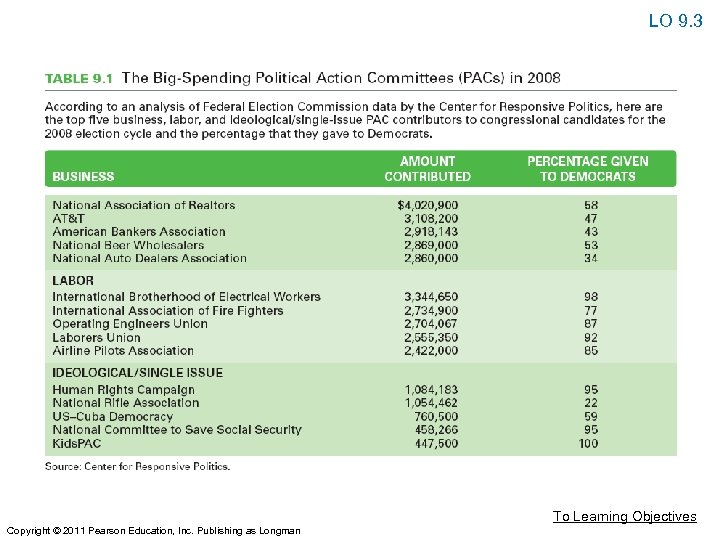
LO 9. 3 To Learning Objectives Copyright © 2011 Pearson Education, Inc. Publishing as Longman
LO 9. 3 Money and Campaigning • Are Campaigns Too Expensive? • Center for Responsive Politics estimated in 2008 that the contests for the presidency and Congress cost over $5 billion. • More congressional incumbents spend, the worse they do. • Doctrine of sufficiency – Spend enough money to get a message across to compete effectively. To Learning Objectives Copyright © 2011 Pearson Education, Inc. Publishing as Longman
The Impact of Campaigns LO 9. 4 • Some factors tend to weaken campaigns’ impact on voters. • Selective perception – Most people pay attention to things they agree with and interpret events according to predispositions. • Party identification influence voting behavior. • Incumbents – Advantage of name recognition and a track record. To Learning Objectives Copyright © 2011 Pearson Education, Inc. Publishing as Longman
THE MEDIA • Most Americans get all of their info. from television • Media slant • Polls • Can be used by the candidates to find out how they’re doing with the voters • Can say anything. Copyright © 2011 Pearson Education, Inc. Publishing as Longman
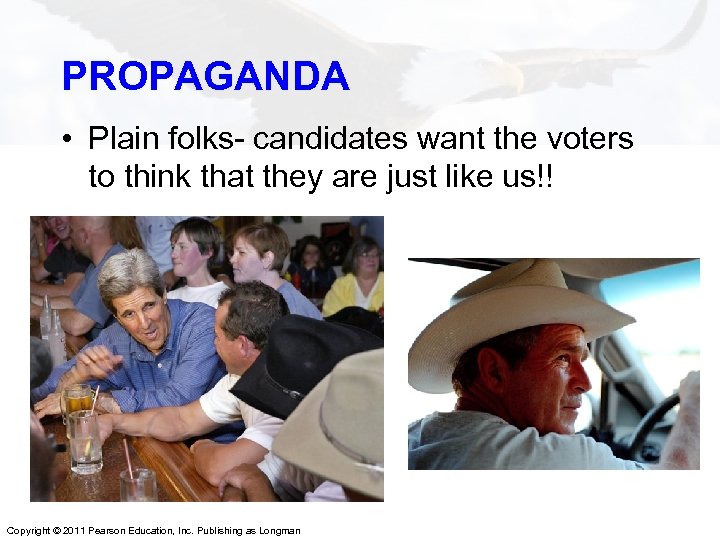
PROPAGANDA • Plain folks- candidates want the voters to think that they are just like us!! Copyright © 2011 Pearson Education, Inc. Publishing as Longman
MORE PROPAGANDA • Bandwagon--everyone’s supporting me & you should too!!!! • Glittering Generalities--slogans that sound good & mean nothing- • VOTE FOR A BETTER TOMORROW!! • THE EDUCATION PRESIDENT!! Copyright © 2011 Pearson Education, Inc. Publishing as Longman
MORE PROPAGANDA • Cardstacking-- telling only one side of the story--”I’m great, my opponent is a crook!!” • Namecalling • Testimonial--have someone famous campaign for you Copyright © 2011 Pearson Education, Inc. Publishing as Longman
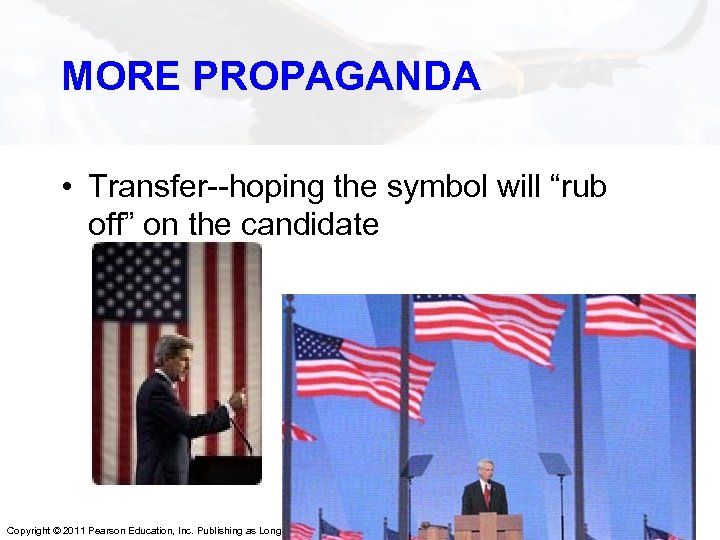
MORE PROPAGANDA • Transfer--hoping the symbol will “rub off” on the candidate Copyright © 2011 Pearson Education, Inc. Publishing as Longman
Understanding Nominations and Campaigns LO 9. 5 • Do Big Campaigns Lead to an Increased Scope of Government? • Candidates make numerous promises, especially to state and local interests. • Hard for politicians to promise to cut size of government. To Learning Objectives Copyright © 2011 Pearson Education, Inc. Publishing as Longman
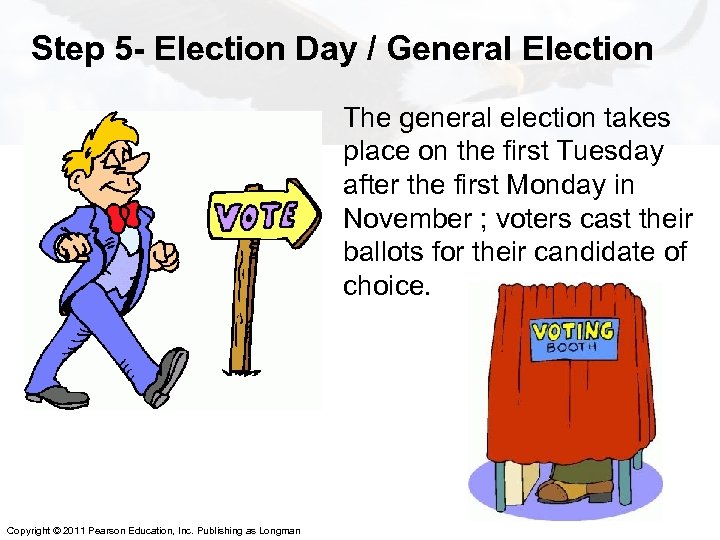
Step 5 - Election Day / General Election The general election takes place on the first Tuesday after the first Monday in November ; voters cast their ballots for their candidate of choice. Copyright © 2011 Pearson Education, Inc. Publishing as Longman
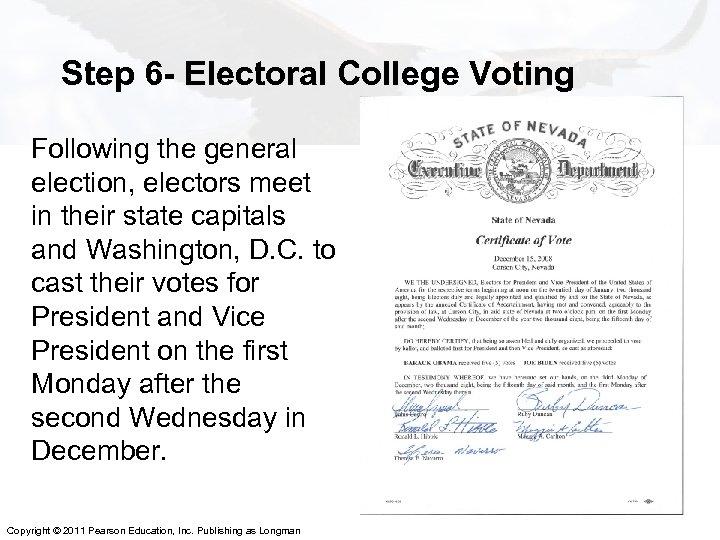
Step 6 - Electoral College Voting Following the general election, electors meet in their state capitals and Washington, D. C. to cast their votes for President and Vice President on the first Monday after the second Wednesday in December. Copyright © 2011 Pearson Education, Inc. Publishing as Longman
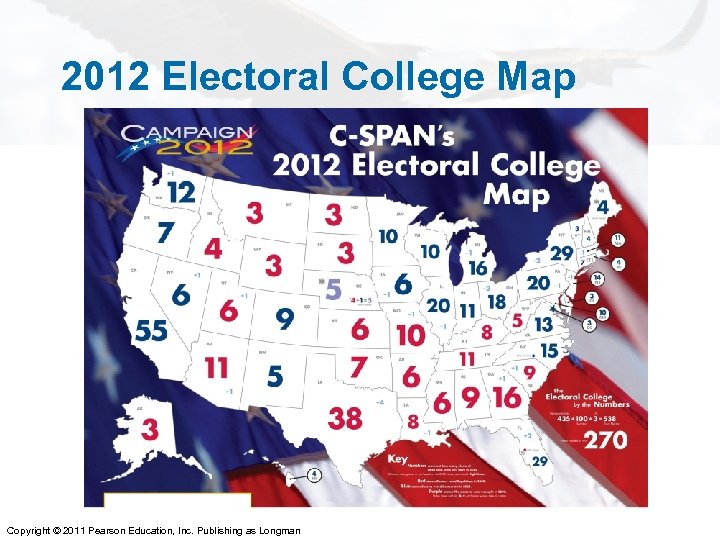
2012 Electoral College Map Copyright © 2011 Pearson Education, Inc. Publishing as Longman
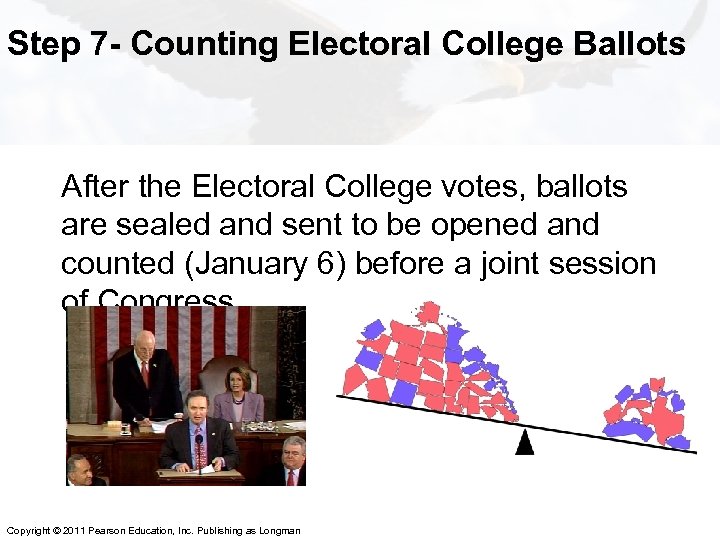
Step 7 - Counting Electoral College Ballots After the Electoral College votes, ballots are sealed and sent to be opened and counted (January 6) before a joint session of Congress Copyright © 2011 Pearson Education, Inc. Publishing as Longman
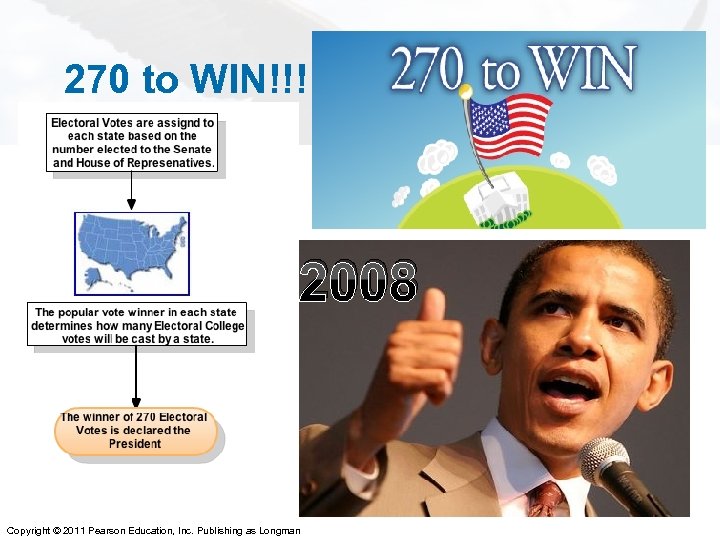
270 to WIN!!! 2008 Copyright © 2011 Pearson Education, Inc. Publishing as Longman
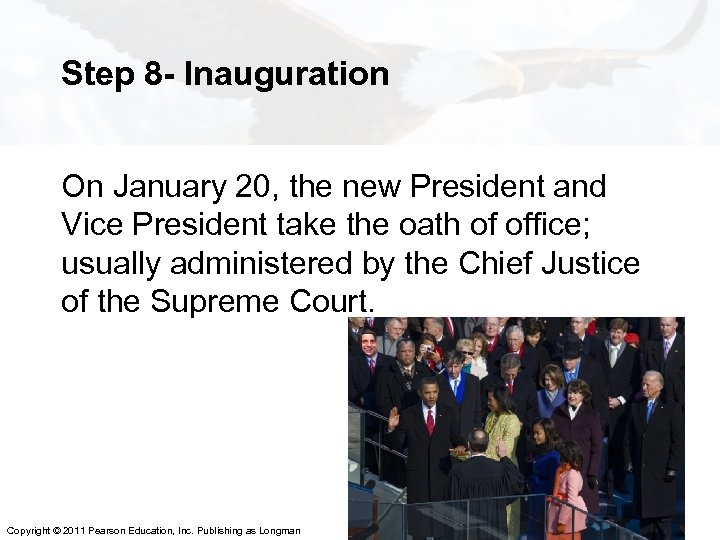
Step 8 - Inauguration On January 20, the new President and Vice President take the oath of office; usually administered by the Chief Justice of the Supreme Court. Copyright © 2011 Pearson Education, Inc. Publishing as Longman
Text Credits • • • The Pew Research Center’s Project for Excellence in Journalism; “Winning the Media Campaign: How the Press Reported the 2008 Presidential General Election, ” Oct 22, 2008, http: //www. journalism. org/sites/journalism. org/files/WINNING%20 T HE%20 MEDIA%20 CAMPAIGN%20 FINAL. pdf. Federal Election Commission. Copyright Center for Responsive Politics, www. opensecrets. org. Pamela K. Lamb Del Rio High School Copyright © 2011 Pearson Education, Inc. Publishing as Longman
Photo Credits • • • • 252: Bruce Ely/The Oregonian 203 T: AP Photo 203 TC: Sean Tevis 203 TB: Ken Cordier/Reuters/HO/Landov 203 B: AP Photo 255: AP Photo 257: Jim Ruyman/Landov 258: AP Photo 257: John Cole 263: Howell/Getty Images 264: Sean Tevis 270: Reuters/HO/Landov 272: AP Photo 275: Used with permission of Matt Wurker and the Cartoonist Group. All Rights Reserved. Copyright © 2011 Pearson Education, Inc. Publishing as Longman
Скачать презентацию The Election Process Influenced by one or more
eb93be92b35d3fccd1a2d21720950a20.ppt