


 Скачать презентацию THE ELECTION OF 1912 A GAME CHANGE
b18fb7249971af2a1fce9b0c135ba02b.ppt
- Количество слайдов: 86
 THE ELECTION OF 1912: A GAME CHANGE
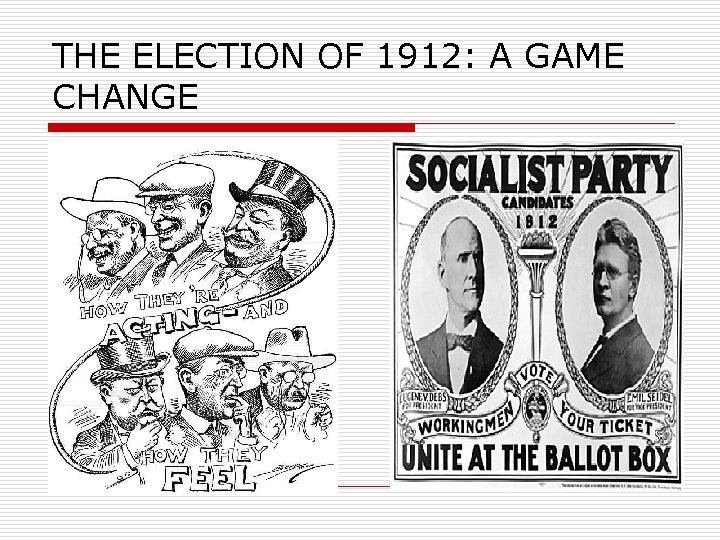
 THE ELECTION OF 1912: A GAME CHANGE o o All the crosscurrents of Progressive era thinking about what Mc. Clure’s Magazine called “the problem of the relation of the State and the corporation” came together in the presidential campaign of 1912. The four way race became a national debate on the relationship between political and economic freedom in the age of big business.
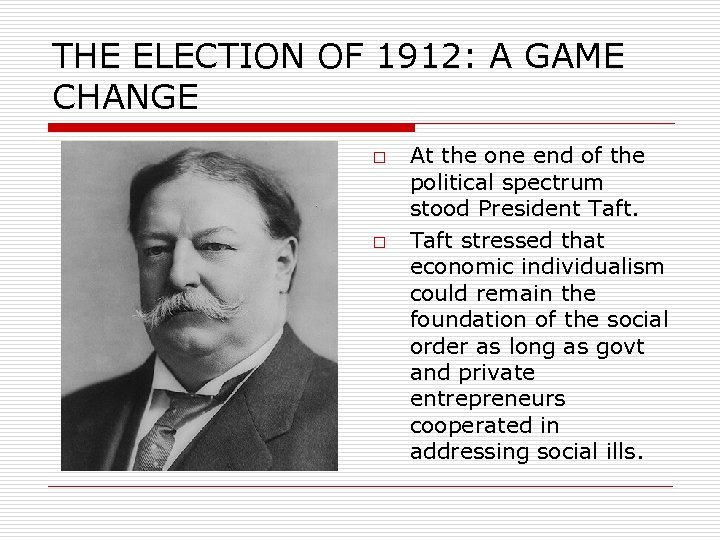 THE ELECTION OF 1912: A GAME CHANGE o o At the one end of the political spectrum stood President Taft stressed that economic individualism could remain the foundation of the social order as long as govt and private entrepreneurs cooperated in addressing social ills.
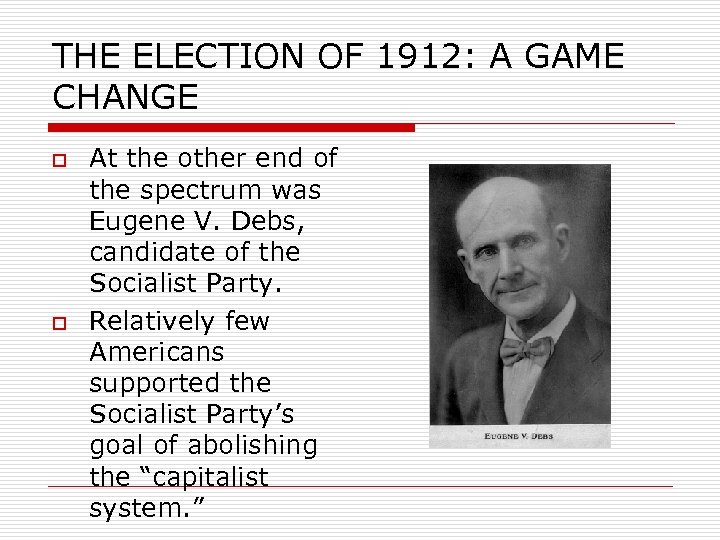 THE ELECTION OF 1912: A GAME CHANGE o o At the other end of the spectrum was Eugene V. Debs, candidate of the Socialist Party. Relatively few Americans supported the Socialist Party’s goal of abolishing the “capitalist system. ”
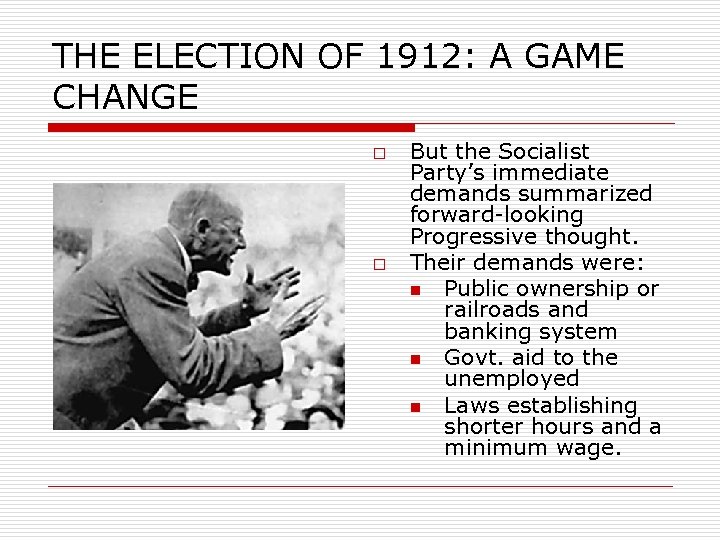 THE ELECTION OF 1912: A GAME CHANGE o o But the Socialist Party’s immediate demands summarized forward-looking Progressive thought. Their demands were: n Public ownership or railroads and banking system n Govt. aid to the unemployed n Laws establishing shorter hours and a minimum wage.
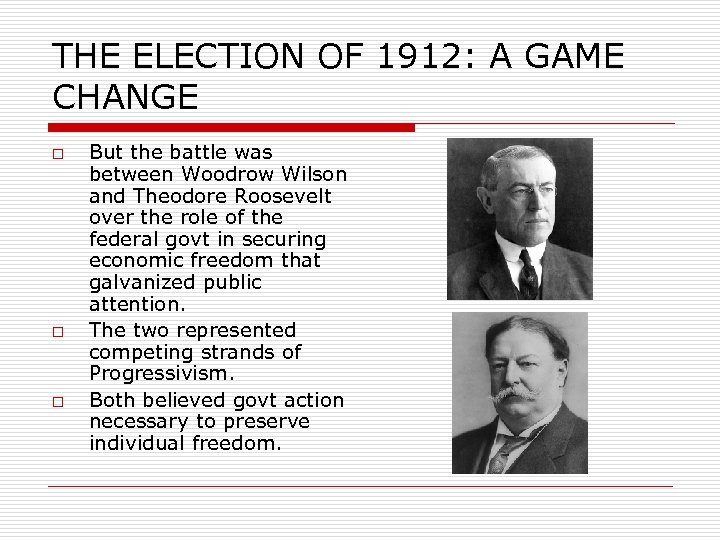 THE ELECTION OF 1912: A GAME CHANGE o o o But the battle was between Woodrow Wilson and Theodore Roosevelt over the role of the federal govt in securing economic freedom that galvanized public attention. The two represented competing strands of Progressivism. Both believed govt action necessary to preserve individual freedom.
 THE ELECTION OF 1912: A GAME CHANGE o o But they differed about the dangers of increasing the govt’s power and the inevitability of economic concentration. Though representing a party thoroughly steeped in states’ rights and laissez-faire ideology, Wilson was deeply imbued with Progressive ideas. “Freedom, ” he declared, “is something more than being let alone. The program of a government of freedom must in these days be positive, not negative merely. ” As governor of NJ, he presided over the implementation of a system of workmen’s compensation and state regulation of utlities and railroads.
 THE ELECTION OF 1912: A GAME CHANGE o o o While the election was a battle between the ideas of Wilson and TR, the story of the election revolves around the relationship between Taft and TR and the schism of the Republican Party. Taft was TR’s hand-picked successor. TR had expected Taft to continue TR’s policies but Taft had his own mind. He won an easy election in 1908 beating William Jennings Bryant. He entered the White House on a wave of good feeling.
 THE ELECTION OF 1912: A GAME CHAN GE o Four years later, Taft would leave office the most decisively defeated president of the 20 th century, with his party deeply divided and govt in the hands of a Democratic administration for the first time in twenty years. o o TR and Taft were not alike at all. But it was not until Taft became president did the real extent of the differences became clear. TR had been the most dynamic public figure of his time. Taft was a stolid and respectable and little more.
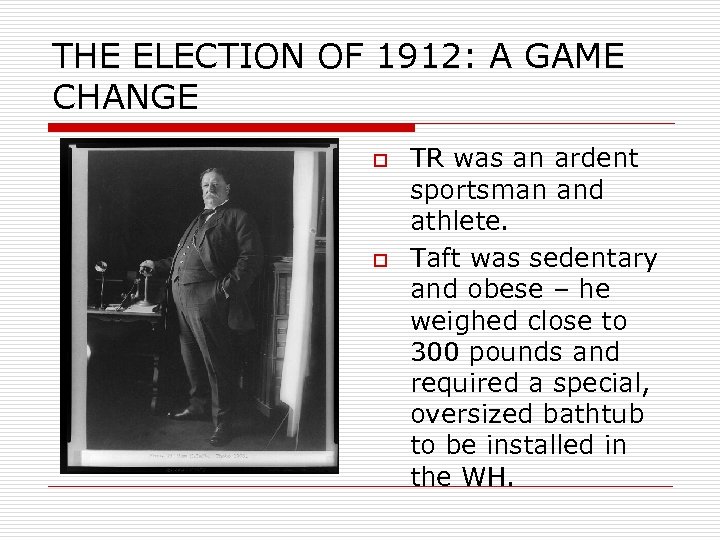 THE ELECTION OF 1912: A GAME CHANGE o o TR was an ardent sportsman and athlete. Taft was sedentary and obese – he weighed close to 300 pounds and required a special, oversized bathtub to be installed in the WH.
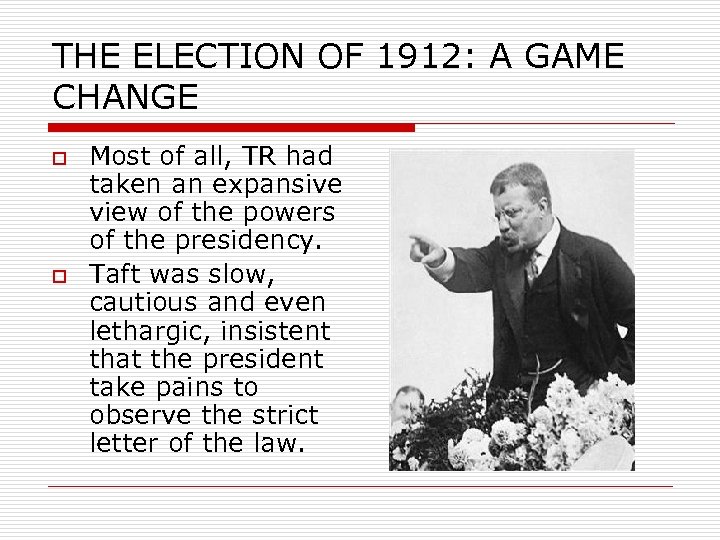 THE ELECTION OF 1912: A GAME CHANGE o o Most of all, TR had taken an expansive view of the powers of the presidency. Taft was slow, cautious and even lethargic, insistent that the president take pains to observe the strict letter of the law.
 THE ELECTION OF 1912: A GAME CHANGE o o Yet even had Taft been the most dynamic of presidents, he would still have had difficulties. o o Having come into office as the darling of progressives and conservatives alike, he soon found that he could not please them both. o o He found himself, without really intending, pleasing the conservatives and alienating the progressives. o TR saw Taft’s actions as president as a betrayal of his progressives policies. Compounding Taft’s problems with progressive Republicans was the overwhelming party loss in the congressional elections of 1910. For the first time in the 20 th century Democrats controlled the Ho. R. TR was out of the country in 1910. But he would return intent on securing the Republican nomination.
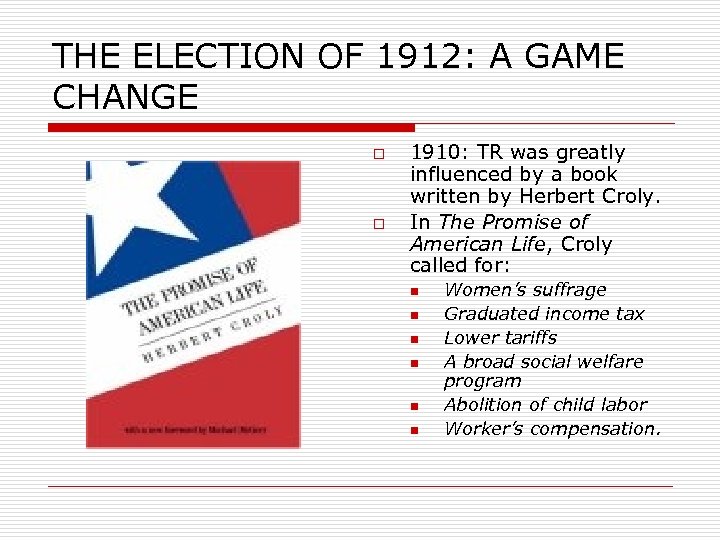 THE ELECTION OF 1912: A GAME CHANGE o o 1910: TR was greatly influenced by a book written by Herbert Croly. In The Promise of American Life, Croly called for: n n n Women’s suffrage Graduated income tax Lower tariffs A broad social welfare program Abolition of child labor Worker’s compensation.
 THE ELECTION OF 1912: A GAME CHANGE o o The battle for the Republican Party involved Taft, TR and Robert La. Follette of Wiscosin. La. Follette had been working for the nomination for sometime. Because of this TR was reluctant to enter the race. But in Feb. 1912, exhausted and distraught over his daughter’s illness, La. Follette appeared to have a breakdown during a speech in Phil. Many of his followers abandoned him and turned to TR who announced his candidacy on 2/22.
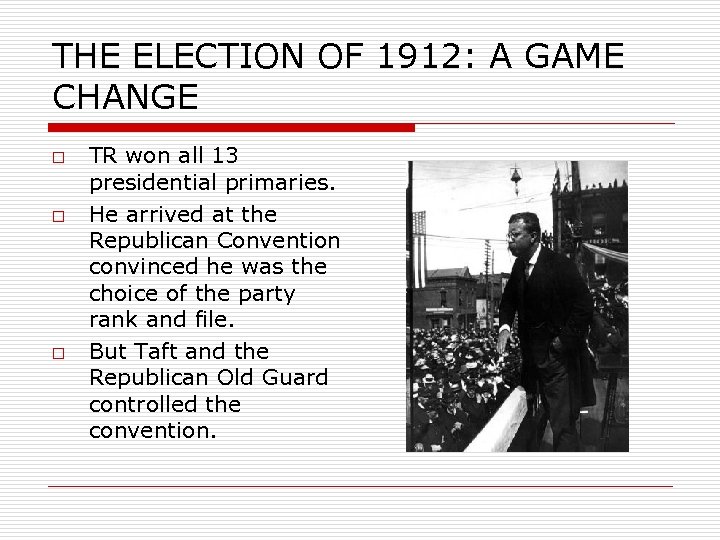 THE ELECTION OF 1912: A GAME CHANGE o o o TR won all 13 presidential primaries. He arrived at the Republican Convention convinced he was the choice of the party rank and file. But Taft and the Republican Old Guard controlled the convention.
 THE ELECTION OF 1912: A GAME CHANGE o o o The battle at the convention revolved around 254 contested delegates. TR needed fewer than half to secure the nomination. But the Old Guard awarded all but 19 of them to Taft. o o o At a rally at night, TR told an audience of 5, 000 supporters that if the convention refused to seat his delegates, he would continue his fight outside the party. The next day, he led his supporters out of the convention and out of the party. The remaining delegates then nominated Taft.
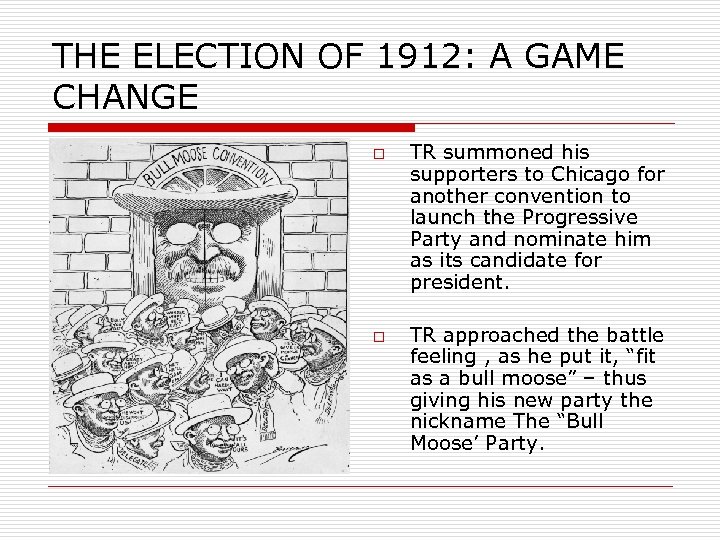 THE ELECTION OF 1912: A GAME CHANGE o o TR summoned his supporters to Chicago for another convention to launch the Progressive Party and nominate him as its candidate for president. TR approached the battle feeling , as he put it, “fit as a bull moose” – thus giving his new party the nickname The “Bull Moose’ Party.
 THE ELECTION OF 1912: A GAME CHANGE o o o But by then, he was aware that his cause was virtually impossible. That was because many of the insurgents who had supported him during the primaries refused to follow him out of the Republican Party. It was also because of the man the Democrats nominated Woodrow Wilson.
 THE ELECTION OF 1912: A GAME CHANGE. o o o The 1912 presidential contest was not simply one between conservatives and reformers. It was also one between two brands of progressivism, expressing two different views of America’s future. And it matched the two most important national leaders of the early 20 th century.
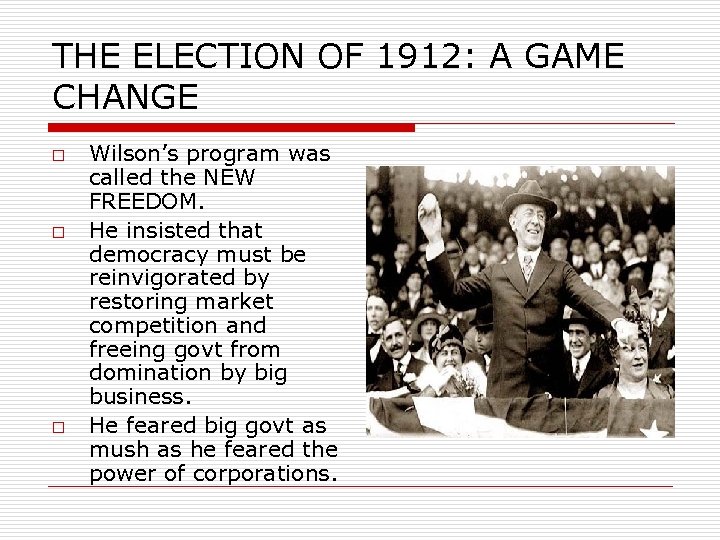 THE ELECTION OF 1912: A GAME CHANGE o o o Wilson’s program was called the NEW FREEDOM. He insisted that democracy must be reinvigorated by restoring market competition and freeing govt from domination by big business. He feared big govt as mush as he feared the power of corporations.
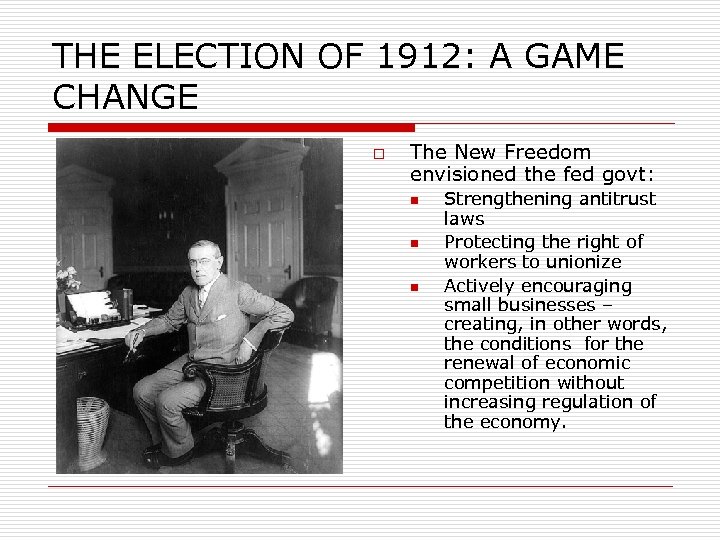 THE ELECTION OF 1912: A GAME CHANGE o The New Freedom envisioned the fed govt: n n n Strengthening antitrust laws Protecting the right of workers to unionize Actively encouraging small businesses – creating, in other words, the conditions for the renewal of economic competition without increasing regulation of the economy.
 THE ELECTION OF 1912: A GAME CHANGE o o TR’s program the NEW NATIONALISM. TR’s program insisted that only controlling and directing the power of the govt could restore the liberty of the oppressed. o He called for: n n Heavy taxes on personal and corporate fortunes Federal regulation of industries, including railroads, mining, and oil.
 THE ELECTION OF 1912: A GAME CHANGE o o The Progressive Party platform was drafted by labor reformers, settlement-house activists, and social scientists. It was a blueprint for a modern, democratic welfare state. o It called for: n n Women’s suffrage Federal supervision of corporate enterprise National labor and health legislation for women and children A system of social insurance covering unemployment, medical care, and old age.
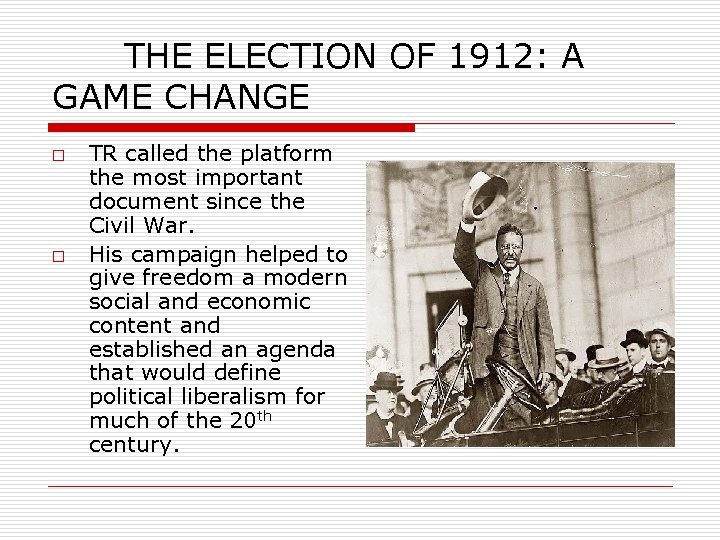 THE ELECTION OF 1912: A GAME CHANGE o o TR called the platform the most important document since the Civil War. His campaign helped to give freedom a modern social and economic content and established an agenda that would define political liberalism for much of the 20 th century.
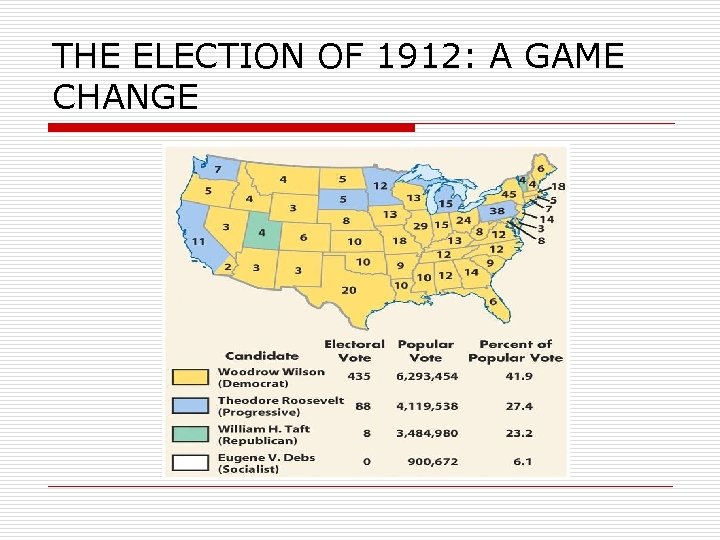 THE ELECTION OF 1912: A GAME CHANGE
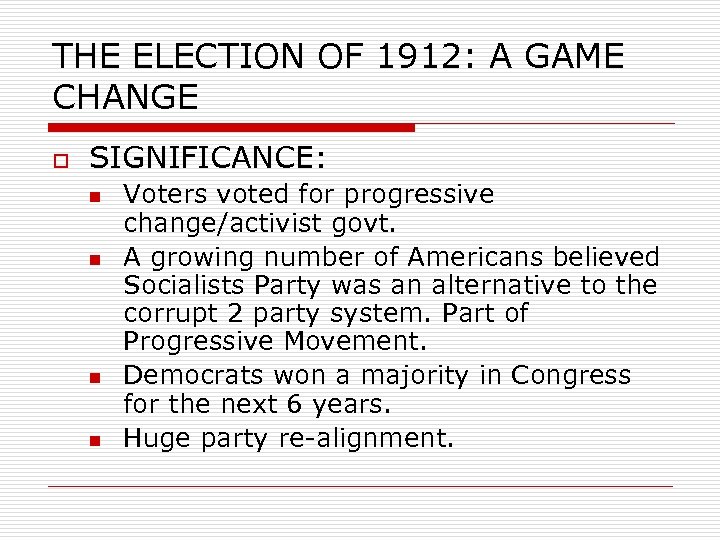 THE ELECTION OF 1912: A GAME CHANGE o SIGNIFICANCE: n n Voters voted for progressive change/activist govt. A growing number of Americans believed Socialists Party was an alternative to the corrupt 2 party system. Part of Progressive Movement. Democrats won a majority in Congress for the next 6 years. Huge party re-alignment.
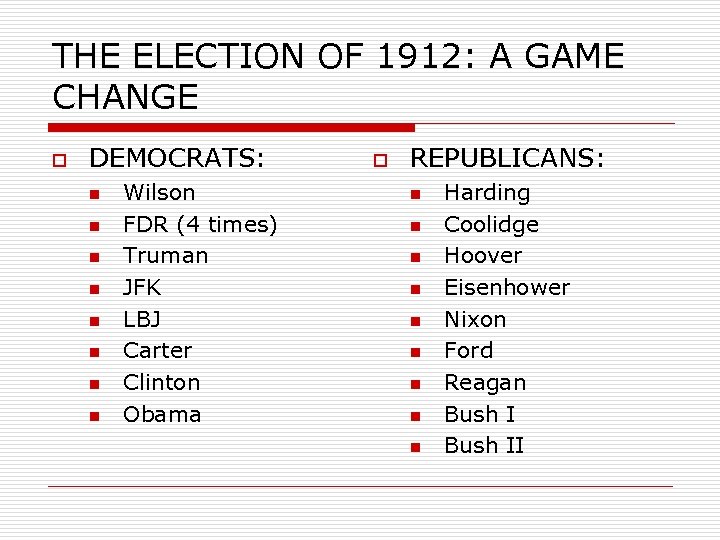 THE ELECTION OF 1912: A GAME CHANGE o DEMOCRATS: n n n n Wilson FDR (4 times) Truman JFK LBJ Carter Clinton Obama o REPUBLICANS: n n n n n Harding Coolidge Hoover Eisenhower Nixon Ford Reagan Bush II
 THE ELECTION OF 1912: A GAME CHANGE
 RACE AND THE PROGRESSIVE MOVEMENT
 RACE AND THE PROGRESSIVE MOVEMENT o o o By far the largest non-white group, African-Americans were excluded from the Progressive Movement. After their disenfranchisement in the south, few could participate in American democracy. Barred from joining unions and from skilled employment, black workers had little access to “industrial freedom. ”
 RACE AND THE PROGRESSIVE MOVEMENT o o A majority of black women worked outside the home, but for wages that offered no hope of independence. Predominately domestic and agricultural workers, they remained unaffected by the era’s laws regulating the hours and conditions of female labor. o Nor could blacks, the majority desperately poor, participate fully in the emerging consumer economy, either as employees in the new department stores (except as janitors and cleaning women) or as purchasers of the consumer goods now flooding the marketplace.
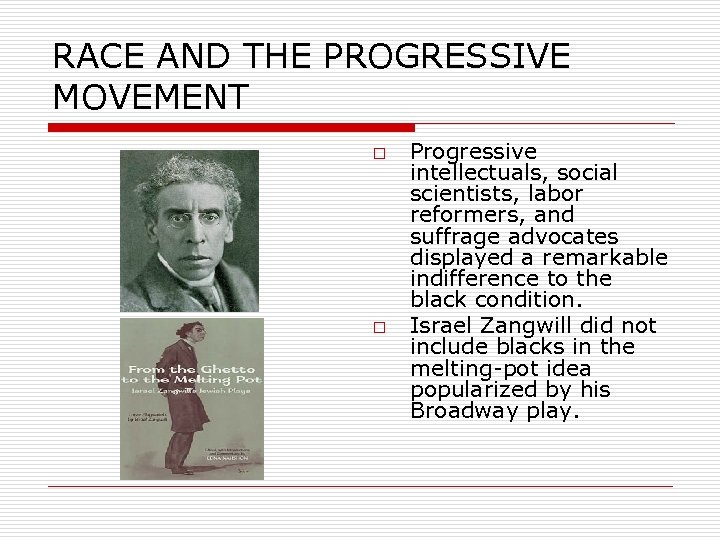 RACE AND THE PROGRESSIVE MOVEMENT o o Progressive intellectuals, social scientists, labor reformers, and suffrage advocates displayed a remarkable indifference to the black condition. Israel Zangwill did not include blacks in the melting-pot idea popularized by his Broadway play.
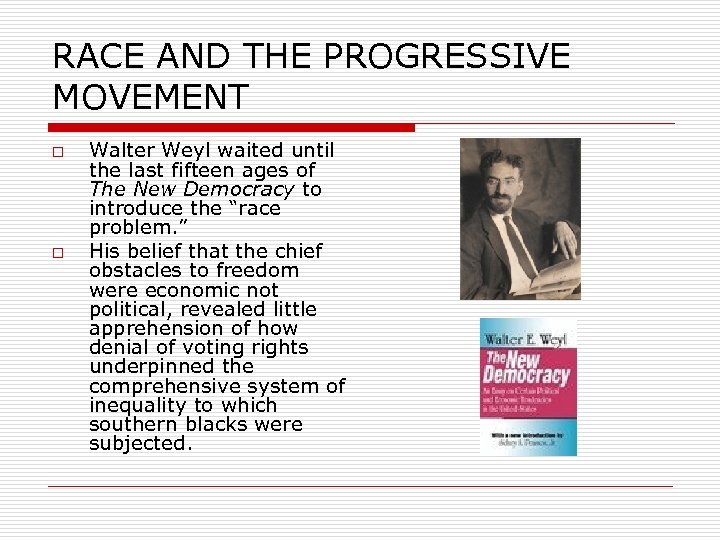 RACE AND THE PROGRESSIVE MOVEMENT o o Walter Weyl waited until the last fifteen ages of The New Democracy to introduce the “race problem. ” His belief that the chief obstacles to freedom were economic not political, revealed little apprehension of how denial of voting rights underpinned the comprehensive system of inequality to which southern blacks were subjected.
 RACE AND THE PROGRESSIVE MOVEMENT o o o Most settlement house reformers accepted segregation as natural and equitable, assuming there would be white settlements for white neighborhoods and black settlements for black. White leaders of the women’s suffrage movement said little about black disenfranchisement. In the South, upper-class white club women sometimes raised funds for black schools. But suffrage leaders insisted that the vote was a racial entitlement, a “badge and synonym of freedom, ” that should not be denied to “free-born white women. ”
 RACE AND THE PROGRESSIVE MOVEMENT o o During Reconstruction, women had been denied constitutional recognition because it was “the Negro’s hour. ” Now WWI’s “women’s hour” excluded blacks. The amendment that achieved women’s suffrage left the states free to limit voting by poll taxes and literacy tests. Living in the South, the vast majority of the nation’s black women did not enjoy its benefits.
 TR, WILSON AND RACE
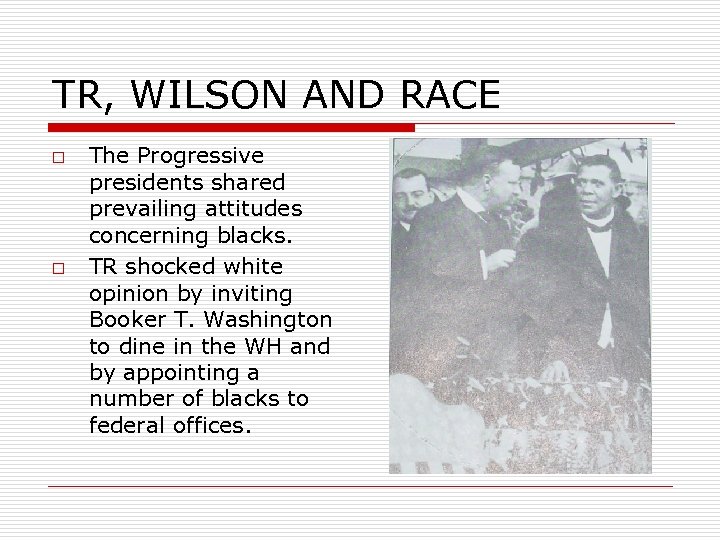 TR, WILSON AND RACE o o The Progressive presidents shared prevailing attitudes concerning blacks. TR shocked white opinion by inviting Booker T. Washington to dine in the WH and by appointing a number of blacks to federal offices.
 TR, WILSON AND RACE o o But in 1906, when a small group of black soldiers shot off their guns in Brownsville, TX, killing one resident, and none of their fellows would name them. TR ordered the dishonorable discharge of three black companies – 156 men in all, including 6 winners of the Congressional Medal of Honor. o TR’s ingrained belief in Anglo-Saxon racial destiny (he called Indians “savages” and blacks “wholly unfit for the suffrage”) did nothing to lessen Progressive intellectuals’ enthusiasm for the New Nationalism.
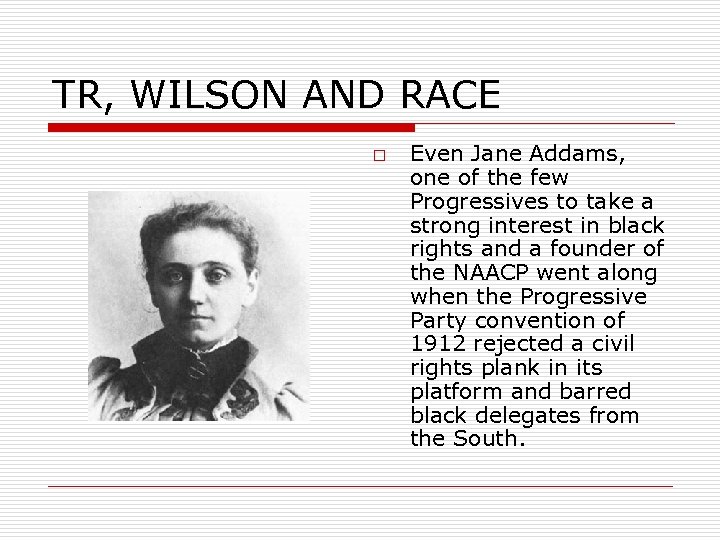 TR, WILSON AND RACE o Even Jane Addams, one of the few Progressives to take a strong interest in black rights and a founder of the NAACP went along when the Progressive Party convention of 1912 rejected a civil rights plank in its platform and barred black delegates from the South.
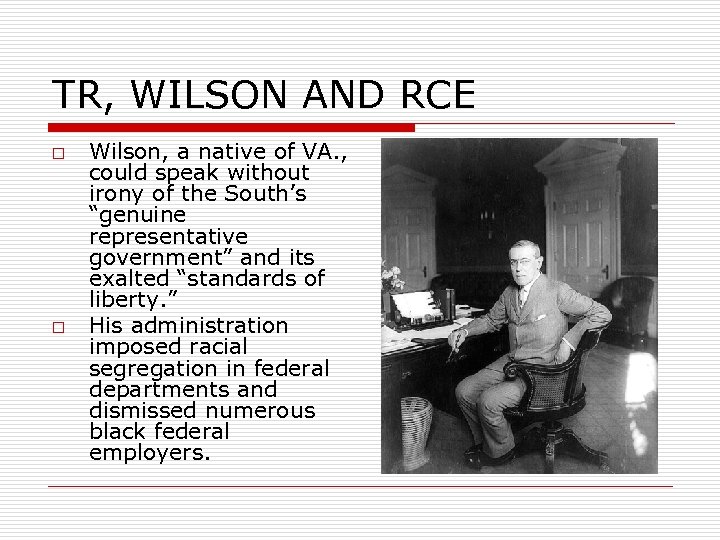 TR, WILSON AND RCE o o Wilson, a native of VA. , could speak without irony of the South’s “genuine representative government” and its exalted “standards of liberty. ” His administration imposed racial segregation in federal departments and dismissed numerous black federal employers.
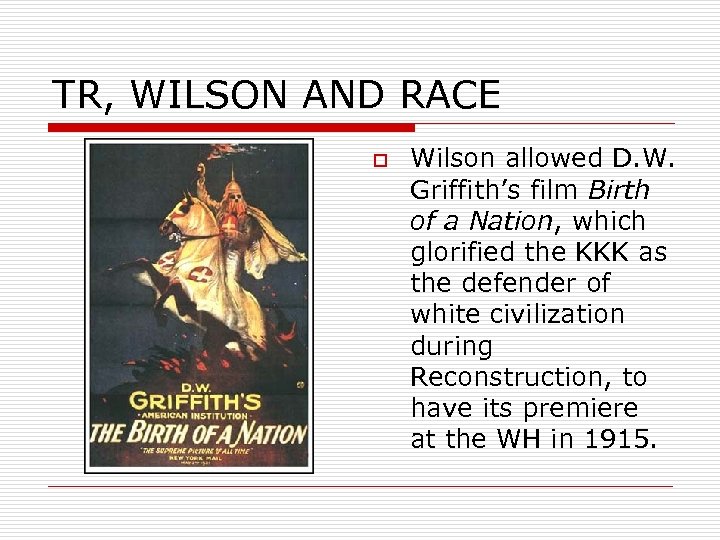 TR, WILSON AND RACE o Wilson allowed D. W. Griffith’s film Birth of a Nation, which glorified the KKK as the defender of white civilization during Reconstruction, to have its premiere at the WH in 1915.
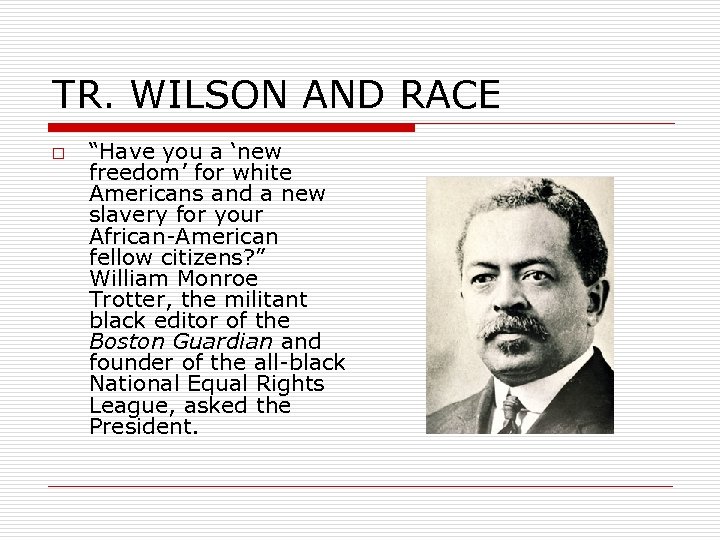 TR. WILSON AND RACE o “Have you a ‘new freedom’ for white Americans and a new slavery for your African-American fellow citizens? ” William Monroe Trotter, the militant black editor of the Boston Guardian and founder of the all-black National Equal Rights League, asked the President.
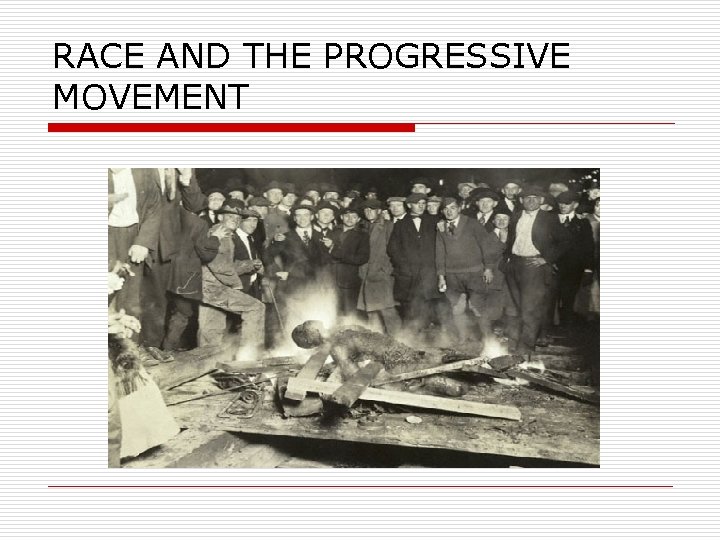
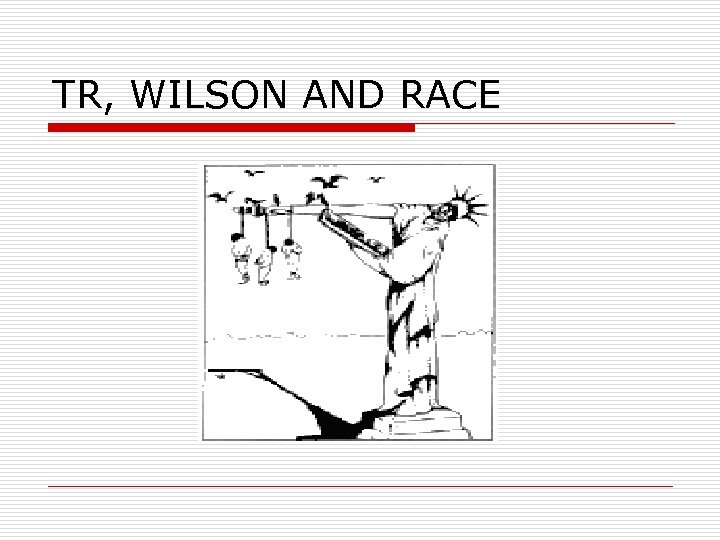
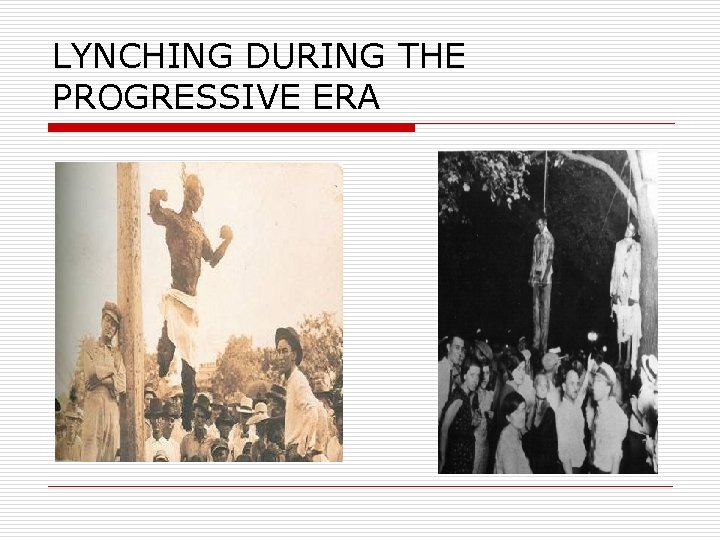
 TR, WILSON AND RACE o o Blacks subject to disenfranchisement and segregation were understandably skeptical of the nation’s claim to embody freedom and fully appreciated the ways the symbols of liberty could coexist brutal racial violence. In one of hundreds of lynchings during the Progressive era, a white mob in Springfield, Missouri, in 1906 falsely accused three black men of rape, hanged them from an electric light pole, and burned their bodies in a public orgy of violence. Atop the pole stood a replica of the Statue of Liberty.
 W. E. B DU BOIS AND THE REVIVAL OF BLACK PROTEST
 W. E. B. DU BOIS AND THE REVIVAL OF BLACK PROTEST o o Black leaders struggled to find a strategy to rekindle the national commitment to equality that had flickered brightly, if briefly, during Reconstruction. No one thought more deeply, or over so long a period, about the black condition and the challenge it posed to American democracy than the scholar and activist W. E. B. Du Bois.
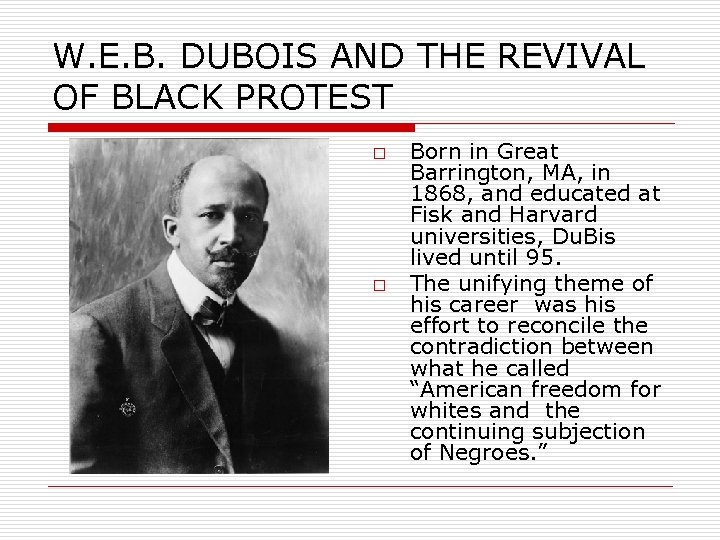 W. E. B. DUBOIS AND THE REVIVAL OF BLACK PROTEST o o Born in Great Barrington, MA, in 1868, and educated at Fisk and Harvard universities, Du. Bis lived until 95. The unifying theme of his career was his effort to reconcile the contradiction between what he called “American freedom for whites and the continuing subjection of Negroes. ”
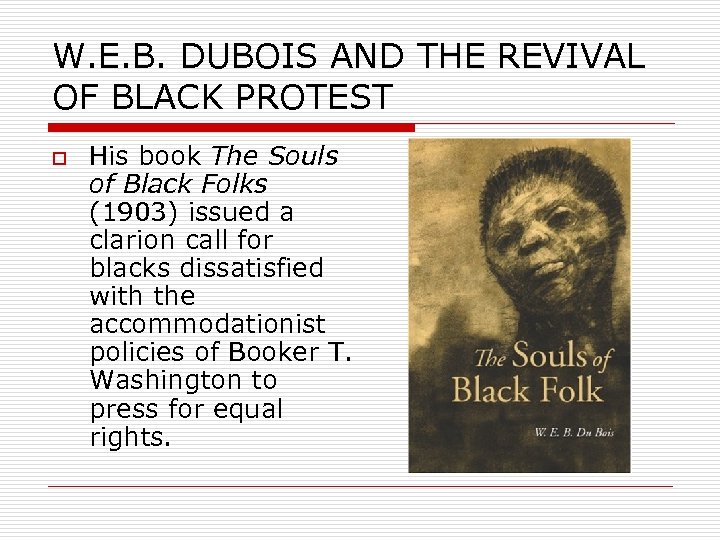 W. E. B. DUBOIS AND THE REVIVAL OF BLACK PROTEST o His book The Souls of Black Folks (1903) issued a clarion call for blacks dissatisfied with the accommodationist policies of Booker T. Washington to press for equal rights.
 W. E. B. DU BOIS AND THE REVIVAL OF BLACK PROTEST o o Du Bois believed that educated African-Americans like himself – the “talented tenth” of the black community – must use their education and training to challenge inequality. In some ways, he was a typical Progressive who believed that investigation, exposure and education would lead to solutions for social problems. As a professor at Atlanta University, he projected a grandiose plan for decades of scholarly study of black life in order to make the country aware of racism and point the way toward its elimination. But he also understood the necessity of political action.
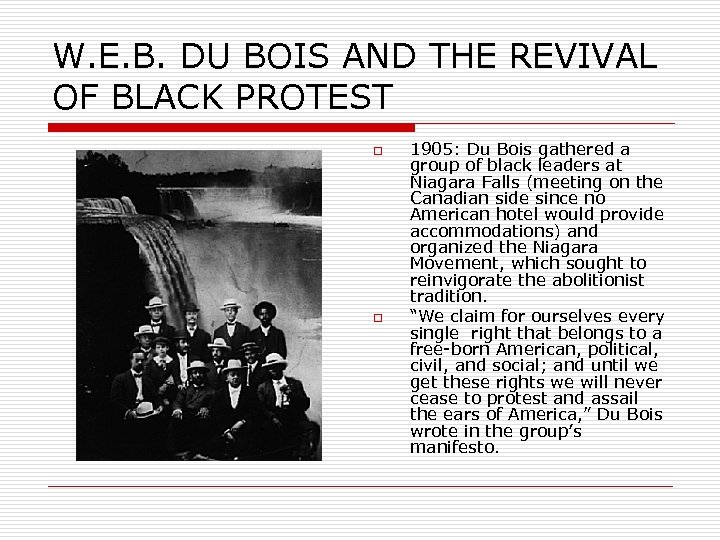 W. E. B. DU BOIS AND THE REVIVAL OF BLACK PROTEST o o 1905: Du Bois gathered a group of black leaders at Niagara Falls (meeting on the Canadian side since no American hotel would provide accommodations) and organized the Niagara Movement, which sought to reinvigorate the abolitionist tradition. “We claim for ourselves every single right that belongs to a free-born American, political, civil, and social; and until we get these rights we will never cease to protest and assail the ears of America, ” Du Bois wrote in the group’s manifesto.
 W. E. B. DU BOIS AND THE REVIVAL OF BLACK PROTEST o The Declaration of Principles adopted at Niagara Falls called for: n n Restoring to blacks the right to vote An end to segregation Complete equality in economic and educational opportunity. These principles would remain the cornerstone of the black struggle for racial justice for decades to come.
 W. E. B. DU BOIS AND THE REVIVAL OF BLACK PROTEST o o 1909: Du Bois joined a group of white reformers shocked by a lynching in Springfield, Ill (Lincoln’s adult home), to create the National Association for the Advancement of Colored People (NAACP). The NAACP launched a long struggle for the enforcement of the XIV and XV Amendments.
 W. E. B. DU BOIS AND THE REVIVAL OF BLACK PROTEST o o o The NAACP’s legal strategy won a few victories. In Bailey v. Alabama (1911), the S. C. , overturned southern “peonage” laws that made it a crime for sharecroppers to break their labor contracts. 1917: The S. C. , ruled unconstitutional a Louisville zoning regulation excluding blacks from living in certain parts of the city (primarily because it interfered with whites’ right to sell their property as they saw fit).
 W. E. B. DU BOIS AND THE REVIVAL OF BLACK PROTEST o o o Overall, however, the Progressive era witnessed virtually no progress toward racial justice. At a time when Americans’ rights were being reformualted, blacks, said Moorfield Story, the NAACP’s president, enjoyed a “curious citizenship. ” They shared obligations like military service, but not the “fundamental rights to which all men are entitled unless we rupdiate…the Declaration of Independence. ”
 RACE AND WORLD WAR ONE
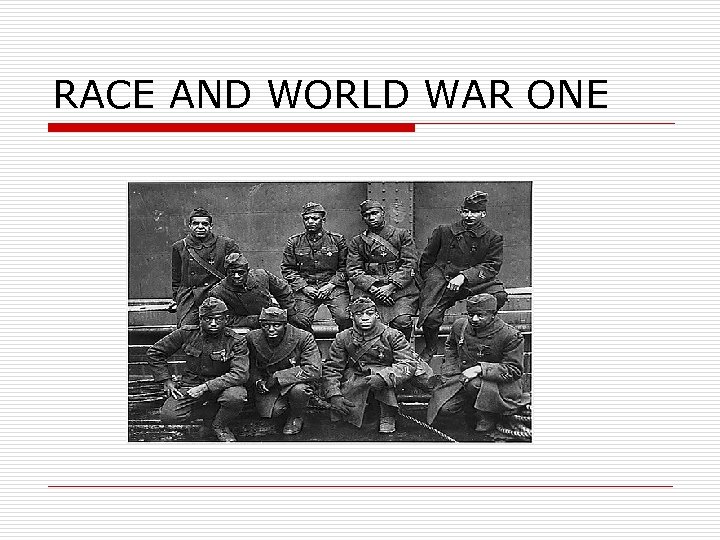
 RACE AND WORLD WAR ONE o o Among black Americans, the wartime language of freedom inspired hopes for a radical change in the country’s racial system. With the notable exception of William Monroe Trotter, most black leaders saw American participation in the war as an opportunity to make real the promise of freedom.
 RACE AND WORLD WAR ONE o To Trotter, muchpublicized German atrocities were no worse than American lynchings; rather than making the world safe for democracy, he argued, the government should worry about “making the South safe for Negroes. ” o o Yet the black press rallied to the war. Du Bois, himself, in a widely reprinted editorial in the NAACP’s monthly magazine The Crisis, called on African. Americans to “close ranks” and enlist in the army, to help “make our own America a real land of the free. ”
 RACE AND WORLD WAR ONE o o o Black participation in the Civil War had helped to secure the destruction of slavery. But during World War I, closing ranks did not bring significant gains. The navy barred blacks entirely and he segregated army confined most of the 400, 000 blacks who served in the war to supply units rather than combat.
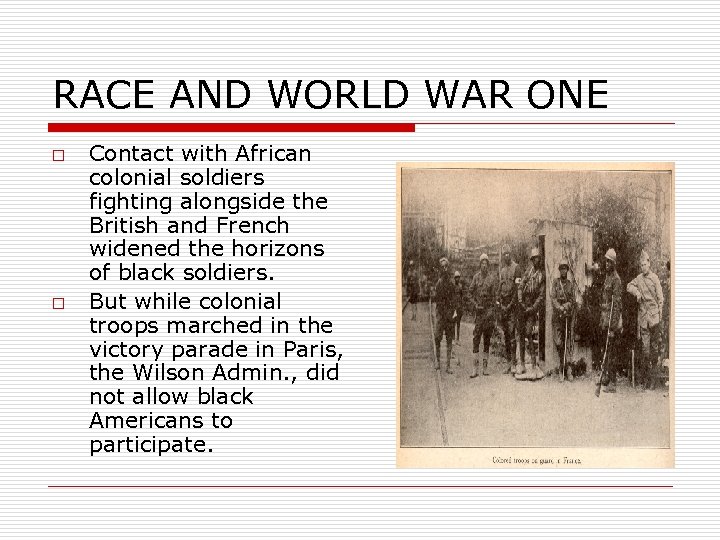 RACE AND WORLD WAR ONE o o Contact with African colonial soldiers fighting alongside the British and French widened the horizons of black soldiers. But while colonial troops marched in the victory parade in Paris, the Wilson Admin. , did not allow black Americans to participate.
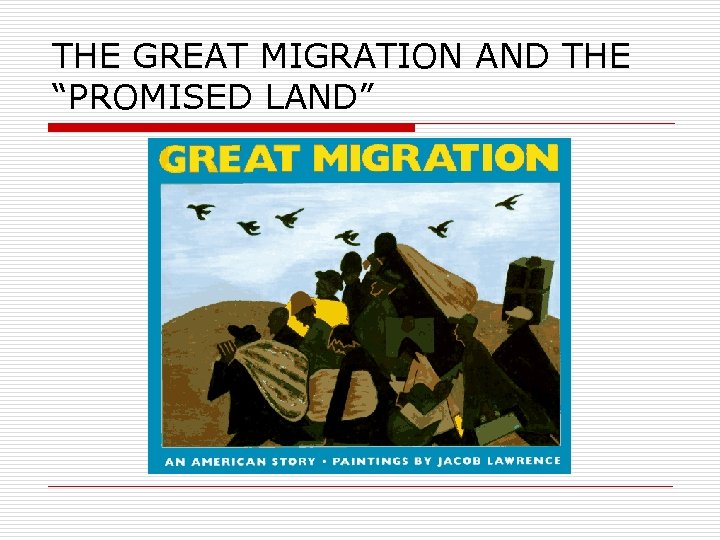 THE GREAT MIGRATION AND THE “PROMISED LAND”
 THE GREAT MIGRATION AND THE “PROMISED LAND” o o o World War I unleashed social changes that altered the contours of American race relations. The combination of increased wartime production opened thousands of industrial jobs to black laborers for the first time, inspiring a large-scale migration from South to North. On the eve of WWI, 90% of the African. American population still lived in the South.
 THE GREAT MIGRATION AND THE “PRMISED LAND” o o o Most northern cities had tiny black populations. Domestic and service work still predominated among black men and women in the North. 1910 -1920: Half a million blacks left the South. o Northern cities: n n n Chicago: Black population more than doubled. NYC: Black population rose 66% Smaller industrial cities like Akron, Buffalo, and Trenton showed similar gains.
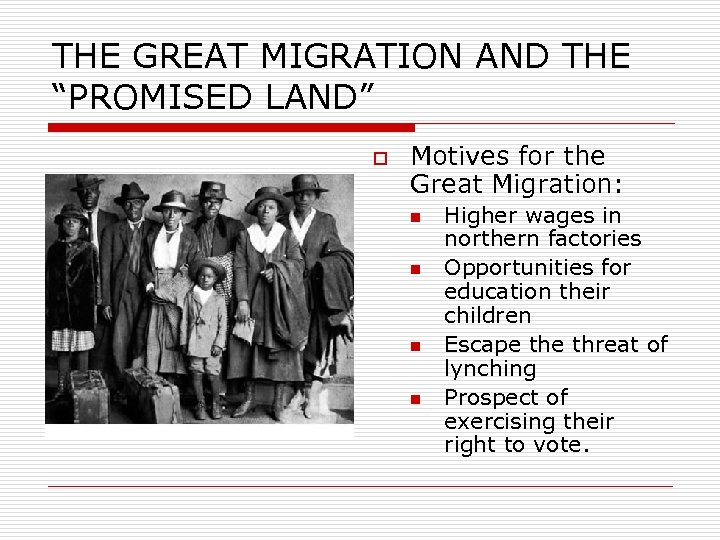 THE GREAT MIGRATION AND THE “PROMISED LAND” o Motives for the Great Migration: n n Higher wages in northern factories Opportunities for education their children Escape threat of lynching Prospect of exercising their right to vote.
 THE GREAT MIGRATION AND THE “PROMISED LAND” o o Migrants spoke of a Second Emancipation, of “crossing over Jordan, ” and of leaving the realm of pharaoh for the Promised Land. One group from Mississippi stopped to sing, “I am bound for the land of Canaan, ” after their train crossed the Ohio River into the North.
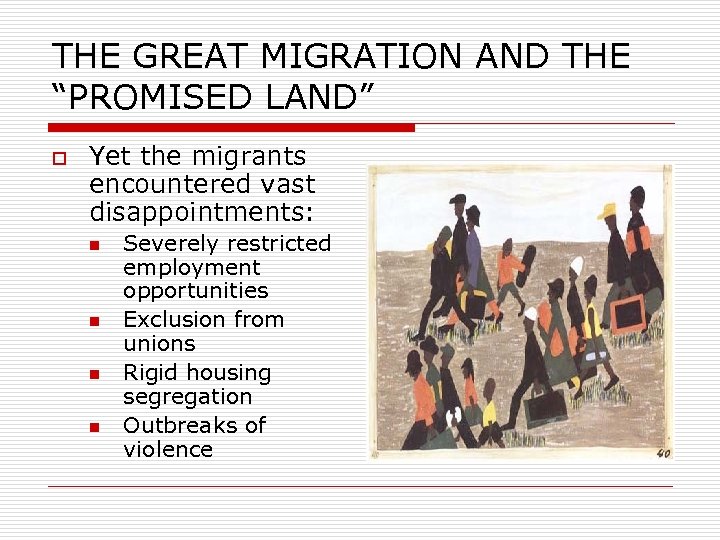 THE GREAT MIGRATION AND THE “PROMISED LAND” o Yet the migrants encountered vast disappointments: n n Severely restricted employment opportunities Exclusion from unions Rigid housing segregation Outbreaks of violence
 THE GREAT MIGRATION AND THE “PROMISED LAND” o o More white southerners than blacks moved north during the war, often with similar economic aspirations. But the new black presence, coupled with demands for change inspired by the war, created a racial tinderbox that needed only an incident to trigger an explosion.
 THE RED SUMMER OF 1919
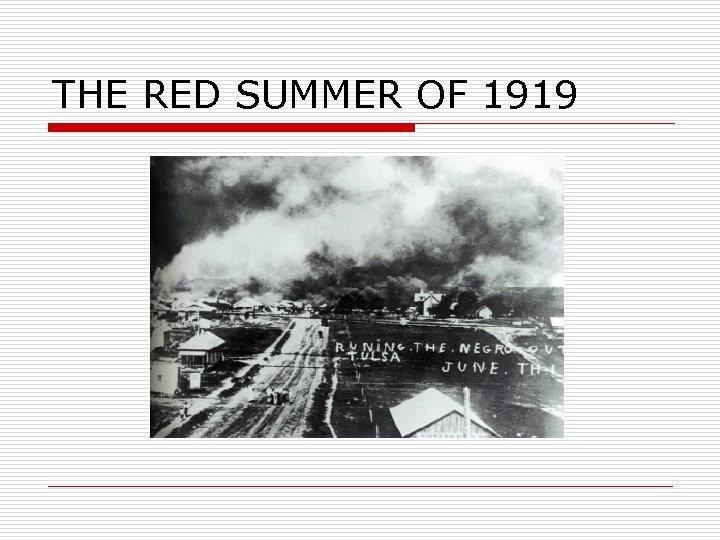
 THE RED SUMMER OF 1919 o o o The summer of 1919 witnessed a number of race riots in the south and north. The nation’s capital also witnessed a race riot where several black and white residents were killed. The violence was so strong that the summer of 1919 was dubbed the Red Summer of 1919.
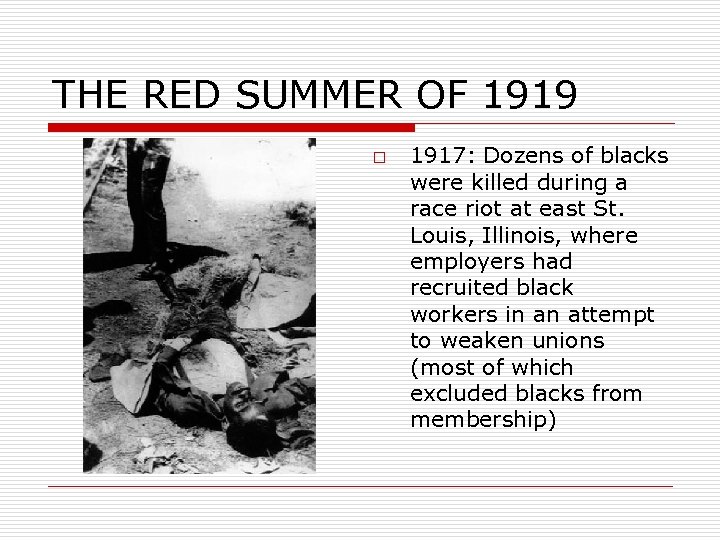 THE RED SUMMER OF 1919 o 1917: Dozens of blacks were killed during a race riot at east St. Louis, Illinois, where employers had recruited black workers in an attempt to weaken unions (most of which excluded blacks from membership)
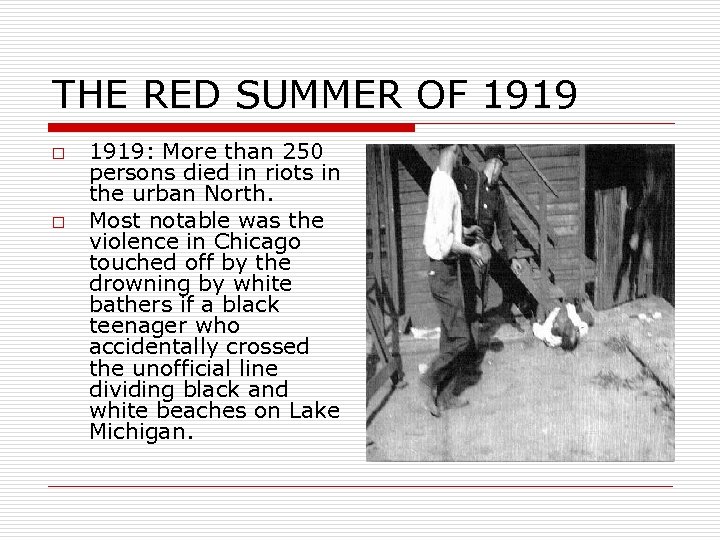 THE RED SUMMER OF 1919 o o 1919: More than 250 persons died in riots in the urban North. Most notable was the violence in Chicago touched off by the drowning by white bathers if a black teenager who accidentally crossed the unofficial line dividing black and white beaches on Lake Michigan.
 THE RED SUMMER OF 1919 o o The riot that followed lasted 5 days and involved pitched battles between the races throughout the city. By the time the National Guard restored order, 38 persons (23 black, 15 white) had been killed; 520 seriously wounded; over 1, 000 left homeless.
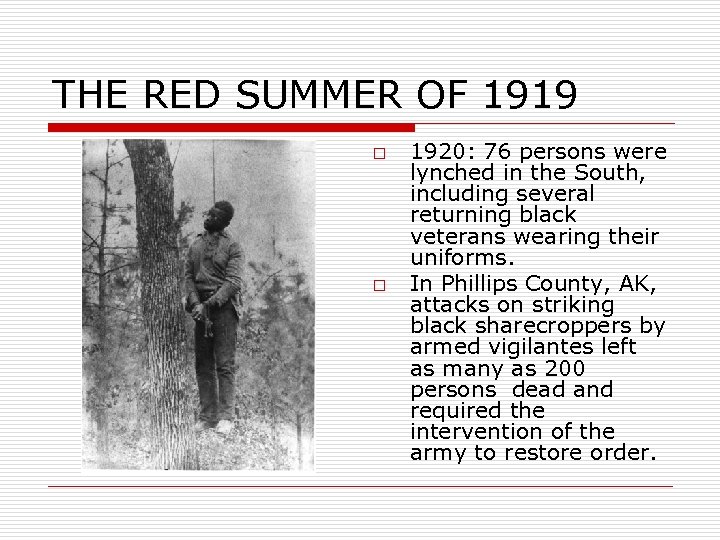 THE RED SUMMER OF 1919 o o 1920: 76 persons were lynched in the South, including several returning black veterans wearing their uniforms. In Phillips County, AK, attacks on striking black sharecroppers by armed vigilantes left as many as 200 persons dead and required the intervention of the army to restore order.
 THE TULSA RACE RIOT 1921
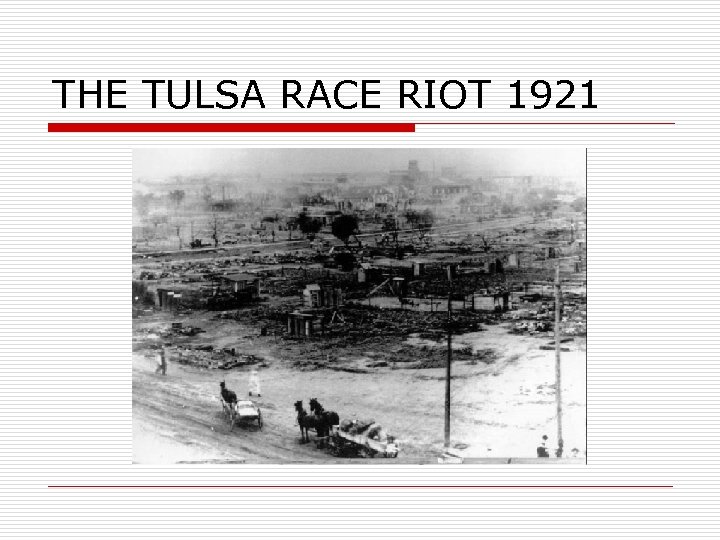
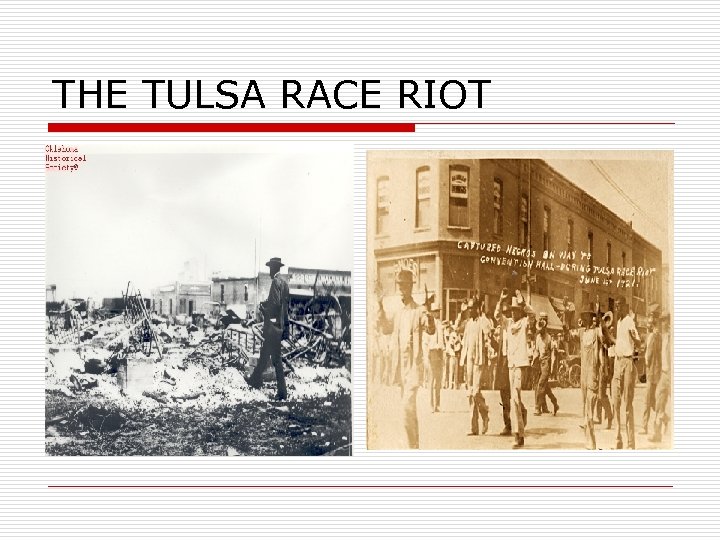
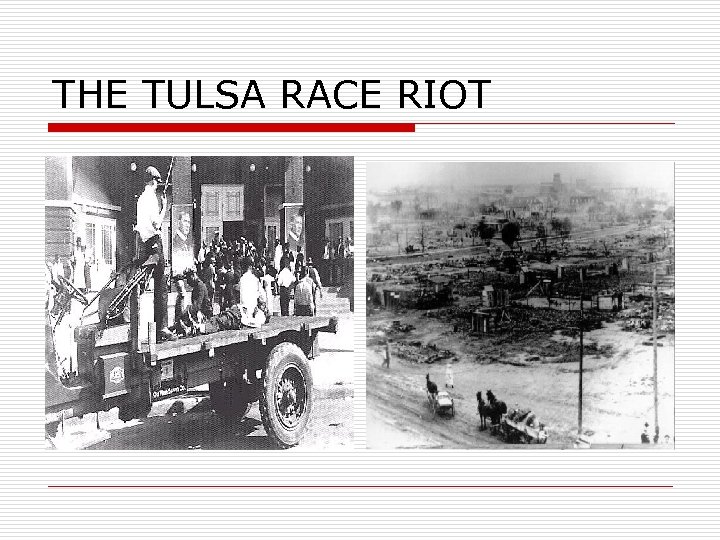
 THE TULSA RACE RIOT 1921 o o The worst race riot in American history occurred in Tulsa, OK, in 1921. More than 300 blacks were killed and over 10, 000 left homeless after a white mob, including police and National Guardsmen, burned an allblack section of the city to the ground.
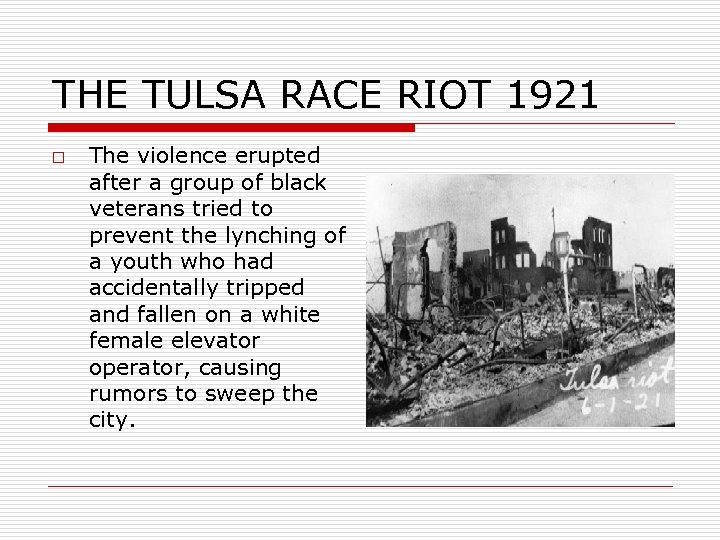 THE TULSA RACE RIOT 1921 o The violence erupted after a group of black veterans tried to prevent the lynching of a youth who had accidentally tripped and fallen on a white female elevator operator, causing rumors to sweep the city.
 THE TULSA RACE RIOT
 THE TULSA RACE RIOT
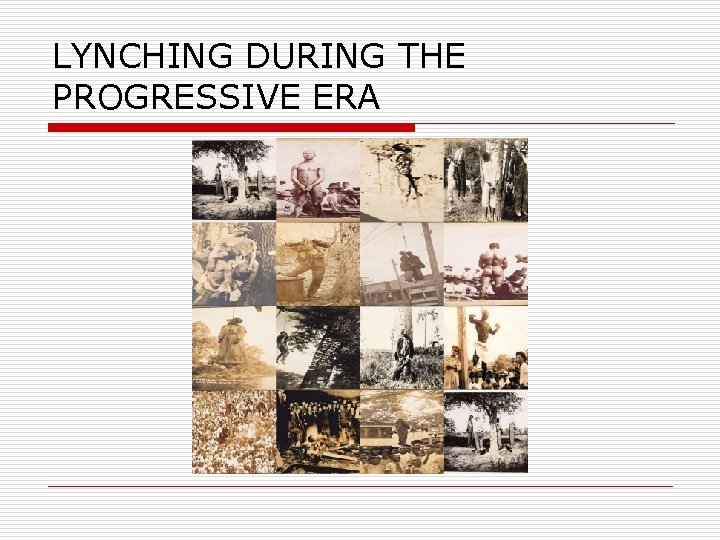 LYNCHING DURING THE PROGRESSIVE ERA
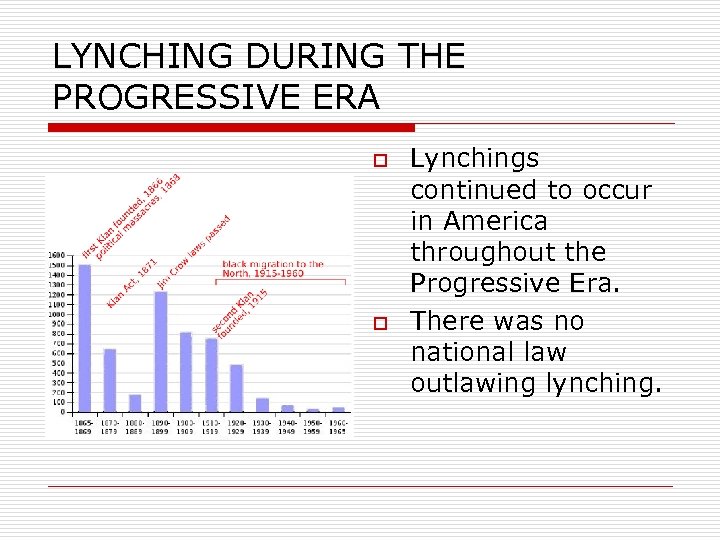 LYNCHING DURING THE PROGRESSIVE ERA o o Lynchings continued to occur in America throughout the Progressive Era. There was no national law outlawing lynching.
 LYNCHING DURING THE PROGRESSIVE ERA
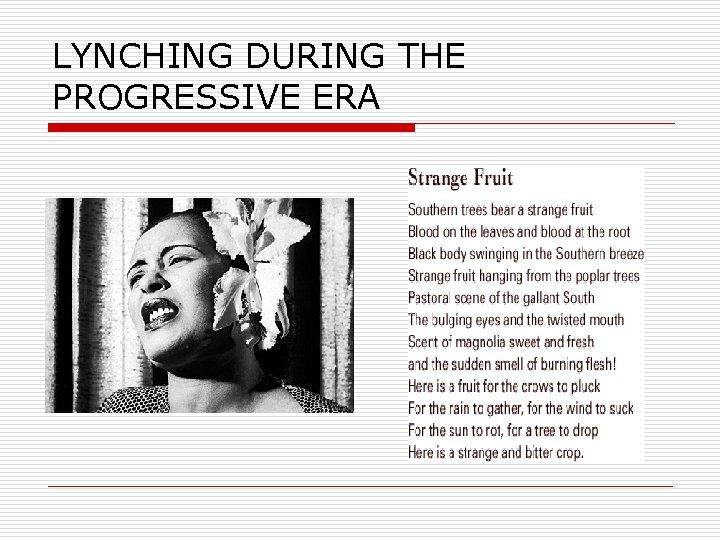 LYNCHING DURING THE PROGRESSIVE ERA
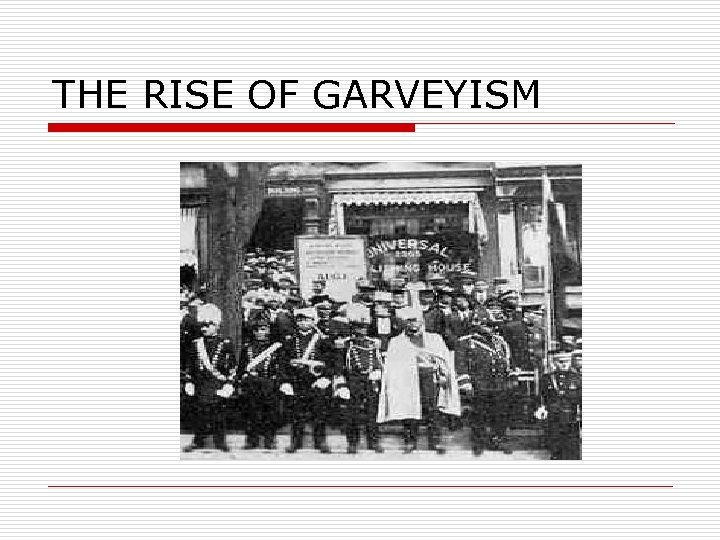 THE RISE OF GARVEYISM
 THE RISE OF GARVEYISM o In the densely populated black ghettoes of the North, widespread support emerged for the Universal Negro Improvement Association. o This was a movement for African independence and black self-reliance launched Marcus Garvey, a recent immigrant from Jamaica
 THE RISE OF GARVEYISM o o Freedom for Garveyites meant national self-determination. Blacks, they insisted, should enjoy the same internationally recognized identity enjoyed by other peoples in the aftermath of World War I.
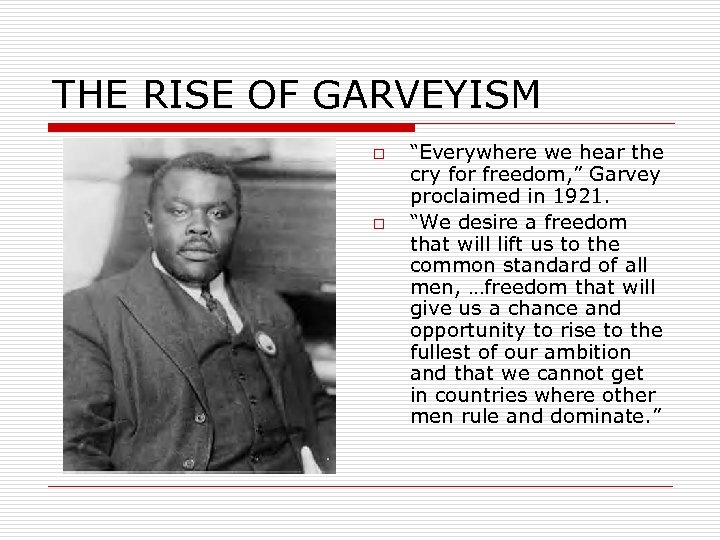 THE RISE OF GARVEYISM o o “Everywhere we hear the cry for freedom, ” Garvey proclaimed in 1921. “We desire a freedom that will lift us to the common standard of all men, …freedom that will give us a chance and opportunity to rise to the fullest of our ambition and that we cannot get in countries where other men rule and dominate. ”
 THE RISE OF GARVEYISM o o o Du Bois and other established black leaders viewed Garvey as little more than a demagogue. They applauded when the govt. , deported him after a conviction for mail fraud. But the massive following his movement achieved testified to the sense of betrayal that had been kindled in black communities during and after the Progressive Era.
 THE DARKER SIDE OF PROGRESSIVISM o o o Progressives were criticized for attempting to impose their middleclass WASP values on all of society. They often supported segregation of blacks to prevent social tensions. They became increasingly nativist, and supported harsh antiimmigration laws of the 1920 s. o o Progressive attempt to legislate morality led to the disastrous “prohibition experiment” in the 1920 s. Progressive trust in science led to the extreme practice of eugenics: attempt to eliminate crime, insanity and other defects through selective breeding. This also gave white supremacy the endorsement of science.