 Скачать презентацию The Elasticity Approach to Balance-of-Payments and Exchange-Rate Determination
683b29ccfb8390ade0e79ff4b6ec07da.ppt
- Количество слайдов: 28



The Elasticity Approach to Balance-of-Payments and Exchange-Rate Determination Daniels and Van. Hoose Elasticity Approach
Overview of the Elasticity Approach • The elasticity approach emphasizes price changes as a determinant of a nation’s balance of payments and exchange rate. • The elasticity approach is helpful in understanding the different outcomes that might arise from the short to long run. Daniels and Van. Hoose Elasticity Approach 2
Review of Elasticity • Price Elasticity of Demand is a measure of the responsiveness of quantity demanded to a change in price. • If quantity demanded is highly responsive to a change in price, then demand is said to be relatively elastic. • If quantity demanded is not very responsive to a change in price, then demand is said to be relatively inelastic. Daniels and Van. Hoose Elasticity Approach 3
The Effect of Exchange Rate Changes • The exchange rate is an important price to an economy. • When a nation’s currency depreciates, domestic goods become relatively cheaper and foreign goods relatively more expensive in the global market. • Hence, we would expect exports to rise and imports to decline. Daniels and Van. Hoose Elasticity Approach 4
The Responsiveness of Imports and Exports • The elasticity approach, therefore, considers the responsiveness of imports and exports to a change in the value of a nation’s currency. • For example, if import demand is highly elastic, a depreciation of the domestic currency will cause a disproportional decline in the nation’s imports. Daniels and Van. Hoose Elasticity Approach 5
Elasticity of Foreign Exchange Supply and Demand • A nation’s supply of foreign exchange is dependent upon (among other things) its import demand, e. g. when a nation imports, it supplies foreign exchange as payment. • A nation’s demand foreign exchange is dependent upon its export supply, e. g. when a nation exports, it demands foreign exchange as payment. Daniels and Van. Hoose Elasticity Approach 6
Surpluses and Deficits • An excess supply of foreign exchange is equivalent to a current account deficit. • An excess demand foreign exchange is equivalent to a current account surplus. • The current account is in balance when the quantity of foreign exchange supplied and quantity demanded are equal. Daniels and Van. Hoose Elasticity Approach 7
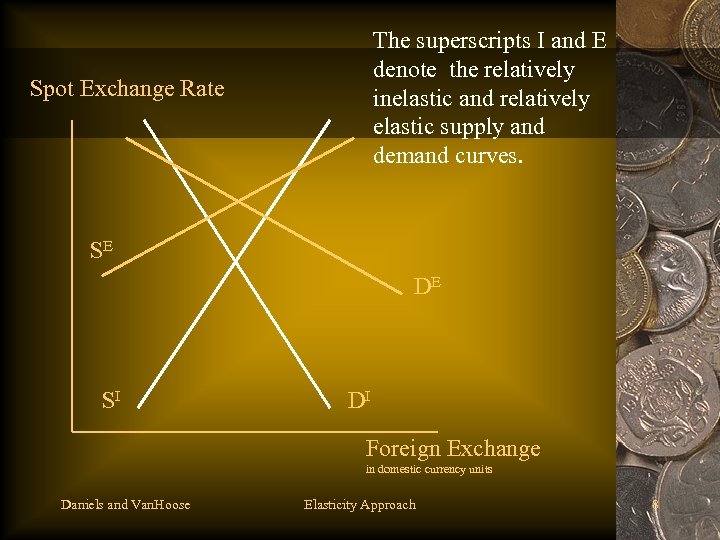
The superscripts I and E denote the relatively inelastic and relatively elastic supply and demand curves. Spot Exchange Rate SE DE SI DI Foreign Exchange in domestic currency units Daniels and Van. Hoose Elasticity Approach 8
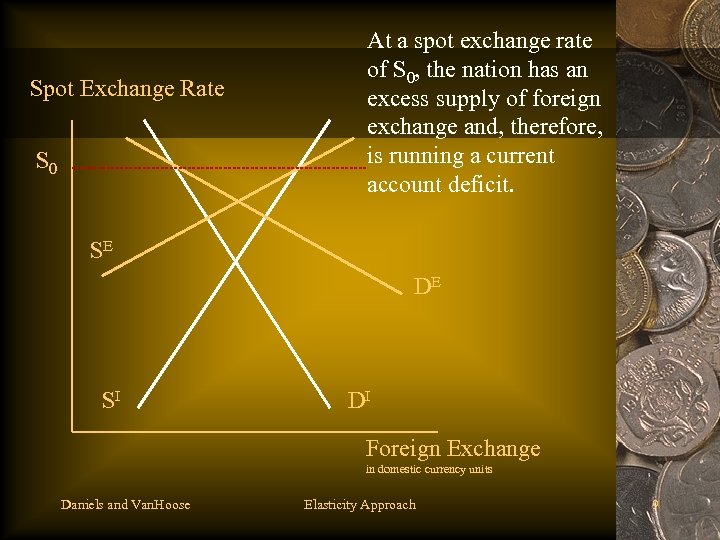
Spot Exchange Rate S 0 At a spot exchange rate of S 0, the nation has an excess supply of foreign exchange and, therefore, is running a current account deficit. SE DE SI DI Foreign Exchange in domestic currency units Daniels and Van. Hoose Elasticity Approach 9
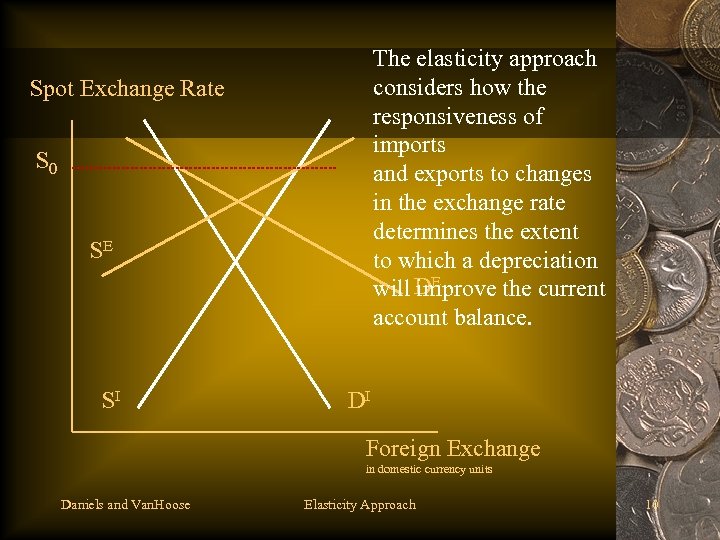
The elasticity approach considers how the responsiveness of imports and exports to changes in the exchange rate determines the extent to which a depreciation will DE improve the current account balance. Spot Exchange Rate S 0 SE SI DI Foreign Exchange in domestic currency units Daniels and Van. Hoose Elasticity Approach 10
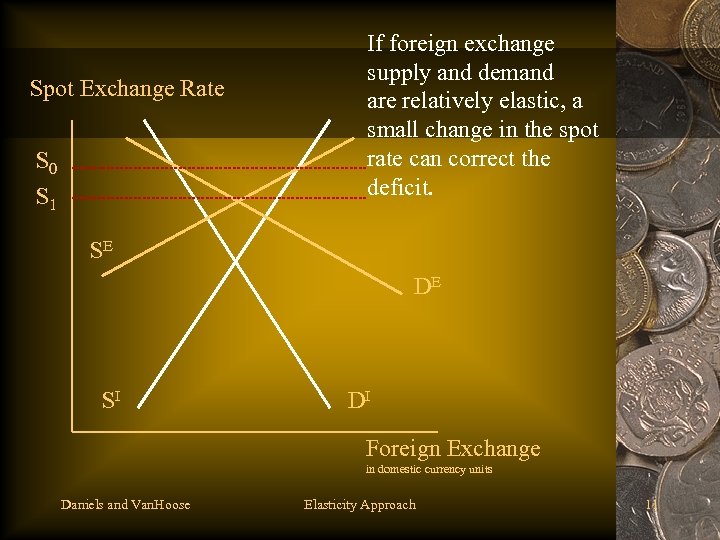
Spot Exchange Rate S 0 S 1 If foreign exchange supply and demand are relatively elastic, a small change in the spot rate can correct the deficit. SE DE SI DI Foreign Exchange in domestic currency units Daniels and Van. Hoose Elasticity Approach 11
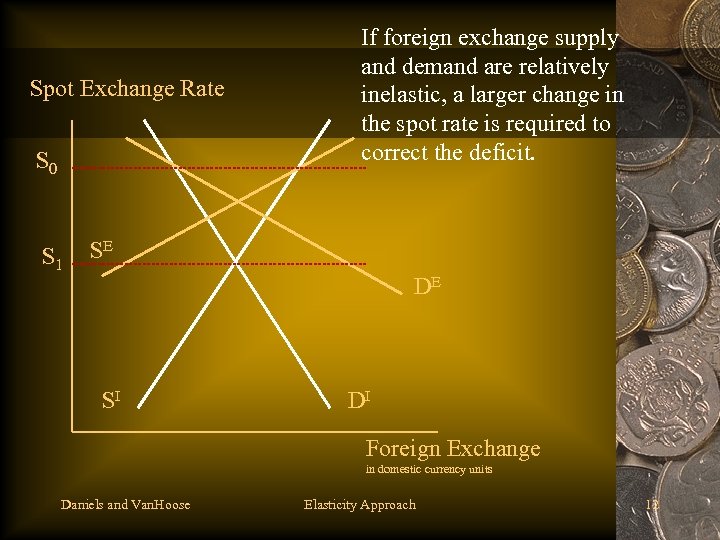
Spot Exchange Rate S 0 S 1 If foreign exchange supply and demand are relatively inelastic, a larger change in the spot rate is required to correct the deficit. SE DE SI DI Foreign Exchange in domestic currency units Daniels and Van. Hoose Elasticity Approach 12
The “J-Curve” • The “J-Curve” is an (often, but not always) observed phenomenon. • What is observed is that, follow a depreciation or devaluation, the nation’s balance of payments worsens before it improves. Daniels and Van. Hoose Elasticity Approach 13
Pass-Through Effects • A pass-through effect is when the domestic price of an imported good rises (falls) following the depreciation (appreciation) of the domestic currency. Daniels and Van. Hoose Elasticity Approach 14
The Absorption Approach to Balance-of-Payments and Exchange-Rate Determination Daniels and Van. Hoose Elasticity Approach
Overview of The Absorption Approach • The absorption approach emphasizes changes in real domestic income as a determinant of a nation’s balance of payments and exchange rate. • Because it treats prices as constant, all variables are real measures. Daniels and Van. Hoose Elasticity Approach 16
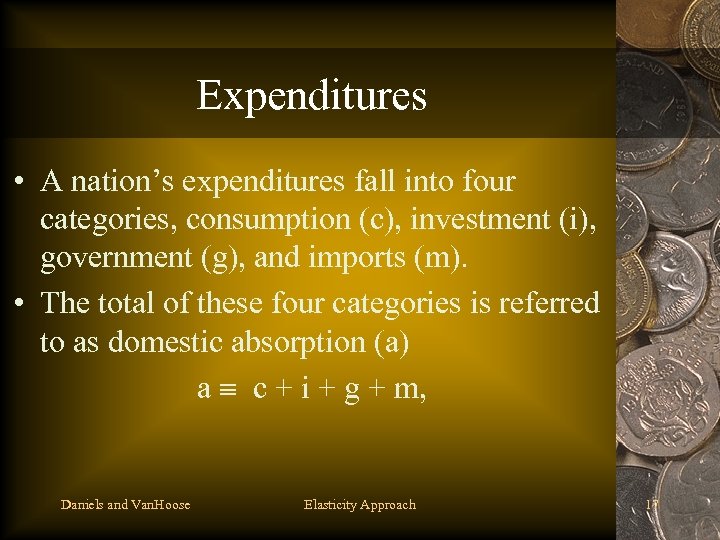
Expenditures • A nation’s expenditures fall into four categories, consumption (c), investment (i), government (g), and imports (m). • The total of these four categories is referred to as domestic absorption (a) a c + i + g + m, Daniels and Van. Hoose Elasticity Approach 17
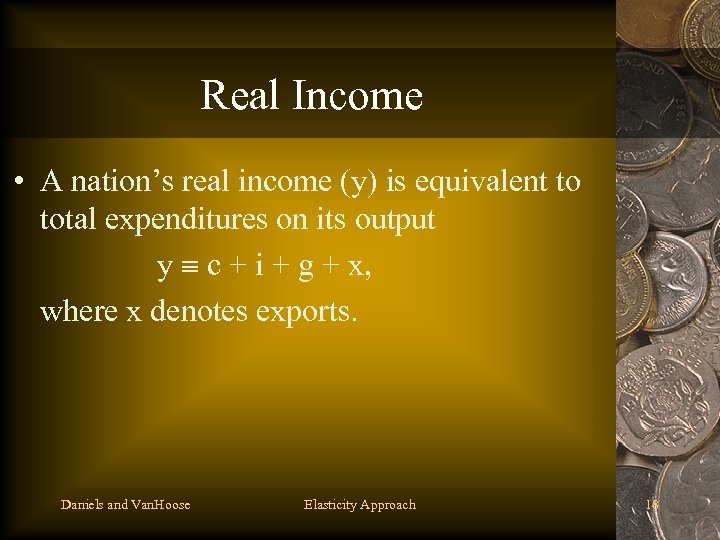
Real Income • A nation’s real income (y) is equivalent to total expenditures on its output y c + i + g + x, where x denotes exports. Daniels and Van. Hoose Elasticity Approach 18
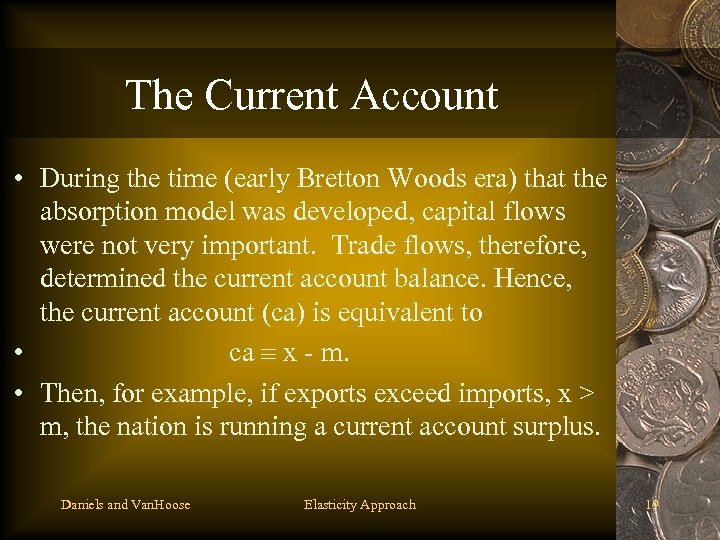
The Current Account • During the time (early Bretton Woods era) that the absorption model was developed, capital flows were not very important. Trade flows, therefore, determined the current account balance. Hence, the current account (ca) is equivalent to • ca x - m. • Then, for example, if exports exceed imports, x > m, the nation is running a current account surplus. Daniels and Van. Hoose Elasticity Approach 19
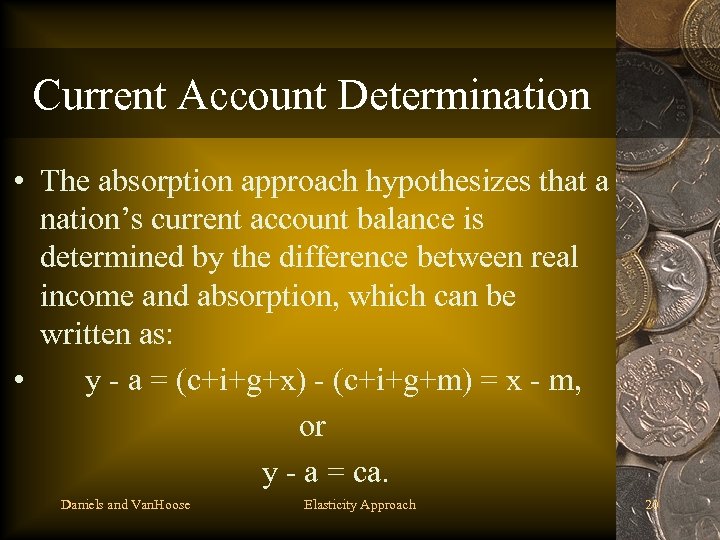
Current Account Determination • The absorption approach hypothesizes that a nation’s current account balance is determined by the difference between real income and absorption, which can be written as: • y - a = (c+i+g+x) - (c+i+g+m) = x - m, or y - a = ca. Daniels and Van. Hoose Elasticity Approach 20
Contractions and Expansions • Though a simple theory, the absorption approach is helpful in understanding a nation’s external performance during contractions and expansions. • For example, when a nation experiences an economic contraction, does its current account necessarily improve and does its currency definitely appreciate? • Does the opposite necessarily hold during an economic expansion? Daniels and Van. Hoose Elasticity Approach 21
Balance of Payments Determination • Consider the case of an economic expansion. Real income rises, thereby increasing real expenditures or absorption. • Whether the current account balance improves or worsens depends on the relative changes in these two variables. Daniels and Van. Hoose Elasticity Approach 22
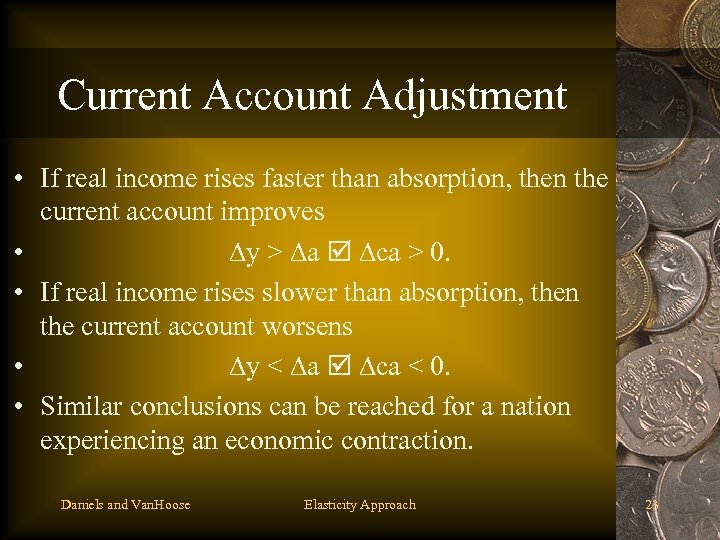
Current Account Adjustment • If real income rises faster than absorption, then the current account improves • y > a ca > 0. • If real income rises slower than absorption, then the current account worsens • y < a ca < 0. • Similar conclusions can be reached for a nation experiencing an economic contraction. Daniels and Van. Hoose Elasticity Approach 23
Exchange Rate Determination • The absorption approach can also be used to examine how changes in income affect the value of a nation’s currency. • Recall that y - a = x - m. • For example, if real income is rising faster than absorption, then exports must be increasing relative to imports. Hence, the nation’s currency will appreciate. Daniels and Van. Hoose Elasticity Approach 24
Policy Implications • A nation may resort to absorption instruments or expenditure switching instruments to correct an external imbalance. • The effectiveness of these instruments, however, is uncertain, as can be seen in the model. Daniels and Van. Hoose Elasticity Approach 25
Policy Instruments • Absorption Instrument: Influences absorption by altering expenditures. • Suppose the government reduces its expenditures (g). Absorption will decline as g declines. • However, since expenditures decline, so does output. The absorption instrument is effective only if absorption declines faster than output. Daniels and Van. Hoose Elasticity Approach 26
Policy Instruments, Continued • Expenditure Switching Instrument: Alters expenditures among imports and exports by changing relative prices. • Suppose the government devalues the domestic currency. Imports are relatively more expensive, and exports are relatively cheaper. • If households and businesses switch directly between imports and domestic output without changing overall absorption or income, there is no impact on the current account balance. Daniels and Van. Hoose Elasticity Approach 27
Conclusion • The Absorption Approach emphasizes real income in balance-of-payments and exchange-rate determination. • The approach hypothesizes that relative changes in real income or output and absorption determine a nation’s balance-ofpayments and exchange-rate performance. • It is not clear that expenditure switching and absorption instruments are effective. Daniels and Van. Hoose Elasticity Approach 28
Скачать презентацию The Elasticity Approach to Balance-of-Payments and Exchange-Rate Determination
683b29ccfb8390ade0e79ff4b6ec07da.ppt