


 Скачать презентацию THE EFFICIENT MARKET HYPOTHESIS LECTURE TWO LECTURE
71c33cf4154a19240f55ec3e359e9320.ppt
- Количество слайдов: 10
 THE EFFICIENT MARKET HYPOTHESIS LECTURE TWO
 LECTURE OBJECTIVES By the end of this lecture, the students should have understood the following: The difference between passive and active management. The role of a portfolio manager in an efficient market. Be able to do calculations on testing the EMH. The emperical evidence on the three versions of the EMH.
 ACTIVE OR PASSIVE MANAGEMENT Active Management • Security analysis • Timing Passive Management • Buy and Hold • Index Funds
 MARKET EFFICIENCY & PORTFOLIO MANAGEMENT Even if the market is efficient a role exists for portfolio management: Appropriate risk level Tax considerations Other considerations
 ARE MARKETS EFFICIENT v. Magnitude Issue v. Selection Bias Issue v. Lucky Event Issue
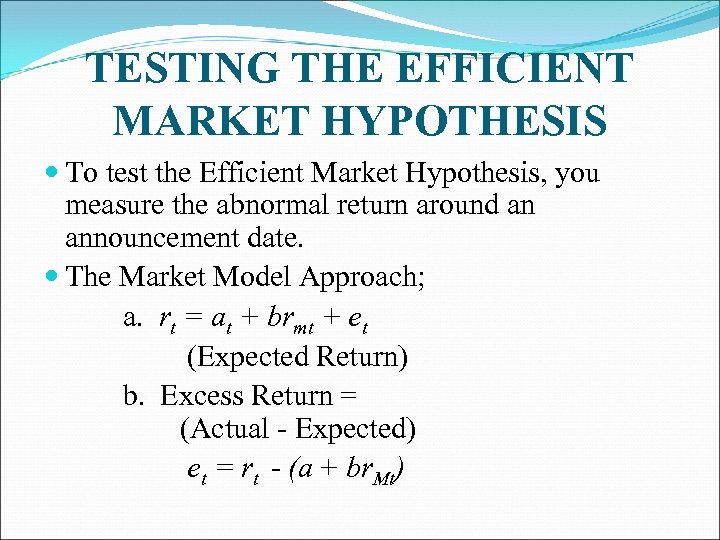 TESTING THE EFFICIENT MARKET HYPOTHESIS To test the Efficient Market Hypothesis, you measure the abnormal return around an announcement date. The Market Model Approach; a. rt = at + brmt + et (Expected Return) b. Excess Return = (Actual - Expected) et = rt - (a + br. Mt)
 EMPERICAL EVIDENCE ON WEAK FORM EMH ØSerial Correlation Test ØRuns Test ØFilter Rules Test
 EMPERICAL EVIDENCE ON SEMI STRONG FORM EMH Possible to earn superior risk-adjusted return by trading on information events? (Event study) Possible to earn superior risk-adjusted return by trading on an observable characteristic of a firm? (Portfolio study)
 EMPERICAL EVIDENCE ON STRONG FORM EMH Empirical evidence broadly suggests the following: • Corporate insiders earn superior returns, after adjustment for risk. • Mutual fund managers, on average, do not earn superior returns after adjustment for risk.
 SUMMARY • Empirical evidence suggests that markets are reasonably efficient, but not perfectly so. Empirical evidence seems to provide strong support for weakform efficiency, mixed support for semi-strong form efficiency, and weak support for strong-form. Therefore, Investors and corporate officers should modify their behaviours and expectations in light of the evidence of market efficiency.