


 Скачать презентацию The efficiency of the real estate market a
7ba15e4e91bb0b99d86701df282a4e8c.ppt
- Количество слайдов: 16
 The efficiency of the real estate market: a meta-analysis of the empirical literature Gunther Maier, Shanaka Herath Research Institute for Spatial and Real Estate Economics
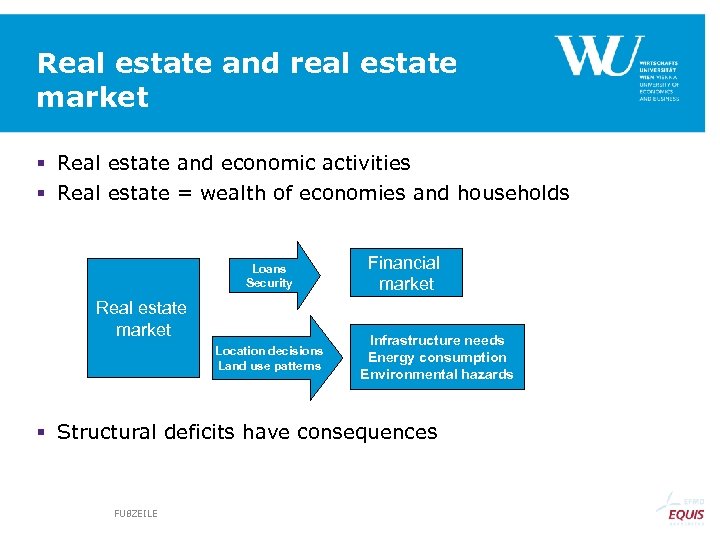 Real estate and real estate market § Real estate and economic activities § Real estate = wealth of economies and households Loans Security Real estate market Location decisions Land use patterns Financial market Infrastructure needs Energy consumption Environmental hazards § Structural deficits have consequences FUßZEILE
 Market efficiency research § Originally on financial markets § Early research on market efficiency (Samuelson 1965, Fama et al. 1969, Fama 1970) § A market is efficient when it “adjusts rapidly to new information” (Fama et al. 1969) § An efficient market is one where prices “fully reflect all available information” (Fama 1991) § EMH in financial markets § Early decade: “no other proposition in economics which has more solid empirical evidence supporting it” (Jensen 1978) § Today: EMH appears more controversial (Beechey et al. 2000) FUßZEILE
 Market efficiency research (contd. ) § Market efficiency depends on a specific information set (not an absolute characteristic) § Efficiency with respect to some set of information § Three forms of market efficiency § Weak the relevant information set consists of only past prices § Semi-strong information set consists of past prices and all publicly available information § Strong information set also includes non-public information § Efficiency of the real estate market Linnemann 1986) FUßZEILE (Gau 1984, 1985,
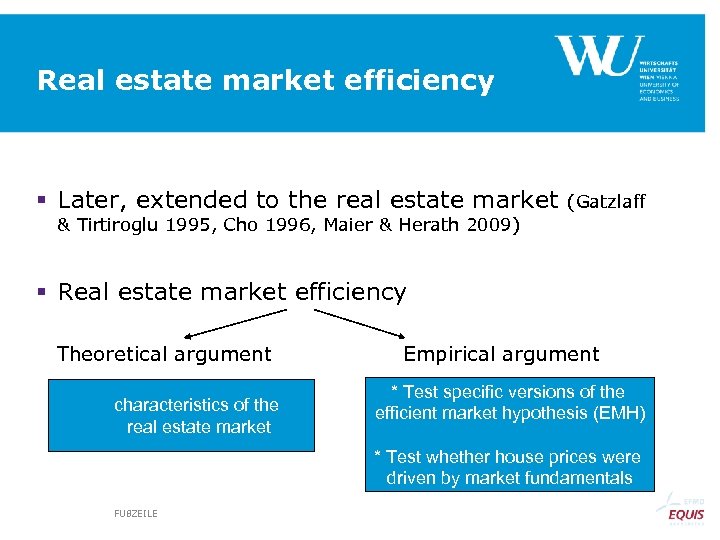 Real estate market efficiency § Later, extended to the real estate market (Gatzlaff & Tirtiroglu 1995, Cho 1996, Maier & Herath 2009) § Real estate market efficiency Theoretical argument characteristics of the real estate market Empirical argument * Test specific versions of the efficient market hypothesis (EMH) * Test whether house prices were driven by market fundamentals FUßZEILE
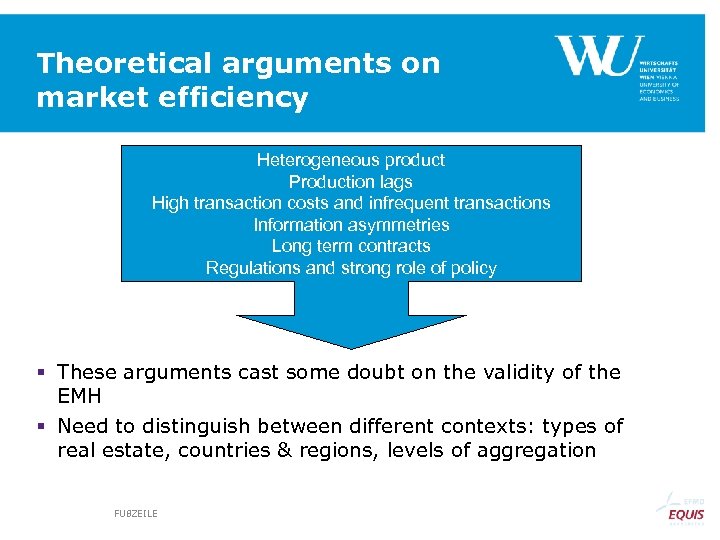 Theoretical arguments on market efficiency Heterogeneous product Production lags High transaction costs and infrequent transactions Information asymmetries Long term contracts Regulations and strong role of policy § These arguments cast some doubt on the validity of the EMH § Need to distinguish between different contexts: types of real estate, countries & regions, levels of aggregation FUßZEILE
 Our emphasis: empirical studies § Analysis of different types of real estate › different countries-cities-regions › different levels of aggregation › different time period § Literature provide no decisive result § Whether some of the parameters of these analyses make the conclusion of an efficient real estate market more or less likely § A meta-analysis of empirical studies § A Binary Logit Model § Discrete dependent variable: binary indicator whether or not a certain study concluded the real estate market is efficient § Explanatory variables: factors characterizing the sample (the study) FUßZEILE
 Meta-analysis § No original data about the phenomenon, unit of analysis is previous studies on that § Proper construction of the data set is a challenge § Previous studies do not describe all the characteristics of the analysis § Differences in the quality of the studies (and how to take this into account) § Advantages: * can detect some dependence of empirical results on the context of the analysis; * can identify the risk of taking the empirical results of one study at face value § Disadvantages: * publication bias (potential selectivity of the peer review and publication process) -Jensen (1978) › filedrawer problem –Rosenthal (1979). FUßZEILE
 Data § Literature survey Maier & Herath (2009) § New addition of relevant literature § Selection of empirical studies directly testing EMH (51 papers published from 1984 -2007) § What we left out: § Papers indirectly deal with market efficiency § Conceptual papers and papers using simulations FUßZEILE
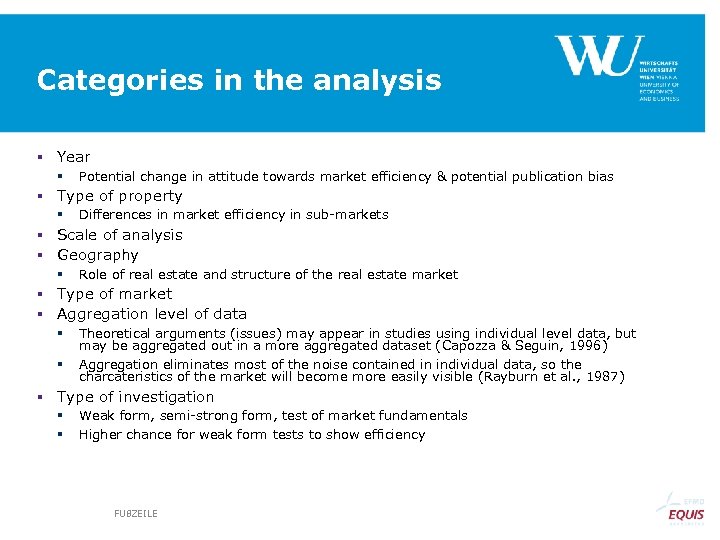 Categories in the analysis § Year § Potential change in attitude towards market efficiency & potential publication bias § Type of property § Differences in market efficiency in sub-markets § Scale of analysis § Geography § Role of real estate and structure of the real estate market § Type of market § Aggregation level of data § § Theoretical arguments (issues) may appear in studies using individual level data, but may be aggregated out in a more aggregated dataset (Capozza & Seguin, 1996) Aggregation eliminates most of the noise contained in individual data, so the charcateristics of the market will become more easily visible (Rayburn et al. , 1987) § Type of investigation § § Weak form, semi-strong form, test of market fundamentals Higher chance for weak form tests to show efficiency FUßZEILE
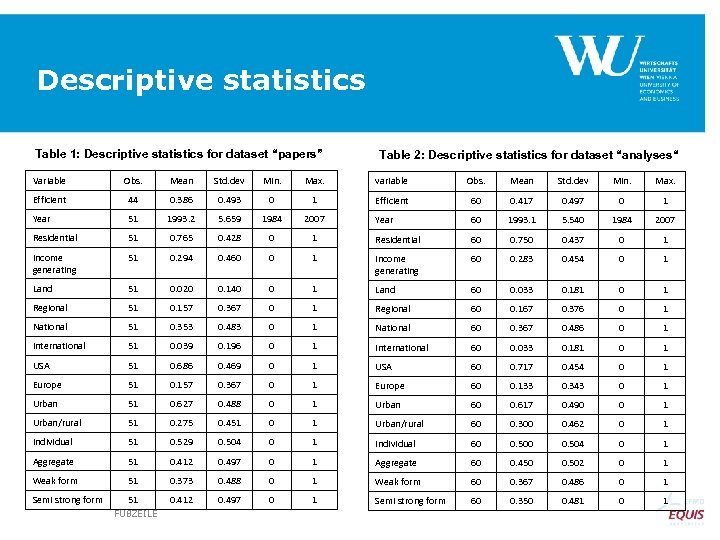 Descriptive statistics Table 1: Descriptive statistics for dataset “papers” Table 2: Descriptive statistics for dataset “analyses“ Variable Obs. Mean Std. dev Min. Max. variable Obs. Mean Std. dev Min. Max. Efficient 44 0. 386 0. 493 0 1 Efficient 60 0. 417 0. 497 0 1 Year 51 1993. 2 5. 659 1984 2007 Year 60 1993. 1 5. 540 1984 2007 Residential 51 0. 765 0. 428 0 1 Residential 60 0. 750 0. 437 0 1 Income generating 51 0. 294 0. 460 0 1 Income generating 60 0. 283 0. 454 0 1 Land 51 0. 020 0. 140 0 1 Land 60 0. 033 0. 181 0 1 Regional 51 0. 157 0. 367 0 1 Regional 60 0. 167 0. 376 0 1 National 51 0. 353 0. 483 0 1 National 60 0. 367 0. 486 0 1 International 51 0. 039 0. 196 0 1 International 60 0. 033 0. 181 0 1 USA 51 0. 686 0. 469 0 1 USA 60 0. 717 0. 454 0 1 Europe 51 0. 157 0. 367 0 1 Europe 60 0. 133 0. 343 0 1 Urban 51 0. 627 0. 488 0 1 Urban 60 0. 617 0. 490 0 1 Urban/rural 51 0. 275 0. 451 0 1 Urban/rural 60 0. 300 0. 462 0 1 Individual 51 0. 529 0. 504 0 1 Individual 60 0. 504 0 1 Aggregate 51 0. 412 0. 497 0 1 Aggregate 60 0. 450 0. 502 0 1 Weak form 51 0. 373 0. 488 0 1 Weak form 60 0. 367 0. 486 0 1 Semi strong form 51 0. 412 0. 497 0 1 Semi strong form 60 0. 350 0. 481 0 1 FUßZEILE
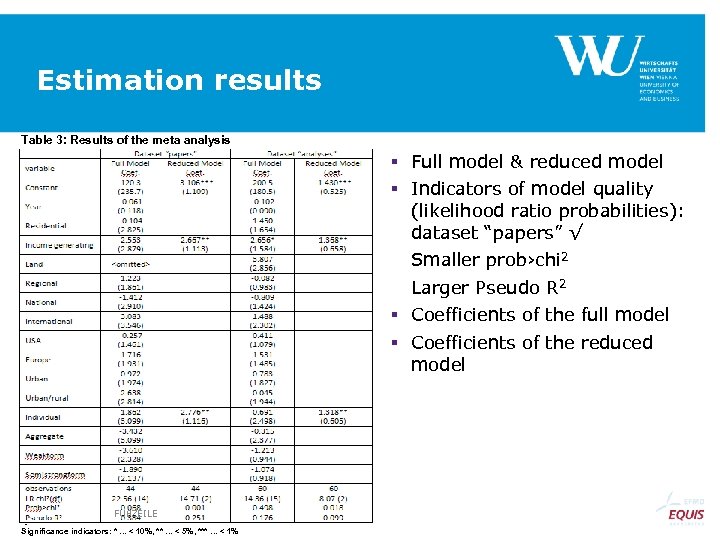 Estimation results Table 3: Results of the meta analysis § Full model & reduced model § Indicators of model quality (likelihood ratio probabilities): dataset “papers” √ Smaller prob›chi 2 Larger Pseudo R 2 § Coefficients of the full model § Coefficients of the reduced model FUßZEILE Significance indicators: * … < 10%, ** … < 5%, *** … < 1%
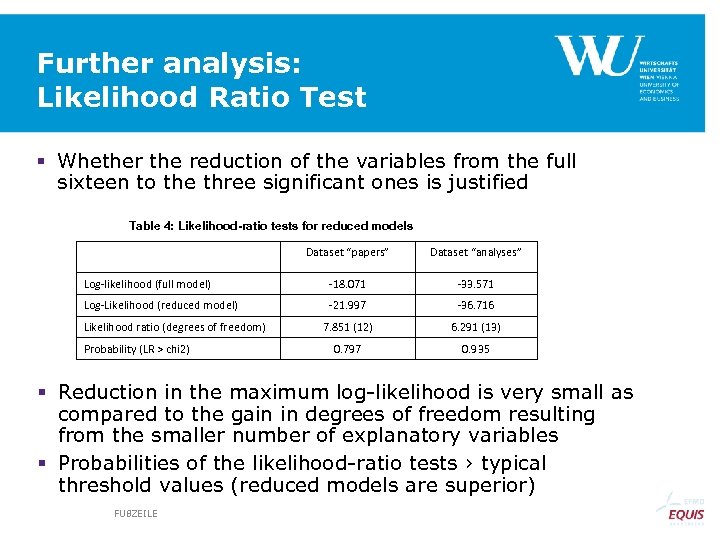 Further analysis: Likelihood Ratio Test § Whether the reduction of the variables from the full sixteen to the three significant ones is justified Table 4: Likelihood-ratio tests for reduced models Dataset “papers” Dataset “analyses” Log-likelihood (full model) -18. 071 -33. 571 Log-Likelihood (reduced model) -21. 997 -36. 716 7. 851 (12) 6. 291 (13) 0. 797 0. 935 Likelihood ratio (degrees of freedom) Probability (LR > chi 2) § Reduction in the maximum log-likelihood is very small as compared to the gain in degrees of freedom resulting from the smaller number of explanatory variables § Probabilities of the likelihood-ratio tests › typical threshold values (reduced models are superior) FUßZEILE
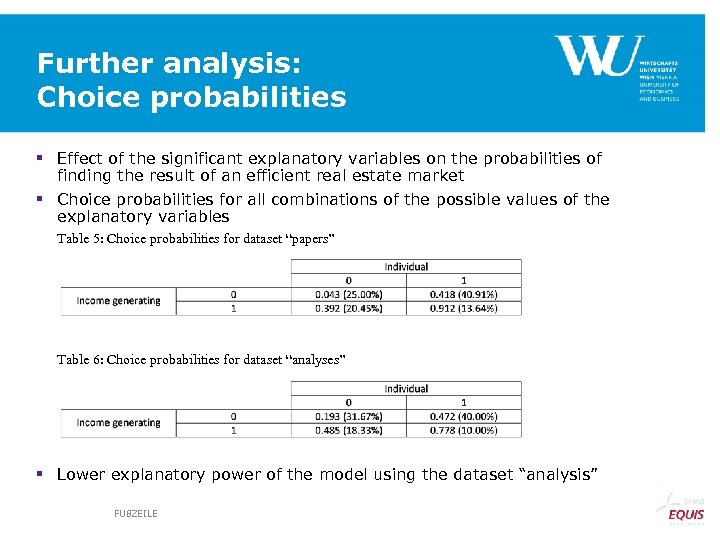 Further analysis: Choice probabilities § Effect of the significant explanatory variables on the probabilities of finding the result of an efficient real estate market § Choice probabilities for all combinations of the possible values of the explanatory variables Table 5: Choice probabilities for dataset “papers” Table 6: Choice probabilities for dataset “analyses” § Lower explanatory power of the model using the dataset “analysis” FUßZEILE
 Conclusions § Real estate market and market efficiency § The model with all the variables yield no significant coefficients § “Reduced model” is statistically superior to the full model § Variables “income generating” and “individual” are significant § Significantly positive influence in both cases § When income generating properties are analyzed in a study, it is more likely to conclude that the market is efficient § Studies that use individual level data are significantly more likely to find an efficient real estate market FUßZEILE
 Thank you! VIENNA UNIVERSITY OF ECONOMICS AND BUSINESS Augasse 2 -6, 1090 Vienna, Austria www. wu. ac. at SPATIAL AND REAL ESTATE ECONOMICS RESEARCH INSTITUTE Nordbergstraße 15 (UZA 4, Kern B, 4. Stock) A-1090 Vienna, Austria http: //www. wu. ac. at/immobilienwirtschaft UNIV. PROF. DR. GUNTHER MAIER SHANAKA HERATH T +43 -1 -31336 -4780 T +43 -1 -31336 -5764 F +43 -(0)1 -31336 705 gunther. maier@wu. ac. at Shanaka. herath@wu. ac. at FUßZEILE