


 Скачать презентацию The Efficacy of Service-Learning as Practical Experiences for
43bbf0ee9899c755a5ecf8fbe29d127f.ppt
- Количество слайдов: 39
 The Efficacy of Service-Learning as Practical Experiences for Pre-service Special Education Teachers Randall Dunn and Christopher Shon Liberty University School of Education November 9, 2007 CEC, TED Conference 2007, Milwaukee, WI
 the agenda • • A Review of Literature Program Description of College for Living Research Questions Research Design Statistical Report Qualitative Review Anecdotal Results Future Directions
 service-learning as practical experiences LITERATURE REVIEW
 definitional considerations • • • Service Learning is an integration of meaningful action in the community with classroom learning (instruction and reflection) to build notions of civic responsibility and strengthen communities (Kronick, 2007; Carpini & Keeter, 2000; Dymond et al, 2007; Butin, 2003). “Service-learning may be described as both a philosophy of education and an instructional method. As a philosophy of education, service-learning reflects the belief that education should develop social responsibility and prepare students to be involved citizens in democratic life. As an instructional method, servicelearning involves a blending of service activities with the academic curriculum in order to address real community needs while students learn through active engagement (Anderson, 1998; Conrad & Hedin, 1991; Root, 1997). ” “. . . a means of energizing classroom curricula, re-engaging students in their own learning, and prompting forms of social and civic development or establishing linkage among universities and schools with their local communities and community agencies” (Vickers et al. , 2004)
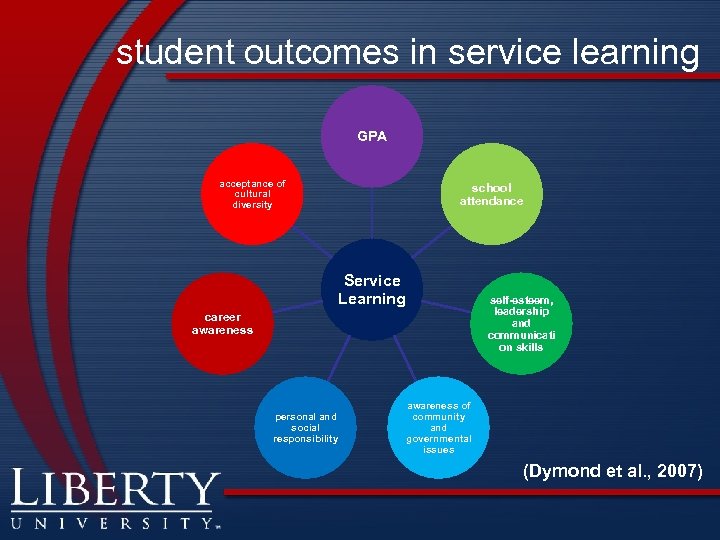 student outcomes in service learning GPA acceptance of cultural diversity school attendance Service Learning self-esteem, leadership and communicati on skills career awareness personal and social responsibility awareness of community and governmental issues (Dymond et al. , 2007)
 service learning & special education • Needs: – SL is currently employed by approximately 46% of all high schools in the US (Skinner & Chapman, 1999), yet not much information is available about the inclusion of students with disabilities in these programs (Dymond et al. , 2003). – Even when high school students and their peers with disabilities are in the same school setting, interaction rarely occurs without intentional programming (Copeland et al. , 2004) • Examples: – Peer Buddy Program: a high school social interaction program in a large urban school district providing social and academic peer support and friendship to students with moderate or severe disabilities and servicelearning opportunities to students without disabilities (Copeland et al. , 2004)
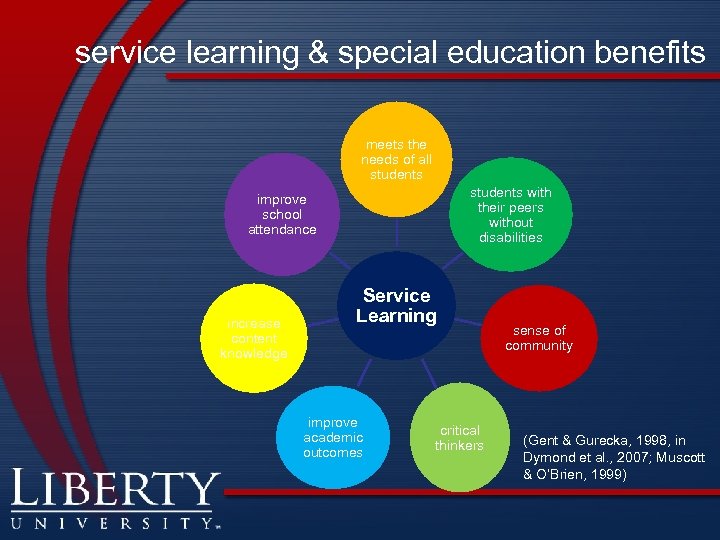 service learning & special education benefits meets the needs of all students with their peers without disabilities improve school attendance increase content knowledge Service Learning improve academic outcomes critical thinkers sense of community (Gent & Gurecka, 1998, in Dymond et al. , 2007; Muscott & O’Brien, 1999)
 service learning in teacher education • Definition: “a pedagogical strategy that combines authentic community service with integrated academic learning to strengthen teacher education and enhance community life” (Swick, 2001) • Examples: – Professional Experience 3 (PE 3) at the University of Western Sydney: “an alternate practicum encouraging pre-service teachers to engage in broader educational settings within local community” (Vickers et al. , 2004)
 service learning in teacher education • Purposes of SL in Teacher Education – To promote SL as a powerful pedagogical tool for the development of effective teachers in diverse educational settings. – To promote understanding of the significant social-cultural, political and economic issues influencing students’ learning and to develop skills and strategies to address these issues. – To develop and maintain university-community partnerships that have benefits for all involved—the University, students, teachers, schools and community (Vickers et al. , 2004).
 service learning in teacher education • Philosophical/Historical Backgrounds: – the strength of learning from doing (Dewey, 1937) – bonders vs. bridgers (Kronick, 2007) – service learners, internship learners, & volunteers • Strategic Approaches to SL: Knowledge, Service, and Reflection – …reflection is the link between service experience and learning (academic work) (Burns, 1998, as quoted in Kronick, 2007; Swick, 2001). – Service learning links academic instruction with community service guided by reflection. … Reflection is considered the critical piece in service learning as without it student’s involvement in service remains as some form of volunteering or a ‘feel-good’ exercise without linking student’s experience with curriculum content (Vickers et al. , 2004). – a learning journal prior to, during and after their community placements (Butcher et al. , 2003)
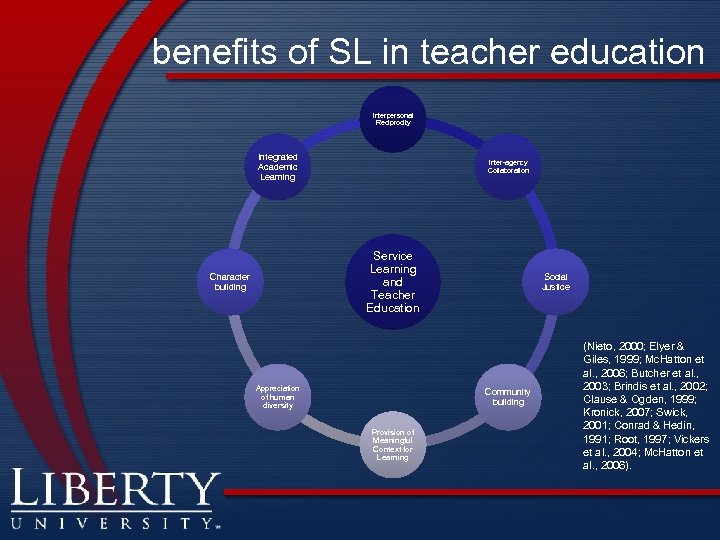 benefits of SL in teacher education Interpersonal Reciprocity Integrated Academic Learning Inter-agency Collaboration Service Learning and Teacher Education Character building Appreciation of human diversity Social Justice Community building Provision of Meaningful Context for Learning (Nieto, 2000; Elyer & Giles, 1999; Mc. Hatton et al. , 2006; Butcher et al. , 2003; Brindis et al. , 2002; Clause & Ogden, 1999; Kronick, 2007; Swick, 2001; Conrad & Hedin, 1991; Root, 1997; Vickers et al. , 2004; Mc. Hatton et al. , 2006).
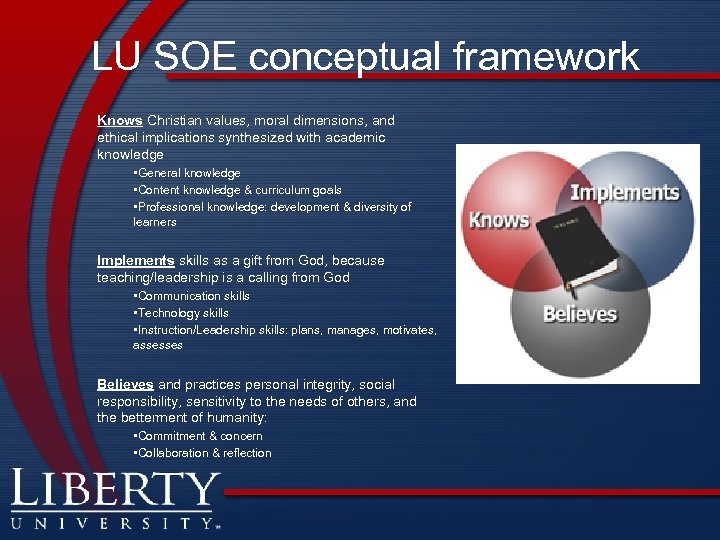 LU SOE conceptual framework Knows Christian values, moral dimensions, and ethical implications synthesized with academic knowledge • General knowledge • Content knowledge & curriculum goals • Professional knowledge: development & diversity of learners Implements skills as a gift from God, because teaching/leadership is a calling from God • Communication skills • Technology skills • Instruction/Leadership skills: plans, manages, motivates, assesses Believes and practices personal integrity, social responsibility, sensitivity to the needs of others, and the betterment of humanity: • Commitment & concern • Collaboration & reflection
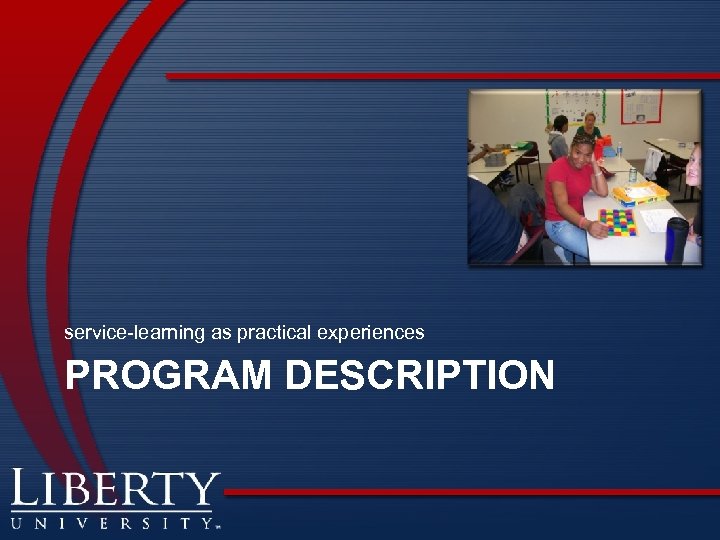 service-learning as practical experiences PROGRAM DESCRIPTION
 the who • Providers • • Students/ Clients • • Lynchburg City Schools initially, now four area school districts are participating or are in talks. LEAs pay tuition at local community college (Central Virginia Community College) for space/ courses in varied topics Students with significant disabilities ages 18 -22 years old (Post Grads) receive campus-based special education services. The program is offered on a four-year or community college campus. Initially there were some ten students enrolled. Now, two years later, the numbers are pushing thirty. One aged-out student’s parents are paying his tuition directly. Mentors • Liberty University and Lynchburg College students (sophomore and junior teacher education students), acting as mentors and a primary component of the Least Restrictive Environment. Between twenty and thirty students are enrolled in the practicum courses aligned with this experience each semester (Interventions for Mental Retardation and Issues in Special Education).
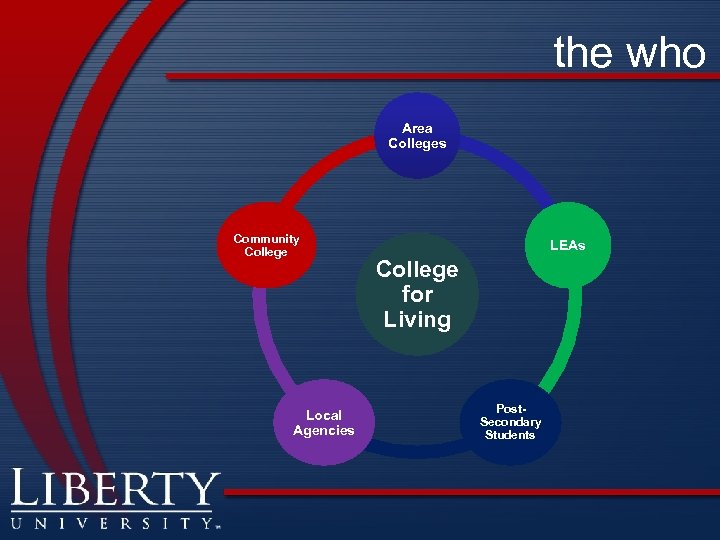 the who Area Colleges Community College Local Agencies LEAs College for Living Post. Secondary Students
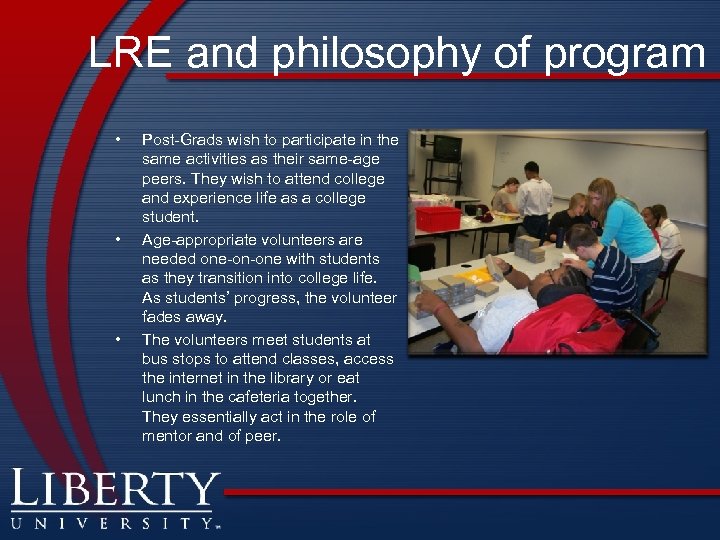 LRE and philosophy of program • • • Post-Grads wish to participate in the same activities as their same-age peers. They wish to attend college and experience life as a college student. Age-appropriate volunteers are needed one-on-one with students as they transition into college life. As students’ progress, the volunteer fades away. The volunteers meet students at bus stops to attend classes, access the internet in the library or eat lunch in the cafeteria together. They essentially act in the role of mentor and of peer.
 curriculum • • • The program focuses primarily on integrating life skills into functional academic work. CVCC professors work along side special education professionals to deliver appropriate and meaningful curricular content. For each set of nine students enrolled, there is one special educator and one paraprofessional. Students are taught skills in. . . Vocational Peripheral Job Skills Specific Job Skills Independent Living Money Skills Home Economics Skills Laundry, Cooking, Home Care Functional Academics Mathematics Reading Skills Community Living Skills Transportation Leisure
 success • One of the fastest implementations observed • The role of child advocate in this process (and its success) • Multi-agency collaboration
 service-learning as practical experiences PSEUDO-STATISTICAL RESULTS
 experiences of the LU students Gathering of Likert-style survey data based on teacher competencies identified in LU’s special education teacher preservice licensure program. Personal written reflections of LU student participants.
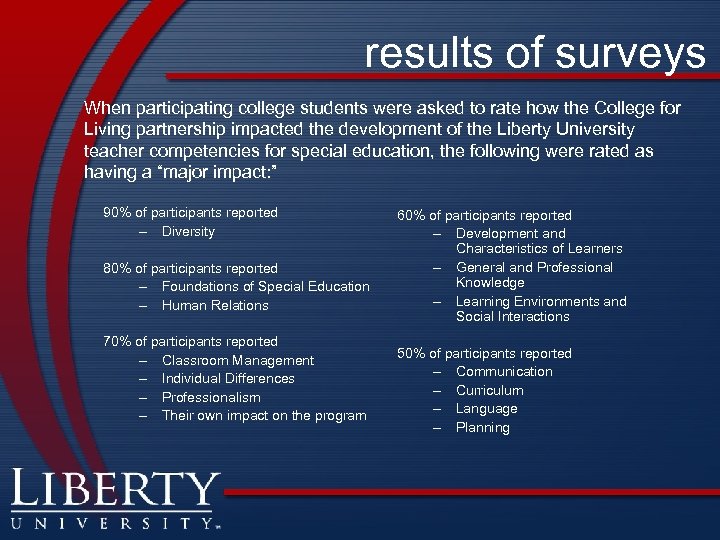 results of surveys When participating college students were asked to rate how the College for Living partnership impacted the development of the Liberty University teacher competencies for special education, the following were rated as having a “major impact: ” 90% of participants reported – Diversity 80% of participants reported – Foundations of Special Education – Human Relations 70% of participants reported – Classroom Management – Individual Differences – Professionalism – Their own impact on the program 60% of participants reported – Development and Characteristics of Learners – General and Professional Knowledge – Learning Environments and Social Interactions 50% of participants reported – Communication – Curriculum – Language – Planning
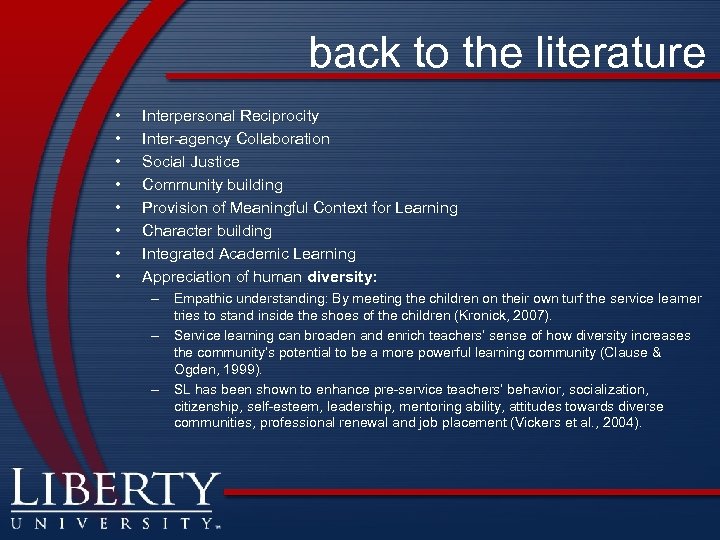 back to the literature • • Interpersonal Reciprocity Inter-agency Collaboration Social Justice Community building Provision of Meaningful Context for Learning Character building Integrated Academic Learning Appreciation of human diversity: – Empathic understanding: By meeting the children on their own turf the service learner tries to stand inside the shoes of the children (Kronick, 2007). – Service learning can broaden and enrich teachers’ sense of how diversity increases the community’s potential to be a more powerful learning community (Clause & Ogden, 1999). – SL has been shown to enhance pre-service teachers’ behavior, socialization, citizenship, self-esteem, leadership, mentoring ability, attitudes towards diverse communities, professional renewal and job placement (Vickers et al. , 2004).
 service-learning as practical experiences RESEARCH QUESTIONS
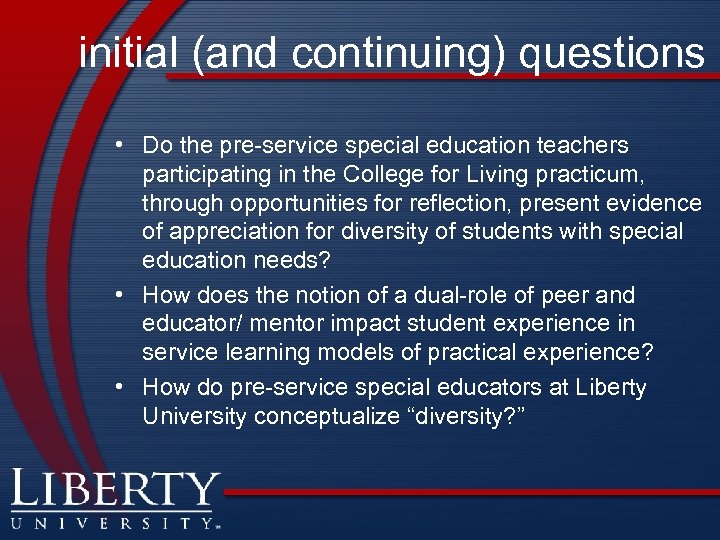 initial (and continuing) questions • Do the pre-service special education teachers participating in the College for Living practicum, through opportunities for reflection, present evidence of appreciation for diversity of students with special education needs? • How does the notion of a dual-role of peer and educator/ mentor impact student experience in service learning models of practical experience? • How do pre-service special educators at Liberty University conceptualize “diversity? ”
 service-learning as practical experiences RESEARCH DESIGN
 general design • Techniques – General grounded theory approaches – Employ content analysis (Mayring, 2000) – Sensitizing concepts of diversity and recognition of individual learner/ person (Bowen, 2006) • Phase Approach – Phase 1 - Grounded Theory Approach looking for any general themes. Engage a sensitizing concept of looking for individual student considerations (and diversity) – Phase 2 - Review of initial coding selections and grouping. Combination of initial characteristics of reflections into palatable groupings. – Phase 3 - A second sweep to code at Logistical Focus and Personal Connections, for potential cross-referencing. – Phase 4 - An overall reflection on coded entries, thinking about context and drawing conclusions concerning the nature of this experience in its context.
 service-learning as practical experiences QUALITATIVE RESULTS
 the prompt • Write a 2 -3 page, typed summary on what was observed as part of your practicum experience. Include any specific observations related to behavior management, great teaching ideas, reflections on the particular setting (regular ed. class/resource room, etc. ) and/or reflections on the placement for a particular student. Also take note of modifications, accommodations, and specific strategies used.
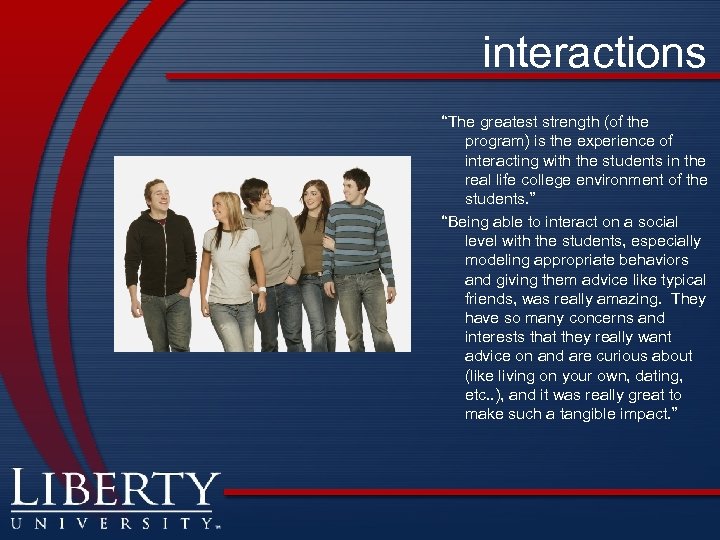 interactions “The greatest strength (of the program) is the experience of interacting with the students in the real life college environment of the students. ” “Being able to interact on a social level with the students, especially modeling appropriate behaviors and giving them advice like typical friends, was really amazing. They have so many concerns and interests that they really want advice on and are curious about (like living on your own, dating, etc. . ), and it was really great to make such a tangible impact. ”
 appreciation of individual differences “At first I didn’t feel adequate to work with Susie who has serious hearing disabilities. However, after watching her normal teacher work with her for several days I finally did sit with her and work with her. . . I had observed her teacher repeating directions often that the lecturer had given but Susie was unable to hear. She also uses sign language for a lot of things. Susie actually taught me some sign and one time we briefly skimmed a book on sign language that she had at her desk that she uses. Eventually, I came to really enjoy working with her because although it was a challenge she was mostly eager to learn. ” “John was unlike any other child with autism that I had worked with. Previously, most of the children with autism that I had experience working with were very unresponsive and had poor language skills. John, however, was very talkative, very friendly and responsive, and very neat and organized. He actually had difficulties not shouting out in class and talking in excess. I loved getting a chance to work with him just to be able to see the different symptoms that is included in the diagnosis of autism. ” “Through my experience at CVCC I have been able to eliminate most of my naive thoughts and have been able to learn a lot. ”
 special education foundations “Once they get to school, they usually have about twenty minutes of free time until class begins. During this time they are allowed and encouraged to walk around campus or go to the Student Center as long as they are back in time for the first class. I believe this has really helped the students to become independent and confident in themselves. They are being treated like adults which is the first step for them in becoming successful on their own. ” “I saw a number of different accommodations and modifications every visit, but what surprised me the most was how simple and easy to incorporate they all were. Without watching purposefully they would have been easy to miss. ” “During a math assignment where the students had to determine which grocery item was the “better buy, ” and by how much, I saw my first, real example of differentiated instruction. ” “One of the greatest things I saw just recently, was the student who is non-verbal actually stand in front of the class and share his personal statement. This student was the first to volunteer, and he walked proudly up the podium and began reading his statement. The teacher just read the actual words along side him, but he made eye contact, used hand gestures, and fluctuated his voice with his points. He seemed so proud and excited. It really made me think, because with him being non-verbal I probably would have just let him turn in a written statement, but he would have lost such a good experience, and the other students wouldn’t have been able to benefit either. ”
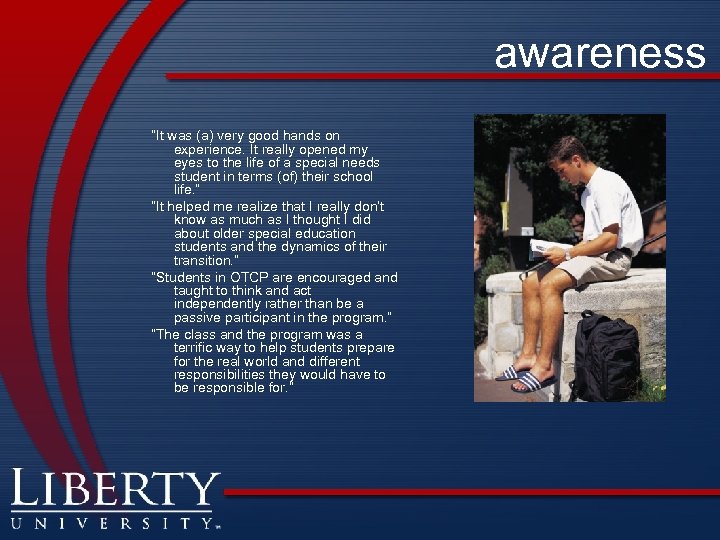 awareness “It was (a) very good hands on experience. It really opened my eyes to the life of a special needs student in terms (of) their school life. ” “It helped me realize that I really don’t know as much as I thought I did about older special education students and the dynamics of their transition. ” “Students in OTCP are encouraged and taught to think and act independently rather than be a passive participant in the program. ” “The class and the program was a terrific way to help students prepare for the real world and different responsibilities they would have to be responsible for. ”
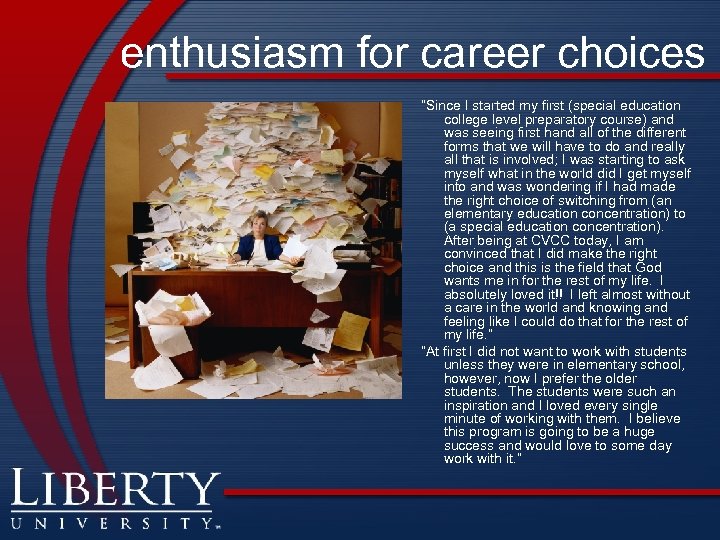 enthusiasm for career choices “Since I started my first (special education college level preparatory course) and was seeing first hand all of the different forms that we will have to do and really all that is involved; I was starting to ask myself what in the world did I get myself into and was wondering if I had made the right choice of switching from (an elementary education concentration) to (a special education concentration). After being at CVCC today, I am convinced that I did make the right choice and this is the field that God wants me in for the rest of my life. I absolutely loved it!! I left almost without a care in the world and knowing and feeling like I could do that for the rest of my life. ” “At first I did not want to work with students unless they were in elementary school, however, now I prefer the older students. The students were such an inspiration and I loved every single minute of working with them. I believe this program is going to be a huge success and would love to some day work with it. ”
 service-learning as practical experiences ANECDOTAL RESULTS
 positive results • Pre-Service Educators - Enthusiastic feedback from students on nature of program (with some “career switchers” to post-secondary transition) • Community Collaboration - Close working relationships between Liberty University and area agencies/ local school districts and other colleges. • Program Benefits - Program has seen a 300% growth in two years, with additional school districts coming on board.
 service-learning as practical experiences FUTURE DIRECTIONS
 further questions and directions • Deeper into how students conceptualize diversity with regard to special education • Measured benefits and successes with program graduates • Program improvement opportunities?
 references • • Bowen, G. A. (2006). Grounded Theory and Sensitizing Concepts. International Journal of Qualitative Methods, 5(3), 1 -9. Butcher, J. , Howard, P. , Labone, E. , Bailey, M. , Smith, S. G. , Mc. Fadden, M. , et al. (2003). Teacher Education, Community Service Learning and Student Efficacy for Community Engagement. Asia-Pacific Journal of Teacher Education, 31(2), 109. Copeland, S. R. , Hughes, C. , Carter, E. W. , Guth, C. , Presley, J. A. , Williams, C. R. , et al. (2004). Increasing Access to General Education. Remedial & Special Education, 25(6), 342 -352. Kronick, R. (2007). Service learning and the university student. College Student Journal, 41(2), 296 -304. Mayring, P. (2000). Qualitative content analysis. Forum Qualitative Sozialforschung / Forum: Qualitative Social Research [On-line Journal], 1(2). Mc. Hatton, P. A. , Thomas, D. , & Lehman, K. (2006). Lessons learned in servicelearning: personnel preparation through community action. Mentoring & Tutoring, 14(1), pp. 67– 79. Vickers, M. , Harris, C. , & Mc. Carthy, F. (2004). University-community engagement: exploring service-learning options within the practicum. Asia. Pacific Journal of Teacher Education, 32(2), 129 -141.
 presentation acquisition • In the interest of being environmentally conscious and weight-conscience with regard to travel, we have arranged the following means to obtain this presentation: – Email rdunn@liberty. edu (Randall Dunn) – You may download the presentation from http: //works. bepress. com/randall_dunn