


 Скачать презентацию THE EFFECTS OF TASK COMPLEXITY ON MEASURES OF
8b9b7c5d41d6d2cfecef4451d4211845.ppt
- Количество слайдов: 33
 THE EFFECTS OF TASK COMPLEXITY ON MEASURES OF ACCURACY AND LEXICAL VARIETY IN EFL WRITING Nihal Gökgöz, Marmara University, nihalgokgoz@yahoo. com Assoc. Prof. Derin Atay, Marmara University, dyatay@yahoo. com
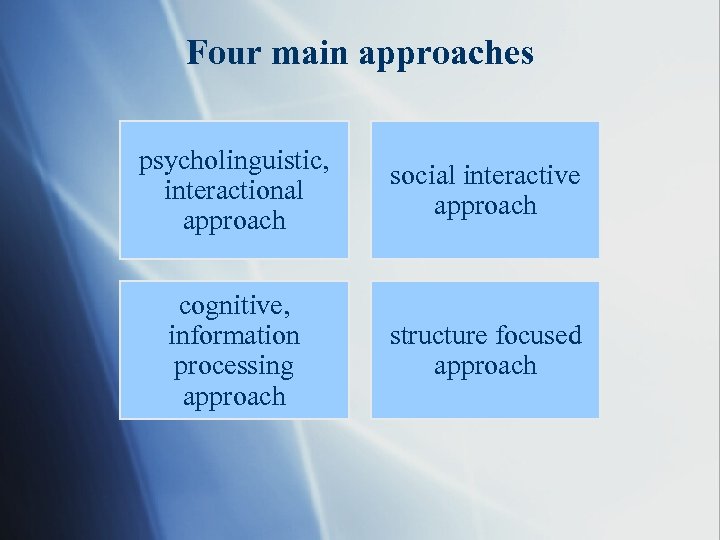 Four main approaches psycholinguistic, interactional approach social interactive approach cognitive, information processing approach structure focused approach
 Tasks provide social context the use of meaningful language attention to input noticing IL development input processing
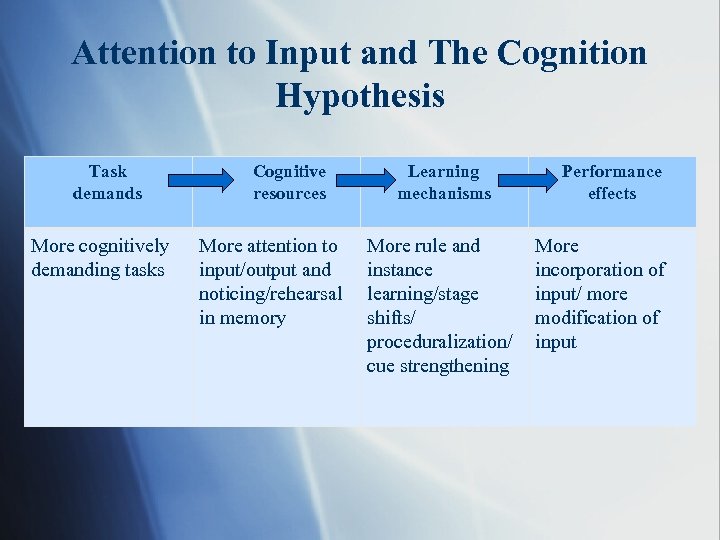 Attention to Input and The Cognition Hypothesis Task demands Cognitive resources Learning mechanisms More cognitively demanding tasks More attention to input/output and noticing/rehearsal in memory More rule and instance learning/stage shifts/ proceduralization/ cue strengthening Performance effects More incorporation of input/ more modification of input
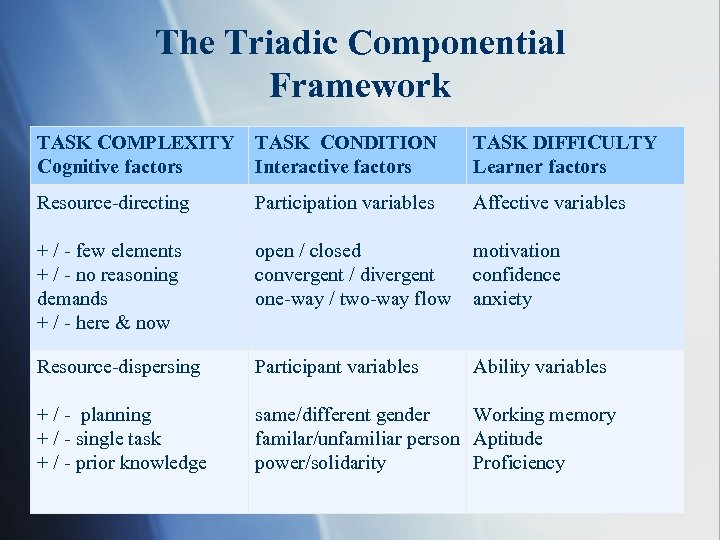 The Triadic Componential Framework TASK COMPLEXITY Cognitive factors TASK CONDITION Interactive factors TASK DIFFICULTY Learner factors Resource-directing Participation variables Affective variables + / - few elements + / - no reasoning demands + / - here & now open / closed convergent / divergent one-way / two-way flow motivation confidence anxiety Resource-dispersing Participant variables Ability variables + / - planning + / - single task + / - prior knowledge same/different gender Working memory familar/unfamiliar person Aptitude power/solidarity Proficiency
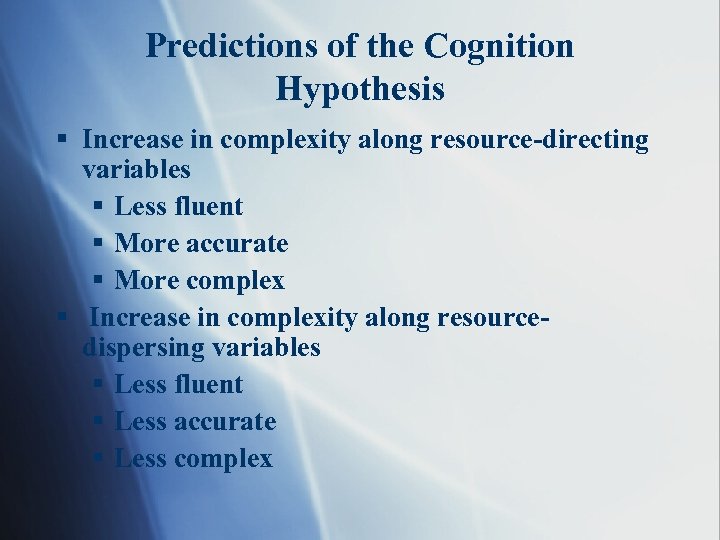 Predictions of the Cognition Hypothesis § Increase in complexity along resource-directing variables § Less fluent § More accurate § More complex § Increase in complexity along resourcedispersing variables § Less fluent § Less accurate § Less complex
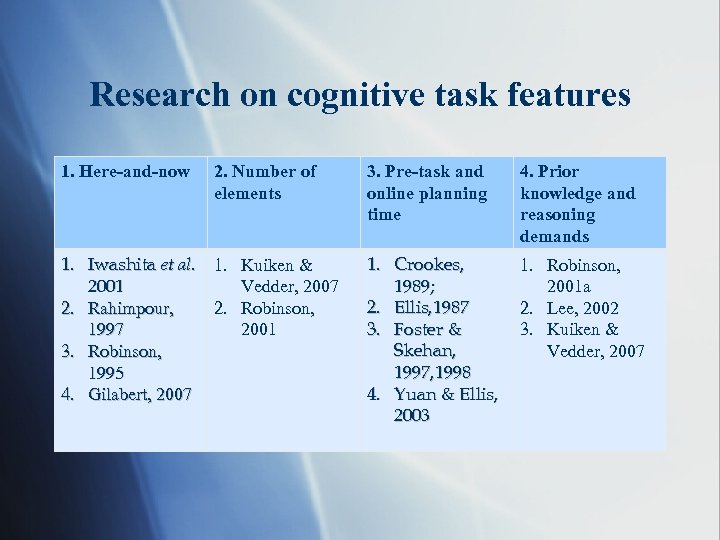 Research on cognitive task features 1. Here-and-now 2. Number of elements 1. Iwashita et al. 1. Kuiken & 2001 Vedder, 2007 2. Rahimpour, 2. Robinson, 1997 2001 3. Robinson, 1995 4. Gilabert, 2007 3. Pre-task and online planning time 4. Prior knowledge and reasoning demands 1. Crookes, 1989; 2. Ellis, 1987 3. Foster & Skehan, 1997, 1998 4. Yuan & Ellis, 2003 1. Robinson, 2001 a 2. Lee, 2002 3. Kuiken & Vedder, 2007
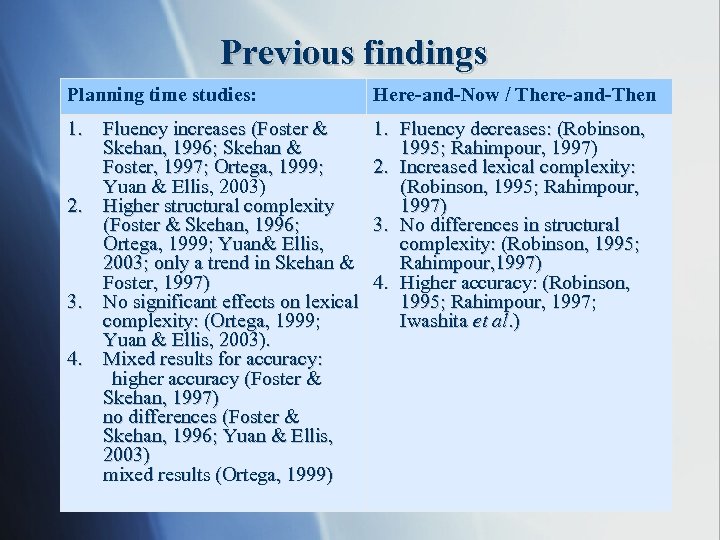 Previous findings Planning time studies: Here-and-Now / There-and-Then 1. Fluency increases (Foster & Skehan, 1996; Skehan & Foster, 1997; Ortega, 1999; Yuan & Ellis, 2003) 2. Higher structural complexity (Foster & Skehan, 1996; Ortega, 1999; Yuan& Ellis, 2003; only a trend in Skehan & Foster, 1997) 3. No significant effects on lexical complexity: (Ortega, 1999; Yuan & Ellis, 2003). 4. Mixed results for accuracy: higher accuracy (Foster & Skehan, 1997) no differences (Foster & Skehan, 1996; Yuan & Ellis, 2003) mixed results (Ortega, 1999) 1. Fluency decreases: (Robinson, 1995; Rahimpour, 1997) 2. Increased lexical complexity: (Robinson, 1995; Rahimpour, 1997) 3. No differences in structural complexity: (Robinson, 1995; Rahimpour, 1997) 4. Higher accuracy: (Robinson, 1995; Rahimpour, 1997; Iwashita et al. )
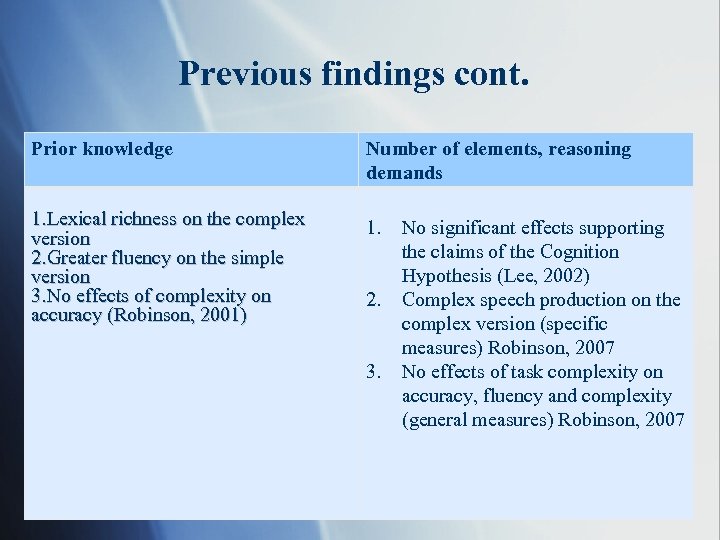 Previous findings cont. Prior knowledge Number of elements, reasoning demands 1. Lexical richness on the complex version 2. Greater fluency on the simple version 3. No effects of complexity on accuracy (Robinson, 2001) 1. 2. 3. No significant effects supporting the claims of the Cognition Hypothesis (Lee, 2002) Complex speech production on the complex version (specific measures) Robinson, 2007 No effects of task complexity on accuracy, fluency and complexity (general measures) Robinson, 2007
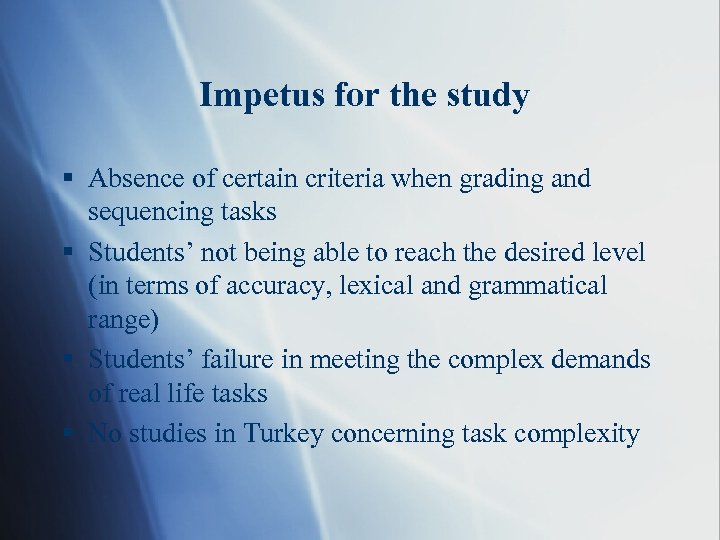 Impetus for the study § Absence of certain criteria when grading and sequencing tasks § Students’ not being able to reach the desired level (in terms of accuracy, lexical and grammatical range) § Students’ failure in meeting the complex demands of real life tasks § No studies in Turkey concerning task complexity
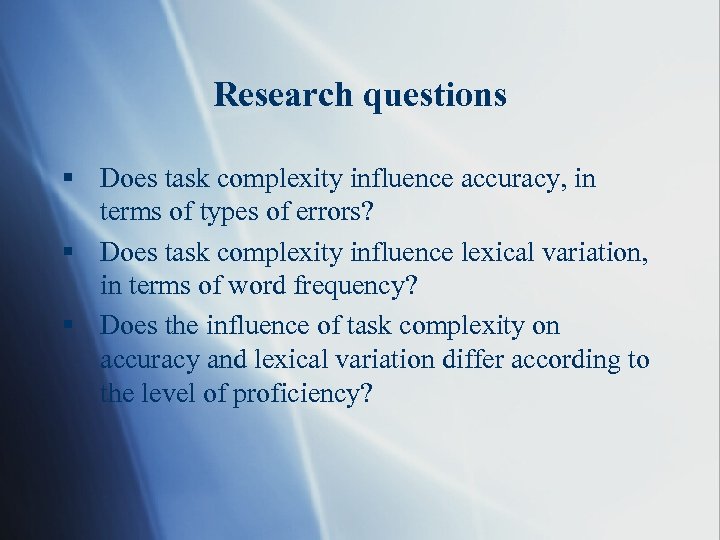 Research questions § Does task complexity influence accuracy, in terms of types of errors? § Does task complexity influence lexical variation, in terms of word frequency? § Does the influence of task complexity on accuracy and lexical variation differ according to the level of proficiency?
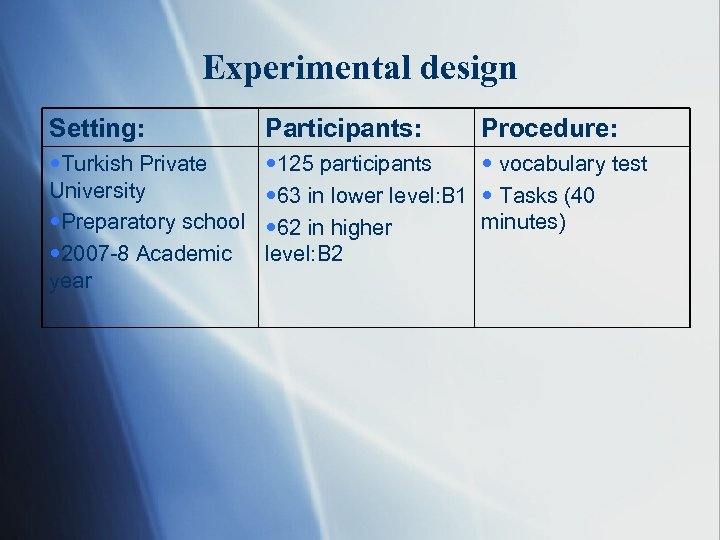 Experimental design Setting: Participants: Procedure: Turkish Private University Preparatory school 2007 -8 Academic year 125 participants vocabulary test 63 in lower level: B 1 Tasks (40 minutes) 62 in higher level: B 2
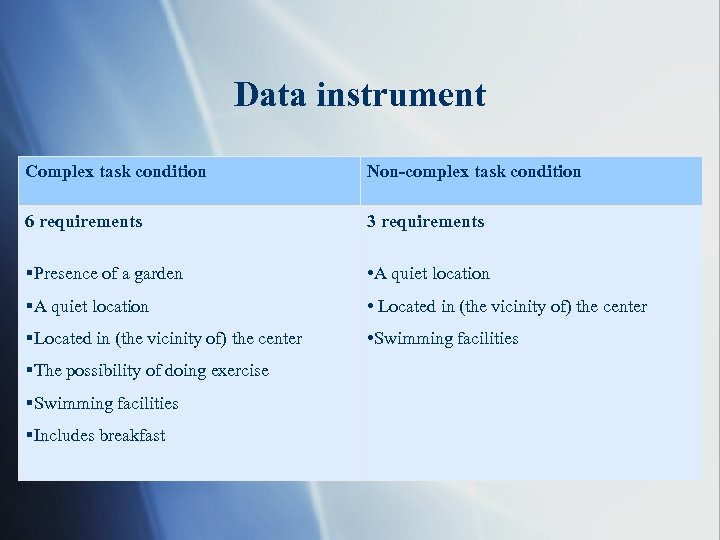 Data instrument Complex task condition Non-complex task condition 6 requirements 3 requirements §Presence of a garden • A quiet location §A quiet location • Located in (the vicinity of) the center §Located in (the vicinity of) the center • Swimming facilities §The possibility of doing exercise §Swimming facilities §Includes breakfast
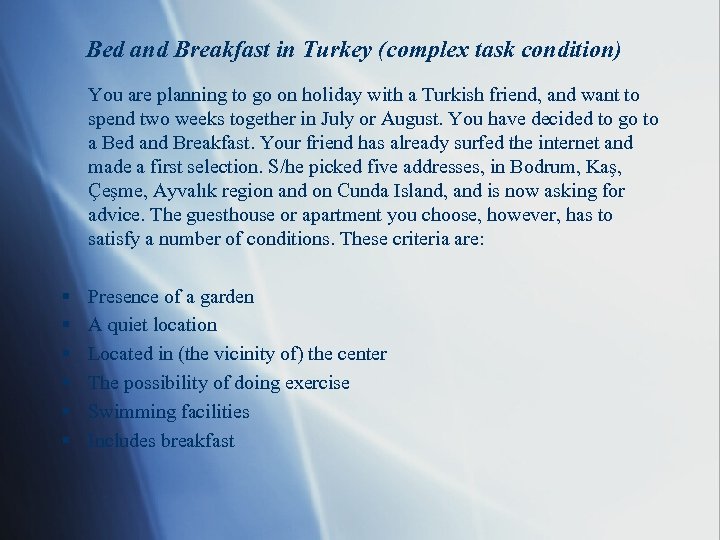 Bed and Breakfast in Turkey (complex task condition) You are planning to go on holiday with a Turkish friend, and want to spend two weeks together in July or August. You have decided to go to a Bed and Breakfast. Your friend has already surfed the internet and made a first selection. S/he picked five addresses, in Bodrum, Kaş, Çeşme, Ayvalık region and on Cunda Island, and is now asking for advice. The guesthouse or apartment you choose, however, has to satisfy a number of conditions. These criteria are: § § § Presence of a garden A quiet location Located in (the vicinity of) the center The possibility of doing exercise Swimming facilities Includes breakfast
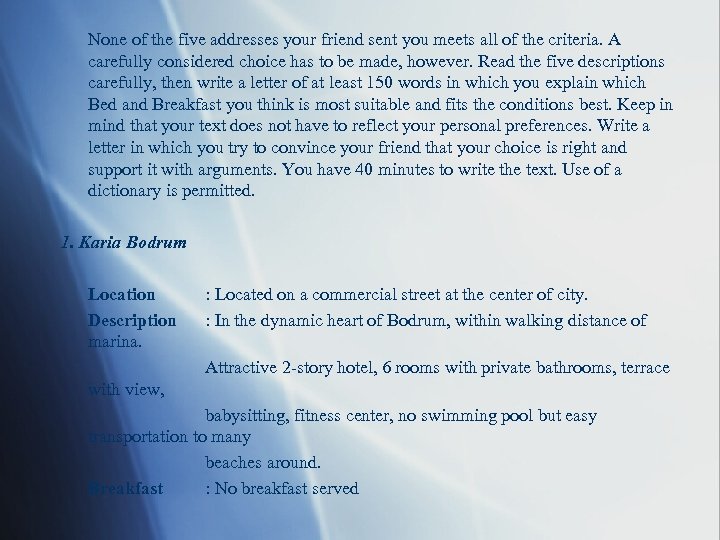 None of the five addresses your friend sent you meets all of the criteria. A carefully considered choice has to be made, however. Read the five descriptions carefully, then write a letter of at least 150 words in which you explain which Bed and Breakfast you think is most suitable and fits the conditions best. Keep in mind that your text does not have to reflect your personal preferences. Write a letter in which you try to convince your friend that your choice is right and support it with arguments. You have 40 minutes to write the text. Use of a dictionary is permitted. 1. Karia Bodrum Location : Located on a commercial street at the center of city. Description : In the dynamic heart of Bodrum, within walking distance of marina. Attractive 2 -story hotel, 6 rooms with private bathrooms, terrace with view, babysitting, fitness center, no swimming pool but easy transportation to many beaches around. Breakfast : No breakfast served
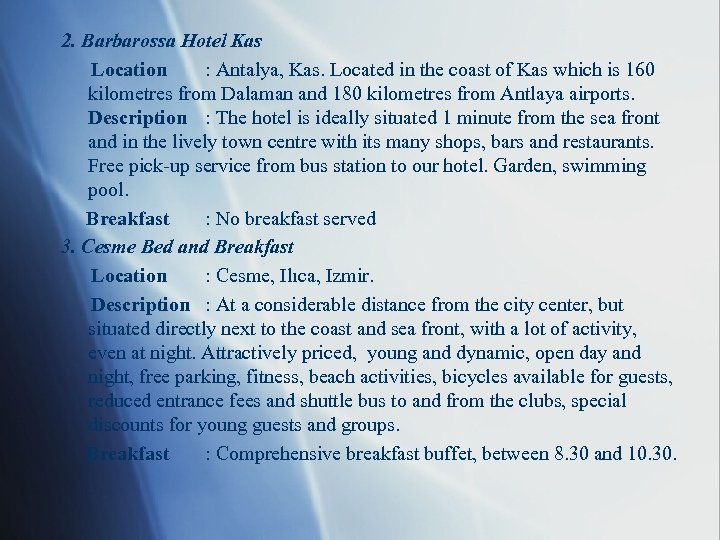 2. Barbarossa Hotel Kas Location : Antalya, Kas. Located in the coast of Kas which is 160 kilometres from Dalaman and 180 kilometres from Antlaya airports. Description : The hotel is ideally situated 1 minute from the sea front and in the lively town centre with its many shops, bars and restaurants. Free pick-up service from bus station to our hotel. Garden, swimming pool. Breakfast : No breakfast served 3. Cesme Bed and Breakfast Location : Cesme, Ilıca, Izmir. Description : At a considerable distance from the city center, but situated directly next to the coast and sea front, with a lot of activity, even at night. Attractively priced, young and dynamic, open day and night, free parking, fitness, beach activities, bicycles available for guests, reduced entrance fees and shuttle bus to and from the clubs, special discounts for young guests and groups. Breakfast : Comprehensive breakfast buffet, between 8. 30 and 10. 30.
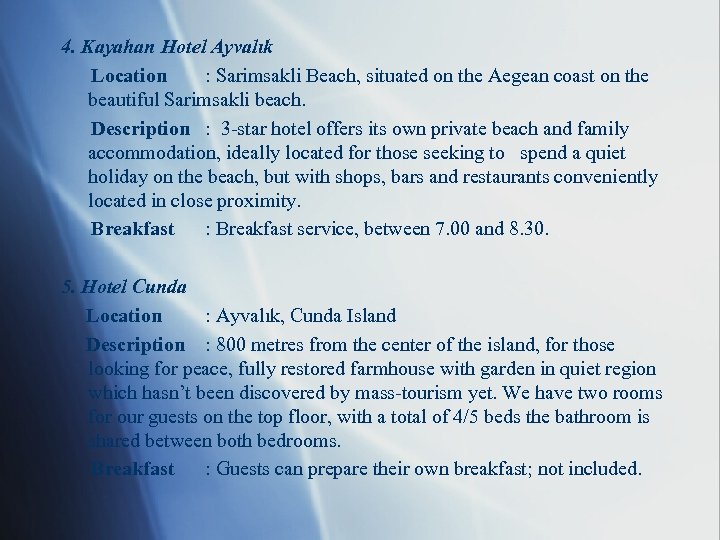 4. Kayahan Hotel Ayvalık Location : Sarimsakli Beach, situated on the Aegean coast on the beautiful Sarimsakli beach. Description : 3 -star hotel offers its own private beach and family accommodation, ideally located for those seeking to spend a quiet holiday on the beach, but with shops, bars and restaurants conveniently located in close proximity. Breakfast : Breakfast service, between 7. 00 and 8. 30. 5. Hotel Cunda Location : Ayvalık, Cunda Island Description : 800 metres from the center of the island, for those looking for peace, fully restored farmhouse with garden in quiet region which hasn’t been discovered by mass-tourism yet. We have two rooms for our guests on the top floor, with a total of 4/5 beds the bathroom is shared between both bedrooms. Breakfast : Guests can prepare their own breakfast; not included.
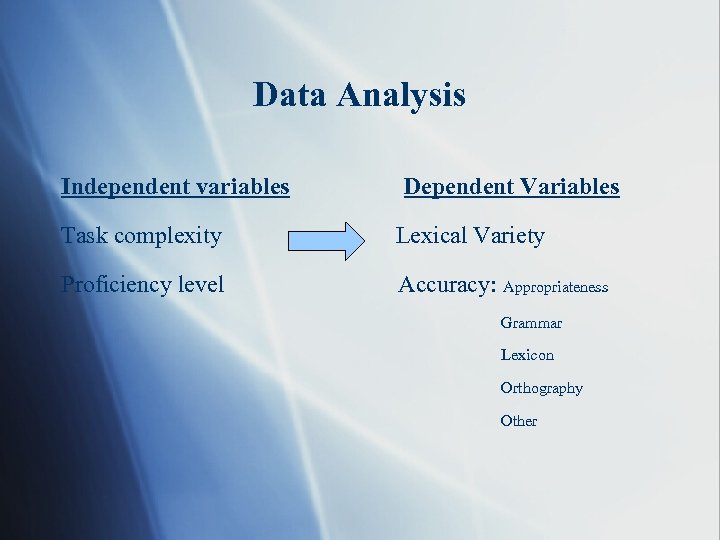 Data Analysis Independent variables Dependent Variables Task complexity Lexical Variety Proficiency level Accuracy: Appropriateness Grammar Lexicon Orthography Other
 Coding for accuracy § Errors per T-unit (E/T): E/T is an accuracy ratio which is the calculation of the total number of errors divided by the total number of T-units. § T-Unit: one main clause with all subordinate clauses attached to it (Hunt, 1965)
 Coding for lexical variety § Lexical proficiency analysis (Laufer &Nation, 1995) § Lexical frequency profile (LFP): “the percentage of words a learner uses at different vocabulary frequency levels in her writing- or, put differently relative proportions of words from different frequency levels” (p. 311). § The Compleat Lexical Tutor (Cobb, 1998) § Lexical variation was operationalized by the way of a typetoken ratio which does not ignore the text length: the total number of different word types divided by the square root of two times the total number of words (Carroll, 1967).
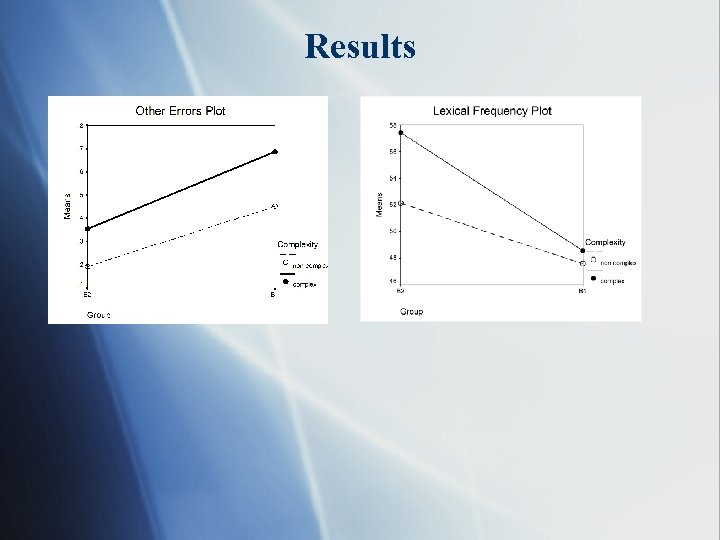
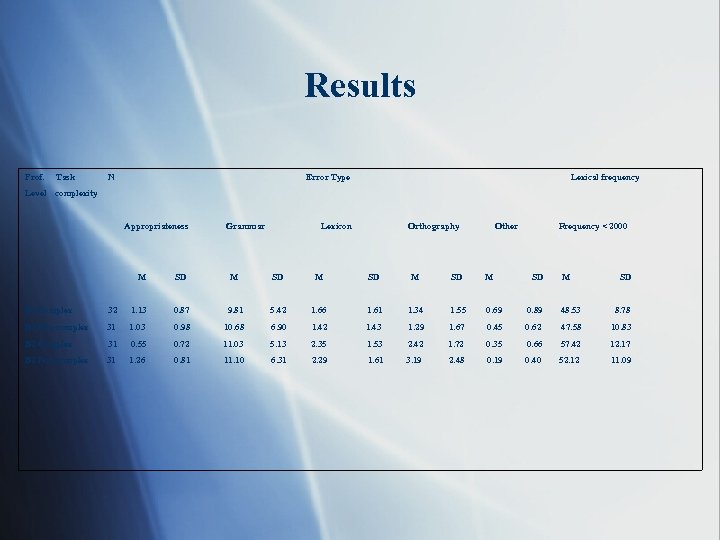 Results Prof. Task N Error Type Lexical frequency Level complexity Appropriateness Grammar Lexicon Orthography Other Frequency < 2000 M SD M SD M SD M SD B 1 Complex 32 1. 13 0. 87 9. 81 5. 42 1. 66 1. 61 1. 34 1. 55 0. 69 0. 89 48. 53 8. 78 B 1 Non-complex 31 1. 03 0. 98 10. 68 6. 90 1. 42 1. 43 1. 29 1. 67 0. 45 0. 62 47. 58 10. 83 B 2 Complex 31 0. 55 0. 72 11. 03 5. 13 2. 35 1. 53 2. 42 1. 72 0. 35 0. 66 57. 42 12. 17 B 2 Non-complex 31 1. 26 0. 81 11. 10 6. 31 2. 29 1. 61 3. 19 2. 48 0. 19 0. 40 52. 12 11. 09
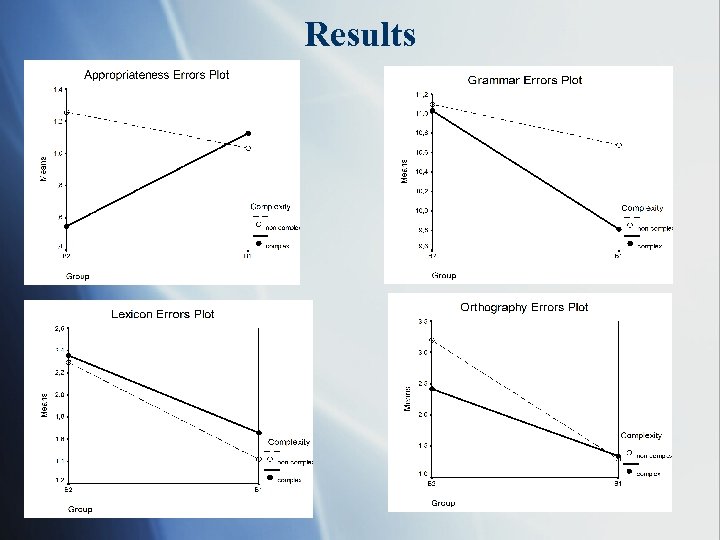 Results
 Results
 Discussion Task complexity and accuracy § No significant effects, except for appropriateness errors, were found supporting the claim that more cognitively complex version of the task (along the dimensions explained in the study) results in greater accuracy. § Appropriateness error was the only error type influenced by increasing cognitive complexity of the task.
 Discussion Task complexity and lexical frequency § No significant results were found supporting the Cognition Hypothesis or Limited Attentional Capacity Model. § Although general means and standard deviations show that complex task condition in both proficiency levels yield to more frequent words used, the results did not indicate a significant effect of complexity on lexical frequency. § However, it can be discussed that there is a trend towards Limited Attentional Capacity Model which claims that cognitively less complex tasks result in lexical richness.
 Discussion Task complexity and proficiency level: § Unexpected results § Higher proficiency level produced more errors than lower proficieny level did. § The effect of the syllabus at that time § Less accurate but more complex language ? ? ?
 Examples of learner errors B 2 -higher proficiency group 1. You want to go to a hotel which include garden, private beach, fitness and good breakfast service. 2. This hotel involved what we want. 3. We also go walking in Forest which Antalya has a lot. 4. So I think Barbarossa Hotel Kas is the only hotel which include everything we want among these five hotels. 5. I don’t like the other hotels because these haven’t provide our criteria. 6. It has number of option to eat.
 Examples of learner errors cont. B 1 -lower proficiency group 1. You can because there isn’t fitness center in this hotel. 2. We can breakfast with clear weather. 3. The hotel which is in Kas. 4. I make plan holiday for us. 5. I asked to travel management, how is your prefers. 6. I know we going vacation together this summery.
 Implications and suggestions for future research § Inconclusive results: difficulty of operationalization of task complexity § More studies to test writing production § Longitudinal studies where a continuous treatment which involves gradually increased cognitive complexity of tasks is applied may contribute to the understanding of causal relationships of the variables of the research better.
 References Foster, F. , & Skehan, P. (1999). The influence of source of planning and focus on taskbased performance. Language Teaching Research, 3(3), 215 -247. Gilabert, R. (2007). Effects of manipulating task complexity on self-repairs during L 2 oral production. IRAL, International Review of Applied Linguistics in Language Teaching, 45(3), 215 -240. Hunt, K. W. (1965). Grammatical structures written at three levels. Urbana, IL: The National Council of Teachers of English. Kuiken, V. , & Vedder, I. (2007 a). Cognitive task complexity and linguistic performance in French L 2 writing. In Maria del Pilar Garcia Mayo (Ed. ) Investigating Tasks in Formal Language learning, (pp. 117 -135). Clevedon: Multilingual Matters. Kuiken, V. , & Vedder, I. (2007 b). Task complexity and measures of linguistic performance in L 2 writing. IRAL, International Review of Applied Linguistic in Language Teaching, 45(3), 261 -284. Laufer, B. , & Nation, P. (1995). Vocabulary size and use: Lexical richness in L 2 written production. Applied Linguistics, 16, 307 -322. Michel, M. C. , Kuiken, V. , & Vedder, I. (2007). The influence of complexity in monologic versus dialogic tasks in Dutch L 2. IRAL, International Review of Applied Linguistic in Language Teaching, 45(3), 241 -259. Robinson, P. (1995 a). Attention, memory, and the “noticing” hypothesis. Language Learning, 45, 99140. Robinson, P. (1995 b). Task complexity and second language narrative discourse. Language Learning, 45(1), 99 -140.
 References cont. Robinson, P. (2001 a). Task complexity, task difficulty, and task production: Exploring interactions in a componential framework. Applied Linguistics, 22(1), 27 -57. Robinson, P. (2001 b). Task complexity, cognitive resources, and syllabus design: a triadic framework for examining task influences on SLA. In P. Robinson (Ed. ), Cognition and Second Language Instruction (pp. 287 -318). Cambridge: Cambridge University Press. Robinson, P. (2003). The cognition hypothesis, task design, and adult task-based learning. Second Language Studies, 21(2), 45 -105. Robinson, P. (2005). Cognitive complexity and task sequencing: Studies in a componential framework for second language task design. IRAL, International Review of Applied Linguistics in Language Teaching, 43(1), 1 -32. Robinson, P. (2007 a). Task complexity, theory of mind, and intentional reasoning: Effects of L 2 speech production, interaction, uptake and perceptions of task difficulty. IRAL, International Review of Applied Linguistics in Language Teaching, 45(3), 193 -213. Robinson, P. (2007 b). Criteria for grading and sequencing pedagogic tasks. In Maria del Pilar Garcia Mayo (Ed. ), Investigating Tasks in Formal Language Learning (pp. 7 -27). Clevedon: Multilingual Matters. Robinson, P. , & Gilabert, R. (2007). Task complexity, the Cognition Hypothesis and second language learning and performance. IRAL, International Review of Applied Linguistics in Language Teaching, 45(3), 161 -176. Skehan, P. (1996). A framework for the implementation of task based instruction. Applied Linguistics, 17(1), 38– 62.
 References cont. Skehan, P. (1998). A cognitive approach to language learning. Hong Kong: Oxford. Skehan, P. (2003). Task-based instruction. Language Teaching, 31, 1 -14. Skehan, P. , & Foster, P. (1997). Task type and task processing conditions as influences on foreign language performance. Language Teaching Research, 1(3), 185 -212. Skehan, P. , & Foster, P. (1999). The influence of task structure and processing conditions on narrative retellings. Language Learning, 49(1), 93 -120. Skehan, P. , & Foster, P. (2001). Cognition and tasks. In P. Robinson (Ed. ), Cognition and second language instruction (pp. 183 -205). Cambridge: Cambridge University Press. Tavakoli, P. , & Foster, P. (2008). Task design and second language performance: The effect of narrative type on learner output. Language Learning, 58(2), 439 -473.
 THANK YOU