 Скачать презентацию THE EFFECTS OF ROAD PRICING ON TRAVEL BEHAVIOUR
4ba4e9aee5345ff16910659d49b67d28.ppt
- Количество слайдов: 22



THE EFFECTS OF ROAD PRICING ON TRAVEL BEHAVIOUR. THE CASE OF MILAN Paolo Beria Ilaria Mariotti Ila Maltese Flavio Boscacci DASt. U, Politecnico di Milano SIET 2013 Venezia, September 18 th-20 th, 2013
STRUCTURE • Aim of the work • Literature review on Road Pricing • Data and methodology • Descriptive statistics • Multinomial logit results • Conclusions
AIM OF THE WORK Investigating the road pricing impact on travel behaviour at the urban scale. 1, 198 Milan citizens have been surveyed (Green Move project).
STRUCTURE • Aim of the work • Literature review on Road Pricing • Data and methodology • Descriptive statistics • Multinomial logit results • Conclusions
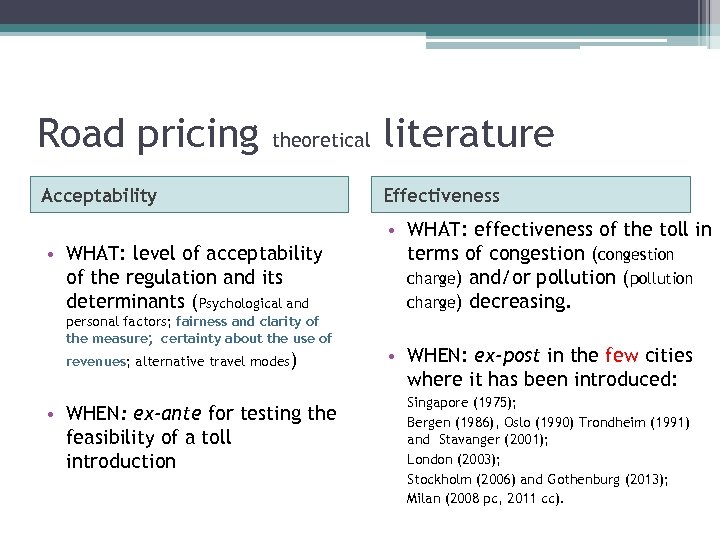
Road pricing theoretical literature Acceptability Effectiveness • WHAT: level of acceptability of the regulation and its determinants (Psychological and • WHAT: effectiveness of the toll in terms of congestion (congestion charge) and/or pollution (pollution charge) decreasing. personal factors; fairness and clarity of the measure; certainty about the use of revenues; alternative travel modes) • WHEN: ex-ante for testing the feasibility of a toll introduction • WHEN: ex-post in the few cities where it has been introduced: Singapore (1975); Bergen (1986), Oslo (1990) Trondheim (1991) and Stavanger (2001); London (2003); Stockholm (2006) and Gothenburg (2013); Milan (2008 pc, 2011 cc).
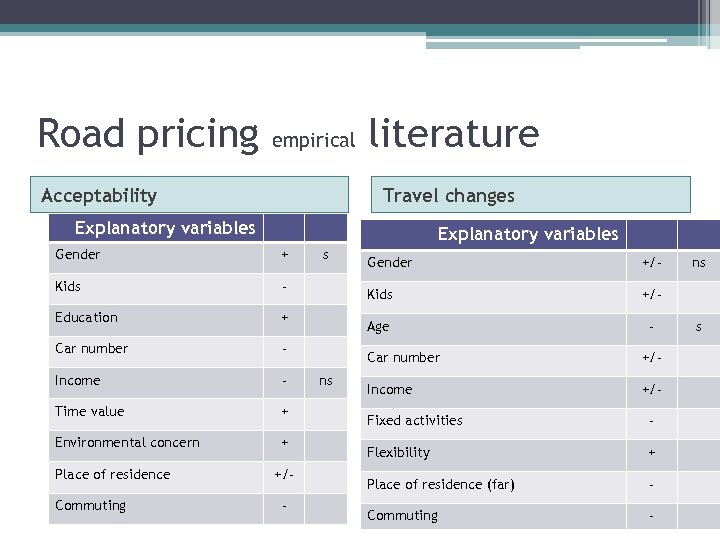
Road pricing empirical Acceptability literature Travel changes Explanatory variables Gender + Kids - Education + Car number - Income - Time value + Environmental concern + Place of residence Commuting +/- s Gender +/- Kids +/- Age - Car number ns +/- Income +/- Fixed activities - Flexibility + Place of residence (far) - Commuting - ns s
STRUCTURE • Aim of the work • Literature review on Road Pricing • Data and methodology • Descriptive statistics • Multinomial logit results • Conclusions
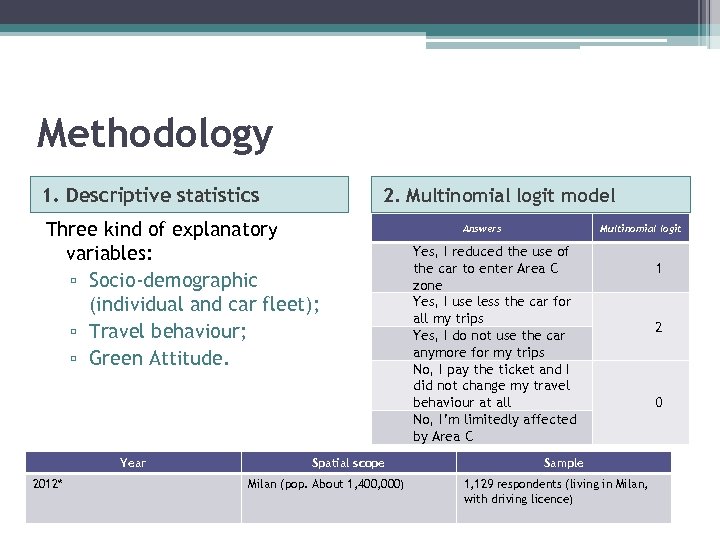
Methodology 1. Descriptive statistics 2. Multinomial logit model Three kind of explanatory variables: ▫ Socio-demographic (individual and car fleet); ▫ Travel behaviour; ▫ Green Attitude. Year 2012* Spatial scope Milan (pop. About 1, 400, 000) Answers Multinomial logit Yes, I reduced the use of the car to enter Area C zone Yes, I use less the car for all my trips Yes, I do not use the car anymore for my trips No, I pay the ticket and I did not change my travel behaviour at all No, I’m limitedly affected by Area C Sample 1, 129 respondents (living in Milan, with driving licence) 1 2 0
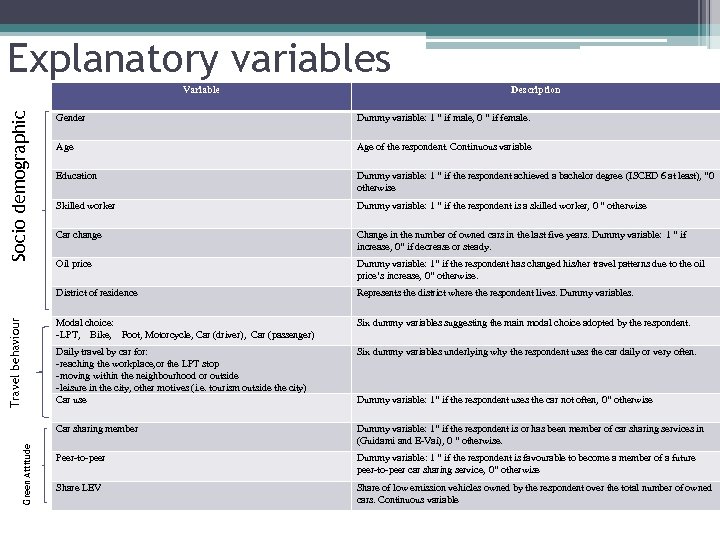
Explanatory variables Socio demographic Variable Description Age of the respondent. Continuous variable Education Dummy variable: 1 “ if the respondent achieved a bachelor degree (ISCED 6 at least), “ 0 otherwise Skilled worker Dummy variable: 1 “ if the respondent is a skilled worker, 0 “ otherwise Car change Change in the number of owned cars in the last five years. Dummy variable: 1 “ if increase, 0“ if decrease or steady. Oil price Dummy variable: 1“ if the respondent has changed his/her travel patterns due to the oil price’s increase, 0“ otherwise. Represents the district where the respondent lives. Dummy variables. Modal choice: -LPT, Bike, Foot, Motorcycle, Car (driver), Car (passenger) Six dummy variables suggesting the main modal choice adopted by the respondent. Daily travel by car for: -reaching the workplace, or the LPT stop -moving within the neighbourhood or outside -leisure in the city, other motives (i. e. tourism outside the city) Car use Six dummy variables underlying why the respondent uses the car daily or very often. Car sharing member Travel behaviour Dummy variable: 1 “ if male, 0 “ if female. District of residence Green Attitude Gender Dummy variable: 1“ if the respondent is or has been member of car sharing services in (Guidami and E-Vai), 0 “ otherwise. Peer-to-peer Dummy variable: 1 “ if the respondent is favourable to become a member of a future peer-to-peer car sharing service, 0“ otherwise Share LEV Share of low emission vehicles owned by the respondent over the total number of owned cars. Continuous variable Dummy variable: 1“ if the respondent uses the car not often, 0“ otherwise
STRUCTURE • Aim of the work • Literature review on Road Pricing • Data and methodology • Descriptive statistics • Multinomial logit results • Conclusions
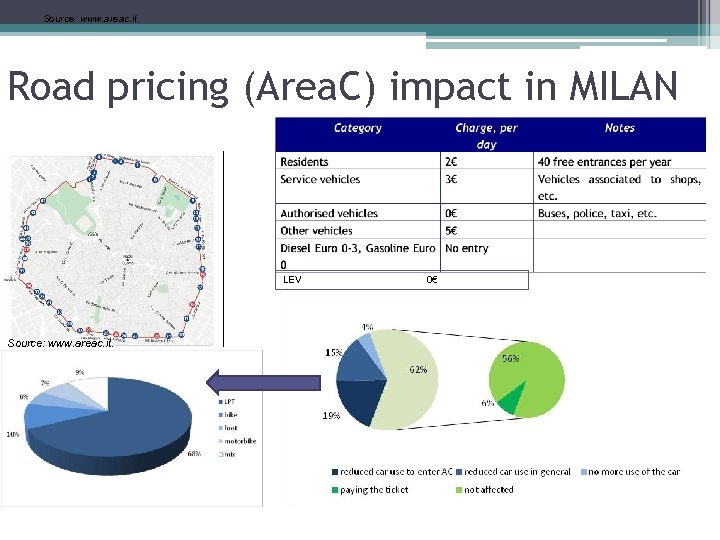
Source: www. areac. it. Road pricing (Area. C) impact in MILAN LEV Source: www. areac. it. 0€
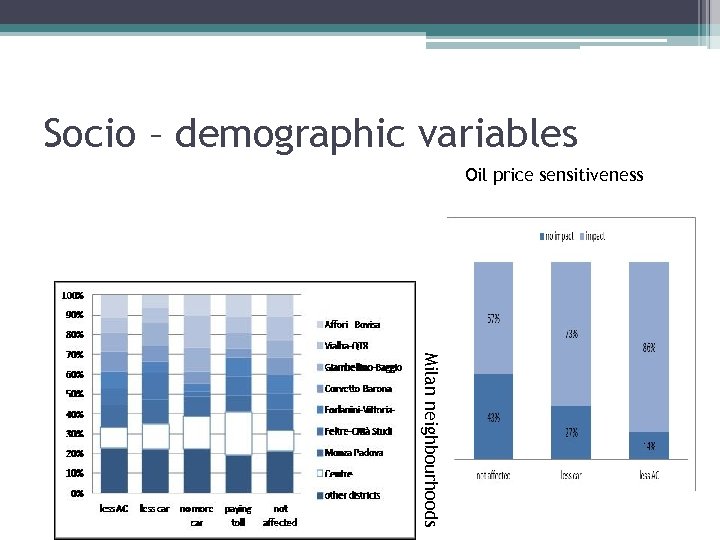
Socio – demographic variables Oil price sensitiveness Milan neighbourhoods
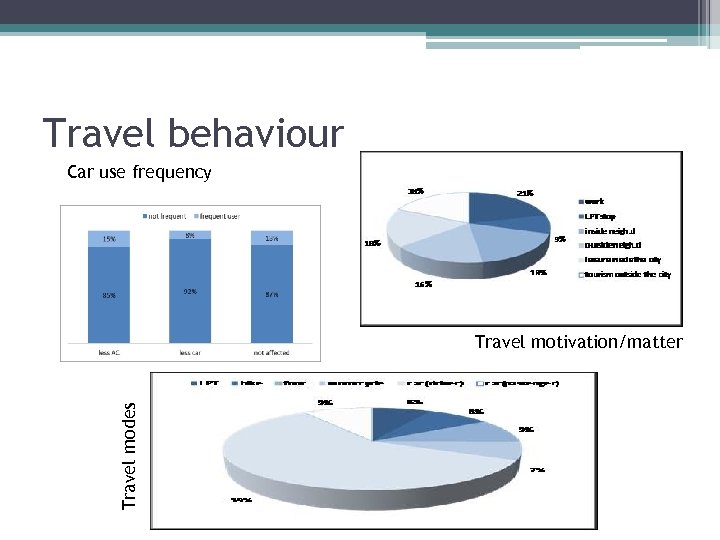
Travel behaviour Car use frequency Travel modes Travel motivation/matter
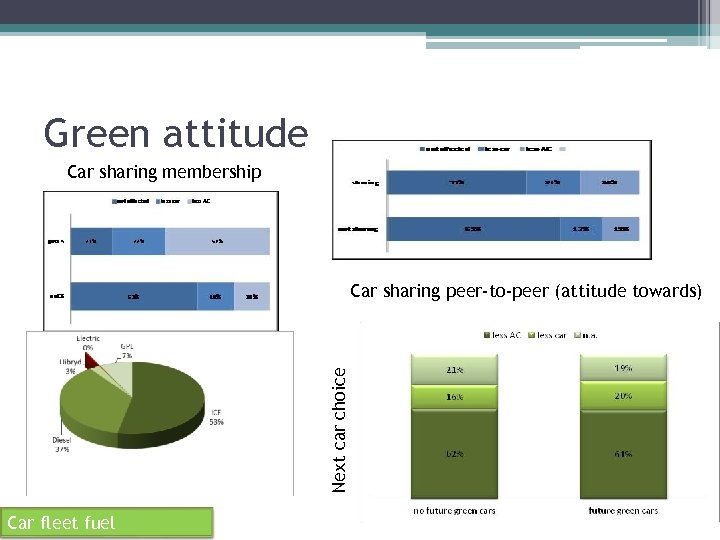
Green attitude Car sharing membership Next car choice Car sharing peer-to-peer (attitude towards) Car fleet fuel
STRUCTURE • Aim of the work • Literature review on Road Pricing • Data and methodology • Descriptive statistics • Multinomial logit results • Conclusions
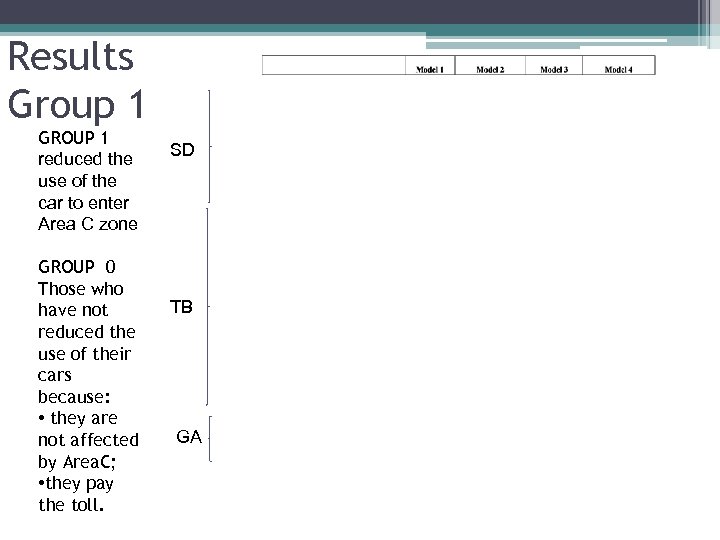
Results Group 1 GROUP 1 reduced the use of the car to enter Area C zone GROUP 0 Those who have not reduced the use of their cars because: • they are not affected by Area. C; • they pay the toll. SD TB GA
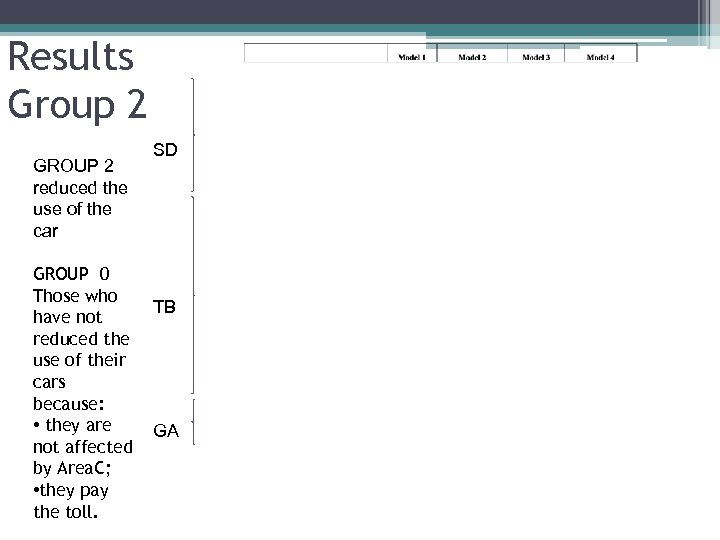
Results Group 2 GROUP 2 reduced the use of the car GROUP 0 Those who have not reduced the use of their cars because: • they are not affected by Area. C; • they pay the toll. SD TB GA
COMMENTS • Gender is not always significant • Permanent job (proxied by using the car to reach the work place) makes respondents less flexible • Age proved to be significant • Groups 1 and 2 tend to prefer LPT, and to use the car to reach the LPT stop • The two groups share some features like pricesensitiveness, travel behavior, and green attitude. • Owning Low Emission Vehicles is always negative and significant.
STRUCTURE • Aim of the work • Literature review on Road Pricing • Data and methodology • Descriptive statistics • Multinomial logit results • Conclusions
CONCLUSIONS EFFECTIVENESS of the Area C program in car use reduction. The impact is not homogeneously distributed among users: q Weaker groups tend to be more affected due to their price sensitiveness. q LPT users as well are more likely to reduce their car use. EXOGENOUS factors (not investigated) • A clear communication of ▫ the policy goals ▫ the use of the toll revenues • The presence of a good LPT service • The involvement of the citizens.
Thank you for your attention! Questions and suggestions are welcome. Ila Maltese DASt. U – Politecnico di Milano ila. maltese@polimi. it
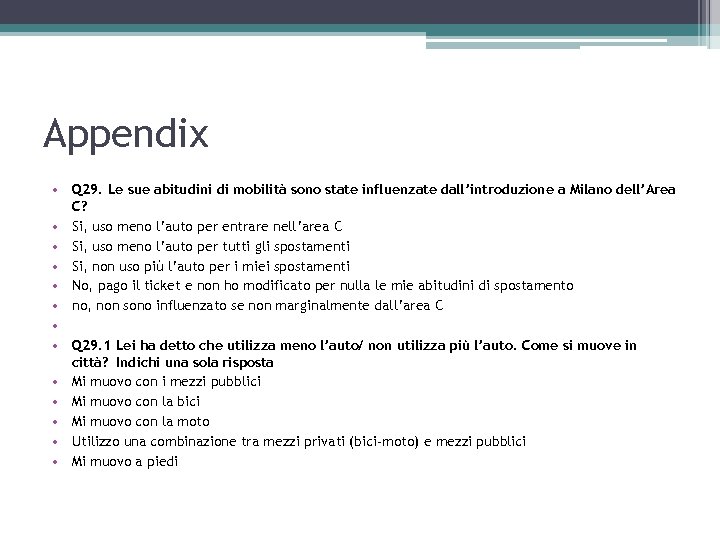
Appendix • Q 29. Le sue abitudini di mobilità sono state influenzate dall’introduzione a Milano dell’Area C? • Si, uso meno l’auto per entrare nell’area C • Si, uso meno l’auto per tutti gli spostamenti • Si, non uso più l’auto per i miei spostamenti • No, pago il ticket e non ho modificato per nulla le mie abitudini di spostamento • no, non sono influenzato se non marginalmente dall’area C • • Q 29. 1 Lei ha detto che utilizza meno l’auto/ non utilizza più l’auto. Come si muove in città? Indichi una sola risposta • Mi muovo con i mezzi pubblici • Mi muovo con la bici • Mi muovo con la moto • Utilizzo una combinazione tra mezzi privati (bici-moto) e mezzi pubblici • Mi muovo a piedi
Скачать презентацию THE EFFECTS OF ROAD PRICING ON TRAVEL BEHAVIOUR
4ba4e9aee5345ff16910659d49b67d28.ppt