 Скачать презентацию The effects of obstetric complications on the health
9196fe548fccec9766845b5224e6bb0e.ppt
- Количество слайдов: 25



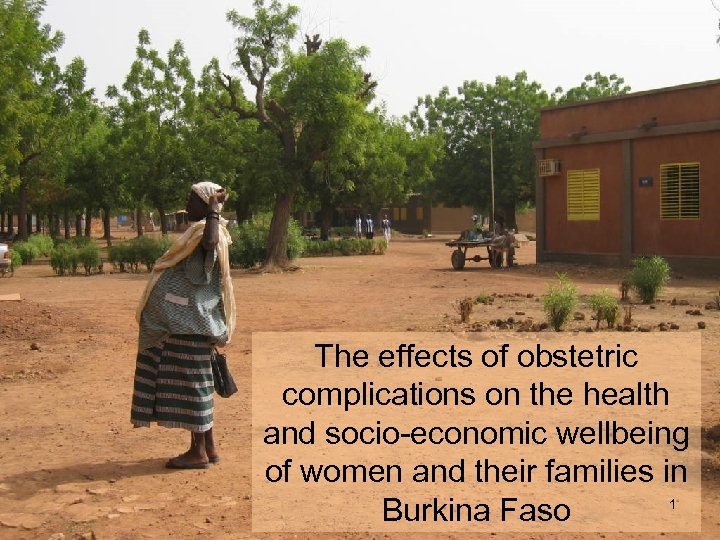
The effects of obstetric complications on the health and socio-economic wellbeing of women and their families in 1 Burkina Faso
The effects of obstetric complications on the health and socio-economic wellbeing of women and their families in Burkina Faso (V Filippi, N Meda, R Ganaba, S Murray, T Marshall, S Russell, K Storeng, P Iboulo, M Akoum) Hewlett Foundation / ESRC funded 2
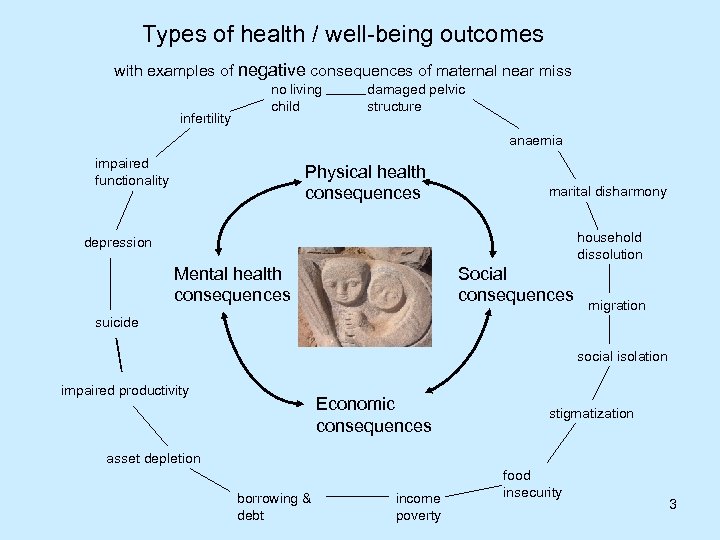
Types of health / well-being outcomes with examples of negative consequences of maternal near miss infertility no living child damaged pelvic structure anaemia impaired functionality Physical health consequences marital disharmony household dissolution depression Mental health consequences Social consequences migration suicide social isolation impaired productivity Economic consequences stigmatization asset depletion borrowing & debt income poverty food insecurity 3
![Well-being following a pregnancy, childbirth or complications [The delivery] is a little bit dangerous.](https://present5.com/presentation/9196fe548fccec9766845b5224e6bb0e/image-4.jpg "Well-being following a pregnancy, childbirth or complications [The delivery] is a little bit dangerous.")
Well-being following a pregnancy, childbirth or complications [The delivery] is a little bit dangerous. But there is also happiness. After the delivery, if everything went well, and you see the child, you are happy (Burkinabè mother) Because I was losing urine, I did not want to get pregnant before my fistula was repaired. [My husband] used to threaten me with a knife, accusing me of having sexual relationships with other men (18 -year old Burkinabè woman with vesico-vaginal fistula) 4
Well-being following a pregnancy, childbirth or complications “Even yesterday they were speaking about it. They were saying that if it hadn’t been for the cost of my operation, the problem of buying [food] wouldn’t have been as bad, because we could have spent the money that we spent on the operation to buy millet. When they say things like this, I just get up and leave the room and wait until they have finished before I go back in and join them”. 5
Rationale • Burden of disease from maternal causes underestimated due to lack of attention to outcomes after pregnancy • Emergency medical care saves lives, but those surviving near miss may face potentially disabling consequences. But inadequate support for those women who survive such experiences • The research also relevant to wider social protection debates. Illhealth is a shock to household resources and livelihood activities impoverishment • Identify factors influencing vulnerability and resilience to such shocks • Inform social protection policy, including health policy, to enhance resilience. Growing research in this policy area but not for maternal health. 6
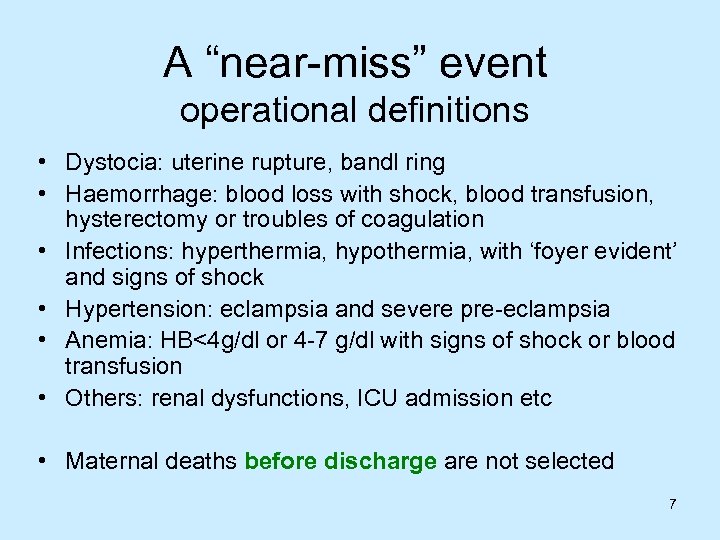
A “near-miss” event operational definitions • Dystocia: uterine rupture, bandl ring • Haemorrhage: blood loss with shock, blood transfusion, hysterectomy or troubles of coagulation • Infections: hyperthermia, hypothermia, with ‘foyer evident’ and signs of shock • Hypertension: eclampsia and severe pre-eclampsia • Anemia: HB<4 g/dl or 4 -7 g/dl with signs of shock or blood transfusion • Others: renal dysfunctions, ICU admission etc • Maternal deaths before discharge are not selected 7
Our basic hypotheses • Near-miss complications are likely to be associated with long-term health, social and economic consequences • The consequences experienced by women will depend in part on the type or child outcome of near-miss complication experienced by the woman. 8
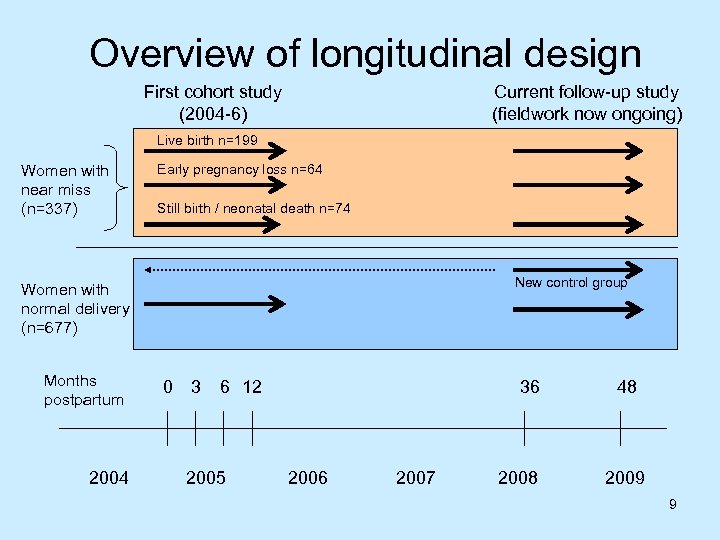
Overview of longitudinal design First cohort study (2004 -6) Current follow-up study (fieldwork now ongoing) Live birth n=199 Women with near miss (n=337) Early pregnancy loss n=64 Still birth / neonatal death n=74 New control group Women with normal delivery (n=677) Months postpartum 2004 0 3 6 12 2005 36 2007 2008 48 2009 9

First study - Key findings 10
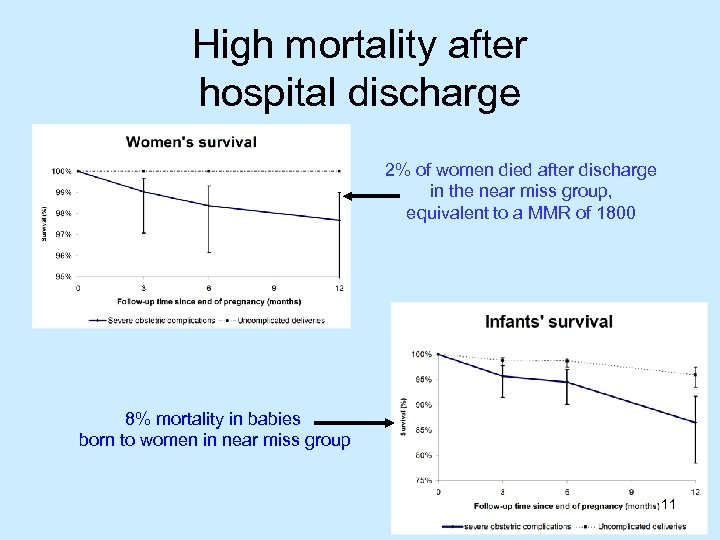
High mortality after hospital discharge 2% of women died after discharge in the near miss group, equivalent to a MMR of 1800 8% mortality in babies born to women in near miss group 11
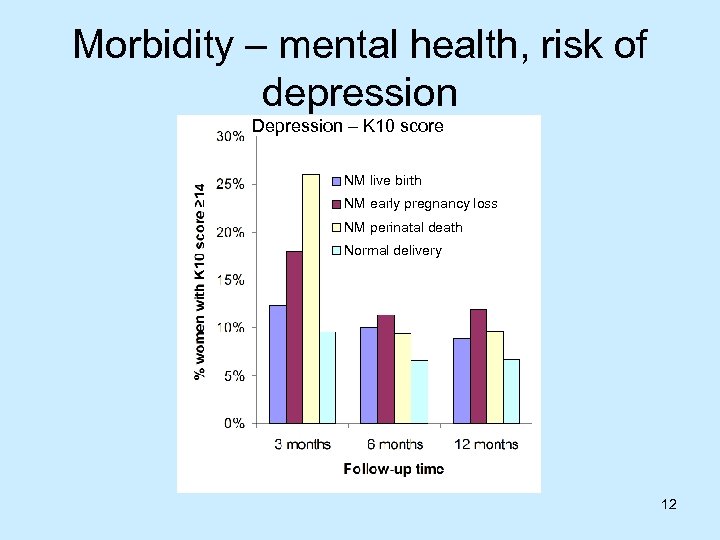
Morbidity – mental health, risk of depression Depression – K 10 score NM live birth NM early pregnancy loss NM perinatal death Normal delivery 12
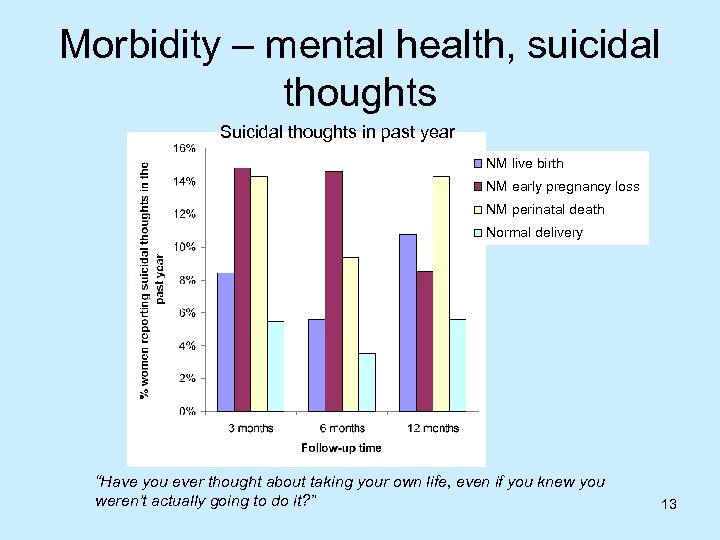
Morbidity – mental health, suicidal thoughts Suicidal thoughts in past year NM live birth NM early pregnancy loss NM perinatal death Normal delivery “Have you ever thought about taking your own life, even if you knew you weren’t actually going to do it? ” 13
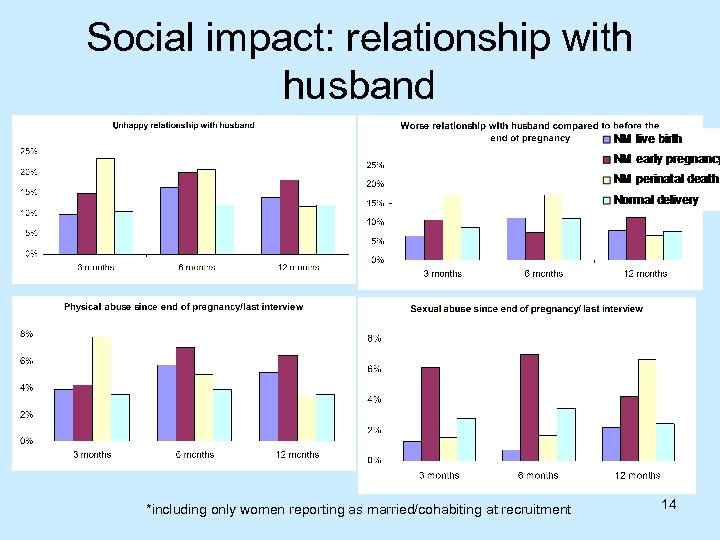
Social impact: relationship with husband *including only women reporting as married/cohabiting at recruitment 14
Economic impacts: long-lasting burdens • Higher fees and direct cost burdens for nearmiss cohort • Higher levels of debt • Slower repayment of debt among debt-takers who had near-miss complications: 12. 0% in debt vs. 3. 7% at 12 months • Small levels of debt contributed to everyday struggle for survival for poor households • But in general economic findings more limited in first study 15
Summary of findings • High level of postpartum morbidity for all women • Evidence of near-miss effect but also ‘no baby’ effect • Near-miss effect: – – – • Significant increased mortality in near-miss women and babies after discharge negative feelings, lack of self esteem up to a year postpartum More likely to have debts up to 1 year postpartum ‘No baby’ effect: – – Women with perinatal mortality at increased risk for mental health problems – Marital disharmony in early postpartum, and sexual violence remains at 12 months – • Women with early pregnancy loss at much higher risk for severe anaemia& ill health Pressure to have another pregnancy again quickly Limited role of socio-economic status in explaining health findings 16
Methods for follow up study • Find the women in the original cohort and seek informed consent to do follow up visits • Re-visit the women in the cohort at 36 and 48 months • Add a comparison group of women who delivered at home or in a health centre (neighbourhood sampling approach) • Select a small purposive sample for in depth qualitative follow up 17
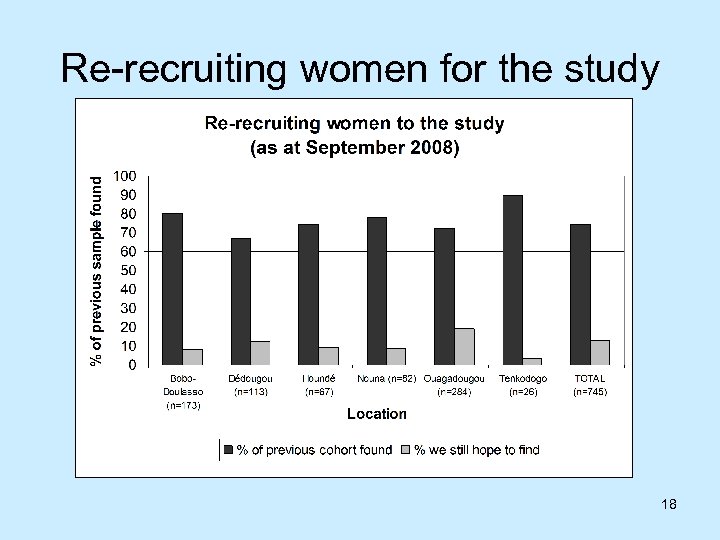
Re-recruiting women for the study 18
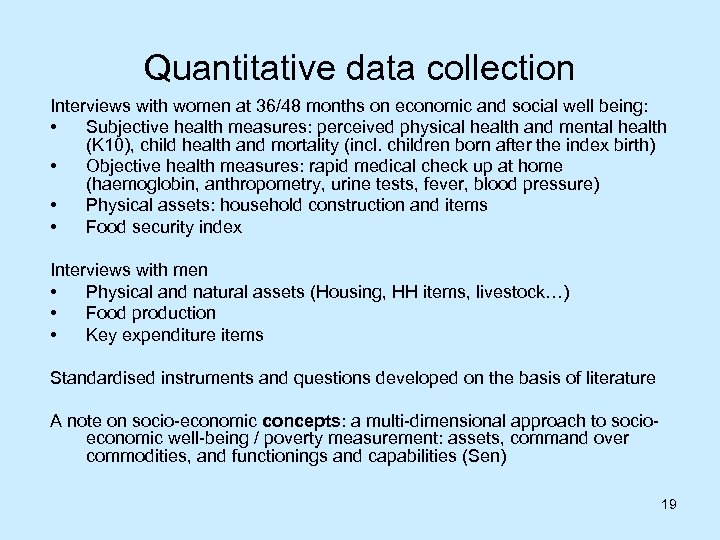
Quantitative data collection Interviews with women at 36/48 months on economic and social well being: • Subjective health measures: perceived physical health and mental health (K 10), child health and mortality (incl. children born after the index birth) • Objective health measures: rapid medical check up at home (haemoglobin, anthropometry, urine tests, fever, blood pressure) • Physical assets: household construction and items • Food security index Interviews with men • Physical and natural assets (Housing, HH items, livestock…) • Food production • Key expenditure items Standardised instruments and questions developed on the basis of literature A note on socio-economic concepts: a multi-dimensional approach to socioeconomic well-being / poverty measurement: assets, command over commodities, and functionings and capabilities (Sen) 19
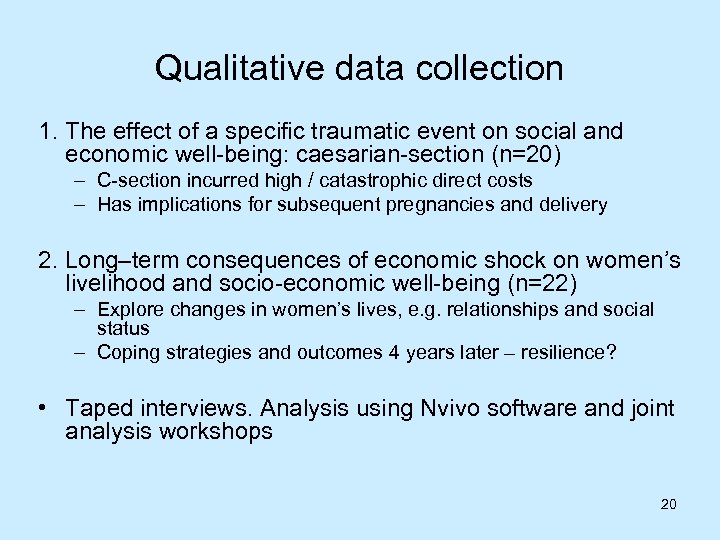
Qualitative data collection 1. The effect of a specific traumatic event on social and economic well-being: caesarian-section (n=20) – C-section incurred high / catastrophic direct costs – Has implications for subsequent pregnancies and delivery 2. Long–term consequences of economic shock on women’s livelihood and socio-economic well-being (n=22) – Explore changes in women’s lives, e. g. relationships and social status – Coping strategies and outcomes 4 years later – resilience? • Taped interviews. Analysis using Nvivo software and joint analysis workshops 20
Ethical dilemmas • Big debate among team, and some disagreement, on whether and how the research project can act when suffering and dangers to health identified among research subjects, especially during in depth repeat visits. • In first study overwhelming amount of suffering found in repeated visits: depression, fistulae, extreme hunger, violence, • At that time difficult to decide on a threshold at which to intervene • Team has now established some basic guidelines for the researchers in the field on whether and when to take action, and what action to take. • Length of questionnaire also a concern • At end of first study, community dissemination with theatre forums well received and well attended 21
Policy implications • Programmes must consider the implications of severe, near-miss complications with sequelae for women who survive, not only in evaluation but also programmatically. • Rethink postnatal care: target ‘near-misses’ in the post-partum as they may have long term ill health • It is essential to develop innovative mechanisms for financing maternal healthcare that do not place the burden on the household and contribute to further impoverishment • Greater government provision for expensive emergency care, not just skilled birth attendance • Measures to increase awareness of risks in pregnancy and initiatives to address gender inequalities that place some women at disproportionate risk • • E. g. White Ribbon Alliance for Safe Motherhood (in Burkina Faso) E. g. Income generating schemes for women? 22
Further research needed • Intervention studies testing innovative strategies, not only before or during pregnancy or delivery, but also after complications have occurred • Evaluate effects of changes in user fees or other financing mechanisms to protect the poor on long term economic outcomes 23
Acknowledgments • Funders: • Immpact (Burkina Phase 1) • Hewlett Foundation/ESRC (Burkina Phase 2) • Research teams: • Burkina Phase 1: Veronique Filippi, Rasmane Ganaba, Thomas Ouedraogo, Tom Marshall, Issiaka Sombie, Melanie Akoum, Fatou Ouattara, Becky Baggaley and Nicolas Meda • Burkina Phase 2: Veronique Filippi, Rasmane Ganaba, Tom Marshall, Melanie Akoum, Nicolas Meda , Susan Murray, Steve Russell 24
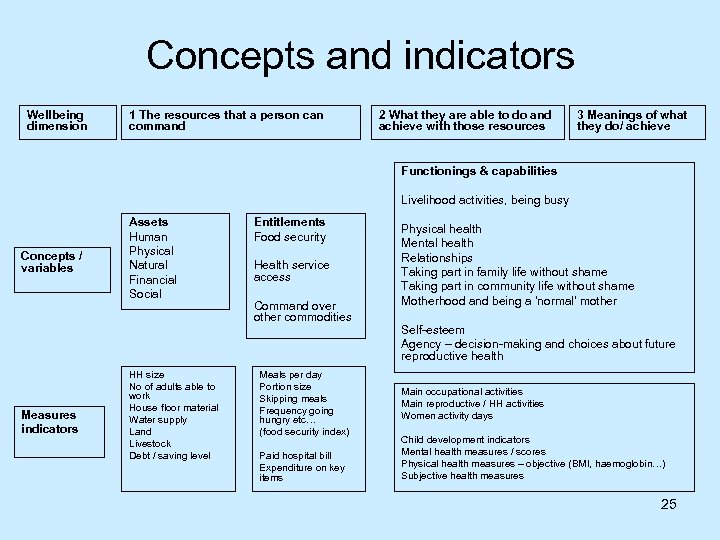
Concepts and indicators Wellbeing dimension 1 The resources that a person can command 2 What they are able to do and achieve with those resources 3 Meanings of what they do/ achieve Functionings & capabilities Livelihood activities, being busy Concepts / variables Measures indicators Assets Human Physical Natural Financial Social HH size No of adults able to work House floor material Water supply Land Livestock Debt / saving level Entitlements Food security Health service access Command over other commodities Meals per day Portion size Skipping meals Frequency going hungry etc… (food security index) Paid hospital bill Expenditure on key items Physical health Mental health Relationships Taking part in family life without shame Taking part in community life without shame Motherhood and being a ‘normal’ mother Self-esteem Agency – decision-making and choices about future reproductive health Main occupational activities Main reproductive / HH activities Women activity days Child development indicators Mental health measures / scores Physical health measures – objective (BMI, haemoglobin…) Subjective health measures 25
Скачать презентацию The effects of obstetric complications on the health
9196fe548fccec9766845b5224e6bb0e.ppt