


 Скачать презентацию The Effects of Foreign Shocks when Interest Rates
c1ad51e3f04e3650ca8d10bc9cb5b691.ppt
- Количество слайдов: 15
 The Effects of Foreign Shocks when Interest Rates are at Zero M. Bodenstein, C. J. Erceg, L. Guerrieri Discussion by Ricardo Mestre Macroeconomic Modelling Workshop Jerusalem, 28 -29 October 2009
 Structure of presentation • • • Brief description of goals of paper Remarks on stability properties under the ZLB Some issues on the exercise Some issues on the model Great job done by authors! 2
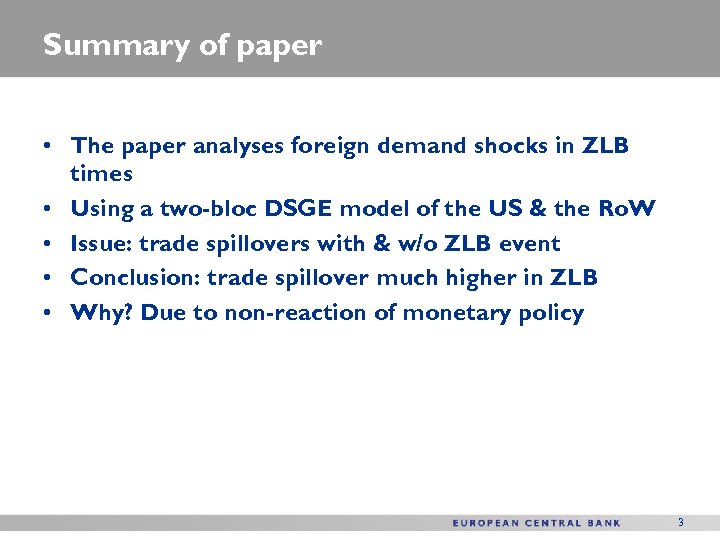 Summary of paper • The paper analyses foreign demand shocks in ZLB times • Using a two-bloc DSGE model of the US & the Ro. W • Issue: trade spillovers with & w/o ZLB event • Conclusion: trade spillover much higher in ZLB • Why? Due to non-reaction of monetary policy 3
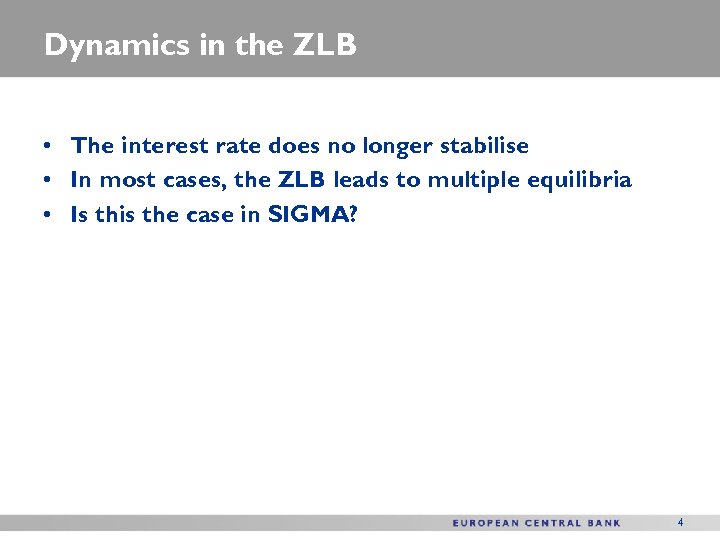 Dynamics in the ZLB • The interest rate does no longer stabilise • In most cases, the ZLB leads to multiple equilibria • Is this the case in SIGMA? 4
 Dynamics in the ZLB • Multiple equilibria: one forward (unstable) root becomes backward (stable) root • A return to the stable region is assured in the exercise • Variables affected jump downward, then return to base • The jump is (in models of this kind) expectation-driven • Hence, importance of managing expectations • Demand shocks matter! • What about fiscal in the paper? 5
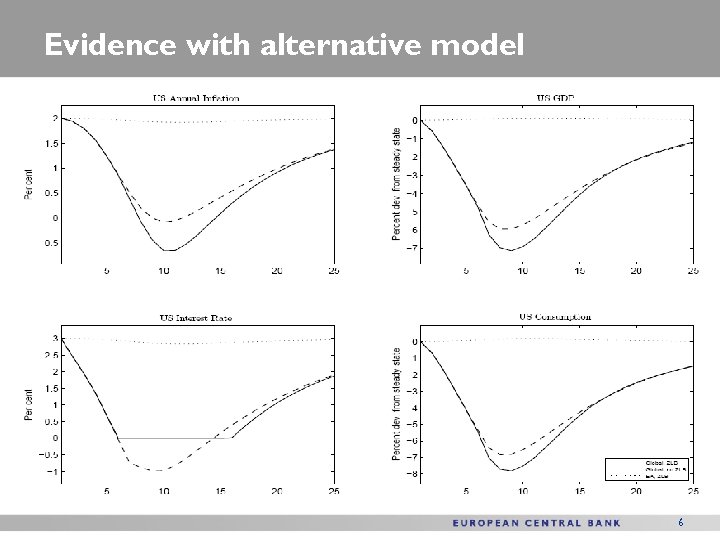 Evidence with alternative model 6
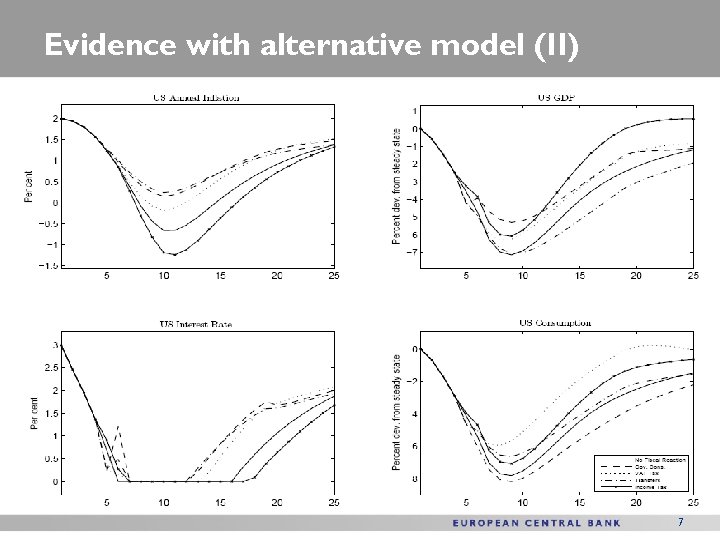 Evidence with alternative model (II) 7
 Solution method • The solution method seems as implemented in Troll • End point: why not long simulations? • Risks of non-linear models & steady state (Benhabib et al. , 2001): deserves a comment 8
 Monetary policy rule • Gradualism vs. activism: persistent rule may avoid the ZLB • Reasons given in paper are not convincing • How does it work? – Low rate mobility reduces the likelihood of hitting the ZLB (but worsen output, inflation) – BUT: if ZLB hit, chances are that output, inflation will worsen • Avoiding the ZLB matters! • Ergo: important to simulate with alternative γi (see previous point) 9
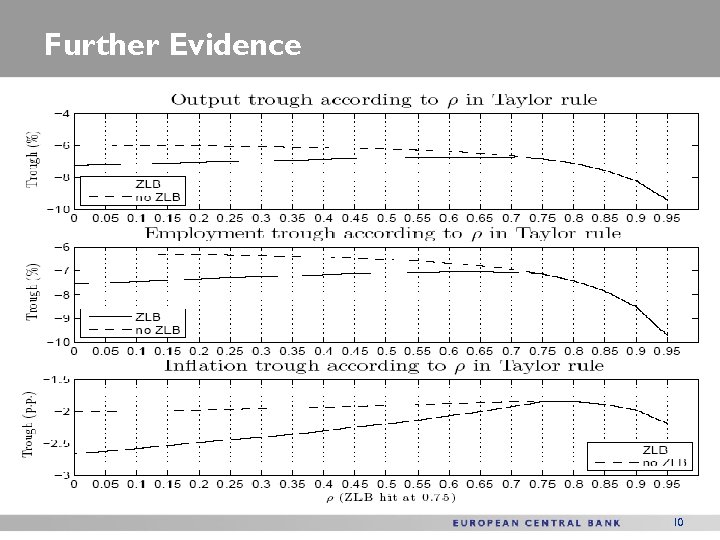 Further Evidence 10
 Model: price elasticity • Demand elasticity at firm level same for domestic production and exports (0. 1) • Sure, demand is simpler to model, but: – Is this the evidence? • Import content of consumption and investment goods is the same: – Again, is the best empirical choice? 11
 Model: pricing mechanisms • • Model is symmetric LCP What about asymmetric PCP(US)/LPC(Ro. W)? US exporters are PCP: higher impact on exports Ro. W exporters are LPC: less transmission to US imports & US prices • Isn’t this the empirically relevant setup? 12
 Minor points • Why using inot in the rule? • Justification seems weak: – Little extra delay in exiting the ZLB – Use of inot implies odd kind of policy! • Why are spillovers not returning to non-ZLB case when the ZLB does not bind? 13
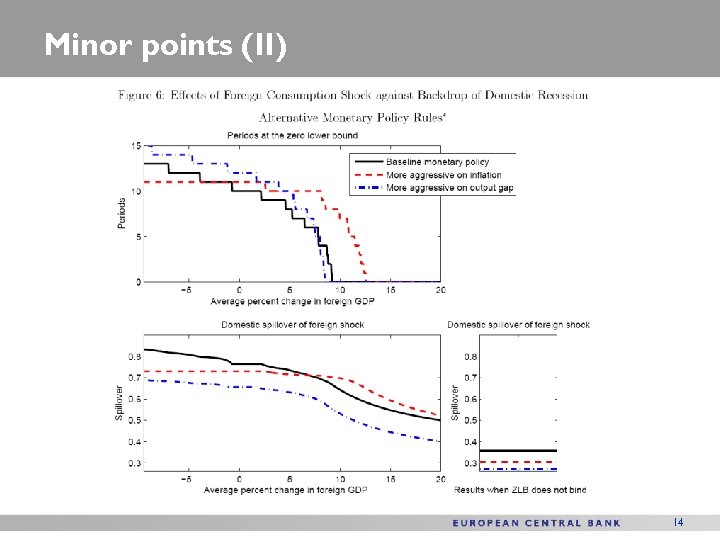 Minor points (II) 14
 END OF PRESENTATION 15