


 Скачать презентацию The effects of FDI on host country export
da053b5ce06bd8c73d4d8444b26b1ed9.ppt
- Количество слайдов: 24
 The effects of FDI on host country export performance (Austria) A presentation by; AJang Elvis Ngwesse Supervised by; Prof. Joseph Francois
 Overview • Research objective and hypothesis • Theoretical consideration • Empirical evidence • Trends in Austria • The Austrian economy • Data description • Methodology • Results and Conclusion
 Research objectives and Hypothesis • The main objective of this study is to investigate the impact of FDI on export performance in Austria during the period (1970 -2005). • We hypothesize that the inflow of FDI has impacted export growth positively during the period (1970 -2005).
 Theoretical considerations Ø The New Growth Theory. • It views technological progress as a product of economic activity. It also suggests that knowledge and technology are characterised by increasing returns (Cortright, 2001). • Investment in human capital contributes to increasing returns, the more resources devoted to R&D the faster the rate of innovation and the higher the rate of growth (Teixeira and Fortuna , 2003). • FDI is expected to generate growth by encouraging the incorporation of new inputs and foreign technologies into host countries economy. • The transfer of advanced technology strengthens the host country’s existing stock of knowledge through labour training, skill acquisition, and the introduction of better management practices (Sjoholm , 1999). • As a consequence, FDI increases productivity in the recipient economy, and FDI can be deemed to be a catalyst for domestic investment and technological progress (Markusen, 1999).
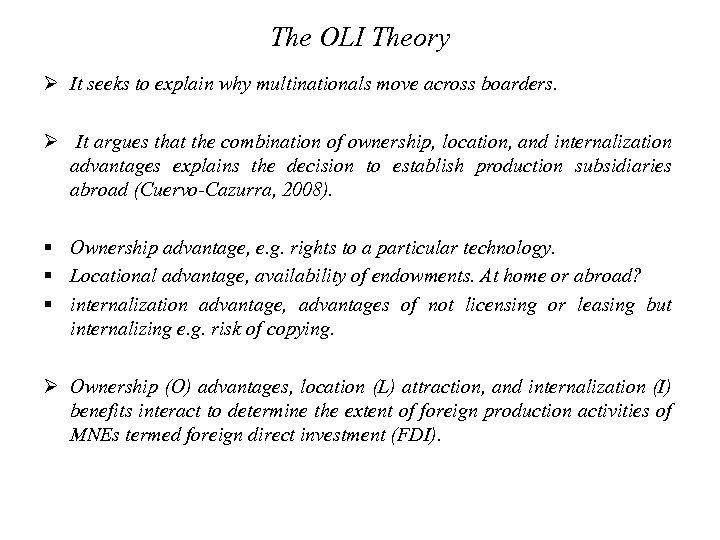 The OLI Theory Ø It seeks to explain why multinationals move across boarders. Ø It argues that the combination of ownership, location, and internalization advantages explains the decision to establish production subsidiaries abroad (Cuervo-Cazurra, 2008). § Ownership advantage, e. g. rights to a particular technology. § Locational advantage, availability of endowments. At home or abroad? § internalization advantage, advantages of not licensing or leasing but internalizing e. g. risk of copying. Ø Ownership (O) advantages, location (L) attraction, and internalization (I) benefits interact to determine the extent of foreign production activities of MNEs termed foreign direct investment (FDI).
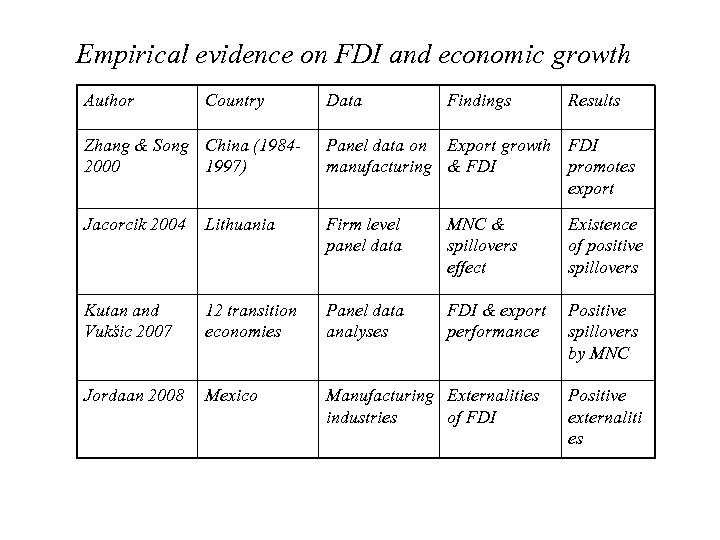 Empirical evidence on FDI and economic growth Author Country Data Findings Results Zhang & Song China (19842000 1997) Panel data on Export growth FDI manufacturing & FDI promotes export Jacorcik 2004 Lithuania Firm level panel data MNC & spillovers effect Existence of positive spillovers Kutan and Vukšic 2007 12 transition economies Panel data analyses FDI & export performance Positive spillovers by MNC Jordaan 2008 Mexico Manufacturing Externalities industries of FDI Positive externaliti es
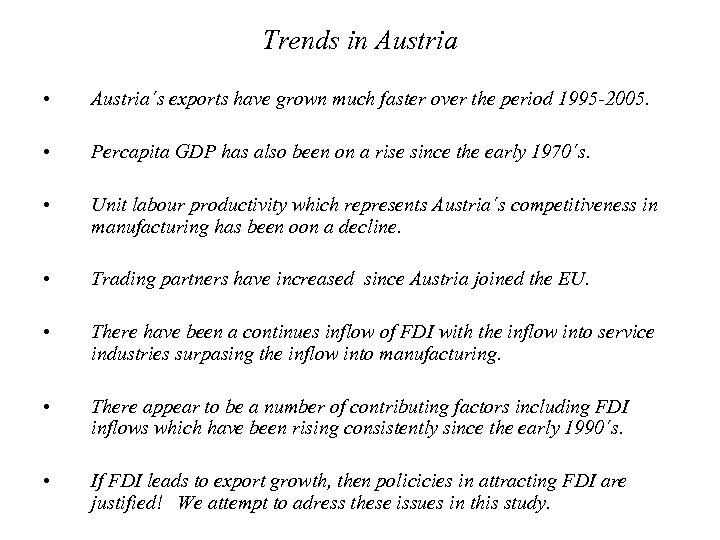 Trends in Austria • Austria´s exports have grown much faster over the period 1995 -2005. • Percapita GDP has also been on a rise since the early 1970´s. • Unit labour productivity which represents Austria´s competitiveness in manufacturing has been oon a decline. • Trading partners have increased since Austria joined the EU. • There have been a continues inflow of FDI with the inflow into service industries surpasing the inflow into manufacturing. • There appear to be a number of contributing factors including FDI inflows which have been rising consistently since the early 1990´s. • If FDI leads to export growth, then policicies in attracting FDI are justified! We attempt to adress these issues in this study.
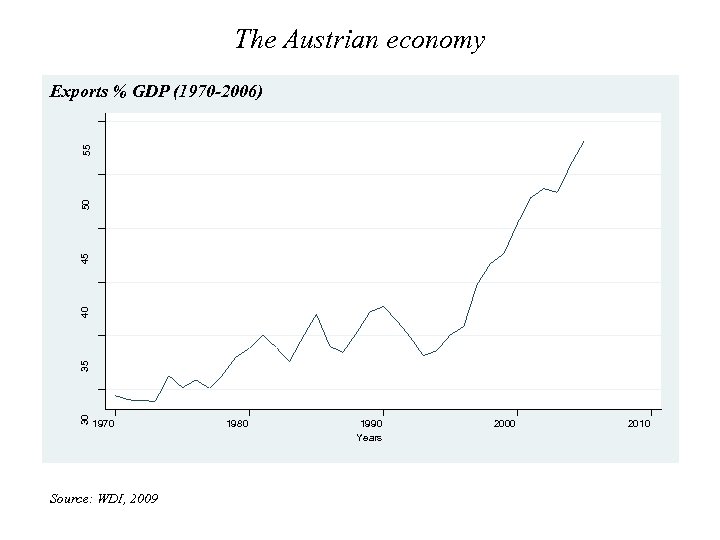 The Austrian economy 30 35 40 45 50 55 Exports % GDP (1970 -2006) 1970 Source: WDI, 2009 1980 1990 Years 2000 2010
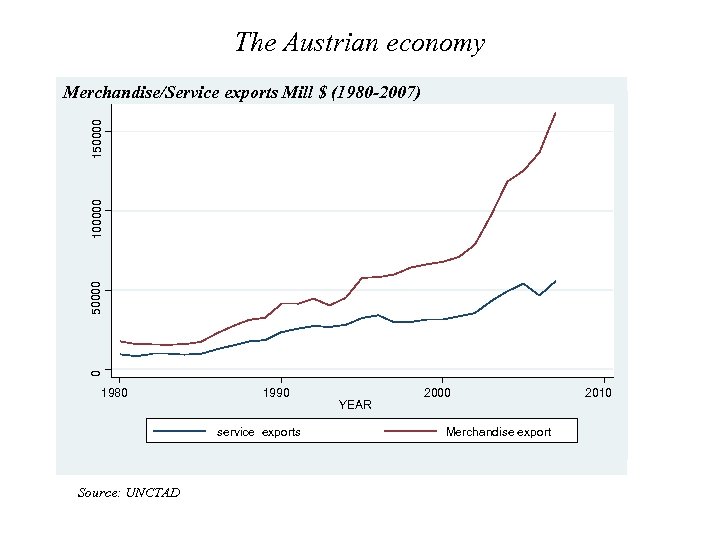 The Austrian economy 0 50000 100000 150000 Merchandise/Service exports Mill $ (1980 -2007) 1980 1990 service exports Source: UNCTAD YEAR 2000 Merchandise export 2010
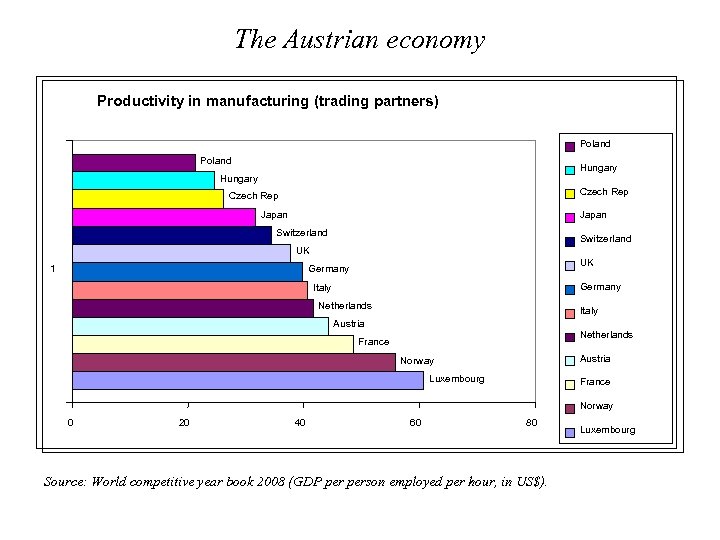 The Austrian economy Productivity in manufacturing (trading partners) Poland Hungary Czech Rep Japan Switzerland UK 1 UK Germany Italy Netherlands Italy Austria Netherlands France Austria Norway Luxembourg France Norway 0 20 40 60 80 Source: World competitive year book 2008 (GDP person employed per hour, in US$). Luxembourg
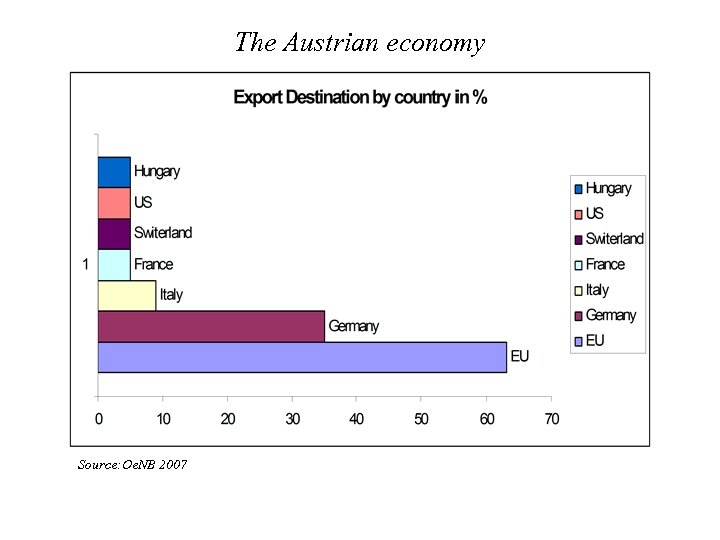 The Austrian economy Source: Oe. NB 2007
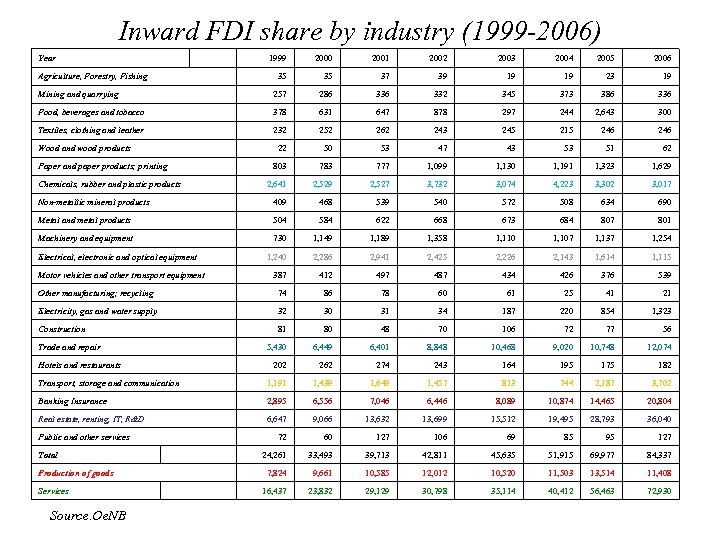 Inward FDI share by industry (1999 -2006) Year 1999 2000 2001 2002 2003 2004 2005 2006 35 35 37 39 19 19 23 19 Mining and quarrying 257 286 332 345 373 386 336 Food, beverages and tobacco 378 631 647 878 297 244 2, 643 300 Textiles, clothing and leather 232 252 262 243 245 215 246 22 50 53 47 43 53 51 62 803 783 777 1, 099 1, 130 1, 191 1, 323 1, 629 2, 641 2, 529 2, 527 3, 732 3, 074 4, 223 3, 302 3, 017 Non-metallic mineral products 409 468 539 540 572 508 634 690 Metal and metal products 504 584 622 668 673 684 807 801 Machinery and equipment 730 1, 149 1, 189 1, 358 1, 110 1, 107 1, 137 1, 254 1, 240 2, 286 2, 941 2, 425 2, 226 2, 143 1, 614 1, 115 387 412 497 487 434 426 376 539 Other manufacturing; recycling 74 86 78 60 61 25 41 21 Electricity, gas and water supply 32 30 31 34 187 220 854 1, 323 Construction 81 80 48 70 106 72 77 56 5, 430 6, 449 6, 401 8, 848 10, 468 9, 020 10, 748 12, 074 202 262 274 243 164 195 175 182 Transport, storage and communication 1, 191 1, 439 1, 649 1, 457 813 744 2, 187 3, 702 Banking Insurance 2, 895 6, 556 7, 046 6, 446 8, 089 10, 874 14, 465 20, 804 Real estate, renting, IT, R&D 6, 647 9, 066 13, 632 13, 699 15, 512 19, 495 28, 793 36, 040 72 60 127 106 69 85 95 127 24, 261 33, 493 39, 713 42, 811 45, 635 51, 915 69, 977 84, 337 7, 824 9, 661 10, 585 12, 012 10, 520 11, 503 13, 514 11, 408 16, 437 23, 832 29, 129 30, 798 35, 114 40, 412 56, 463 72, 930 Agriculture, Forestry, Fishing Wood and wood products Paper and paper products; printing Chemicals, rubber and plastic products Electrical, electronic and optical equipment Motor vehicles and other transport equipment Trade and repair Hotels and restaurants Public and other services Total Production of goods Services Source. Oe. NB
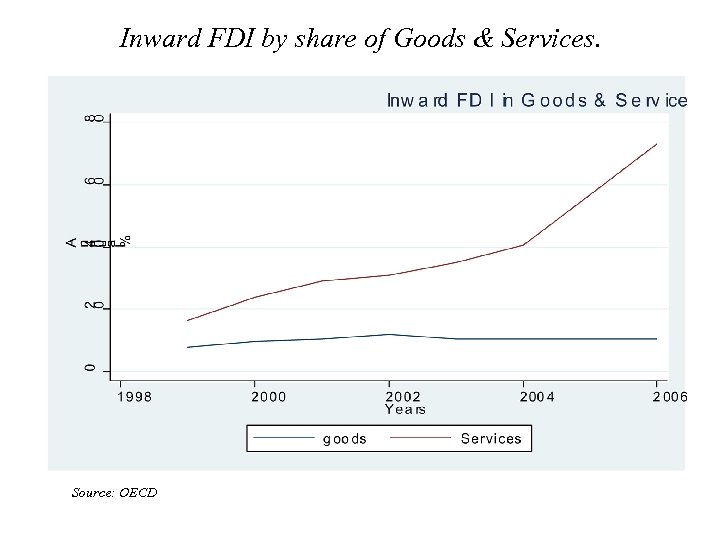 Inward FDI by share of Goods & Services. Source: OECD
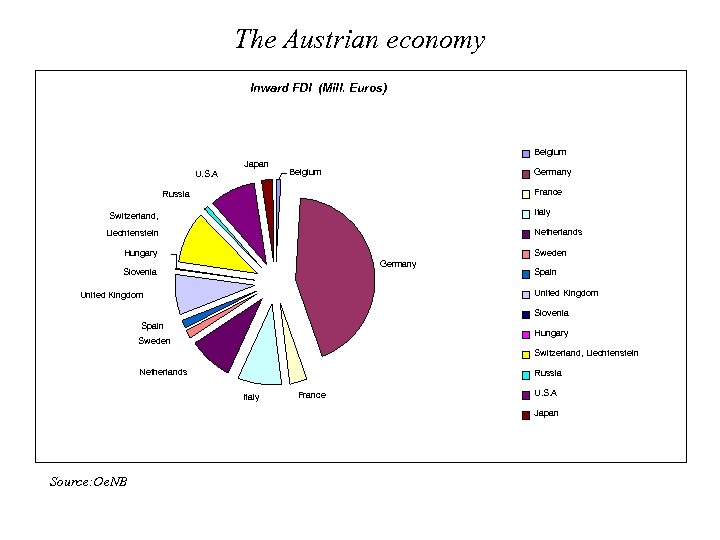 The Austrian economy Inward FDI (Mill. Euros) Belgium U. S. A Japan Belgium Germany France Russia Italy Switzerland, Netherlands Liechtenstein Hungary Sweden Germany Slovenia Spain United Kingdom Slovenia Spain Hungary Sweden Switzerland, Liechtenstein Netherlands Russia Italy France U. S. A Japan Source: Oe. NB
 Data • All of the data used in this study are from secondary sources. • Some data sources include UNCTAD, IMF, WDI, WIFO, Oe. NB, OECD, UNESCO. • The period covered is from 1970 -2005 • Some data have missing values e. g Terms of trade • Most data are aggregate data (FDI) making further findings not possible. • Poxy for HC Primary/Secondary enrolmenet was not available.
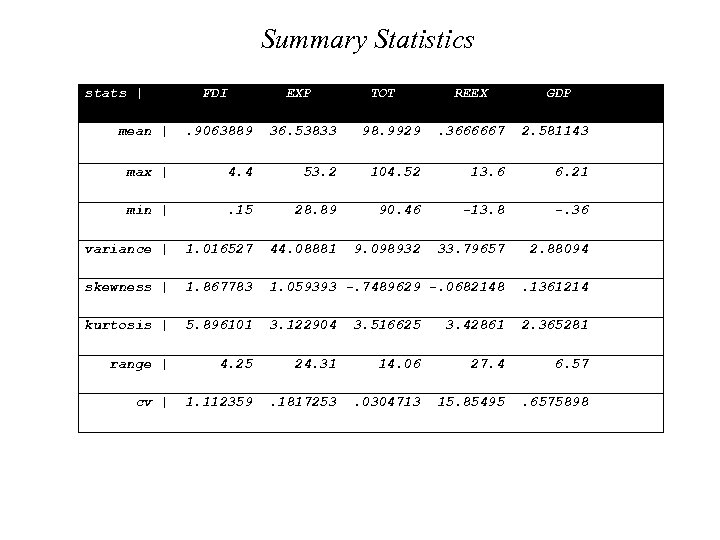 Summary Statistics stats | FDI EXP TOT REEX GDP mean | . 9063889 36. 53833 98. 9929 . 3666667 2. 581143 max | 4. 4 53. 2 104. 52 13. 6 6. 21 min | . 15 28. 89 90. 46 -13. 8 -. 36 variance | 1. 016527 44. 08881 9. 098932 33. 79657 2. 88094 skewness | 1. 867783 1. 059393 -. 7489629 -. 0682148 . 1361214 kurtosis | 5. 896101 3. 122904 3. 516625 3. 42861 2. 365281 range | 4. 25 24. 31 14. 06 27. 4 6. 57 cv | 1. 112359 . 1817253 . 0304713 15. 85495 . 6575898
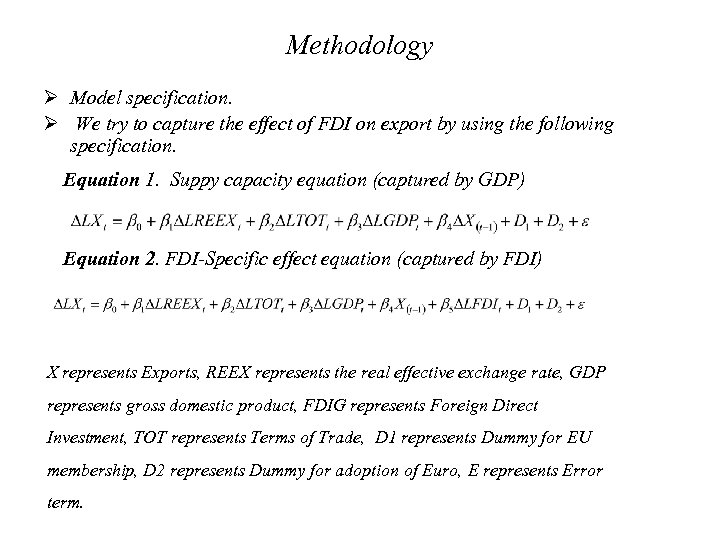 Methodology Ø Model specification. Ø We try to capture the effect of FDI on export by using the following specification. Equation 1. Suppy capacity equation (captured by GDP) Equation 2. FDI-Specific effect equation (captured by FDI) X represents Exports, REEX represents the real effective exchange rate, GDP represents gross domestic product, FDIG represents Foreign Direct Investment, TOT represents Terms of Trade, D 1 represents Dummy for EU membership, D 2 represents Dummy for adoption of Euro, Ε represents Error term.
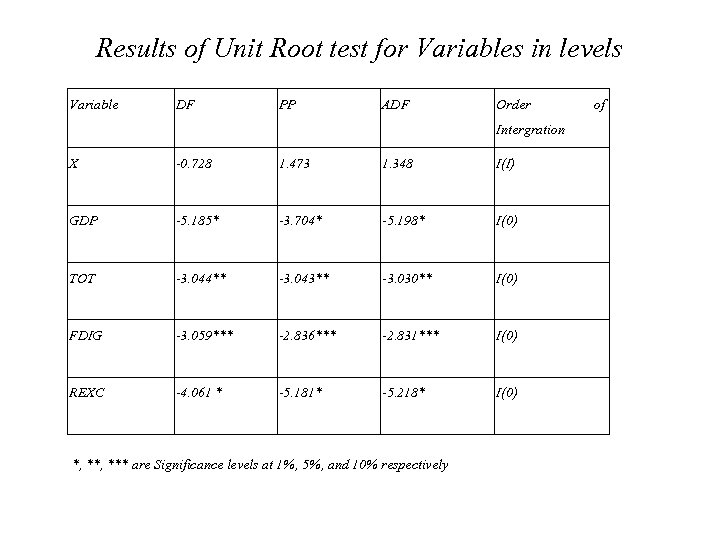 Results of Unit Root test for Variables in levels Variable DF PP ADF Order Intergration X -0. 728 1. 473 1. 348 I(I) GDP -5. 185* -3. 704* -5. 198* I(0) TOT -3. 044** -3. 043** -3. 030** I(0) FDIG -3. 059*** -2. 836*** -2. 831*** I(0) REXC -4. 061 * -5. 181* -5. 218* I(0) *, *** are Significance levels at 1%, 5%, and 10% respectively of
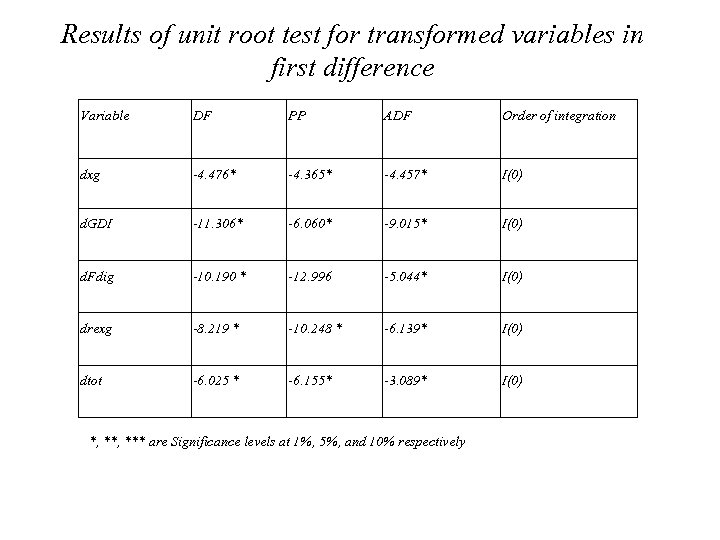 Results of unit root test for transformed variables in first difference Variable DF PP ADF Order of integration dxg -4. 476* -4. 365* -4. 457* I(0) d. GDI -11. 306* -6. 060* -9. 015* I(0) d. Fdig -10. 190 * -12. 996 -5. 044* I(0) drexg -8. 219 * -10. 248 * -6. 139* I(0) dtot -6. 025 * -6. 155* -3. 089* I(0) *, *** are Significance levels at 1%, 5%, and 10% respectively
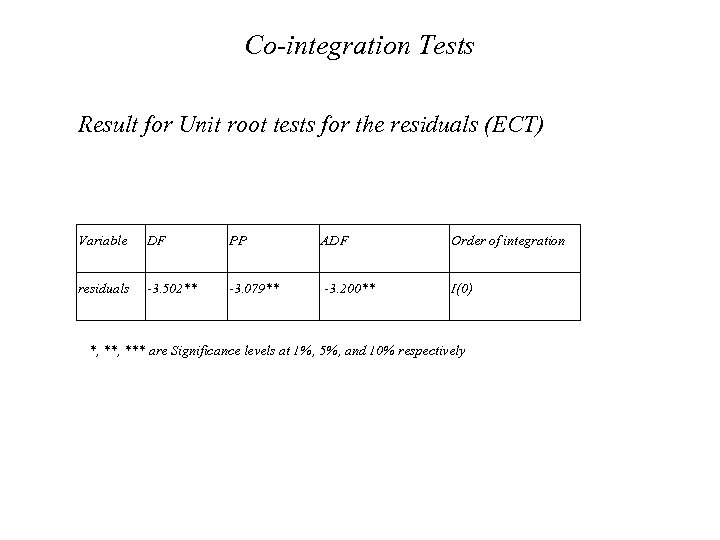 Co-integration Tests Result for Unit root tests for the residuals (ECT) Variable DF PP ADF Order of integration residuals -3. 502** -3. 079** -3. 200** I(0) *, *** are Significance levels at 1%, 5%, and 10% respectively
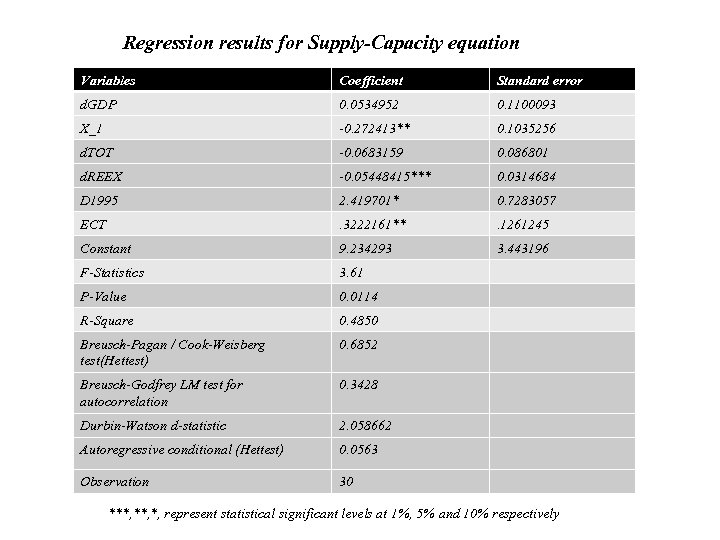 Regression results for Supply-Capacity equation Variables Coefficient Standard error d. GDP 0. 0534952 0. 1100093 X_1 -0. 272413** 0. 1035256 d. TOT -0. 0683159 0. 086801 d. REEX -0. 05448415*** 0. 0314684 D 1995 2. 419701* 0. 7283057 ECT . 3222161** . 1261245 Constant 9. 234293 3. 443196 F-Statistics 3. 61 P-Value 0. 0114 R-Square 0. 4850 Breusch-Pagan / Cook-Weisberg test(Hettest) 0. 6852 Breusch-Godfrey LM test for autocorrelation 0. 3428 Durbin-Watson d-statistic 2. 058662 Autoregressive conditional (Hettest) 0. 0563 Observation 30 ***, *, represent statistical significant levels at 1%, 5% and 10% respectively
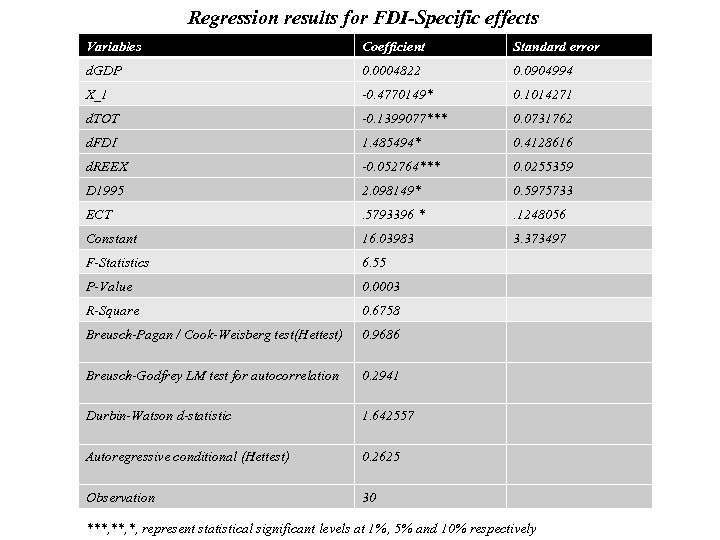 Regression results for FDI-Specific effects Variables Coefficient Standard error d. GDP 0. 0004822 0. 0904994 X_1 -0. 4770149* 0. 1014271 d. TOT -0. 1399077*** 0. 0731762 d. FDI 1. 485494* 0. 4128616 d. REEX -0. 052764*** 0. 0255359 D 1995 2. 098149* 0. 5975733 ECT . 5793396 * . 1248056 Constant 16. 03983 3. 373497 F-Statistics 6. 55 P-Value 0. 0003 R-Square 0. 6758 Breusch-Pagan / Cook-Weisberg test(Hettest) 0. 9686 Breusch-Godfrey LM test for autocorrelation 0. 2941 Durbin-Watson d-statistic 1. 642557 Autoregressive conditional (Hettest) 0. 2625 Observation 30 ***, *, represent statistical significant levels at 1%, 5% and 10% respectively
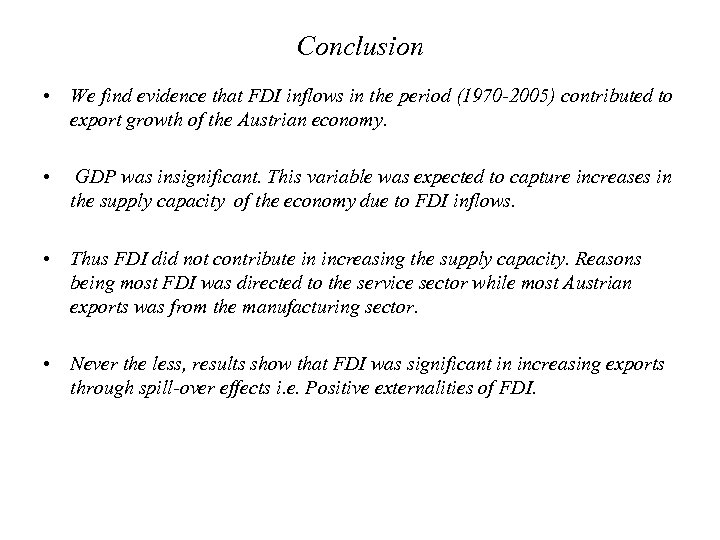 Conclusion • We find evidence that FDI inflows in the period (1970 -2005) contributed to export growth of the Austrian economy. • GDP was insignificant. This variable was expected to capture increases in the supply capacity of the economy due to FDI inflows. • Thus FDI did not contribute in increasing the supply capacity. Reasons being most FDI was directed to the service sector while most Austrian exports was from the manufacturing sector. • Never the less, results show that FDI was significant in increasing exports through spill-over effects i. e. Positive externalities of FDI.
 Thanks for your attension