


 Скачать презентацию The Effects of Domestic Violence on Children and
2529980ee7a4b0975adc579508465329.ppt
- Количество слайдов: 91
 The Effects of Domestic Violence on Children and Adolescents Nicole Trabold, CSW Doctoral Student School of Social Work University at Buffalo 2003 CDHS, College Relations Group, BSC Research Foundation
 What is Domestic Violence n Frequently referred to as: n n “Battering” “Spouse Abuse” 2003 CDHS, College Relations Group, BSC Research Foundation
 n Commonly referred to today as Intimate Partner Violence (IPV) 2003 CDHS, College Relations Group, BSC Research Foundation
 Definition n Is the violence committed by a spouse, ex-spouse, or current or former partner (heterosexual and homosexual relationships) n All definitions per the Center for Disease Control and Prevention (CDC), 2003 CDHS, College Relations Group, BSC Research Foundation
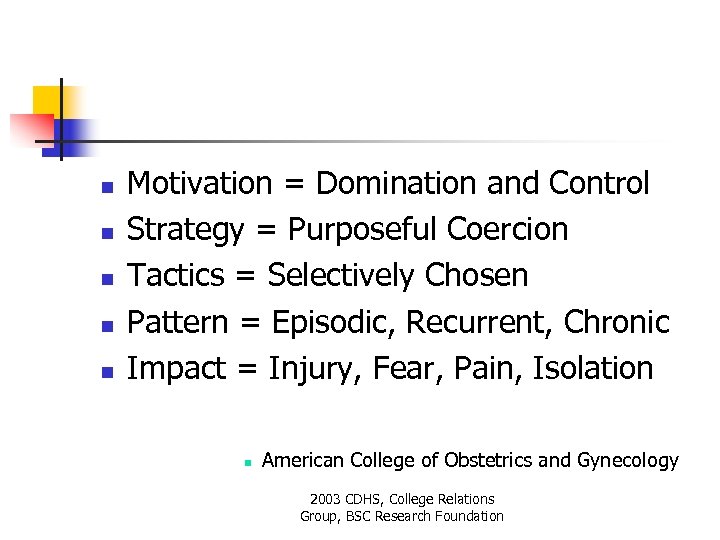 n n n Motivation = Domination and Control Strategy = Purposeful Coercion Tactics = Selectively Chosen Pattern = Episodic, Recurrent, Chronic Impact = Injury, Fear, Pain, Isolation n American College of Obstetrics and Gynecology 2003 CDHS, College Relations Group, BSC Research Foundation
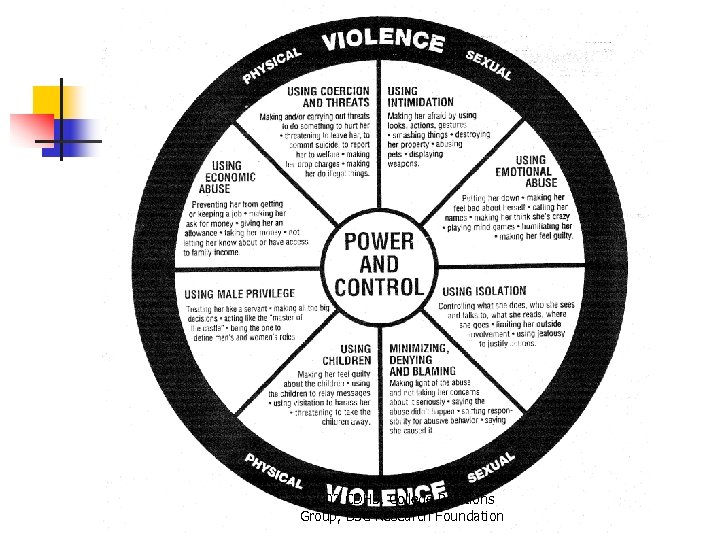
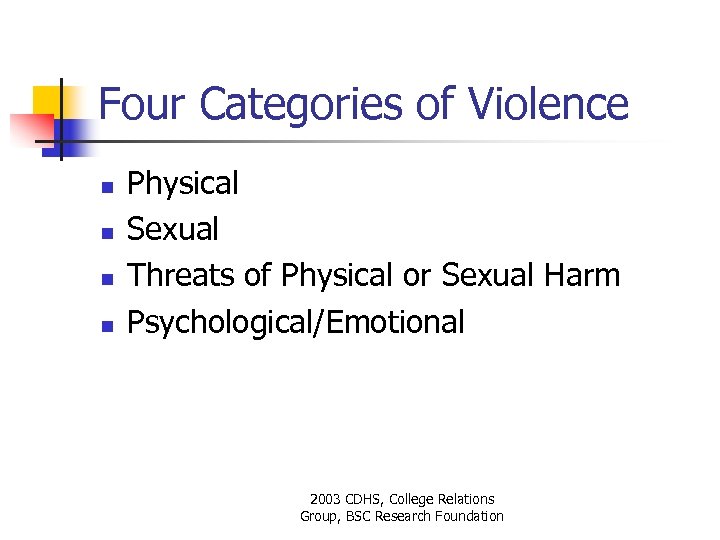 Four Categories of Violence n n Physical Sexual Threats of Physical or Sexual Harm Psychological/Emotional 2003 CDHS, College Relations Group, BSC Research Foundation
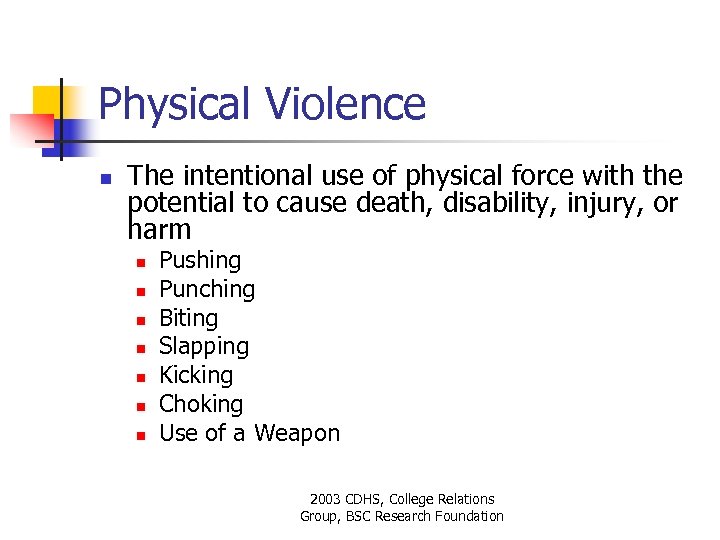 Physical Violence n The intentional use of physical force with the potential to cause death, disability, injury, or harm n n n n Pushing Punching Biting Slapping Kicking Choking Use of a Weapon 2003 CDHS, College Relations Group, BSC Research Foundation
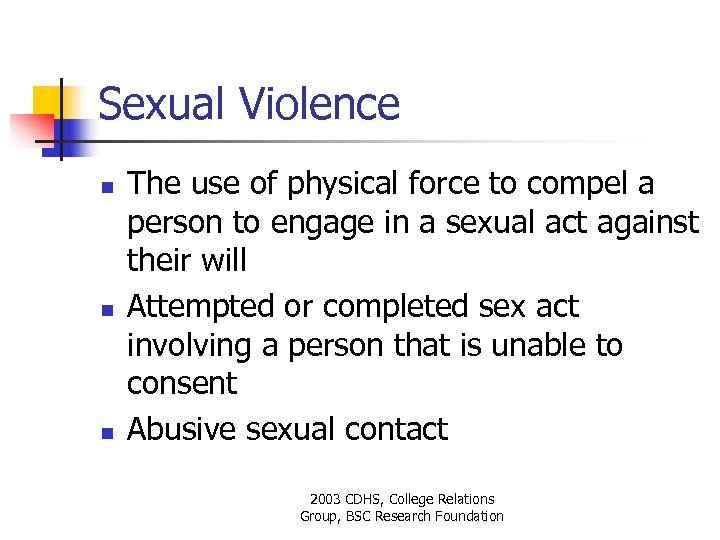 Sexual Violence n n n The use of physical force to compel a person to engage in a sexual act against their will Attempted or completed sex act involving a person that is unable to consent Abusive sexual contact 2003 CDHS, College Relations Group, BSC Research Foundation
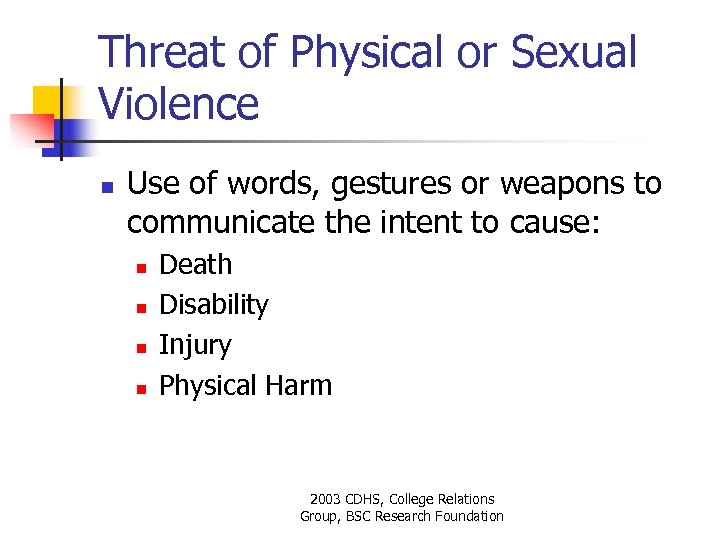 Threat of Physical or Sexual Violence n Use of words, gestures or weapons to communicate the intent to cause: n n Death Disability Injury Physical Harm 2003 CDHS, College Relations Group, BSC Research Foundation
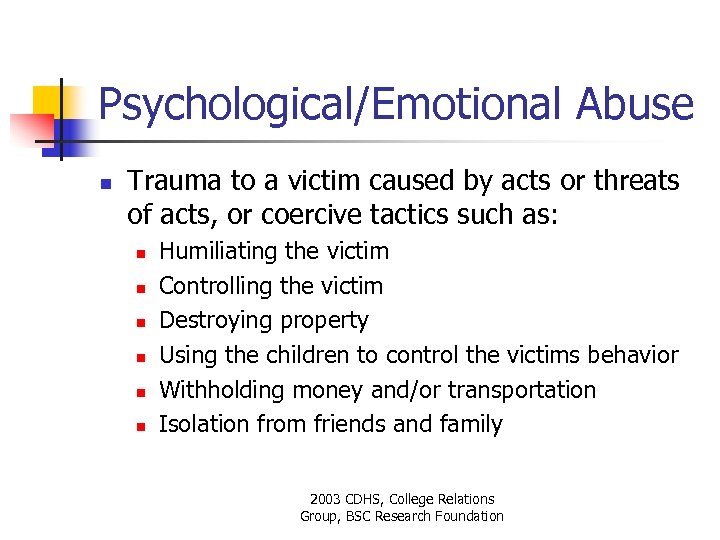 Psychological/Emotional Abuse n Trauma to a victim caused by acts or threats of acts, or coercive tactics such as: n n n Humiliating the victim Controlling the victim Destroying property Using the children to control the victims behavior Withholding money and/or transportation Isolation from friends and family 2003 CDHS, College Relations Group, BSC Research Foundation
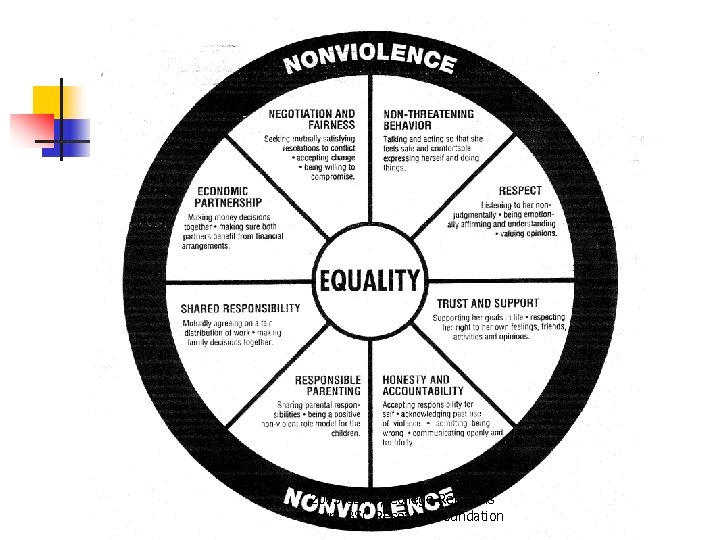
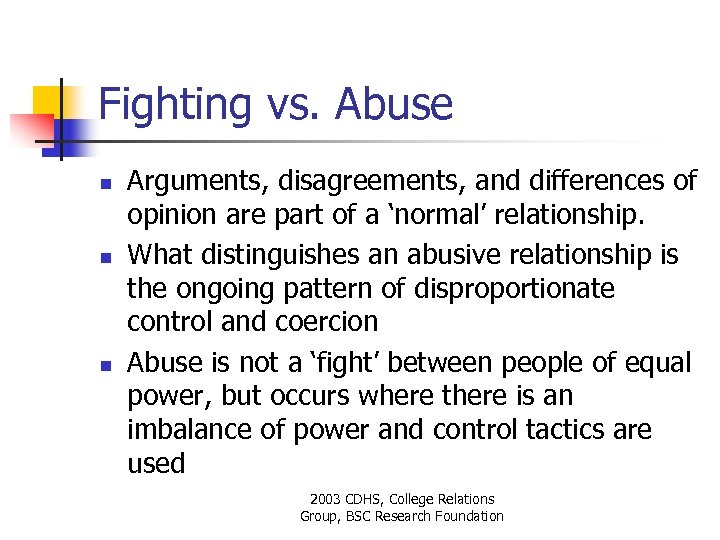 Fighting vs. Abuse n n n Arguments, disagreements, and differences of opinion are part of a ‘normal’ relationship. What distinguishes an abusive relationship is the ongoing pattern of disproportionate control and coercion Abuse is not a ‘fight’ between people of equal power, but occurs where there is an imbalance of power and control tactics are used 2003 CDHS, College Relations Group, BSC Research Foundation
 2003 CDHS, College Relations Group, BSC Research Foundation
 2003 CDHS, College Relations Group, BSC Research Foundation
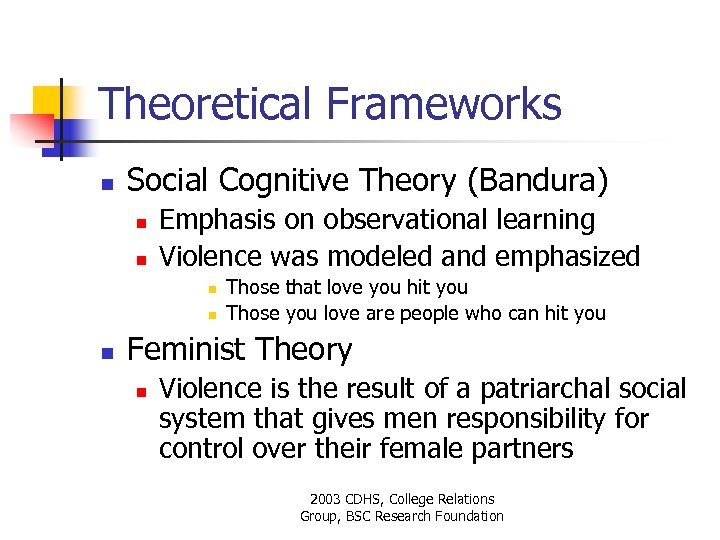 Theoretical Frameworks n Social Cognitive Theory (Bandura) n n Emphasis on observational learning Violence was modeled and emphasized n n n Those that love you hit you Those you love are people who can hit you Feminist Theory n Violence is the result of a patriarchal social system that gives men responsibility for control over their female partners 2003 CDHS, College Relations Group, BSC Research Foundation
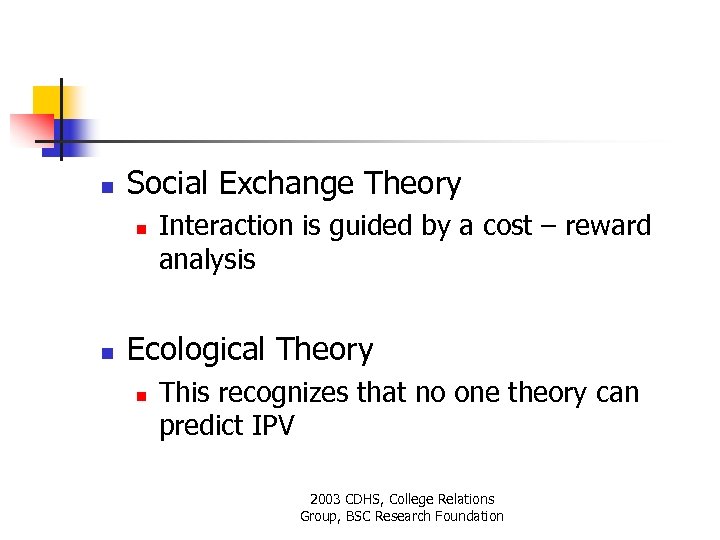 n Social Exchange Theory n n Interaction is guided by a cost – reward analysis Ecological Theory n This recognizes that no one theory can predict IPV 2003 CDHS, College Relations Group, BSC Research Foundation
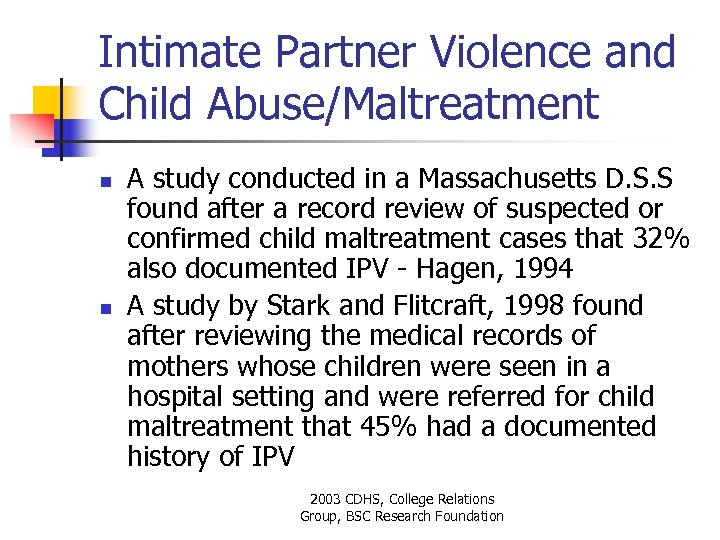 Intimate Partner Violence and Child Abuse/Maltreatment n n A study conducted in a Massachusetts D. S. S found after a record review of suspected or confirmed child maltreatment cases that 32% also documented IPV - Hagen, 1994 A study by Stark and Flitcraft, 1998 found after reviewing the medical records of mothers whose children were seen in a hospital setting and were referred for child maltreatment that 45% had a documented history of IPV 2003 CDHS, College Relations Group, BSC Research Foundation
 n n 40% of women who were seeking services at a battered women’s shelter reported that their spouse physically abused their children. Suh & Abel, 1990 According to Two National Surveys 50 -70% of families with IPV also reported physical abuse toward the child – Bowker et al. , 1988; Stauss & Gillis, 1990 2003 CDHS, College Relations Group, BSC Research Foundation
 In Summary… n n Studies show that in approximately 50% of cases where women are victims of violence, children are victims of physical violence Or… in 50% of cases of child physical abuse, women are also victims of physical violence 2003 CDHS, College Relations Group, BSC Research Foundation
 Intimate Partner Violence Harms Children In Various Ways n n n Perpetrators of violence may physically harm their intimate partner and their children They may sexually abuse their children or the children of their intimate partner The physical abuse prevents the victim of violence from caring for the children 2003 CDHS, College Relations Group, BSC Research Foundation
 Harms Continued… n n n Children may be coerced by the perpetrator to assist in the violence against the victim Children witness violence Perpetrators of violence may undermine interventions to protect children 2003 CDHS, College Relations Group, BSC Research Foundation
 So how do you ask about IPV? n n n First and foremost – INTERVIEW THE WOMAN ALONE Create a private space to conduct an interview Conduct the interview in the primary language 2003 CDHS, College Relations Group, BSC Research Foundation
 How to ask… n n n Be direct and nonjudgmental Have good eye contact Stay calm Do not exhibit emotionally charged reactions Do not dismiss what is being told to you 2003 CDHS, College Relations Group, BSC Research Foundation
 How do you start? n You may want to start in a general manner… n n “Because violence is so common in many people’s lives, I’ve begun to ask all my clients about it. ” “Many women I see are dealing will violence in their relationships. Some are too afraid to bring it up themselves, so I have begun to ask about it routinely. ” 2003 CDHS, College Relations Group, BSC Research Foundation
 Specific Screening Questions n n Are you in a relationship in which you have been physically hurt or threatened by your partner? Has your partner ever destroyed things you cared about? Has your partner ever forced you to have sex, or engage in sex that makes you feel uncomfortable? Do you feel afraid of your partner? 2003 CDHS, College Relations Group, BSC Research Foundation
 More Screening Questions… n n n Has your partner ever prevented you from leaving the house, visiting family, seeking friends, getting a job, or going to school? Has your partner threatened or harmed your children in any way? Do you have guns in your home? Has your partner threatened to use them? n Questions from the American Medical Association Practice Guidelines for Screening for IPV 2003 CDHS, College Relations Group, BSC Research Foundation
 Or Sometimes You Need To Ask… n Did someone cause this injury? (or insert black eye, broken wrist etc. ) 2003 CDHS, College Relations Group, BSC Research Foundation
 Do You Screen in Front of Children? n n n If the child is 3 or younger it may be fine However it is best to take the lead from the mother… so ask Some factors to consider why not to have children present: n n Women fear the children will accidentally disclose Fear of traumatizing the child by listening Need to protect the abuser Concern that the child would worry and want to protect n Zink and Jacobson 2003 CDHS, College Relations Group, BSC Research Foundation
 What Next When The IPV Screen is Positive? n Safety Plan, Safety Plan 2003 CDHS, College Relations Group, BSC Research Foundation
 What is a Safety Plan? n A tool to assist in identifying options, evaluating those options and committing a plan to reduce the risk when confronted with threat of harm or with actual harm 2003 CDHS, College Relations Group, BSC Research Foundation
 Developing a Safety Plan n When your partner escalates where can you move that is low risk n n **avoid the kitchen, garage, or rooms where there are weapons ** Use your judgment or intuition – if the situation is very serious what can be done to calm your partner 2003 CDHS, College Relations Group, BSC Research Foundation
 Safety Planning Continued… n n n Where can you leave money, important documents and cloths (i. e. with someone or have a bag packed and hidden) Can you create a code word or signal with a friend or neighbor that indicates the need for help Is there a safe place to go - Is it appropriate to have a plan of escape 2003 CDHS, College Relations Group, BSC Research Foundation
 Safety Planning… n Do they have an Order of Protection n Is it with them at all times Are copies provided to those who need it (hospital, local police departments, friends or family, employer, children’s day care) What will you do if your partner violates the order 2003 CDHS, College Relations Group, BSC Research Foundation
 Safety Planning… n Provide community resources in a manner that is safe from the partner 2003 CDHS, College Relations Group, BSC Research Foundation
 How Does Witnessing IPV Affect Children? n Children’s Problems Associated with Witnessing Violence have been categorized as: n n n Behavioral and Emotional Cognitive Functioning and Attitude Longer Term 2003 CDHS, College Relations Group, BSC Research Foundation
 n Children who witness parental IPV may exhibit n n n n aggression hostility anxiety social withdrawal cognitive-functioning problems depression lower-verbal and quantitative skills attitudes supporting violence n (Edleson 1999) 2003 CDHS, College Relations Group, BSC Research Foundation
 Impact of Exposure to Domestic Violence n Increase in Externalizing Behaviors n n Aggressiveness Behavior problems in school n n Temper Tantrums Fights 2003 CDHS, College Relations Group, BSC Research Foundation
 n Increase in Internalizing Behaviors n n n n Depression Suicidal Behavior Anxiety Fear Phobias Insomnia Bed-wetting Low Self-Esteem 2003 CDHS, College Relations Group, BSC Research Foundation
 n Cognitive and Academic Functioning Problems n Impaired ability to concentrate n Difficulty with school work n Lower scores in verbal, motor and cognitive measures 2003 CDHS, College Relations Group, BSC Research Foundation
 Witnessing IPV and Post Traumatic Stress Disorder (PTSD) n n Study by Kilpatrick, Litt and Williams (1997) showed that 85% of children ages 6 -12 who witnessed IPV had moderate to severe PTSD symptoms Compared to 0% of the control group who had witnessed no violence 2003 CDHS, College Relations Group, BSC Research Foundation
 PTSD Symptoms May Be n n Emotional Numbing Increased Arousal Avoidance of Reminders of the Violent Event Obsessive or Repeated Focus on the Event 2003 CDHS, College Relations Group, BSC Research Foundation
 Long Term Implications n Retrospective studies have shown that negative effects of IPV persist into adulthood with increased rates of n n Depression Poor Self-Esteem Violent Practices in the Home Criminal Behavior n Fantuzzo and Mohr 1999 2003 CDHS, College Relations Group, BSC Research Foundation
 Impacts of Violence on Child Development n Infancy n Insecure attachment 2003 CDHS, College Relations Group, BSC Research Foundation
 n Toddlers n n n Hesitancy to explore Separation Anxiety Aggression Withdrawal Reduced ability to cope with frustrations Communication problems 2003 CDHS, College Relations Group, BSC Research Foundation
 n Preschoolers n n Disrupted Interpersonal Relationships Cognitive Difficulties Lack in peer support Caretaking by child 2003 CDHS, College Relations Group, BSC Research Foundation
 n School-age and Adolescents n n n Aggression, Delinquency Self-Destructive Behaviors Bias for interpreting hostile intent Limited competent social responses Depression, Anxiety, Fear Post-Traumatic Stress Symptoms n Hypervigilance, Hyperarousal 2003 CDHS, College Relations Group, BSC Research Foundation
 n Disruptions at one stage my contribute to the next stage further disrupting the mastery of the following developmental stages 2003 CDHS, College Relations Group, BSC Research Foundation
 How do you Respond to Children? n Believe Them 2003 CDHS, College Relations Group, BSC Research Foundation
 n Allow children the opportunity to tell their story n n n Start with what they know and think You can ask neutral questions to facilitate the process for them only if you see they are willing to share Do NOT ask further questions if the child appears uncomfortable or unwilling to continue the discussion 2003 CDHS, College Relations Group, BSC Research Foundation
 n Reflect Back on and Validate Their Feelings n That must have been scary for you 2003 CDHS, College Relations Group, BSC Research Foundation
 n Provide Reassurance - Children Need to Know That Adults are Available to Help n You may respond by saying: n n n It is not their fault Violence is NOT ok You do not deserve to have violence in your family 2003 CDHS, College Relations Group, BSC Research Foundation
 What Helps Children Exposed to Violence? n Help Children Identify Safe People n n Having a powerful relationship with an adult is important in healing from trauma Children need to have an adult that believes in them 2003 CDHS, College Relations Group, BSC Research Foundation
 n n n Provide Nurturing, Time and Attention Provide Structure and Consistency Humor Creativity Involvement with Activities 2003 CDHS, College Relations Group, BSC Research Foundation
 Interventions for Children Exposed to Violence n n Help to Re-Establish a Safe Environment Identify the Non-Offending Parent and Provide Information, Resources, Support and Advocacy 2003 CDHS, College Relations Group, BSC Research Foundation
 n Assess the Child, Family Living Situation and Events Child Has Been Exposed to 2003 CDHS, College Relations Group, BSC Research Foundation
 n Recommendations Will Depend on n n Child’s age Stage of development Nature and duration of symptoms Child’s functioning Child’s perception of and experiences with the violence 2003 CDHS, College Relations Group, BSC Research Foundation
 n n n Current Environment Presence of adults for emotional support Cultural and ethnic definitions of violence 2003 CDHS, College Relations Group, BSC Research Foundation
 n Therapeutic Interventions are Many Times Appropriate n n Group Individual 2003 CDHS, College Relations Group, BSC Research Foundation
 Group Interventions n n n Generally Target ages 5 -15 Less Helpful to Preschoolers Not Appropriate for More Traumatized Children Not Appropriate to Children with More Complex Needs Provide Assistance with Developmental Tasks 2003 CDHS, College Relations Group, BSC Research Foundation
 Four Major Goals of Groups n Break the Family Secret n n n Defining violence Sharing personal experience Learning about feelings 2003 CDHS, College Relations Group, BSC Research Foundation
 n Learning to Protect n n Assertive conflict resolution Safe/Unsafe touching 2003 CDHS, College Relations Group, BSC Research Foundation
 n n Positive Experiences in a Safe Environment Strengthening Self-Esteem by Positive Reinforcement n Peled and Davis 1995 2003 CDHS, College Relations Group, BSC Research Foundation
 Individual n n n More Appropriate for Younger Children Who are More Impulsive Have Fewer Peer-Relationships This Intervention Promotes Discussion Helps Children Understand Cope with their Feelings Helps Reduce Symptoms (i. e. insomnia, nightmares) 2003 CDHS, College Relations Group, BSC Research Foundation
 Interventions that Help Children Involve a Range of Disciplines n Collaborate, Collaborate 2003 CDHS, College Relations Group, BSC Research Foundation
 So What Happens Now? n What Does this Mean When you are Confronted with IPV in the Field? 2003 CDHS, College Relations Group, BSC Research Foundation
 Guiding Framework for Interventions n Recommendation 1 n To achieve three outcomes n n n Create Safety Enhance Well-Being Provide Stability for Children and Families n All recommendations adapted from Effective Interventions In Domestic Violence and Child Maltreatment Cases: Guidelines for Policy and Practice 2003 CDHS, College Relations Group, BSC Research Foundation
 n Recommendation 2 n Creating safety for the adult victim and stopping batterer assaults removes risk and creates permanency for the child 2003 CDHS, College Relations Group, BSC Research Foundation
 How Do You Create Safety? n Service Planning With a Focus on: n n n Securing Safe Housing Advocacy Services Help Secure Financial Income Emotional Support for Adult Victim & Children Legal Assistance for Custody and/or Orders of Protection 2003 CDHS, College Relations Group, BSC Research Foundation
 n Recommendation 3 n Make Every Effort to Develop Separate Service Plans for the Adult Victims and the Perpetrator of Violence Regardless of Their Legal Status 2003 CDHS, College Relations Group, BSC Research Foundation
 n Perpetrators Are Often Left Out Because They May Not Be n n Living in the Home Legally or Biologically Related to the Child Inconsistent Presence in the Family Make Workers Feel Unsafe 2003 CDHS, College Relations Group, BSC Research Foundation
 Service Plans For Perpetrators Should Include… n n Cessations of All Forms of Violence to all Members of the Family Cessation of Interference with Partner’s Efforts to Parent Safely Compliance With Protective Orders and Other Court Mandates Compliance With Batterers Programs 2003 CDHS, College Relations Group, BSC Research Foundation
 n Recommendation 4 n Keep the child with the non-offending parent whenever possible 2003 CDHS, College Relations Group, BSC Research Foundation
 Remember… n To Avoid Blaming the Non-Abusive Parent for “Failure to Protect” Against the Violence Committed by the Batterer 2003 CDHS, College Relations Group, BSC Research Foundation
 People Frequently Ask Why Do Victims Stay? n n Victims of Violence Calculate the Risks and Benefits of Their Decisions They May Ask Themselvesn n “Will the violence escalate if I leave? ” “How will I support myself and children? ” “Where will we live, will it be safe for my children? ” “Should I leave and risk losing my children in a custody battle to the abusive parent? ” 2003 CDHS, College Relations Group, BSC Research Foundation
 n Recommendation 5 n Avoid using or use cautiously interventions such as: n n Couples Therapy Mediation Family Conferencing Anger Management Classes 2003 CDHS, College Relations Group, BSC Research Foundation
 n Recommendation 6 n Pay careful attention to visitation arrangements that may endanger adult victims and their children 2003 CDHS, College Relations Group, BSC Research Foundation
 Points to Assess n n Perpetrators History of Abuse and Neglect to Children Level of Continued Danger to the Adult Victim of IPV History and Pattern of Abuse History of Using Children In Violence or Exposing them to Violence 2003 CDHS, College Relations Group, BSC Research Foundation
 n n Level of Coercive Control Exhibited by The Perpetrator of Violence History of Substance Abuse and Mental Illness Perpetrators Willingness to Accept Decisions From Victim, Law Enforcement etc. Risk of Child Abduction n Bancroft and Silverman 2002 2003 CDHS, College Relations Group, BSC Research Foundation
 n Recommendation 7 n If a child needs to be placed in foster care, with a relative or with an adoptive family assessments prior to placement should n n n Determine Ability to Keep Child Safe Ensure Safety During Visitation Determine that Caregiver is Supportive of the Adult Victim of Violence 2003 CDHS, College Relations Group, BSC Research Foundation
 n When Evaluating If a Placement is Appropriate 2003 CDHS, College Relations Group, BSC Research Foundation
 Assessing The Risk to Children n n Detailed Review of the Trauma Current Symptoms Developmental History Reactions of Adult Victim and Perpetrator on the Childs Experience and Symptoms n Groves, Roberts and Weinreb 2000 2003 CDHS, College Relations Group, BSC Research Foundation
 Assess For Safety n Does the Adult Victim of Violence Perceive Themselves or Their Children to be Safe 2003 CDHS, College Relations Group, BSC Research Foundation
 Parenting n Adequacy of Victim and Perpetrator Parenting in the Context of IPV 2003 CDHS, College Relations Group, BSC Research Foundation
 Risk of Continued Exposure to the Perpetrator n n Risk of continued undermining of Adult Victim Parenting and Relationship with Non-Abusive Parent Continued Exposure to Authoritative or Neglectful Parenting 2003 CDHS, College Relations Group, BSC Research Foundation
 n n n Risk of Continued Exposure to Violence Risk of Learning Violent Behaviors Risk of Being a “Tool” for the Perpetrator n Bancroft and Silverman 2002 2003 CDHS, College Relations Group, BSC Research Foundation
 Nicholson v. Williams n n Class Action Court Case ‘Battered’ Women and Their Children Challenged New York City’s Child Welfare Policies Regarding Cases that Involve IPV 2003 CDHS, College Relations Group, BSC Research Foundation
 The Court Findings n n n The Child Welfare Agency Regularly Alleges and Indicates Neglect Against Battered Mothers The Child Welfare Agency Rarely Hold Batterers Accountable The Child Welfare Agency Failed to Offer Adequate Resources Before Removal 2003 CDHS, College Relations Group, BSC Research Foundation
 n The Child Welfare Agency Regularly Separates Battered Women From Their Children Unnecessarily 2003 CDHS, College Relations Group, BSC Research Foundation
 The Court Issued an Injunction n n The Child Welfare Agency May Not Remove a Child on the Grounds that a Mother is a Victim of IPV Unless There is Imminent Danger to the Child Reasonable Efforts Must be Made to Remove the Batterer From the Mother and Child Using All Possible Resources 2003 CDHS, College Relations Group, BSC Research Foundation
 Injunction Continued n Complaints Against ‘Battered’ Mothers to the Central Registry Shall Be Declared “Unfounded” if the Only Reason for Services Was IPV Related n Court Information Adapted from Jill M. Zuccardy, Esq. Sanctuary for Families’ Center for Battered Women’s Legal Services 2003 CDHS, College Relations Group, BSC Research Foundation
 Resources Everyone Should Know n New York State Adult Domestic Violence Hotline n n English 1 -800 -942 -6906 Spanish 1 -800 -942 -6908 2003 CDHS, College Relations Group, BSC Research Foundation
 n National Resource Center on Domestic Violence n n 1 -800 -537 -2238 Violence Against Women’s Act National Hotline n 1 -800 -799 -SAFE 2003 CDHS, College Relations Group, BSC Research Foundation