


 Скачать презентацию The effect of short-course ART initiated in primary
e92c2b413b29bea41a261dd924aee1d3.ppt
- Количество слайдов: 1
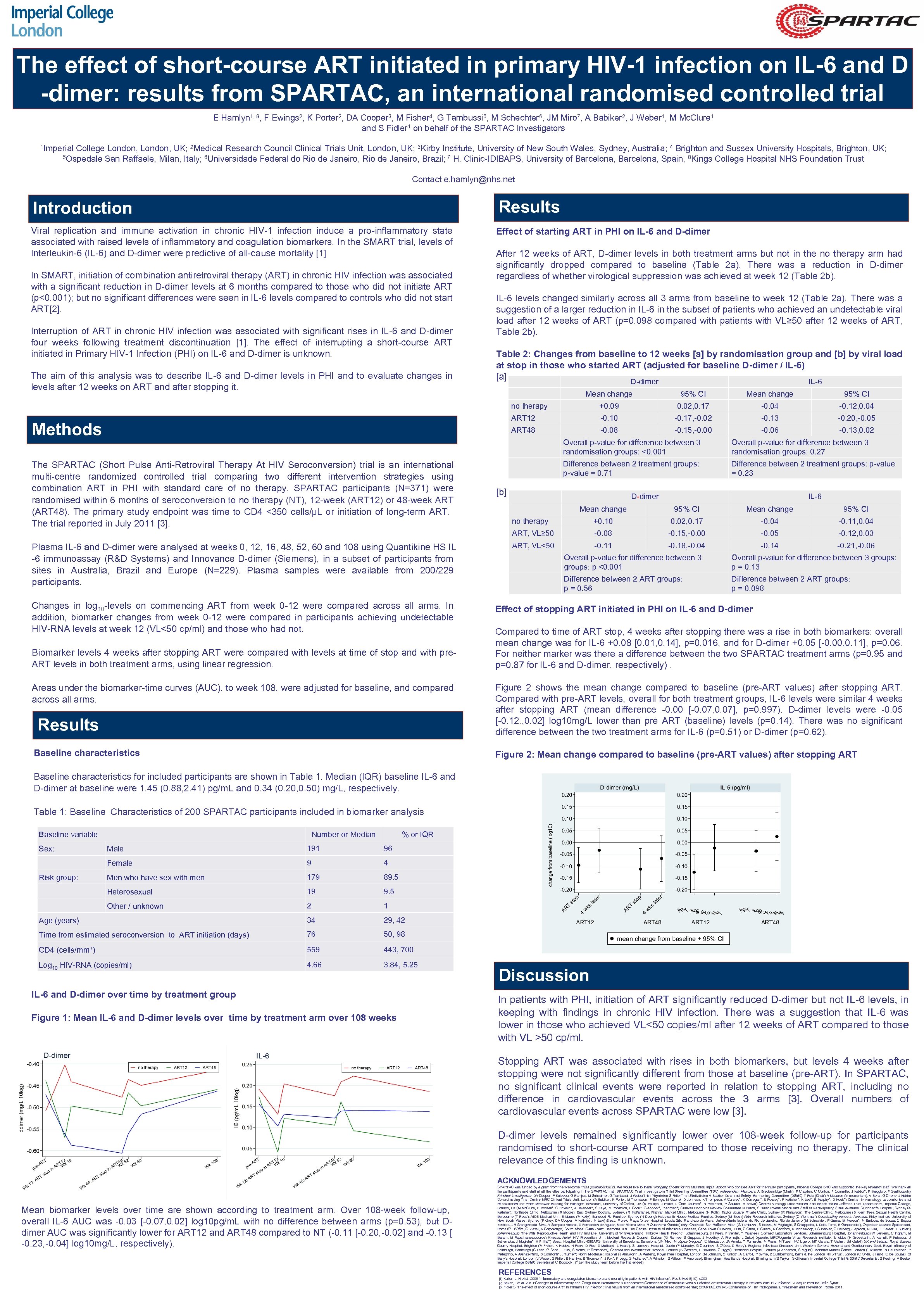 The effect of short-course ART initiated in primary HIV-1 infection on IL-6 and D -dimer: results from SPARTAC, an international randomised controlled trial E Hamlyn 1, 8, F Ewings 2, K Porter 2, DA Cooper 3, M Fisher 4, G Tambussi 5, M Schechter 6, JM Miro 7, A Babiker 2, J Weber 1, M Mc. Clure 1 and S Fidler 1 on behalf of the SPARTAC Investigators 1 Imperial College London, UK; 2 Medical Research Council Clinical Trials Unit, London, UK; 3 Kirby Institute, University of New South Wales, Sydney, Australia; 4 Brighton and Sussex University Hospitals, Brighton, UK; 5 Ospedale San Raffaele, Milan, Italy; 6 Universidade Federal do Rio de Janeiro, Brazil; 7 H. Clinic-IDIBAPS, University of Barcelona, Spain, 8 Kings College Hospital NHS Foundation Trust Contact e. hamlyn@nhs. net Introduction Results Viral replication and immune activation in chronic HIV-1 infection induce a pro-inflammatory state associated with raised levels of inflammatory and coagulation biomarkers. In the SMART trial, levels of Interleukin-6 (IL-6) and D-dimer were predictive of all-cause mortality [1] Effect of starting ART in PHI on IL-6 and D-dimer In SMART, initiation of combination antiretroviral therapy (ART) in chronic HIV infection was associated with a significant reduction in D-dimer levels at 6 months compared to those who did not initiate ART (p<0. 001); but no significant differences were seen in IL-6 levels compared to controls who did not start ART[2]. Interruption of ART in chronic HIV infection was associated with significant rises in IL-6 and D-dimer four weeks following treatment discontinuation [1]. The effect of interrupting a short-course ART initiated in Primary HIV-1 Infection (PHI) on IL-6 and D-dimer is unknown. The aim of this analysis was to describe IL-6 and D-dimer levels in PHI and to evaluate changes in levels after 12 weeks on ART and after stopping it. After 12 weeks of ART, D-dimer levels in both treatment arms but not in the no therapy arm had significantly dropped compared to baseline (Table 2 a). There was a reduction in D-dimer regardless of whether virological suppression was achieved at week 12 (Table 2 b). IL-6 levels changed similarly across all 3 arms from baseline to week 12 (Table 2 a). There was a suggestion of a larger reduction in IL-6 in the subset of patients who achieved an undetectable viral load after 12 weeks of ART (p=0. 098 compared with patients with VL≥ 50 after 12 weeks of ART, Table 2 b). Table 2: Changes from baseline to 12 weeks [a] by randomisation group and [b] by viral load at stop in those who started ART (adjusted for baseline D-dimer / IL-6) [a] D-dimer IL-6 Mean change 95% CI no therapy +0. 09 0. 02, 0. 17 -0. 04 -0. 12, 0. 04 ART 12 -0. 10 -0. 17, -0. 02 -0. 13 -0. 20, -0. 05 ART 48 Methods 95% CI -0. 08 -0. 15, -0. 00 -0. 06 -0. 13, 0. 02 Overall p-value for difference between 3 randomisation groups: <0. 001 The SPARTAC (Short Pulse Anti-Retroviral Therapy At HIV Seroconversion) trial is an international multi-centre randomized controlled trial comparing two different intervention strategies using combination ART in PHI with standard care of no therapy. SPARTAC participants (N=371) were randomised within 6 months of seroconversion to no therapy (NT), 12 -week (ART 12) or 48 -week ART (ART 48). The primary study endpoint was time to CD 4 <350 cells/µL or initiation of long-term ART. The trial reported in July 2011 [3]. Overall p-value for difference between 3 randomisation groups: 0. 27 Difference between 2 treatment groups: p-value = 0. 71 Difference between 2 treatment groups: p-value = 0. 23 [b] D-dimer IL-6 Changes in log 10 -levels on commencing ART from week 0 -12 were compared across all arms. In addition, biomarker changes from week 0 -12 were compared in participants achieving undetectable HIV-RNA levels at week 12 (VL<50 cp/ml) and those who had not. Biomarker levels 4 weeks after stopping ART were compared with levels at time of stop and with pre. ART levels in both treatment arms, using linear regression. Areas under the biomarker-time curves (AUC), to week 108, were adjusted for baseline, and compared across all arms. Results Baseline characteristics 95% CI Mean change 95% CI no therapy +0. 10 0. 02, 0. 17 -0. 04 -0. 11, 0. 04 ART, VL≥ 50 Plasma IL-6 and D-dimer were analysed at weeks 0, 12, 16, 48, 52, 60 and 108 using Quantikine HS IL -6 immunoassay (R&D Systems) and Innovance D-dimer (Siemens), in a subset of participants from sites in Australia, Brazil and Europe (N=229). Plasma samples were available from 200/229 participants. Mean change -0. 08 -0. 15, -0. 00 -0. 05 -0. 12, 0. 03 ART, VL<50 -0. 11 -0. 18, -0. 04 -0. 14 -0. 21, -0. 06 Overall p-value for difference between 3 groups: p <0. 001 Overall p-value for difference between 3 groups: p = 0. 13 Difference between 2 ART groups: p = 0. 56 Difference between 2 ART groups: p = 0. 098 Effect of stopping ART initiated in PHI on IL-6 and D-dimer Compared to time of ART stop, 4 weeks after stopping there was a rise in both biomarkers: overall mean change was for IL-6 +0. 08 [0. 01, 0. 14], p=0. 016, and for D-dimer +0. 05 [-0. 00, 0. 11], p=0. 06. For neither marker was there a difference between the two SPARTAC treatment arms (p=0. 95 and p=0. 87 for IL-6 and D-dimer, respectively). Figure 2 shows the mean change compared to baseline (pre-ART values) after stopping ART. Compared with pre-ART levels, overall for both treatment groups, IL-6 levels were similar 4 weeks after stopping ART (mean difference -0. 00 [-0. 07, 0. 07], p=0. 997). D-dimer levels were -0. 05 [-0. 12. , 0. 02] log 10 mg/L lower than pre ART (baseline) levels (p=0. 14). There was no significant difference between the two treatment arms for IL-6 (p=0. 51) or D-dimer (p=0. 62). Figure 2: Mean change compared to baseline (pre-ART values) after stopping ART Baseline characteristics for included participants are shown in Table 1. Median (IQR) baseline IL-6 and D-dimer at baseline were 1. 45 (0. 88, 2. 41) pg/m. L and 0. 34 (0. 20, 0. 50) mg/L, respectively. Table 1: Baseline Characteristics of 200 SPARTAC participants included in biomarker analysis Baseline variable Number or Median % or IQR Male 191 96 Female 9 4 Men who have sex with men 179 89. 5 Heterosexual 19 9. 5 Other / unknown 2 1 Age (years) 34 29, 42 Time from estimated seroconversion to ART initiation (days) 76 50, 98 CD 4 (cells/mm 3) 559 443, 700 Log 10 HIV-RNA (copies/ml) 4. 66 3. 84, 5. 25 Sex: Risk group: IL-6 and D-dimer over time by treatment group Figure 1: Mean IL-6 and D-dimer levels over time by treatment arm over 108 weeks Discussion In patients with PHI, initiation of ART significantly reduced D-dimer but not IL-6 levels, in keeping with findings in chronic HIV infection. There was a suggestion that IL-6 was lower in those who achieved VL<50 copies/ml after 12 weeks of ART compared to those with VL >50 cp/ml. Stopping ART was associated with rises in both biomarkers, but levels 4 weeks after stopping were not significantly different from those at baseline (pre-ART). In SPARTAC, no significant clinical events were reported in relation to stopping ART, including no difference in cardiovascular events across the 3 arms [3]. Overall numbers of cardiovascular events across SPARTAC were low [3]. D-dimer levels remained significantly lower over 108 -week follow-up for participants randomised to short-course ART compared to those receiving no therapy. The clinical relevance of this finding is unknown. ACKNOWLEDGEMENTS Mean biomarker levels over time are shown according to treatment arm. Over 108 -week follow-up, overall IL-6 AUC was -0. 03 [-0. 07, 0. 02] log 10 pg/m. L with no difference between arms (p=0. 53), but Ddimer AUC was significantly lower for ART 12 and ART 48 compared to NT (-0. 11 [-0. 20, -0. 02] and -0. 13 [ -0. 23, -0. 04] log 10 mg/L, respectively). SPARTAC was funded by a grant from the Wellcome Trust (069598/Z/02/Z). We would like to thank Wolfgang Stoehr for his statistical input, Abbott who donated ART for the study participants, Imperial College BRC who supported the key research staff. We thank all the participants and staff at all the sites participating in the SPARTAC trial. SPARTAC Trial Investigators Trial Steering Committee (TSC) Independent Members: A Breckenridge (Chair), P Clayden, C Conlon, F Conradie, J Kaldor*, F Maggiolo, F Ssali. Country Principal Investigators: DA Cooper, P Kaleebu, G Ramjee, M Schechter, G Tambussi, J Weber. Trial Physician S Fidler. Trial Statistician A Babiker Data and Safety Monitoring Committee (DSMC) T Peto (Chair) A Mc. Laren (in memoriam), V Beral, G Chene, J Hakim Co-ordinating Trial Centre MRC Clinical Trials Unit, London (A Babiker, K Porter, M Thomason, F Ewings, M Gabriel, D Johnson, K Thompson, A Cursley*, K Donegan*, E Fossey*, P Kelleher*, K Lee*, B Murphy*, D Nock*) Central Immunology Laboratories and Repositories. The Peter Medawar Building for Pathogen Research, University of Oxford, UK (R Phillips, J Frater, L Ohm Laursen*, N Robinson, P Goulder, H Brown) Central Virology Laboratories and Repositories Jefferiss Trust Laboratories, Imperial College, London, UK (M Mc. Clure, D Bonsall*, O Erlwein*, A Helander*, S Kaye, M Robinson, L Cook*, G Adcock*, P Ahmed*) Clinical Endpoint Review Committee N Paton, S Fidler Investigators and Staff at Participating Sites Australia: St Vincent’s Hospital, Sydney (A Kelleher), Northside Clinic, Melbourne (R Moore), East Sydney Doctors, Sydney, (R Mc. Farlane), Prahran Market Clinic, Melbourne (N Roth), Taylor Square Private Clinic, Sydney (R Finlayson), The Centre Clinic, Melbourne (B Kiem Tee), Sexual Health Centre, Melbourne (T Read), AIDS Medical Unit, Brisbane (M Kelly), Burwood Rd Practice, Sydney (N Doong) Holdsworth House Medical Practice, Sydney (M Bloch) Aids Research Initiative, Sydney (C Workman) Coordinating centre in Australia: Kirby Institute University of New South Wales, Sydney (P Grey, DA Cooper, A Kelleher, M Law) Brazil: Projeto Praça Onze, Hospital Escola São Francisco de Assis, Universidade federal do Rio de Janeiro, Rio de Janeiro (M Schechter, P Gama, M Mercon*, M Barbosa de Souza, C Beppu Yoshida, JR Grangeiro da Silva, A Sampaio Amaral, D Fernandes de Aguiar, M de Fátima Melo, R Quaresma Garrido) Italy: Ospedale San Raffaele, Milan (G Tambussi, S Nozza, M Pogliaghi, S Chiappetta, L Della Torre, E Gasparotto, ), Ospedale Lazzaro Spallanzani, Roma (G D’Offizi, C Vlassi, A Corpolongo) South Africa: Cape Town: Desmond Tutu HIV Centre, Institute of Infectious Diseases, Cape Town (R Wood, J Pitt, C Orrell, F Cilliers, R Croxford, K Middelkoop, LG Bekker, C Heiberg, J Aploon, N Killa, E Fielder, T Buhler ) Johannesburg: The Wits Reproductive Health and HIV Institute, University of Witswatersrand, Hillbrow Health Precinct, Johannesburg. (H Rees, F Venter, T Palanee), Contract Laboratory Services, Johannesburg Hospital, Johannesburg (W Stevens, C Ingram, M Majam, M Papathanasopoulos) Kwazulu-Natal: HIV Prevention Unit, Medical Research Council, Durban (G Ramjee, S Gappoo, J Moodley, A Premrajh, L Zako) Uganda: MRC/Uganda Virus Research Institute, Entebbe (H Grosskurth, A Kamali, P Kaleebu, U Bahemuka, J Mugisha*, H F Njaj*) Spain: Hospital Clinic-IDIBAPS, University of Barcelona, Barcelona (JM Miro, M López-Dieguez*, C Manzardo, JA Arnaiz, T Pumarola, M Plana, M Tuset, MC Ligero, MT García, T Gallart, JM Gatell) UK and Ireland: Royal Sussex County Hospital, Brighton (M Fisher, K Hobbs, N Perry, D Pao, D Maitland, L Heald), St James’s Hospital, Dublin (F Mulcahy, G Courtney, S O’Dea, D Reidy), Regional Infectious Diseases Unit, Western General Hospital and Genitourinary Dept, Royal Infirmary of Edinburgh, Edinburgh (C Leen, G Scott, L Ellis, S Morris, P Simmonds), Chelsea and Westminster Hospital, London (B Gazzard, D Hawkins, C Higgs), Homerton Hospital, London (J Anderson, S Mguni), Mortimer Market Centre, London (I Williams, N De Esteban, P Pellegrino, A Arenas-Pinto, D Cornforth*, J Turner*) North Middlesex Hospital (J Ainsworth, A Waters), Royal Free Hospital, London (M Johnson, S Kinloch, A Carroll, P Byrne, Z Cuthbertson), Barts & the London NHS Trust, London (C Orkin, J Hand, C De Souza), St Mary’s Hospital, London (J Weber, S Fidler, E Hamlyn, E Thomson*, J Fox*, K Legg, S Mullaney*, A Winston, S Wilson, P Ambrose), Birmingham Heartlands Hospital, Birmingham (S Taylor, G Gilleran) Imperial College Trial & DSMC Secretariat S Keeling, A Becker Imperial College DSMC Secretariat C Boocock (* Left the study team before the trial ended) REFERENCES [1] Kuller, L. H et al. 2008 'Inflammatory and coagulation biomarkers and mortality in patients with HIV infection', PLo. S Med 5(10): e 203 [2] Baker, J et al. 2010 'Changes in Inflammatory and Coagulation Biomarkers: A Randomized Comparison of Immediate versus Deferred Antiretroviral Therapy in Patients With HIV Infection', J Acquir Immune Defic Syndr. [3] Fidler S. The effect of short-course ART in Primary HIV Infection: final results from an international randomised controlled trial; SPARTAC. 6 th IAS Conference on HIV Pathogenesis, Treatment and Prevention. Rome 2011.