


 Скачать презентацию The Effect of Faculty Presence on Small-group Learning
f5fe685b29e04685192c24fc283e91ea.ppt
- Количество слайдов: 21
 The Effect of Faculty Presence on Small-group Learning and Group Dynamics in a Family Medicine Clerkship Miriam Hoffman, MD; Joanne Wilkinson, MD; John Wiecha, MD, MPH; Jin Xu, BS Department of Family Medicine Boston University School of Medicine
 Outline Background n Brief literature review n FM Core Curriculum, Rationale n Methods n Results n Future directions n
 Small Group Learning Is it better? n Why? How do we know? n What type of small group learning? n
 Literature Review PBL; Preclinical years n Questionnaires, focus groups n Have assessed: n Group learning process n Preference n Evaluation/assessment of the group experience n Learning outcomes n
 Literature Review n Outcomes n n Peer-led discussions similar to teacher-led (performance, highly rated) Role of the faculty Active faculty -> better satisfaction and board scores, perception by students of teacher’s importance n What makes a good group from process/dynamics standpoint? -> Faculty member ranked lowest (Willis) n
 Role of the faculty – group dynamics and group learning process n Teachers were responsible for 93% of the interactions which resulted in a teacher-dominated discussion (Jaarsma 2009). n Student-led groups took short cuts through the cases. This may undermine the development of complex problem-solving skills (Steele). n Students may be relying on the teacher to provide the right answer, rather than participating in the group process and interaction (Jaarsma 2008).
 Preference n Both students and faculty prefer PBL or small group based learning (even in less clinically oriented courses). n Faculty perceptions concern about amount of faculty time (Mayo).
 BUSM Family Medicine Clerkship 6 week third year clerkship n Clinical placements throughout New England n Core curriculum n Online Clerkship n
 Core curriculum n 4 didactic days at BUSM n n Mc. Q and Rivera families n n Small Groups, SP’s, Geriatrics, Grand Rounds Small group, SP’s, online video, final OSCE Small groups Paper cases n Student-run discussion n Faculty facilitator n
 Differing dynamics and discussion levels between groups Point in the year; outliers within the group n Prior rotations n Personality types n Student interest and buy-in n Nature and content of a particular case n Faculty member n
 Our Instrument Most items derived from 2 validated tools, including the GCQ-S n Assessed: n Group learning process n Group dynamics n Role of the faculty n Student preference n Participation n
 Implementation n 15 -24 students per block n Divided into 2 -3 small groups with 1 faculty/group 2 surveys completed per session (intervention and control) n Scripted instructions, standardized timing n Cases rotated n Paired t-tests n
 Results – Group dynamics and Group Learning Process n Group dynamics and group learning process were significantly better, with more student discussion and participation, during cases in which the faculty member was absent.
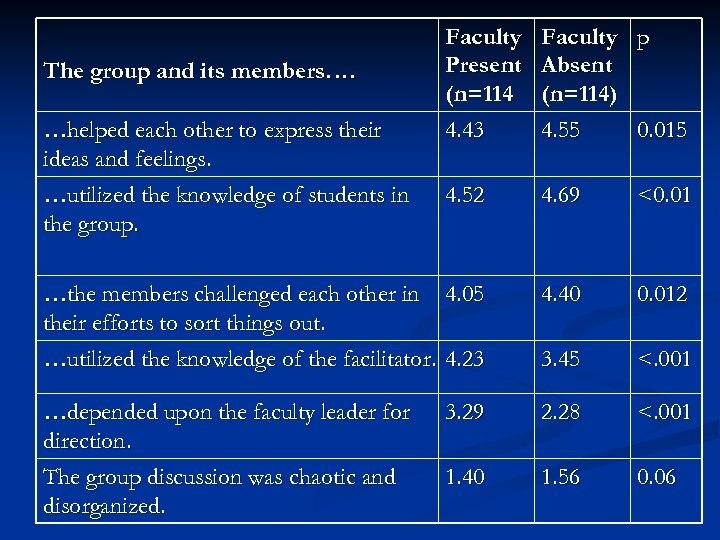 Faculty Present (n=114 4. 43 Faculty p Absent (n=114) 4. 55 0. 015 4. 52 4. 69 <0. 01 …the members challenged each other in 4. 05 their efforts to sort things out. …utilized the knowledge of the facilitator. 4. 23 4. 40 0. 012 3. 45 <. 001 …depended upon the faculty leader for direction. The group discussion was chaotic and disorganized. 3. 29 2. 28 <. 001 1. 40 1. 56 0. 06 The group and its members…. …helped each other to express their ideas and feelings. …utilized the knowledge of students in the group.
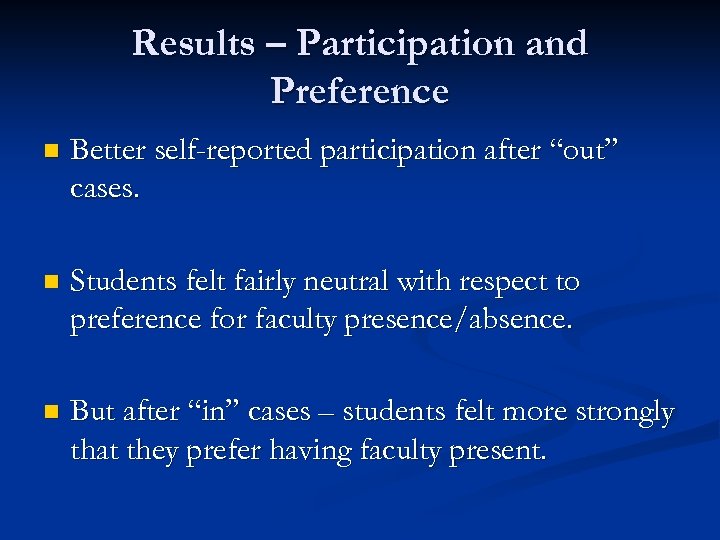 Results – Participation and Preference n Better self-reported participation after “out” cases. n Students felt fairly neutral with respect to preference for faculty presence/absence. n But after “in” cases – students felt more strongly that they prefer having faculty present.
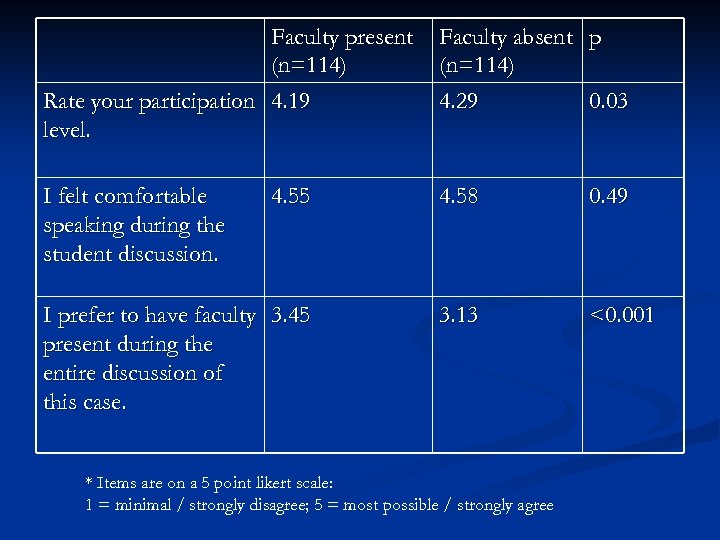 Faculty present (n=114) Rate your participation 4. 19 level. Faculty absent p (n=114) 4. 29 0. 03 I felt comfortable speaking during the student discussion. 4. 55 4. 58 0. 49 I prefer to have faculty 3. 45 present during the entire discussion of this case. 3. 13 <0. 001 * Items are on a 5 point likert scale: 1 = minimal / strongly disagree; 5 = most possible / strongly agree
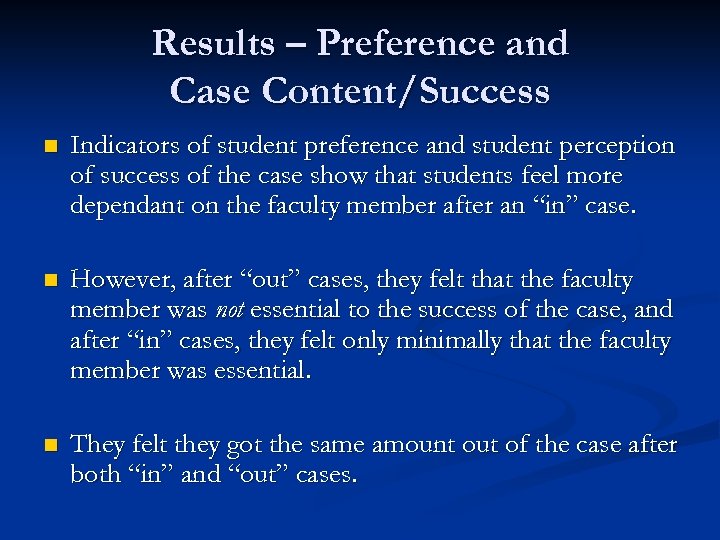 Results – Preference and Case Content/Success n Indicators of student preference and student perception of success of the case show that students feel more dependant on the faculty member after an “in” case. n However, after “out” cases, they felt that the faculty member was not essential to the success of the case, and after “in” cases, they felt only minimally that the faculty member was essential. n They felt they got the same amount out of the case after both “in” and “out” cases.
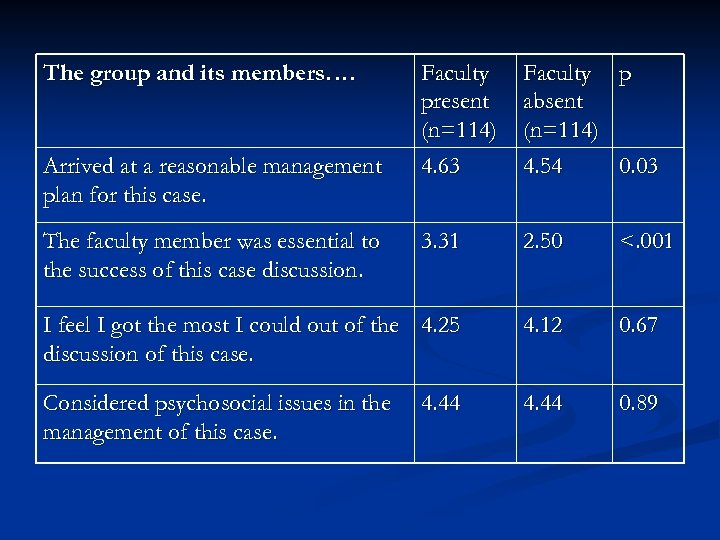 The group and its members…. Faculty present (n=114) 4. 63 Faculty p absent (n=114) 4. 54 0. 03 3. 31 2. 50 <. 001 I feel I got the most I could out of the 4. 25 discussion of this case. 4. 12 0. 67 Considered psychosocial issues in the management of this case. 4. 44 0. 89 Arrived at a reasonable management plan for this case. The faculty member was essential to the success of this case discussion. 4. 44
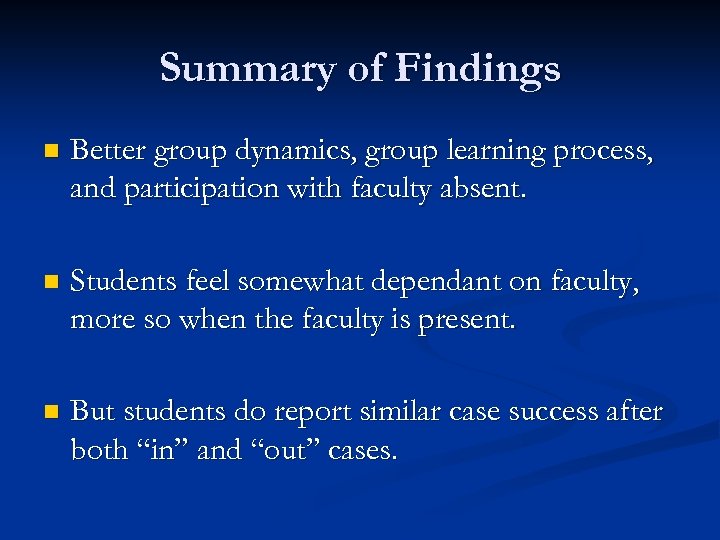 Summary of Findings n Better group dynamics, group learning process, and participation with faculty absent. n Students feel somewhat dependant on faculty, more so when the faculty is present. n But students do report similar case success after both “in” and “out” cases.
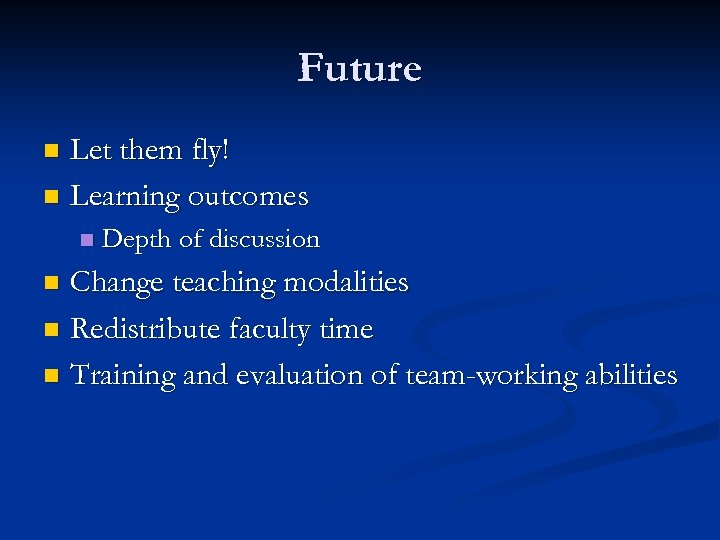 Future Let them fly! n Learning outcomes n n Depth of discussion Change teaching modalities n Redistribute faculty time n Training and evaluation of team-working abilities n
 Selected References n n n n n Carisle C et al. Introducing problem-based learning into research methods teaching: student and facilitator evaluation. Nursing Education Today 2005; 25(7): 527 -541. De Villiers M et al. The value of small group learning: an evaluation of an innovative CPD programme for primary care medical practitioners. Medical Education 2003; 37: 815821. Kropiunigg U et al. Learning in groups: Teamshaping in the teaching of medical psychology. Medical Education 2002; 36: 334 -336. Mayo P et al. Student perceptions of tutor effectiveness in a problem-based surgery clerkship. Teach Learn Medicine 1993; 4: 227 -233. Silver M et al. Effects of tutors with subject expertise on the problem-based tutorial process. Academic Medicine 1991; 66(5): 298 -300. Steele D et al. A comparison of learning outcomes and attitudes in student- versus faculty-led problem-based learning: an experimental study. Medical education 2000; 34: 23 -29. Steinert Y. Student perceptions of effective small group teaching. Medical Education 2004; 38: 286 -293. Vernon D et al. Faculty attitudes and opinions about problem-based learning. Academic Medicine 1996; 71: 1233 -1238. Willis SC et al. Small group work and assessment in a PBL curriculum: a qualitative and quantitative evaluation of student perceptions of the process of working in small groups and its assessment. Medical Teacher 2002; 24 (5): 495 -501.