 Скачать презентацию The effect of EU liberalization scenarios on export
4866ff3e6f6b7fbd5f6c0af46a67d6f6.ppt
- Количество слайдов: 75



The effect of EU liberalization scenarios on export between Israel and the EU-W 20. Submitted by Amir Heiman Yacov Tsur Presentation of the final report Montpellier – May 18
The effect of EU liberalization scenarios on export between Israel and the EU. • This study aims at estimating the effects of different EU liberalization scenarios on the exports to the EU of horticulture products from the following Mediterranean countries: Turkey, Tunisia, Morocco, Egypt and Israel. • In addition to other techniques, the liberalization is being studied using the Delphi survey technique.
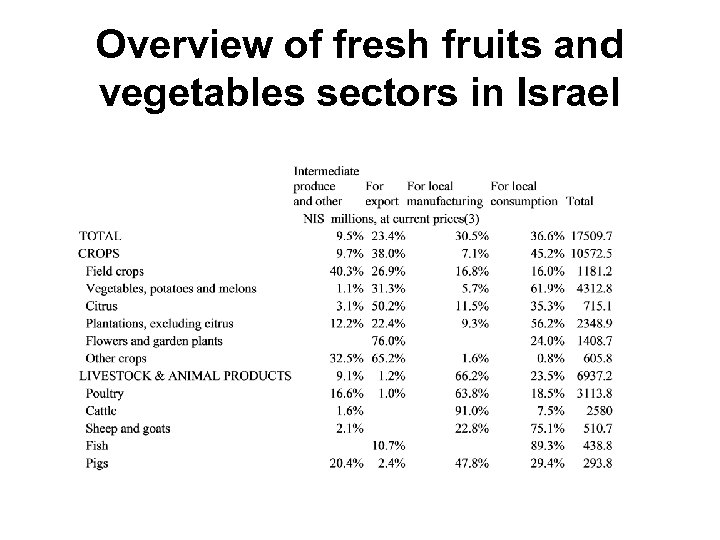
Overview of fresh fruits and vegetables sectors in Israel
• The crop sectors as a whole export 38% of output value while the livestock sectors export only 1. 2%. • The most export-oriented sector is the flowers industry that obtains 76% of its revenues from exports, followed by citrus, vegetables and fruits (orchards. ( • The citrus sector has been reduced dramatically since it heyday during the 1960 s and is now only ninth in size.
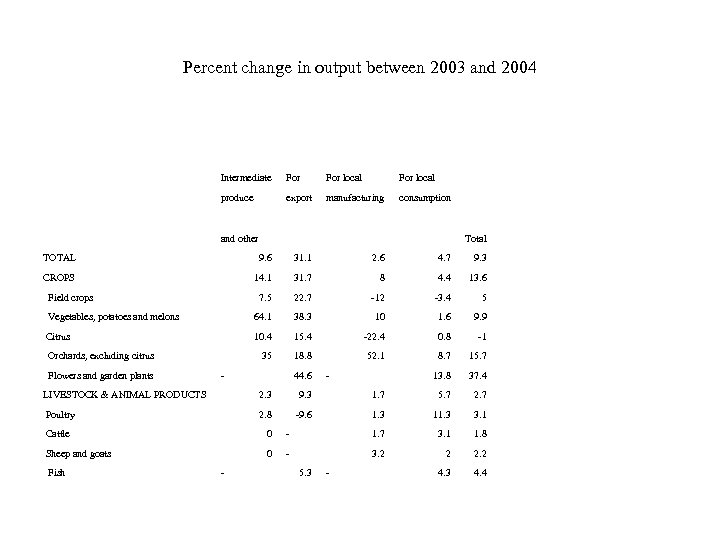
Percent change in output between 2003 and 2004 Intermediate For local produce export manufacturing consumption and other Total TOTAL 9. 6 31. 1 2. 6 4. 7 9. 3 CROPS 14. 1 31. 7 8 4. 4 13. 6 7. 5 22. 7 -12 -3. 4 5 Vegetables, potatoes and melons 64. 1 38. 3 10 1. 6 9. 9 Citrus 10. 4 15. 4 -22. 4 0. 8 -1 35 18. 8 52. 1 8. 7 15. 7 13. 8 37. 4 Field crops Orchards, excluding citrus Flowers and garden plants - 44. 6 - LIVESTOCK & ANIMAL PRODUCTS 2. 3 9. 3 1. 7 5. 7 2. 7 Poultry 2. 8 -9. 6 1. 3 11. 3 3. 1 Cattle 0 - 1. 7 3. 1 1. 8 Sheep and goats 0 - 3. 2 2 2. 2 4. 3 4. 4 Fish - 5. 3 -
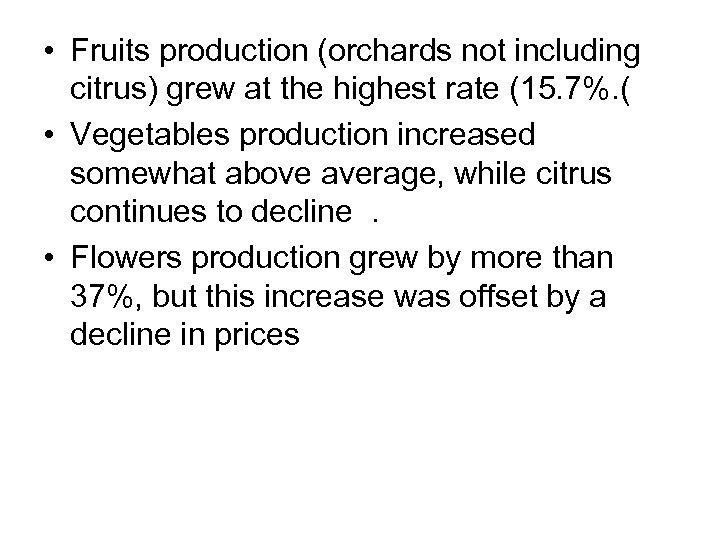
• Fruits production (orchards not including citrus) grew at the highest rate (15. 7%. ( • Vegetables production increased somewhat above average, while citrus continues to decline. • Flowers production grew by more than 37%, but this increase was offset by a decline in prices
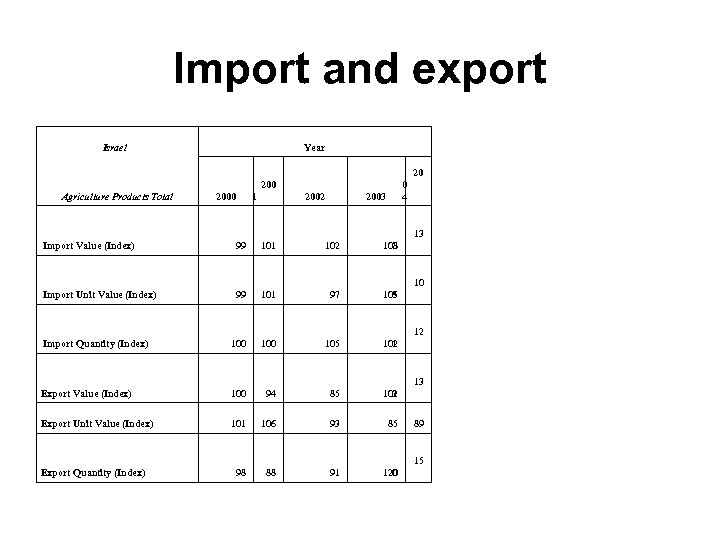
Import and export Israel Year 20 200 Agriculture Products Total 2000 1 2002 0 4 2003 13 Import Value (Index) 99 101 102 108 0 Import Unit Value (Index) 99 101 97 105 8 Import Quantity (Index) 100 105 102 1 Export Value (Index) 100 94 85 102 3 Export Unit Value (Index) 101 106 93 85 98 88 91 120 0 10 12 13 89 15 Export Quantity (Index)
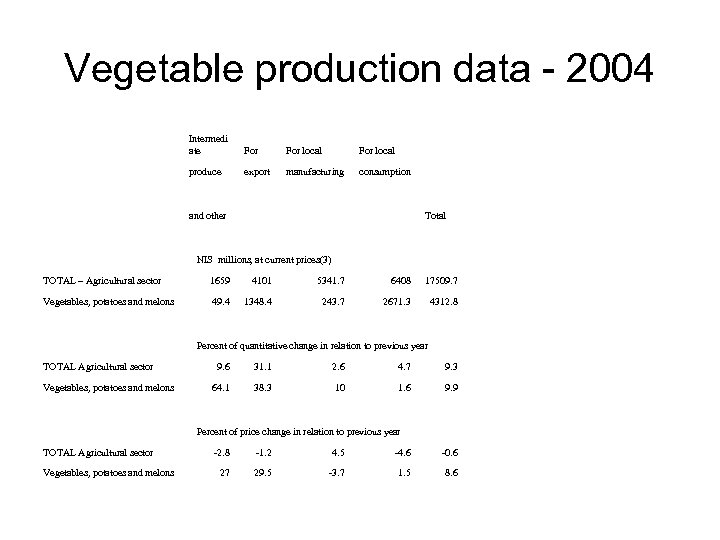
Vegetable production data - 2004 Intermedi ate For local produce export manufacturing consumption and other Total NIS millions, at current prices(3) TOTAL – Agricultural sector 1659 4101 5341. 7 6408 17509. 7 Vegetables, potatoes and melons 49. 4 1348. 4 243. 7 2671. 3 4312. 8 Percent of quantitative change in relation to previous year TOTAL Agricultural sector Vegetables, potatoes and melons 9. 6 31. 1 2. 6 4. 7 9. 3 64. 1 38. 3 10 1. 6 9. 9 Percent of price change in relation to previous year TOTAL Agricultural sector Vegetables, potatoes and melons -2. 8 -1. 2 4. 5 -4. 6 -0. 6 27 29. 5 -3. 7 1. 5 8. 6
• The production of vegetables increased by 9. 9% during 2004 – above 9. 3% growth rate of agricultural sector as a whole. • The largest increase is in vegetables for intermediate produce and for local manufacturing. • In contrast (or perhaps as a result) the average vegetables price has declined.
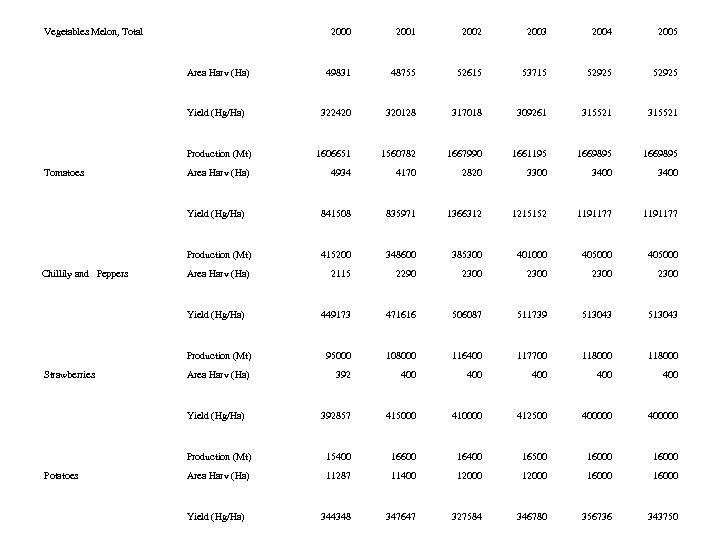
Vegetables Melon, Total 2002 2003 2004 2005 49831 48755 52615 53715 52925 Yield (Hg/Ha) 322420 320128 317018 309261 315521 Production (Mt) 1606651 1560782 1667990 1661195 1669895 Area Harv (Ha) 4934 4170 2820 3300 3400 Yield (Hg/Ha) 841508 835971 1366312 1215152 1191177 Production (Mt) 415200 348600 385300 401000 405000 Area Harv (Ha) 2115 2290 2300 449173 471616 506087 511739 513043 Production (Mt) 95000 108000 116400 117700 118000 Area Harv (Ha) 392 400 400 400 392857 415000 410000 412500 400000 Production (Mt) Chillily and Peppers 2001 Area Harv (Ha) Tomatoes 2000 15400 16600 16400 16500 16000 Area Harv (Ha) 11287 11400 12000 16000 Yield (Hg/Ha) 344348 347647 327584 346780 356736 343750 Yield (Hg/Ha) Strawberries Yield (Hg/Ha) Potatoes
Fruits • While area of fruits orchards hardly changed between 1990 and 2004 , output dropped by 41%. • However, production of fruits excluding citrus actually recovered between 2002 and 2004. • The share of fruits export increased. Production of the avocados and persimmons alternate between abundance years and shortage years.
• Estimation of the impact of liberalization scenarios • The expected effects of the two liberalization scenarios are estimated using the Delphi survey technique • The Delphi survey technique uses a panel of experts to forecast impacts of various policy measures. • The method is quite simple. • In the first step the responder is asked to answer to the questionnaire. • The second step will be held shortly after that, and will include another round of questions • A panel of experts are chosen and they are asked to provide their estimates.
Methodology • Delphi methodology was developed in the 60’s at Rand Cooperation. • The name was taken from the Greek mythology where the oracle could predict future events • The methodology of Delphi research design in presented in the next slide
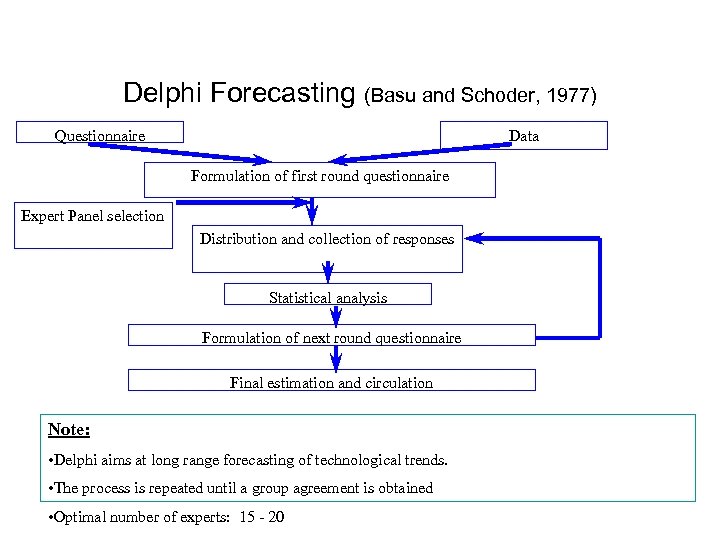
Delphi Forecasting (Basu and Schoder, 1977) Questionnaire Data Formulation of first round questionnaire Expert Panel selection Distribution and collection of responses Statistical analysis Formulation of next round questionnaire Final estimation and circulation Note: • Delphi aims at long range forecasting of technological trends. • The process is repeated until a group agreement is obtained • Optimal number of experts: 15 - 20
Highlights on Delphi methodology • The Delphi methodology is based on expert panel • Every participant is supposed to give his/her best estimate to future scenario without knowing who are other members of the panel. • Calibration of estimates is the most fragile part of this research- the second round provides each responder with information about the average and standard deviation of the entire sample
• We assume that if the prior beliefs are strong than the new information will be discounted, i. e. , get a small weight and vise versa. • To guarantee high validity the questionnaire was administrated via mail (or email. (
Choice of products • The five products selected for the Expert Panel study are tomatoes, potatoes, pepper, table grapes, and strawberries. • We note that given their weights in the Israeli exports, both avocado and flowers are more important than strawberries and grapes.
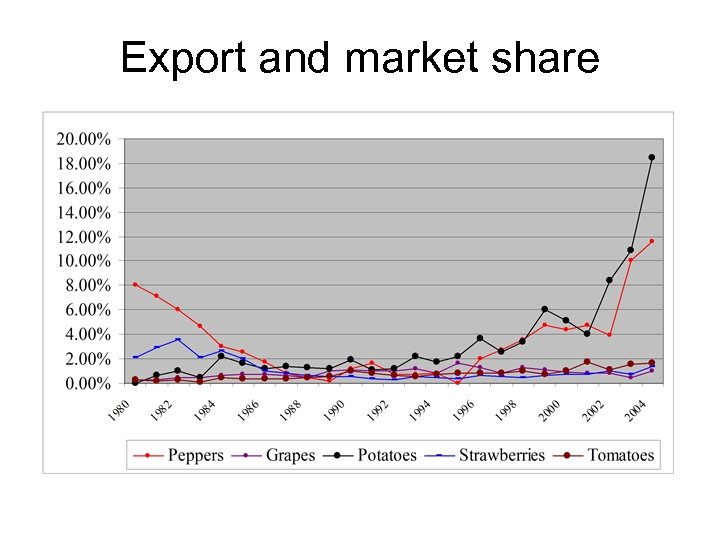
Export and market share
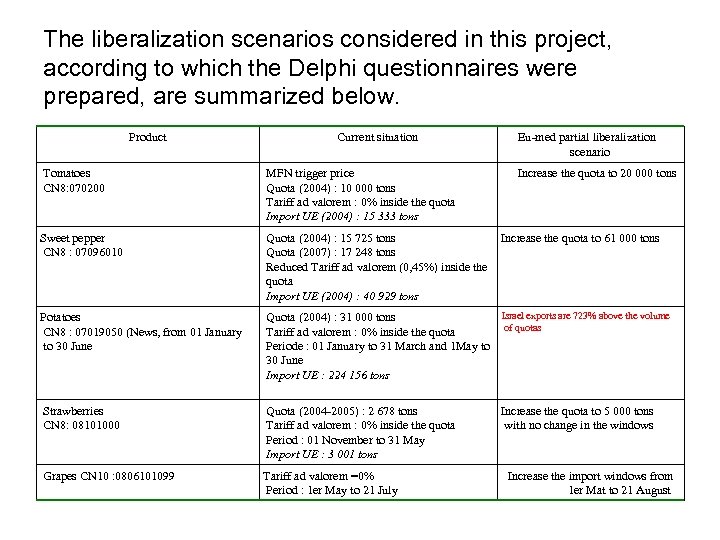
The liberalization scenarios considered in this project, according to which the Delphi questionnaires were prepared, are summarized below. Product Current situation Eu-med partial liberalization scenario Tomatoes CN 8: 070200 MFN trigger price Quota (2004) : 10 000 tons Tariff ad valorem : 0% inside the quota Import UE (2004) : 15 333 tons Increase the quota to 20 000 tons Sweet pepper CN 8 : 07096010 Quota (2004) : 15 725 tons Increase the quota to 61 000 tons Quota (2007) : 17 248 tons Reduced Tariff ad valorem (0, 45%) inside the quota Import UE (2004) : 40 929 tons Potatoes CN 8 : 07019050 (News, from 01 January to 30 June Israel exports are 723% above the volume Quota (2004) : 31 000 tons of quotas Tariff ad valorem : 0% inside the quota Periode : 01 January to 31 March and 1 May to 30 June Import UE : 224 156 tons Strawberries CN 8: 08101000 Quota (2004 -2005) : 2 678 tons Tariff ad valorem : 0% inside the quota Period : 01 November to 31 May Import UE : 3 001 tons Grapes CN 10 : 0806101099 Tariff ad valorem =0% Period : 1 er May to 21 July Increase the quota to 5 000 tons with no change in the windows Increase the import windows from 1 er Mat to 21 August
Sample description • We chose responders who could give reliable valuation based on experience, e. g. , mangers of export firms, policy makers in the Ministry of Agriculture and extension service members.
• We identified 35 potential responders and (after convincing their mangers to authorize their participation in the study) sent them the questionnaire by mail and email. • We received 29 responses (5 replied that they are not knowledgeable enough to handle this mission and 1 declined). • Since responders were instructed to answer only questions in their field of expertise and the number of experts is not the same across all product categories, we obtained uneven number of responses for the different categories.
Second Round • After receiving the first-round questionnaires and processing the information, we sent a revised questionnaire that contained descriptive statistics (mean, standard deviation, maximum and minimum values). • The responders were informed that they may revise their initial evaluation, but if they are confident in their initial evaluation they should stick to it (for Israelis this goes without saying). • Only four responders out of 29 revised their initial evaluations.
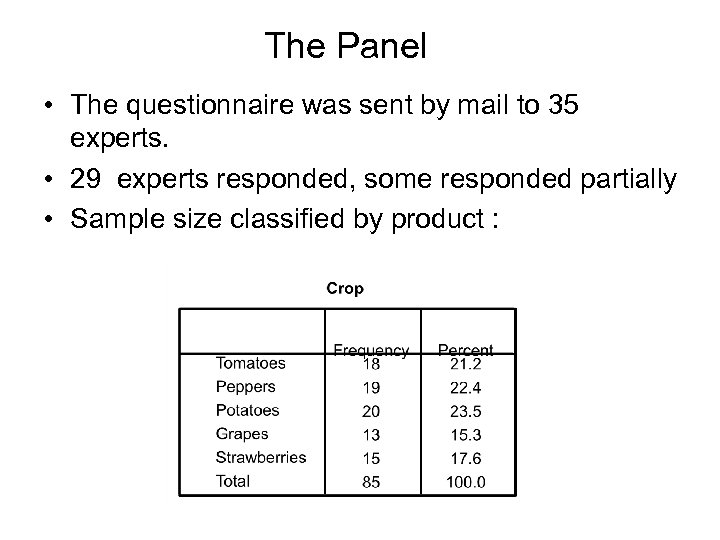
The Panel • The questionnaire was sent by mail to 35 experts. • 29 experts responded, some responded partially • Sample size classified by product :
The Questionnaire –Example
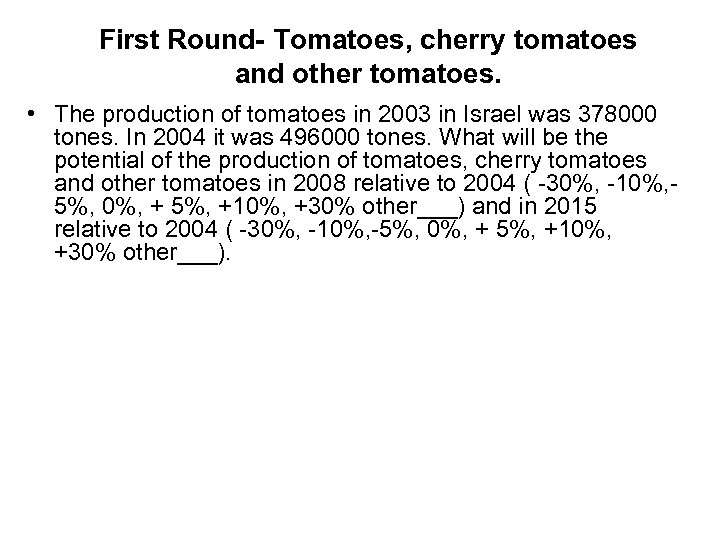
First Round- Tomatoes, cherry tomatoes and other tomatoes. • The production of tomatoes in 2003 in Israel was 378000 tones. In 2004 it was 496000 tones. What will be the potential of the production of tomatoes, cherry tomatoes and other tomatoes in 2008 relative to 2004 ( -30%, -10%, 5%, 0%, + 5%, +10%, +30% other___) and in 2015 relative to 2004 ( -30%, -10%, -5%, 0%, + 5%, +10%, +30% other___).
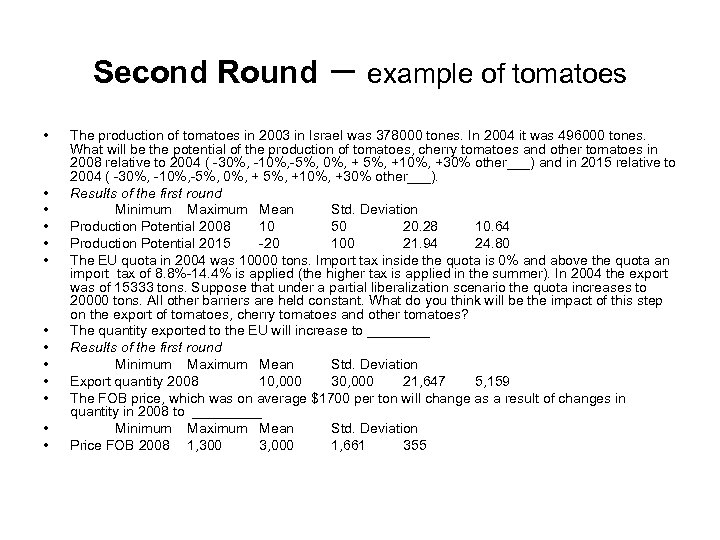
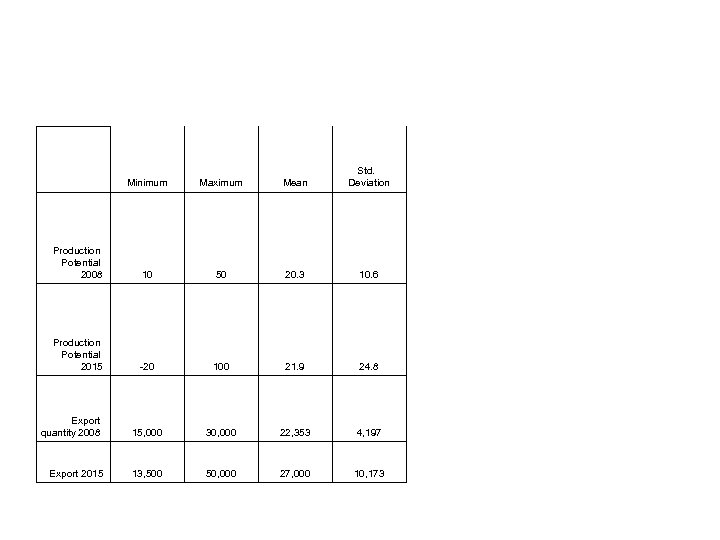
Second Round • • • • – example of tomatoes The production of tomatoes in 2003 in Israel was 378000 tones. In 2004 it was 496000 tones. What will be the potential of the production of tomatoes, cherry tomatoes and other tomatoes in 2008 relative to 2004 ( -30%, -10%, -5%, 0%, + 5%, +10%, +30% other___) and in 2015 relative to 2004 ( -30%, -10%, -5%, 0%, + 5%, +10%, +30% other___). Results of the first round Minimum Maximum Mean Std. Deviation Production Potential 2008 10 50 20. 28 10. 64 Production Potential 2015 -20 100 21. 94 24. 80 The EU quota in 2004 was 10000 tons. Import tax inside the quota is 0% and above the quota an import tax of 8. 8%-14. 4% is applied (the higher tax is applied in the summer). In 2004 the export was of 15333 tons. Suppose that under a partial liberalization scenario the quota increases to 20000 tons. All other barriers are held constant. What do you think will be the impact of this step on the export of tomatoes, cherry tomatoes and other tomatoes? The quantity exported to the EU will increase to ____ Results of the first round Minimum Maximum Mean Std. Deviation Export quantity 2008 10, 000 30, 000 21, 647 5, 159 The FOB price, which was on average $1700 per ton will change as a result of changes in quantity in 2008 to _____ Minimum Maximum Mean Std. Deviation Price FOB 2008 1, 300 3, 000 1, 661 355
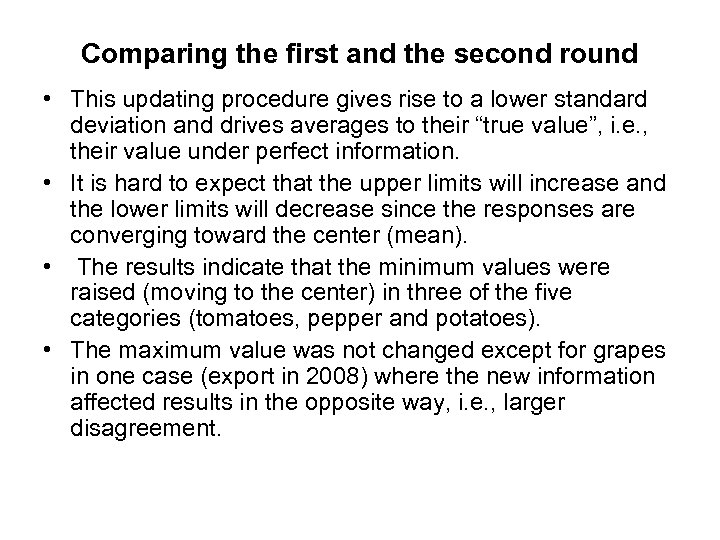
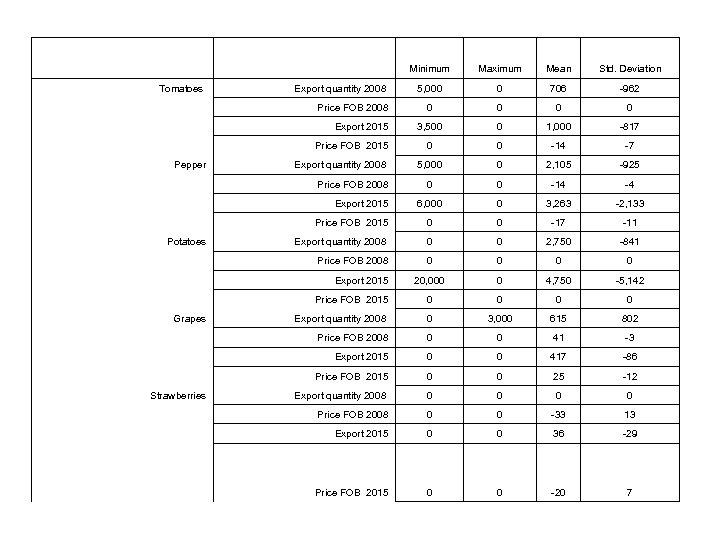
Comparing the first and the second round • This updating procedure gives rise to a lower standard deviation and drives averages to their “true value”, i. e. , their value under perfect information. • It is hard to expect that the upper limits will increase and the lower limits will decrease since the responses are converging toward the center (mean). • The results indicate that the minimum values were raised (moving to the center) in three of the five categories (tomatoes, pepper and potatoes). • The maximum value was not changed except for grapes in one case (export in 2008) where the new information affected results in the opposite way, i. e. , larger disagreement.
• The responders did not change their valuation of the potential production and thus changes in these figures will not be presented. • The standard deviations became smaller and changes were made more frequently in the quantities under the two scenarios of liberalization.
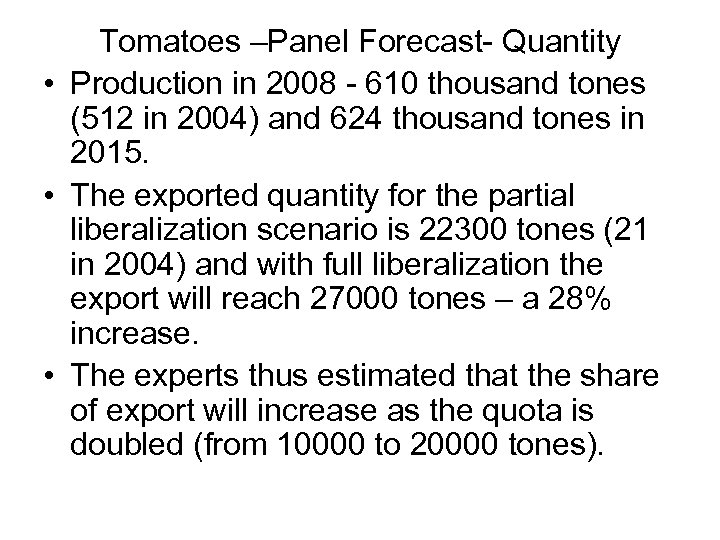
Tomatoes –Panel Forecast- Quantity • Production in 2008 - 610 thousand tones (512 in 2004) and 624 thousand tones in 2015. • The exported quantity for the partial liberalization scenario is 22300 tones (21 in 2004) and with full liberalization the export will reach 27000 tones – a 28% increase. • The experts thus estimated that the share of export will increase as the quota is doubled (from 10000 to 20000 tones).
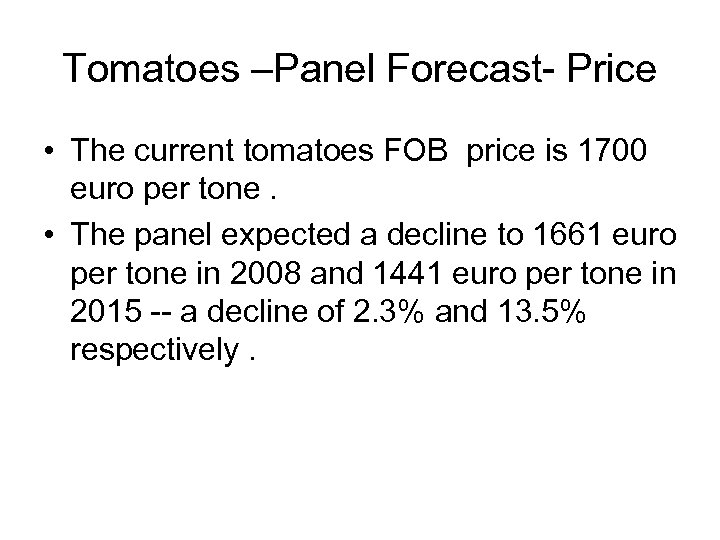
Tomatoes –Panel Forecast- Price • The current tomatoes FOB price is 1700 euro per tone. • The panel expected a decline to 1661 euro per tone in 2008 and 1441 euro per tone in 2015 -- a decline of 2. 3% and 13. 5% respectively.
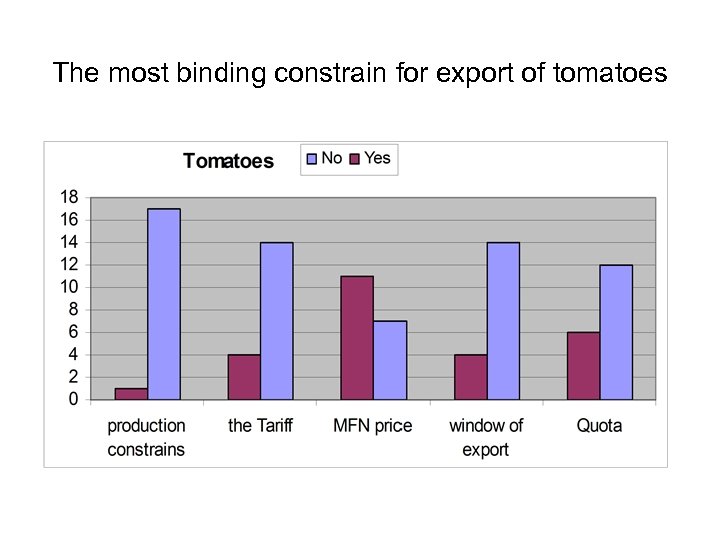
The most binding constrain for export of tomatoes
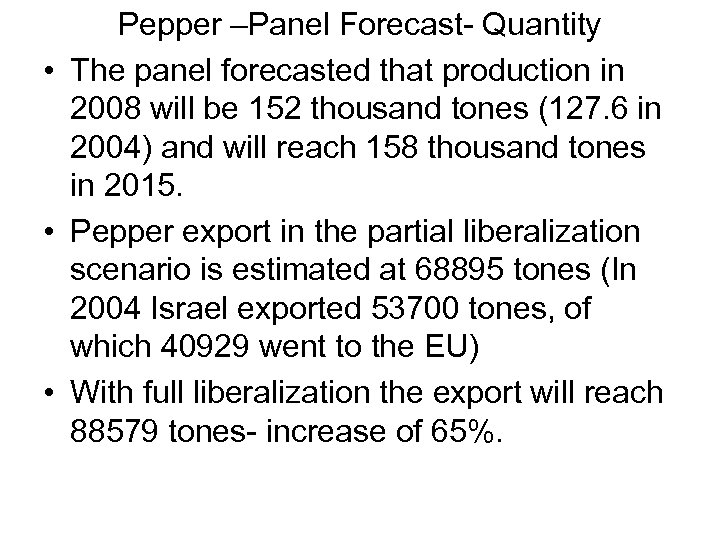
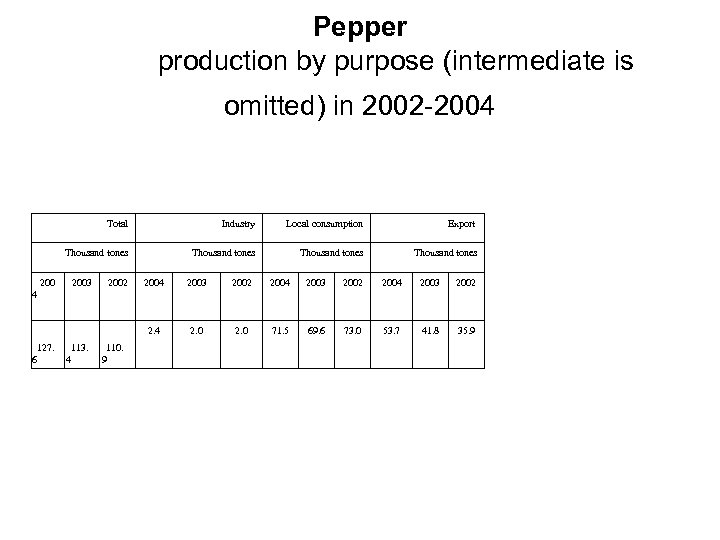
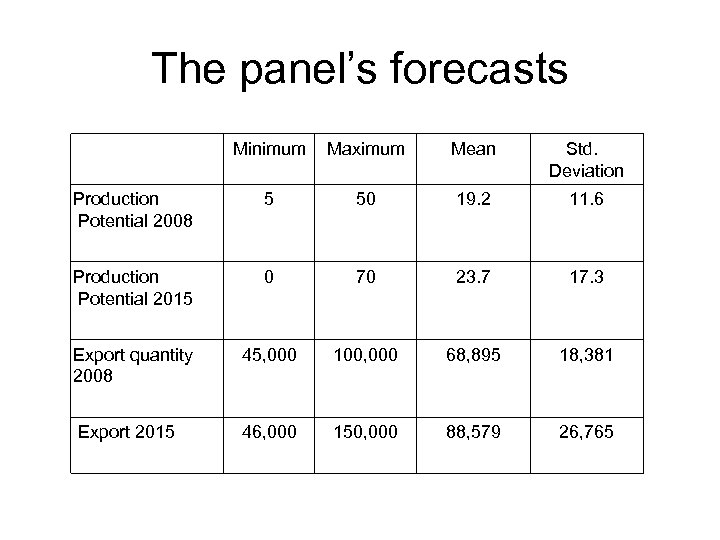
Pepper –Panel Forecast- Quantity • The panel forecasted that production in 2008 will be 152 thousand tones (127. 6 in 2004) and will reach 158 thousand tones in 2015. • Pepper export in the partial liberalization scenario is estimated at 68895 tones (In 2004 Israel exported 53700 tones, of which 40929 went to the EU) • With full liberalization the export will reach 88579 tones- increase of 65%.
Pepper - effect of increase in quantity exported on prices • The current FOB pepper price is in the range of 1200 – 1500 euro per tone. • The experts forecast that the increase in quantity will result in sharp decline of price. • The price is expected to decline to 1234 euro per tone in 2008 and 1158 euro per tone in 2015 with full liberalization.
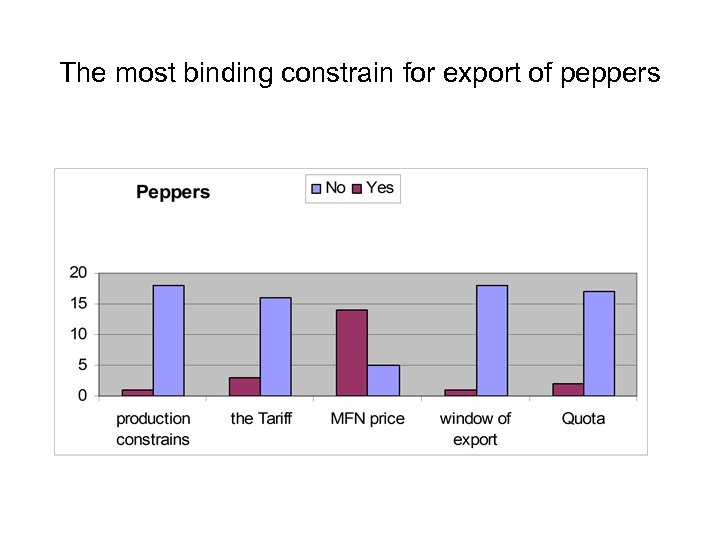
The most binding constrain for export of peppers
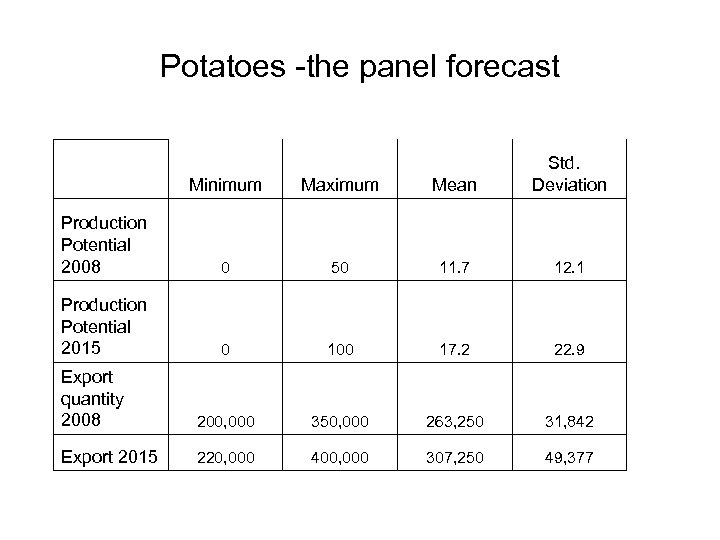
Potatoes -the panel forecast • The panel forecasted 637 thousand tones production in 2008 (570. 8 tones in 2004) and 669 thousand ton in 2015. • The exported quantity for the partial liberalization scenario is 263250 tones (251000 tones in 2004, of which 224156 tones are exported to the EU) and with full liberalization the export will reach 307250 tones – an increase of 22. 4%.
Potatoes panel forecast -Price • The current FOB potatoes price is in the range of 220 euro per tone The price is expected to decline to 218 euro per tone in 2008 and increase to 298 euro per tone in 2015 after full liberalization. • The two price estimates are not straightforward. In the current price of 220 euro per tone the profitability of exporting potatoes is questionable, thus a larger export under a lower price is, at best, odd. • The price in 2015 is supposed to increase while the quantity continues to increase. This will happen if potatoes production becomes more efficient or demand shifts upward
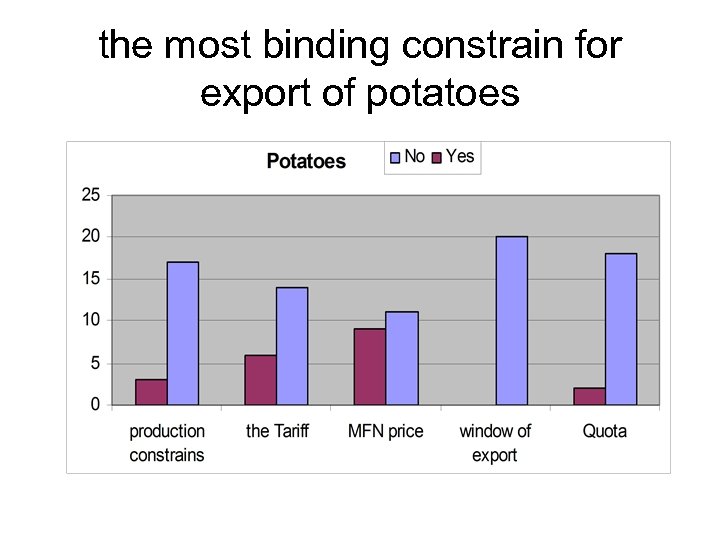
the most binding constrain for export of potatoes
Grapes -panel forecast • The production of grapes in 2008 will be 88. 8 thousand tones (73. 5 in 2004) and will reach 92 thousand tones in 2015. • The exported quantity under the partial liberalization scenario is 11546 tones (compare with 6700 tones export to the EU in 2004) and will reach 19667 tones under full liberalization - increase of 72% and 193%, respectively
Grapes-Price • The current rapes FOB price is around 1800 -1600 euro per tone. • The price is expected to decline to 1150 euro per tone in 2008 and increase slightly to 1170 euro per tone in 2015. • Again the increase of price between 2008 and 2015 is not easy to explain.
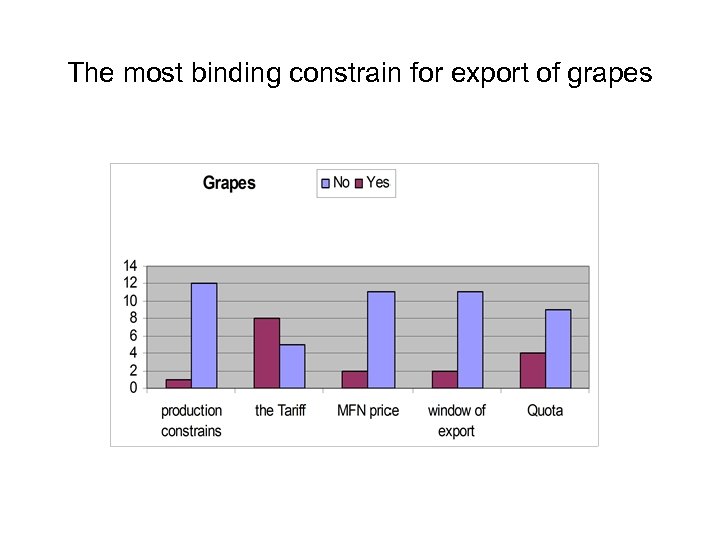
The most binding constrain for export of grapes
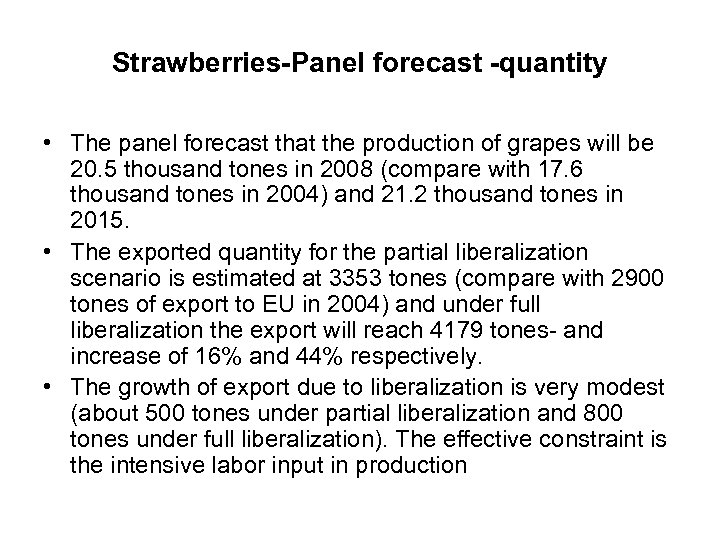
Strawberries-Panel forecast -quantity • The panel forecast that the production of grapes will be 20. 5 thousand tones in 2008 (compare with 17. 6 thousand tones in 2004) and 21. 2 thousand tones in 2015. • The exported quantity for the partial liberalization scenario is estimated at 3353 tones (compare with 2900 tones of export to EU in 2004) and under full liberalization the export will reach 4179 tones- and increase of 16% and 44% respectively. • The growth of export due to liberalization is very modest (about 500 tones under partial liberalization and 800 tones under full liberalization). The effective constraint is the intensive labor input in production
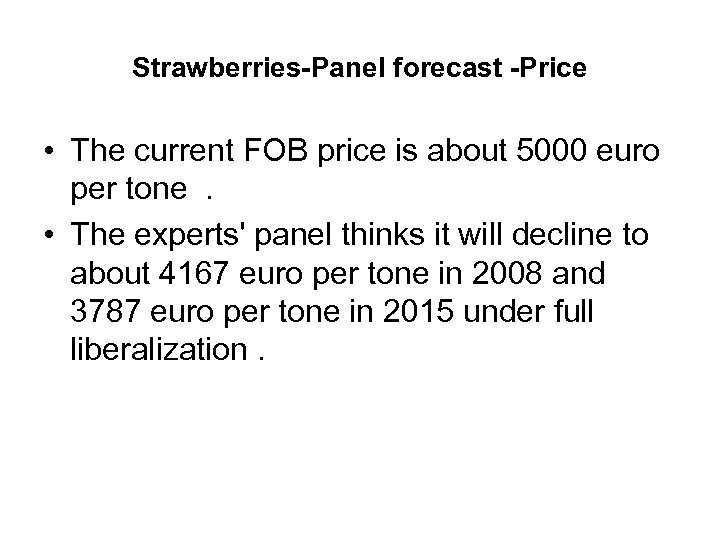
Strawberries-Panel forecast -Price • The current FOB price is about 5000 euro per tone. • The experts' panel thinks it will decline to about 4167 euro per tone in 2008 and 3787 euro per tone in 2015 under full liberalization.
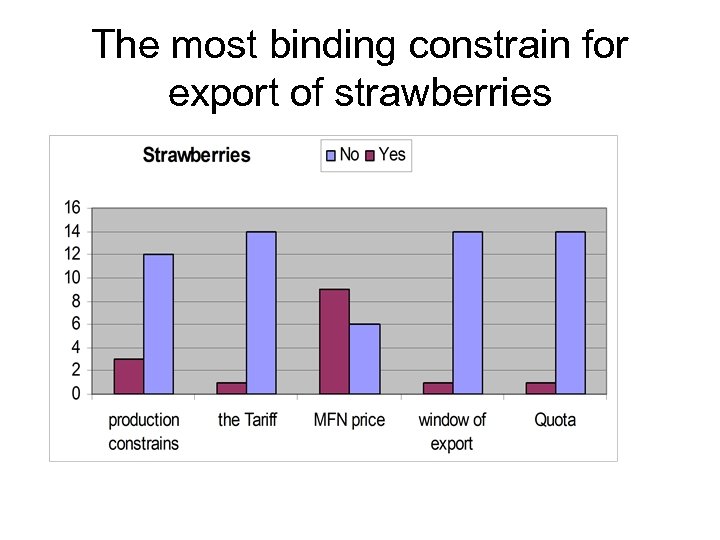
The most binding constrain for export of strawberries
Closing comments Issues that raised Concerns • The study covers effects on the export of Israeli agricultural products to the EU but ignores the possibility of import from EU (and other Mediterranean countries) to Israel. • Another issue that surfaced during the interviews was the choice of the product categories. Most experts were puzzled why flowers – a major export crop – were not part of the survey and why strawberries were included.
• Trade liberalization is excepted to increase Israeli export agricultural products to the EU by about 12 -60% and decrease prices by 3%-15%. • We believe that experts’ forecasts are based on partial aspects of liberalization.

Detailed Questions and Findings
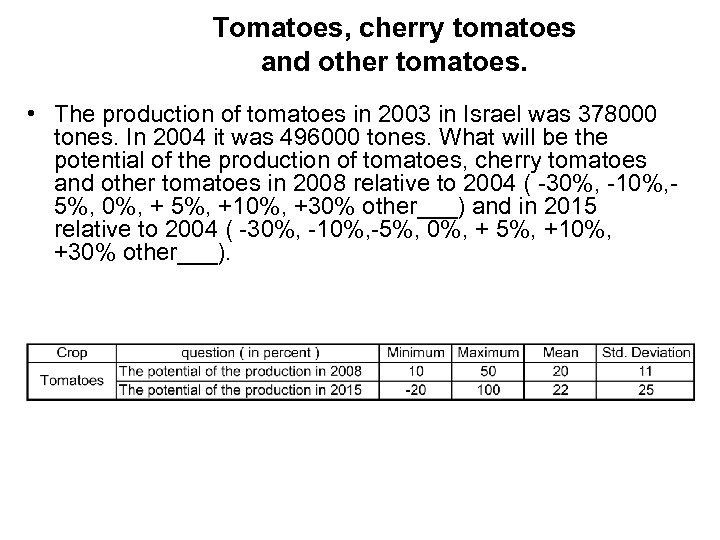
Tomatoes, cherry tomatoes and other tomatoes. • The production of tomatoes in 2003 in Israel was 378000 tones. In 2004 it was 496000 tones. What will be the potential of the production of tomatoes, cherry tomatoes and other tomatoes in 2008 relative to 2004 ( -30%, -10%, 5%, 0%, + 5%, +10%, +30% other___) and in 2015 relative to 2004 ( -30%, -10%, -5%, 0%, + 5%, +10%, +30% other___).
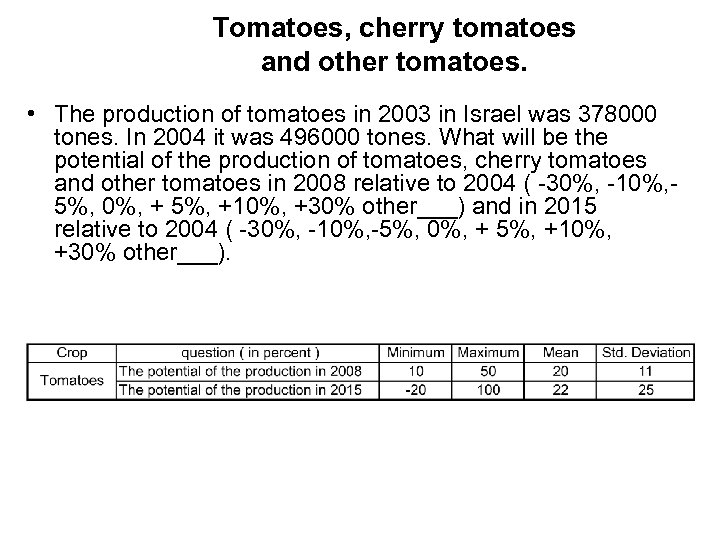
Tomatoes, cherry tomatoes and other tomatoes. • The production of tomatoes in 2003 in Israel was 378000 tones. In 2004 it was 496000 tones. What will be the potential of the production of tomatoes, cherry tomatoes and other tomatoes in 2008 relative to 2004 ( -30%, -10%, 5%, 0%, + 5%, +10%, +30% other___) and in 2015 relative to 2004 ( -30%, -10%, -5%, 0%, + 5%, +10%, +30% other___).
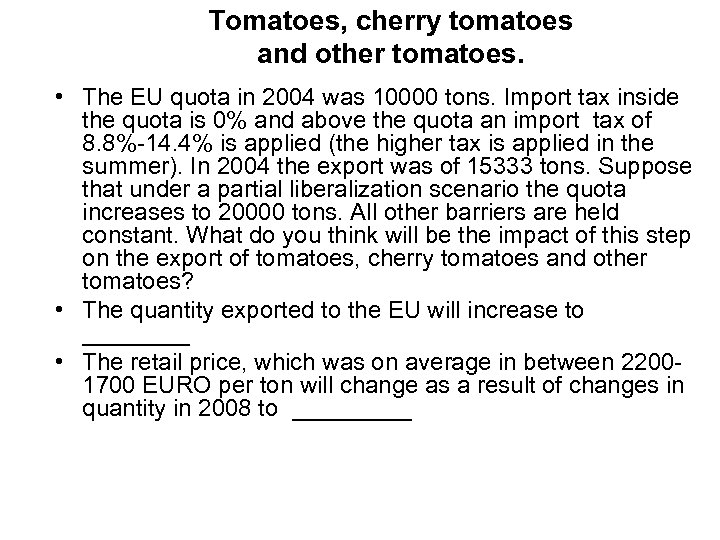
Tomatoes, cherry tomatoes and other tomatoes. • The EU quota in 2004 was 10000 tons. Import tax inside the quota is 0% and above the quota an import tax of 8. 8%-14. 4% is applied (the higher tax is applied in the summer). In 2004 the export was of 15333 tons. Suppose that under a partial liberalization scenario the quota increases to 20000 tons. All other barriers are held constant. What do you think will be the impact of this step on the export of tomatoes, cherry tomatoes and other tomatoes? • The quantity exported to the EU will increase to ____ • The retail price, which was on average in between 22001700 EURO per ton will change as a result of changes in quantity in 2008 to _____
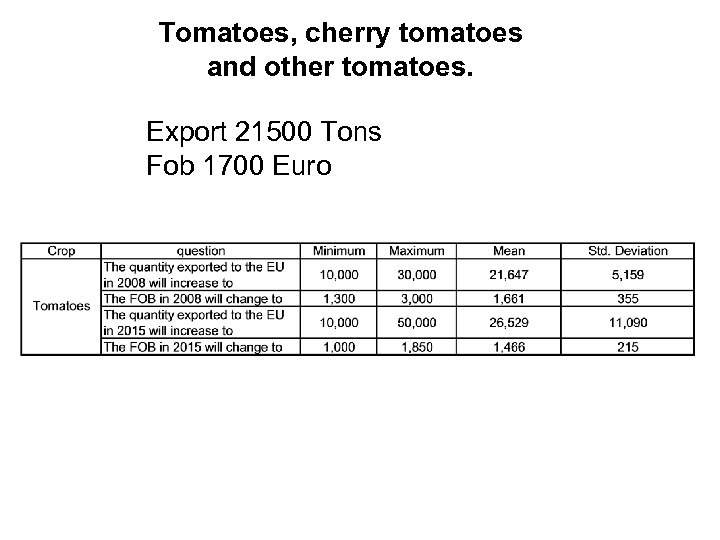
Tomatoes, cherry tomatoes and other tomatoes. Export 21500 Tons Fob 1700 Euro
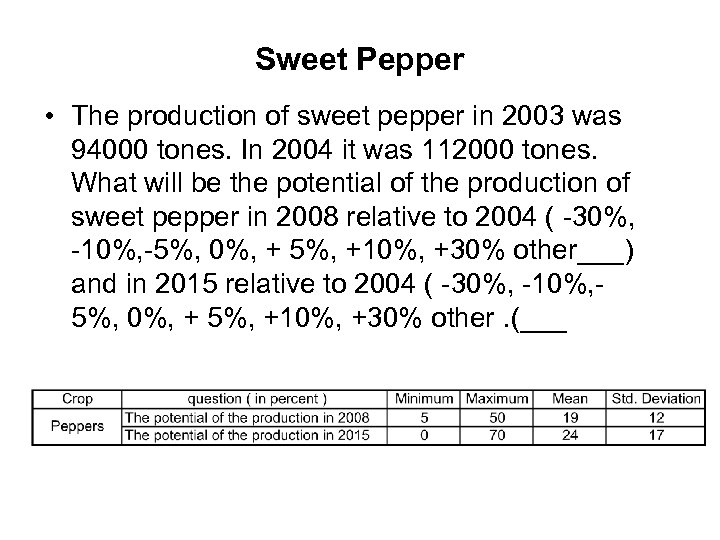
Sweet Pepper • The production of sweet pepper in 2003 was 94000 tones. In 2004 it was 112000 tones. What will be the potential of the production of sweet pepper in 2008 relative to 2004 ( -30%, -10%, -5%, 0%, + 5%, +10%, +30% other___) and in 2015 relative to 2004 ( -30%, -10%, 5%, 0%, + 5%, +10%, +30% other. (___
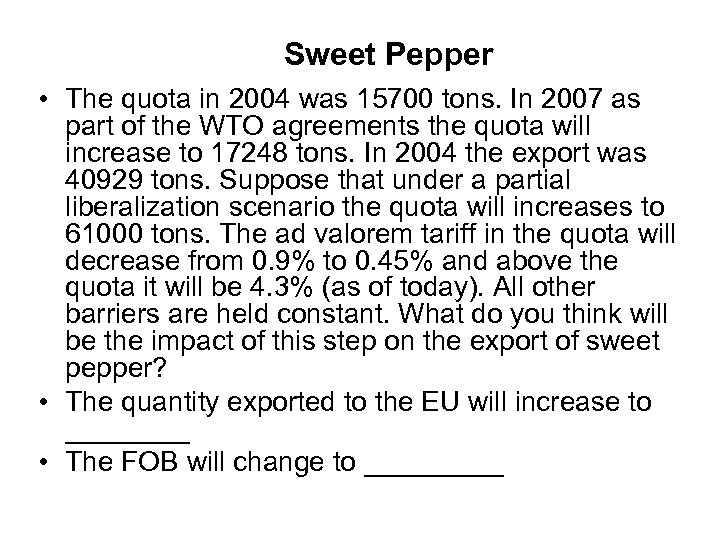
Sweet Pepper • The quota in 2004 was 15700 tons. In 2007 as part of the WTO agreements the quota will increase to 17248 tons. In 2004 the export was 40929 tons. Suppose that under a partial liberalization scenario the quota will increases to 61000 tons. The ad valorem tariff in the quota will decrease from 0. 9% to 0. 45% and above the quota it will be 4. 3% (as of today). All other barriers are held constant. What do you think will be the impact of this step on the export of sweet pepper? • The quantity exported to the EU will increase to ____ • The FOB will change to _____
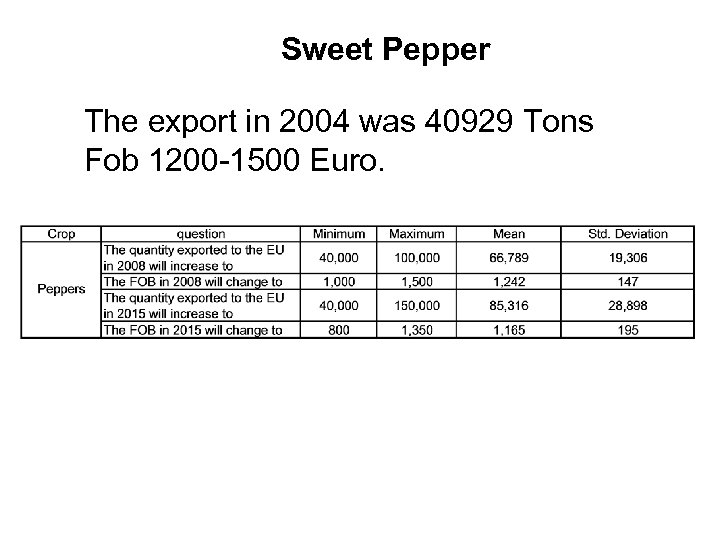
Sweet Pepper The export in 2004 was 40929 Tons Fob 1200 -1500 Euro.
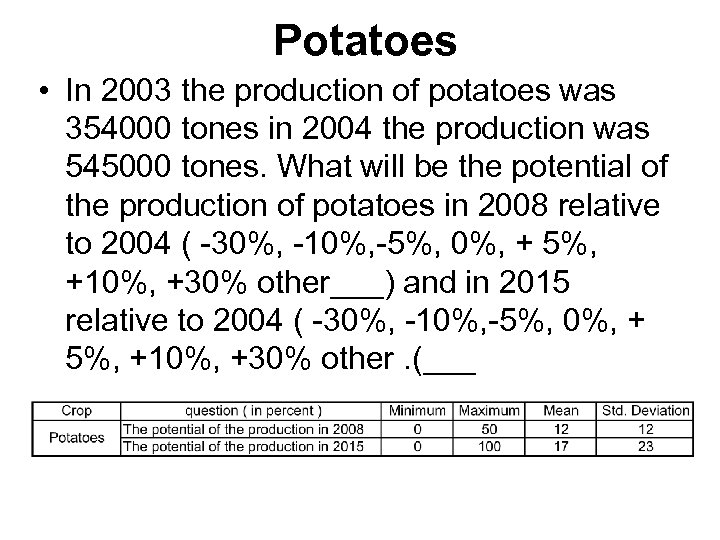
Potatoes • In 2003 the production of potatoes was 354000 tones in 2004 the production was 545000 tones. What will be the potential of the production of potatoes in 2008 relative to 2004 ( -30%, -10%, -5%, 0%, + 5%, +10%, +30% other___) and in 2015 relative to 2004 ( -30%, -10%, -5%, 0%, + 5%, +10%, +30% other. (___
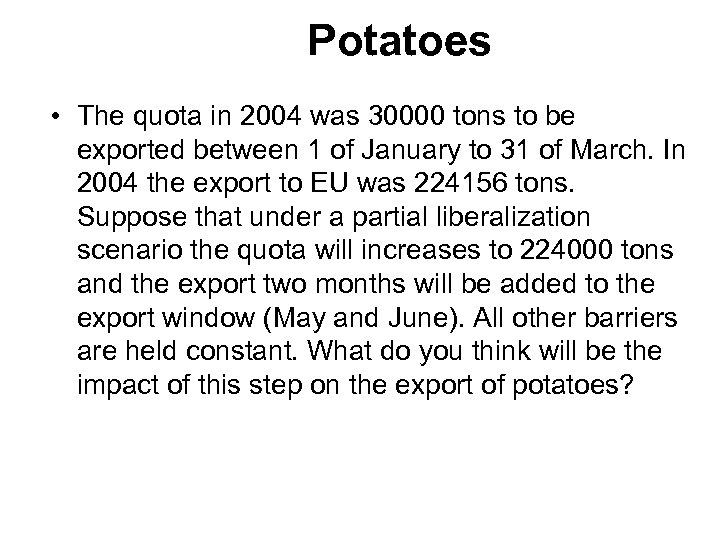
Potatoes • The quota in 2004 was 30000 tons to be exported between 1 of January to 31 of March. In 2004 the export to EU was 224156 tons. Suppose that under a partial liberalization scenario the quota will increases to 224000 tons and the export two months will be added to the export window (May and June). All other barriers are held constant. What do you think will be the impact of this step on the export of potatoes?
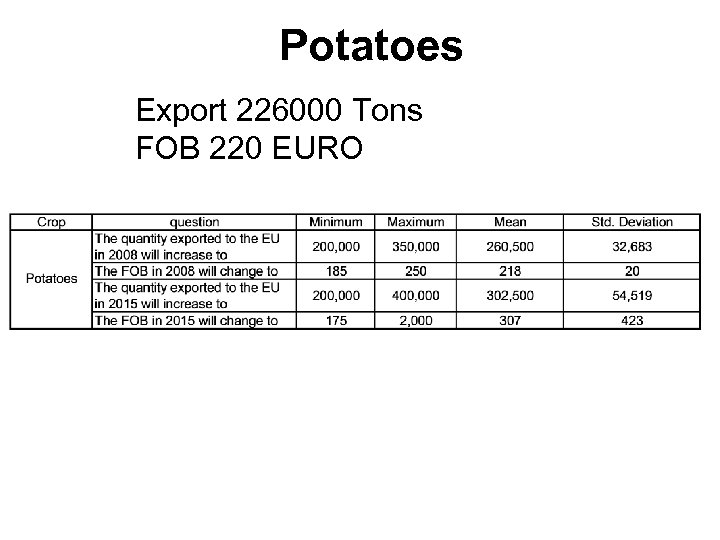
Potatoes Export 226000 Tons FOB 220 EURO
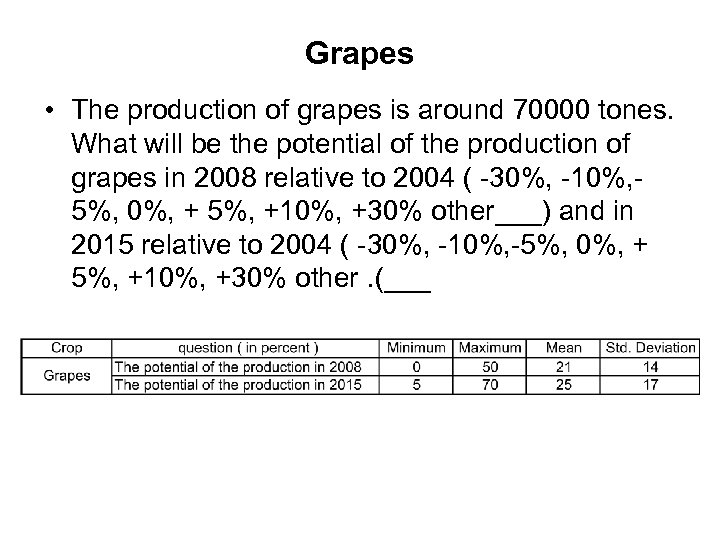
Grapes • The production of grapes is around 70000 tones. What will be the potential of the production of grapes in 2008 relative to 2004 ( -30%, -10%, 5%, 0%, + 5%, +10%, +30% other___) and in 2015 relative to 2004 ( -30%, -10%, -5%, 0%, + 5%, +10%, +30% other. (___
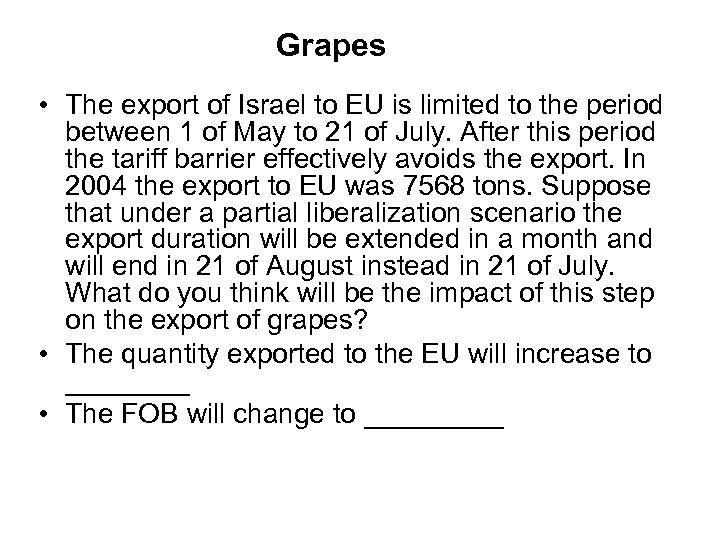
Grapes • The export of Israel to EU is limited to the period between 1 of May to 21 of July. After this period the tariff barrier effectively avoids the export. In 2004 the export to EU was 7568 tons. Suppose that under a partial liberalization scenario the export duration will be extended in a month and will end in 21 of August instead in 21 of July. What do you think will be the impact of this step on the export of grapes? • The quantity exported to the EU will increase to ____ • The FOB will change to _____
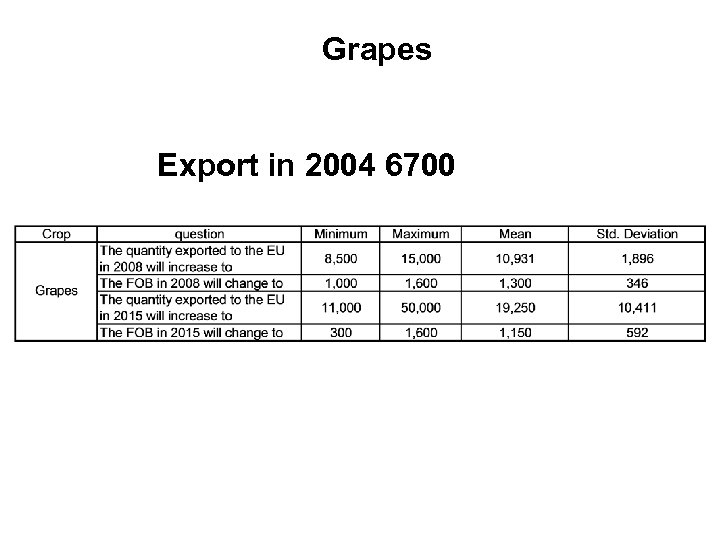
Grapes Export in 2004 6700
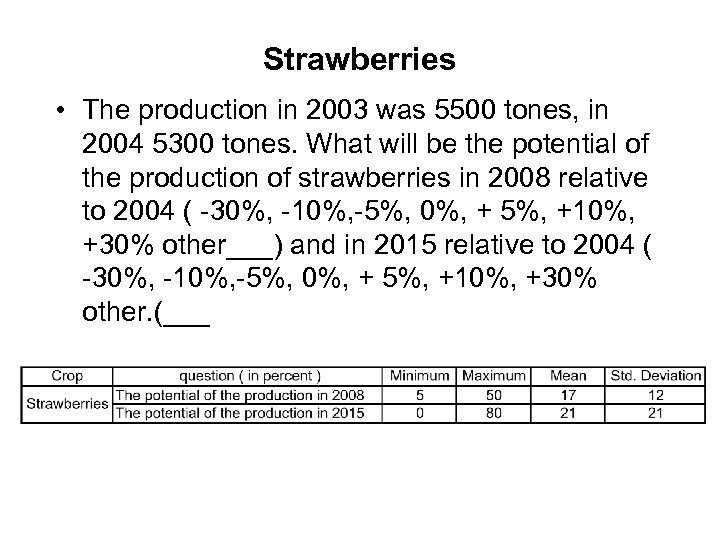
Strawberries • The production in 2003 was 5500 tones, in 2004 5300 tones. What will be the potential of the production of strawberries in 2008 relative to 2004 ( -30%, -10%, -5%, 0%, + 5%, +10%, +30% other___) and in 2015 relative to 2004 ( -30%, -10%, -5%, 0%, + 5%, +10%, +30% other. (___
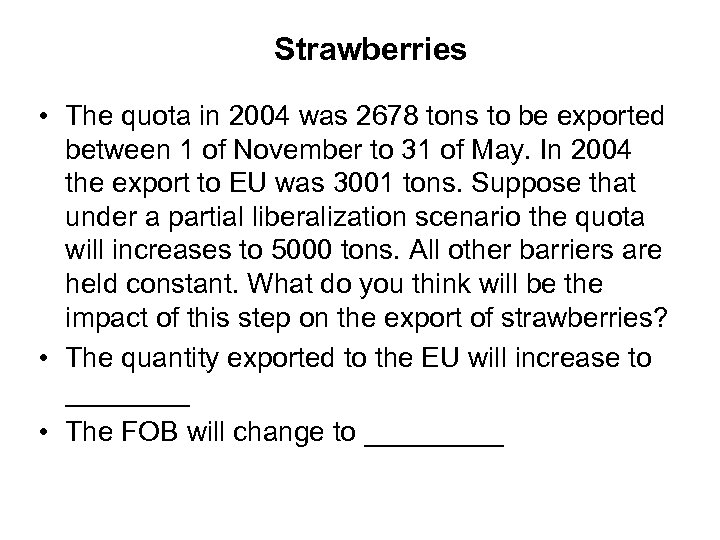
Strawberries • The quota in 2004 was 2678 tons to be exported between 1 of November to 31 of May. In 2004 the export to EU was 3001 tons. Suppose that under a partial liberalization scenario the quota will increases to 5000 tons. All other barriers are held constant. What do you think will be the impact of this step on the export of strawberries? • The quantity exported to the EU will increase to ____ • The FOB will change to _____
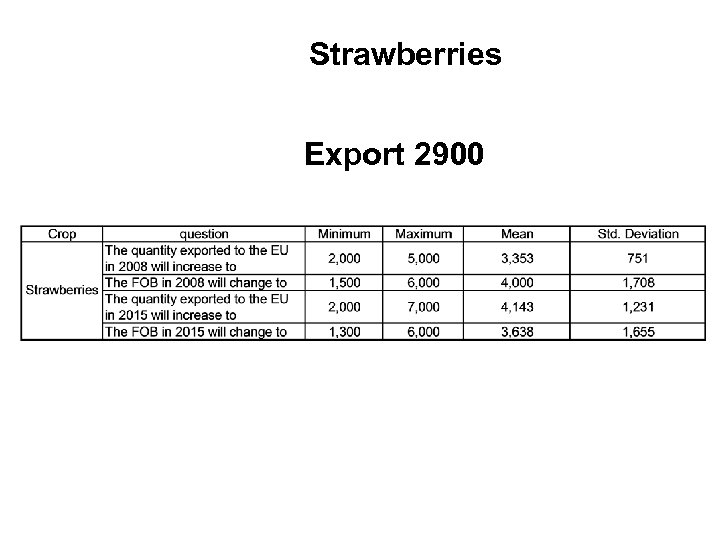
Strawberries Export 2900
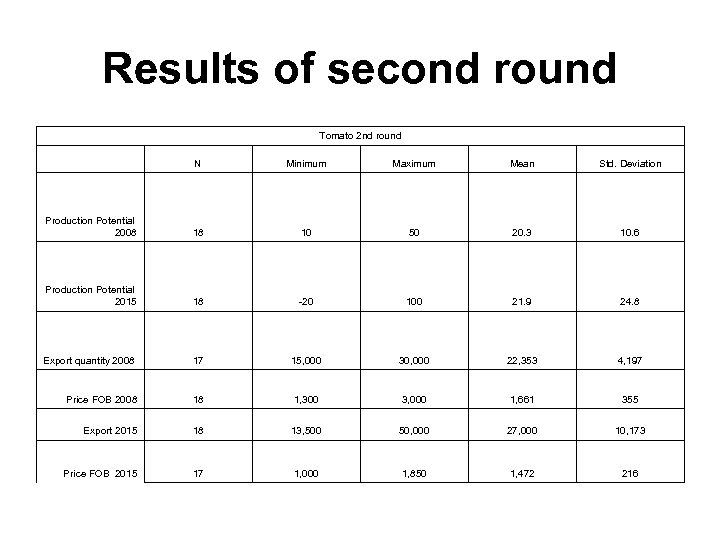
Results of second round Tomato 2 nd round N Minimum Maximum Mean Std. Deviation Production Potential 2008 18 10 50 20. 3 10. 6 Production Potential 2015 18 -20 100 21. 9 24. 8 Export quantity 2008 17 15, 000 30, 000 22, 353 4, 197 Price FOB 2008 18 1, 300 3, 000 1, 661 355 Export 2015 18 13, 500 50, 000 27, 000 10, 173 Price FOB 2015 17 1, 000 1, 850 1, 472 216
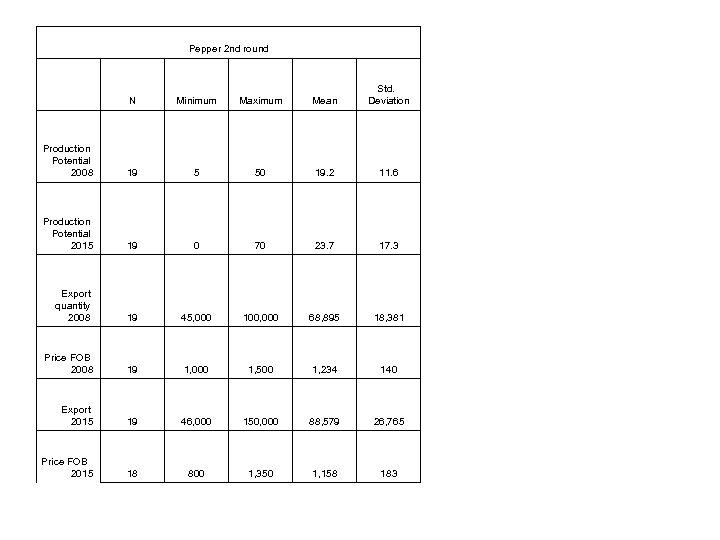
Pepper 2 nd round N Minimum Maximum Mean Std. Deviation Production Potential 2008 19 5 50 19. 2 11. 6 Production Potential 2015 19 0 70 23. 7 17. 3 Export quantity 2008 19 45, 000 100, 000 68, 895 18, 381 Price FOB 2008 19 1, 000 1, 500 1, 234 140 Export 2015 19 46, 000 150, 000 88, 579 26, 765 Price FOB 2015 18 800 1, 350 1, 158 183
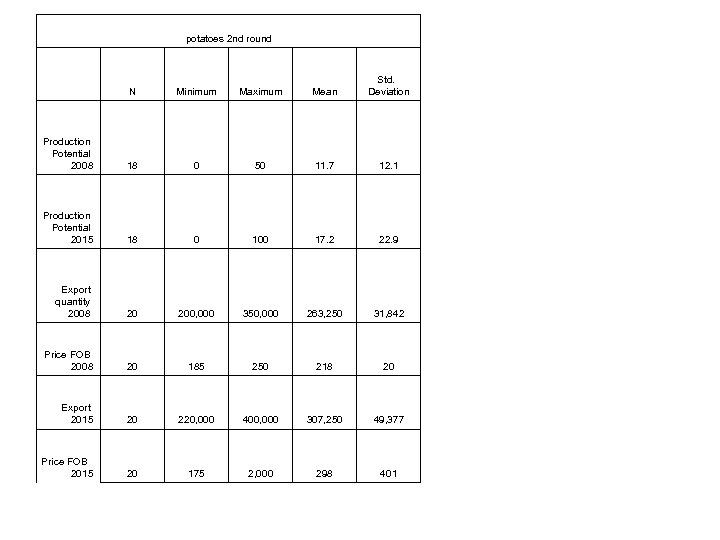
potatoes 2 nd round N Minimum Maximum Mean Std. Deviation Production Potential 2008 18 0 50 11. 7 12. 1 Production Potential 2015 18 0 100 17. 2 22. 9 Export quantity 2008 20 200, 000 350, 000 263, 250 31, 842 Price FOB 2008 20 185 250 218 20 Export 2015 20 220, 000 400, 000 307, 250 49, 377 Price FOB 2015 20 175 2, 000 298 401
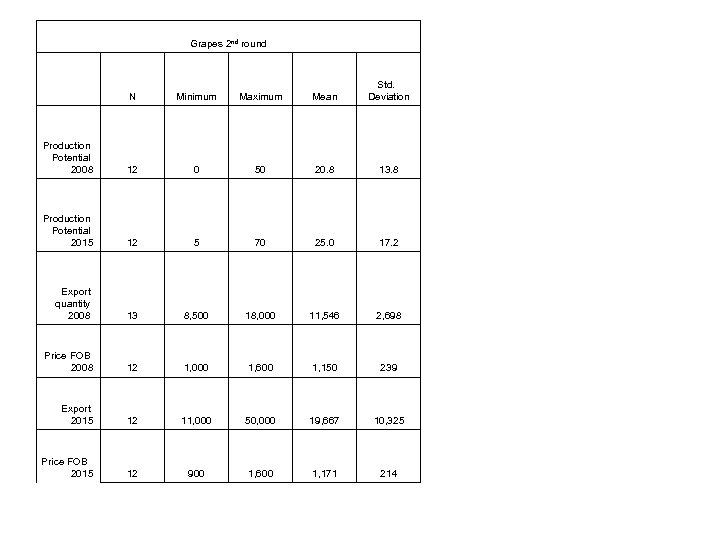
Grapes 2 nd round N Minimum Maximum Mean Std. Deviation Production Potential 2008 12 0 50 20. 8 13. 8 Production Potential 2015 12 5 70 25. 0 17. 2 Export quantity 2008 13 8, 500 18, 000 11, 546 2, 698 Price FOB 2008 12 1, 000 1, 600 1, 150 239 Export 2015 12 11, 000 50, 000 19, 667 10, 325 Price FOB 2015 12 900 1, 600 1, 171 214
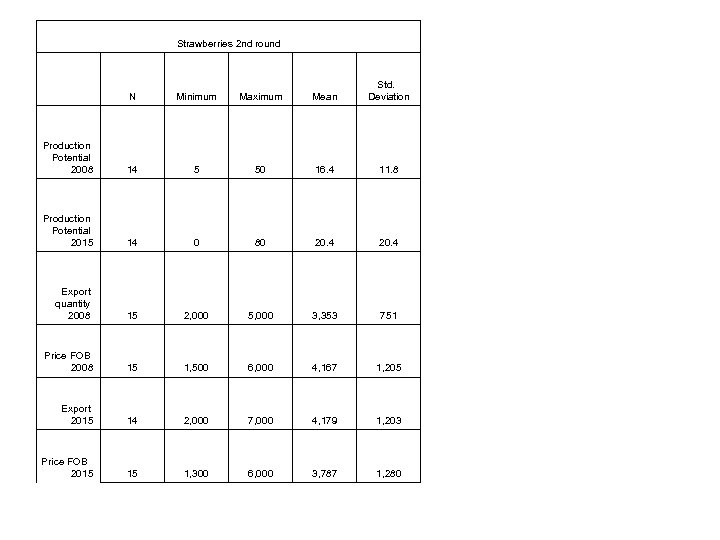
Strawberries 2 nd round N Minimum Maximum Mean Std. Deviation Production Potential 2008 14 5 50 16. 4 11. 8 Production Potential 2015 14 0 80 20. 4 Export quantity 2008 15 2, 000 5, 000 3, 353 751 Price FOB 2008 15 1, 500 6, 000 4, 167 1, 205 Export 2015 14 2, 000 7, 000 4, 179 1, 203 Price FOB 2015 15 1, 300 6, 000 3, 787 1, 280
Minimum Mean Std. Deviation 5, 000 0 706 -962 0 0 3, 500 0 1, 000 -817 0 0 -14 -7 5, 000 0 2, 105 -925 0 0 -14 -4 6, 000 0 3, 263 -2, 133 Price FOB 2015 0 0 -17 -11 Export quantity 2008 0 0 2, 750 -841 Price FOB 2008 0 0 20, 000 0 4, 750 -5, 142 Price FOB 2015 0 0 Export quantity 2008 0 3, 000 615 802 Price FOB 2008 0 0 41 -3 Export 2015 0 0 417 -86 Price FOB 2015 Tomatoes Maximum 0 0 25 -12 Export quantity 2008 0 0 Price FOB 2008 0 0 -33 13 Export 2015 0 0 36 -29 Price FOB 2015 0 0 -20 7 Export quantity 2008 Price FOB 2008 Export 2015 Price FOB 2015 Pepper Export quantity 2008 Price FOB 2008 Export 2015 Potatoes Export 2015 Grapes Strawberries
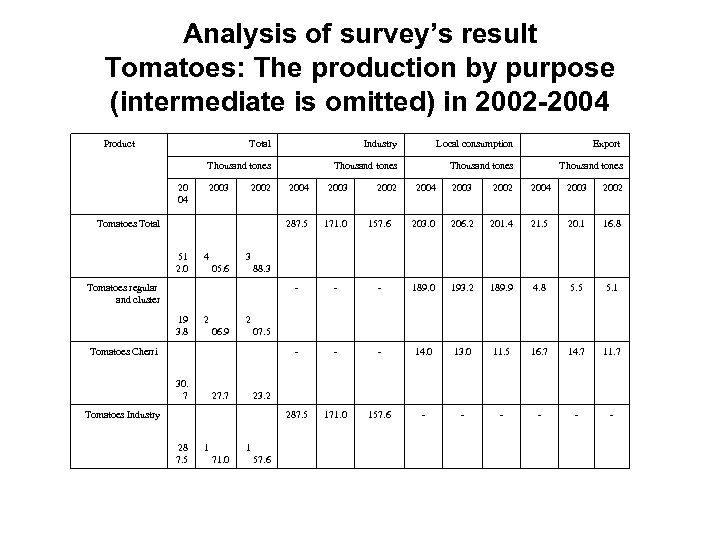
Analysis of survey’s result Tomatoes: The production by purpose (intermediate is omitted) in 2002 -2004 Product Total Local consumption Export Thousand tones 20 04 Industry Thousand tones 2003 2002 Tomatoes regular and cluster 27. 7 1 71. 0 2002 2004 2003 2002 157. 6 203. 0 206. 2 201. 4 21. 5 20. 1 16. 8 - - 189. 0 193. 2 189. 9 4. 8 5. 5 5. 1 - - 14. 0 13. 0 11. 5 16. 7 14. 7 11. 7 171. 0 157. 6 - - - 2 07. 5 23. 2 Tomatoes Industry 28 7. 5 2002 3 88. 3 Tomatoes Cherri 30. 7 2003 287. 5 2 06. 9 2004 - 19 3. 8 4 05. 6 171. 0 - 51 2. 0 2003 287. 5 Tomatoes Total 2004 1 57. 6
Minimum Maximum Mean Std. Deviation Production Potential 2008 10 50 20. 3 10. 6 Production Potential 2015 -20 100 21. 9 24. 8 Export quantity 2008 15, 000 30, 000 22, 353 4, 197 Export 2015 13, 500 50, 000 27, 000 10, 173
Pepper production by purpose (intermediate is omitted) in 2002 -2004 Total Local consumption Export Thousand tones 200 Industry Thousand tones 2003 2002 2004 2003 2002 2. 4 2. 0 71. 5 69. 6 73. 0 53. 7 41. 8 35. 9 4 127. 6 113. 4 110. 9
The panel’s forecasts Minimum Maximum Mean Std. Deviation Production Potential 2008 5 50 19. 2 11. 6 Production Potential 2015 0 70 23. 7 17. 3 Export quantity 2008 45, 000 100, 000 68, 895 18, 381 Export 2015 46, 000 150, 000 88, 579 26, 765
Potatoes -the panel forecast Minimum Maximum Mean Std. Deviation Production Potential 2008 0 50 11. 7 12. 1 Production Potential 2015 0 100 17. 2 22. 9 Export quantity 2008 200, 000 350, 000 263, 250 31, 842 Export 2015 220, 000 400, 000 307, 250 49, 377

 Скачать презентацию The effect of EU liberalization scenarios on export
4866ff3e6f6b7fbd5f6c0af46a67d6f6.ppt