 Скачать презентацию The Edu Specs Program A Brief Introduction
fe21dc05f9ab14392557cda5b40bd372.ppt
- Количество слайдов: 37



The Edu. Specs Program & A Brief Introduction to e-Learning Specifications & Standards Solvig Norman, Open Learning Agency & Edu. Specs Technical Liaison Office & Mary Da Costa, Edu. Specs Program, Industry Canada Industry Forum March 24 th 2003 Toronto
Making Sense of e-Learning Specifications & Standards “The phrase ‘learning standards’ is one of the most powerful and most misunderstood aspects of the e-Learning revolution. ” The MASIE Center, 2002 “techno-mumbo-jumbo and engineering speak? ”
Why e-Learning Standards & Specifications? § § Huge amounts of money is being spent on elearning initiatives and current trends show significant growth. Purchasers, developers, and service providers of content and systems need to maximize their return on investment (e. g. , re-use, flexible) The new world of content development is focused on “structured information. ” A need to work within a framework that supports pedagogical diversity & promoting interoperability of e-learning materials (e. g. , a “content structure”).
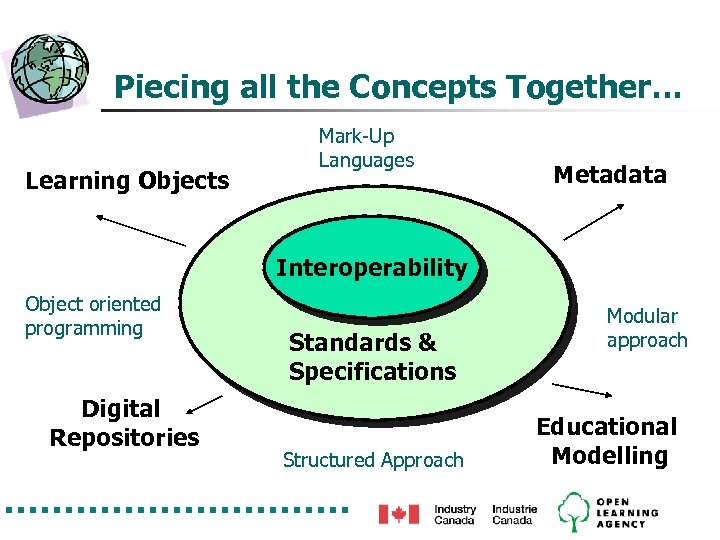
Piecing all the Concepts Together… Learning Objects Mark-Up Languages Metadata Interoperability Object oriented programming Digital Repositories Standards & Specifications Structured Approach Modular approach Educational Modelling
Notion of Sharing “Learning objects are not a recent innovation. However, the way in which educators create and categorize them is changing. ” (Tuiren et al. 2002)
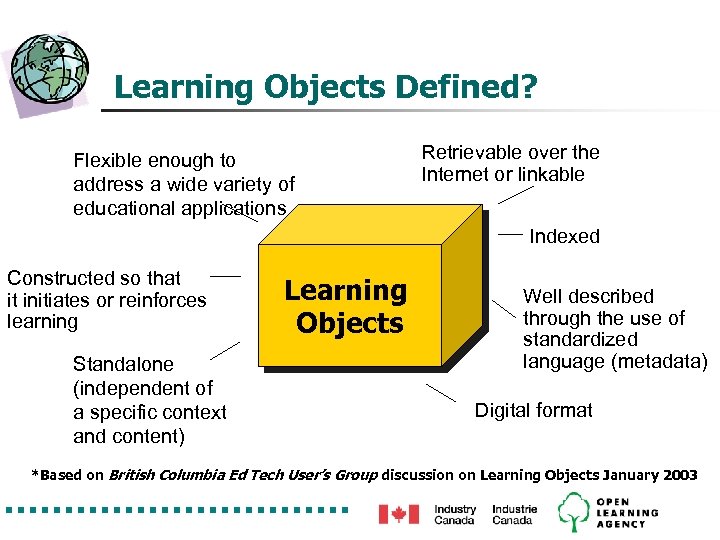
Learning Objects Defined? Flexible enough to address a wide variety of educational applications Retrievable over the Internet or linkable Indexed Constructed so that it initiates or reinforces learning Standalone (independent of a specific context and content) Learning Objects Well described through the use of standardized language (metadata) Digital format *Based on British Columbia Ed Tech User’s Group discussion on Learning Objects January 2003
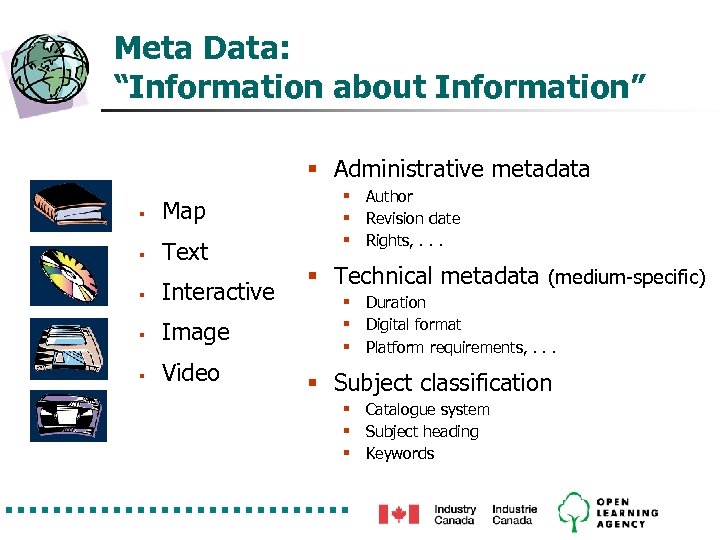
Meta Data: “Information about Information” § Administrative metadata § Map § Text § Interactive § Image § Video § Author § Revision date § Rights, . . . § Technical metadata (medium-specific) § Duration § Digital format § Platform requirements, . . . § Subject classification § Catalogue system § Subject heading § Keywords
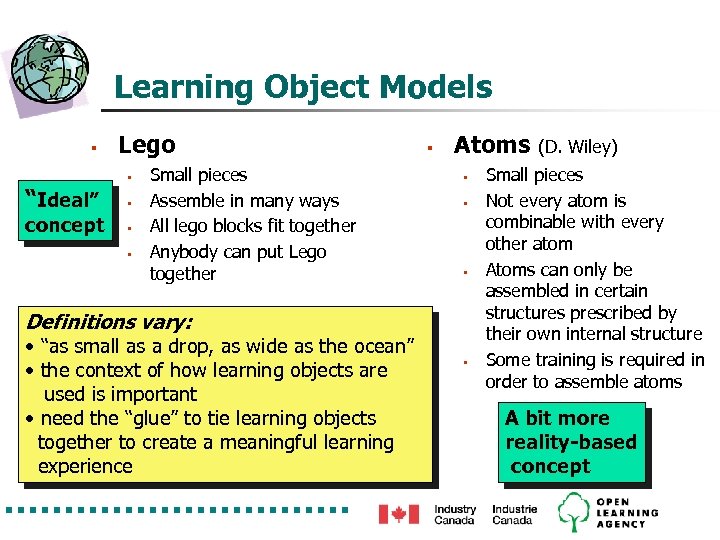
Learning Object Models § Lego § “Ideal” concept § § § Small pieces Assemble in many ways All lego blocks fit together Anybody can put Lego together Definitions vary: • “as small as a drop, as wide as the ocean” • the context of how learning objects are used is important • need the “glue” to tie learning objects together to create a meaningful learning experience § Atoms (D. Wiley) § § Small pieces Not every atom is combinable with every other atom Atoms can only be assembled in certain structures prescribed by their own internal structure Some training is required in order to assemble atoms A bit more reality-based concept
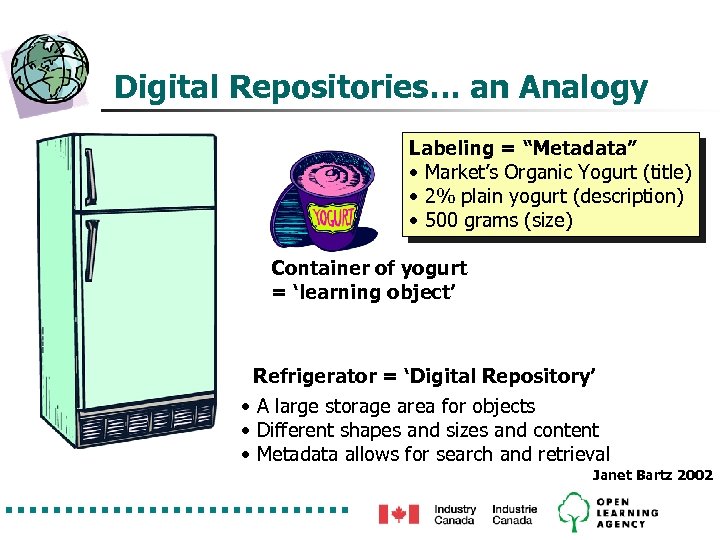
Digital Repositories… an Analogy Labeling = “Metadata” • Market’s Organic Yogurt (title) • 2% plain yogurt (description) • 500 grams (size) Container of yogurt = ‘learning object’ Refrigerator = ‘Digital Repository’ • A large storage area for objects • Different shapes and sizes and content • Metadata allows for search and retrieval Janet Bartz 2002
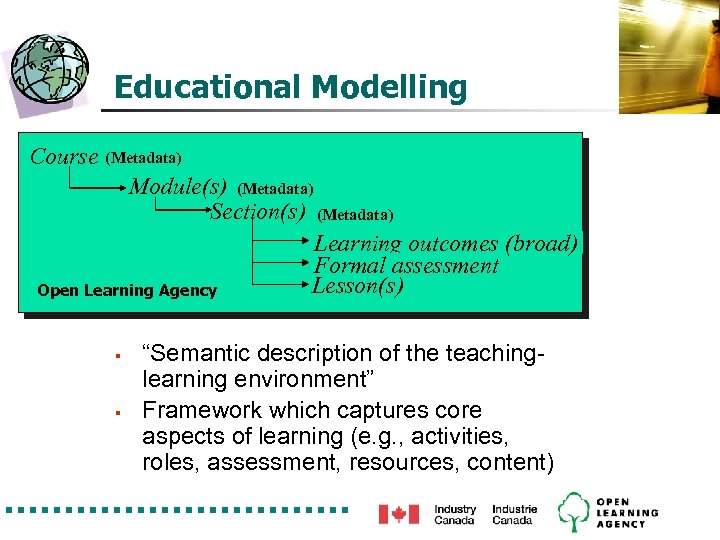
Educational Modelling Course (Metadata) Module(s) (Metadata) Section(s) (Metadata) Learning outcomes (broad) Formal assessment Lesson(s) Open Learning Agency § § “Semantic description of the teachinglearning environment” Framework which captures core aspects of learning (e. g. , activities, roles, assessment, resources, content)
TOOLS: What are SGML/XML? § SGML – Standard Generalized Markup Language § § § International standard published in 1986 (ISO 8879: 1986) Used for documentation with high tech and publishing industries XML – e. Xtensible Markup Language § § SGML profile for the Web maximize information retrieval and ease of interchange
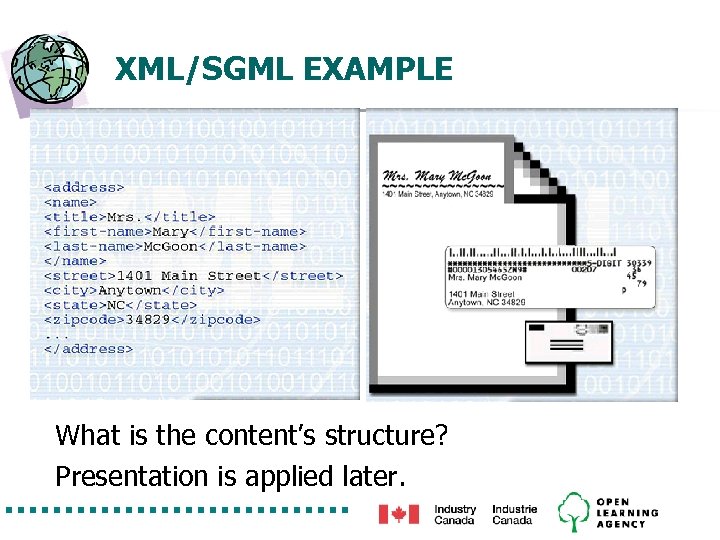
XML/SGML EXAMPLE What is the content’s structure? Presentation is applied later.
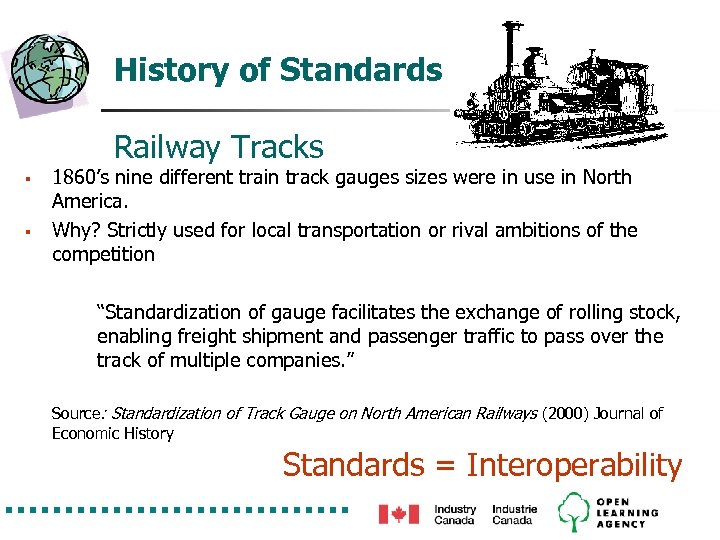
History of Standards Railway Tracks § § 1860’s nine different train track gauges sizes were in use in North America. Why? Strictly used for local transportation or rival ambitions of the competition “Standardization of gauge facilitates the exchange of rolling stock, enabling freight shipment and passenger traffic to pass over the track of multiple companies. ” Source: Standardization of Track Gauge on North American Railways (2000) Journal of Economic History Standards = Interoperability
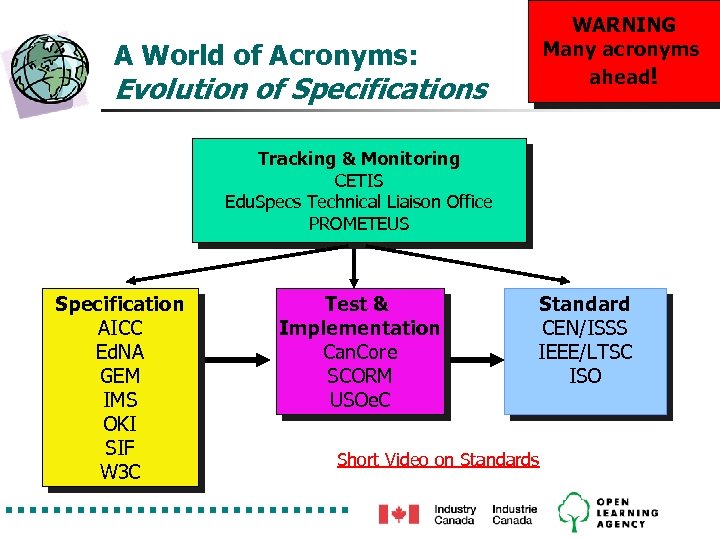
WARNING Many acronyms ahead! A World of Acronyms: Evolution of Specifications Tracking & Monitoring CETIS Edu. Specs Technical Liaison Office PROMETEUS Specification AICC Ed. NA GEM IMS OKI SIF W 3 C Test & Implementation Can. Core SCORM USOe. C Standard CEN/ISSS IEEE/LTSC ISO Short Video on Standards
Profile of a Specification Organization: IMS Global Learning Consortium § § 54 contributing members from around the globe (e. g. , UK, Canada, USA, Australia, Italy, Netherlands, Finland) Two key activities: § Define technical specifications for interoperability of applications and services in distributed learning. § Support the incorporation of the IMS specifications into products and services worldwide, promoting the widespread adoption of specifications that will allow distributed learning environments and content from multiple authors to work together (in technical parlance, "interoperate”). Working on Specifications that include: § Learning Design, Metadata, Content Packaging, Learner Profile, Accessibility, to name a few http: //www. imsglobal. org/
Profile of a Test/Implementation Initiative: Can. Core § Can. Core - the Canadian Core Learning Resource Metadata Protocol (Can. Core) Protocol. § A “made in Canada” recognized sub-set of the IMS Learning Resource Metadata Specification (36 elements vs 70) § Facilitates easier implementation of the IMS Metadata Specification § Achieving recognition and adoption within Canada and internationally § http: //www. cancore. org
Bringing it All Together Many different e-learning standards and specifications being developed So, what do each of these specifications & standards actually do?
Bringing it All Together… Metadata You want content to be marked with info so it can be browsed or searched in a consistent way. § § § Specs: IMS Metadata, Dublin Core Implementation: SCORM, Can. Core Standard: IEEE LOM
Bringing it All Together… Content Packaging You want content to be packaged in such a way it can be moved from one system to another in a consistent way. § § Specifications: IMS Content Packaging Implementation: SCORM
Bringing it All Together… Enterprise You want a Learning Management System to be able to talk to a student record system (e. g. , student info, grades etc. ) § Specifications: IMS Enterprise
Bringing it All Together… Questions/Assessment You want to be able to exchange question and test banks from one system to another and be able to track usage and results from these questions in a Learning Management System. § Specifications: IMS Question & Testing
Bringing it All Together. . Learning Design You want to design learning that captures pedagogical diverse experiences, while promoting interoperability of learning content. § Specifications: IMS Learning Design
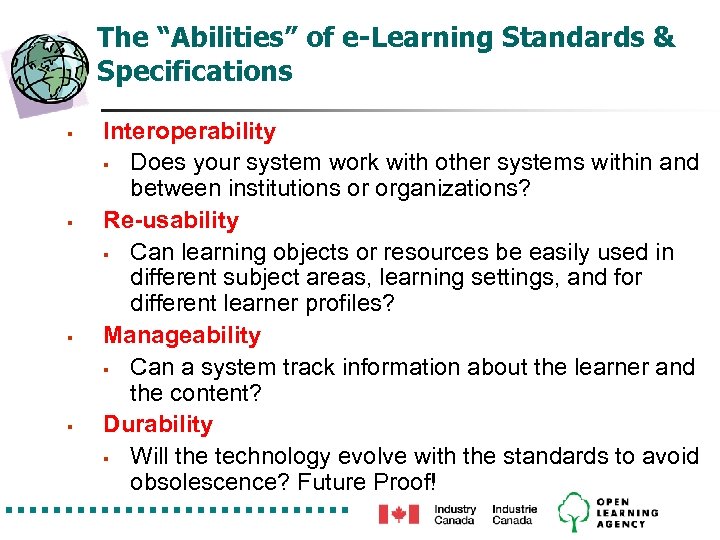
The “Abilities” of e-Learning Standards & Specifications § § Interoperability § Does your system work with other systems within and between institutions or organizations? Re-usability § Can learning objects or resources be easily used in different subject areas, learning settings, and for different learner profiles? Manageability § Can a system track information about the learner and the content? Durability § Will the technology evolve with the standards to avoid obsolescence? Future Proof!
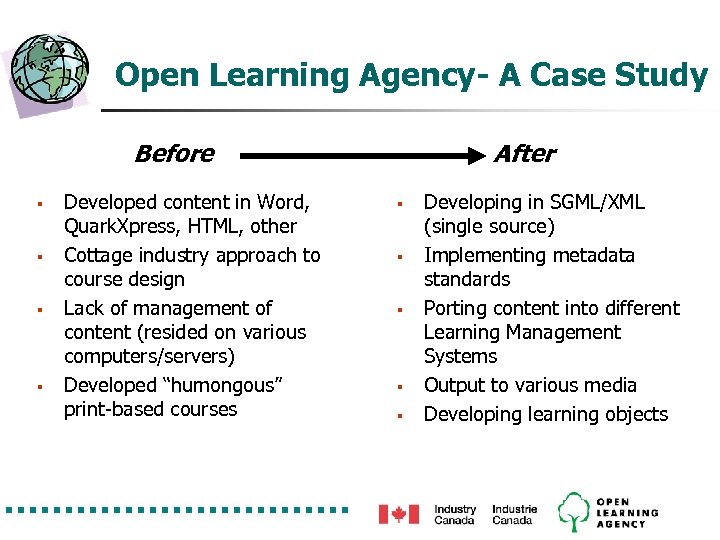
Open Learning Agency- A Case Study Before § § Developed content in Word, Quark. Xpress, HTML, other Cottage industry approach to course design Lack of management of content (resided on various computers/servers) Developed “humongous” print-based courses After § § § Developing in SGML/XML (single source) Implementing metadata standards Porting content into different Learning Management Systems Output to various media Developing learning objects
Industry Showcase GTK Press What § § Why Benefits & Challenges § § § Educational Publisher focusing on the K-12 sector Developing an electronic Authoring Environment that will conform with the IMS Learning Design Specification and IEEE/Learning Object Metadata (LOM) Mix and match Learning Objects to support cross-jurisdictions & subjects curriculums. Reduce content development effort and time substantially in the future. Users can adapt content
Industry Showcase Etraffic Solutions What § International provider of online learning content & applications for K-12 & adult learning Peer-to-peer application Sharing content Meta data tool (Can. Core and soon IEEE LOM and SCORM) Why § § An interactive, multimedia language learning tool for the delivery over the Web “Learning Object” approach Learner controls their learning (learning objects) Clients deserve reusability and longevity
Industry Showcase Odyssey Learning Systems Inc. What § Integrated e-Learning products: § Learning Content Management Systems -Nautikos § Nautikos Courseware § Nautikos Virtual Classroom § Implemented Can. Core Meta data application profile TM TM TM Why § Able to import and export content, supporting independence of “learning objects”
Canada’s Innovation Strategy § § § Goals: For Canada to become one of the most innovative countries in the world Improve Canada’s innovation performance to secure competitiveness and a higher standard of living Priority areas: knowledge performance, skills, innovation environment, and skills Both papers describe need to strengthen capacity for innovation and improve the levels of skills within the Canadian population
E-Learning and School. Net § § § Information Highway Applications Branch of Industry Canada has developed a number of programs that facilitate the integration of ICT into learning Network of Innovative Schools, Grass. Roots (www. schoolnet. ca) Canada’s Campus Connection (www. campusconnection. ca) Multimedia Learning Group, under the School. Net umbrella, supports applications, tools, models, and practices for e-learning which enable sharing of learning resources by education institutions, governments, and business Multimedia Learnware Fund
What is Edu. Specs ? § § Goal is to facilitate the creation and adoption of international elearning specifications and standards for Canada 2001 -established Edu. Specs Technical Liaison Office; currently being led by British Columbia’s Open Learning Agency Coordinates Canadian participation on Canadian international specifications bodies including IMS, IEEE/LTSC, ISO/IEC/JTC 1 SC 36 to influence development of specs and standards that reflect Canada’s unique linguistic and cultural interests Disseminates information on specifications and standards to Canada’s e-learning community
Edu. Specs Activities § § Web Site Newly updated and interactive Web site to become primary Canadian vehicle for learners, educators, and practitioners to find practical information on the application and implementation of standards and specifications relating to on-line content development Detailed information about specifications, standards, learning objects, and learning object repositories; Interactive e-learning communities for e-learning educators and practitioners to exchange information, share best practices, and add resources to the Web site;
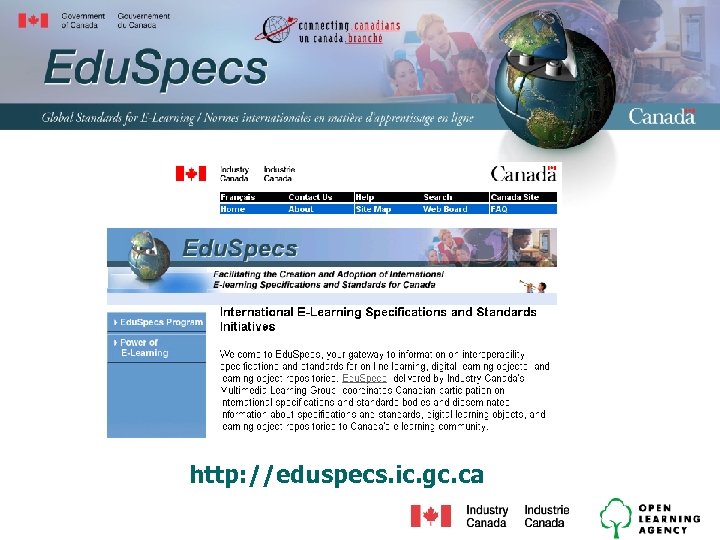
http: //eduspecs. ic. gc. ca
Edu. Specs Activities § § Pilot Projects Undertaking pilot projects to explore, evaluate, and test use of interoperability standards for on-line learning, digital learning objects, and learning object repositories in education community Participants: Canadian Virtual University, Canadian Virtual College Consortium, Ottawa-Carleton Catholic District School Board, Telus Learning, and New Brunswick Distance Education Network Goals: promote collaboration among K-12 schools and postsecondary institutions in the development of on-line content and improve access to quality on-line educational resources
Edu. Specs Activities § § § Pilot Projects Coordinated three training sessions in collaboration with edu. Source Canada in New Brunswick, Alberta, and Ontario to introduce pilot participants to learning objects and open source meta data tagging tools Facilitating and encouraging information sharing and exchange among pilot participants in the development and use of e-learning standards, digital learning objects, and LOR’s Evaluation framework being developed to assess pilot projects according to common set of indicators Exploring potential of similar pilot projects and training sessions with industry practitioners
Edu. Specs Next Steps § § § Establish pan-Canadian network of experts and partners in the Canadian e-learning community Seek input and participation from all sectors Undertake further pilot projects to explore, evaluate, and test use of interoperability standards for on-line learning, digital learning objects, and learning object repositories among private sector firms and education organizations
Resources Edu. Specs Web Site http: //eduspecs. ic. gc. ca § MASIE Centre Report http: //www. masie. com/standards/S 3_Guide. pdf § CETIS http: //www. cetis. ac. uk/ § Learning Objects (David Wiley) http: //reusability. org/read/ § Learning Object Pioneers (Tom Barron) http: //www. learningcircuits. org/mar 2000/barron. html §
Contacts Solvig Norman Mary Da Costa Open Learning Agency & Team Leader for Edu. Specs Technical Liaison Office (250) 953 7413 solvign@ola. bc. ca Project Officer, Edu. Specs Program Industry Canada (613) 954 0157 Da. Costa. Mary@ic. gc. ca
Скачать презентацию The Edu Specs Program A Brief Introduction
fe21dc05f9ab14392557cda5b40bd372.ppt