


 Скачать презентацию The economy of the United Kingdom
экономика великобритании.pptx
- Количество слайдов: 11
 The economy of the United Kingdom
 • The economy of the United Kingdom is the sixthlargest national economy in the world measured by nominal GDP and seventh-largest measured by purchasing power parity (PPP), and the thirdlargest in Europe measured by nominal GDP (after Germany and France) and second-largest measured by PPP (after Germany). The UK's GDP per capita is the 22 nd highest in the world in nominal terms and the 17 th highest measured by PPP. The British economy comprises (in descending order of size) the economies of the countries of England, Scotland, Wales and Northern Ireland.
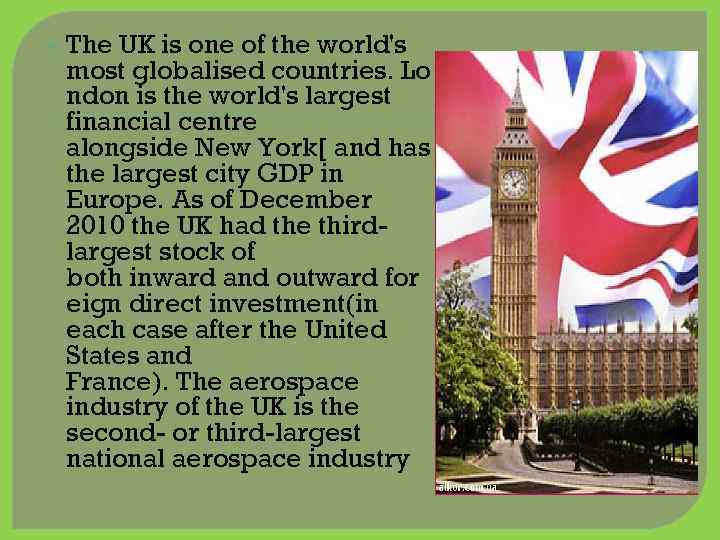 The UK is one of the world's most globalised countries. Lo ndon is the world's largest financial centre alongside New York[ and has the largest city GDP in Europe. As of December 2010 the UK had the thirdlargest stock of both inward and outward for eign direct investment(in each case after the United States and France). The aerospace industry of the UK is the second- or third-largest national aerospace industry
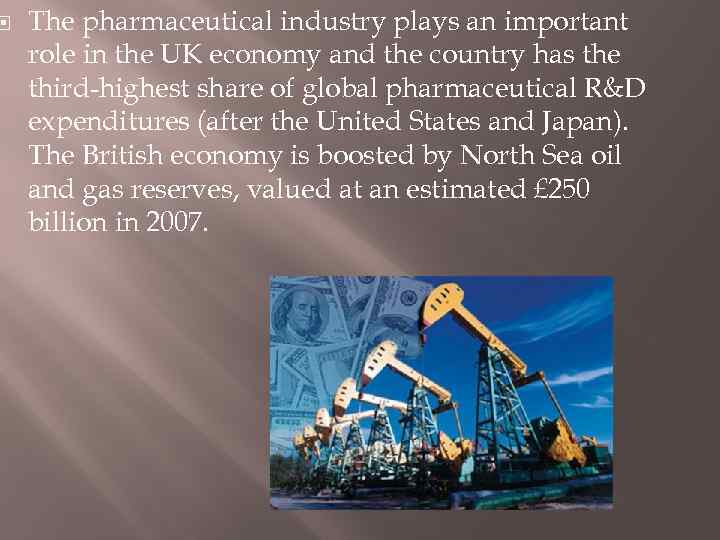 The pharmaceutical industry plays an important role in the UK economy and the country has the third-highest share of global pharmaceutical R&D expenditures (after the United States and Japan). The British economy is boosted by North Sea oil and gas reserves, valued at an estimated £ 250 billion in 2007.
 The UK is a member of the Commonwealth of Nations, the European Union, the G 7, the G 8, the G 20, the International Monetary Fund, the Organisation for Economic Cooperation and Development, the World Bank, the World Trade Organisation and the United Nations.
 London is the world capital foreign exchange trading. The currency of the UK is the pound sterling, represented by the symbol £. The Bank of England is the central bank, responsible for issuing currency. Pound sterling is also used as a reserve currency by other governments and institutions, and is the thirdlargest after the U. S. dollar and the euro
 London is a major centre for international business and commerce and is one of the three "command centres" of the global economy(alongside New York City and Tokyo). There are over 500 banks with offices in London, and it is the leading international centre for banking, insurance, Eurobonds, foreign exchange trading and energy futures. London's financial services industry is primarily based in the City of London and Canary Wharf. The City houses the London Stock Exchange, the London International Financial Futures and Options Exchange, the London Metal Exchange, Lloyds of London, and the Bank of England. London is also a major centre for other business and professional services, and four of the six largest law firms in the world are headquartered there. Several other major UK cities have large financial sectors and related services. Edinburgh has one of the large financial centres in Europe and is home to the headquarters of the Royal Bank of Scotland Group and Standard Life. Leeds is now the UK's largest centre for business and financial services outside London, and the largest centre for legal services in the UK after London.
 . The UK grocery market is dominated by five companies – Asda (owned by Wal-Mart Stores), The Co-operative Food, Morrisons, Sainsbury's and Tesco – which together have a market share of over 80%. London is a major retail centre and in 2010 had the highest non-food retail sales of any city in the world, with a total spend of around £ 64. 2 billion. The UKbased Tesco is the third-largest retailer in the world measured by revenues (after Wal-Mart Stores and Carrefour) and is the current leader in the UK market with around a 30% share.
 The money Gross Domestic Product (GDP) for the United Kingdom, at market prices, in 2009 was £ 1 396 billion (or $2 003 billion) according to the Office for National Statistics in February 2010. Britain provides 10% of world exports of services - banking, insurance, brokerage, advisory, as well as in computer programming.
 Despite the fact that the population of Britain is only 1% of the population of the globe, the United Kingdom took fourth place in the world trade. Machinery and transport, manufactured goods and chemicals are the main exports of Great Britain. Leading sector of the UK economy is service sector (74% of GDP)
 Starting in the 70 s, oil not only has reduced imports of petroleum products, but also brought substantial profits in trading. British Petrolium is the largest industrial corporation, and Great Britain is the second largest in Europe.