


 Скачать презентацию The Economics of Systems and Software Delivery Reducing
9f8f1753591b70e58d6ba7aed7ff9b23.ppt
- Количество слайдов: 42
 The Economics of Systems and Software Delivery: Reducing Risk and Improving Governance Brian T. Nolan, Ph. D. , Go to Market Manager, Aerospace & Defense Rational Systems Marketing 2011 © 2010 IBM Corporation
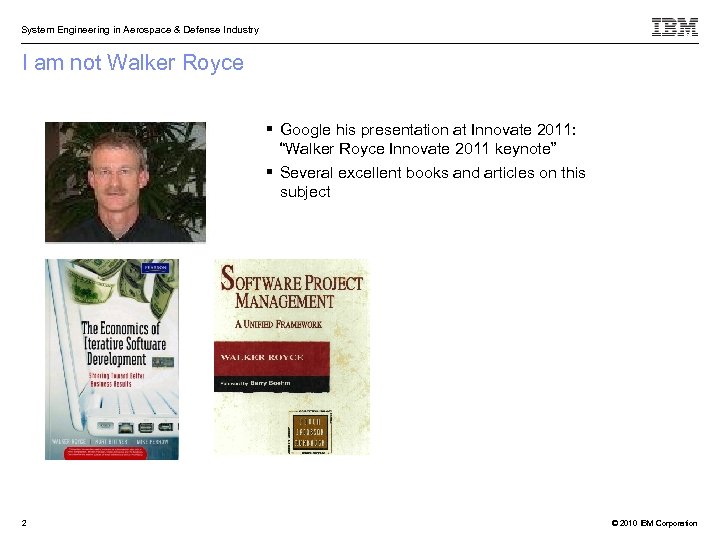 System Engineering in Aerospace & Defense Industry I am not Walker Royce Google his presentation at Innovate 2011: “Walker Royce Innovate 2011 keynote” Several excellent books and articles on this subject 2 © 2010 IBM Corporation
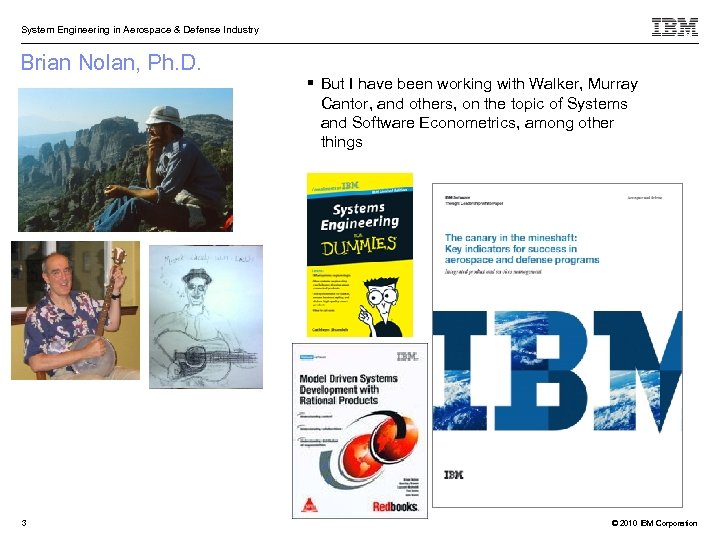 System Engineering in Aerospace & Defense Industry Brian Nolan, Ph. D. But I have been working with Walker, Murray Cantor, and others, on the topic of Systems and Software Econometrics, among other things 3 © 2010 IBM Corporation
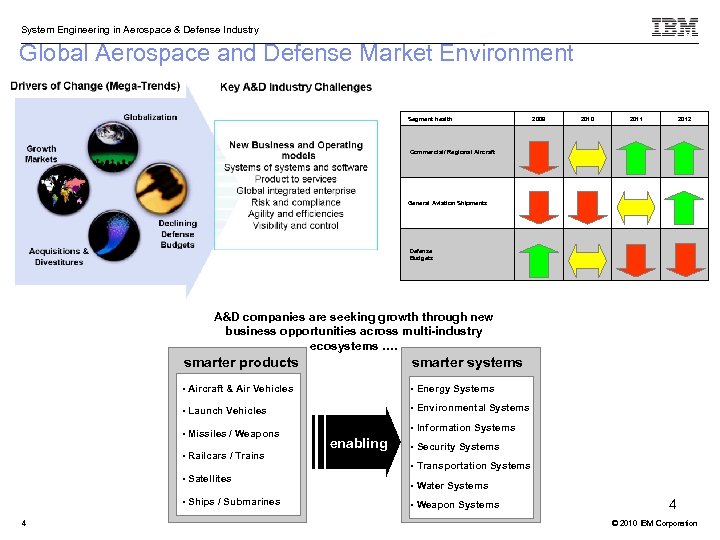 System Engineering in Aerospace & Defense Industry Global Aerospace and Defense Market Environment Segment health 2009 2010 2011 2012 Commercial/ Regional Aircraft General Aviation Shipments Defense Budgets A&D companies are seeking growth through new business opportunities across multi-industry ecosystems …. smarter products smarter systems • Aircraft & Air Vehicles • Energy Systems • Launch Vehicles • Environmental Systems • Missiles / Weapons • Railcars / Trains • Satellites • Ships / Submarines 4 • Information Systems enabling • Security Systems • Transportation Systems • Water Systems • Weapon Systems 4 © 2010 IBM Corporation
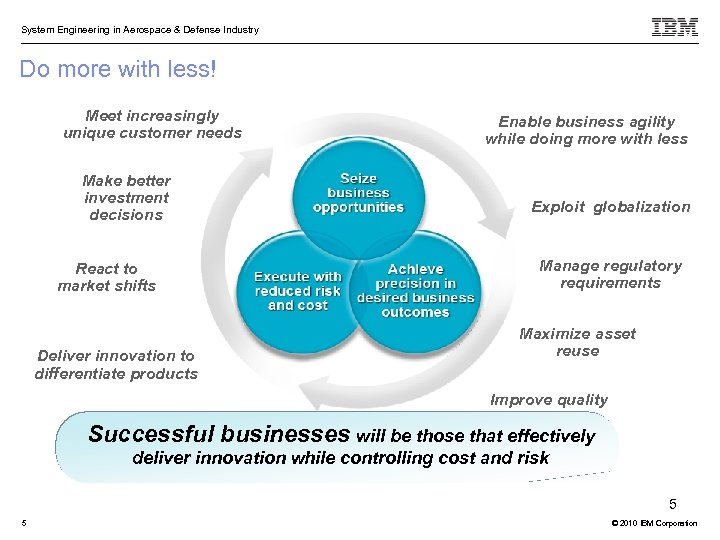 System Engineering in Aerospace & Defense Industry Do more with less! Meet increasingly unique customer needs Make better investment decisions React to market shifts Deliver innovation to differentiate products Enable business agility while doing more with less Exploit globalization Manage regulatory requirements Maximize asset reuse Improve quality Successful businesses will be those that effectively deliver innovation while controlling cost and risk 5 5 © 2010 IBM Corporation
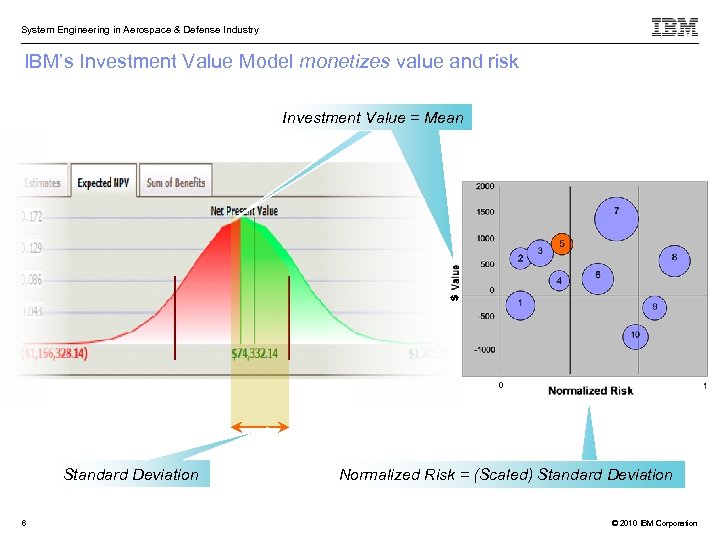 System Engineering in Aerospace & Defense Industry IBM’s Investment Value Model monetizes value and risk $ Investment x. Value = Mean Standard Deviation 6 ? IV = Mean Normalized Risk = (Scaled) Standard Deviation © 2010 IBM Corporation
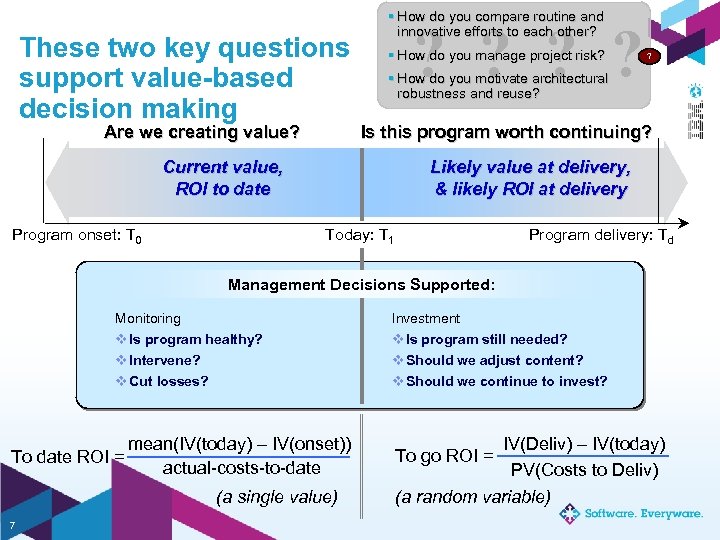 These two key questions support value-based decision making Are we creating value? How do you compare routine and innovative efforts to each other? ? ? How do you manage project risk? How do you motivate architectural robustness and reuse? Is this program worth continuing? Current value, ROI to date Program onset: T 0 ? Likely value at delivery, & likely ROI at delivery Today: T 1 Program delivery: Td Management Decisions Supported: Monitoring Investment v Is program healthy? v Intervene? v Cut losses? v Is program still needed? v Should we adjust content? v Should we continue to invest? To date ROI = mean(IV(today) – IV(onset)) actual-costs-to-date (a single value) 7 To go ROI = IV(Deliv) – IV(today) PV(Costs to Deliv) (a random variable)
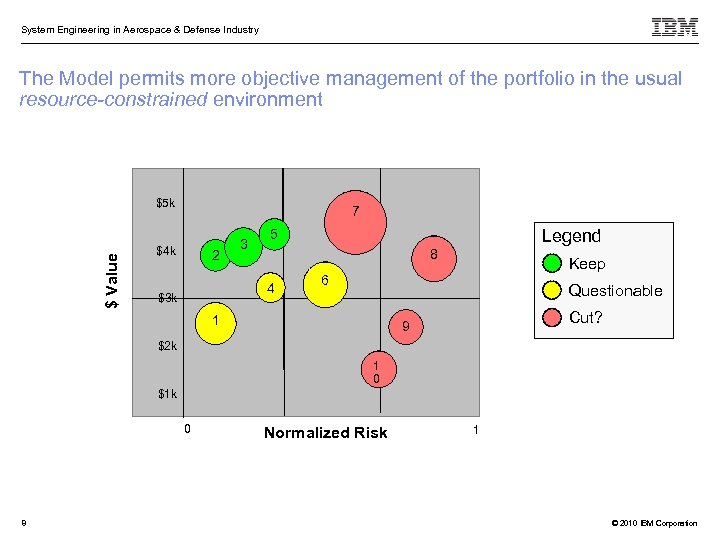 System Engineering in Aerospace & Defense Industry The Model permits more objective management of the portfolio in the usual resource-constrained environment $ Value $5 k 7 $4 k 2 3 5 4 $3 k Legend Project 6 8 1 9 Questionable 6 Keep Cut? $2 k 1 0 $1 k 0 8 Normalized Risk 1 © 2010 IBM Corporation
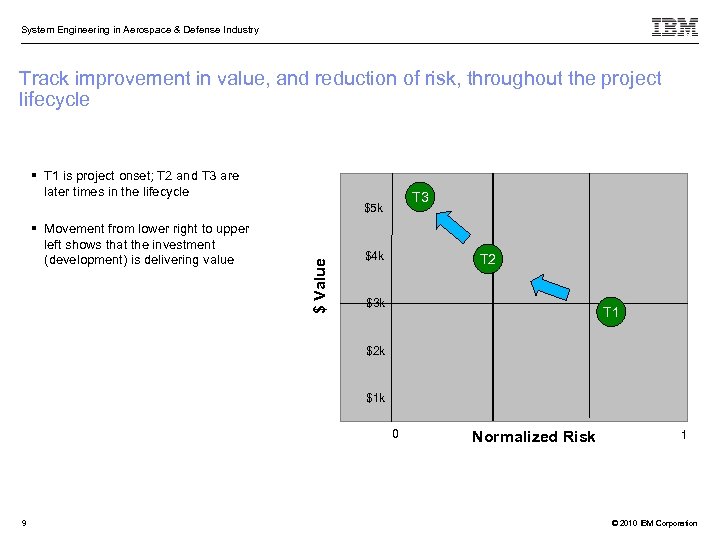 System Engineering in Aerospace & Defense Industry Track improvement in value, and reduction of risk, throughout the project lifecycle T 1 is project onset; T 2 and T 3 are later times in the lifecycle T 3 Movement from lower right to upper left shows that the investment (development) is delivering value $ Value $5 k $4 k T 2 $3 k T 1 $2 k $1 k 0 9 Normalized Risk 1 © 2010 IBM Corporation
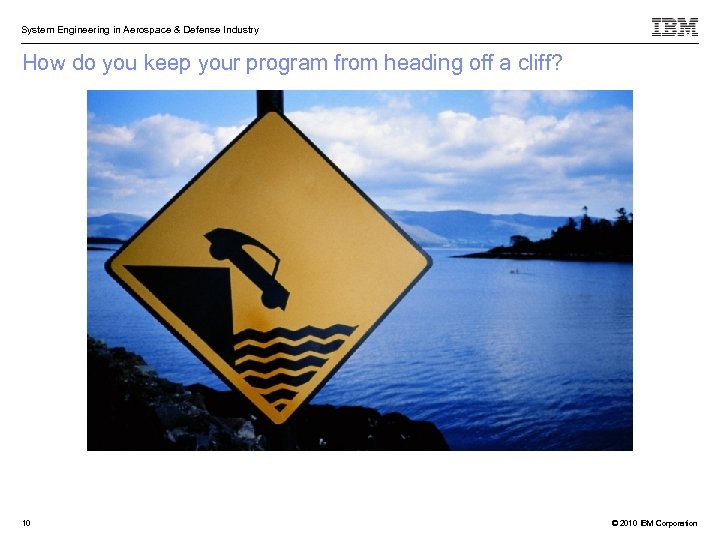 System Engineering in Aerospace & Defense Industry How do you keep your program from heading off a cliff? 10 © 2010 IBM Corporation
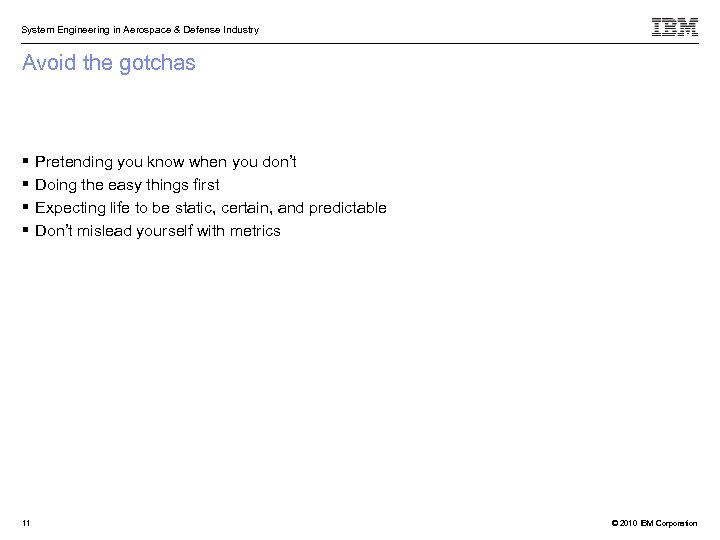 System Engineering in Aerospace & Defense Industry Avoid the gotchas 11 Pretending you know when you don’t Doing the easy things first Expecting life to be static, certain, and predictable Don’t mislead yourself with metrics © 2010 IBM Corporation
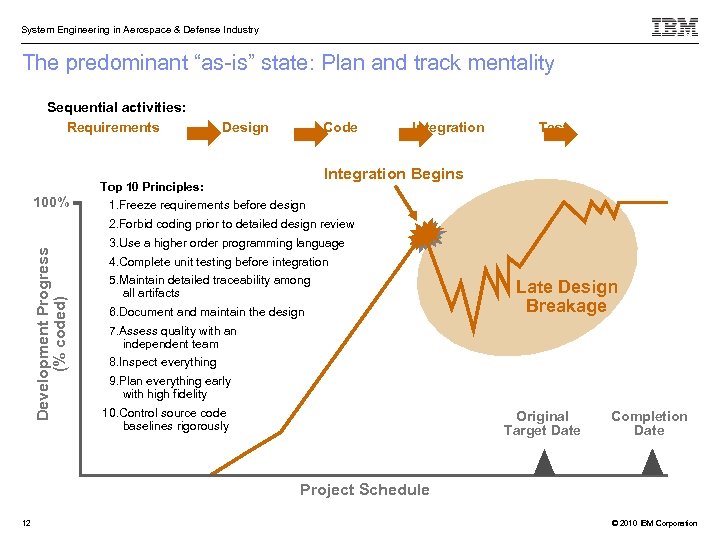 System Engineering in Aerospace & Defense Industry The predominant “as-is” state: Plan and track mentality Sequential activities: Requirements Design Code Test Integration Begins Top 10 Principles: 100% Integration 1. Freeze requirements before design Development Progress (% coded) 2. Forbid coding prior to detailed design review 3. Use a higher order programming language 4. Complete unit testing before integration 5. Maintain detailed traceability among all artifacts 6. Document and maintain the design Late Design Breakage 7. Assess quality with an independent team 8. Inspect everything 9. Plan everything early with high fidelity 10. Control source code baselines rigorously Original Target Date Completion Date Project Schedule 12 © 2010 IBM Corporation
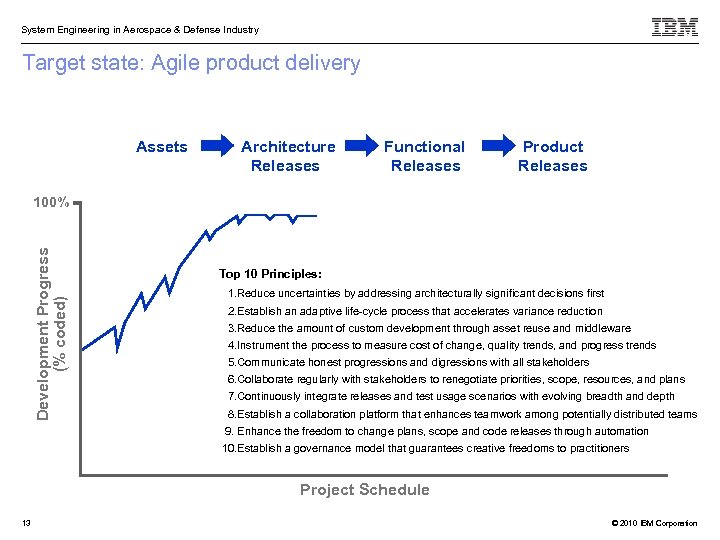 System Engineering in Aerospace & Defense Industry Target state: Agile product delivery Assets Architecture Releases Functional Releases Product Releases Development Progress (% coded) 100% Top 10 Principles: 1. Reduce uncertainties by addressing architecturally significant decisions first 2. Establish an adaptive life-cycle process that accelerates variance reduction 3. Reduce the amount of custom development through asset reuse and middleware 4. Instrument the process to measure cost of change, quality trends, and progress trends 5. Communicate honest progressions and digressions with all stakeholders 6. Collaborate regularly with stakeholders to renegotiate priorities, scope, resources, and plans 7. Continuously integrate releases and test usage scenarios with evolving breadth and depth 8. Establish a collaboration platform that enhances teamwork among potentially distributed teams 9. Enhance the freedom to change plans, scope and code releases through automation 10. Establish a governance model that guarantees creative freedoms to practitioners Project Schedule 13 © 2010 IBM Corporation
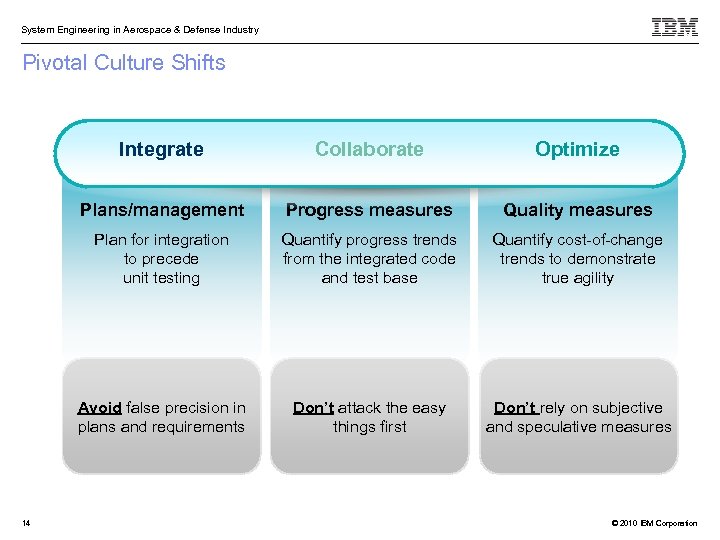 System Engineering in Aerospace & Defense Industry Pivotal Culture Shifts Integrate Optimize Plans/management Progress measures Quality measures Plan for integration to precede unit testing Quantify progress trends from the integrated code and test base Quantify cost-of-change trends to demonstrate true agility Avoid false precision in plans and requirements 14 Collaborate Don’t attack the easy things first Don’t rely on subjective and speculative measures © 2010 IBM Corporation
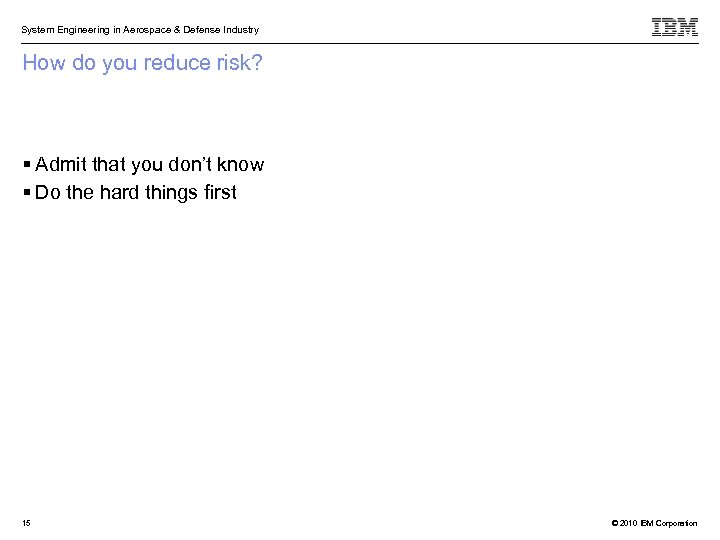 System Engineering in Aerospace & Defense Industry How do you reduce risk? Admit that you don’t know Do the hard things first 15 © 2010 IBM Corporation
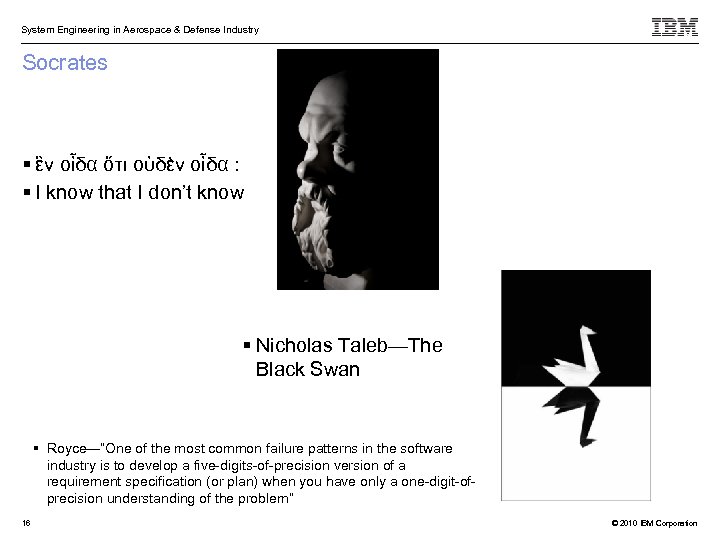 System Engineering in Aerospace & Defense Industry Socrates ἓν οἶδα ὅτι οὐδὲν οἶδα : I know that I don’t know Nicholas Taleb—The Black Swan Royce—”One of the most common failure patterns in the software industry is to develop a five-digits-of-precision version of a requirement specification (or plan) when you have only a one-digit-ofprecision understanding of the problem” 16 © 2010 IBM Corporation
 System Engineering in Aerospace & Defense Industry But can we measure what we don’t know? Or estimate it? 17 © 2010 IBM Corporation
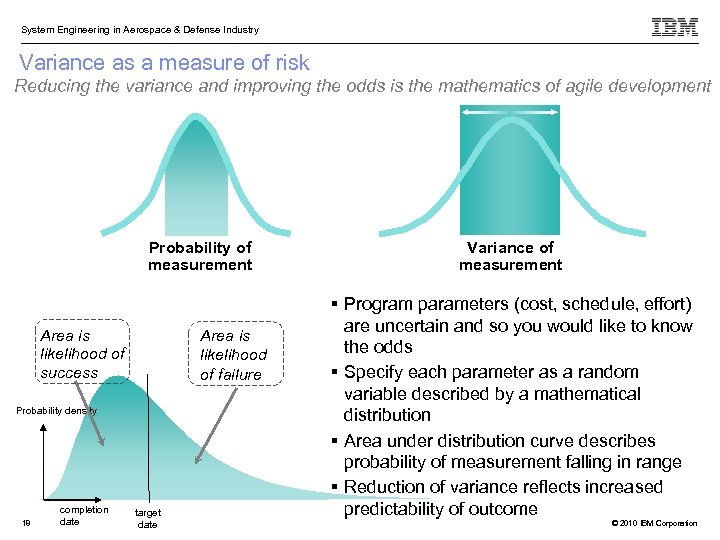 System Engineering in Aerospace & Defense Industry Variance as a measure of risk Reducing the variance and improving the odds is the mathematics of agile development Probability of measurement Area is likelihood of success Area is likelihood of failure Probability density 18 completion date target date Variance of measurement Program parameters (cost, schedule, effort) are uncertain and so you would like to know the odds Specify each parameter as a random variable described by a mathematical distribution Area under distribution curve describes probability of measurement falling in range Reduction of variance reflects increased predictability of outcome © 2010 IBM Corporation
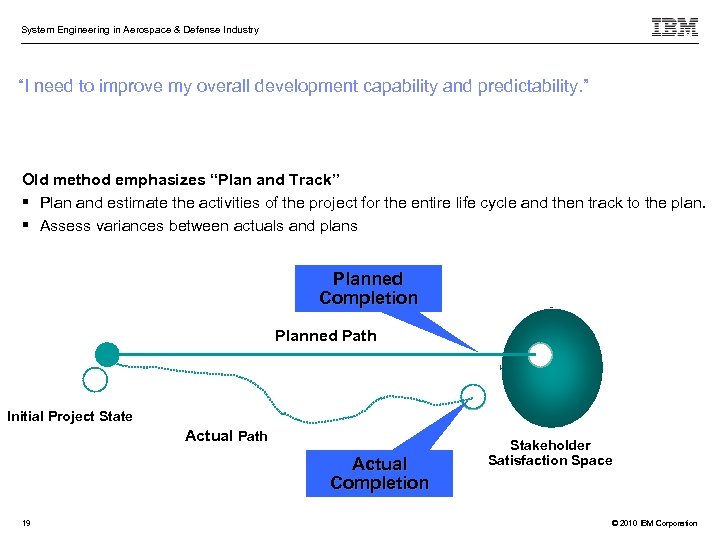 System Engineering in Aerospace & Defense Industry “I need to improve my overall development capability and predictability. ” Old method emphasizes “Plan and Track” Plan and estimate the activities of the project for the entire life cycle and then track to the plan. Assess variances between actuals and plans Planned Completion Planned Path Initial Project State Actual Path Actual Completion 19 Stakeholder Satisfaction Space © 2010 IBM Corporation
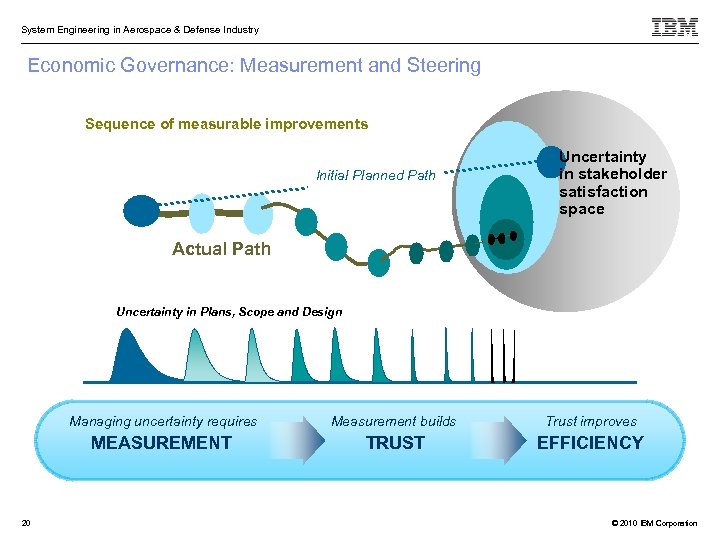 System Engineering in Aerospace & Defense Industry Economic Governance: Measurement and Steering Sequence of measurable improvements Initial Planned Path Uncertainty in stakeholder satisfaction space Actual Path Uncertainty in Plans, Scope and Design Managing uncertainty requires Trust improves MEASUREMENT 20 Measurement builds TRUST EFFICIENCY © 2010 IBM Corporation
 System Engineering in Aerospace & Defense Industry Do the hard things first Iterative development Integrate, then test 21 © 2010 IBM Corporation
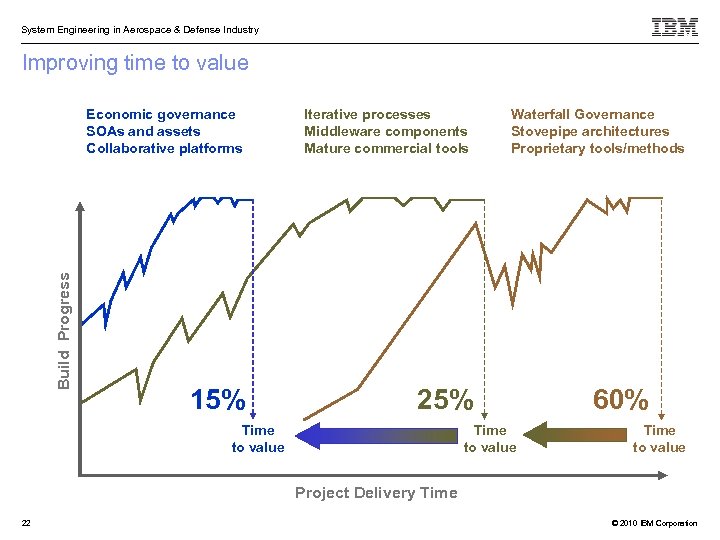 System Engineering in Aerospace & Defense Industry Improving time to value Build Progress Economic governance SOAs and assets Collaborative platforms Iterative processes Middleware components Mature commercial tools 15% 25% Time to value Waterfall Governance Stovepipe architectures Proprietary tools/methods Time to value 60% Time to value Project Delivery Time 22 © 2010 IBM Corporation
 System Engineering in Aerospace & Defense Industry Integrate then test The sooner you integrate, the lower your risk Force integration between collaborating subsystems to reduce writing of emulation code, and surface problems earlier This also enforces better collaboration between teams Use models to determine integration schedules Use models to drive testing Execute models to test integration 23 © 2010 IBM Corporation
 System Engineering in Aerospace & Defense Industry Do not expect life (programs, projects) to be static and predictable Manage change Manage complexity 24 © 2010 IBM Corporation
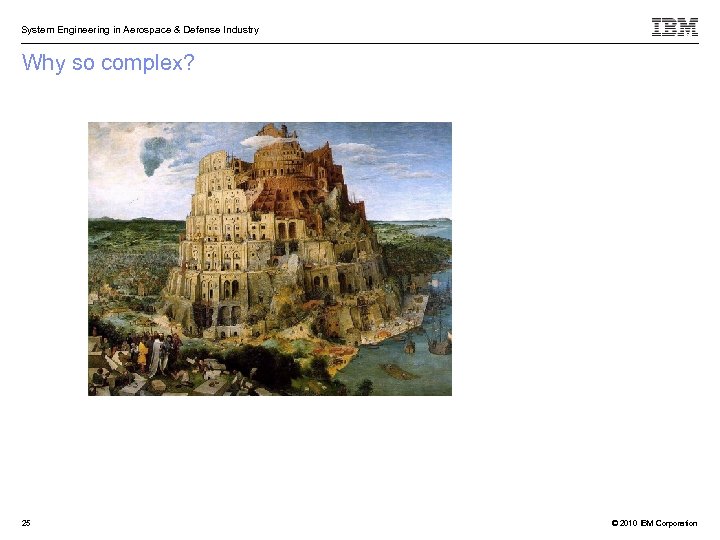 System Engineering in Aerospace & Defense Industry Why so complex? 25 © 2010 IBM Corporation
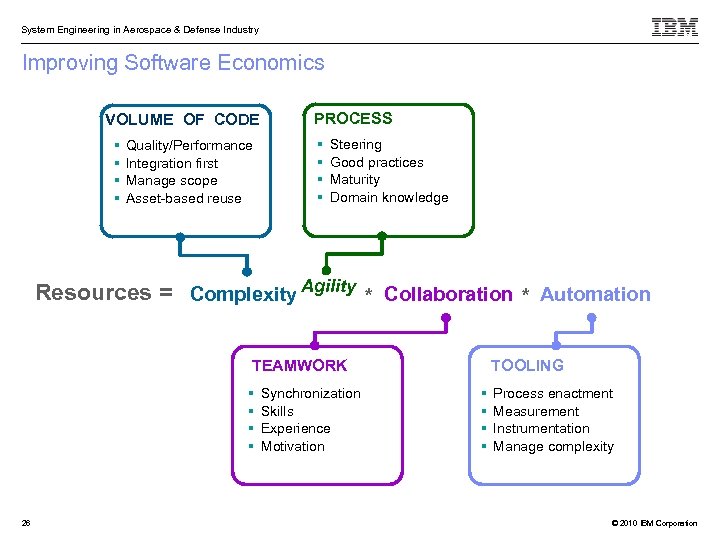 System Engineering in Aerospace & Defense Industry Improving Software Economics VOLUME OF CODE Quality/Performance Integration first Manage scope Asset-based reuse PROCESS Steering Good practices Maturity Domain knowledge Resources = Complexity Agility * Collaboration * Automation TEAMWORK 26 Synchronization Skills Experience Motivation TOOLING Process enactment Measurement Instrumentation Manage complexity © 2010 IBM Corporation
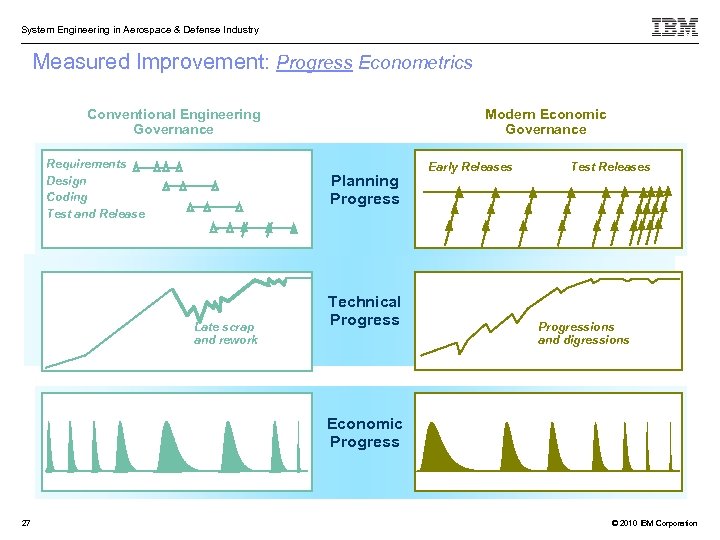 System Engineering in Aerospace & Defense Industry Measured Improvement: Progress Econometrics Conventional Engineering Governance Requirements Design Coding Test and Release Modern Economic Governance Planning Progress Late scrap and rework Technical Progress Early Releases Test Releases Progressions and digressions Economic Progress 27 © 2010 IBM Corporation
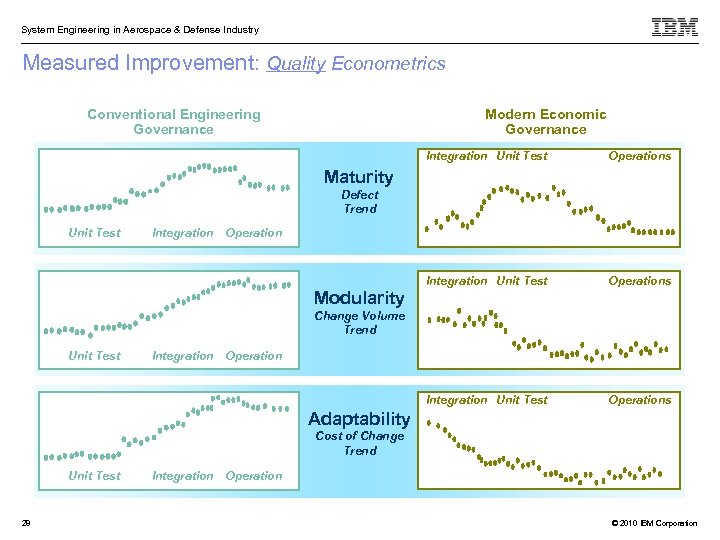 System Engineering in Aerospace & Defense Industry Measured Improvement: Quality Econometrics Conventional Engineering Governance Modern Economic Governance Integration Unit Test Operations Maturity Defect Trend Unit Test Integration Operation Modularity Change Volume Trend Unit Test Integration Operation Adaptability Cost of Change Trend Unit Test 28 Integration Operation © 2010 IBM Corporation
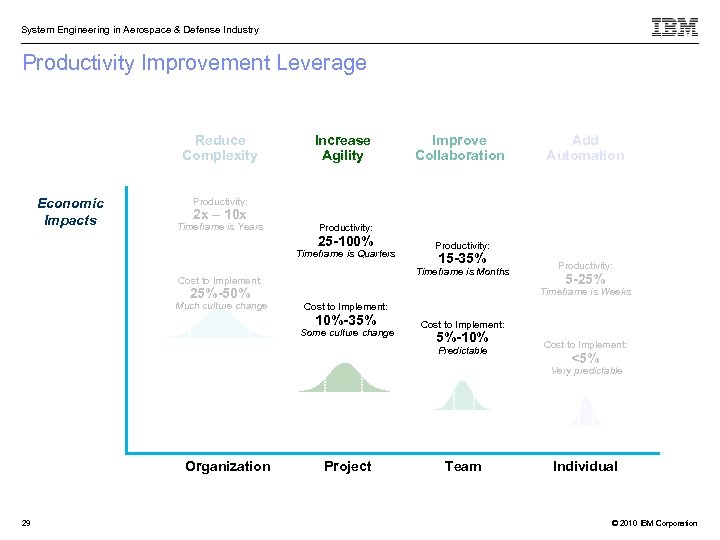 System Engineering in Aerospace & Defense Industry Productivity Improvement Leverage Reduce Add Increase Improve Resources = Complexity Agility * Collaboration * Automation Agility Collaboration Economic Impacts Productivity: 2 x – 10 x Timeframe is Years Productivity: 25 -100% Timeframe is Quarters Productivity: 15 -35% Timeframe is Months Cost to Implement: 25%-50% Much culture change Productivity: 5 -25% Timeframe is Weeks Cost to Implement: 10%-35% Some culture change Cost to Implement: 5%-10% Predictable Cost to Implement: <5% Very predictable Organization 29 Project Team Individual © 2010 IBM Corporation
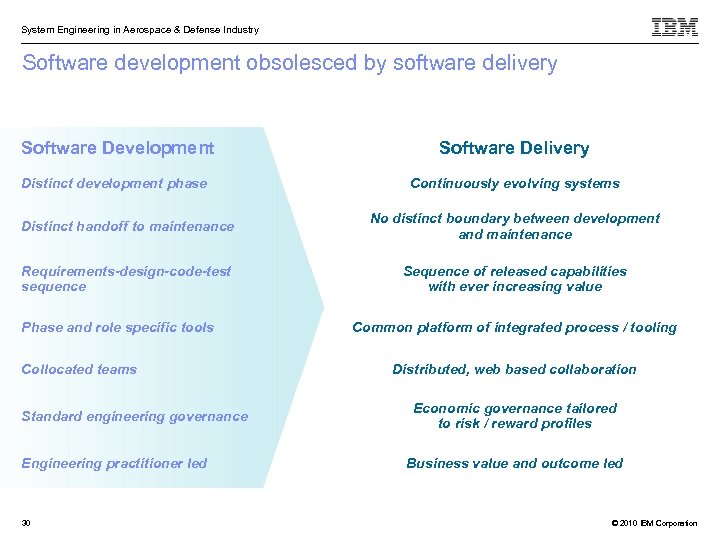 System Engineering in Aerospace & Defense Industry Software development obsolesced by software delivery Software Development Software Delivery Distinct development phase Continuously evolving systems Distinct handoff to maintenance No distinct boundary between development and maintenance Requirements-design-code-test sequence Sequence of released capabilities with ever increasing value Phase and role specific tools Collocated teams Standard engineering governance Engineering practitioner led 30 Common platform of integrated process / tooling Distributed, web based collaboration Economic governance tailored to risk / reward profiles Business value and outcome led © 2010 IBM Corporation
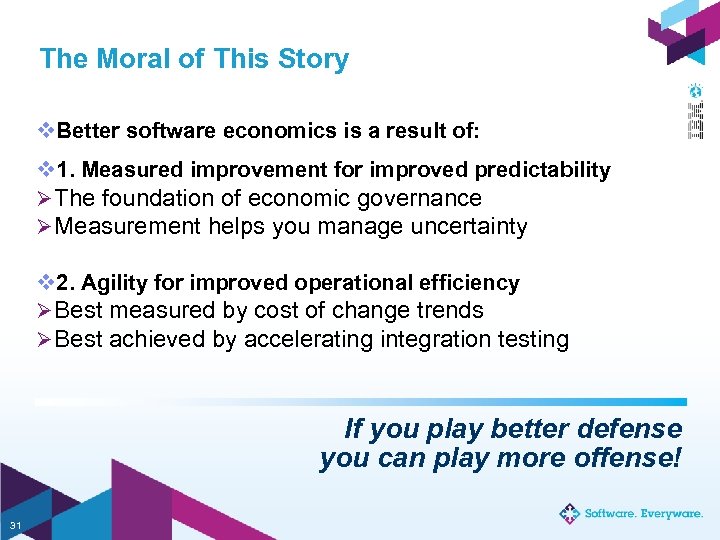 The Moral of This Story v. Better software economics is a result of: v 1. Measured improvement for improved predictability Ø The foundation of economic governance Ø Measurement helps you manage uncertainty v 2. Agility for improved operational efficiency Ø Best measured by cost of change trends Ø Best achieved by accelerating integration testing If you play better defense you can play more offense! 31
 System Engineering in Aerospace & Defense Industry www. ibm. com/software/rational 32 © 2010 IBM Corporation
 System Engineering in Aerospace & Defense Industry www. ibm. com/software/rational © Copyright IBM Corporation 2011. All rights reserved. The information contained in these materials is provided for informational purposes only, and is provided AS IS without warranty of any kind, express or implied. IBM shall not be responsible for any damages arising out of the use of, or otherwise related to, these materials. Nothing contained in these materials is intended to, nor shall have the effect of, creating any warranties or representations from IBM or its suppliers or licensors, or altering the terms and conditions of the applicable license agreement governing the use of IBM software. References in these materials to IBM products, programs, or services do not imply that they will be available in all countries in which IBM operates. Product release dates and/or capabilities referenced in these materials may change at any time at IBM’s sole discretion based on market opportunities or other factors, and are not intended to be a commitment to future product or feature availability in any way. IBM, the IBM logo, Rational, the Rational logo, Telelogic, the Telelogic logo, and other IBM products and services are trademarks of the International Business Machines Corporation, in the United States, other countries or both. Other company, product, or service names may be trademarks or service marks of others. 33 © 2010 IBM Corporation
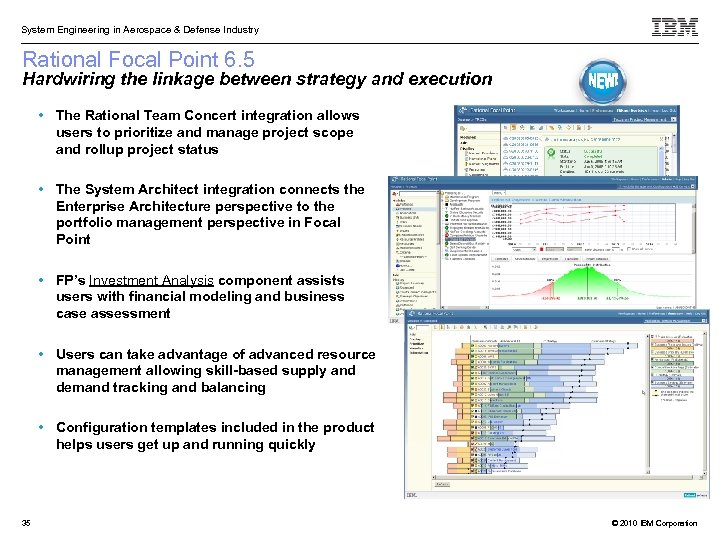 System Engineering in Aerospace & Defense Industry Rational Focal Point 6. 5 Hardwiring the linkage between strategy and execution • The Rational Team Concert integration allows users to prioritize and manage project scope and rollup project status • The System Architect integration connects the Enterprise Architecture perspective to the portfolio management perspective in Focal Point • FP’s Investment Analysis component assists users with financial modeling and business case assessment • Users can take advantage of advanced resource management allowing skill-based supply and demand tracking and balancing • Configuration templates included in the product helps users get up and running quickly 35 © 2010 IBM Corporation
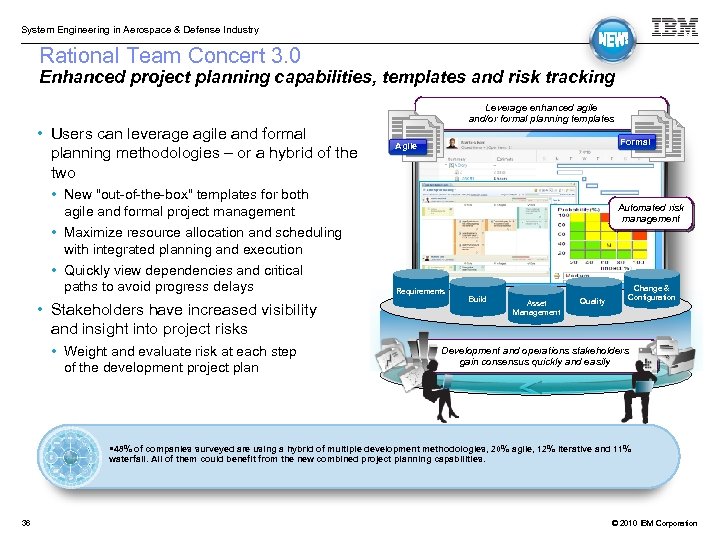 System Engineering in Aerospace & Defense Industry Rational Team Concert 3. 0 Enhanced project planning capabilities, templates and risk tracking • Users can leverage agile and formal planning methodologies – or a hybrid of the two • New "out-of-the-box" templates for both agile and formal project management • Maximize resource allocation and scheduling with integrated planning and execution • Quickly view dependencies and critical paths to avoid progress delays • Stakeholders have increased visibility and insight into project risks • Weight and evaluate risk at each step of the development project plan Leverage enhanced agile and/or formal planning templates Formal Agile Automated risk management Requirements Build Asset Management Quality Change & Configuration Development and operations stakeholders gain consensus quickly and easily 48% of companies surveyed are using a hybrid of multiple development methodologies, 20% agile, 12% iterative and 11% waterfall. All of them could benefit from the new combined project planning capabilities. 36 © 2010 IBM Corporation 36
 System Engineering in Aerospace & Defense Industry Learn More IBM A&D Solutions IBM Rational A&D solutions ibm. com/Watson ibm. com/BAO 37 © 2010 IBM Corporation
 System Engineering in Aerospace & Defense Industry Backup 38 © 2010 IBM Corporation
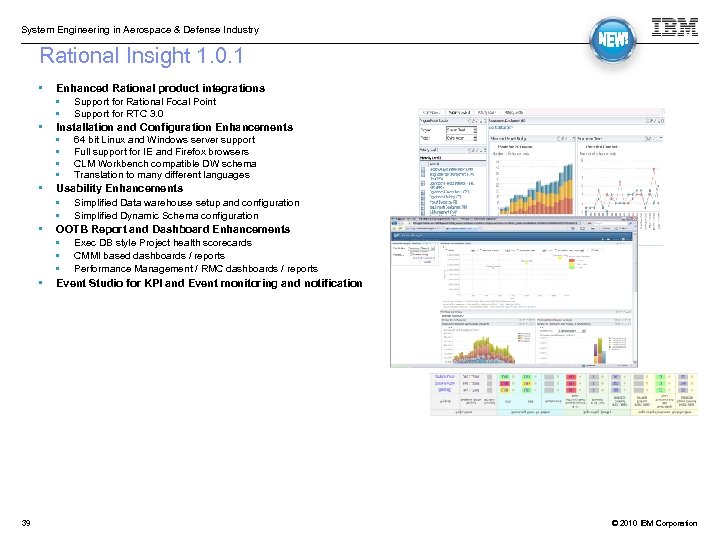 System Engineering in Aerospace & Defense Industry Rational Insight 1. 0. 1 • • • 39 Enhanced Rational product integrations • Support for Rational Focal Point • Support for RTC 3. 0 Installation and Configuration Enhancements • 64 bit Linux and Windows server support • Full support for IE and Firefox browsers • CLM Workbench compatible DW schema • Translation to many different languages Usability Enhancements • Simplified Data warehouse setup and configuration • Simplified Dynamic Schema configuration OOTB Report and Dashboard Enhancements • Exec DB style Project health scorecards • CMMI based dashboards / reports • Performance Management / RMC dashboards / reports Event Studio for KPI and Event monitoring and notification © 2010 IBM Corporation
 System Engineering in Aerospace & Defense Industry Backup 40 © 2010 IBM Corporation
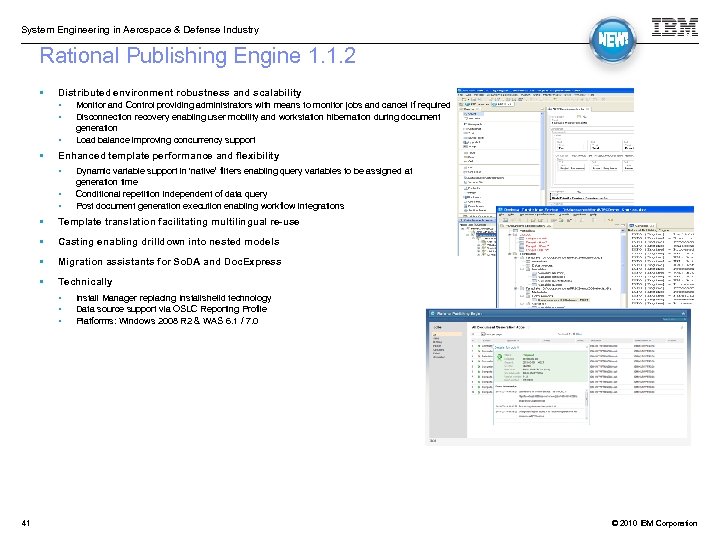 System Engineering in Aerospace & Defense Industry Rational Publishing Engine 1. 1. 2 • Distributed environment robustness and scalability • • Monitor and Control providing administrators with means to monitor jobs and cancel if required Disconnection recovery enabling user mobility and workstation hibernation during document generation Load balance improving concurrency support Enhanced template performance and flexibility • • • Dynamic variable support in ‘native’ filters enabling query variables to be assigned at generation time Conditional repetition independent of data query Post document generation execution enabling workflow integrations • Template translation facilitating multilingual re-use • Casting enabling drilldown into nested models • Migration assistants for So. DA and Doc. Express • Technically • • • 41 Install Manager replacing Installsheild technology Data source support via OSLC Reporting Profile Platforms: Windows 2008 R 2 & WAS 6. 1 / 7. 0 © 2010 IBM Corporation
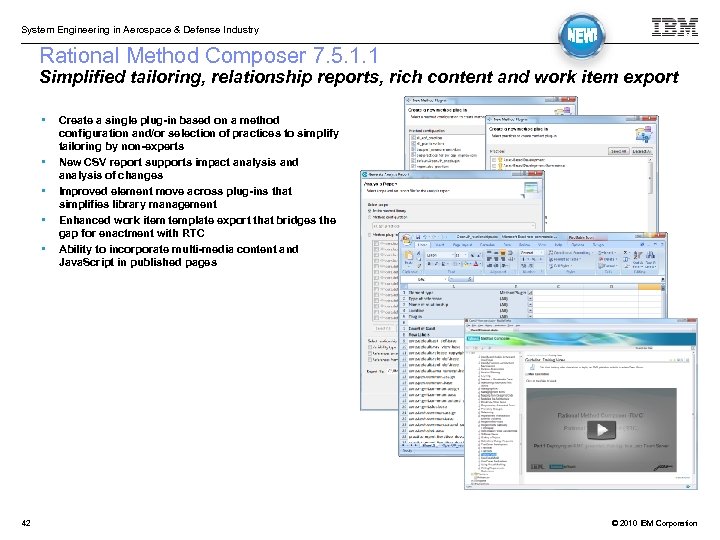 System Engineering in Aerospace & Defense Industry Rational Method Composer 7. 5. 1. 1 Simplified tailoring, relationship reports, rich content and work item export • • • 42 Create a single plug-in based on a method configuration and/or selection of practices to simplify tailoring by non-experts New CSV report supports impact analysis and analysis of changes Improved element move across plug-ins that simplifies library management Enhanced work item template export that bridges the gap for enactment with RTC Ability to incorporate multi-media content and Java. Script in published pages © 2010 IBM Corporation
 Monte Carlo Simulation (Wikipedia System Engineering in Aerospace & Defense Industry 1 has a good article at http: //en. wikipedia. org/wiki/Monte_Carlo_method) Monte Carlo methods (or Monte Carlo experiments) are a class of computational algorithms that rely on repeated random sampling to compute their results. Monte Carlo methods are often used in simulating physical and mathematical systems. These methods are most suited to calculation by a computer and tend to be used when it is infeasible to compute an exact result with a deterministic algorithm. This method is also used to complement theoretical derivations. Monte Carlo methods are especially useful for simulating systems with many coupled degrees of freedom, such as fluids, disordered materials, strongly coupled solids, and cellular structures (see cellular Potts model). They are used to model phenomena with significant uncertainty in inputs, such as the calculation of risk in business. They are widely used in mathematics, for example to evaluate multidimensional definite integrals with complicated boundary conditions. When Monte Carlo simulations have been applied in space exploration and oil exploration, their predictions of failures, cost overruns and schedule overruns are routinely better than human intuition or alternative "soft" methods. The Monte Carlo method was coined in the 1940 s by John von Neumann, Stanislaw Ulam and Nicholas Metropolis, while they were working on nuclear weapon projects in the Los Alamos National Laboratory. It was named in homage to Monte Carlo casino, a famous casino, where Ulam's uncle would often gamble away his money. Introduction and example: Monte Carlo method applied to approximating the value of π Monte Carlo methods vary, but tend to follow a particular pattern: – Define a domain of possible inputs. – Generate inputs randomly from a probability distribution over the domain. – Perform a deterministic computation on the inputs. – Aggregate the results. For example, given that a circle inscribed in a square and the square itself have a ratio of areas that is π/4, the value of π can be approximated using a Monte Carlo method: – Draw a square on the ground, then inscribe a circle within it. – Uniformly scatter some objects of uniform size (grains of rice or sand) over the square. – Count the number of objects inside the circle and the total number of objects. – The ratio of the two counts is an estimate of the ratio of the two areas, which is π/4. Multiply the result by 4 to estimate π. In this procedure the domain of inputs is the square that circumscribes our circle. We generate random inputs by scattering grains over the square then perform a computation on each input (test whether it falls within the circle). Finally, we aggregate the results to obtain our final result, the approximation of π. To get an accurate approximation for π this procedure should have two other common properties of Monte Carlo methods. First, the inputs should truly be random. If grains are purposefully dropped into only the center of the circle, they will not be uniformly distributed, and so our approximation will be poor. Second, there should be a large number of inputs. The approximation will generally be poor if only a few grains are randomly dropped into the whole square. On average, the approximation improves as more grains are dropped. 43 © 2010 IBM Corporation