


 Скачать презентацию THE ECONOMICS OF MONEY AND MONETARY POLICY William
38be12dc2f788fefb961122be13c6840.ppt
- Количество слайдов: 97
 THE ECONOMICS OF MONEY AND MONETARY POLICY William D. Lastrapes Terry at Oxford Summer 2008
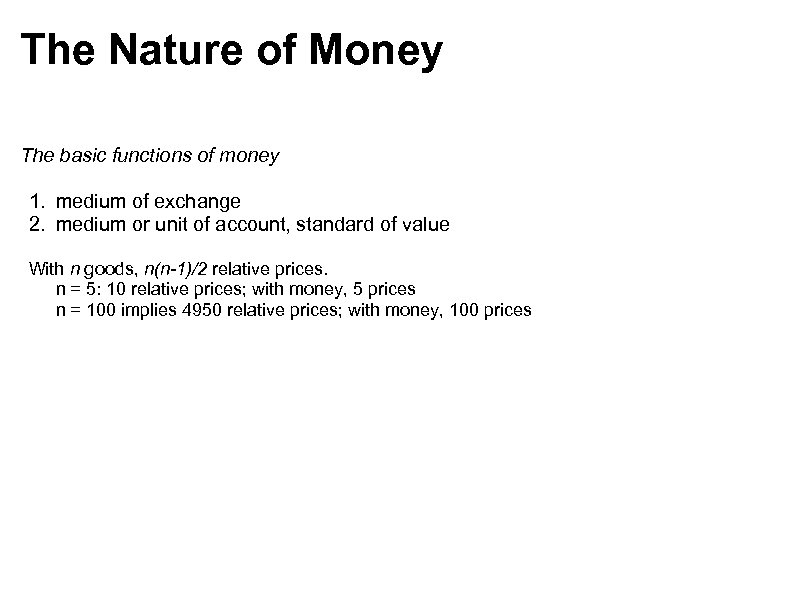 The Nature of Money The basic functions of money 1. medium of exchange 2. medium or unit of account, standard of value With n goods, n(n-1)/2 relative prices. n = 5: 10 relative prices; with money, 5 prices n = 100 implies 4950 relative prices; with money, 100 prices
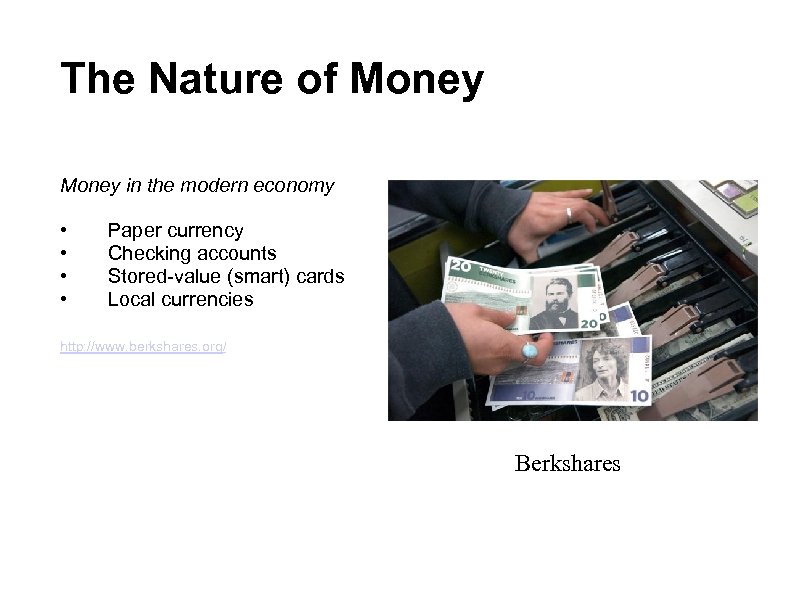 The Nature of Money in the modern economy • • Paper currency Checking accounts Stored-value (smart) cards Local currencies http: //www. berkshares. org/ Berkshares
 The Nature of Money Alternatives to money Credit Liquid assets Gold and silver?
 The Nature of Money Alternatives to money Credit Liquid assets Gold and silver? Purchasing power of money and inflation . . . the number of monetary units (units of account) it takes to buy the average good or service in the economy. The price level is the reciprocal of the purchasing power of money. Inflation measures the rate of depreciation in value of money.
 The Nature of Money Suppose that gold serves as the medium of exchange, and ounces of gold are the unit of account. Lump all the other goods and services in the economy together in a basket. The purchasing power of gold is the amount of these baskets that can be purchased with an ounce of gold. Suppose that 1 ounce buys 1/10 of a basket. Then the price level – the ounces of gold needed to buy one basket – is 10 ounces. Finally, suppose that at the beginning of next year, the basket costs 11 ounces. Then the rate of inflation during the year is 10%.
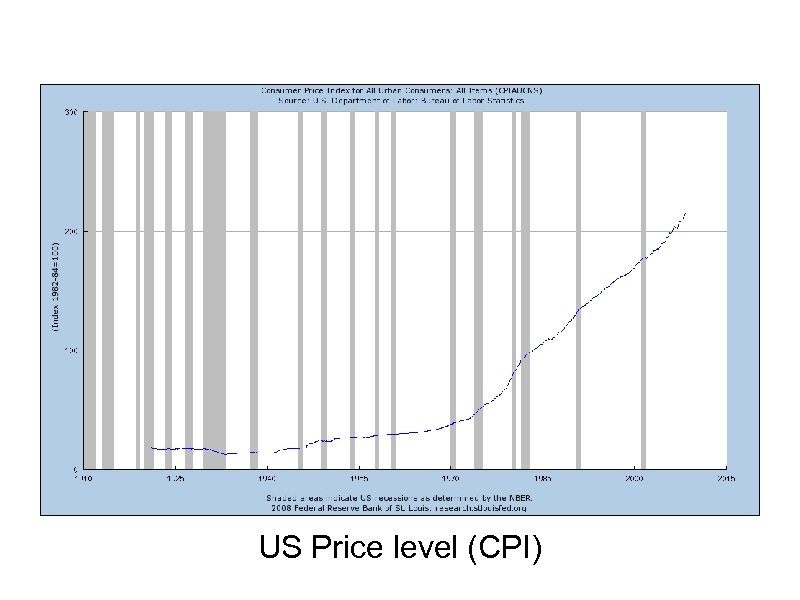 US Price level (CPI)
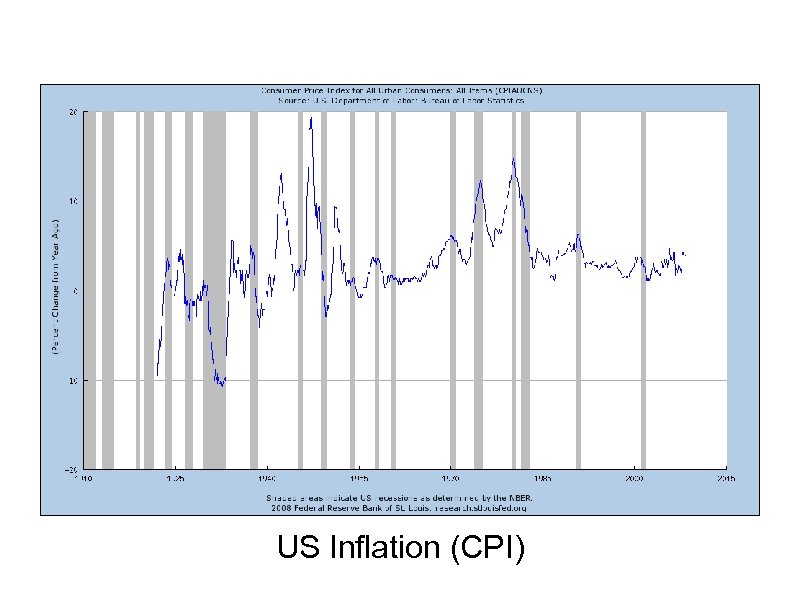 US Inflation (CPI)
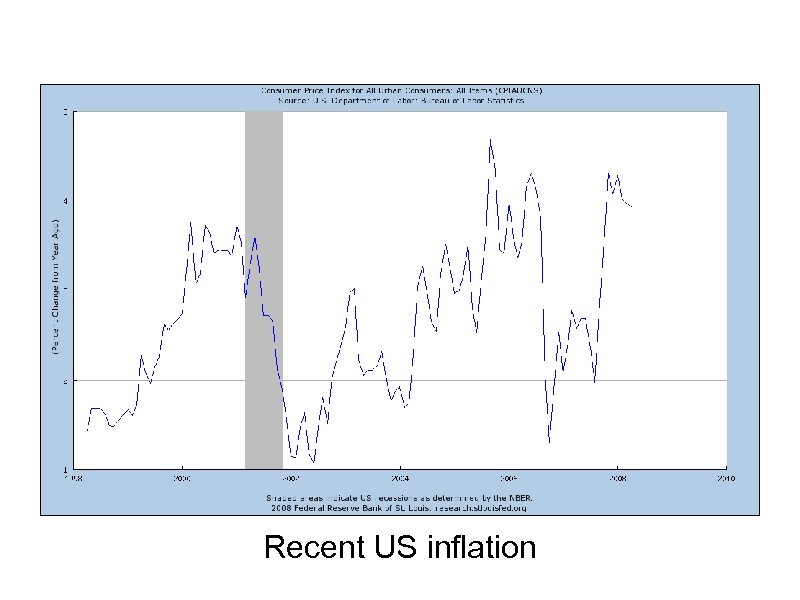 Recent US inflation
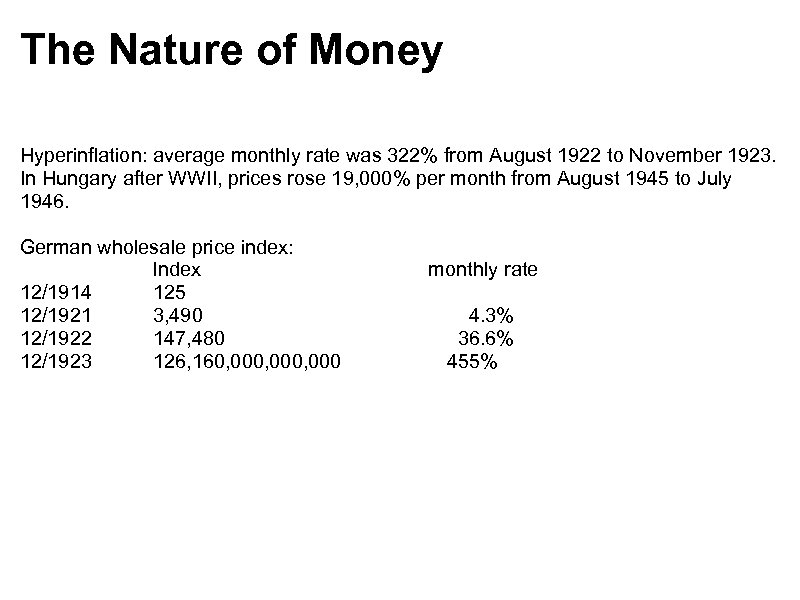 The Nature of Money Hyperinflation: average monthly rate was 322% from August 1922 to November 1923. In Hungary after WWII, prices rose 19, 000% per month from August 1945 to July 1946. German wholesale price index: Index monthly rate 12/1914 125 12/1921 3, 490 4. 3% 12/1922 147, 480 36. 6% 12/1923 126, 160, 000, 000 455%
 The Nature of Money Inflation occurs when the quantity of money is produced at rates that exceed the desire to accumulate it.
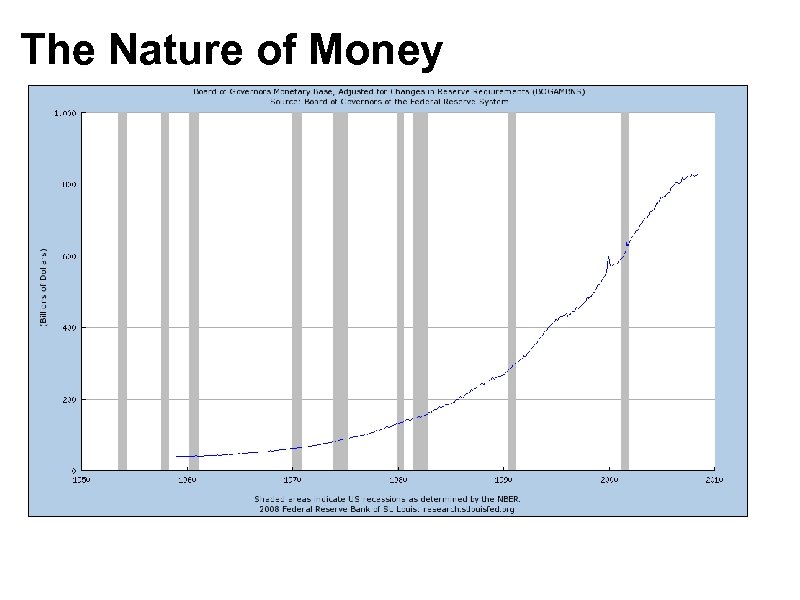
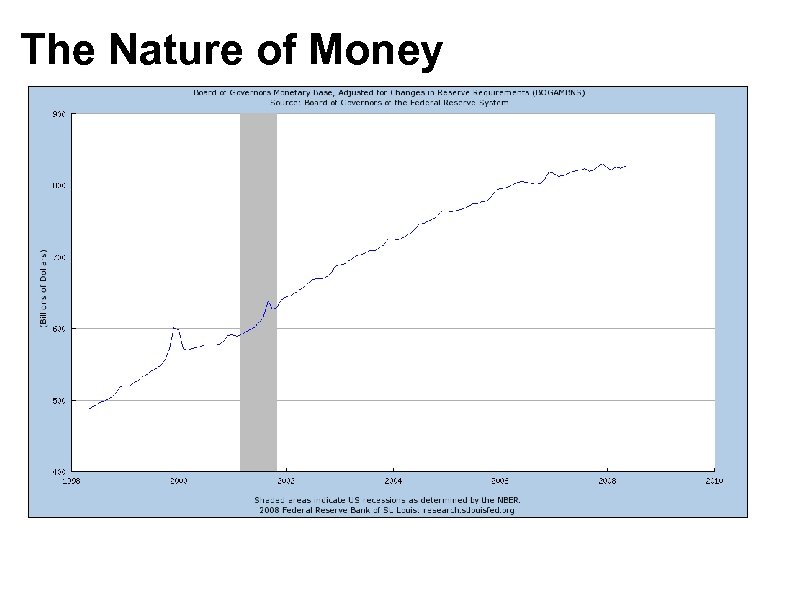
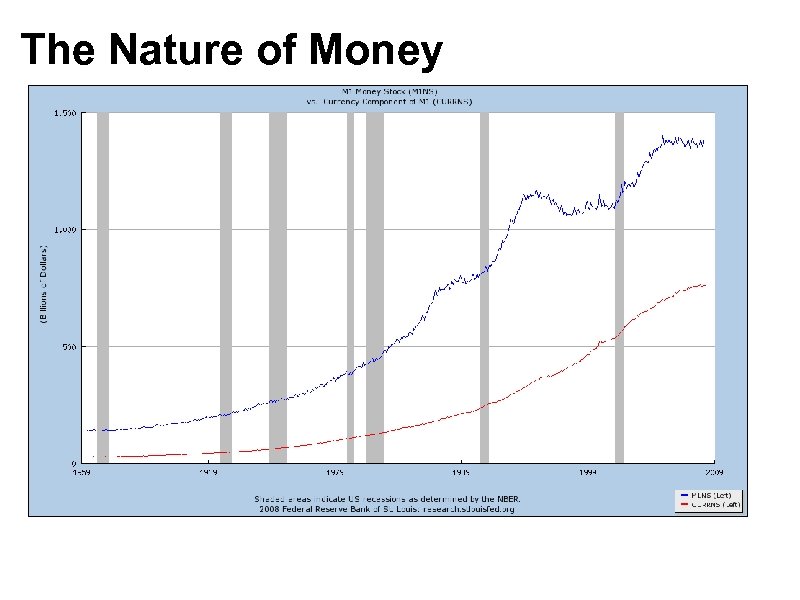
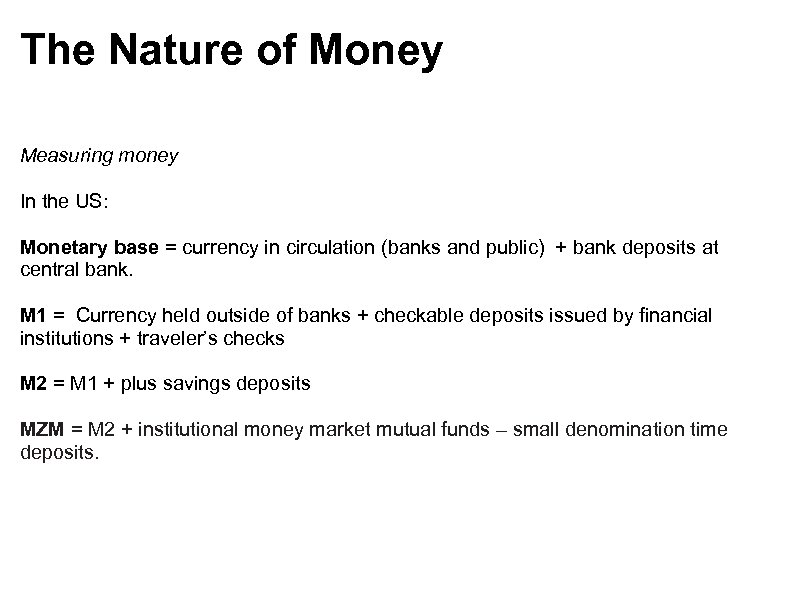 The Nature of Money Measuring money In the US: Monetary base = currency in circulation (banks and public) + bank deposits at central bank. M 1 = Currency held outside of banks + checkable deposits issued by financial institutions + traveler’s checks M 2 = M 1 + plus savings deposits MZM = M 2 + institutional money market mutual funds – small denomination time deposits.
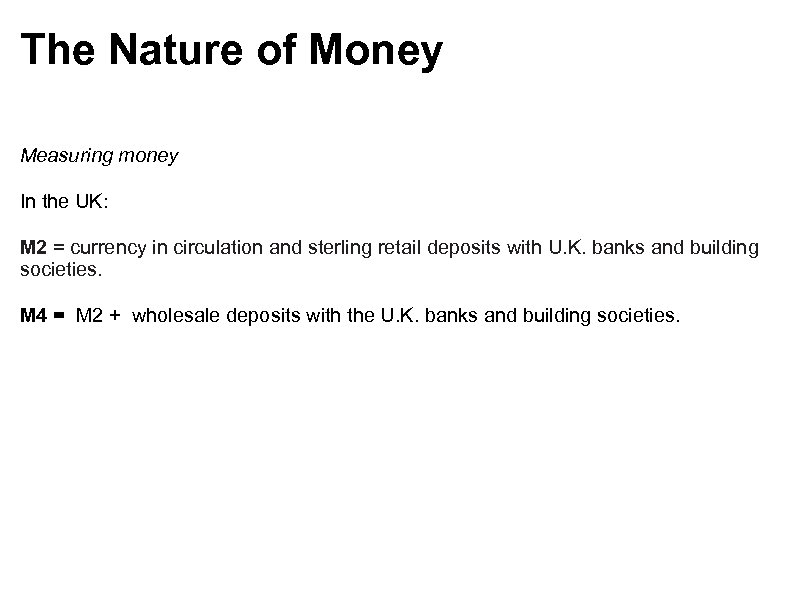 The Nature of Money Measuring money In the UK: M 2 = currency in circulation and sterling retail deposits with U. K. banks and building societies. M 4 = M 2 + wholesale deposits with the U. K. banks and building societies.
 The Nature of Money
 The Nature of Money
 The Nature of Money
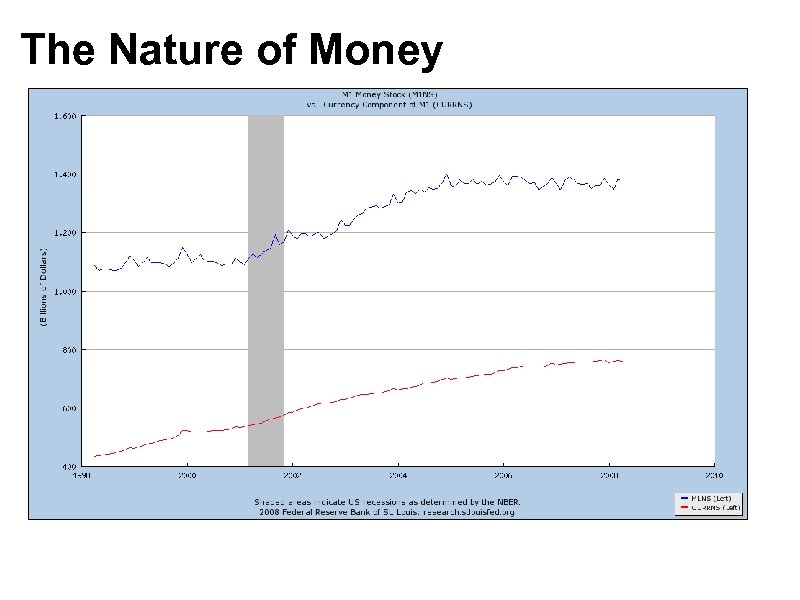 The Nature of Money
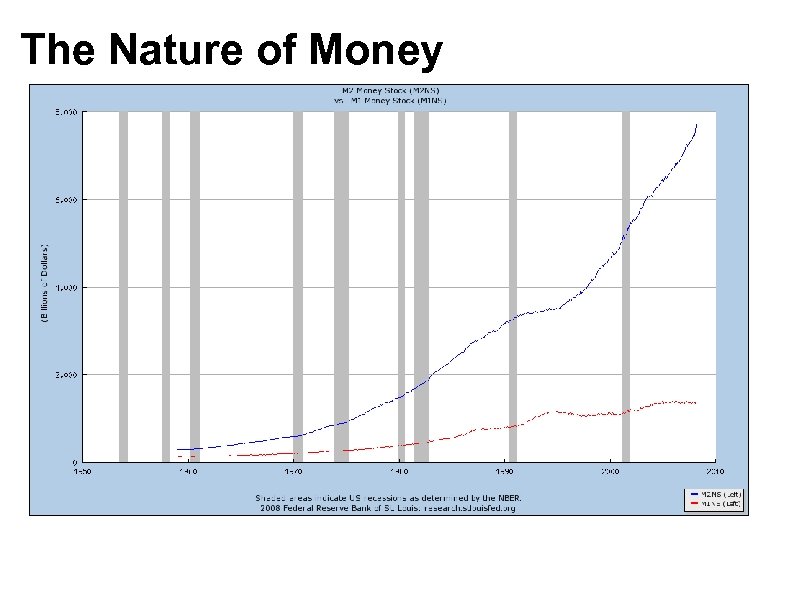 The Nature of Money
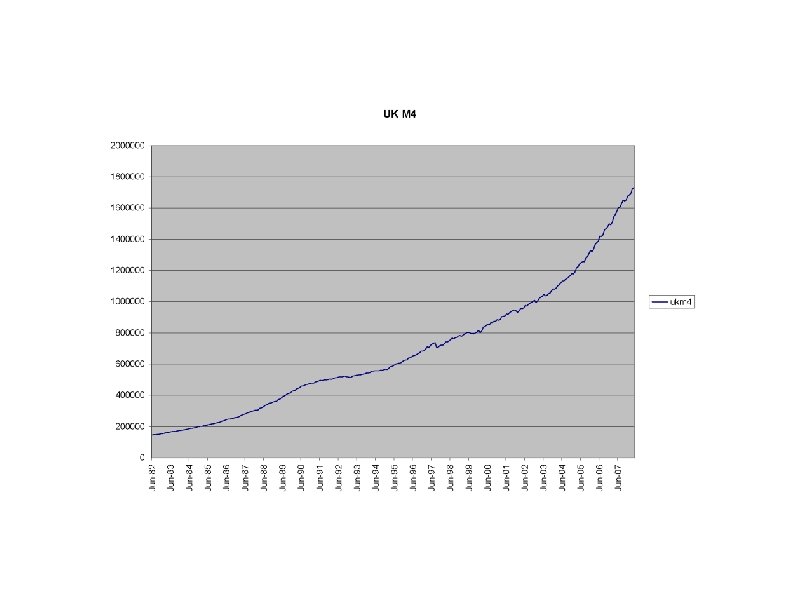
 The Nature of Money Real money balances: M/P M is nominal money P is price level Coincidence of wants and indirect barter
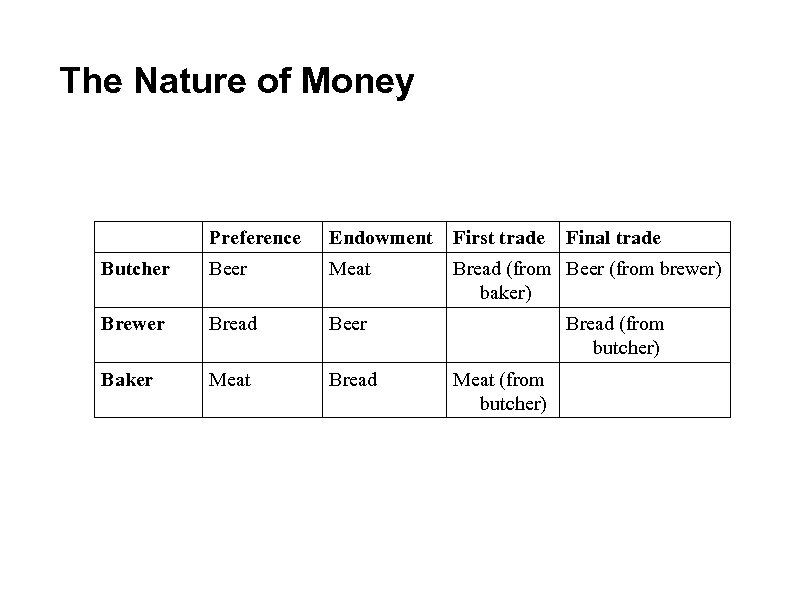 The Nature of Money Preference Endowment First trade Final trade Butcher Beer Meat Bread (from Beer (from brewer) baker) Brewer Bread Beer Baker Meat Bread (from butcher) Meat (from butcher)
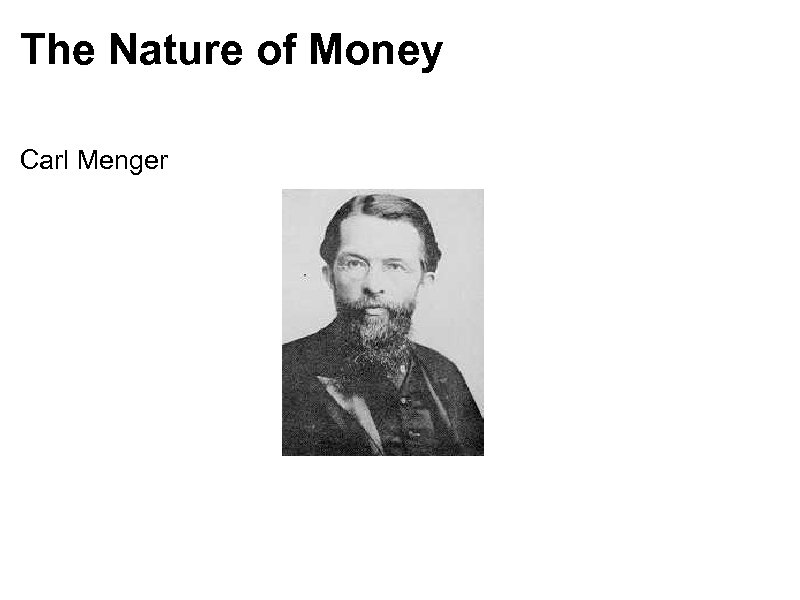 The Nature of Money Carl Menger
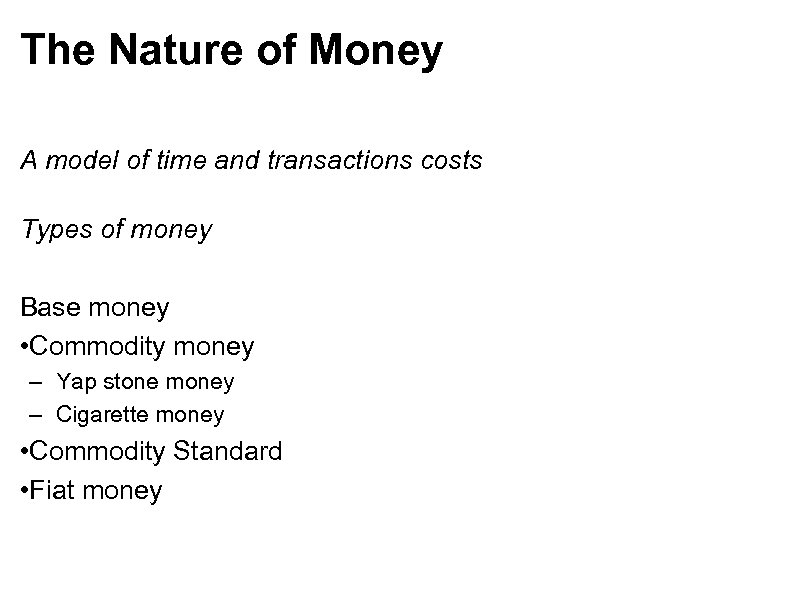 The Nature of Money A model of time and transactions costs Types of money Base money • Commodity money – Yap stone money – Cigarette money • Commodity Standard • Fiat money
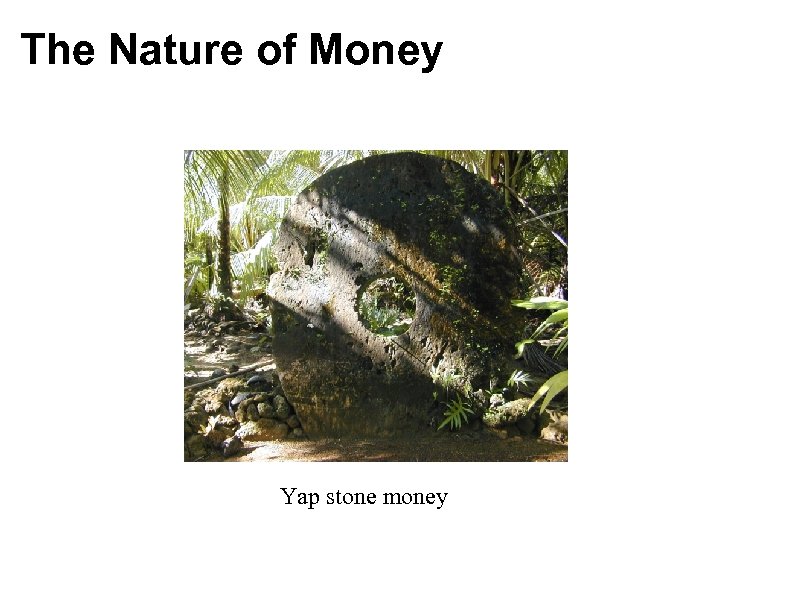 The Nature of Money Yap stone money
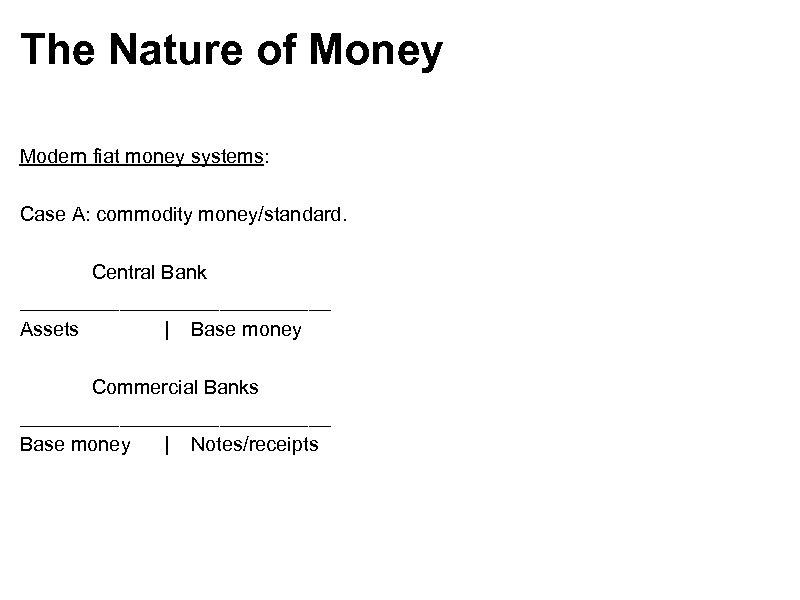 The Nature of Money Modern fiat money systems: Case A: commodity money/standard. Central Bank ______________ Assets | Base money Commercial Banks ______________ Base money | Notes/receipts
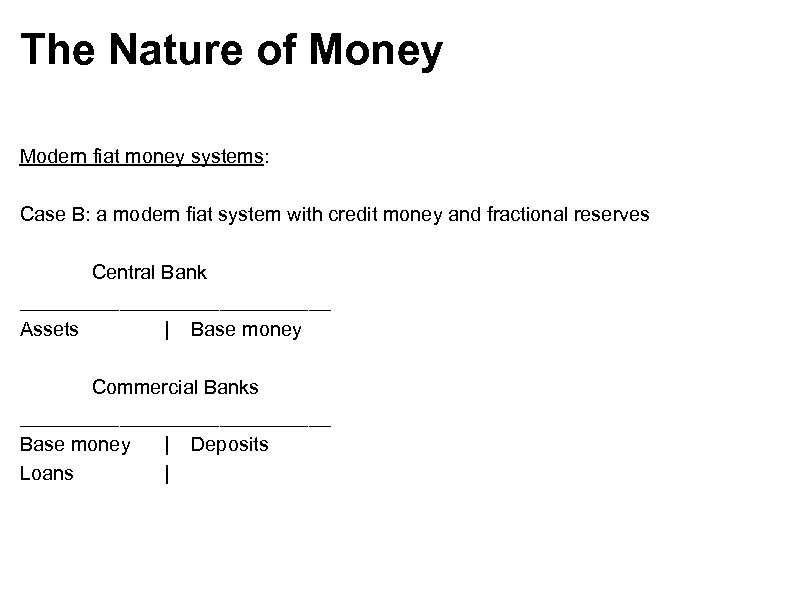 The Nature of Money Modern fiat money systems: Case B: a modern fiat system with credit money and fractional reserves Central Bank ______________ Assets | Base money Commercial Banks ______________ Base money | Deposits Loans |
 Commodity money systems A stock-flow model of prices under a gold standard • • • M = nominal money supply in pounds Pg = nominal price of gold (pounds per ounce); set by central bank authority G = stock of gold in ounces that has been mined and is available for use as money or other purposes in the economy Gm = gold held by central banks as monetary reserves P = price level in pounds per composite good. y = real quantity of composite good produced during the year (real GDP). π = expected inflation (expected rate of change of P). k = gold reserve ratio – the amount of gold held in the central bank as a fraction of nominal money supply. Determined by the central bank. k = Pg*Gm/M. If k<1, then we have a fractional reserve gold standard. Pg/P = relative price or purchasing power of gold: the quantity of composite good per ounce of gold. The model essentially determines this price in short run and long run equilibrium.
 Commodity money systems Basic assumptions: : • G is the stock of gold outside of the ground, and thus usable. At a point in time, this stock is fixed. • The economy obtains gold from two sources: a) mining and b) flows from international trade; when the economy exports goods, it receives payment in the form of gold. It loses gold for two reasons: a) consumption or loss from use, and b) when it imports goods, it pays gold. Both sources provide and use gold only gradually over time, and are thus flows. The stock of gold adjusts gradually over time according to conditions of flow demand supply. [Note, international capital flows are ignored, which could buffer the gold stock from trade flows. ] • Although gold is a commodity with inherent value, we ignore the non-monetary use of gold to simplify (nothing of essence changes by this assumption). • At a point in time, the relative price of gold quickly adjusts so that the existing stock of gold (G) equals the stock demand for gold. However, because Pg is fixed by the nature of the gold standard, the adjustment comes solely through P, the price level. • The focus of the model is on price level adjustments, so we suppose that the economy is in full employment: the level of output is taken as fixed and independent of price level adjustment. This makes the model a theory of the price level.
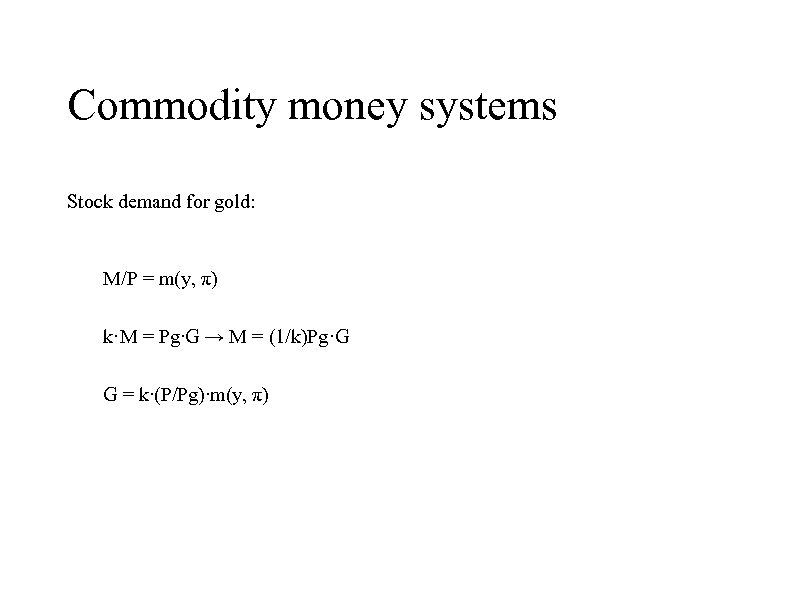 Commodity money systems Stock demand for gold: M/P = m(y, π) k·M = Pg∙G → M = (1/k)Pg·G G = k∙(P/Pg)∙m(y, π)
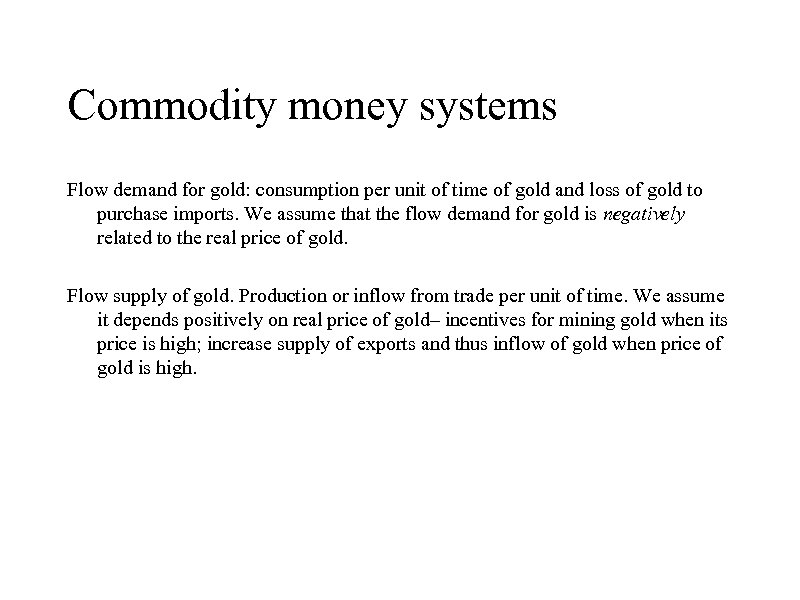 Commodity money systems Flow demand for gold: consumption per unit of time of gold and loss of gold to purchase imports. We assume that the flow demand for gold is negatively related to the real price of gold. Flow supply of gold. Production or inflow from trade per unit of time. We assume it depends positively on real price of gold– incentives for mining gold when its price is high; increase supply of exports and thus inflow of gold when price of gold is high.
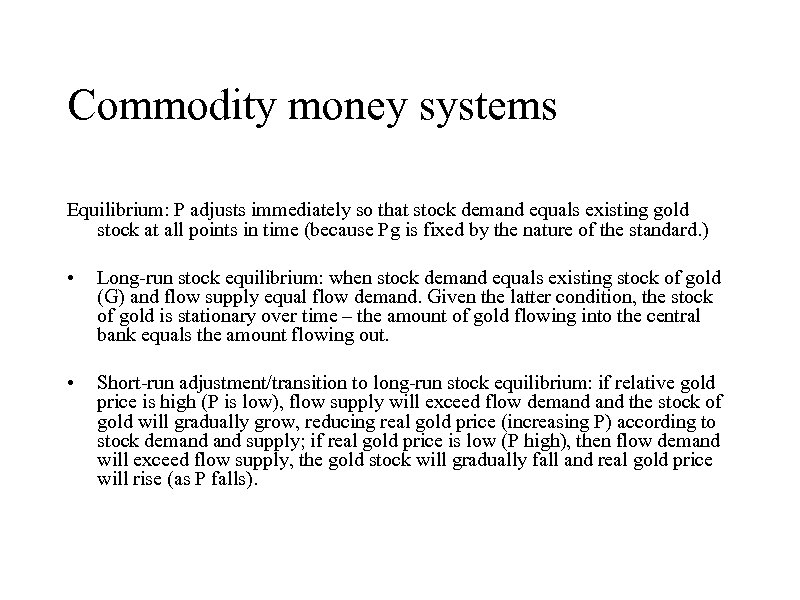 Commodity money systems Equilibrium: P adjusts immediately so that stock demand equals existing gold stock at all points in time (because Pg is fixed by the nature of the standard. ) • Long-run stock equilibrium: when stock demand equals existing stock of gold (G) and flow supply equal flow demand. Given the latter condition, the stock of gold is stationary over time – the amount of gold flowing into the central bank equals the amount flowing out. • Short-run adjustment/transition to long-run stock equilibrium: if relative gold price is high (P is low), flow supply will exceed flow demand the stock of gold will gradually grow, reducing real gold price (increasing P) according to stock demand supply; if real gold price is low (P high), then flow demand will exceed flow supply, the gold stock will gradually fall and real gold price will rise (as P falls).
 Commodity money systems Analysis and implications • • • Gold discovery Reduction in gold reserve Devaluation
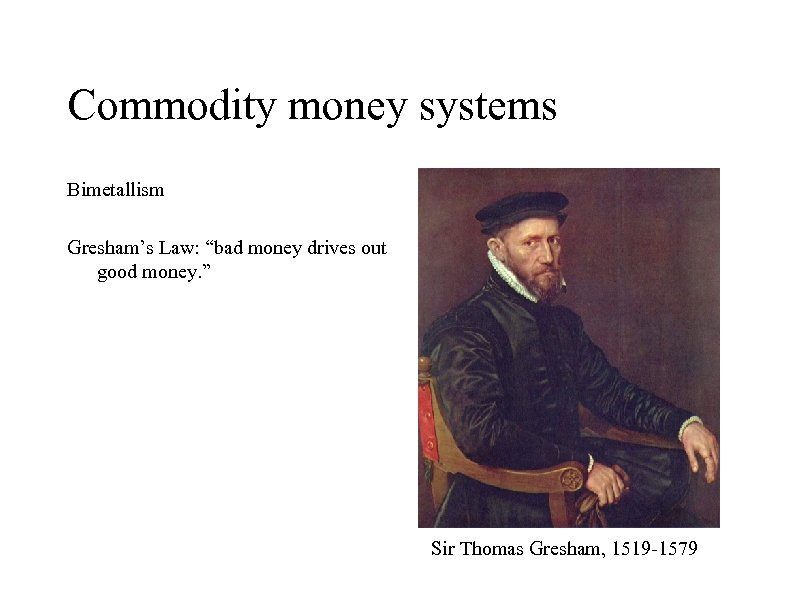 Commodity money systems Bimetallism Gresham’s Law: “bad money drives out good money. ” Sir Thomas Gresham, 1519 -1579
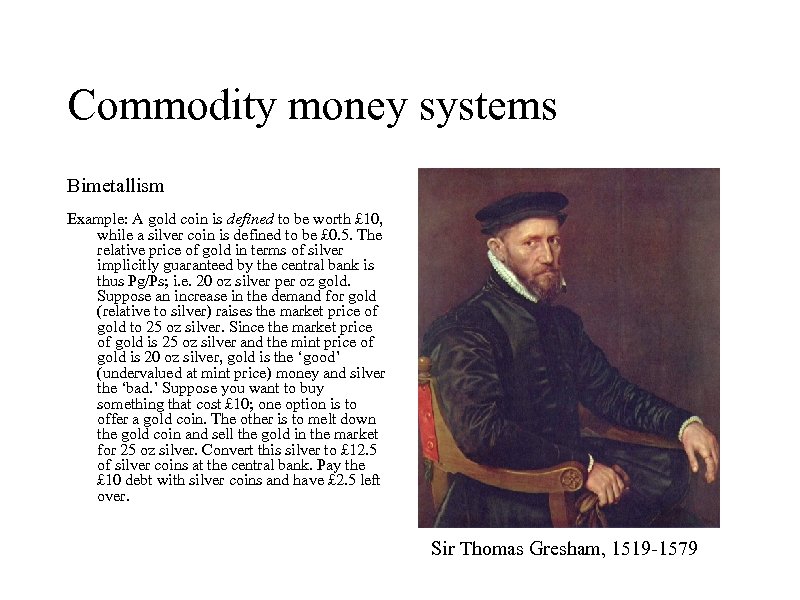 Commodity money systems Bimetallism Example: A gold coin is defined to be worth £ 10, while a silver coin is defined to be £ 0. 5. The relative price of gold in terms of silver implicitly guaranteed by the central bank is thus Pg/Ps; i. e. 20 oz silver per oz gold. Suppose an increase in the demand for gold (relative to silver) raises the market price of gold to 25 oz silver. Since the market price of gold is 25 oz silver and the mint price of gold is 20 oz silver, gold is the ‘good’ (undervalued at mint price) money and silver the ‘bad. ’ Suppose you want to buy something that cost £ 10; one option is to offer a gold coin. The other is to melt down the gold coin and sell the gold in the market for 25 oz silver. Convert this silver to £ 12. 5 of silver coins at the central bank. Pay the £ 10 debt with silver coins and have £ 2. 5 left over. Sir Thomas Gresham, 1519 -1579
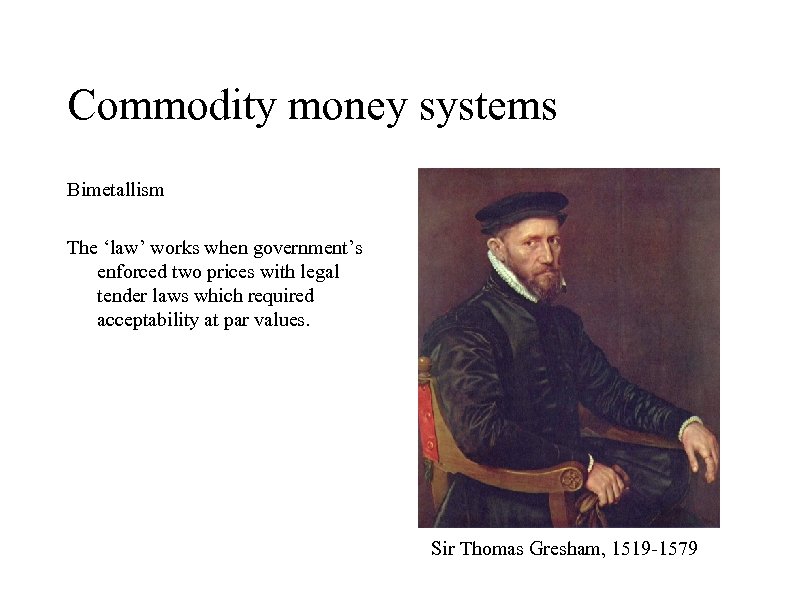 Commodity money systems Bimetallism The ‘law’ works when government’s enforced two prices with legal tender laws which required acceptability at par values. Sir Thomas Gresham, 1519 -1579
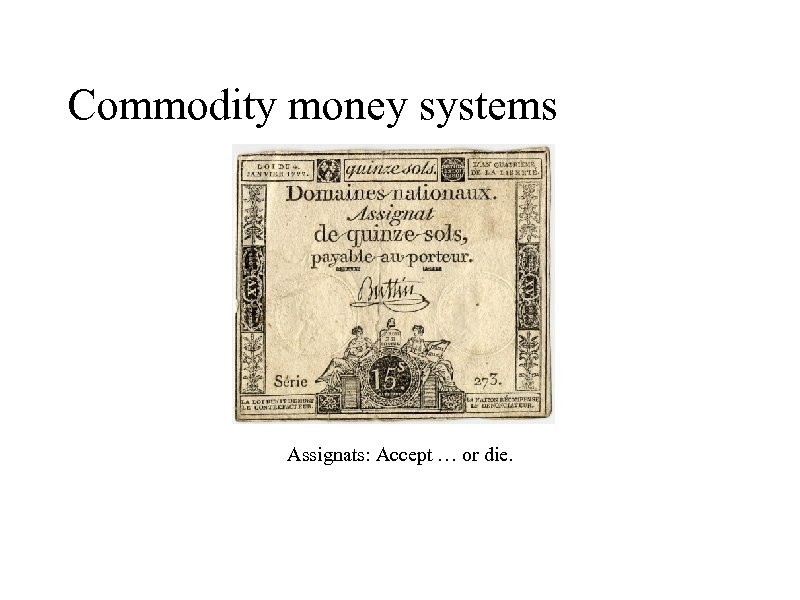 Commodity money systems Assignats: Accept … or die.
 Commodity money systems International exchange under commodity money standards • Price-specie flow mechanism. • Central bank control – Interest rates and capital flows. Suppose that during a trade deficit, the central bank acts to raise interest rates (by selling assets) to encourage lending by foreigners to domestic citizens. This lending could help finance the trade deficit without the necessity of official gold outflows, thus bringing external adjusts more quickly. With a trade surplus, the central bank could buy assets to reduce interest rates and therefore relieve the pressure on gold inflows. This was called the ‘rules of the game’ by Keynes in describing the post WWI gold standard. – Gold sterilization. Central bank can sterilize gold flows, selling assets as gold flowed in a vice versa. In effect, the central bank could alter k in the same direction as the change in gold to buffer the money supply by adjusting the amount of gold held. This would offset the effects of gold flows on the money supply, at least temporarily. – Suspension. To counter this natural mechanism they could also suspend convertibility of paper money; i. e. temporarily (or permanently) go off the gold standard.
 Commodity money systems International exchange under commodity money standards • Foreign exchange – When two countries are on the gold standard, but have different currencies (i. e. media of exchange and unit of account), there currencies will have a fixed rate of exchange. The price of one currency in terms of another is called the exchange rate. Suppose for example that in the US, the fixed nominal price of gold (the price in terms of the dollar unit of account) is $35 per ounce, while in the UK it is fixed by the central bank at £ 20 per ounce. If we assume there are no transactions costs in converting $ to gold, £ to gold, and $ to £, then the $/£ exchange rate will be $1. 75 per £. Suppose that you could convert pounds to dollars at a rate of $2 per pound. Then you could profit by arbitrage: convert an ounce of gold into 20 pounds, with the 20 pounds buy $40, and convert the $40 to 1. 143 ounces of gold. Since there is no risk involved or transactions costs, many would attempt to sell pounds to buy dollars (the supply of pounds would rise), causing the pound to fall from $2 until there are no profit opportunities; i. e. when the exchange rate returns to $1. 75.
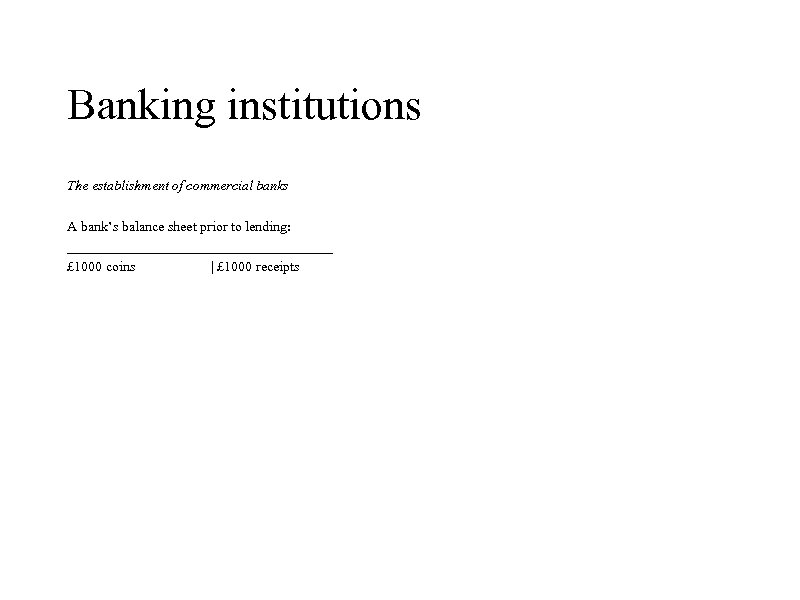 Banking institutions The establishment of commercial banks A bank’s balance sheet prior to lending: ___________________ £ 1000 coins | £ 1000 receipts
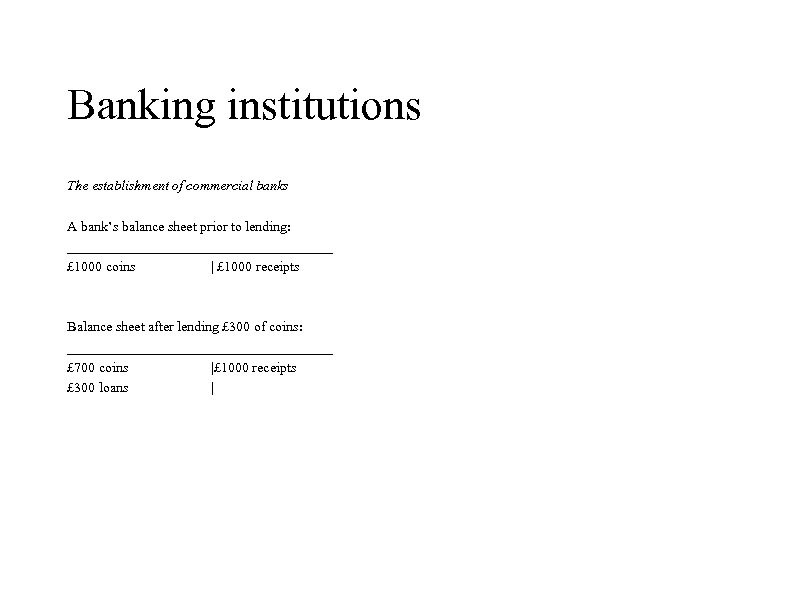 Banking institutions The establishment of commercial banks A bank’s balance sheet prior to lending: ___________________ £ 1000 coins | £ 1000 receipts Balance sheet after lending £ 300 of coins: ___________________ £ 700 coins |£ 1000 receipts £ 300 loans |
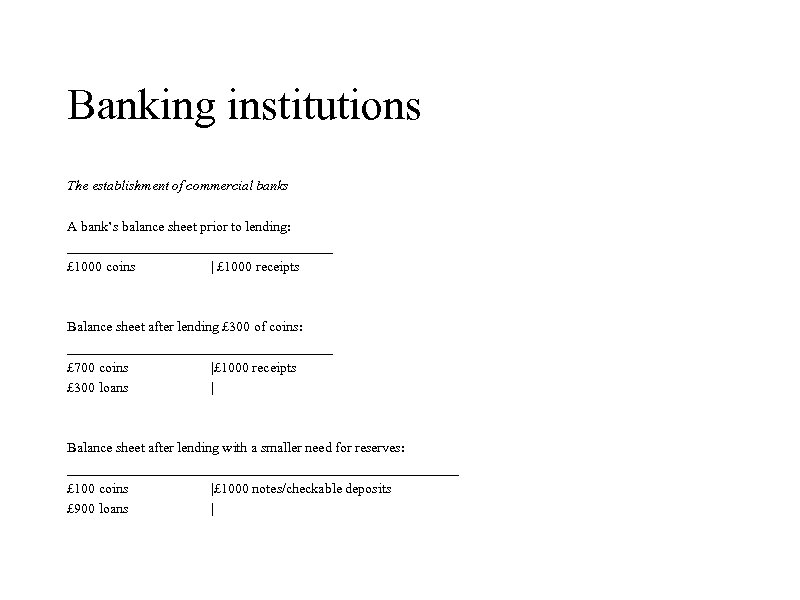 Banking institutions The establishment of commercial banks A bank’s balance sheet prior to lending: ___________________ £ 1000 coins | £ 1000 receipts Balance sheet after lending £ 300 of coins: ___________________ £ 700 coins |£ 1000 receipts £ 300 loans | Balance sheet after lending with a smaller need for reserves: ____________________________ £ 100 coins |£ 1000 notes/checkable deposits £ 900 loans |
 Banking institutions Comments 1) System-wide, this fractional reserve banking system led to a large increase in money/liquidity. The payments system has evolved to one of bank or credit (or inside) money, leading to a large expansion in liquidity, since banks liabilities are part of the money supply. For example, if there were 1000 coins in the economy as a whole, and bankers kept 10% on reserve, this could support a total money supply (the value of notes and checkable deposits) of 10, 000. This expansion could occur because bankers could simply make new loans not with coins, but with notes or checkable deposits. 2) The system is potentially vulnerable or fragile: what happens if all depositors want to claim base (gold) money. Under fractional reserves, this can’t be done systematically. Such a system is very dependent on trustworthiness of the banks. If not, we might expect bank panics/runs.
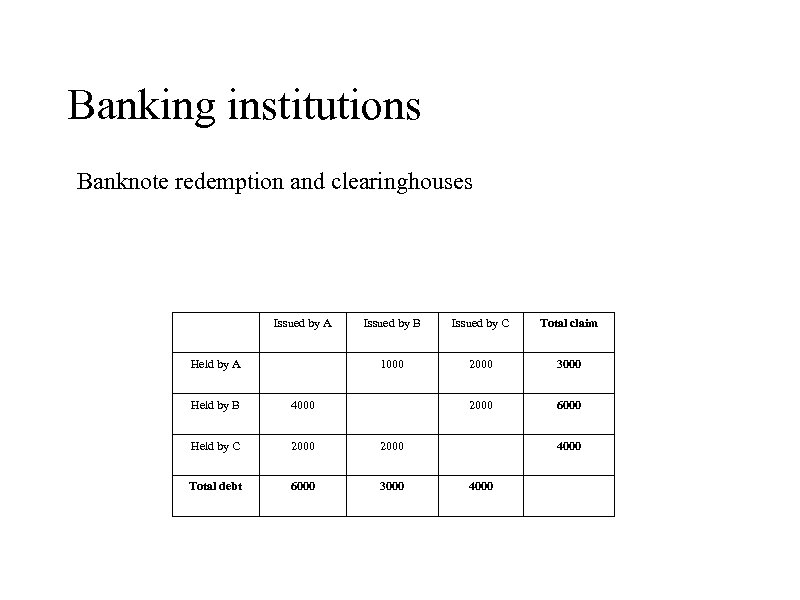 Banking institutions Banknote redemption and clearinghouses Issued by A Issued by C Total claim 1000 Held by A Issued by B 2000 3000 2000 6000 Held by B 4000 Held by C 2000 Total debt 6000 3000 4000
 Banking institutions Implications for money and prices • Banking panics and runs – money stock falls; deflation. Potential solutions: 1) deposit insurance; 2) central bank (lender of last resort) • Banknote over-issue – too much money; inflation. But note redemption is a natural discipline limiting excess monetary expansion.
 Banking institutions Central banks • • Bank for other banks; private commercial banks can hold deposits and borrow from the central bank, but others (besides the government) generally cannot; Reserves ‘centralized’ at the central bank; private banks hold claims on the central bank. Note and deposit issue serve as high-powered money, and are not typically redeemed (but could be under commodity standards). They have a monopoly over note issue, and the notes are usually legal tender. Without adverse clearings, this is very profitable. Other special privileges from the government (if they are not actually part of the government); e. g. they keep government deposits. Because of their large holding of reserves and ability to issue high-powered money they can determine liquidity and the quantity of money, and therefore are responsible for monetary policy. Lender of last resort – make loans to other banks in times of liquidity crises Authority to regulate banks and the financial system.
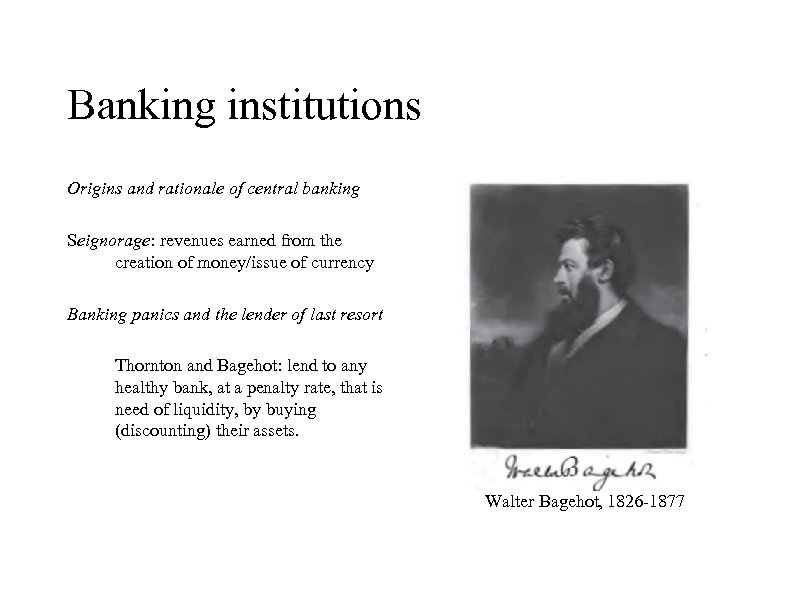 Banking institutions Origins and rationale of central banking Seignorage: revenues earned from the creation of money/issue of currency Banking panics and the lender of last resort Thornton and Bagehot: lend to any healthy bank, at a penalty rate, that is need of liquidity, by buying (discounting) their assets. Walter Bagehot, 1826 -1877
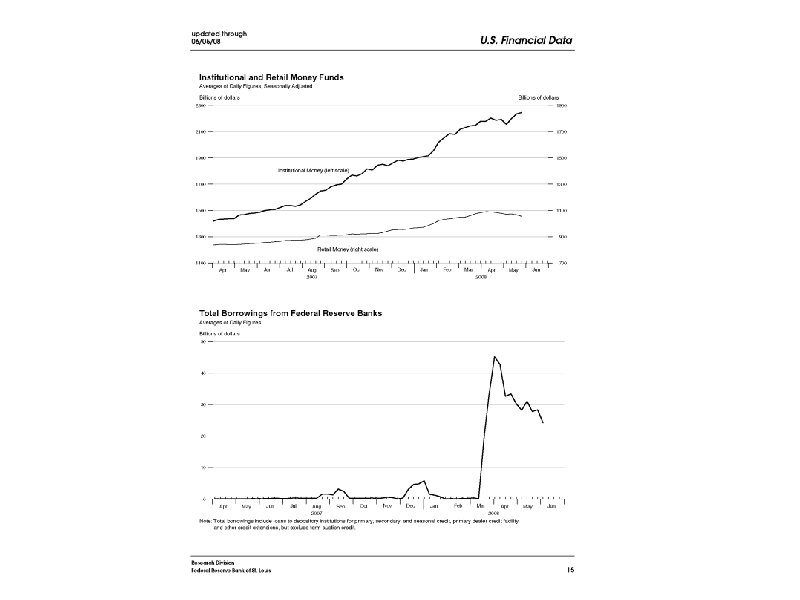
 Banking institutions Other ways to prevent banking panics 1) Deposit insurance 2) Branch banking 3) Temporary suspension of convertibility 4) Clearinghouses Free Banking versus Goodhart Bear-Stearns, 2008
 Banking institutions The Bank of England Monetary background April 25, 1694: Chartered as private bank to buy public debt 1697: Monopoly of chartered banking and limited liability 1708: Allowable capital doubled, and note issue was prohibited to any bank (except the Bank of England) with more than six partners 1797: War-time suspension of convertibility 1797 -1821: Inflation; ‘discovery’ of monetary policy 1821: Resumption to gold (after much to do…) 1826: Joint-stock banks (non-partnerships) 65 miles away from London were allowed note issue to provide some financial stability outside London.
 Banking institutions The Bank of England 1833: Bank of England notes made legal tender 1844: Bank Charter Act split Bo. E into Issue and Banking departments. Bo. E ‘becomes a central bank. ’ Private (profit-maximizing) bank until nationalization in 1946. http: //www. bankofengland. co. uk/banknotes/denom_guide/index. htm
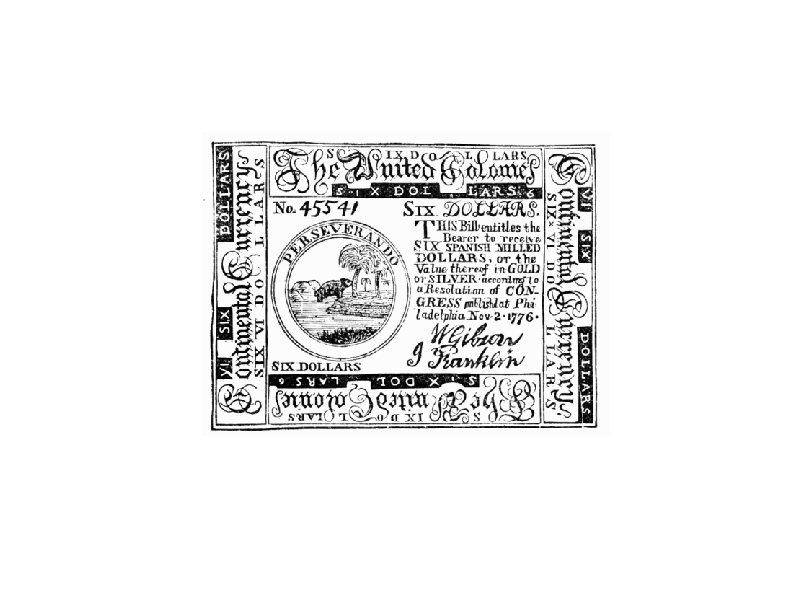
 The evolution of money and banking in the US The colonial and revolutionary war periods • • Colonial period monetary standards: bimetallic (gold and silver); pounds, shilling, pence Revolutionary War Finance and the ‘Continentals’ The first US Banks: The Pennsylvania Bank and the Bank of North America Constitutional money standards: “US dollar” equal to 371. 25 grains (0. 7734 ounces) of pure silver or 24. 75 grains (0. 05156 ounces) of pure gold, free coinage (nominal silver price was $1. 29 per ounce and that of gold $19. 39 per ounce. ); mint ratio 15 to 1.
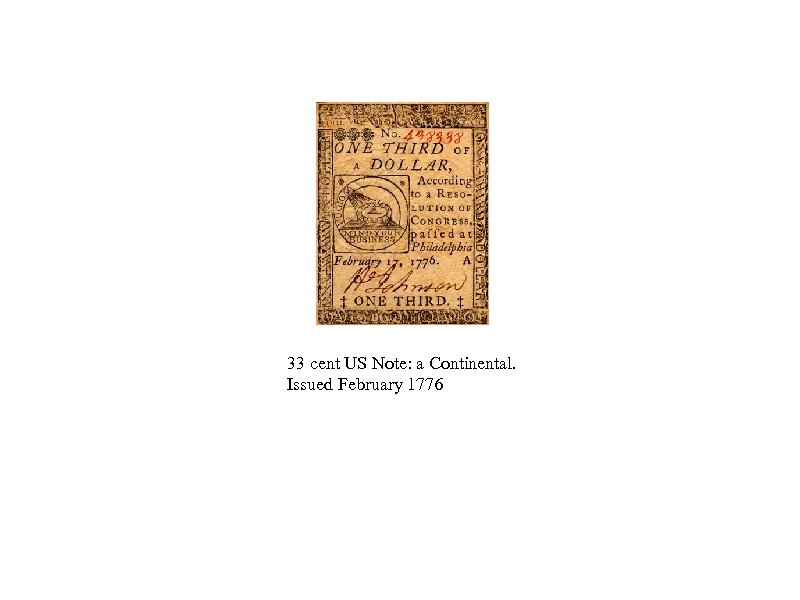 33 cent US Note: a Continental. Issued February 1776
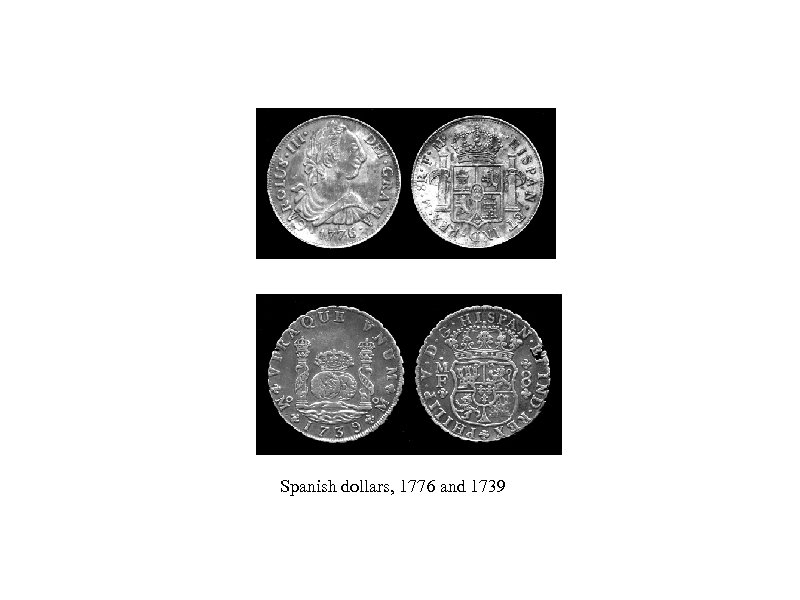 Spanish dollars, 1776 and 1739
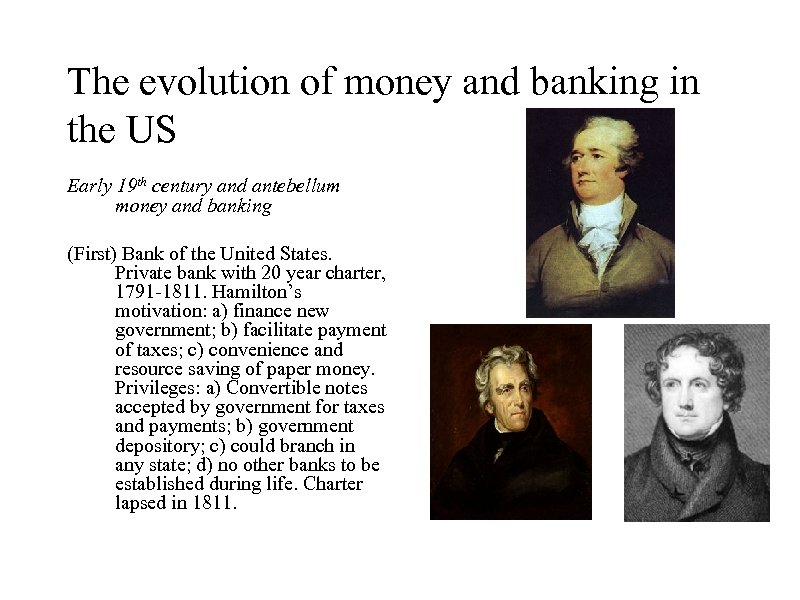 The evolution of money and banking in the US Early 19 th century and antebellum money and banking (First) Bank of the United States. Private bank with 20 year charter, 1791 -1811. Hamilton’s motivation: a) finance new government; b) facilitate payment of taxes; c) convenience and resource saving of paper money. Privileges: a) Convertible notes accepted by government for taxes and payments; b) government depository; c) could branch in any state; d) no other banks to be established during life. Charter lapsed in 1811.
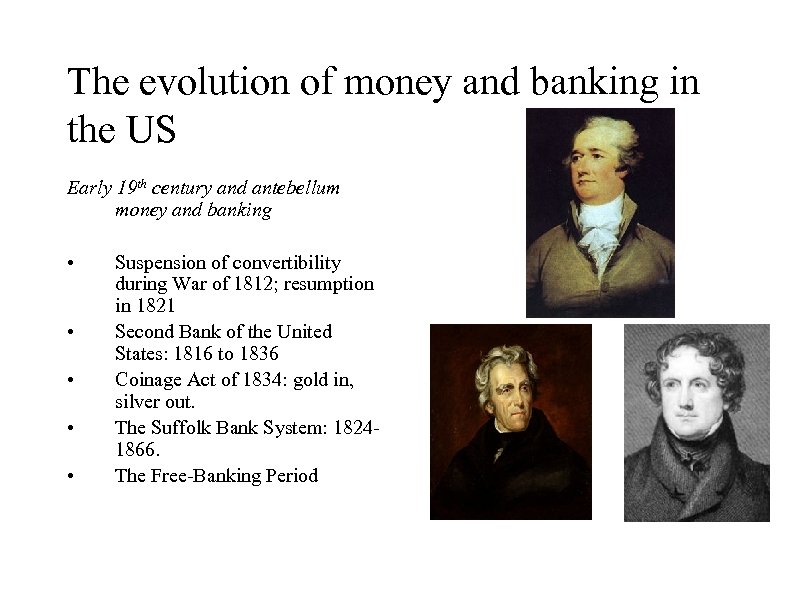 The evolution of money and banking in the US Early 19 th century and antebellum money and banking • • • Suspension of convertibility during War of 1812; resumption in 1821 Second Bank of the United States: 1816 to 1836 Coinage Act of 1834: gold in, silver out. The Suffolk Bank System: 18241866. The Free-Banking Period
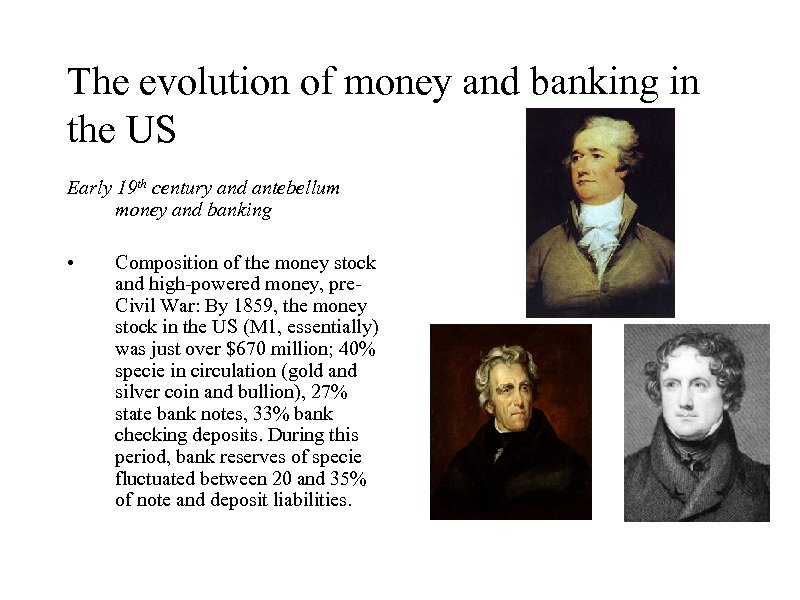 The evolution of money and banking in the US Early 19 th century and antebellum money and banking • Composition of the money stock and high-powered money, pre. Civil War: By 1859, the money stock in the US (M 1, essentially) was just over $670 million; 40% specie in circulation (gold and silver coin and bullion), 27% state bank notes, 33% bank checking deposits. During this period, bank reserves of specie fluctuated between 20 and 35% of note and deposit liabilities.
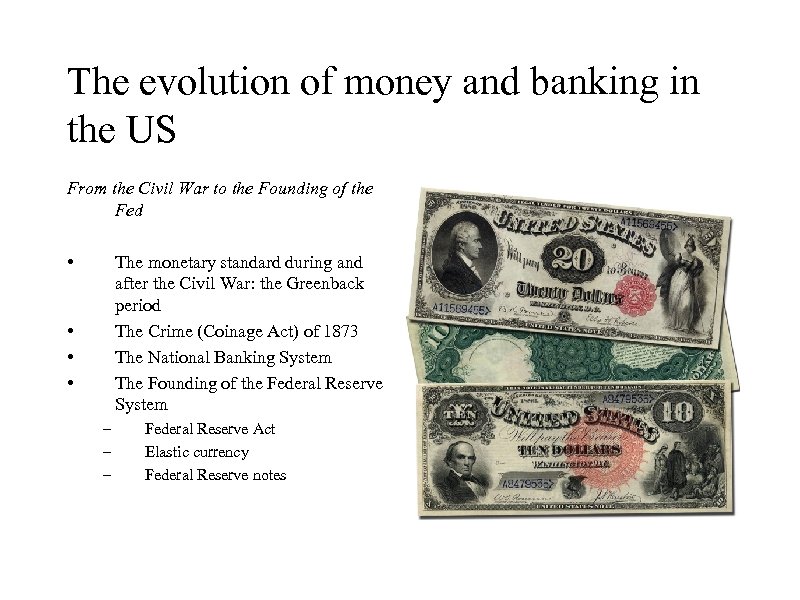 The evolution of money and banking in the US From the Civil War to the Founding of the Fed • The monetary standard during and after the Civil War: the Greenback period The Crime (Coinage Act) of 1873 The National Banking System The Founding of the Federal Reserve System • • • – – – Federal Reserve Act Elastic currency Federal Reserve notes
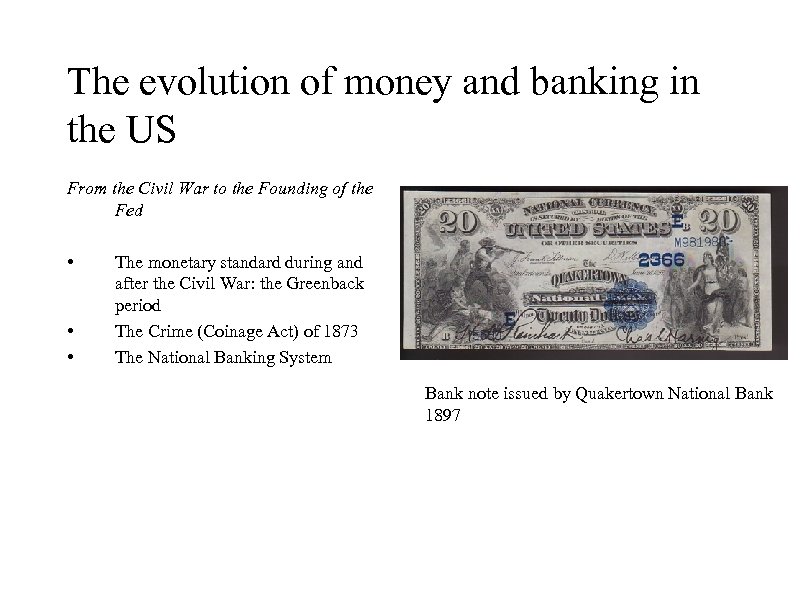 The evolution of money and banking in the US From the Civil War to the Founding of the Fed • • • The monetary standard during and after the Civil War: the Greenback period The Crime (Coinage Act) of 1873 The National Banking System Bank note issued by Quakertown National Bank 1897
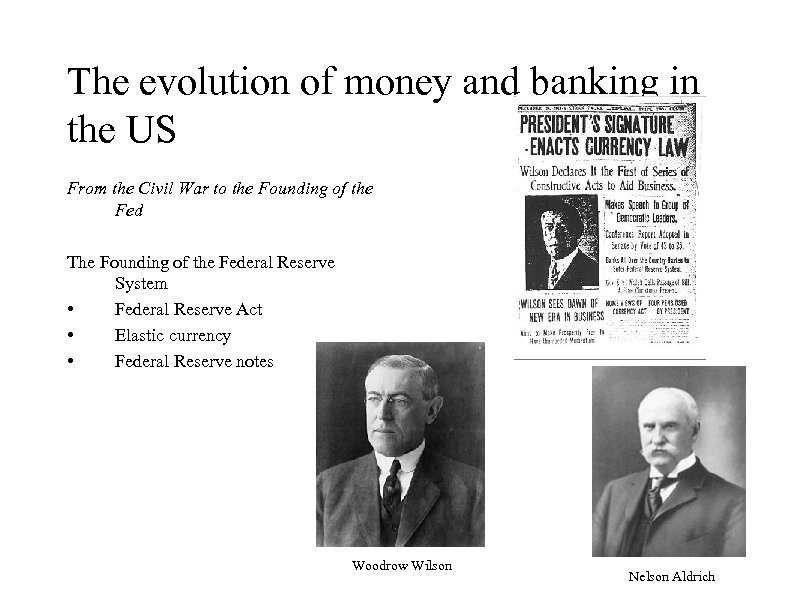 The evolution of money and banking in the US From the Civil War to the Founding of the Fed The Founding of the Federal Reserve System • Federal Reserve Act • Elastic currency • Federal Reserve notes Woodrow Wilson Nelson Aldrich
 The evolution of money and banking in the US World War I and beyond • • • Gold standard during WWI The Great Depression Banking Holiday reforms The Bretton Woods system… …and its collapse
 The Financial System Overview of the financial system Intertemporal exchange – trading current consumption for future consumption; i. e. lending and borrowing Services provided by the financial system 1. Reducing transactions costs. 2. Risk-sharing: intertemporal exchange entails uncertainty since it deals with time and the future. The financial system provides a way for lenders especially to manage risk, primarily through diversification and the ability to trade risk. 3. Liquidity: the ability to quickly convert wealth to money. 4. Information provision: financial transactions are fraught with asymmetric (private) information – borrowers and lenders have different information about how funds will be used. The financial system can help alleviate the costs of asymmetric information.
 The Financial System Overview of the financial system Financial markets • Securities • Primary vs secondary • Debt vs equity Financial Intermediation and asymmetric information • Adverse selection • Moral hazard
 The Financial System Understanding interest rates Interest rates are prices determined in financial markets that measure the trade-offs of intertemporal exchange; rate of increase in wealth (future consumption) that lenders get for sacrificing current consumption, and the rate of borrower’s decline in wealth (future consumption) to get current consumption. A bond or debt security is a contract characterized by 1) price; 2) payoff; and 3) the timing of the payoff/payments (maturity).
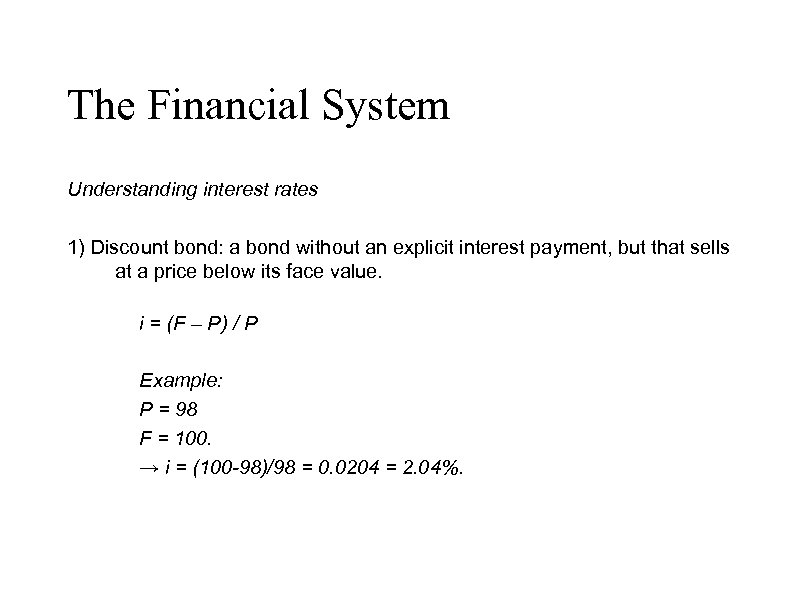 The Financial System Understanding interest rates 1) Discount bond: a bond without an explicit interest payment, but that sells at a price below its face value. i = (F – P) / P Example: P = 98 F = 100. → i = (100 -98)/98 = 0. 0204 = 2. 04%.
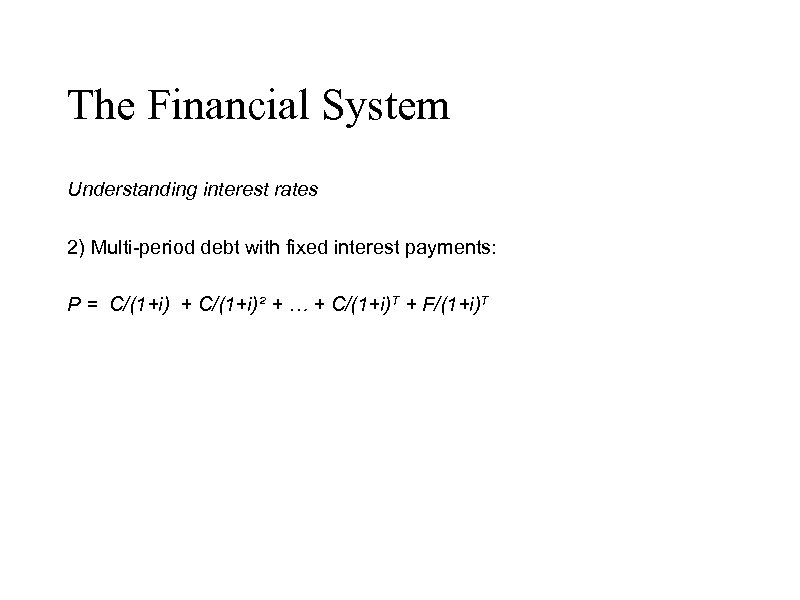 The Financial System Understanding interest rates 2) Multi-period debt with fixed interest payments: P = C/(1+i) + C/(1+i)² + … + C/(1+i)T + F/(1+i)T
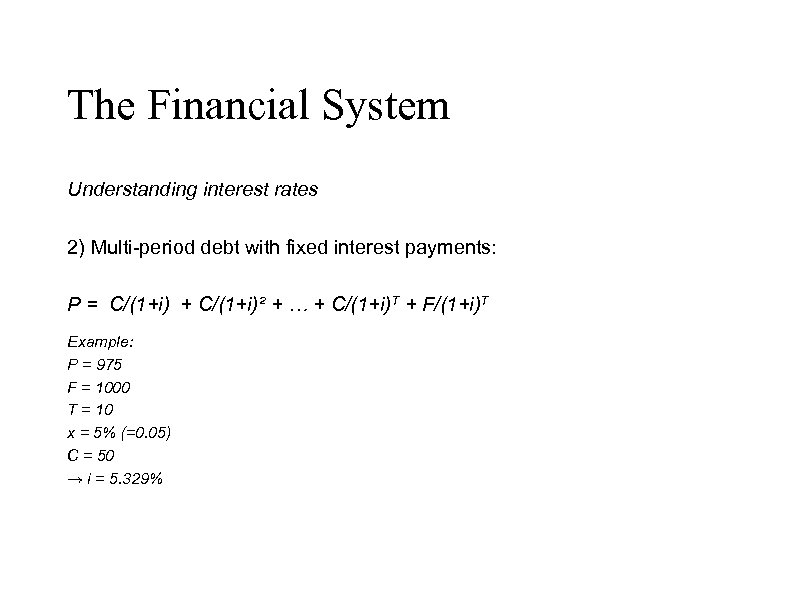 The Financial System Understanding interest rates 2) Multi-period debt with fixed interest payments: P = C/(1+i) + C/(1+i)² + … + C/(1+i)T + F/(1+i)T Example: P = 975 F = 1000 T = 10 x = 5% (=0. 05) C = 50 → i = 5. 329%
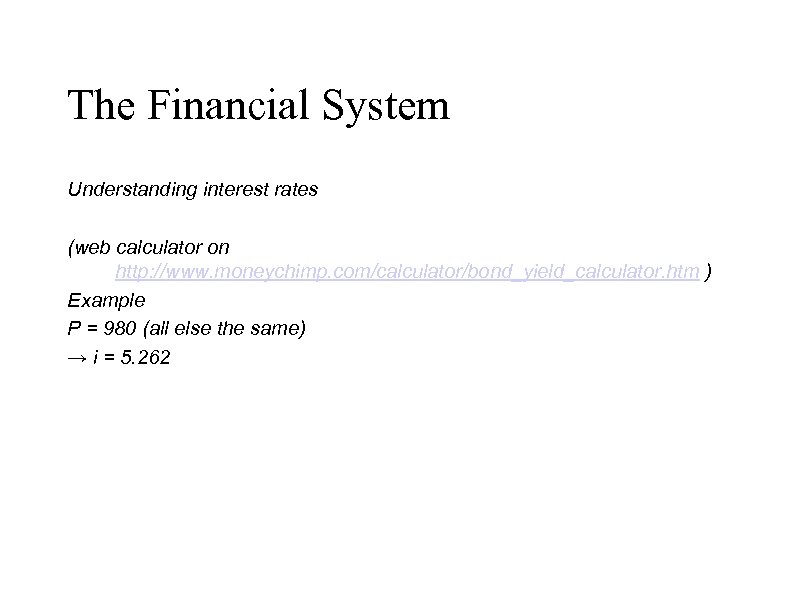 The Financial System Understanding interest rates (web calculator on http: //www. moneychimp. com/calculator/bond_yield_calculator. htm ) Example P = 980 (all else the same) → i = 5. 262
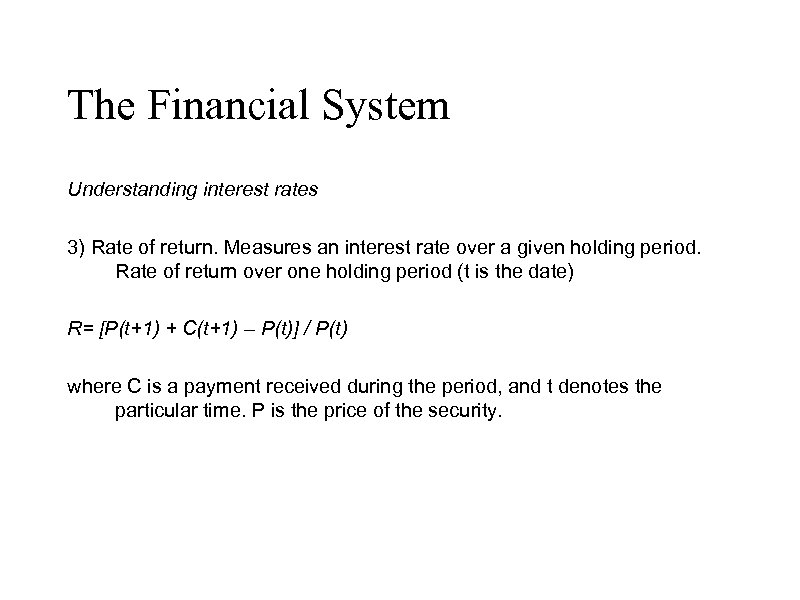 The Financial System Understanding interest rates 3) Rate of return. Measures an interest rate over a given holding period. Rate of return over one holding period (t is the date) R= [P(t+1) + C(t+1) – P(t)] / P(t) where C is a payment received during the period, and t denotes the particular time. P is the price of the security.
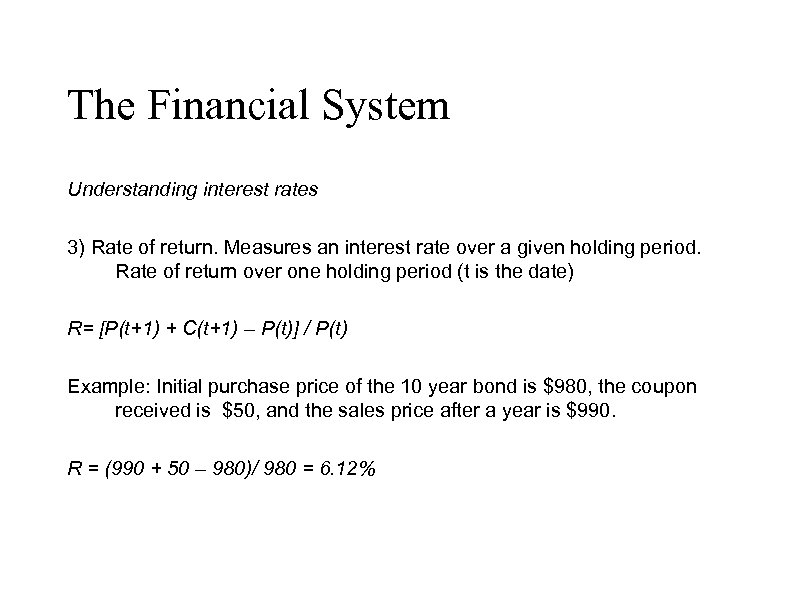 The Financial System Understanding interest rates 3) Rate of return. Measures an interest rate over a given holding period. Rate of return over one holding period (t is the date) R= [P(t+1) + C(t+1) – P(t)] / P(t) Example: Initial purchase price of the 10 year bond is $980, the coupon received is $50, and the sales price after a year is $990. R = (990 + 50 – 980)/ 980 = 6. 12%
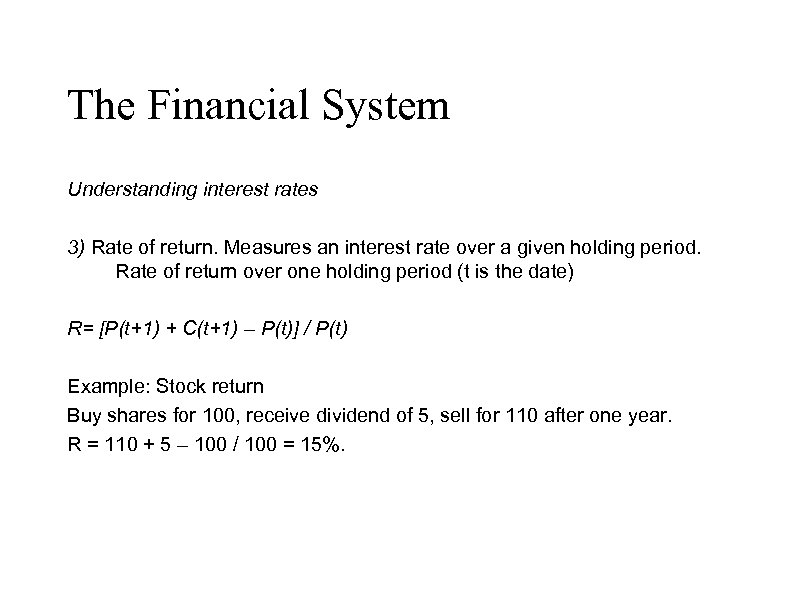 The Financial System Understanding interest rates 3) Rate of return. Measures an interest rate over a given holding period. Rate of return over one holding period (t is the date) R= [P(t+1) + C(t+1) – P(t)] / P(t) Example: Stock return Buy shares for 100, receive dividend of 5, sell for 110 after one year. R = 110 + 5 – 100 / 100 = 15%.
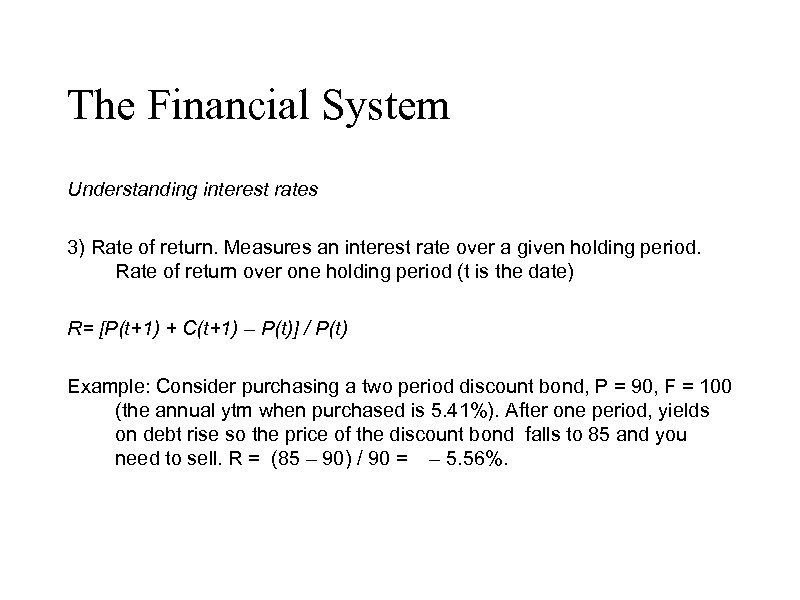 The Financial System Understanding interest rates 3) Rate of return. Measures an interest rate over a given holding period. Rate of return over one holding period (t is the date) R= [P(t+1) + C(t+1) – P(t)] / P(t) Example: Consider purchasing a two period discount bond, P = 90, F = 100 (the annual ytm when purchased is 5. 41%). After one period, yields on debt rise so the price of the discount bond falls to 85 and you need to sell. R = (85 – 90) / 90 = – 5. 56%.
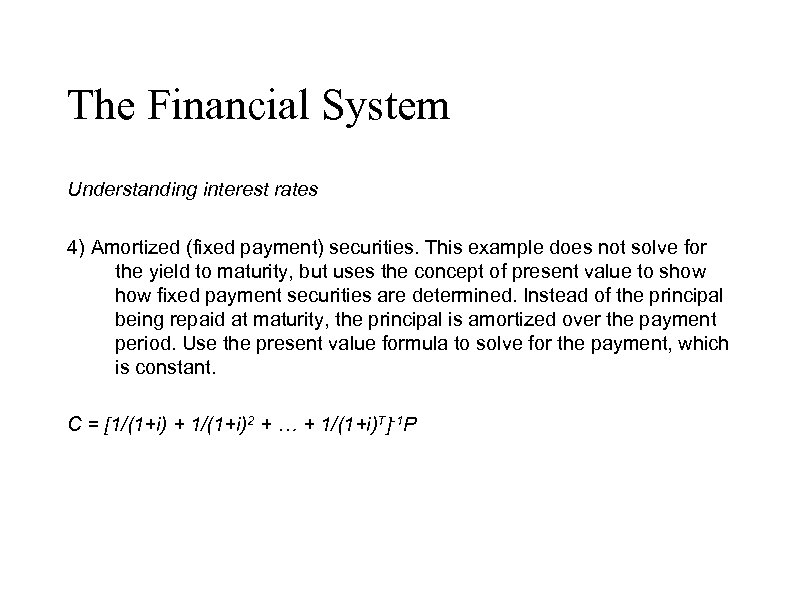 The Financial System Understanding interest rates 4) Amortized (fixed payment) securities. This example does not solve for the yield to maturity, but uses the concept of present value to show fixed payment securities are determined. Instead of the principal being repaid at maturity, the principal is amortized over the payment period. Use the present value formula to solve for the payment, which is constant. C = [1/(1+i) + 1/(1+i)2 + … + 1/(1+i)T]-1 P
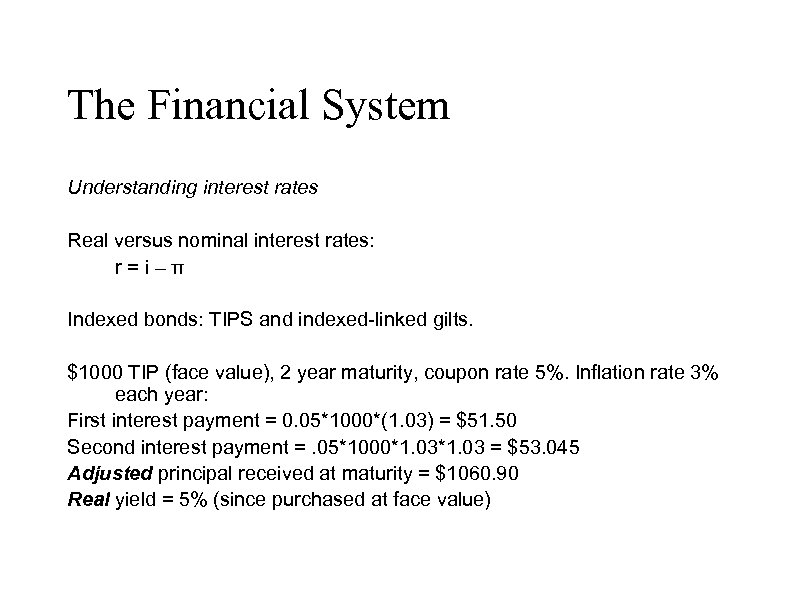 The Financial System Understanding interest rates Real versus nominal interest rates: r = i – π Indexed bonds: TIPS and indexed-linked gilts. $1000 TIP (face value), 2 year maturity, coupon rate 5%. Inflation rate 3% each year: First interest payment = 0. 05*1000*(1. 03) = $51. 50 Second interest payment =. 05*1000*1. 03 = $53. 045 Adjusted principal received at maturity = $1060. 90 Real yield = 5% (since purchased at face value)
 The Financial System Understanding interest rates Determining interest rates: the loanable funds model
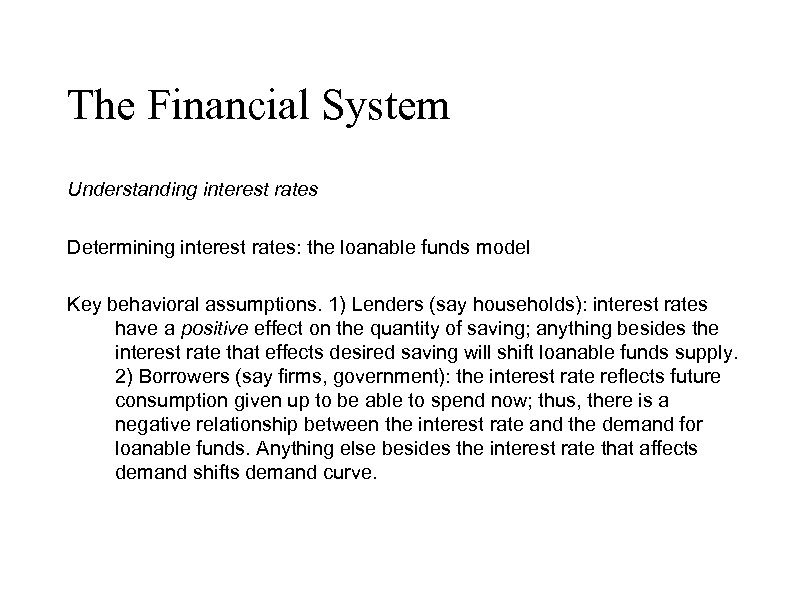 The Financial System Understanding interest rates Determining interest rates: the loanable funds model Key behavioral assumptions. 1) Lenders (say households): interest rates have a positive effect on the quantity of saving; anything besides the interest rate that effects desired saving will shift loanable funds supply. 2) Borrowers (say firms, government): the interest rate reflects future consumption given up to be able to spend now; thus, there is a negative relationship between the interest rate and the demand for loanable funds. Anything else besides the interest rate that affects demand shifts demand curve.
 The Financial System Understanding interest rates Determining interest rates: the loanable funds model Equilibrium: real interest rate such that supply of loanable funds equals demand for loanable funds.
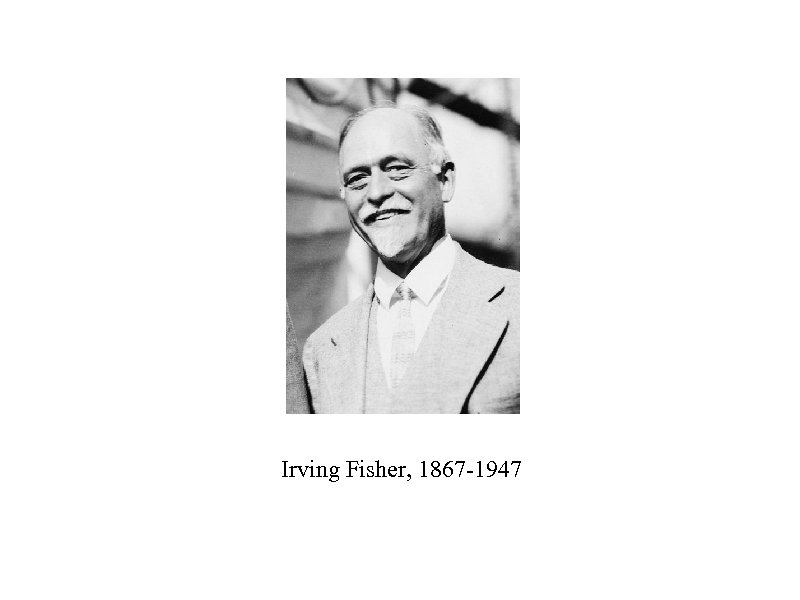
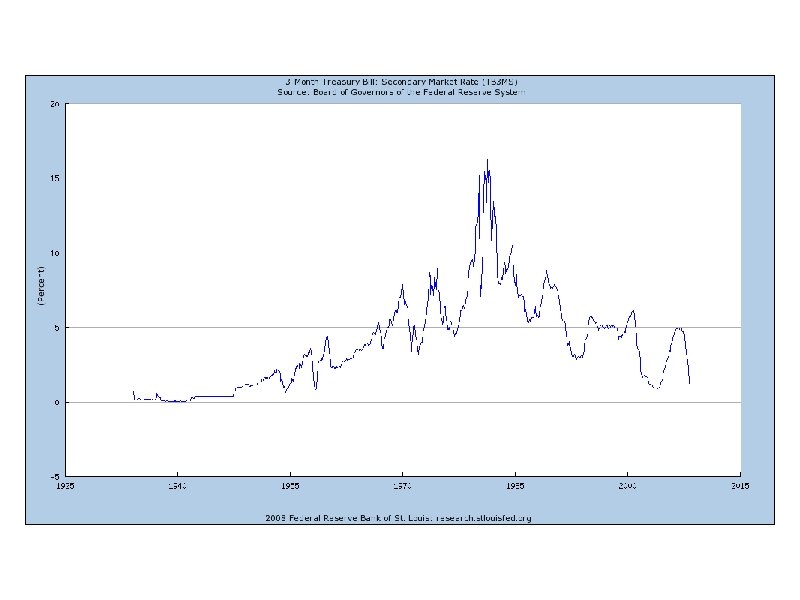
 The Financial System Understanding interest rates Determining interest rates: the loanable funds model Factors explaining fluctuations and spreads in interest rates: 1. Change in Default risk 2. Difference in default risk (risk premium) 3. Government deficits 4. Financial intermediation 5. Expected inflation (the Fisher effect)
 Irving Fisher, 1867 -1947
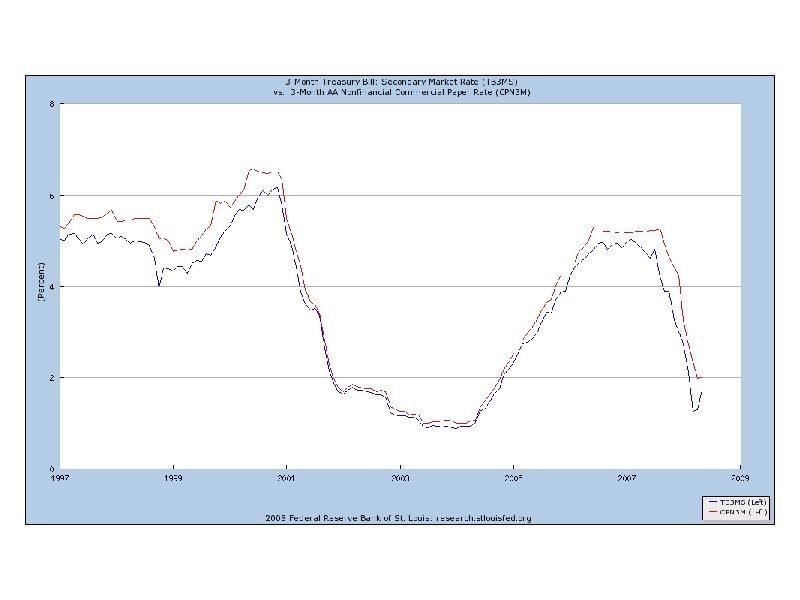
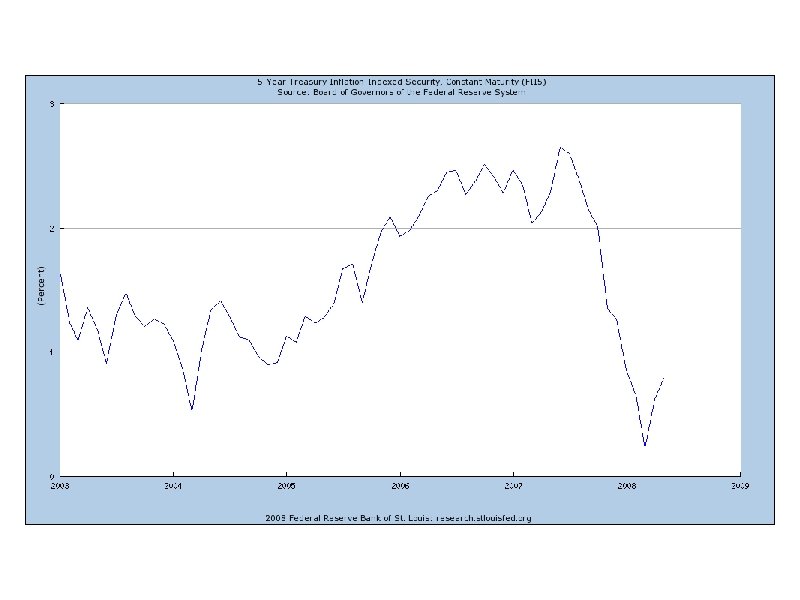
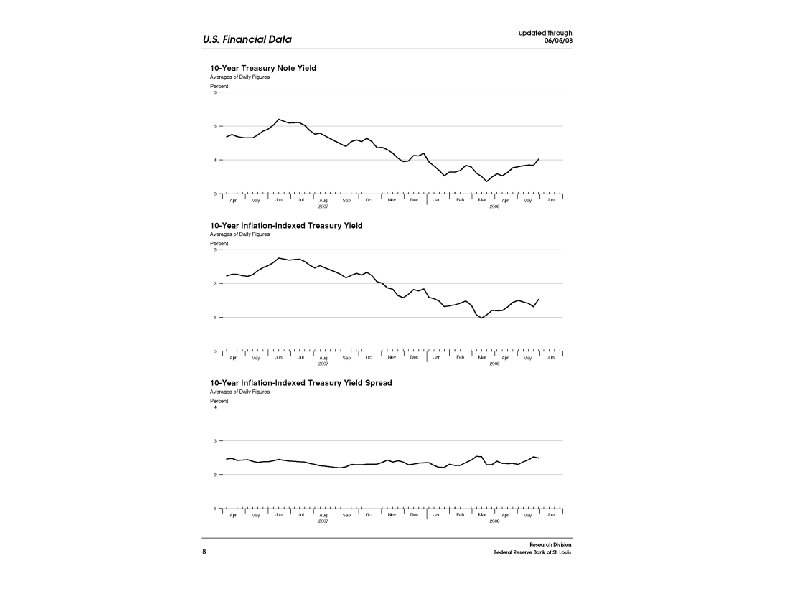
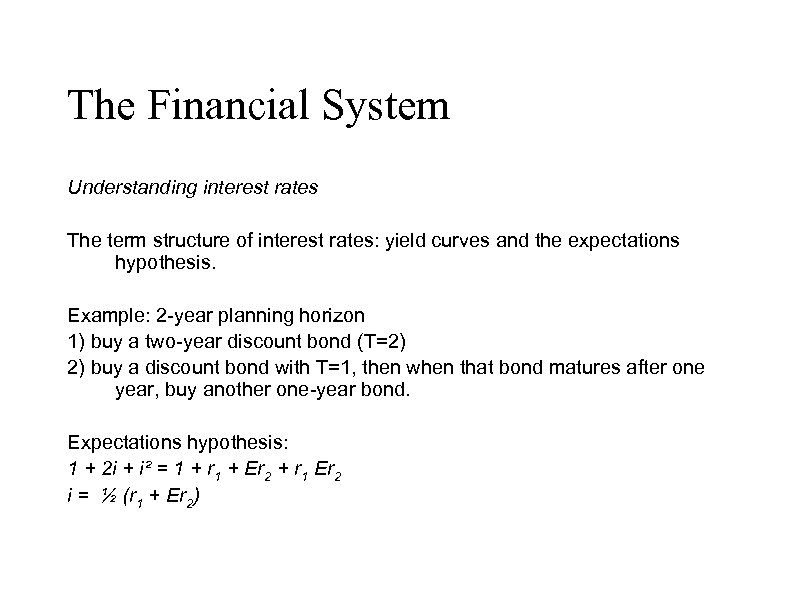 The Financial System Understanding interest rates The term structure of interest rates: yield curves and the expectations hypothesis. Example: 2 -year planning horizon 1) buy a two-year discount bond (T=2) 2) buy a discount bond with T=1, then when that bond matures after one year, buy another one-year bond. Expectations hypothesis: 1 + 2 i + i² = 1 + r 1 + Er 2 + r 1 Er 2 i = ½ (r 1 + Er 2)
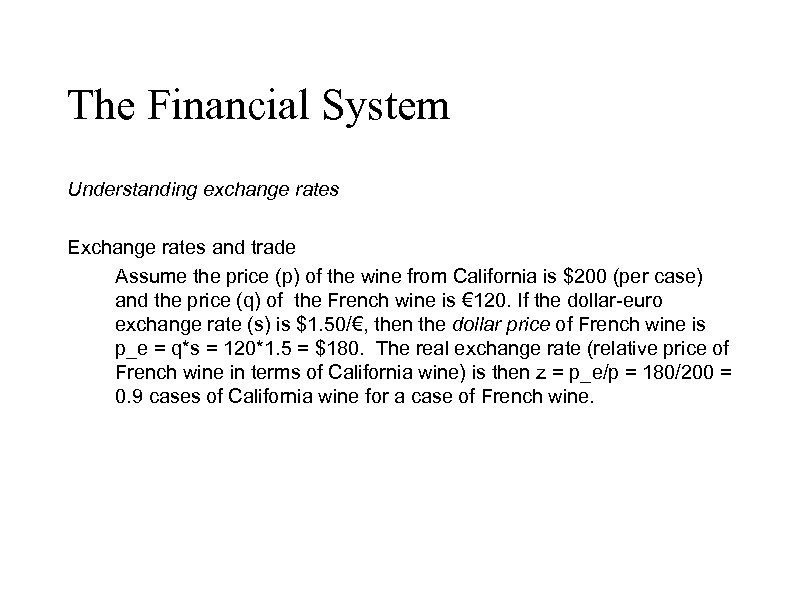 The Financial System Understanding exchange rates Exchange rates and trade Assume the price (p) of the wine from California is $200 (per case) and the price (q) of the French wine is € 120. If the dollar-euro exchange rate (s) is $1. 50/€, then the dollar price of French wine is p_e = q*s = 120*1. 5 = $180. The real exchange rate (relative price of French wine in terms of California wine) is then z = p_e/p = 180/200 = 0. 9 cases of California wine for a case of French wine.
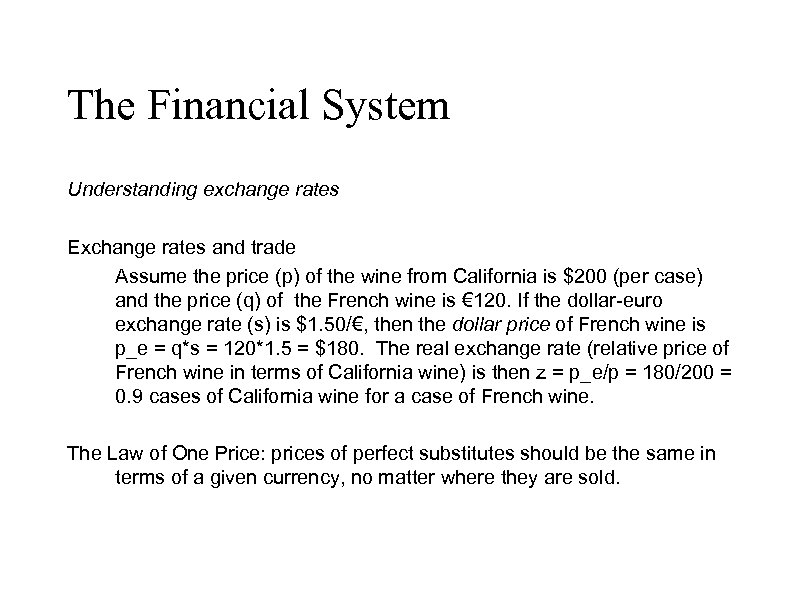 The Financial System Understanding exchange rates Exchange rates and trade Assume the price (p) of the wine from California is $200 (per case) and the price (q) of the French wine is € 120. If the dollar-euro exchange rate (s) is $1. 50/€, then the dollar price of French wine is p_e = q*s = 120*1. 5 = $180. The real exchange rate (relative price of French wine in terms of California wine) is then z = p_e/p = 180/200 = 0. 9 cases of California wine for a case of French wine. The Law of One Price: prices of perfect substitutes should be the same in terms of a given currency, no matter where they are sold.
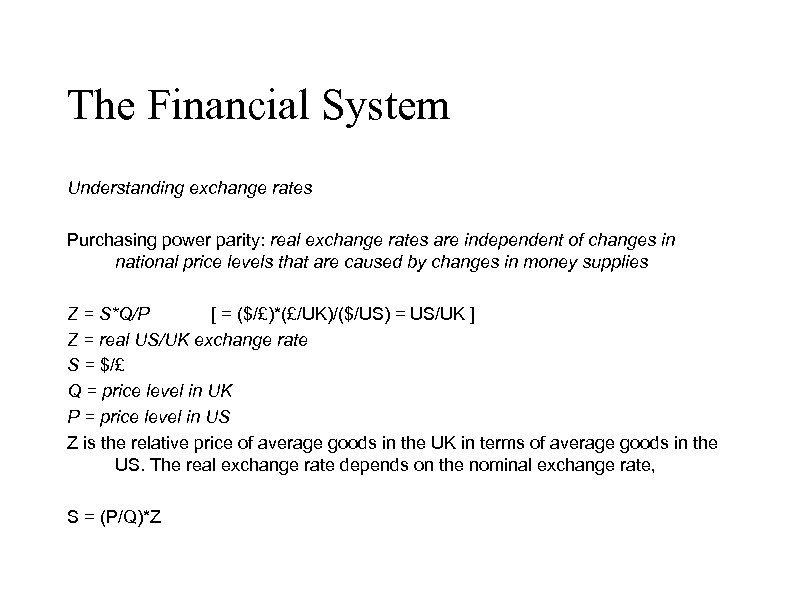 The Financial System Understanding exchange rates Purchasing power parity: real exchange rates are independent of changes in national price levels that are caused by changes in money supplies Z = S*Q/P [ = ($/£)*(£/UK)/($/US) = US/UK ] Z = real US/UK exchange rate S = $/£ Q = price level in UK P = price level in US Z is the relative price of average goods in the UK in terms of average goods in the US. The real exchange rate depends on the nominal exchange rate, S = (P/Q)*Z
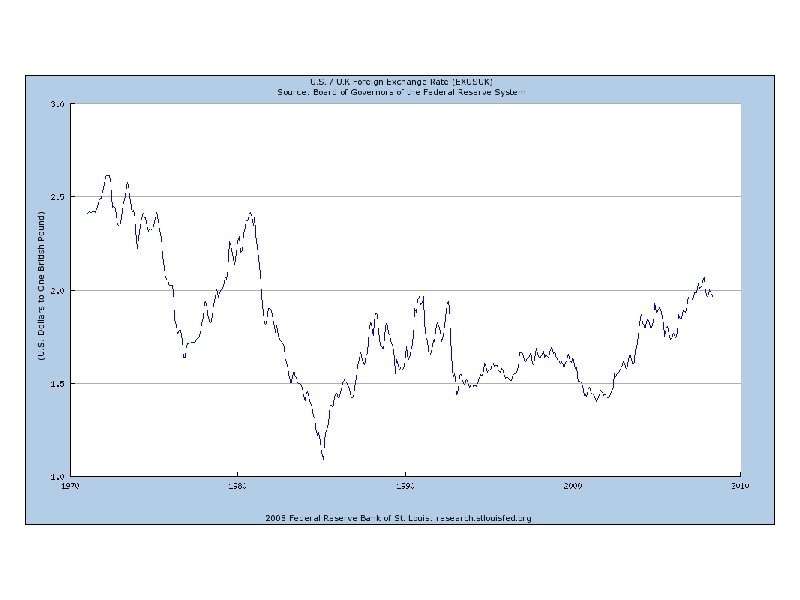
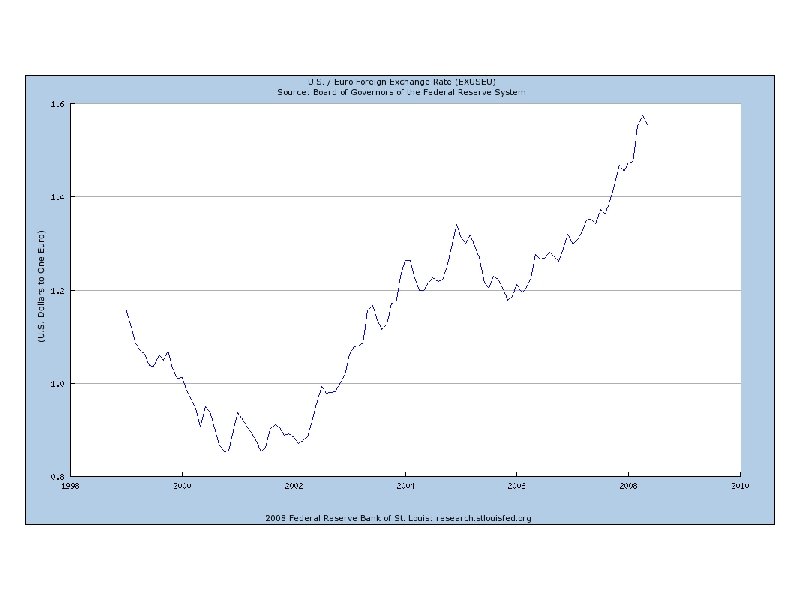
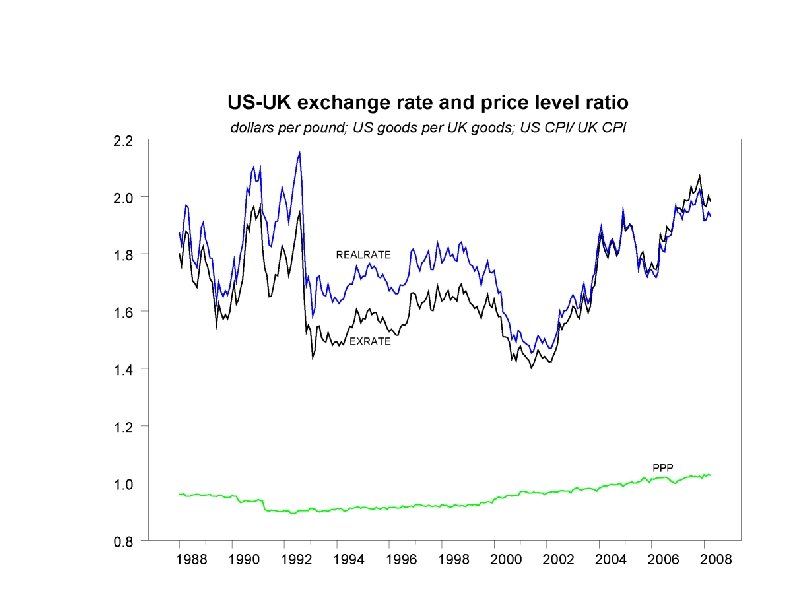
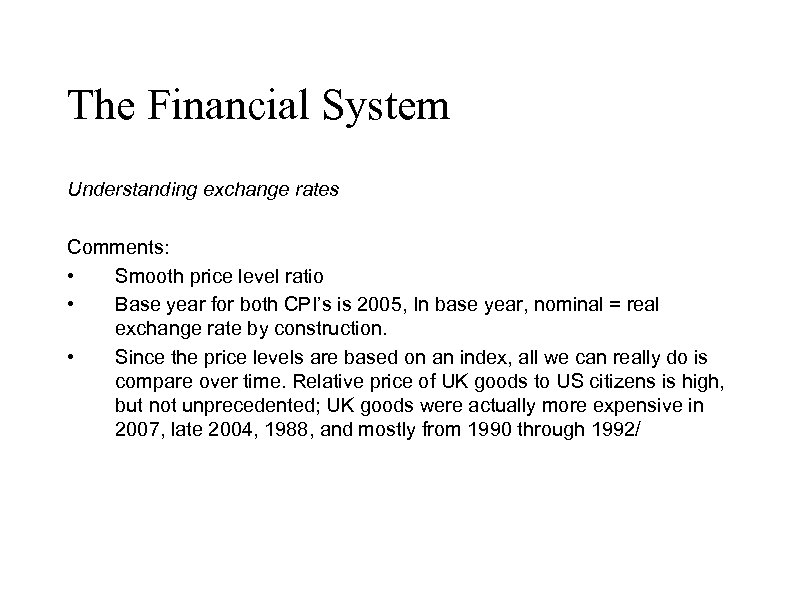 The Financial System Understanding exchange rates Comments: • Smooth price level ratio • Base year for both CPI’s is 2005, In base year, nominal = real exchange rate by construction. • Since the price levels are based on an index, all we can really do is compare over time. Relative price of UK goods to US citizens is high, but not unprecedented; UK goods were actually more expensive in 2007, late 2004, 1988, and mostly from 1990 through 1992/
 The Financial System Understanding exchange rates PPP measures of GDP Current GDP in the US: $14 trillion ($45, 000 per capita) Current GDP in the UK: £ 1. 5 trillion (£ 25, 000 per capita)
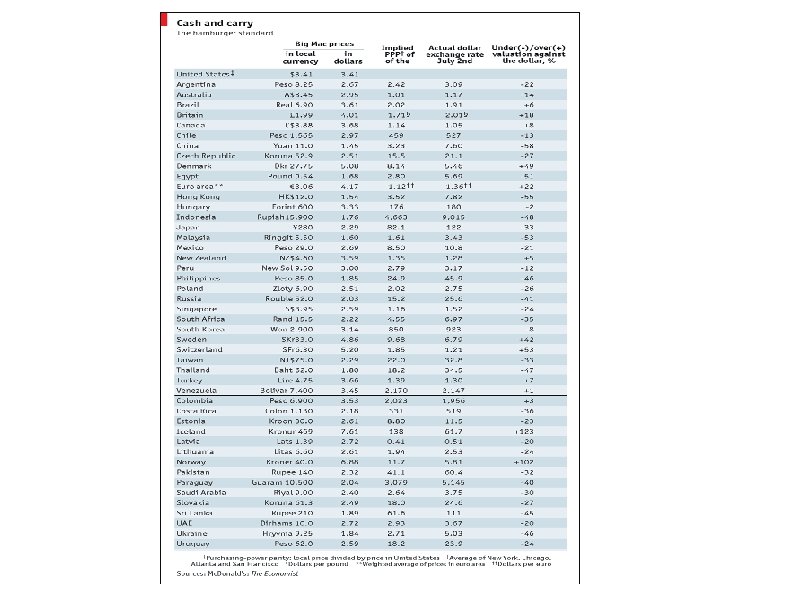
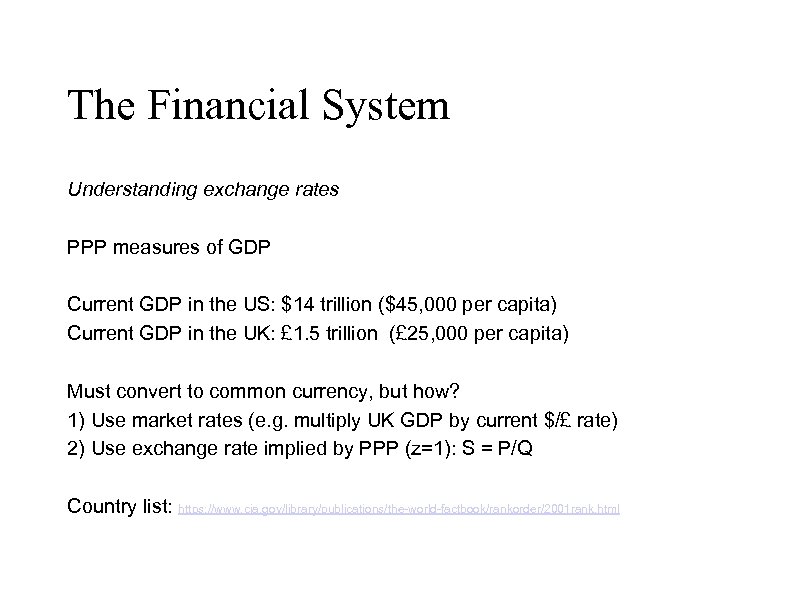 The Financial System Understanding exchange rates PPP measures of GDP Current GDP in the US: $14 trillion ($45, 000 per capita) Current GDP in the UK: £ 1. 5 trillion (£ 25, 000 per capita) Must convert to common currency, but how? 1) Use market rates (e. g. multiply UK GDP by current $/£ rate) 2) Use exchange rate implied by PPP (z=1): S = P/Q Country list: https: //www. cia. gov/library/publications/the-world-factbook/rankorder/2001 rank. html
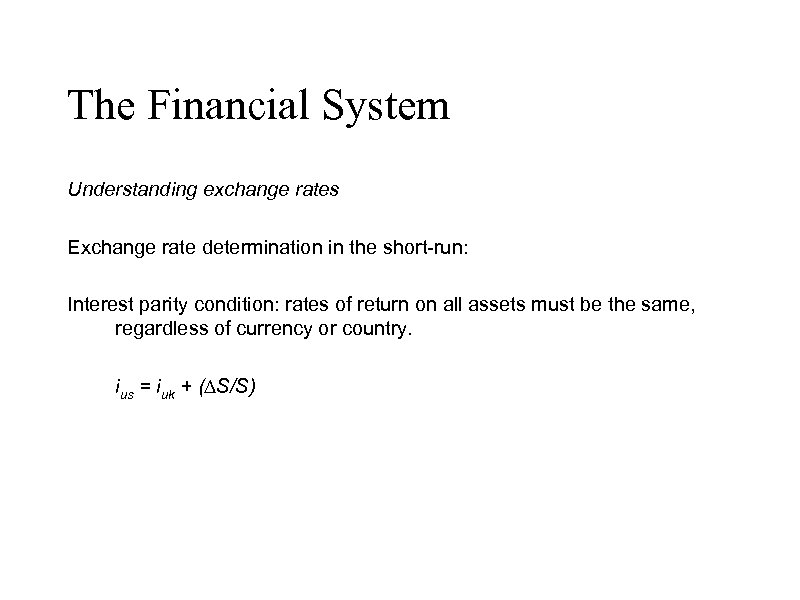 The Financial System Understanding exchange rates Exchange rate determination in the short-run: Interest parity condition: rates of return on all assets must be the same, regardless of currency or country. ius = iuk + (∆S/S)
 The Financial System Understanding exchange rates Exchange rate determination in the short-run: 1) Increase in US interest rates → pound depreciation/dollar appreciation 2) Increase in the expected appreciation of the pound → pound will appreciate immediately