


 Скачать презентацию The Economics and Neuroeconomics of Instant Gratification Canadian
9578767723c91ebb0b19e1b679ec797a.ppt
- Количество слайдов: 60
 The Economics and Neuroeconomics of Instant Gratification Canadian Economic Association “State of the Art Lecture” David Laibson Harvard University and NBER May 30, 2009 University of Toronto
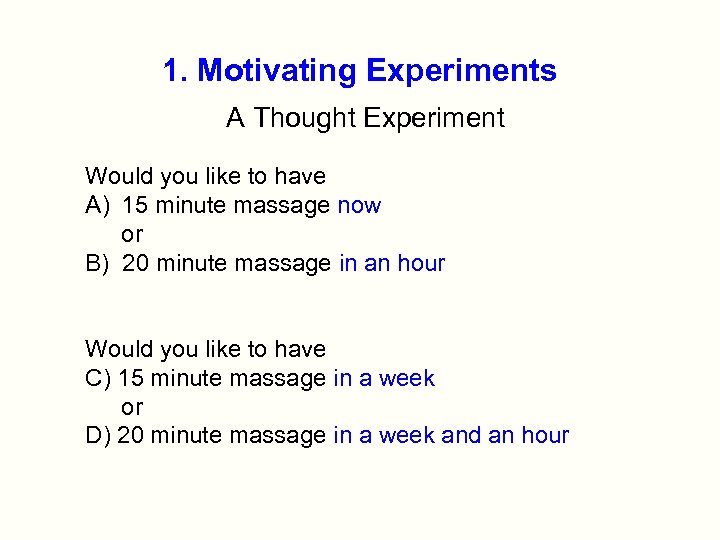 1. Motivating Experiments A Thought Experiment Would you like to have A) 15 minute massage now or B) 20 minute massage in an hour Would you like to have C) 15 minute massage in a week or D) 20 minute massage in a week and an hour
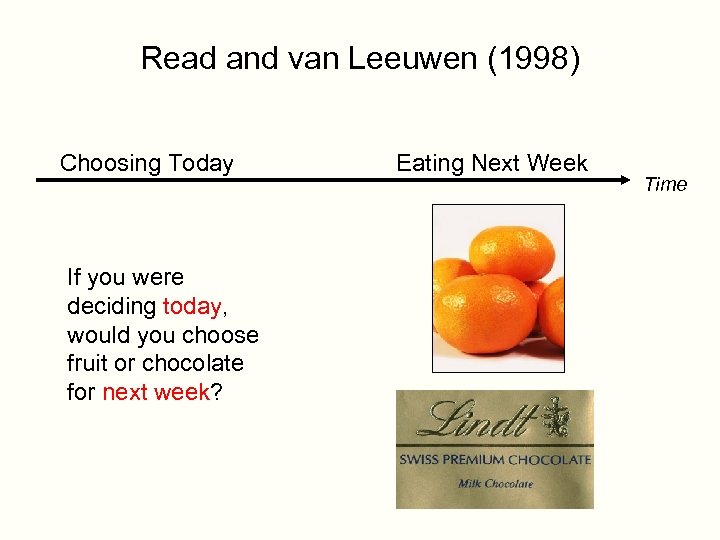 Read and van Leeuwen (1998) Choosing Today If you were deciding today, would you choose fruit or chocolate for next week? Eating Next Week Time
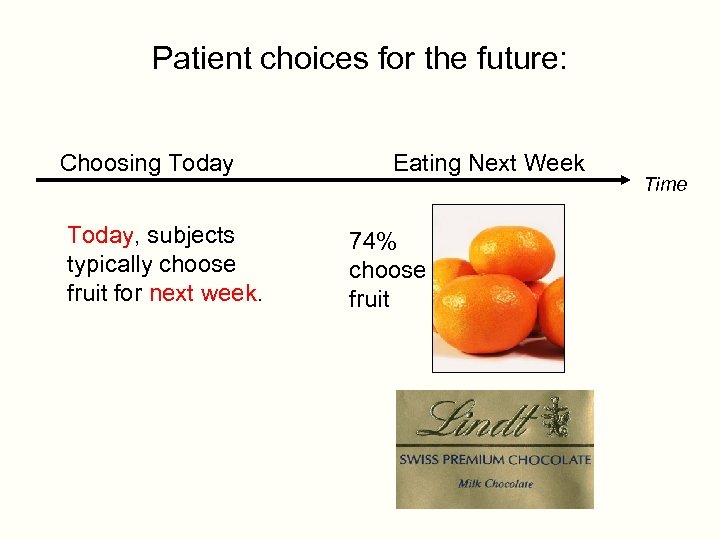 Patient choices for the future: Choosing Today, subjects typically choose fruit for next week. Eating Next Week 74% choose fruit Time
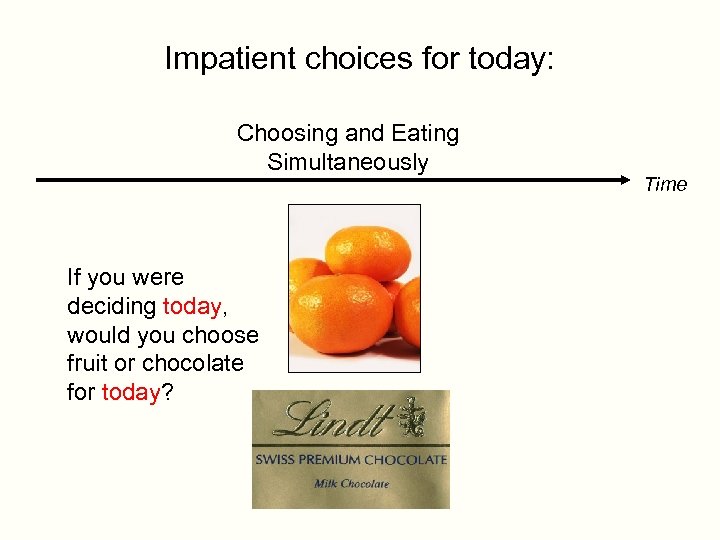 Impatient choices for today: Choosing and Eating Simultaneously If you were deciding today, would you choose fruit or chocolate for today? Time
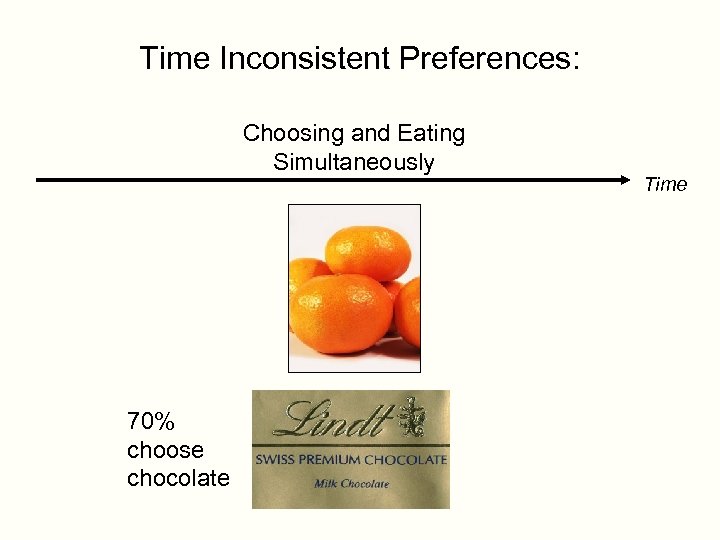 Time Inconsistent Preferences: Choosing and Eating Simultaneously 70% choose chocolate Time
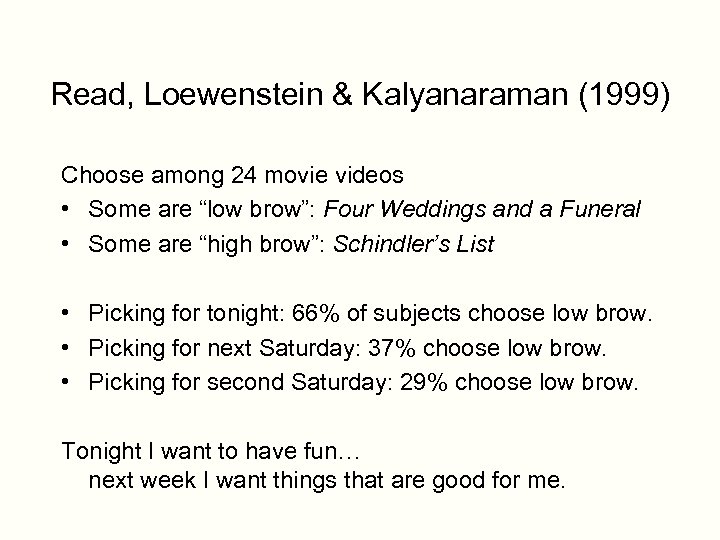 Read, Loewenstein & Kalyanaraman (1999) Choose among 24 movie videos • Some are “low brow”: Four Weddings and a Funeral • Some are “high brow”: Schindler’s List • Picking for tonight: 66% of subjects choose low brow. • Picking for next Saturday: 37% choose low brow. • Picking for second Saturday: 29% choose low brow. Tonight I want to have fun… next week I want things that are good for me.
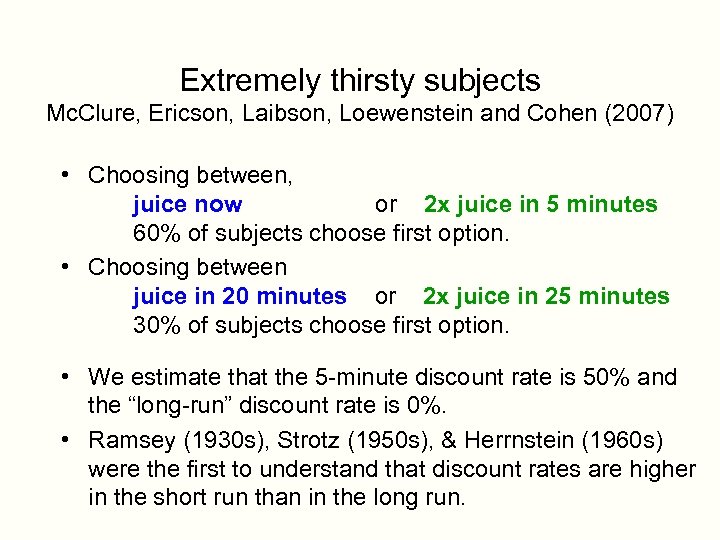 Extremely thirsty subjects Mc. Clure, Ericson, Laibson, Loewenstein and Cohen (2007) • Choosing between, juice now or 2 x juice in 5 minutes 60% of subjects choose first option. • Choosing between juice in 20 minutes or 2 x juice in 25 minutes 30% of subjects choose first option. • We estimate that the 5 -minute discount rate is 50% and the “long-run” discount rate is 0%. • Ramsey (1930 s), Strotz (1950 s), & Herrnstein (1960 s) were the first to understand that discount rates are higher in the short run than in the long run.
 Outline 1. 2. 3. 4. 5. 6. Motivating experimental evidence Theoretical framework Field evidence Neuroscience foundations Neuroimaging evidence Policy analysis
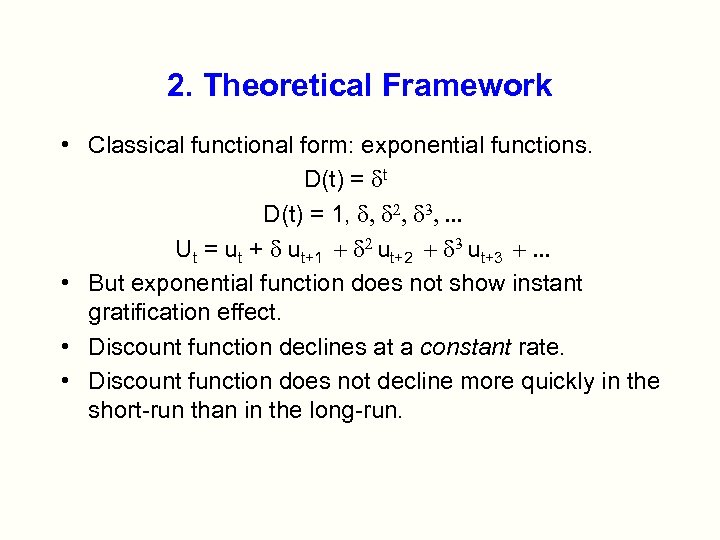 2. Theoretical Framework • Classical functional form: exponential functions. D(t) = dt D(t) = 1, d, d 2, d 3, . . . Ut = ut + d ut+1 + d 2 ut+2 + d 3 ut+3 +. . . • But exponential function does not show instant gratification effect. • Discount function declines at a constant rate. • Discount function does not decline more quickly in the short-run than in the long-run.
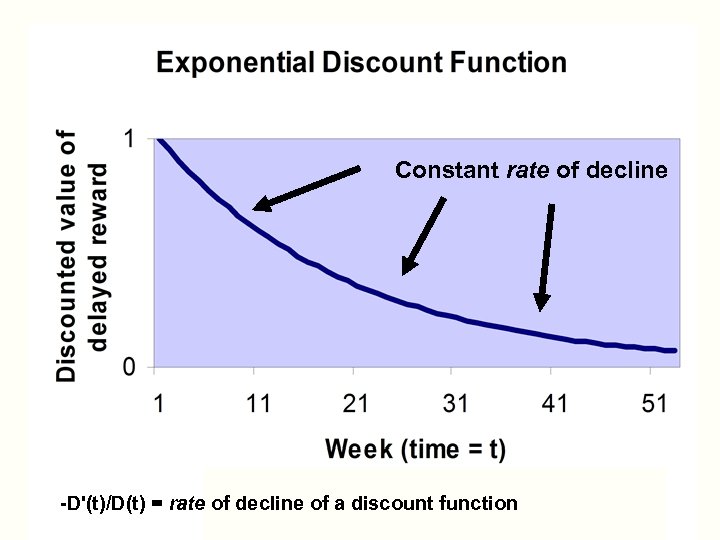 Constant rate of decline -D'(t)/D(t) = rate of decline of a discount function
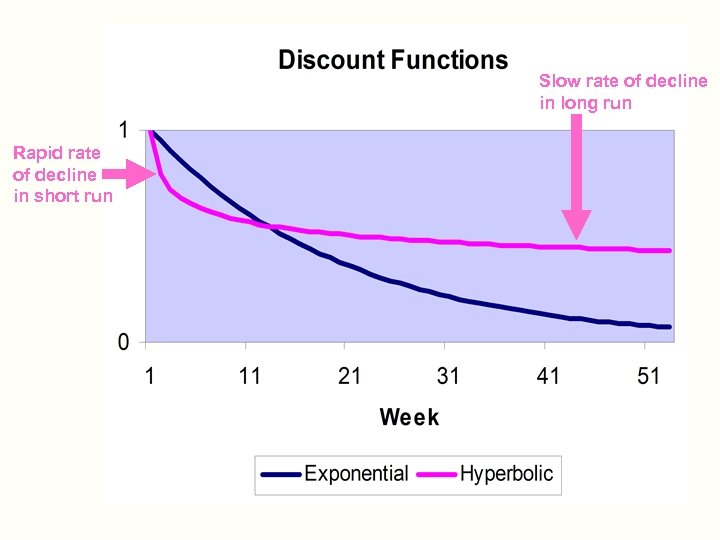 Slow rate of decline in long run Rapid rate of decline in short run
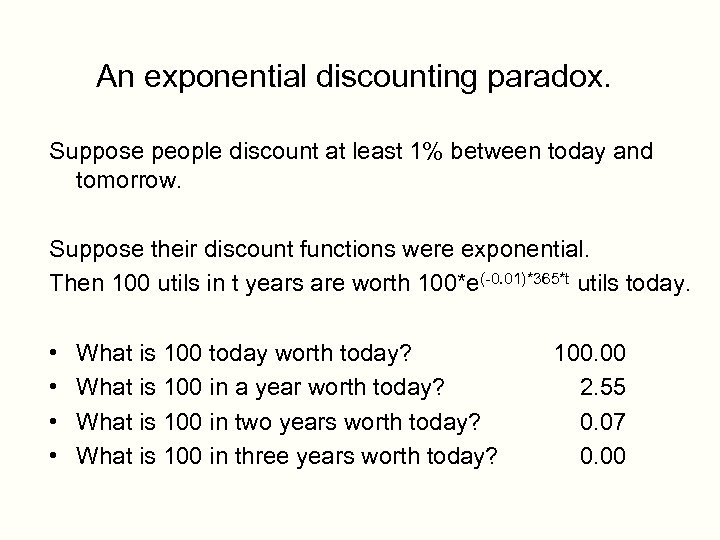 An exponential discounting paradox. Suppose people discount at least 1% between today and tomorrow. Suppose their discount functions were exponential. Then 100 utils in t years are worth 100*e(-0. 01)*365*t utils today. • • What is 100 today worth today? What is 100 in a year worth today? What is 100 in two years worth today? What is 100 in three years worth today? 100. 00 2. 55 0. 07 0. 00
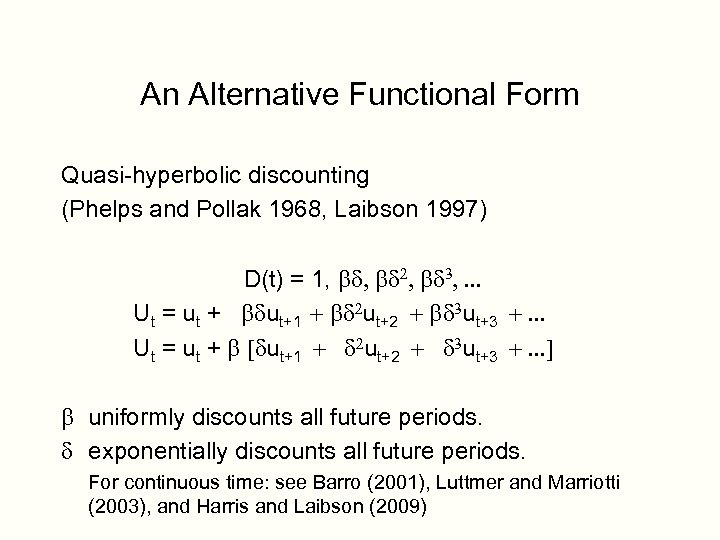 An Alternative Functional Form Quasi-hyperbolic discounting (Phelps and Pollak 1968, Laibson 1997) D(t) = 1, bd 2, bd 3, . . . Ut = ut + bdut+1 + bd 2 ut+2 + bd 3 ut+3 +. . . Ut = ut + b [dut+1 + d 2 ut+2 + d 3 ut+3 +. . . ] b uniformly discounts all future periods. d exponentially discounts all future periods. For continuous time: see Barro (2001), Luttmer and Marriotti (2003), and Harris and Laibson (2009)
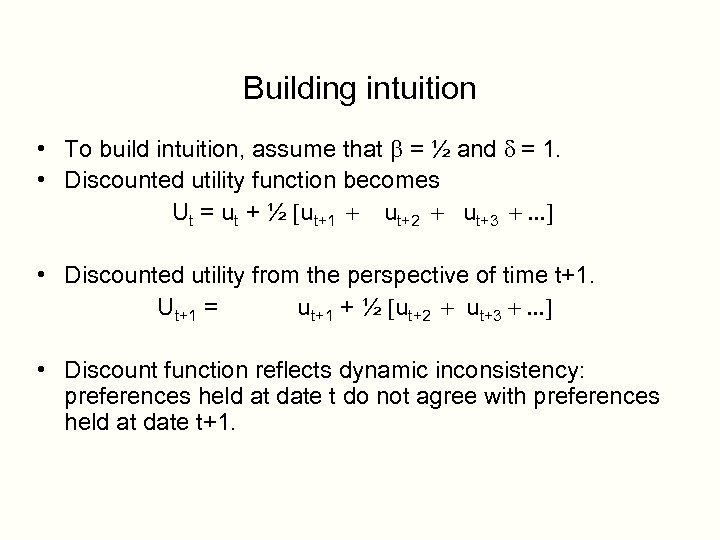 Building intuition • To build intuition, assume that b = ½ and d = 1. • Discounted utility function becomes Ut = ut + ½ [ut+1 + ut+2 + ut+3 +. . . ] • Discounted utility from the perspective of time t+1. Ut+1 = ut+1 + ½ [ut+2 + ut+3 +. . . ] • Discount function reflects dynamic inconsistency: preferences held at date t do not agree with preferences held at date t+1.
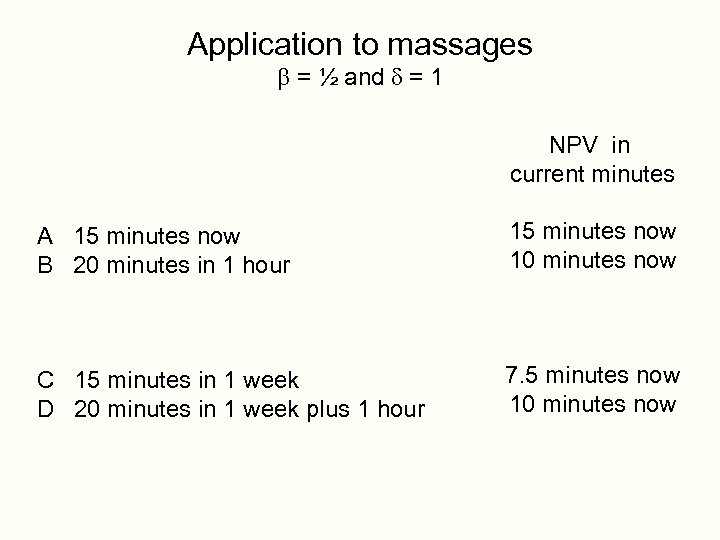 Application to massages b = ½ and d = 1 NPV in current minutes A 15 minutes now B 20 minutes in 1 hour 15 minutes now 10 minutes now C 15 minutes in 1 week D 20 minutes in 1 week plus 1 hour 7. 5 minutes now 10 minutes now
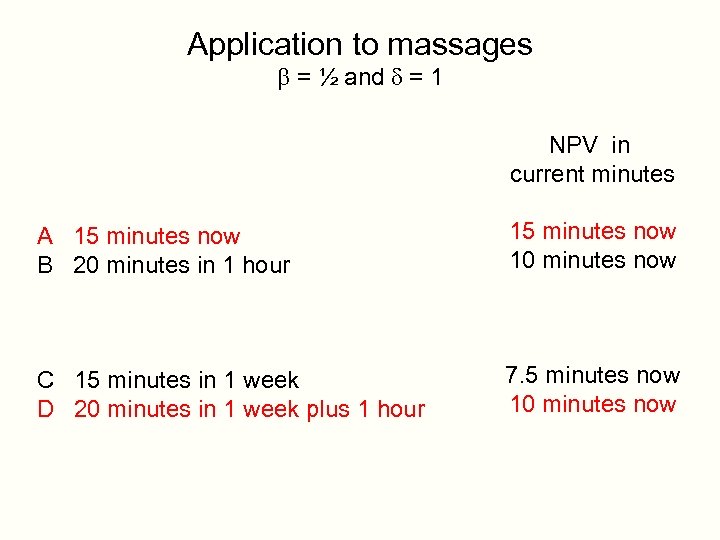 Application to massages b = ½ and d = 1 NPV in current minutes A 15 minutes now B 20 minutes in 1 hour 15 minutes now 10 minutes now C 15 minutes in 1 week D 20 minutes in 1 week plus 1 hour 7. 5 minutes now 10 minutes now
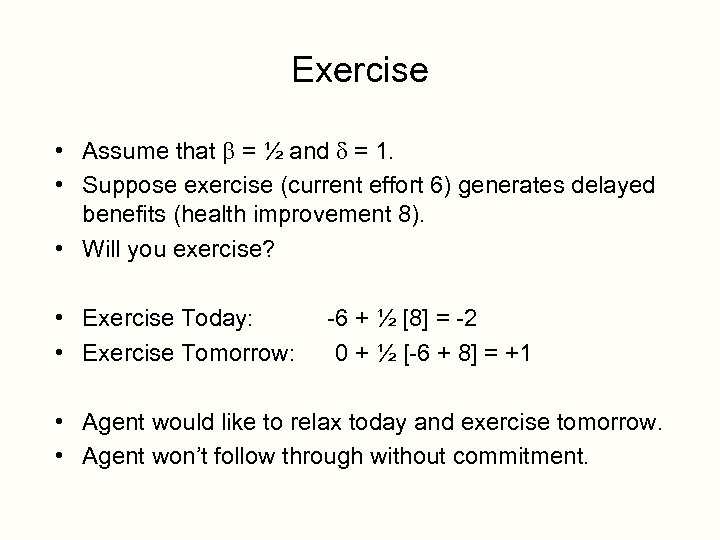 Exercise • Assume that b = ½ and d = 1. • Suppose exercise (current effort 6) generates delayed benefits (health improvement 8). • Will you exercise? • Exercise Today: • Exercise Tomorrow: -6 + ½ [8] = -2 0 + ½ [-6 + 8] = +1 • Agent would like to relax today and exercise tomorrow. • Agent won’t follow through without commitment.
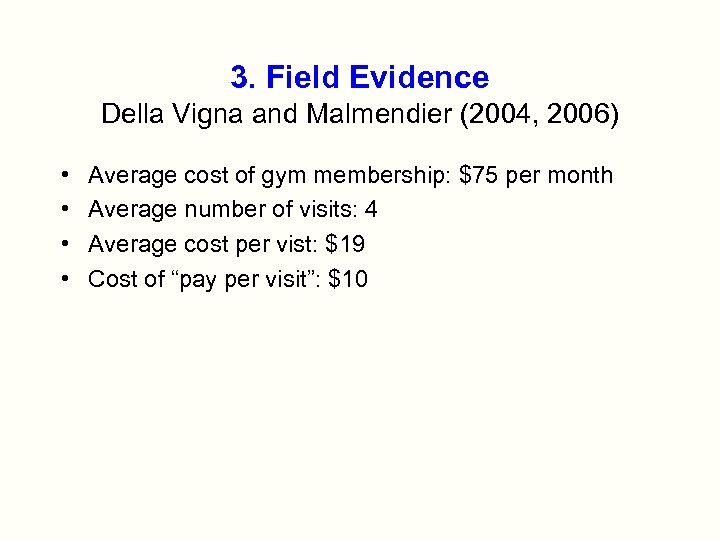 3. Field Evidence Della Vigna and Malmendier (2004, 2006) • • Average cost of gym membership: $75 per month Average number of visits: 4 Average cost per vist: $19 Cost of “pay per visit”: $10
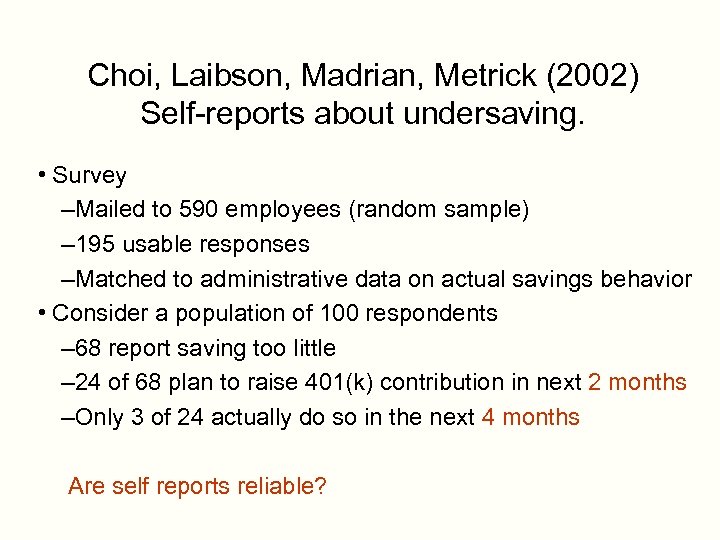 Choi, Laibson, Madrian, Metrick (2002) Self-reports about undersaving. • Survey –Mailed to 590 employees (random sample) – 195 usable responses –Matched to administrative data on actual savings behavior • Consider a population of 100 respondents – 68 report saving too little – 24 of 68 plan to raise 401(k) contribution in next 2 months –Only 3 of 24 actually do so in the next 4 months Are self reports reliable?
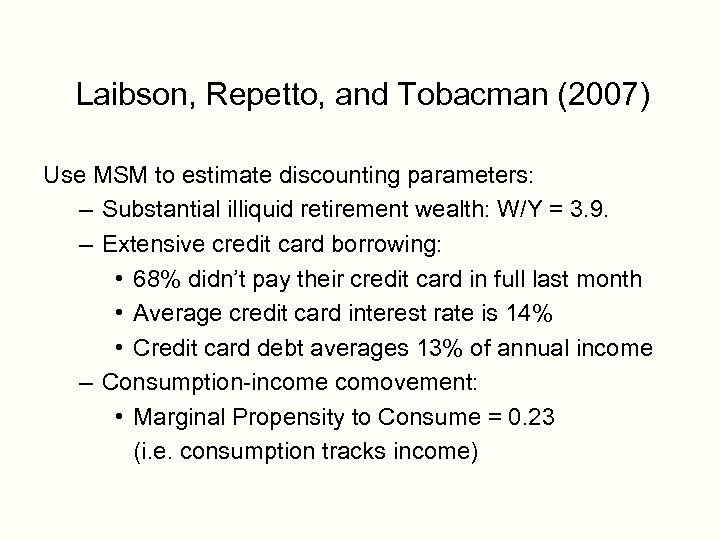 Laibson, Repetto, and Tobacman (2007) Use MSM to estimate discounting parameters: – Substantial illiquid retirement wealth: W/Y = 3. 9. – Extensive credit card borrowing: • 68% didn’t pay their credit card in full last month • Average credit card interest rate is 14% • Credit card debt averages 13% of annual income – Consumption-income comovement: • Marginal Propensity to Consume = 0. 23 (i. e. consumption tracks income)
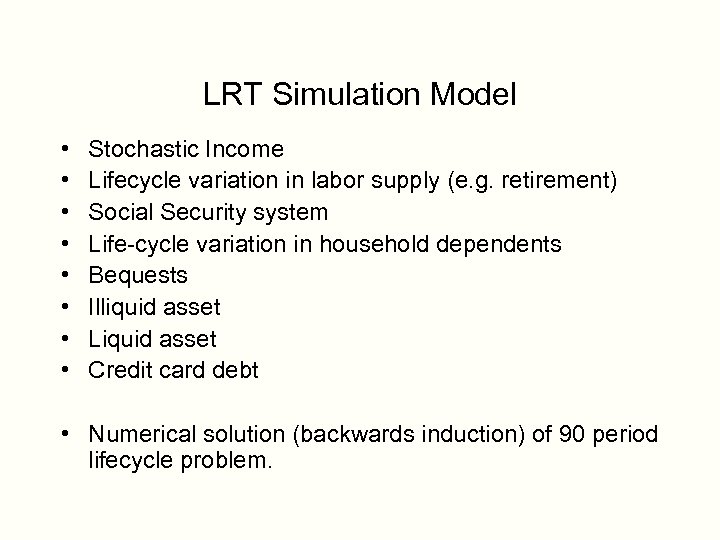 LRT Simulation Model • • Stochastic Income Lifecycle variation in labor supply (e. g. retirement) Social Security system Life-cycle variation in household dependents Bequests Illiquid asset Liquid asset Credit card debt • Numerical solution (backwards induction) of 90 period lifecycle problem.
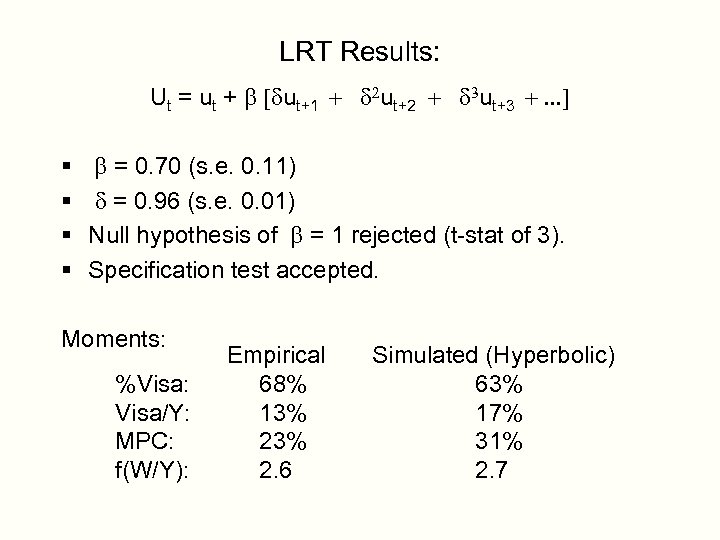 LRT Results: Ut = ut + b [dut+1 + d 2 ut+2 + d 3 ut+3 +. . . ] § § b = 0. 70 (s. e. 0. 11) d = 0. 96 (s. e. 0. 01) Null hypothesis of b = 1 rejected (t-stat of 3). Specification test accepted. Moments: %Visa: Visa/Y: MPC: f(W/Y): Empirical 68% 13% 2. 6 Simulated (Hyperbolic) 63% 17% 31% 2. 7
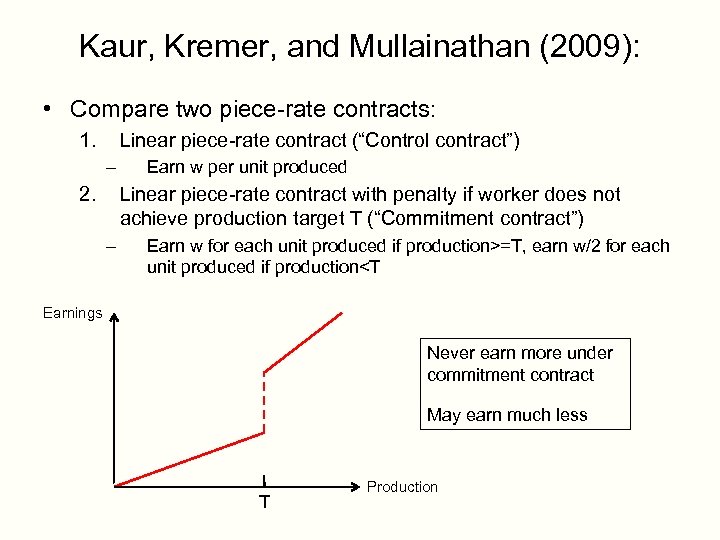 Kaur, Kremer, and Mullainathan (2009): • Compare two piece-rate contracts: 1. Linear piece-rate contract (“Control contract”) – 2. Earn w per unit produced Linear piece-rate contract with penalty if worker does not achieve production target T (“Commitment contract”) – Earn w for each unit produced if production>=T, earn w/2 for each unit produced if production
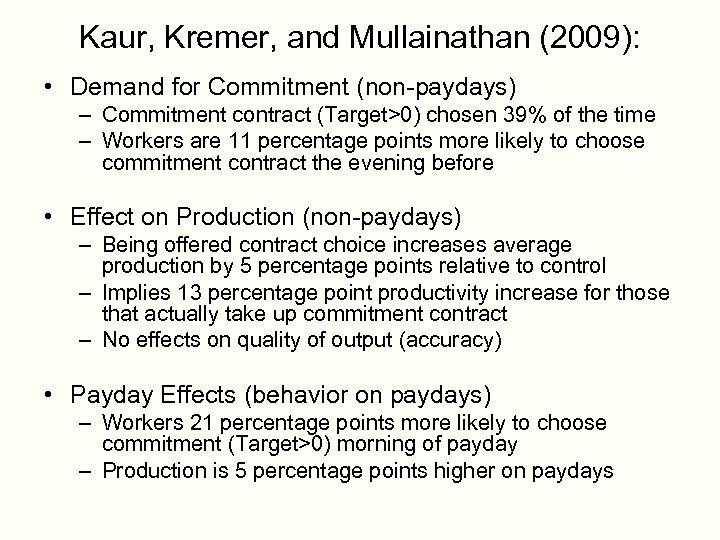 Kaur, Kremer, and Mullainathan (2009): • Demand for Commitment (non-paydays) – Commitment contract (Target>0) chosen 39% of the time – Workers are 11 percentage points more likely to choose commitment contract the evening before • Effect on Production (non-paydays) – Being offered contract choice increases average production by 5 percentage points relative to control – Implies 13 percentage point productivity increase for those that actually take up commitment contract – No effects on quality of output (accuracy) • Payday Effects (behavior on paydays) – Workers 21 percentage points more likely to choose commitment (Target>0) morning of payday – Production is 5 percentage points higher on paydays
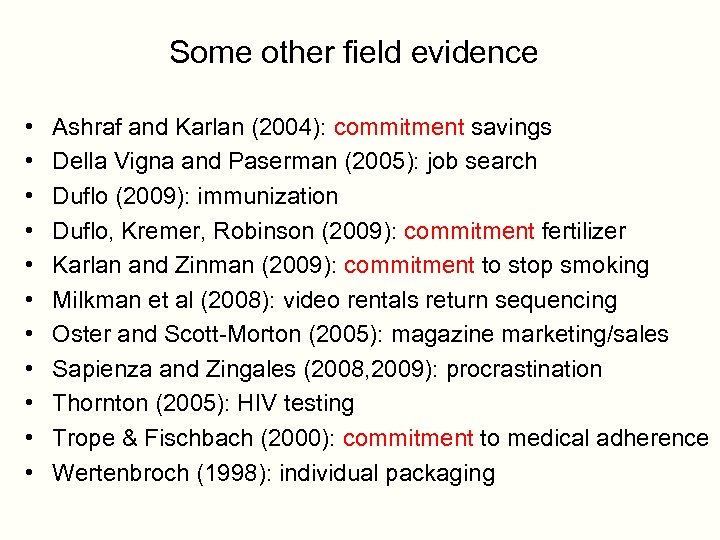 Some other field evidence • • • Ashraf and Karlan (2004): commitment savings Della Vigna and Paserman (2005): job search Duflo (2009): immunization Duflo, Kremer, Robinson (2009): commitment fertilizer Karlan and Zinman (2009): commitment to stop smoking Milkman et al (2008): video rentals return sequencing Oster and Scott-Morton (2005): magazine marketing/sales Sapienza and Zingales (2008, 2009): procrastination Thornton (2005): HIV testing Trope & Fischbach (2000): commitment to medical adherence Wertenbroch (1998): individual packaging
 4. Neuroscience Foundations • • • What is the underlying mechanism? Why are our preferences inconsistent? Is it adaptive? How should it be modeled? Does it arise from a single time preference mechanism (e. g. , Herrnstein’s reward per unit time)? • Or is it the resulting of multiple systems interacting (Shefrin and Thaler 1981, Bernheim and Rangel 2004, O’Donoghue and Loewenstein 2004, Fudenberg and Levine 2004)?
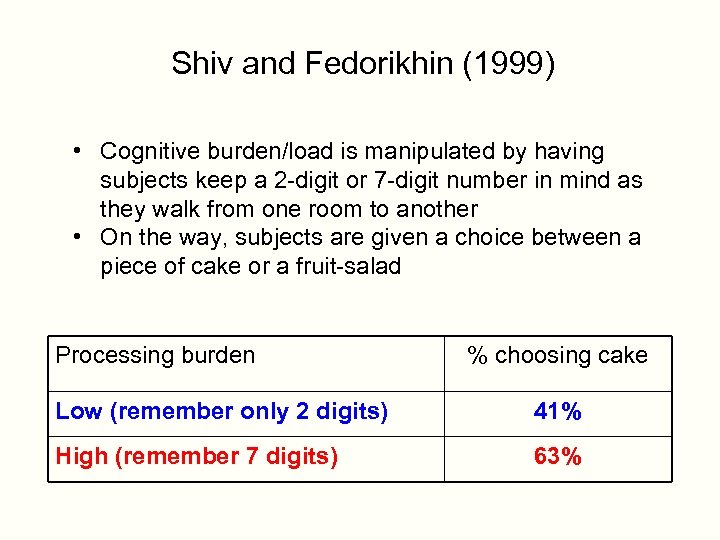 Shiv and Fedorikhin (1999) • Cognitive burden/load is manipulated by having subjects keep a 2 -digit or 7 -digit number in mind as they walk from one room to another • On the way, subjects are given a choice between a piece of cake or a fruit-salad Processing burden % choosing cake Low (remember only 2 digits) 41% High (remember 7 digits) 63%
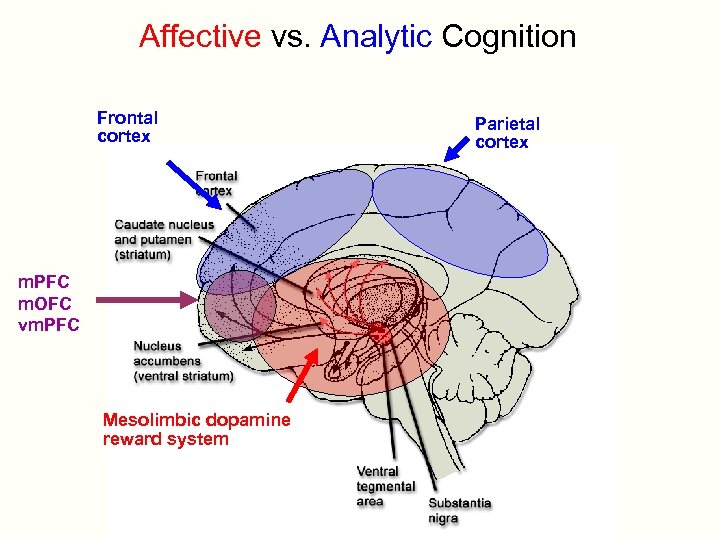 Affective vs. Analytic Cognition Frontal cortex m. PFC m. OFC vm. PFC Mesolimbic dopamine reward system Parietal cortex
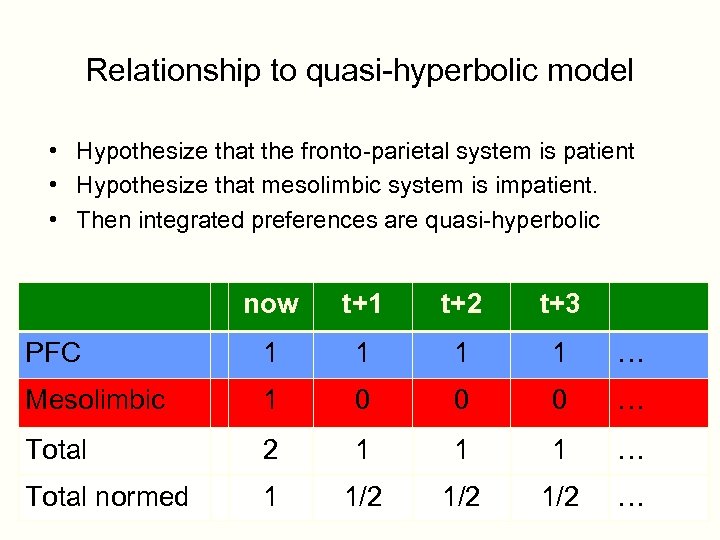 Relationship to quasi-hyperbolic model • Hypothesize that the fronto-parietal system is patient • Hypothesize that mesolimbic system is impatient. • Then integrated preferences are quasi-hyperbolic now t+1 t+2 t+3 PFC 1 1 … Mesolimbic 1 0 0 0 … Total 2 1 1 1 … Total normed 1 1/2 1/2 …
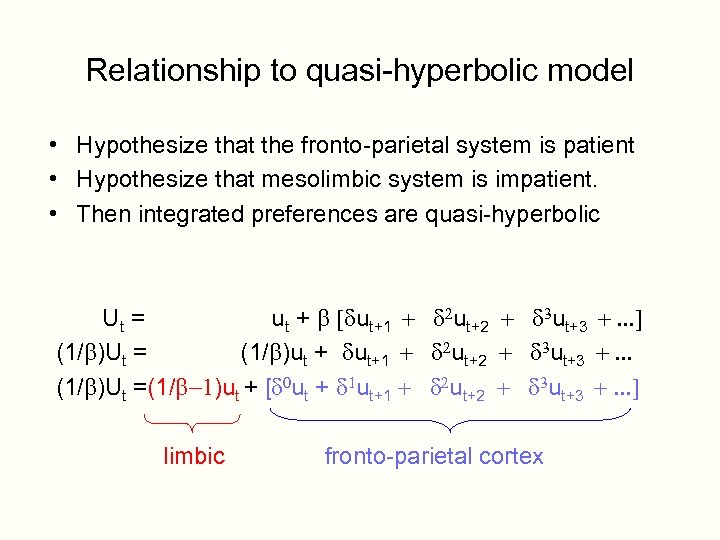 Relationship to quasi-hyperbolic model • Hypothesize that the fronto-parietal system is patient • Hypothesize that mesolimbic system is impatient. • Then integrated preferences are quasi-hyperbolic Ut = ut + b [dut+1 + d 2 ut+2 + d 3 ut+3 +. . . ] (1/b)Ut = (1/b)ut + dut+1 + d 2 ut+2 + d 3 ut+3 +. . . (1/b)Ut =(1/b-1)ut + [d 0 ut + d 1 ut+1 + d 2 ut+2 + d 3 ut+3 +. . . ] limbic fronto-parietal cortex
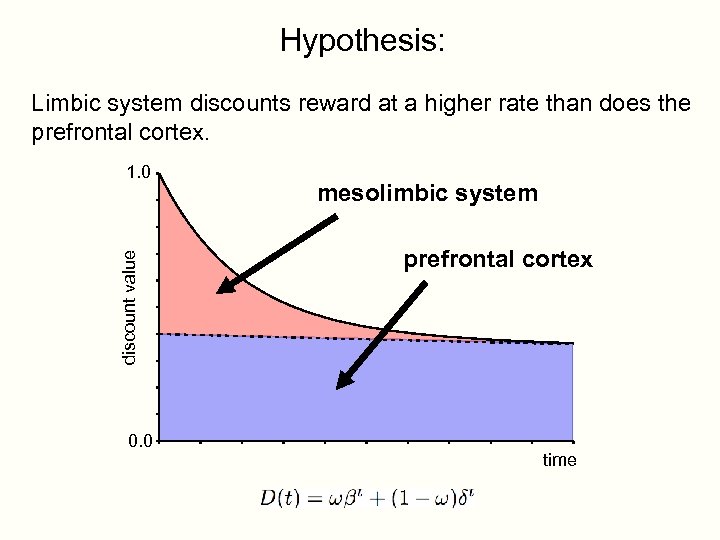 Hypothesis: Limbic system discounts reward at a higher rate than does the prefrontal cortex. discount value 1. 0 0. 0 mesolimbic system prefrontal cortex time
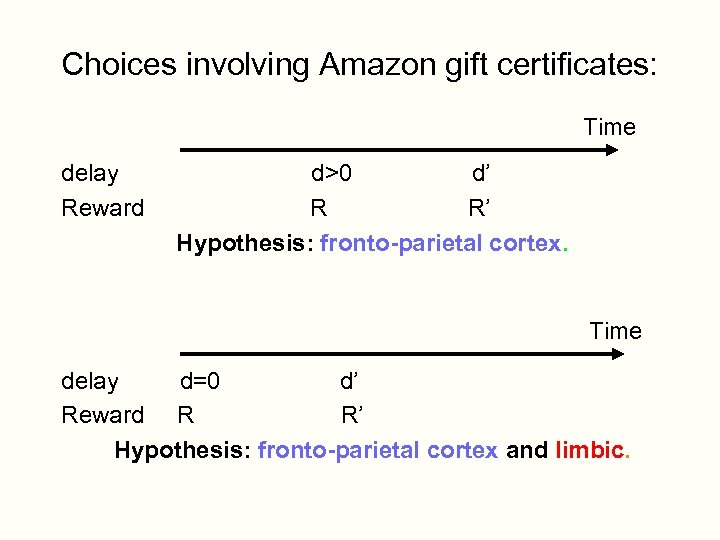
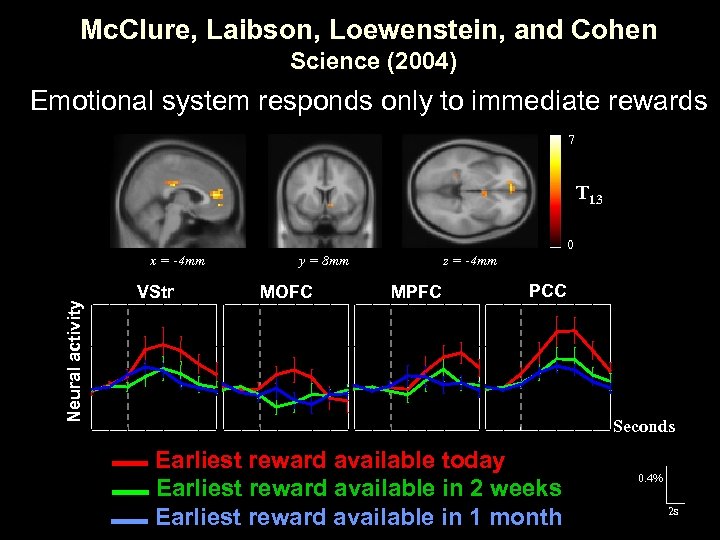
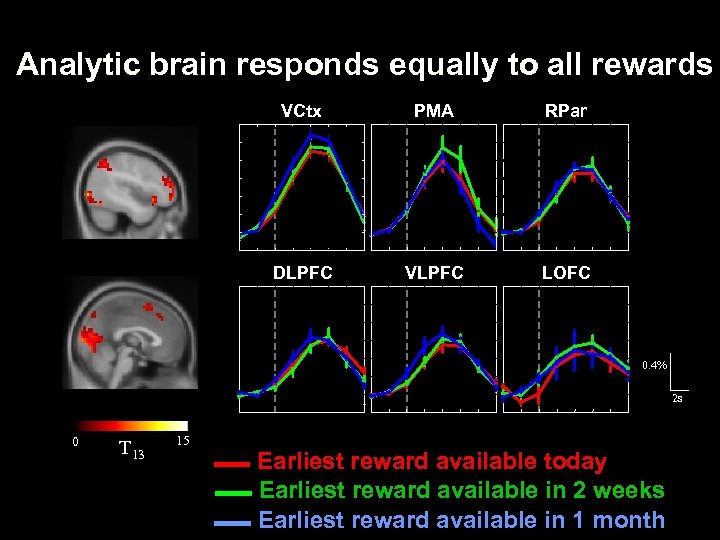
 5. Neuroimaging Evidence Mc. Clure, Laibson, Loewenstein, and Cohen Science (2004) • Do agents think differently about immediate rewards and delayed rewards? • Does immediacy have a special emotional drive/reward component? • Does emotional (mesolimbic) brain discount delayed rewards more rapidly than the analytic (fronto-parietal cortex) brain?
 Choices involving Amazon gift certificates: Time delay Reward d>0 d’ R R’ Hypothesis: fronto-parietal cortex. Time delay d=0 d’ Reward R R’ Hypothesis: fronto-parietal cortex and limbic.
 Mc. Clure, Laibson, Loewenstein, and Cohen Science (2004) Emotional system responds only to immediate rewards 7 T 13 0 Neural activity x = -4 mm VStr y = 8 mm MOFC z = -4 mm MPFC PCC Seconds Earliest reward available today Earliest reward available in 2 weeks Earliest reward available in 1 month 0. 4% 2 s
 Analytic brain responds equally to all rewards VCtx PMA RPar DLPFC VLPFC LOFC x = 44 mm 0. 4% 2 s x = 0 mm 0 T 13 15 Earliest reward available today Earliest reward available in 2 weeks Earliest reward available in 1 month
 Brain Activity in the Frontal System and Emotional System Predict Behavior (Data for choices with an immediate option. ) 0. 05 0. 0 -0. 05 Choose Smaller Immediate Reward Frontal system Emotional System Choose Larger Delayed Reward
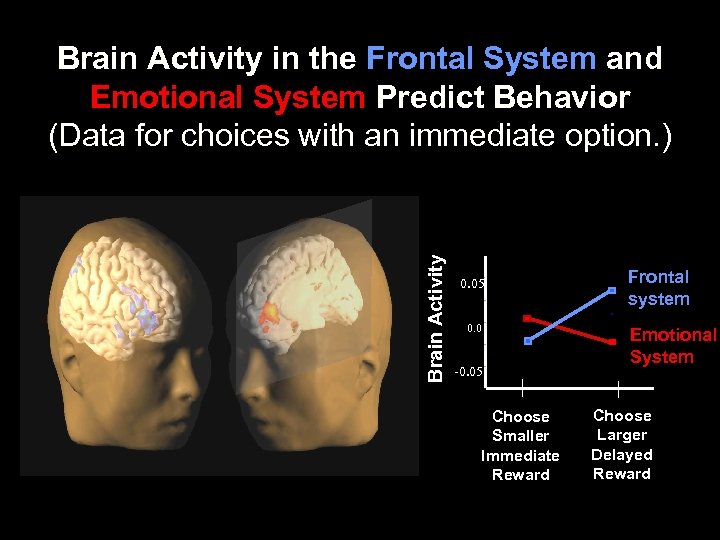
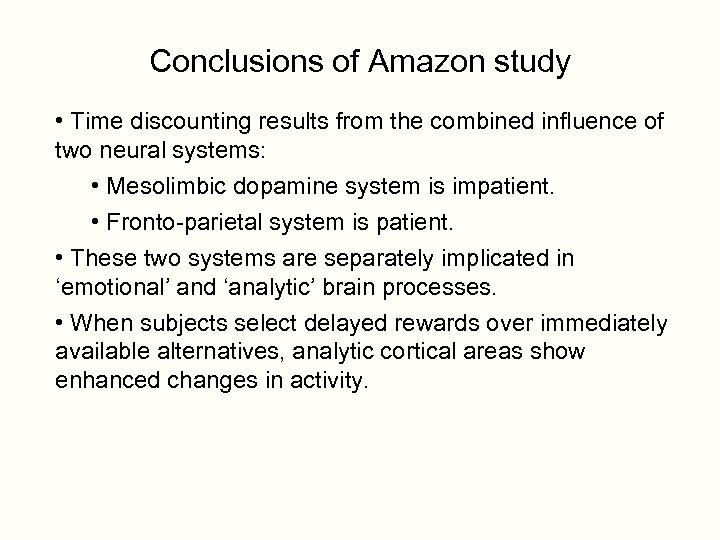 Conclusions of Amazon study • Time discounting results from the combined influence of two neural systems: • Mesolimbic dopamine system is impatient. • Fronto-parietal system is patient. • These two systems are separately implicated in ‘emotional’ and ‘analytic’ brain processes. • When subjects select delayed rewards over immediately available alternatives, analytic cortical areas show enhanced changes in activity.
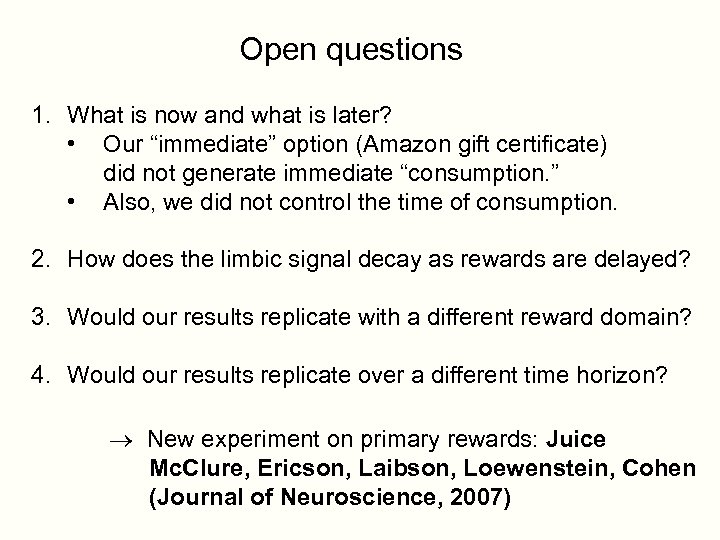 Open questions 1. What is now and what is later? • Our “immediate” option (Amazon gift certificate) did not generate immediate “consumption. ” • Also, we did not control the time of consumption. 2. How does the limbic signal decay as rewards are delayed? 3. Would our results replicate with a different reward domain? 4. Would our results replicate over a different time horizon? ® New experiment on primary rewards: Juice Mc. Clure, Ericson, Laibson, Loewenstein, Cohen (Journal of Neuroscience, 2007)
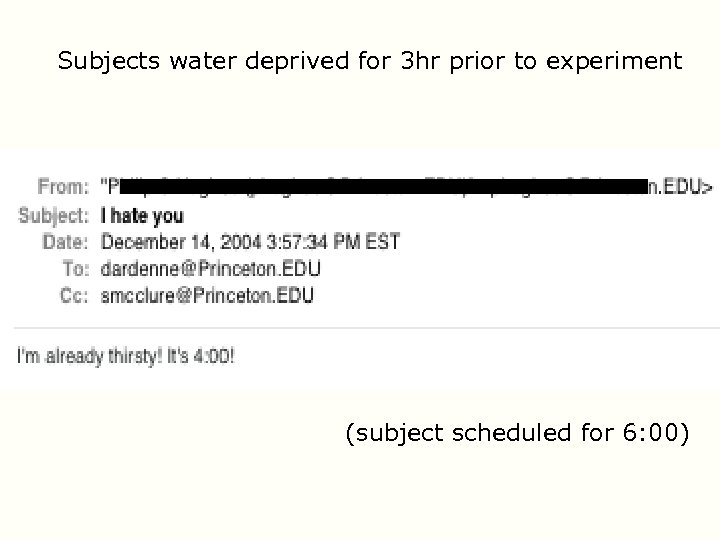 Subjects water deprived for 3 hr prior to experiment (subject scheduled for 6: 00)
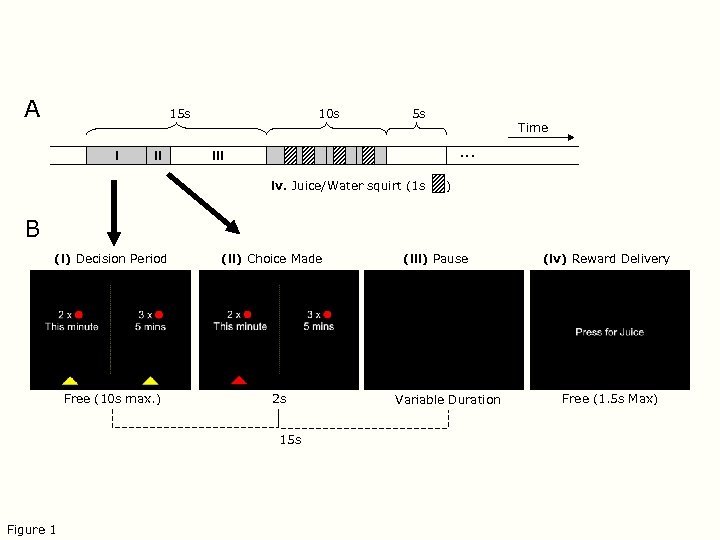 A 15 s i ii 10 s 5 s Time … iii iv. Juice/Water squirt (1 s ) B (i) Decision Period Free (10 s max. ) (ii) Choice Made 2 s 15 s Figure 1 (iii) Pause Variable Duration (iv) Reward Delivery Free (1. 5 s Max)
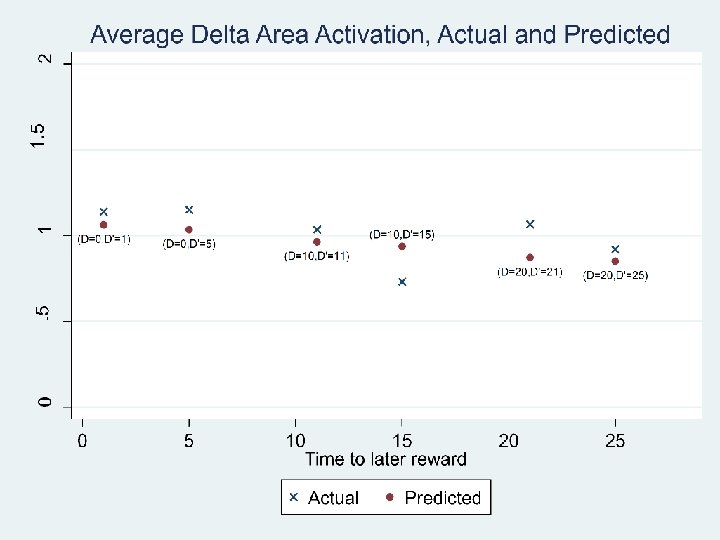
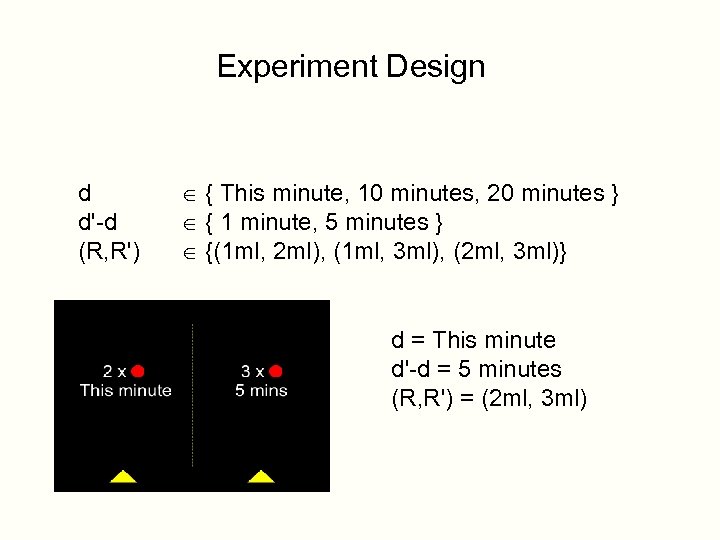 Experiment Design d d'-d (R, R') { This minute, 10 minutes, 20 minutes } { 1 minute, 5 minutes } {(1 ml, 2 ml), (1 ml, 3 ml), (2 ml, 3 ml)} d = This minute d'-d = 5 minutes (R, R') = (2 ml, 3 ml)
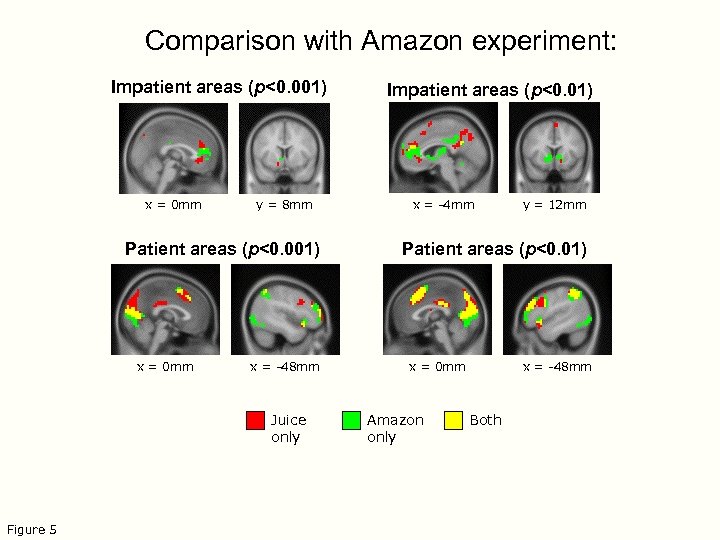 Comparison with Amazon experiment: Impatient areas (p<0. 001) x = 0 mm y = 8 mm Patient areas (p<0. 001) x = 0 mm x = -48 mm Juice only Figure 5 Impatient areas (p<0. 01) x = -4 mm y = 12 mm Patient areas (p<0. 01) x = 0 mm Amazon only x = -48 mm Both
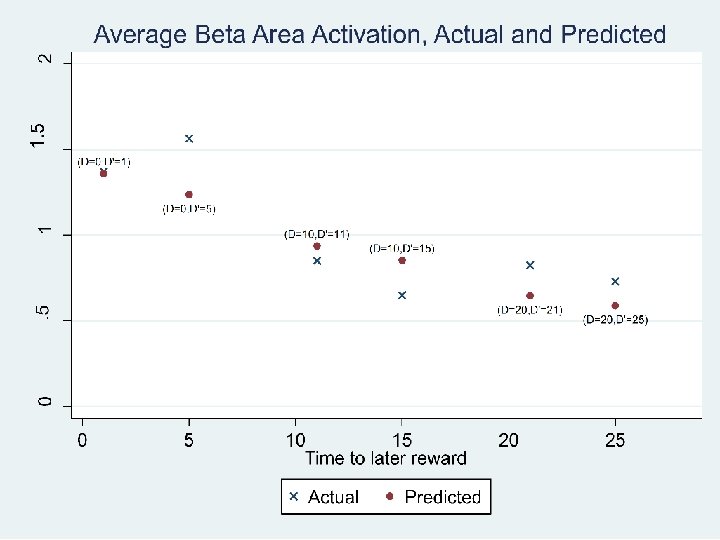
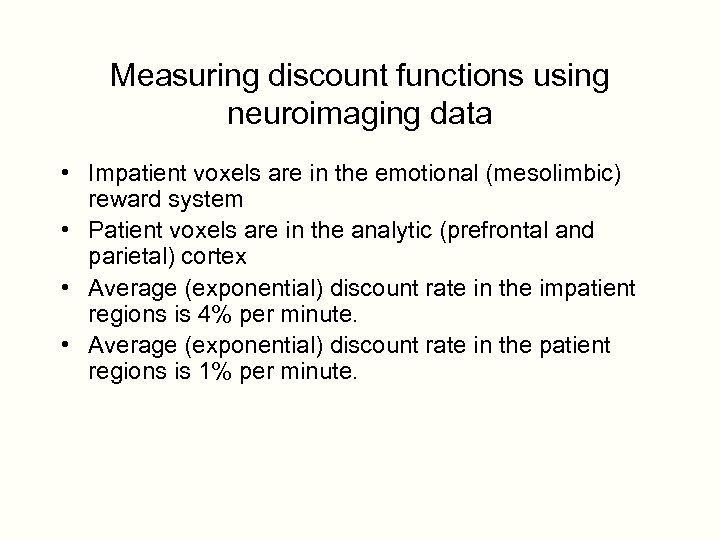 Measuring discount functions using neuroimaging data • Impatient voxels are in the emotional (mesolimbic) reward system • Patient voxels are in the analytic (prefrontal and parietal) cortex • Average (exponential) discount rate in the impatient regions is 4% per minute. • Average (exponential) discount rate in the patient regions is 1% per minute.
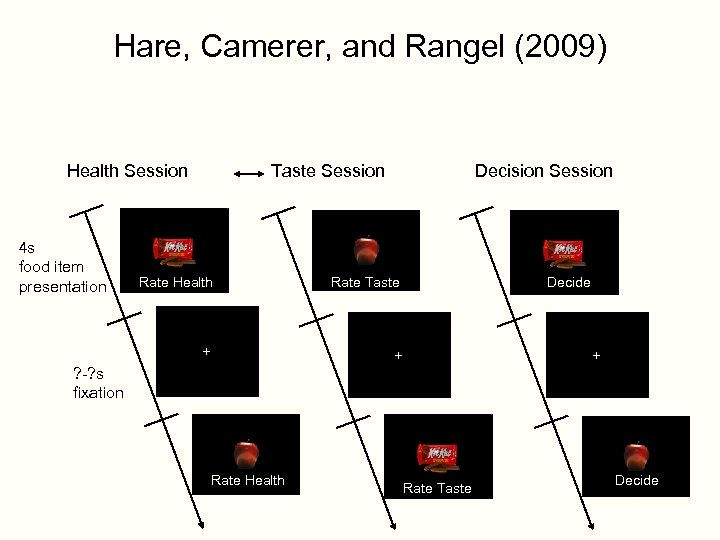 Hare, Camerer, and Rangel (2009) Health Session 4 s food item presentation Taste Session Decision Session Rate Health Rate Taste + + ? -? s fixation Rate Health Decide Rate Taste + Decide
 Rating Details • Taste and health ratings made on five point scale: -2, -1, 0, 1, 2 • Decisions also reported on a five point scale: SN, N, 0, Y, SY “strong no” to “strong yes”
 What is self-control? • Rejecting a good tasting food that is not healthy • Accepting a bad tasting food that is healthy
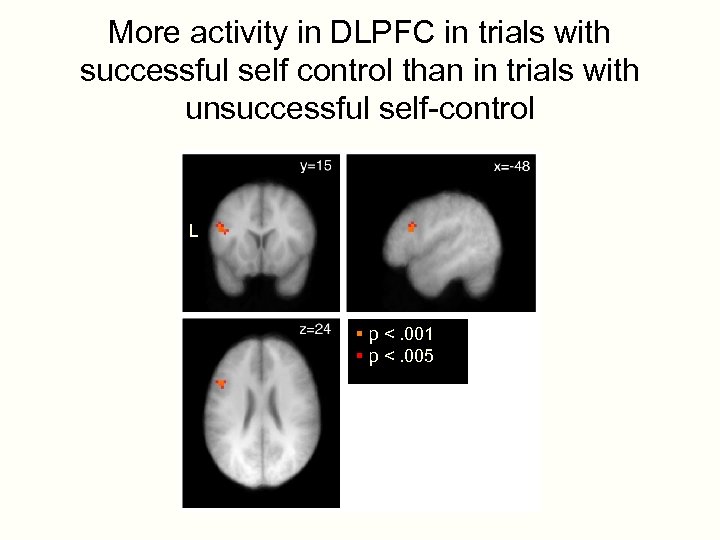 More activity in DLPFC in trials with successful self control than in trials with unsuccessful self-control L § p <. 001 § p <. 005
 Summary of neuroimaging evidence • One system associated with midbrain dopamine neurons (mesolimbic dopamine system) discounts at a high rate. • Second system associated with lateral prefrontal and posterior parietal cortex responsible for self-regulation (and shows relatively little discounting) • Combined function of these two systems accounts for decision making across choice domains, including non-exponential discounting regularities.
 Outline 1. 2. 3. 4. Experimental evidence for dynamic inconsistency. Theoretical framework: quasi-hyperbolic discounting. Field evidence: dynamic decisions. Neuroscience: – Mesolimbic Dopamine System (emotional, impatient) – Fronto-Parietal Cortex (analytic, patient) 5. Neuroimaging evidence – Study 1: Amazon gift certificates – Study 2: juice squirts – Study 3: choice of snack foods 6. Policy
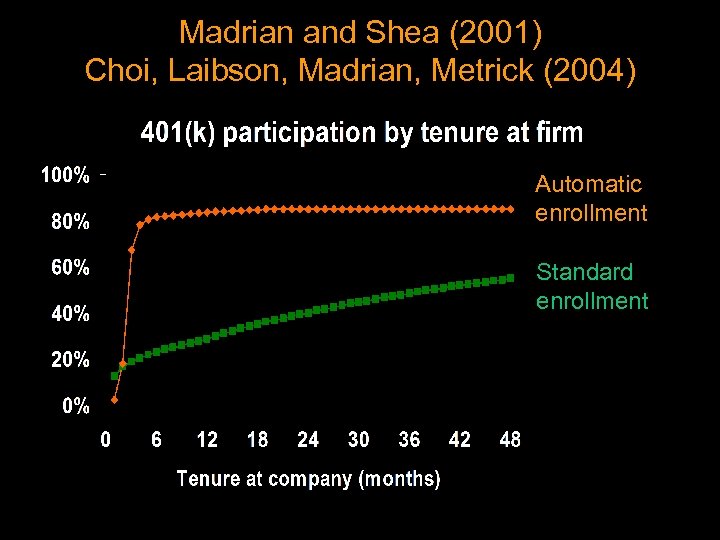
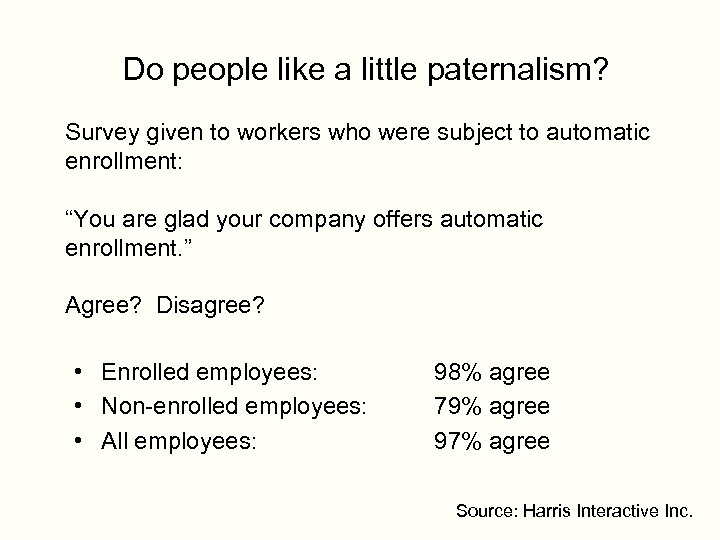
 6. Policy Defaults in the savings domain • Welcome to the company • If you don’t do anything – You are automatically enrolled in the 401(k) – You save 2% of your pay – Your contributions go into a default fund • Call this phone number to opt out of enrollment or change your investment allocations
 Madrian and Shea (2001) Choi, Laibson, Madrian, Metrick (2004) Automatic enrollment Standard enrollment
 Do people like a little paternalism? Survey given to workers who were subject to automatic enrollment: “You are glad your company offers automatic enrollment. ” Agree? Disagree? • Enrolled employees: • Non-enrolled employees: • All employees: 98% agree 79% agree 97% agree Source: Harris Interactive Inc.
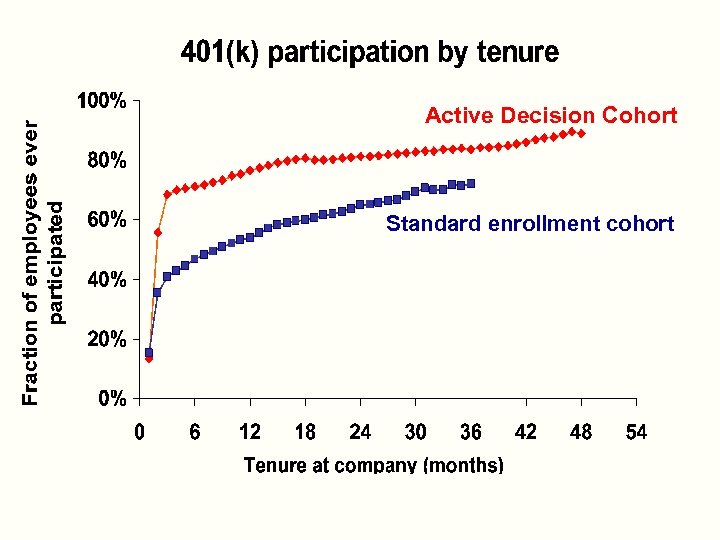
 The power of deadlines: Active decisions Carroll, Choi, Laibson, Madrian, Metrick (2004) Active decision mechanisms require employees to make an active choice about 401(k) participation. • Welcome to the company • You are required to submit this form within 30 days of hire, regardless of your 401(k) participation choice • If you don’t want to participate, indicate that decision • If you want to participate, indicate your contribution rate and asset allocation • Being passive is not an option
 Active Decision Cohort Standard enrollment cohort
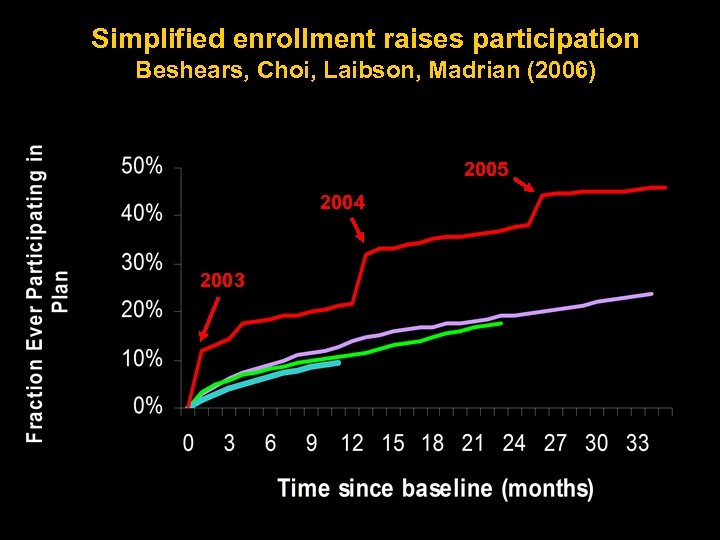 Simplified enrollment raises participation Beshears, Choi, Laibson, Madrian (2006) 2005 2004 2003
 Extensions to health domain Use automaticity and deadlines to nudge people to make better health decisions One early example: Home delivery of chronic meds (e. g. maintenance drugs for diabetes and CVD) • Pharmaceutical adherence is about 50% • One problem: need to pick up your meds • Idea: use active decision intervention to encourage workers on chronic meds to consider home delivery • Early results: HD take up rises from 15% to 50% • Cost savings during first six months: $5 million • Long-run health improvement?
 Outline 1. 2. 3. 4. 5. 6. Motivating experimental evidence Theoretical framework Field evidence Neuroscience foundations Neuroimaging evidence Policy discussion • Defaults • Deadlines • Simplicity (make it easy) A copy of these slides will soon be available on my Harvard website.