 Скачать презентацию The Economic Way of Thinking Think about
bf16b3e7a30b9197b4236932318eb6fb.ppt
- Количество слайдов: 18



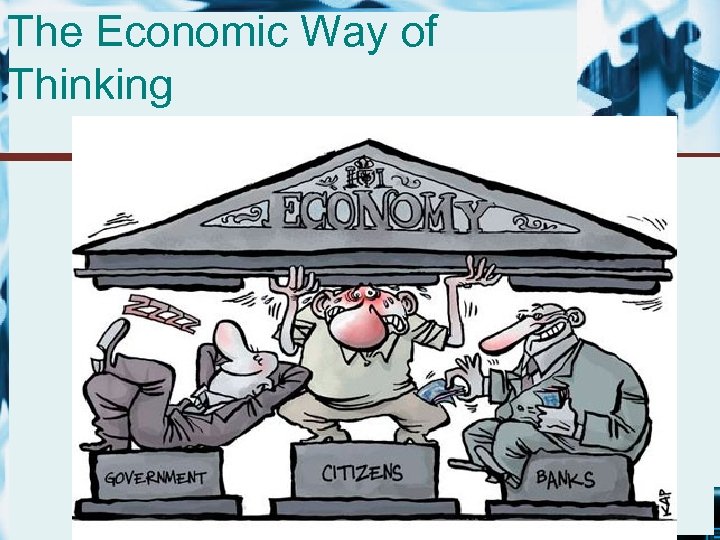
The Economic Way of Thinking
Think about what you did over summer • Write down 5 things that you bought over summer 2
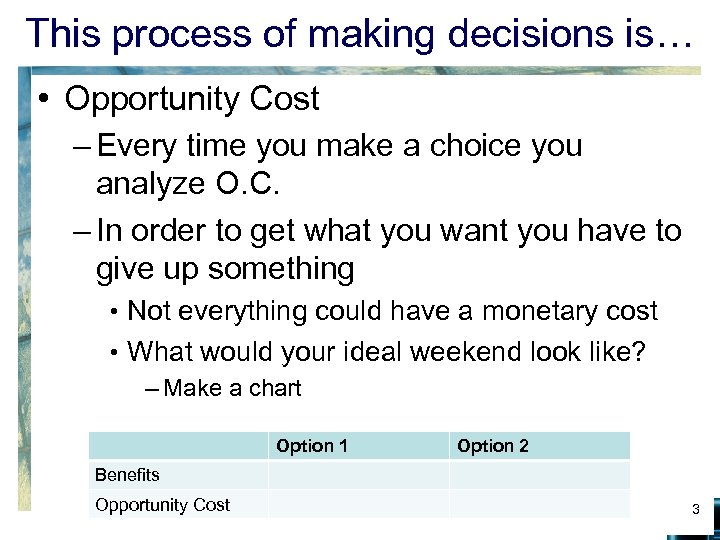
This process of making decisions is… • Opportunity Cost – Every time you make a choice you analyze O. C. – In order to get what you want you have to give up something • Not everything could have a monetary cost • What would your ideal weekend look like? – Make a chart Option 1 Option 2 Benefits Opportunity Cost 3
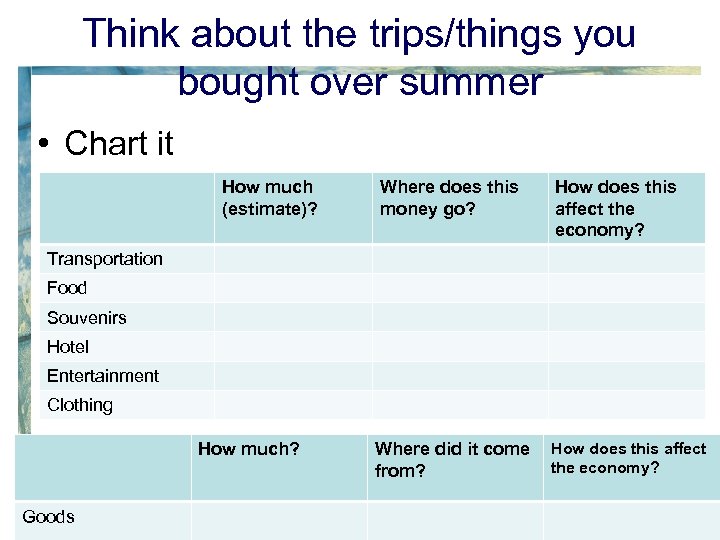
Think about the trips/things you bought over summer • Chart it How much (estimate)? Where does this money go? How does this affect the economy? Transportation Food Souvenirs Hotel Entertainment Clothing How much? Goods Where did it come from? How does this affect the economy? 4
Every time you guys something, it stimulates the economy in some way • There will always be an opportunity cost however 5
The Fundamental Economic Problem: Scarcity and Choice • Our necessities are few but our wants are endless. 6
Vocabulary • Need: something that is essential for survival • Want: An item that is desired but is not necessary for survival • Goods: Physical objects that are produced • Services: Actions performed for someone • Economics: The study of how people seek to satisfy their needs and wants by making choices 7
Scarcity vs Shortage • Scarcity: Limited amounts of good for unlimited wants – Society has unlimited wants in the face of limited resources • Shortage: occurs when consumers want more of a good or service than producers are willing to make available at a particular price – Society has a limited amount of money to buy certain goods which creates 8 shortages
An aside on scarcity • People that tend to acquire a lot of material goods don’t stop, they continue – Hedonic Adaptation: No matter how much money and materials a person possesses, it does not make them happy • Example: Joe wins 10 million dollars. He becomes happy for a short while but then develops a new life style. In order to keep his lifestyle he will need more money so 10 million quickly becomes not enough (and it will run out eventually)
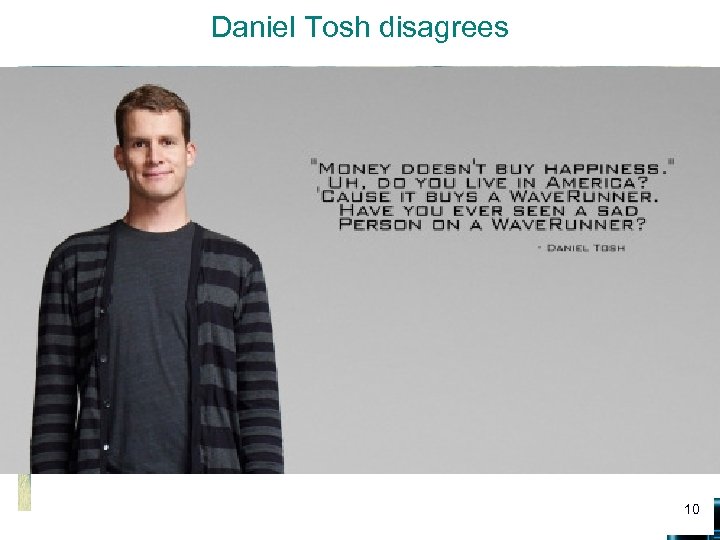
Daniel Tosh disagrees 10
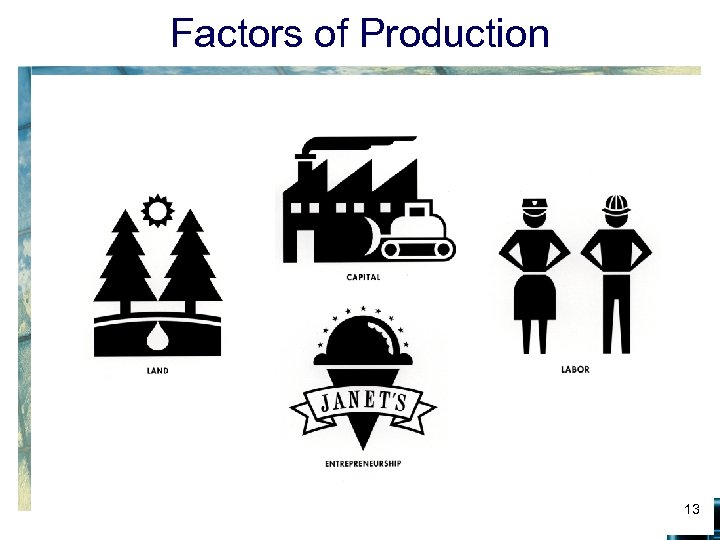
Factors of Production • Resource prices to make a good or service 1. Land: All natural resources used to produce goods and services and physical land 2. Labor: Effort people devote to tasks in exchange for money 3. Entrepreneur: People who combine resources to create a good/service; known as a business owner. Innovators who create new products, put new twists on old products. They also assume the risks of failure in any business endeavor 11
Factors of Production • 4. Capital: Any human made resource that is used to produce other goods and services – Physical: Human made objects made to create other goods and services (Ex. Buildings that house a factory, machinery, tools, computers, etc. ) – Human: Knowledge and skills a worker gains through education and experience (Ex. Paying for a workers education to learn a new skill, a doctor learning about a new procedure) – Financial: Assets such as stocks, bonds, and cash 12
Factors of Production 13
So you want to be an egg farmer? • Consider all of the things that need to go into accomplishing this goal of you selling your product – You have to purchase land – Someone had to produce lumber and chicken wire for you to purchase to build your chicken coop – Someone has to produce chicken feed – A farmer, if not you, has to raise chickens and get them to lay eggs – Someone has to produce an oil rig for gasoline – Someone has to produce a cargo truck for transporting goods • Think of all the parts that go into a truck and their 14 manufacturing
Capital Efficiency • Key to a companies success – Good example: Using machines to speed up production – Bad example: Buying lots of land to use to produce your good except you only end up using a ¼ of it * Show chart on page 7 15
Quick Review • 1. Give two examples of a need • 2. Give two examples of a want • 3. What is the difference between scarcity and shortage? • 4. Why do entrepreneurs take the risk to start or expand a business? • 5. If increasing physical capital increases productivity, why would a company not buy newer, faster computers for all its workers every year? 16
Why Economics? – The study of economics came about when an historian predicted that one day the population growth rate would over power the production of food rate • Which would cause what? – Economics is the framework that underlies all of the business disciplines in the same way that physics underlies all of the engineering disciplines 17
• Economics is not the study of money • Economists study money trends, and the banking system but a pile of money does nothing by itself • Economics is the study of human behavior; the relationship of humans to materials
Скачать презентацию The Economic Way of Thinking Think about
bf16b3e7a30b9197b4236932318eb6fb.ppt