


 Скачать презентацию The Economic Value of Intellectual Property Rights Professor
8a93fbe8a9f06bc59fa2465520c9fad1.ppt
- Количество слайдов: 19
 The Economic Value of Intellectual Property Rights Professor Derek Bosworth Intellectual Property Research Institute of Australia Melbourne University
 Coverage of the presentation • • • Components of value Counterfeiting and infringement Borrowing against assets Distribution of values/risk in investment Conclusions
 Components of value
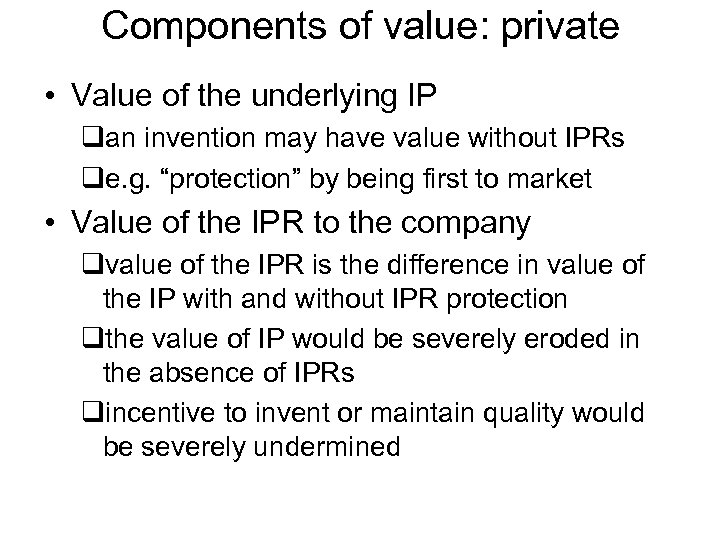 Components of value: private • Value of the underlying IP qan invention may have value without IPRs qe. g. “protection” by being first to market • Value of the IPR to the company qvalue of the IPR is the difference in value of the IP with and without IPR protection qthe value of IP would be severely eroded in the absence of IPRs qincentive to invent or maintain quality would be severely undermined
 Components of value: public • Positive impact of IPRs on dynamic welfare, i. e. qcreativity (i. e. incentive to invent, incentive to maintain or increase product quality, etc. ) qaccessing high technology of others qability to licence/cross licence • Negative impact of IPRs on static welfare, i. e. qhigher prices for goods
 Effects of IPRs on value: inventions • Inventions qexpensive to produce qcheap to reproduce? • Investments in R&D not recouped in absence of IPRs • As expenditure on R&D cannot be recouped, there is no incentive to invest • Countries such as China introduced IPRs in order to access foreign technology
 Effects of IPRs on value: trade marks • Trade names and brand value qexpensive to build qcheap to reproduce (counterfeit/pirate) • Investments in advertising, R&D, etc. not recouped • Perceived product quality is undermined by counterfeit goods • Incentives to maintain or improve quality are affected by counterfeit goods
 Counterfeiting and infringement • Counterfeiting and piracy relate to the actions of one company in attempting to pass-off their goods (or services) as those of another company.
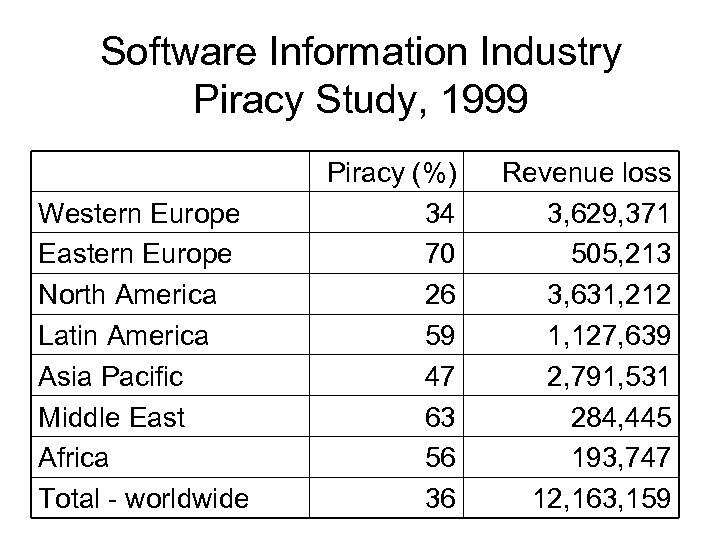 Software Information Industry Piracy Study, 1999 Western Europe Eastern Europe North America Latin America Asia Pacific Middle East Africa Total - worldwide Piracy (%) 34 70 26 59 47 63 56 36 Revenue loss 3, 629, 371 505, 213 3, 631, 212 1, 127, 639 2, 791, 531 284, 445 193, 747 12, 163, 159
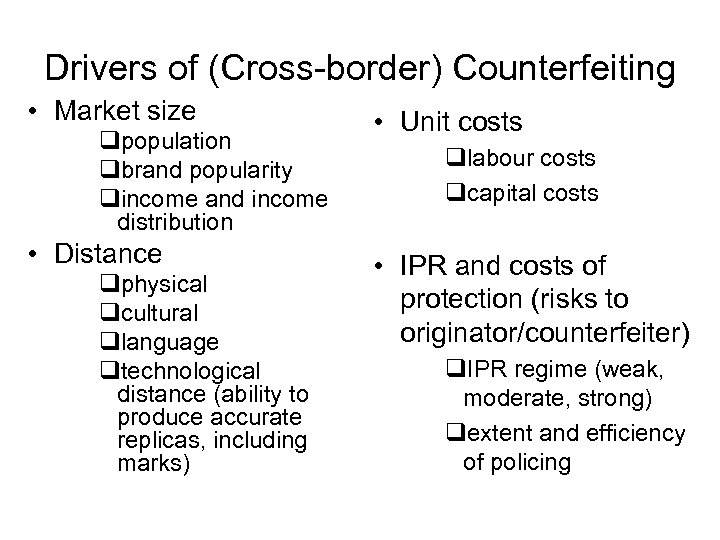 Drivers of (Cross-border) Counterfeiting • Market size qpopulation qbrand popularity qincome and income distribution • Distance qphysical qcultural qlanguage qtechnological distance (ability to produce accurate replicas, including marks) • Unit costs qlabour costs qcapital costs • IPR and costs of protection (risks to originator/counterfeiter) q. IPR regime (weak, moderate, strong) qextent and efficiency of policing
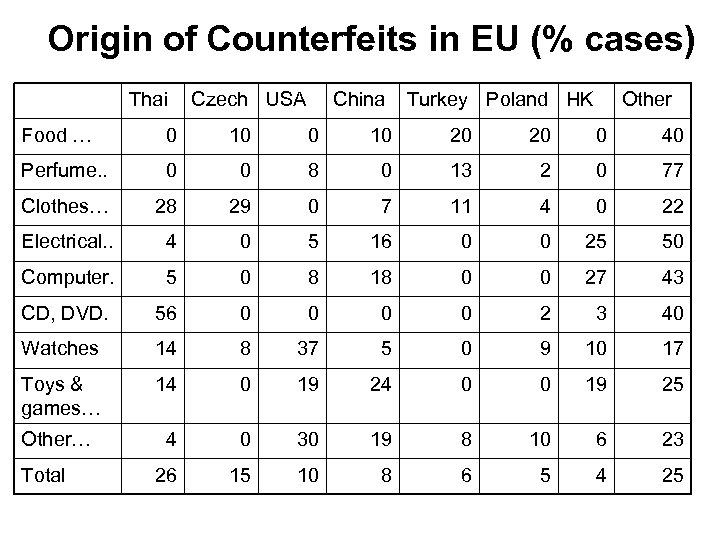 Origin of Counterfeits in EU (% cases) Thai Czech USA China Turkey Poland HK Other Food … 0 10 20 20 0 40 Perfume. . 0 0 8 0 13 2 0 77 Clothes… 28 29 0 7 11 4 0 22 Electrical. . 4 0 5 16 0 0 25 50 Computer. 5 0 8 18 0 0 27 43 CD, DVD. 56 0 0 2 3 40 Watches 14 8 37 5 0 9 10 17 Toys & games… 14 0 19 24 0 0 19 25 Other… 4 0 30 19 8 10 6 23 26 15 10 8 6 5 4 25 Total
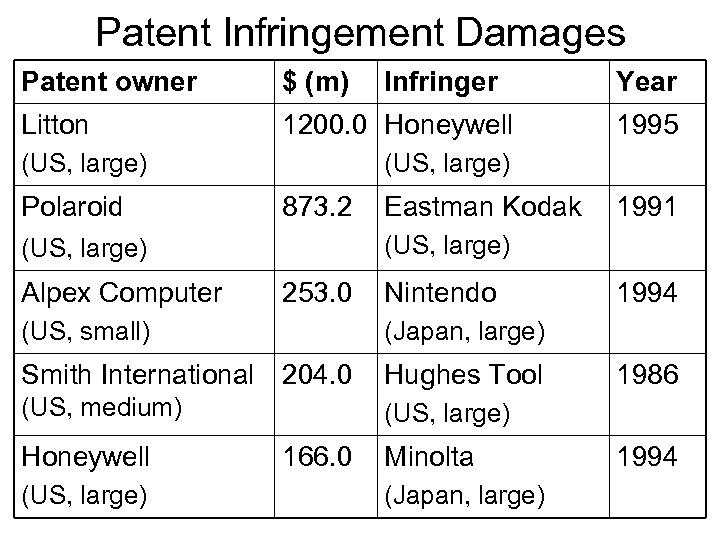 Patent Infringement Damages Patent owner $ (m) Litton 1200. 0 Honeywell (US, large) Polaroid Year 1995 (US, large) 873. 2 Eastman Kodak 1991 (US, large) Alpex Computer Infringer 253. 0 Nintendo (US, small) (Japan, large) Smith International 204. 0 Hughes Tool (US, medium) 1994 (US, large) Honeywell (US, large) 166. 0 Minolta (Japan, large) 1986 1994
 Borrowing against assets
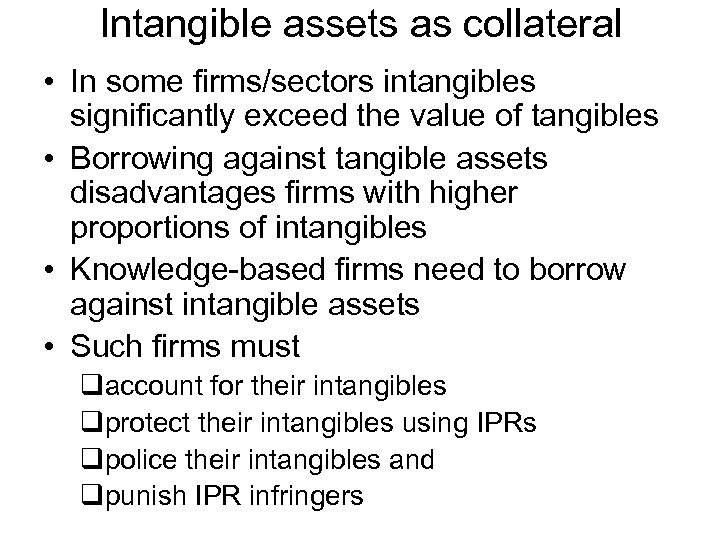 Intangible assets as collateral • In some firms/sectors intangibles significantly exceed the value of tangibles • Borrowing against tangible assets disadvantages firms with higher proportions of intangibles • Knowledge-based firms need to borrow against intangible assets • Such firms must qaccount for their intangibles qprotect their intangibles using IPRs qpolice their intangibles and qpunish IPR infringers
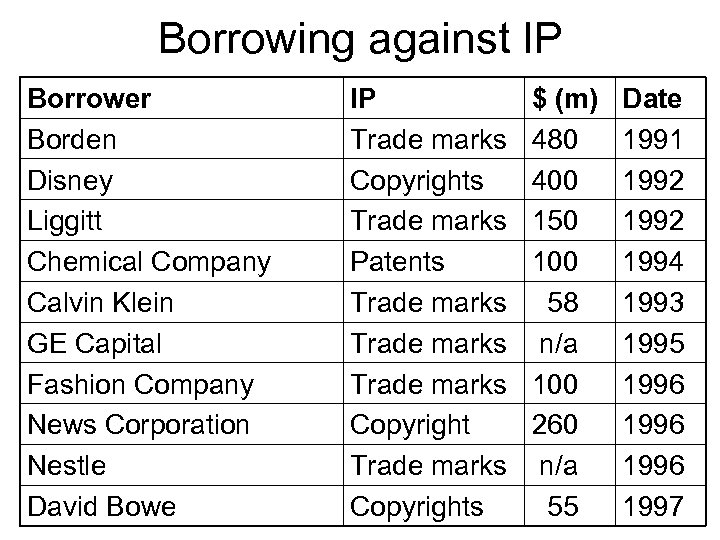 Borrowing against IP Borrower Borden Disney Liggitt Chemical Company Calvin Klein GE Capital Fashion Company News Corporation Nestle David Bowe IP Trade marks Copyrights Trade marks Patents Trade marks Copyrights $ (m) 480 400 150 100 58 n/a 100 260 n/a 55 Date 1991 1992 1994 1993 1995 1996 1997
 Distribution of values
 Distribution of values • All the empirical literature points to a highly -skewed distribution of values of IP/IPRs q. Most IP is worth little if anything q. But a small proportion of IP is extremely valuable • This result is consistent with (though not proof of) the risks of investments in IP q. Basic R&D is a highly risky activity q. New product launches are highly risky
 Identifying value distribution of patents • Main methods: qpatent renewal information qpatent citation information qsurveys of commercial value • Consistent findings: qmost patent lives are short/relatively few very long lived qmost patents receive very few citations/very small proportion receive a large number of citations qsurveys show only a very tiny proportion of patents are worth large amounts/most are worth little if anything
 Example of a highly cited patent • • Bristol-Myers Squibb patent 4105776 Invented by Ondetti and Cuslunan granted in 1978 cited 165 times from the date of its issue in 1978 through September 1995 • single most highly cited patent issued in 1978, out of 70, 590 patents issued in that year – 101 times by later Bristol-Myers Squibb patents – 16 times by American Home Products patents – 48 times by patents assigned to 20 other companies or inventors