


 Скачать презентацию The Economic Approach to Environmental and Natural Resources
919ae501a3812ba99b00463c61ea0038.ppt
- Количество слайдов: 66
 The Economic Approach to Environmental and Natural Resources, 3 e By James R. Kahn © 2005 South-Western, part of the Thomson Corporation
 Part III Renewable Resources and the Environment
 Chapter 11 Fisheries © 2004 Thomson Learning/South-Western
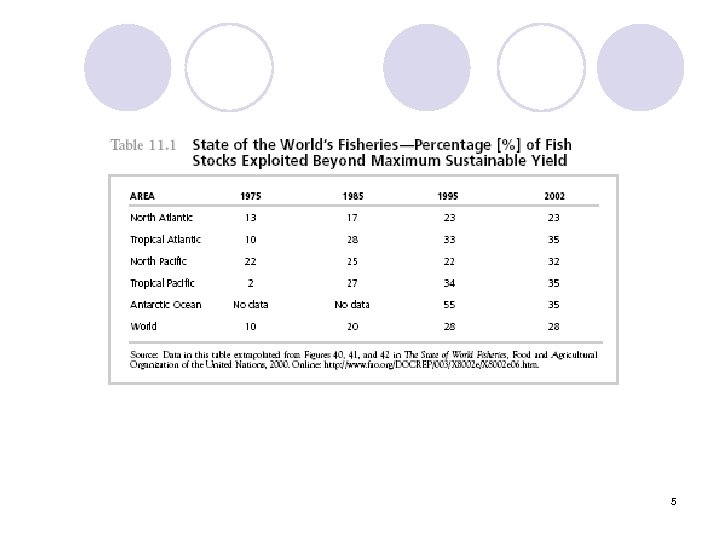
 Introduction Modern fishing technology, coupled with increased demand open-access exploitation of fisheries, has driven many fish stocks to such low levels that they are threatened with extinction. l As illustrated in Table 11. 1, where average annual catch is compared to potential catch, fish populations are declining throughout the world. l The proportion of global fish stocks that are in a state of decline has risen from 10% in 1975 to almost 30% in 2002. l While this number may not sound high, it represents all of the world’s most important fisheries. l 4
 5
5
 Introduction Recreational fishing is also very important in the United States. l According to the U. S. Fish and Wildlife Service, approximately 34 million adult Americans (over age 16) participated in recreational fishing in 2001. l These anglers accounted for 500, 000 days of fishing and $35 billion on fishing-related expenses. l 6
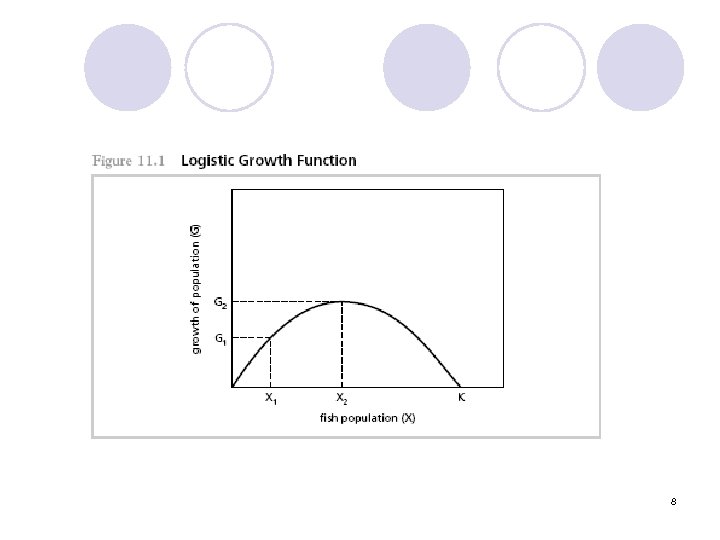
 Fisheries Biology l l l The reproductive potential of a fish population is a function of both the size of the fish population and the characteristics of its habitat. Both the growth of the population and the population itself are measured in biomass (weight) units. Biomass does not distinguish between number of individuals and mass of individuals. Figure 11. 1 depicts a logistic growth function which illustrates the relationship between the fish population and the growth rate of the population. Initially, there is no growth, then over some range of population (up to X 2), population growth is increasing. Beyond X 2, the growth of the population is decreasing. 7
 8
8
 Fisheries Biology l l l The ecosystem's ability to support the fish population is the most significant reason for the changing relationship between population growth and population. With a low population, the resources will support increasing growth. As the population grows, there is a growing competition for those resources and the growth in the population slows. Eventually, the amount of growth falls to zero, which occurs at the maximum population K. This point is also referred to as the carrying capacity of the environment and is a biological equilibrium. 9
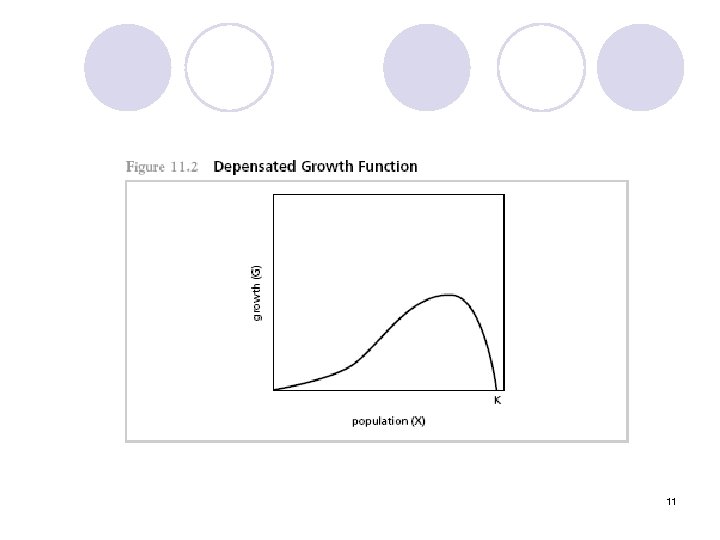
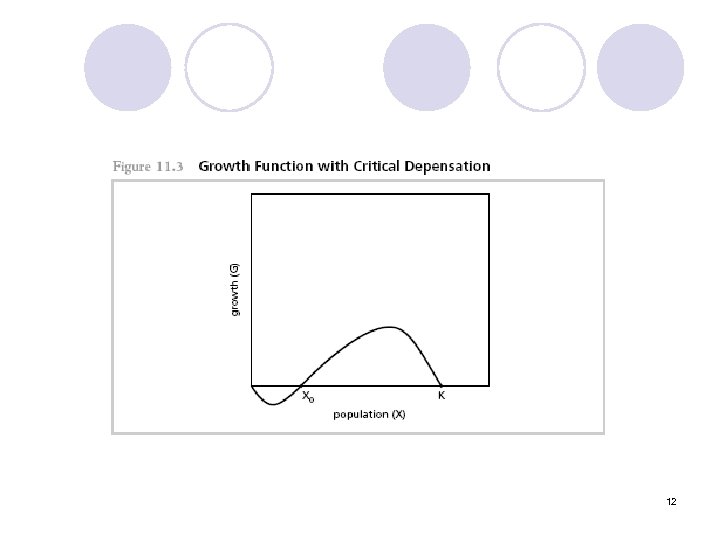
 Fisheries Biology l l l The growth function represented in Figure 11. 1 represents a a compensated growth function. Figure 11. 2 contains a depensated growth function, where the growth rate initially increases and then decreases. Figure 11. 3 contains a critically depensated growth function where, X 0 represents the minimum viable population. If population falls below this level, growth becomes negative and population becomes irreversibly headed towards zero. The implication is that if managers make a mistake and allow too much harvest, they may doom the population to extinction. 10
 11
11
 12
12
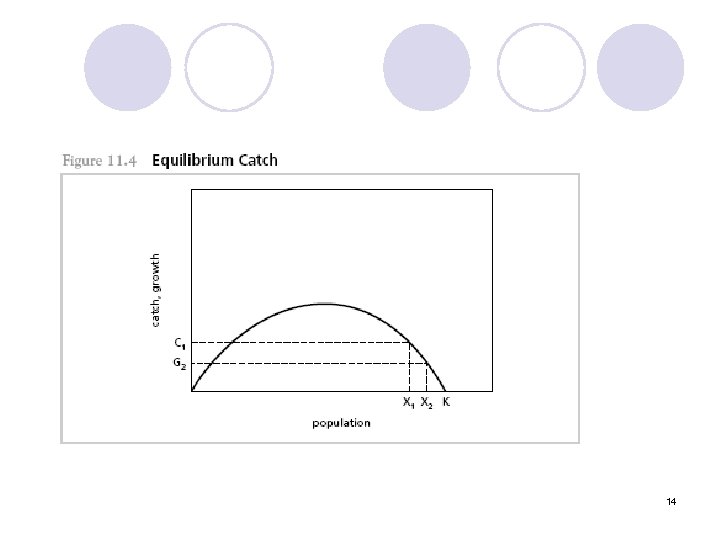
 The Optimal Harvest In order to determine how harvesting affects a fish population, consider the growth function in Figure 11. 4. l Note that C 1 represents the level of harvest (harvest and growth are measured on the vertical axis). l When a harvest of C 1 units per year is removed from the fishery, the fish population declines because there is no natural growth and harvesting is removing a portion of the population. l Population will continue to fall until natural growth is equal to the harvest, which occurs at X 1. l 13
 14
14
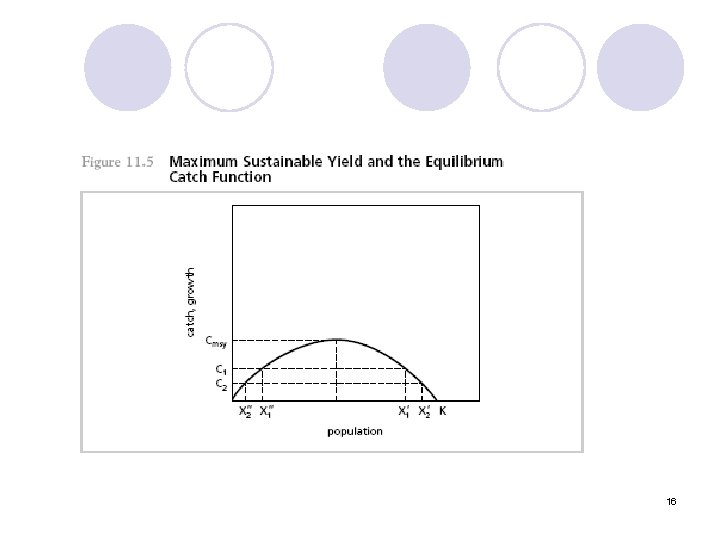
 The Optimal Harvest In Figure 11. 5 a harvest level of C 1 is associated with two equilibrium populations (X 1' and X 1"). l This means that growth is exactly equal to harvest and the population will remain unchanged at either of these levels. l Cmsy represents the harvest level associated with maximum sustainable yield for the fishery. l This is the only harvest level associated with one equilibrium point. l 15
 16
16
 The Optimal Harvest In the early discussions of fishery management, maximum sustainable yield was theoretical goal of management policies. l Recent policy targets a more precautionary goal of a population between the carrying capacity and the level associated with maximum sustainable yield. l 17
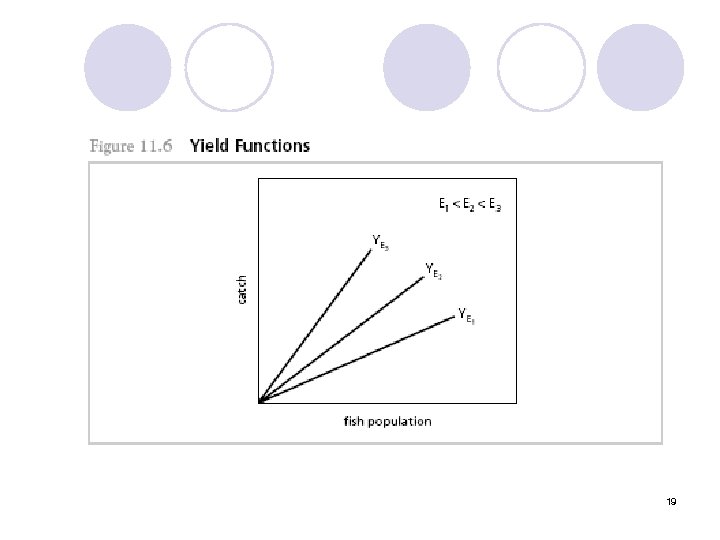
 The Gordon Model and Its Evolution l l l In a 1955 article, H. Scott Gordon made the point that uncontrolled access to fishery resources would result in a greater than optimal level of fishing effort. Gordon derived a catch function that represented a "bionomic" equilibrium. This catch function considered the relationship between fishing effort, catch, and fish population. Gordon’s analysis began by assuming that, holding everything else constant, catch is proportional to the fish population. Figure 11. 6 illustrates a set of yield functions, where each curve represents a different level of fishing effort. 18
 19
19
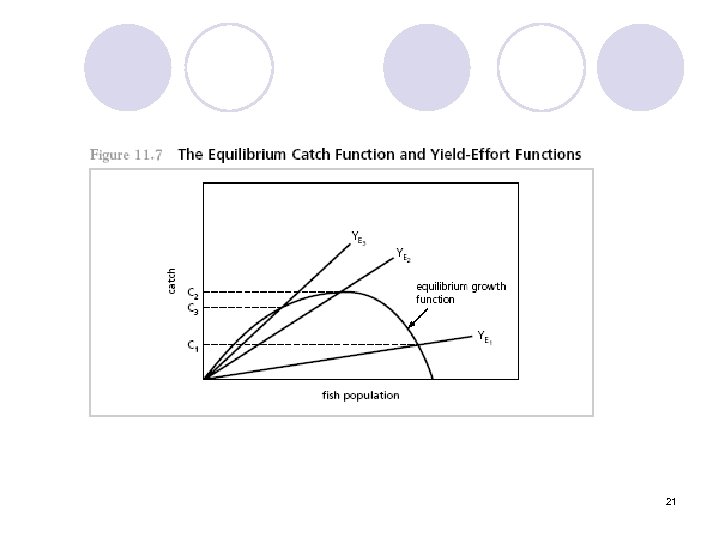
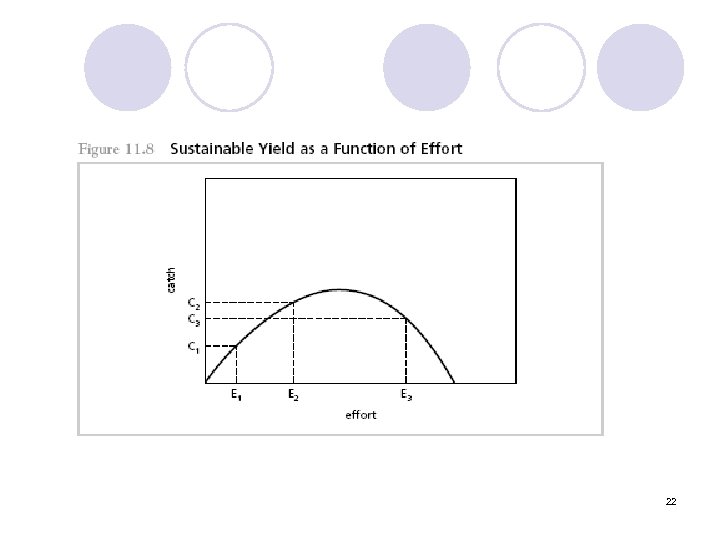
 The Gordon Model and Its Evolution By superimposing the equilibrium catch function on the yield functions (Figure 11. 7) it is possible to identify the effort and yield function associated with maximum sustainable yield in the fishery. l This is known as the sustainable yield function (Figure 11. 8). l Notice the sustainable yield function examines the relationship between effort and catch. l As effort increases, sustainable yield increases and then decreases. l 20
 21
21
 22
22
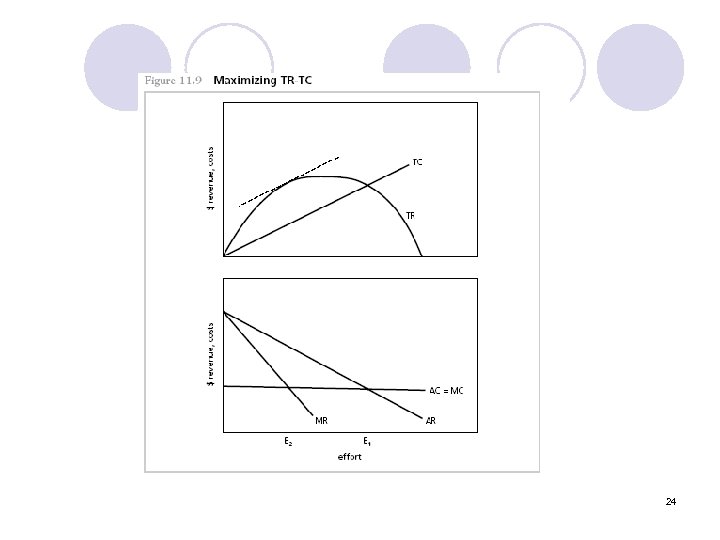
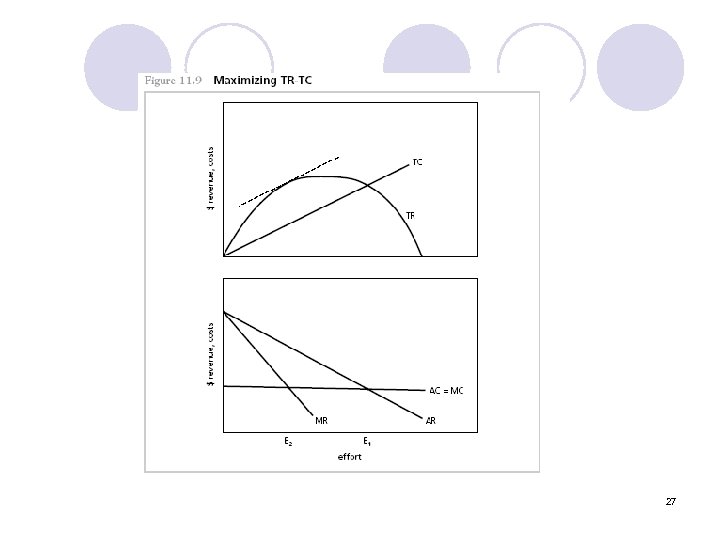
 The Gordon Model and Its Evolution A sustainable total revenue function can be derived from a sustainable yield function. l Price is assumed to be constant, based on the additional assumption that catch from that particular population will be small relative to the total market. l Given a constant price, a sustainable total revenue function can be derived simply by rescaling Figure 11. 8. l In Figure 11. 9, the sustainable total revenue function is labeled TR and an additional curve representing total costs (TC) is also given. l 23
 24
24
 The Gordon Model and Its Evolution Gordon suggests that net economic yield (economic rent) be maximized (identified by MR=MC) so as to maximize social benefits. l Economic rent originates from the productivity of the fish stock, where more fish implies greater catch with less effort (cost). l In Figure 11. 9, the optimal effort, that effort which maximizes economic rent, occurs at E 2. l 25
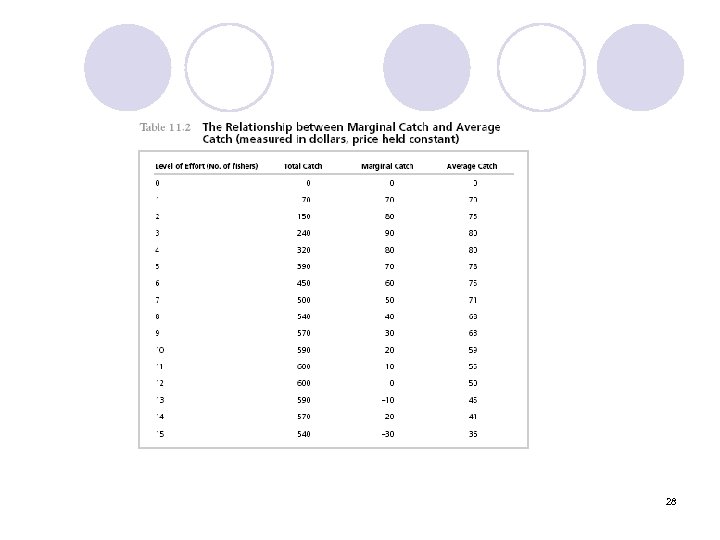
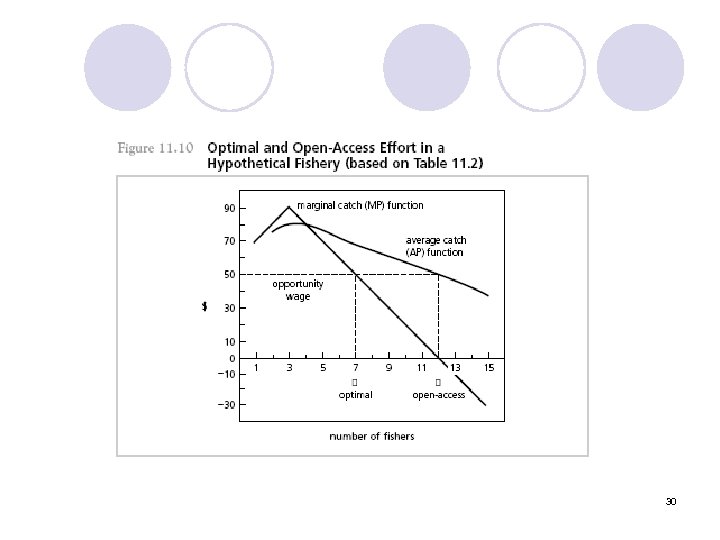
 The Gordon Model and Its Evolution In an open-access fishery, when economic rent is earned in the fishery, entrance by new firms occurs until economic rent falls to zero, effort level of E 1 in Figure 11. 9. l The entrance of firms in response to economic rent and the resulting increase in effort to E 1 results in AR = MC rather than the optimal effort level of E 2 where MR=MC. l Table 11. 2 illustrates the relationship between total catch, marginal catch, and average catch. l 26
 27
27
 28
28
 The Gordon Model and Its Evolution Unlike the behavior of a single firm operator, where the addition to output of an additional unit of input is measured by Marginal Product and compared to Price, within the fishery there is not a single firm operator over the whole fishery. l Each individual fisher compares their average catch and associated revenue with the value of the highest alternative to fishing. l If the highest alternative available is $50 per day, then the fisher will compare average catch (AP) multiplied by Price against the alternative of $50. l The result is that there a greater number of fishers in the fishery than would be if the decision to enter was based on a comparison of marginal product* Price, rather than average product* Price. l 29
 30
30
 The Gordon Model and Its Evolution The Gordon model is designed to focus on the inefficiency associated with open-access, and the loss in welfare associated with too much effort being employed in the fishery. l Gordon suggests that a monopoly within the fishery would prevent the inefficiency associated with open-access. l Policies based on Gordon’s suggestion of limiting effort within the fishery have been ineffective and brought many world fisheries to the brink of collapse. l 31
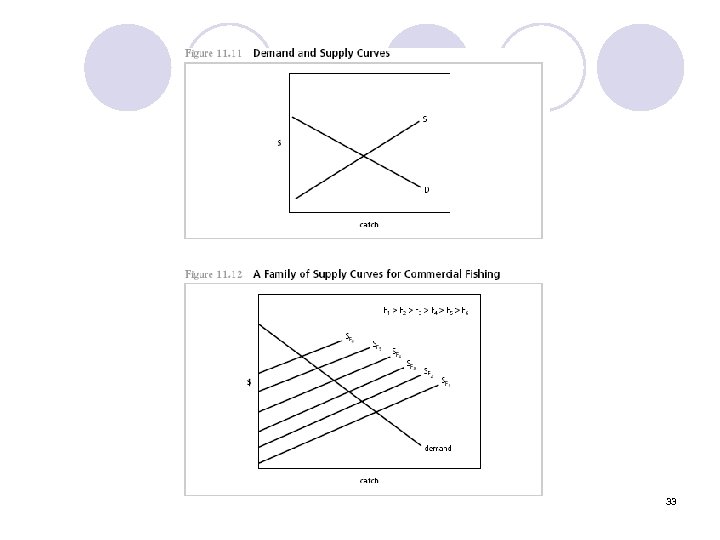
 Shortcomings of the Gordon Model The primary shortcoming of the Gordon model is that it is static in nature, rather than dynamic. l Clark (1985) shows that as the discount rate gets very large, the dynamically optimal level of catch approaches that associated with open access. l Another shortcoming of the Gordon approach is that it does not consider consumers' and producers' surplus, which may exist and be important in many fisheries, particularly for some threatened fisheries such as salmon, redfish, and Alaskan King Crab. l In an attempt to incorporate consumers' and producers' surplus into a model of the fishery, conventional demand supply models are integrated into the fishery model (Figure 11. 11). The horizontal axis is no longer measured in terms of effort, but in units of catch. l 32
 33
33
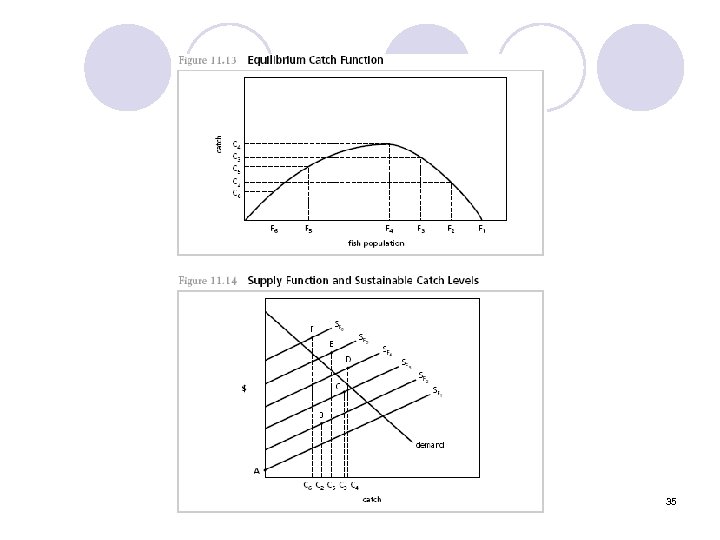
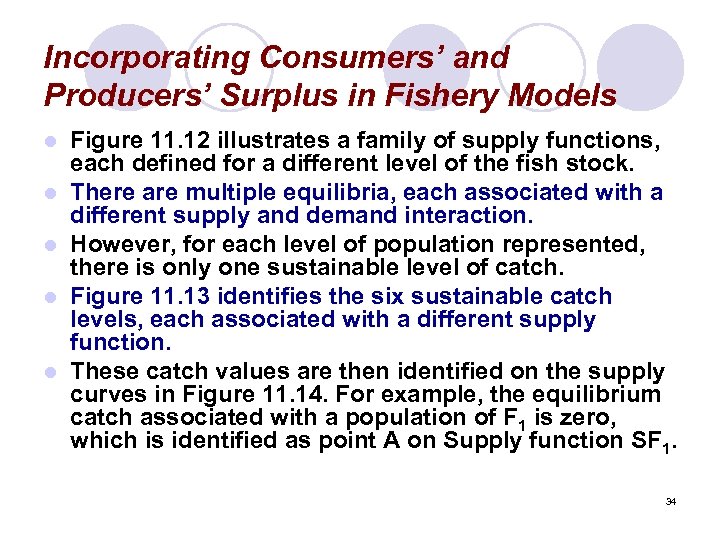 Incorporating Consumers’ and Producers’ Surplus in Fishery Models l l l Figure 11. 12 illustrates a family of supply functions, each defined for a different level of the fish stock. There are multiple equilibria, each associated with a different supply and demand interaction. However, for each level of population represented, there is only one sustainable level of catch. Figure 11. 13 identifies the six sustainable catch levels, each associated with a different supply function. These catch values are then identified on the supply curves in Figure 11. 14. For example, the equilibrium catch associated with a population of F 1 is zero, which is identified as point A on Supply function SF 1. 34
 35
35
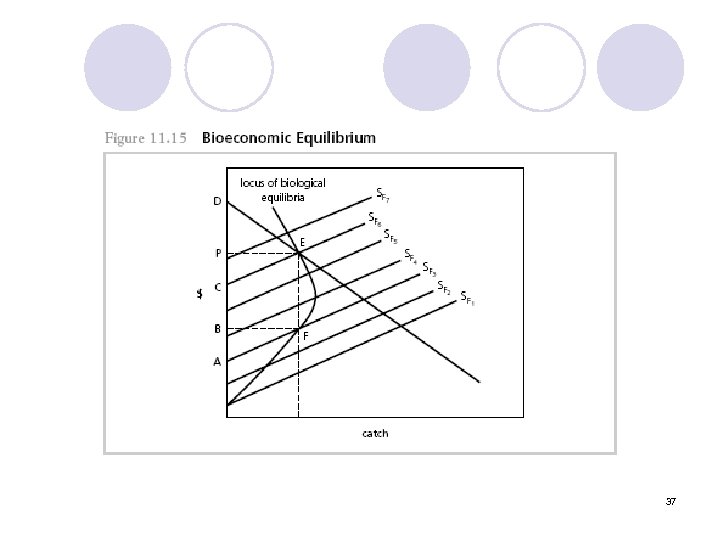
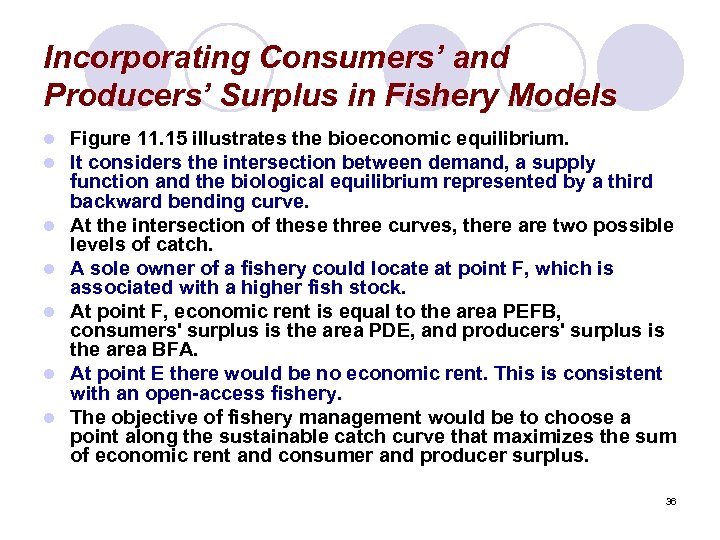 Incorporating Consumers’ and Producers’ Surplus in Fishery Models l l l l Figure 11. 15 illustrates the bioeconomic equilibrium. It considers the intersection between demand, a supply function and the biological equilibrium represented by a third backward bending curve. At the intersection of these three curves, there are two possible levels of catch. A sole owner of a fishery could locate at point F, which is associated with a higher fish stock. At point F, economic rent is equal to the area PEFB, consumers' surplus is the area PDE, and producers' surplus is the area BFA. At point E there would be no economic rent. This is consistent with an open-access fishery. The objective of fishery management would be to choose a point along the sustainable catch curve that maximizes the sum of economic rent and consumer and producer surplus. 36
 37
37
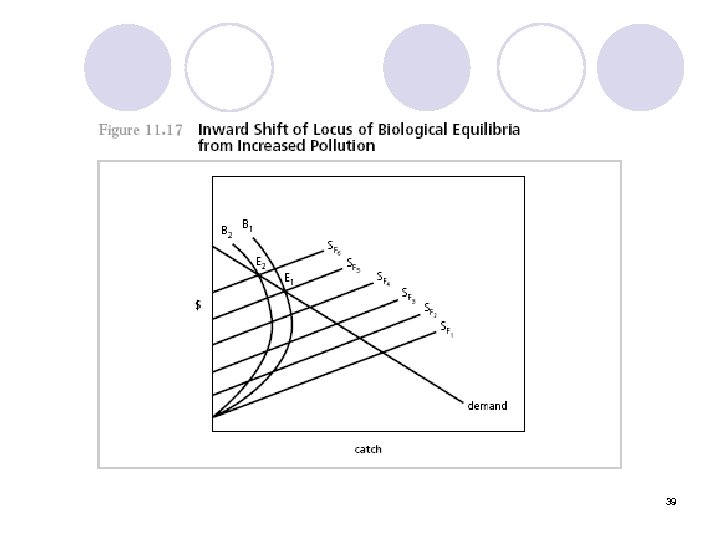
 Incorporating Consumers’ and Producers’ Surplus in Fishery Models l l l l It is also possible to use this model to examine other types of fishery management problems. An example would be modeling the fishery-related damages from the pollution in the Chesapeake Bay. Since the Chesapeake Bay is the major spawning area for striped bass along the Mid-Atlantic and North Atlantic coast, a downward sloping demand curve is appropriate. Evidence suggests that there are strong locational advantages across potential fishing sites. This translates into an increasing marginal cost function associated with catching striped bass. The impact of pollution may be to decrease the carrying capacity of the environment. The result is that the locus of points that illustrate the biological equilibrium associated with different supply functions has shifted inward (Figure 11. 7). 38
 39
39
 Current Fishery Policy l l l This section will focus on two approaches to policy as defined by Anderson (1986). Those policies that can actually address the issue of entry are termed "limited-entry" techniques. All other regulations or policies that do not explicitly address the problem of entry are termed “openaccess" techniques. Open-access techniques modify fishing behavior of those participants in the fishery without directly affecting participation in the fishery. They typically raise the cost associated with fishing. 40
 Current Fishery Policy Open-access regulations are designed to maintain the stocks at some target level, usually stocks consistent with maximum sustainable yield. l These regulations generally take the form of restrictions on how fish may be caught, which fish may be caught, and where fish may be caught. l Because modern technology can give a fishing fleet tremendous fishing power relative to the size of a fish population, open-access regulation generally forces inefficiency on the fishers. l For example, in Maryland's share of the Chesapeake, it is illegal to dredge for oysters under motorized power. This means sails, smaller dredging equipment, and slower movement across the oyster beds. l 41
 Current Fishery Policy Regulation which revolves around restrictions on the minimum size of fish that are legal to harvest are designed to leave a portion of the fish stock in the water to provide a sufficient breeding stock to ensure future populations. l Fishers generally implement this restriction by choosing a mesh size for their nets that allows smaller, illegal fish, to escape. l Because fishing activity may disrupt the spawning process, often the fishing season is closed for a certain period on an annual basis, generally during spawning season. l Also, some species become so extremely congregated during spawning that fishing effort could capture virtually the entire population. l 42
 Current Fishing Policy Regulations on where fish may be caught are designed to protect fish stocks when they are congregated and vulnerable to overharvesting. l These types of regulations also protect vulnerable fishing habitats from destruction by the fishing process. l Often, open-access regulations take the form of limits on how many fish may be captured in a given time period. l These limits may be in the form of weight caught, number of fish, or volume of catch. l The catch limit on giant bluefin tuna is 1 fish per boat. A fish can often weigh as much as 1000 pounds and the market price has been $18 per pound. l 43
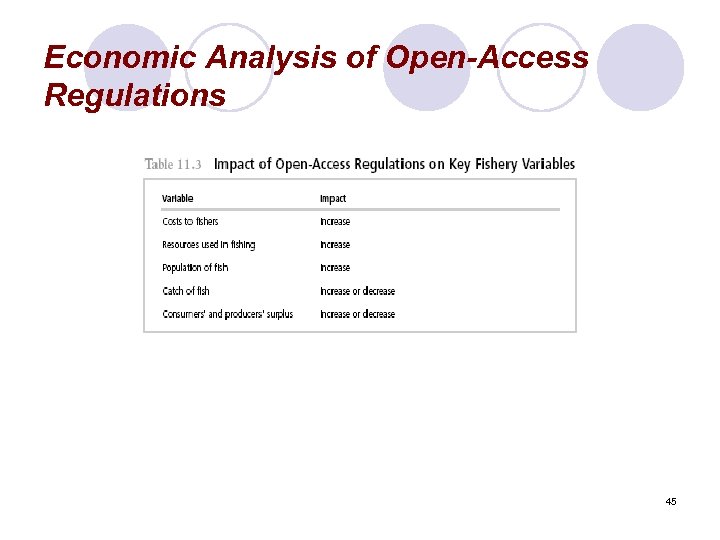
 Economic Analysis of Open-Access Regulations The effect of open-access regulation falls into one of two categories: an increase in cost due to regulations or a possible decrease in cost due to higher catch per effort expended. l It should be noted that in the process of raising costs to protect the stock of fish, the open-access regulations can exacerbate the problem of too many resources being devoted to the fishery. l Table 11. 3 summarizes the impact of the openaccess regulations on key variables in the fishery. l 44
 Economic Analysis of Open-Access Regulations 45
 Aquaculture l l l Aquaculture, the cultivation of fish in artificial environments or in contained natural environments, is often suggested as a means of dealing with the open-access problem. Not all species can be cultivated. Shellfish are ideal because of their inherent immobility. Wildfish will only benefit indirectly from aquaculture if the "farmed" species usurps part of the market demand for the wildfish and therefore reduces the fishing pressure on the species. Aquaculture creates its own set of problems. Communities and industries that are based on wild fisheries could suffer economic setbacks from the decline in demand for wild fish (as consumers choose aquaculture). 46
 Aquaculture can severely damage the environment. l Shrimp aquaculture in Central and South America has resulted in a loss of mangrove forests, excess nutrient loading into estuaries and severely reduced dissolved oxygen in areas bordering estuaries. l There also potential problems associated with hybridized fish escaping and damaging the gene pool of existing species. l 47
 Limited Entry Techniques Limited entry techniques raise the cost for fishers without increasing social costs. l If limited entry techniques are truly analogous to economic incentives for pollution control, then they should be available either as price policies or quantity policies. l Fisheries economics literature tends to focus on permit-based systems. l The name for these systems is individual transferable quotas (ITQs). l 48
 Limited Entry Techniques l l l Individual transferable quotas (ITQs) would work in a fashion similar to marketable pollution permits. By limiting the number of catch quota which are issued, bidding for the quotas will occur until the price of the quota is exactly equal to the divergence between average cost and price (average rent). Limited entry techniques structured to direct effort rather than catch can also be developed. Here only a fixed number of boats would be allowed to operate in the fishery. The method of permit allocation could be by auction or historical presence in the fishery. 49
 Limited Entry Techniques l l l If these ITQs are transferable, it will be possible to have only the most efficient fisherman in the fishery. Enforcement of effort-based limits, that is vessel permits, would be much easier than that associated with the catch limits. No measuring or weighing is necessary; a poster sized certificate of operation would allow easy identification of legal vessels. Catch-based ITQs are subject to several problems. People might cheat on their quota by selling to foreign vessels or in an underground market. Another problem is associated with the differing market values of different size fish. 50
 Limited Entry Techniques Although most fishery regulation relies on open-access techniques, an important example of a limited entry technique is the Virginia oyster fishery, where oyster beds are treated as private property. l It gives oyster bed operators incentive to invest in their property such as seeding with larval oysters and creating more structures to which the oysters can attach. l An additional example of the limited entry regulation is the economic exclusion zone, established under the authority of the United Nations Convention of the Law of the Sea. l This regulation established a 200 mile limit along the coast of a country where each country has the right to limit access to their waters. This is a partial limited access regulation. l 51
 Why We Do Not See More Limits to Entry l l l First, many limits to access are informal. Second, fisherman opposition to the idea of limited entry is high. However, within the fishing industry there are some informal barriers to entry. Fishing communities tend to be close knit and generally resistant to outsiders. It is difficult to enter into these fisheries without facing barriers and possible sabotage of equipment. This particular issue was dramatized in the movie Alamo Bay, a depiction of the tensions and conflicts between historic fishing/ shrimping families along the Texas Gulf coast and an immigrant group of fishers (Vietnamese immigrants). 52
 Why We Do Not See More Limits to Entry A possible explanation for the opposition to limited entry among current fishers is that these fishers may be utility maximizers rather than profit maximizers. l Pure profit maximizers would see the potential economic rents associated with limited entry, and most would probably support limits to entry in order to obtain these potential rents. l Fishers from communities with a tradition of membership in the fishery are likely to fall in this category. l Inshore fisheries that require smaller boats and less equipment are more likely to be utility maximizers rather than profit maximizers. l 53
 Why We Do Not See More Limits to Entry l l l Another factor that may be critically important in the opposition to limited entry has to do with the need to reduce catch today in order to expand fish stock, catch and income in the future. The desire to support fishing families in the present may result in opposition of limited entry policies. A final factor is related to the uncertainty of future benefits. The greater the uncertainty about the success of limited entry policies to enhance future value in the fishery, the greater the chance fishers will not support the policies. Current regulation has not solved the open-access problem. 54
 Other Issues in Fishery Management l Other problems associated with fishery management include: ¡ ¡ ¡ incidental catch; destruction of habitat through fishing activities; destruction of wetlands and related habitat through non-fishing activities; pollution of fishery habitat; conflicts between user groups and international cooperation concerning the harvesting of migratory species. 55
 Gill Nets and Long Lines Often the fisher will catch not only the species that they seek but also other species, referred to as incidental catch. l Many types of fishing gear do not discriminate among fish species, and both the desired species and a spectrum of untargeted species are caught by this gear. l Among the most notorious of these are the gill nets, whose lengths often measured in miles. l These nets are vertically suspended in the water, like underwater fences, ensnaring the gill covers of fish as they attempt to back out. l 56
 Gill Nets and Long Lines Another indiscriminate fishing method is "longlining. " l A long-line consists of line that may be 10 kilometers in length or longer, with baited hooks every several meters. l These lines are employed off the Atlantic coast in pursuit of highly profitable swordfish. l Because sharks are often caught, these long-lines have been an important factor in the decline of the shark populations. l 57
 Gill Nets and Long Lines l l l Due to the difficulties of monitoring, restrictions on fishing methods may be preferential to policies based on economic incentives. An example of this type of policy is the requirement that shrimpers install a Turtle Excluder Device (TED) in their nets to allow endangered sea turtles to escape. In addition to the turtles which are "kicked" out of the shrimp net, non-targeted fish are also allowed to escape. Whether policy makers should implement the restrictions on gill nets and long-line operations needs to be determined on a case-by-case basis for each potential restriction. The benefits of protecting untargeted species are spread out over a large number of people, but the costs are concentrated upon a very few. 58
 Destruction of Habitat Through Fishing Activities Some fishing techniques can cause damage to the ecosystem in which the fish exist, diminishing the productivity of the fishery and ecological services. l Damage can occur when contact of fishing gear with the floor of the estuary or ocean uproots aquatic plants, breaks coral, dislodges shell fish, and so on. l One particularly sensitive ecosystem is that associated with a coral reef, where anchors and boat bottoms dragging across the coral can kill it. l Even more destructive is the practice of fishing using explosions or the use of cyanide in the coral to stun and collect fish for consumption and aquariums. l 59
 Destruction of Wetlands and Related Habitat Other habitats such as upland coastal wetlands, temperate forests and free flowing rivers are critically important to fisheries. l The temperate rainforests of the Pacific Northwest are critically important to maintaining the riverine habitat, which is essential to anadromous fish, such as salmon and steelhead. l Any activity which impacts the quality of these ecosystems can impact the quality of the riverine system and the salmon and steelhead. l 60
 Pollution of Fishery Habitat In the United States, many fisheries are in decline because pollution has diminished habitat. l This pollution and loss of habitat has affected virtually every freshwater species, and many saltwater species, where saltwater species are affected by estuarine pollution. l Anadromous species such as salmon, steelhead, shad, and striped bass are particularly vulnerable to riverine pollution. l In developing countries, soil erosion from deforestation and intensive cultivation of hillside lands has severely impacted water quality not only in the rivers, but in reservoirs, estuaries, lagoons, and coral reefs. l 61
 Management of Recreational Fishery Resources l l l In most North American recreational fisheries, there is unrestricted access to the resource, leading to open-access exploitation. Recreational policies take the form of limits on the number of fish that may be kept, restricted seasons, and size limits. By stocking fish, where a very large number of fish are hatched, grown to size, and released into the wild, the problem of openaccess is addressed by increasing resource base. Recreational fisheries often have closed seasons timed to coincide with spawning periods in the fishery. Access improvements such as launching ramps, fishing piers, parking areas, and artificial reefs can be designed to reduce congestion in the fishery, although they may also lead to increased use. 62
 Management of Recreational Fishery Resources Catch and release programs are based on the idea that a recreational angler does not have to kill his or her catch to produce utility from fishing. l These regulations allow fish to be caught, released, and left to grow, reproduce, and be caught again. l Catch and release regulations generally take the form of moral suasion and command control. l Size limits place restrictions on the minimum (and sometimes maximum) size of fish that are legal to keep. l Creel limits place restrictions on the maximum number of fish per day that may be kept. l Both restrictions are designed to protect the reproductive viability of the fish stocks. l 63
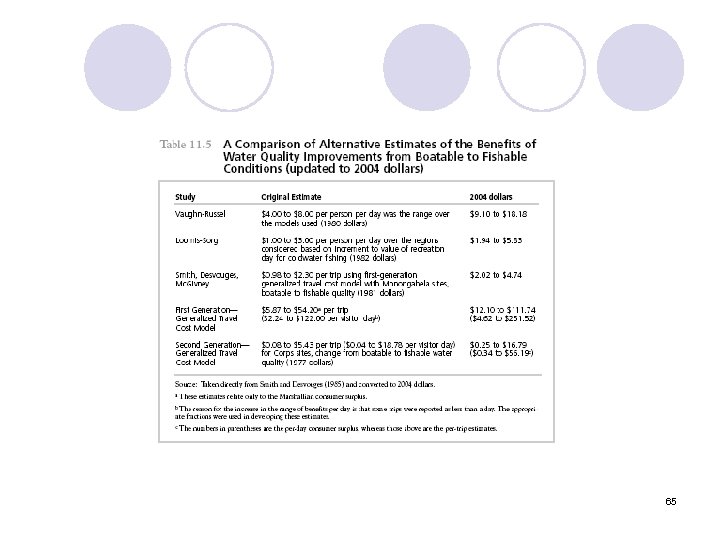
 Management of Recreational Fishery Resources In order to find the benefits associated with a particular recreational fishing activity, a valuation study must be done. l Such studies generally take the form of contingent valuation or travel cost studies. l Freeman (1979) and many others note that the major benefit of improving water quality can be attributed to recreational uses of water resources, including boating, swimming, and recreational fishing. l This and other studies presented in Table 11. 5 indicate a high value placed on recreational fishing. l 64
 65
65
 Summary Fishery resources are renewable but destructible. l The destructibility problem is amplified by the openaccess nature of many of the world’s fishery resources. l For commercial fishing, optimal management strategy requires the limitation of effort to a level that maximizes the sum of consumers’ surplus, producers’ surplus, and fishery rent. l Actual fishery management seldom achieves this goal and is based on developing restrictions on how, when, where, and how much fish can be caught. l 66