 Скачать презентацию The Eco-Municipality Model for Sustainable Community Change Chequamegon
e6f1bf3357dfb76d295c449fab29baba.ppt
- Количество слайдов: 52



The Eco-Municipality Model for Sustainable Community Change: Chequamegon Bay “Making Connections” Pro. Walk/Pro Bike 2006 Madison WI September 6, 2006
What is an “eco-municipality”? q aspires to develop an ecologically, economically, and socially healthy community for the long term q using the Natural Step framework for sustainability as a guide q and a democratic, highly participative development process as the method. Source: “Eco-municipality Synopsis. ” n. d.
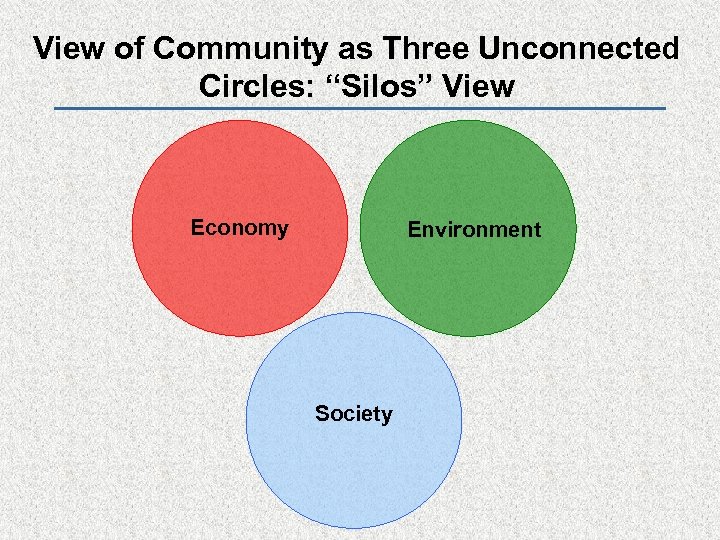
View of Community as Three Unconnected Circles: “Silos” View Economy Environment Society
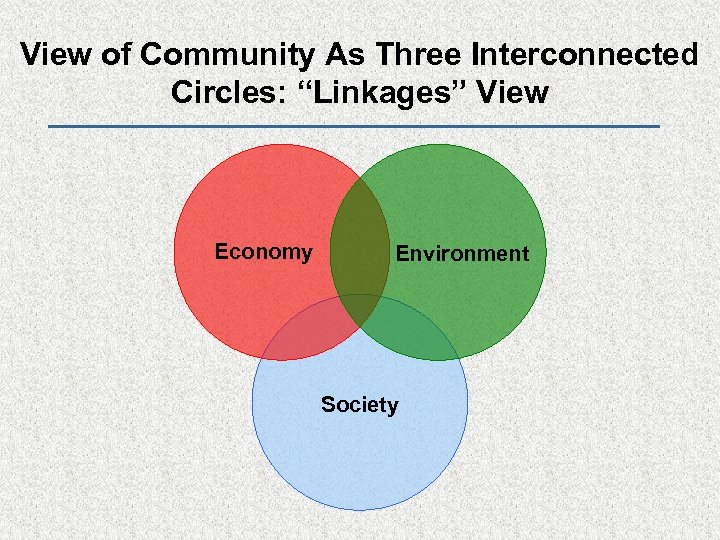
View of Community As Three Interconnected Circles: “Linkages” View Economy Environment Society
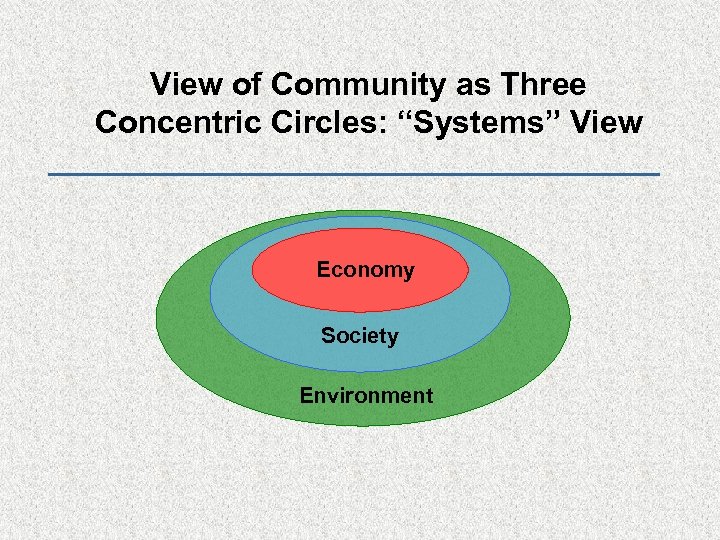
View of Community as Three Concentric Circles: “Systems” View Economy Society Environment
What is different about this model? The eco-municipality model uses a systems approach. Key ingredients are widespread community awareness-raising and integrated community involvement, using a common “sustainability language” based upon the Natural Step framework. Source: “Eco-municipality Synopsis. ” n. d.
The Natural Step Australia Brazil Canada Israel Japan New Zealand South Africa Sweden United Kingdom To develop and share a common framework comprised of easilyunderstood, scientifically-based principles that can serve as a compass to guide society toward a just and sustainable future.
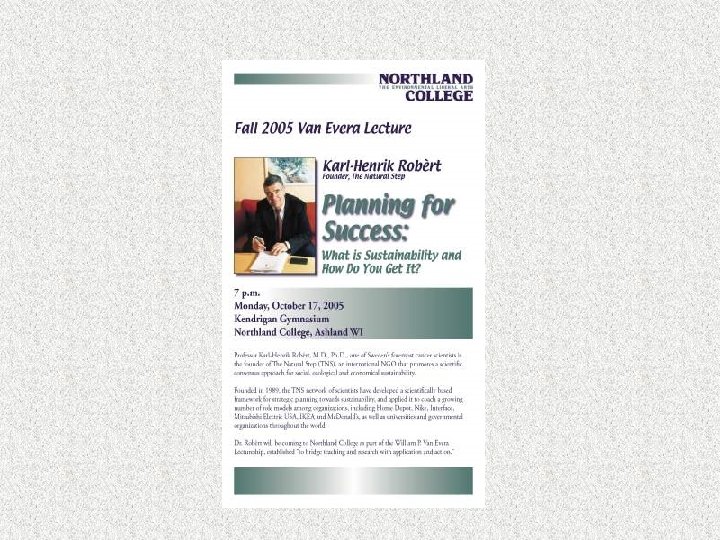
Find fundamental principles of indisputable relevance, and thereafter ask the advice of others on how to apply them. Dr. Karl-Henrik Robèrt

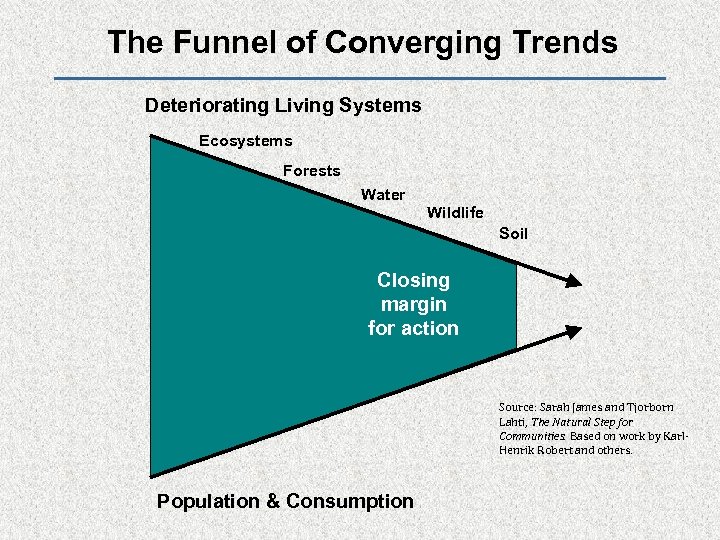
The Funnel of Converging Trends Deteriorating Living Systems Ecosystems Forests Water Wildlife Soil Closing margin for action Source: Sarah James and Tjorborn Lahti, The Natural Step for Communities. Based on work by Karl. Henrik Robert and others. Population & Consumption
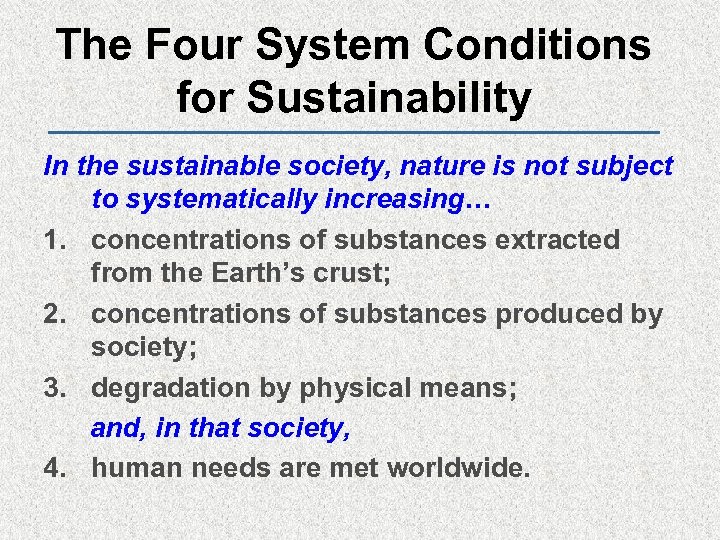
The Four System Conditions for Sustainability In the sustainable society, nature is not subject to systematically increasing… 1. concentrations of substances extracted from the Earth’s crust; 2. concentrations of substances produced by society; 3. degradation by physical means; and, in that society, 4. human needs are met worldwide.
System Condition 1 In order for a society to be sustainable, nature’s functions and diversity are not systematically subject to increasing concentrations of substances extracted from the earth’s crust. • Ties into the First Law of Thermodynamics • Total mass and energy in the universe is conserved • For example, the burning of fossil fuels simply creates gases in the atmosphere
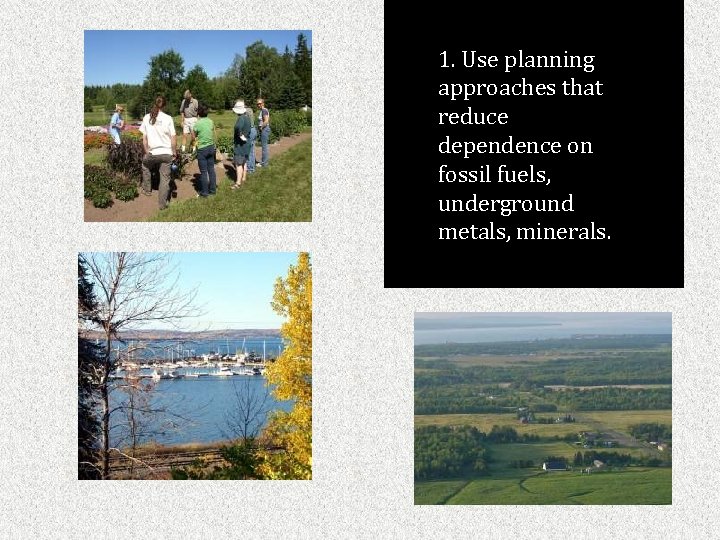
1. Use planning approaches that reduce dependence on fossil fuels, underground metals, minerals.

System Condition 2 In order for a society to be sustainable, nature’s functions and diversity are not systematically subject to increasing concentrations of substances produced by society. • Based on the Second Law of Thermodynamics (the Law of Entropy) • Energy and matter tend to spread spontaneously and everything has a tendency to disperse -- bioaccumulation • Examples range from mercury and lead poisoning to water pollution and toxic waste
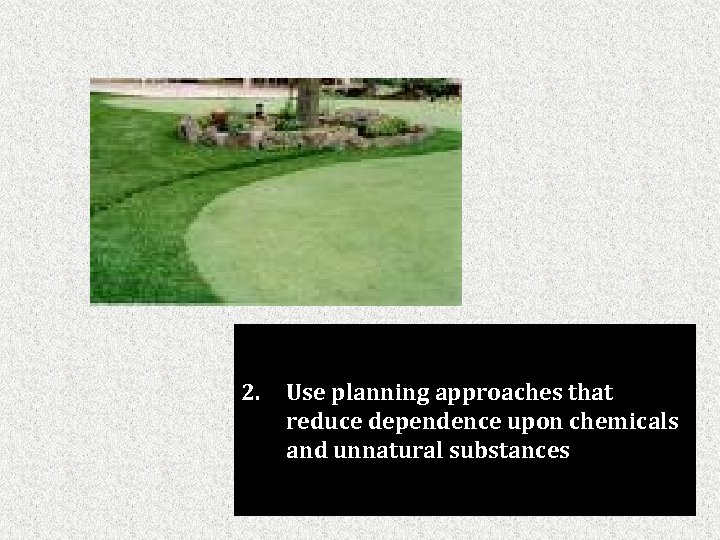
2. Use planning approaches that reduce dependence upon chemicals and unnatural substances.
System Condition 3 In order for a society to be sustainable, nature’s functions and diversity are not systematically impoverished by physical displacement, over-harvesting or other forms of ecosystem manipulation. • Maintaining the integrity of ecosystems, including biodiversity, is underscored • The need to value the functions of living systems, such as water and air purification, pollination and climate regulation • Calls for “systems thinking” approach to resource management and biological conservation
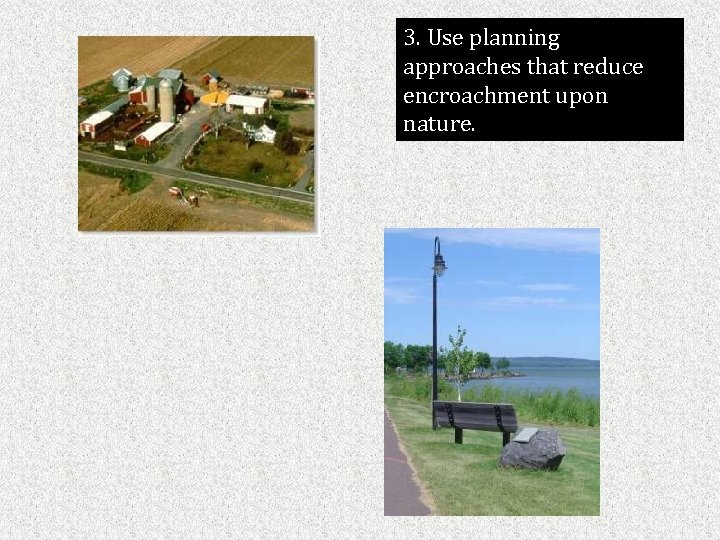
3. Use planning approaches that reduce encroachment upon nature.
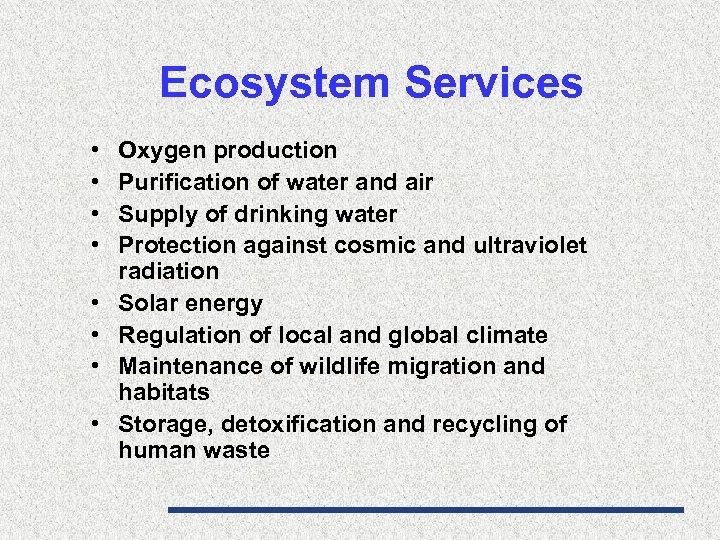
Ecosystem Services • • Oxygen production Purification of water and air Supply of drinking water Protection against cosmic and ultraviolet radiation Solar energy Regulation of local and global climate Maintenance of wildlife migration and habitats Storage, detoxification and recycling of human waste
System Condition 4 In order for a society to be sustainable, resources are used fairly and efficiently to meet basic human needs globally. • Speaks to the issue of equity • Provides an essential ethical aspect to the Natural Step • “Essential for social stability and the cooperation needed for making large-scale changes within the framework laid out by the first three conditions”
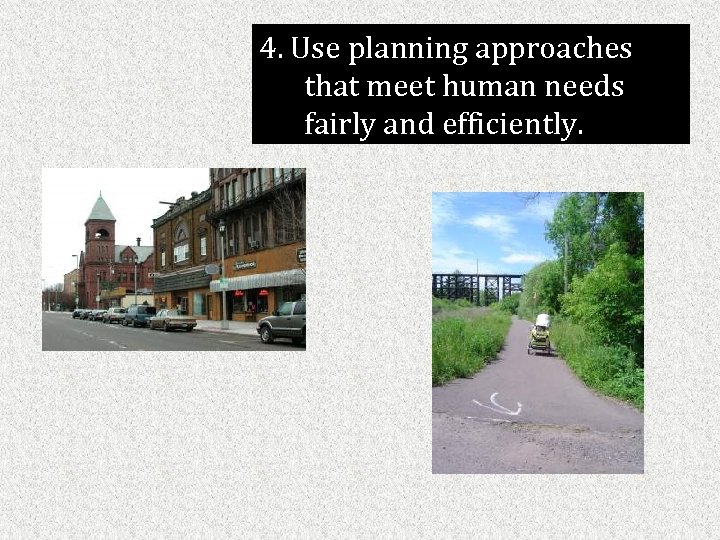
4. Use planning approaches that meet human needs fairly and efficiently.
Planning for Sustainability Policy Guide Adopted April, 2000
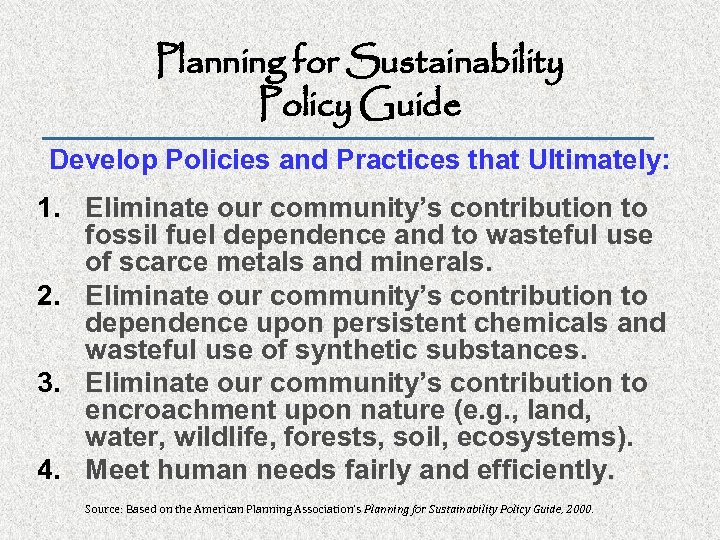
Planning for Sustainability Policy Guide Develop Policies and Practices that Ultimately: 1. Eliminate our community’s contribution to fossil fuel dependence and to wasteful use of scarce metals and minerals. 2. Eliminate our community’s contribution to dependence upon persistent chemicals and wasteful use of synthetic substances. 3. Eliminate our community’s contribution to encroachment upon nature (e. g. , land, water, wildlife, forests, soil, ecosystems). 4. Meet human needs fairly and efficiently. Source: Based on the American Planning Association’s Planning for Sustainability Policy Guide, 2000.
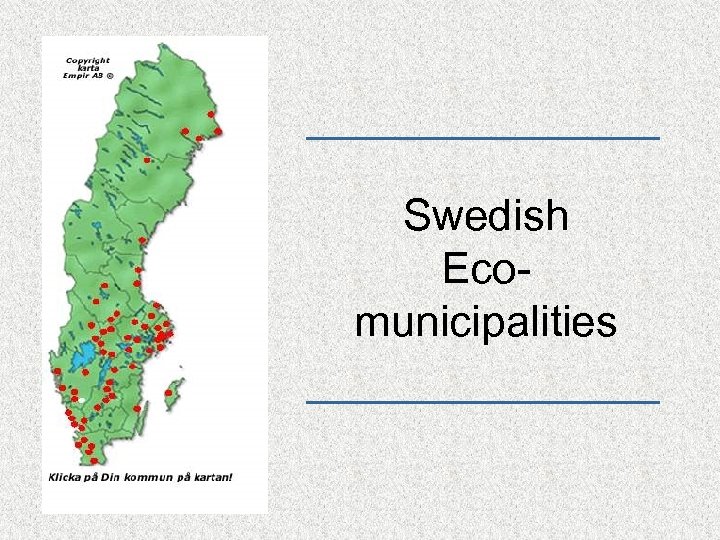
Swedish Ecomunicipalities
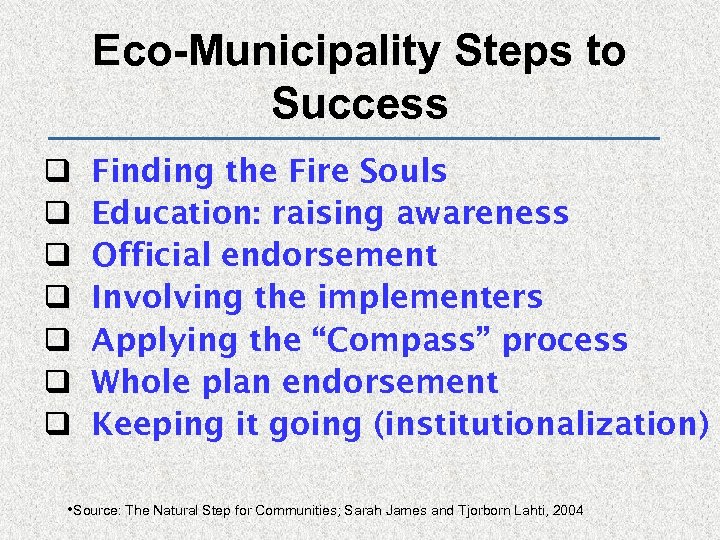
Eco-Municipality Steps to Success q q q q Finding the Fire Souls Education: raising awareness Official endorsement Involving the implementers Applying the “Compass” process Whole plan endorsement Keeping it going (institutionalization) • Source: The Natural Step for Communities; Sarah James and Tjorborn Lahti, 2004
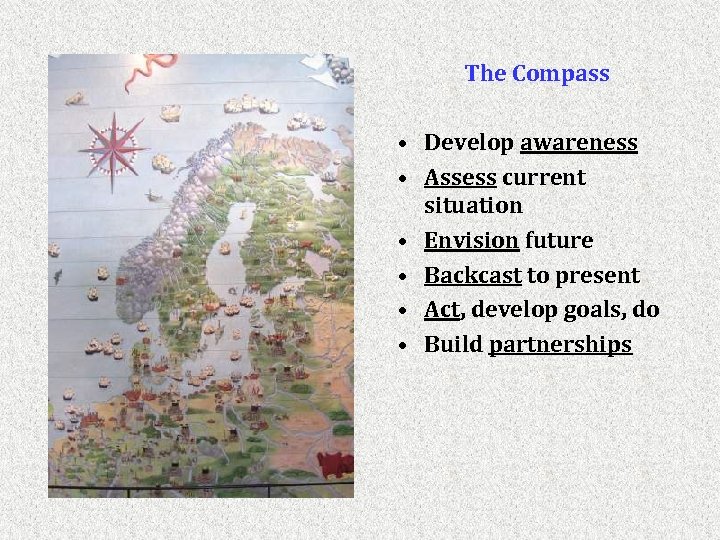
The Compass • Develop awareness • Assess current situation • Envision future • Backcast to present • Act, develop goals, do • Build partnerships
Chequamegon Bay Ecomunicipality Development 2004 -2006
Wisconsin Idea Seminar May 2002
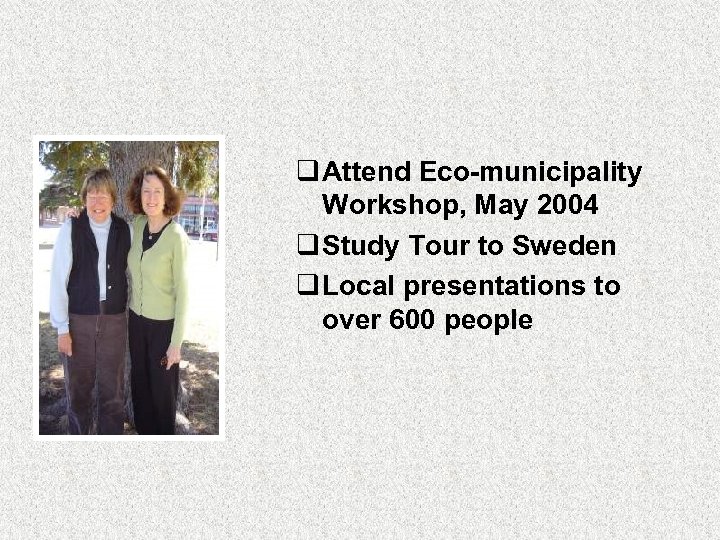
q Attend Eco-municipality Workshop, May 2004 q Study Tour to Sweden q Local presentations to over 600 people
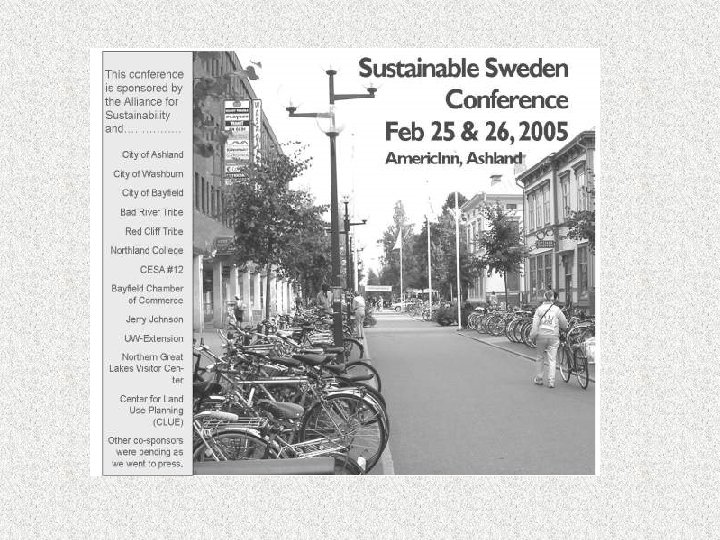
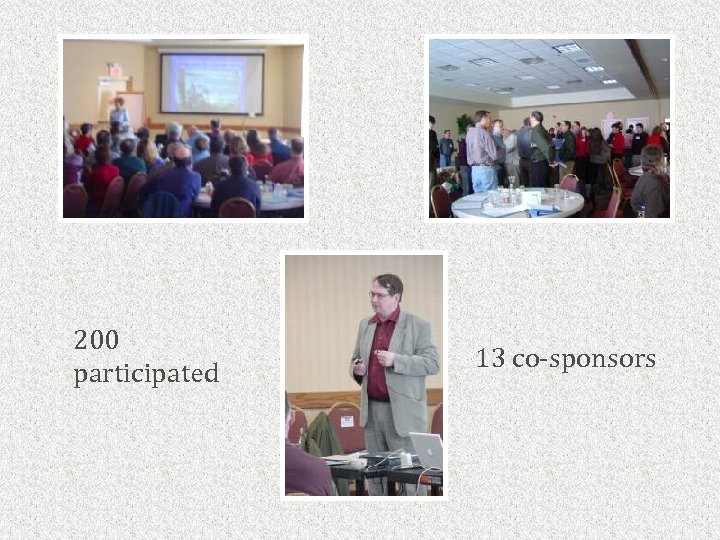
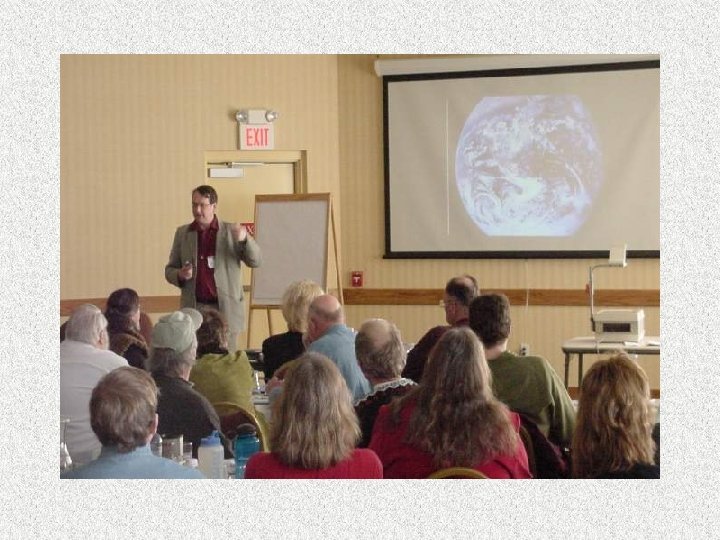
200 participated 13 co-sponsors
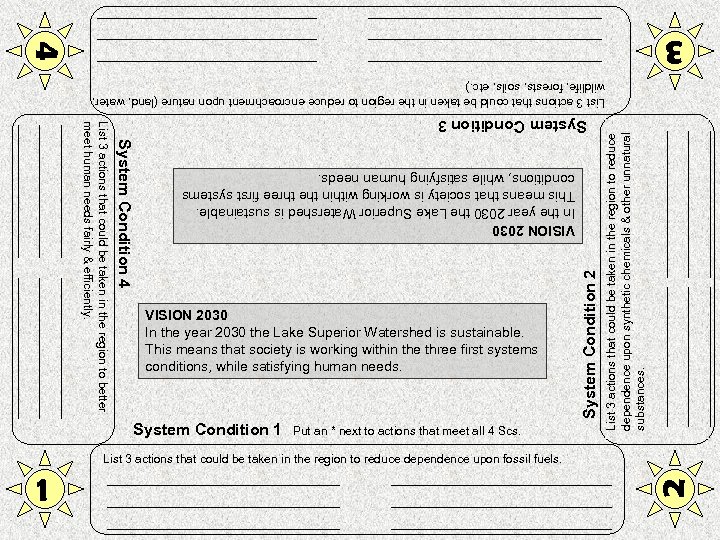
___________________________________ 3 ___________________________________ 4 1 ___________________________________ __________________ 2 List 3 actions that could be taken in the region to reduce dependence upon fossil fuels. ______________________ System Condition 2 VISION 2030 In the year 2030 the Lake Superior Watershed is sustainable. This means that society is working within the three first systems conditions, while satisfying human needs. Put an * next to actions that meet all 4 Scs. ______________________ System Condition 3 ___________ System Condition 1 List 3 actions that could be taken in the region to reduce dependence upon synthetic chemicals & other unnatural substances. List 3 actions that could be taken in the region to reduce encroachment upon nature (land, water, wildlife, forests, soils, etc. ) _____________________ System Condition 4 _____________________ List 3 actions that could be taken in the region to better meet human needs fairly & efficiently. __________ VISION 2030 In the year 2030 the Lake Superior Watershed is sustainable. This means that society is working within the three first systems conditions, while satisfying human needs.
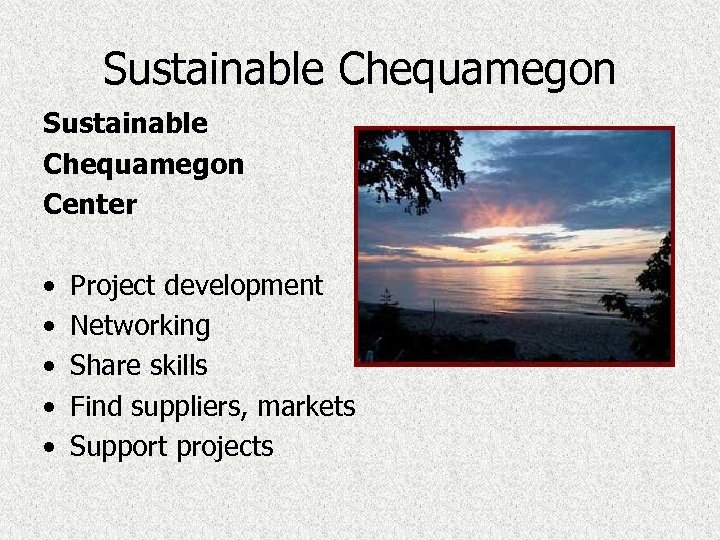
Sustainable Chequamegon Center • • • Project development Networking Share skills Find suppliers, markets Support projects
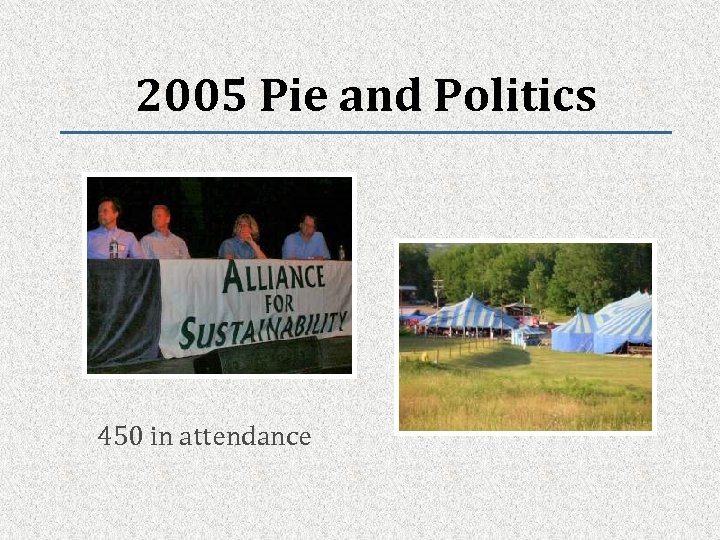
2005 Pie and Politics 450 in attendance
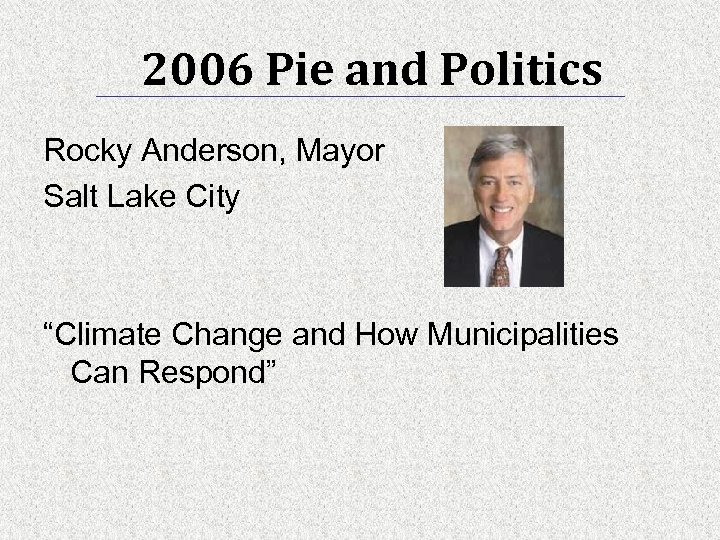
2006 Pie and Politics Rocky Anderson, Mayor Salt Lake City “Climate Change and How Municipalities Can Respond”

US Mayors Climate Change Protection Agreement
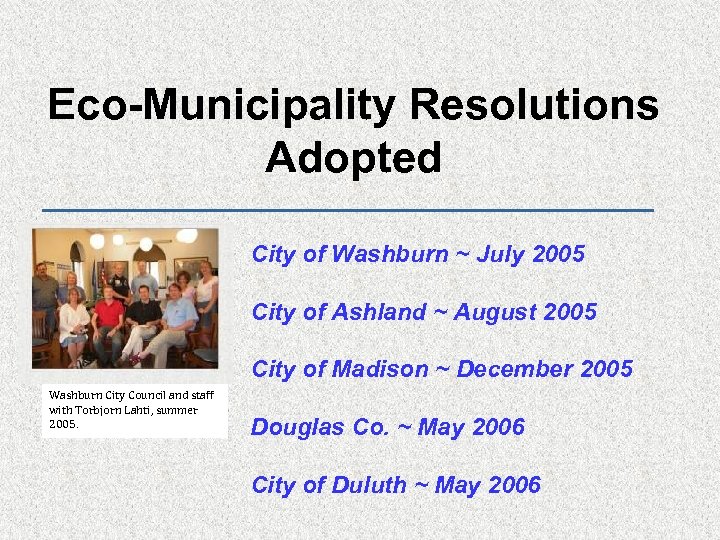
Eco-Municipality Resolutions Adopted City of Washburn ~ July 2005 City of Ashland ~ August 2005 City of Madison ~ December 2005 Washburn City Council and staff with Torbjorn Lahti, summer 2005. Douglas Co. ~ May 2006 City of Duluth ~ May 2006
Study Circles Alliance for Sustainability 9 circles: 3 in Ashland 3 in Washburn 2 in Bayfield 1 on Madeleine 80 participants
North American Eco. Municipality Network City of Washburn City of Ashland City of Madison Portsmouth NH Lawrence NJ Vandergrift PA Tufts University Sustainable Pittsburgh Whistler BC The Natural Step, Canada Sustain Dane University of Wisconsin-Extension
Sustainability Toolkit for Governments • Sherrie Gruder, SHWEC, UW-Madison • Anna Haines, CLUE, UW-Stevens Point • Jerry Hembd, NCCED, UW-Superior • Mary Kluz, CNRED, Marathon County • Lisa Mc. Kinnon, 1000 Friends of Wisconsin • Jane Silberstein, CNRED, Ashland County
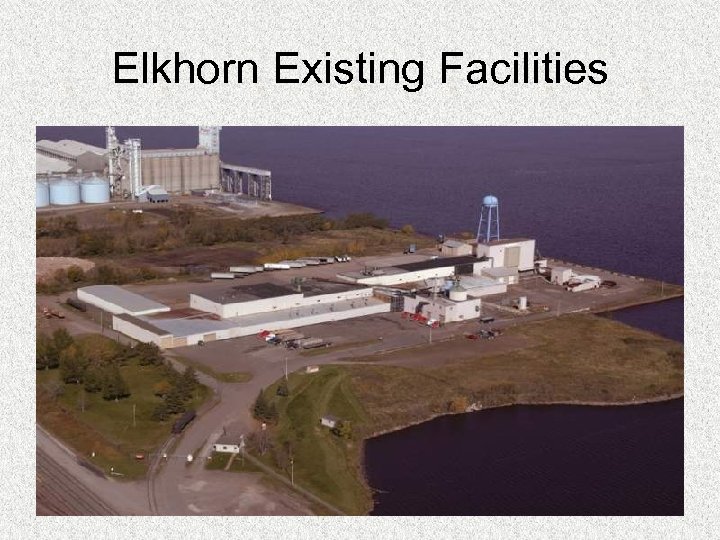
Elkhorn Existing Facilities
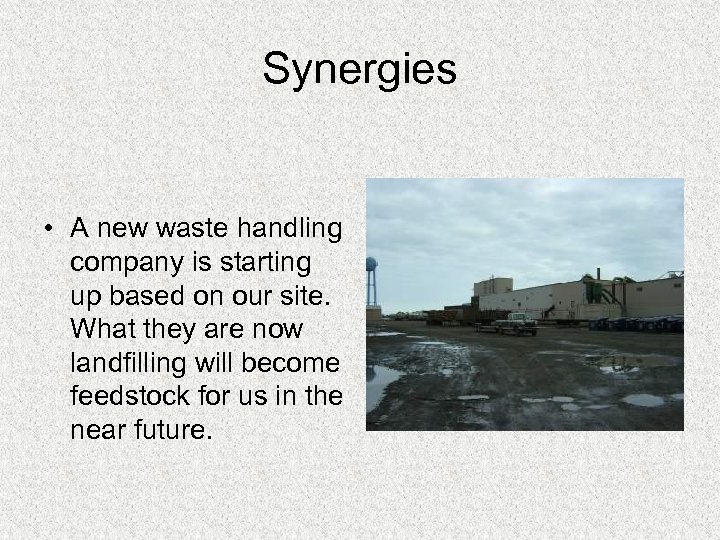
Synergies • A new waste handling company is starting up based on our site. What they are now landfilling will become feedstock for us in the near future.
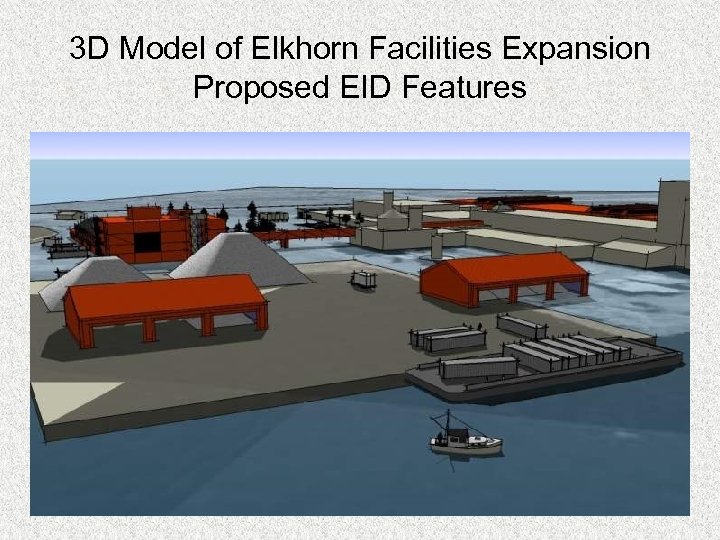
3 D Model of Elkhorn Facilities Expansion Proposed EID Features

Sustainable Chequamegon What’s Next? • Organizational structure and funding • Projects galore • Trip(s) to Sweden • On-going education and training • On-going Study Circles • Office/headquarters
JANE SILBERSTEIN Community, Natural Resource and Economic Development Educator University of Wisconsin-Extension Ashland County www. uwex. edu/ces/cty/ashland
Скачать презентацию The Eco-Municipality Model for Sustainable Community Change Chequamegon
e6f1bf3357dfb76d295c449fab29baba.ppt