


 Скачать презентацию THE EASTERN AFRICA DONOR MAP Show Me The
22675e4b4003ce42be4cf28328425138.ppt
- Количество слайдов: 19
 THE EASTERN AFRICA DONOR MAP Show Me The Money! 14 th Eastern Africa Resource Mobilization Workshop Paper By: David Maingi CEO / Managing Director, Kenya Film Commission © David Maingi 2007 1
 Contents • • Aid Architecture Drivers for Aid Architecture Emerging Aid Paradigm The Influence of Intergovernmental groupings on aid Options for Aid architecture to 2010 Categories of Donors Donor activity in Eastern Africa Guide to resources 2
 Aid Architecture The aid industry is undergoing significant change. On the one hand, volume is rising – from around $US 60 billion a year throughout the 1990 s to $US 100 bn in 2005 and a projected $US 130 bn by 2010. On the other hand, the architecture is becoming ever more complex, with a proliferation of agencies and special purpose vehicles. The United Nations Development Programme (UNDP) calculates that at global level there are now more than 1, 000 financing mechanisms 3
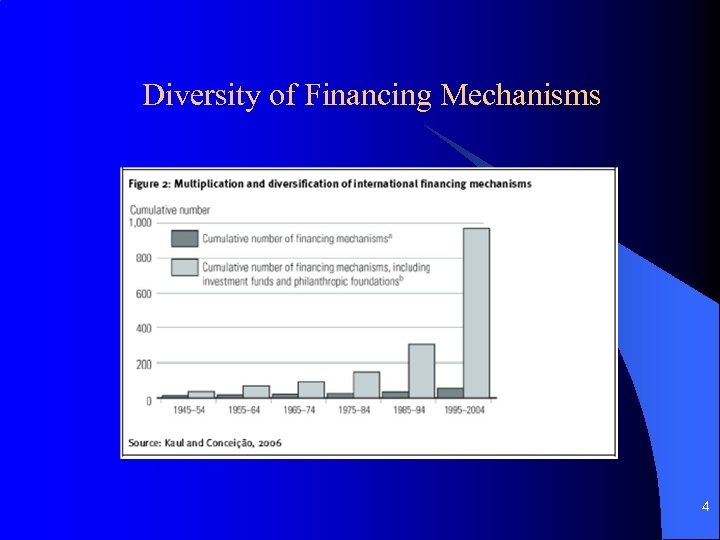 Diversity of Financing Mechanisms 4
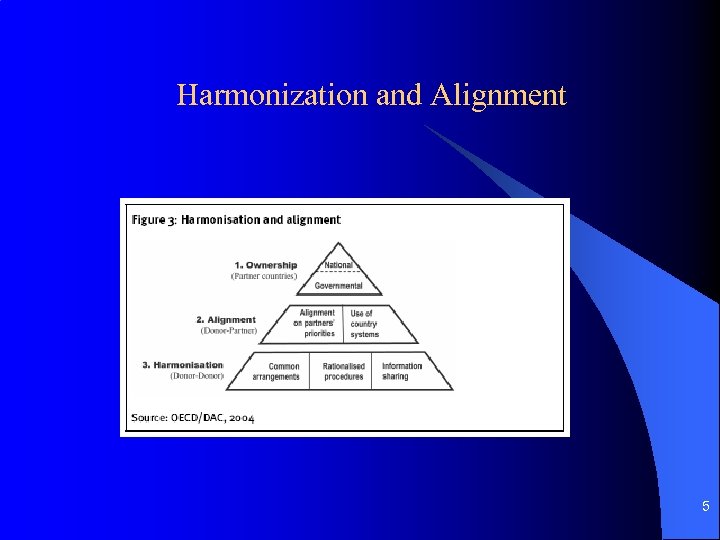 Harmonization and Alignment 5
 Aid Architecture Drivers Four underlying factors can be identified, as driving aid architecture • Multiple foreign and security policy objectives, loosely bundled with anti-poverty goals, with no common weighting system; • Continued existence of institutional barriers insulating aid programmes to different extents from hard budget constraints; • Reduced willingness, or ability, to use aid in its current form at both ends of the client spectrum: more advanced countries reject foreign intrusion; weaker countries badly need aid but cannot demonstrate the ability to use it; • New cosy relationships with private and voluntary organizations, funded by official aid, and competing with them for taxpayer and commercial support. 6
 Key elements of Emerging Aid Paradigm The key elements are • A compact linking sovereign responsibility in developing countries for good governance and development choices with better aid quality and sharply increased aid volume in developed countries; • The Millennium Development Goals (MDGs) as guidance for country development priorities; • Partnership approaches including the Poverty Reduction Strategy process; • Streamlined conditionality, recognizing the failure of traditional conditionality; • Performance-based aid allocations. • Aid vs Grand debate: Jubilee 2000 debt campaign, taken up by the Meltzer Commission and the Bush Administration in the US 7
 The Influence of Intergovernmental groupings on aid • The G 8: While its highly restrictive membership is a disadvantage in terms of legitimacy, the fact that this grouping contributes over two-thirds of ODA makes it an important forum. • The G 20: This informal grouping involves governments representing two-thirds of the world’s population and 85% of the world’s GDP, potentially providing it with greater legitimacy than the G 8. • The Commonwealth Secretariat: This is one of the oldest political groupings in the Inter-governmental constellation and has 53 members including developed, middle income, low-income and small-island states in its membership. • La Francophonie: This grouping plays a similar role to that of the Commonwealth Secretariat but for Francophone countries. 8
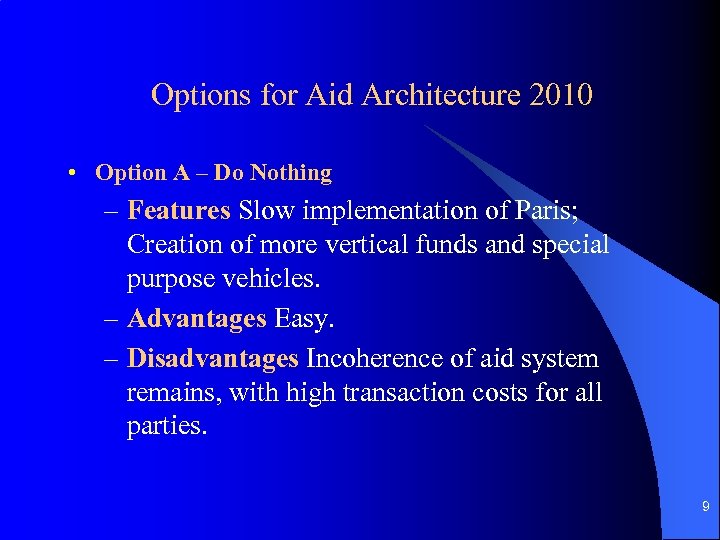 Options for Aid Architecture 2010 • Option A – Do Nothing – Features Slow implementation of Paris; Creation of more vertical funds and special purpose vehicles. – Advantages Easy. – Disadvantages Incoherence of aid system remains, with high transaction costs for all parties. 9
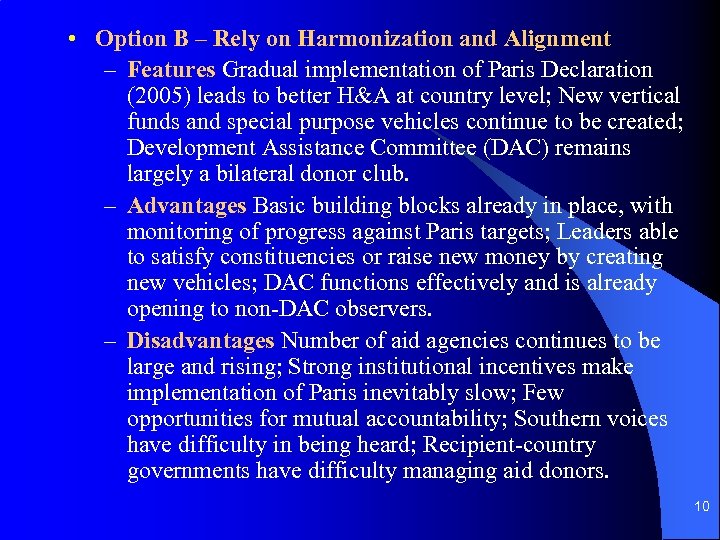 • Option B – Rely on Harmonization and Alignment – Features Gradual implementation of Paris Declaration (2005) leads to better H&A at country level; New vertical funds and special purpose vehicles continue to be created; Development Assistance Committee (DAC) remains largely a bilateral donor club. – Advantages Basic building blocks already in place, with monitoring of progress against Paris targets; Leaders able to satisfy constituencies or raise new money by creating new vehicles; DAC functions effectively and is already opening to non-DAC observers. – Disadvantages Number of aid agencies continues to be large and rising; Strong institutional incentives make implementation of Paris inevitably slow; Few opportunities for mutual accountability; Southern voices have difficulty in being heard; Recipient-country governments have difficulty managing aid donors. 10
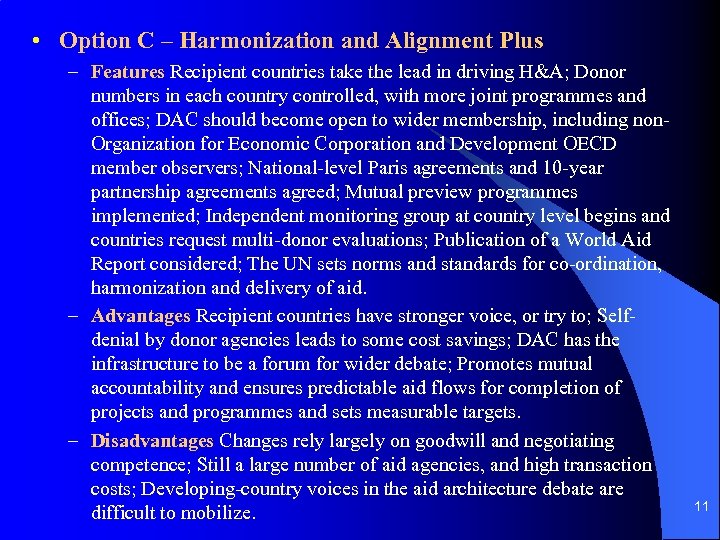 • Option C – Harmonization and Alignment Plus – Features Recipient countries take the lead in driving H&A; Donor numbers in each country controlled, with more joint programmes and offices; DAC should become open to wider membership, including non. Organization for Economic Corporation and Development OECD member observers; National-level Paris agreements and 10 -year partnership agreements agreed; Mutual preview programmes implemented; Independent monitoring group at country level begins and countries request multi-donor evaluations; Publication of a World Aid Report considered; The UN sets norms and standards for co-ordination, harmonization and delivery of aid. – Advantages Recipient countries have stronger voice, or try to; Selfdenial by donor agencies leads to some cost savings; DAC has the infrastructure to be a forum for wider debate; Promotes mutual accountability and ensures predictable aid flows for completion of projects and programmes and sets measurable targets. – Disadvantages Changes rely largely on goodwill and negotiating competence; Still a large number of aid agencies, and high transaction costs; Developing-country voices in the aid architecture debate are difficult to mobilize. 11
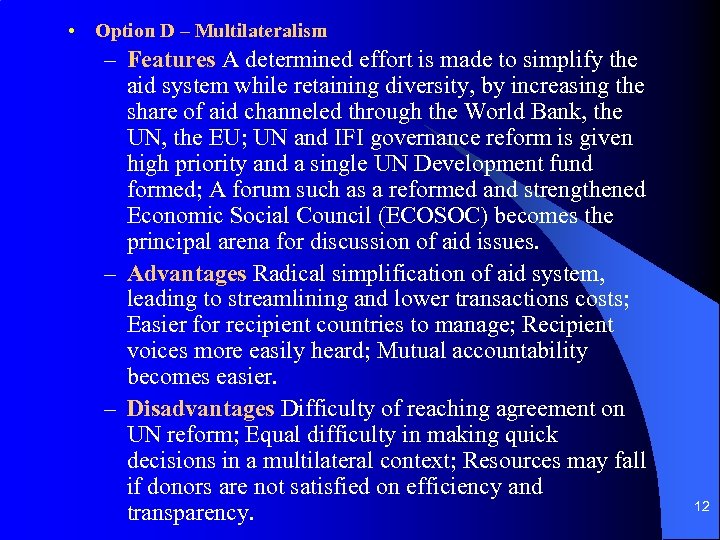 • Option D – Multilateralism – Features A determined effort is made to simplify the aid system while retaining diversity, by increasing the share of aid channeled through the World Bank, the UN, the EU; UN and IFI governance reform is given high priority and a single UN Development fund formed; A forum such as a reformed and strengthened Economic Social Council (ECOSOC) becomes the principal arena for discussion of aid issues. – Advantages Radical simplification of aid system, leading to streamlining and lower transactions costs; Easier for recipient countries to manage; Recipient voices more easily heard; Mutual accountability becomes easier. – Disadvantages Difficulty of reaching agreement on UN reform; Equal difficulty in making quick decisions in a multilateral context; Resources may fall if donors are not satisfied on efficiency and transparency. 12
 Option E – Empower Recipient Governments • Features Developing countries are equipped with better information about the relative performance of aid agencies, the result of independent monitoring and evaluation; They are then given more say in the choice of which agencies act as suppliers of aid, perhaps through vouchers or similar; A forum such as a reformed an strengthened ECOSOC becomes the principal arena for discussion of aid issues. • Advantages Rational allocation system possible; Recipient countries making their own choices of supplier of aid; Accountability easy to manage. • Disadvantages Difficult to establish universally accepted and independent benchmarks of performance; High level of audit and accountability needed to avoid rent-seeking; Resources may fall if donors are not satisfied on efficiency and transparency. 13
 Categories of Donors • • • Official Development Assistance (ODA) Agencies United Nations Agencies: Multilateral Development Banks International Foundations Global Corporations International Nongovernmental Organizations International Church-Based or Religious Organizations Government Sources Local Businesses Local Independent Foundations and Trusts Community Foundations Service Clubs and Membership Associations 14
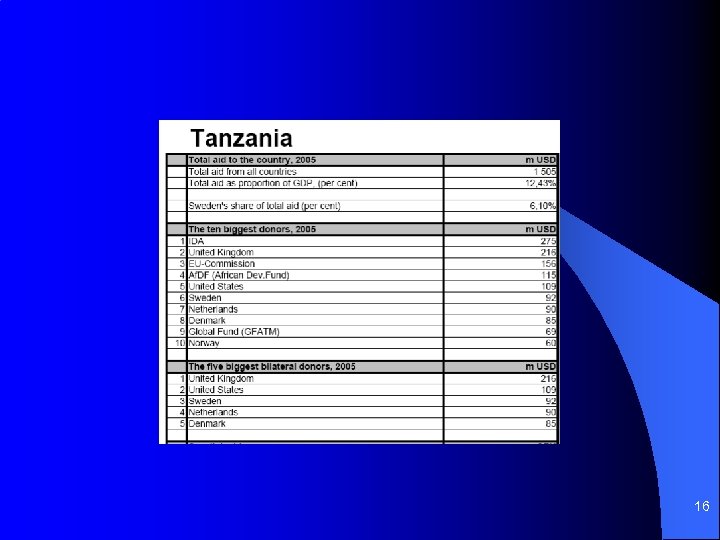
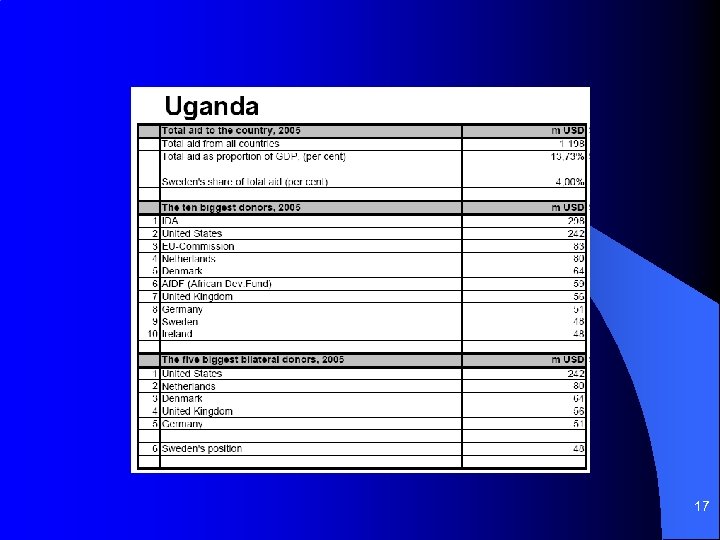
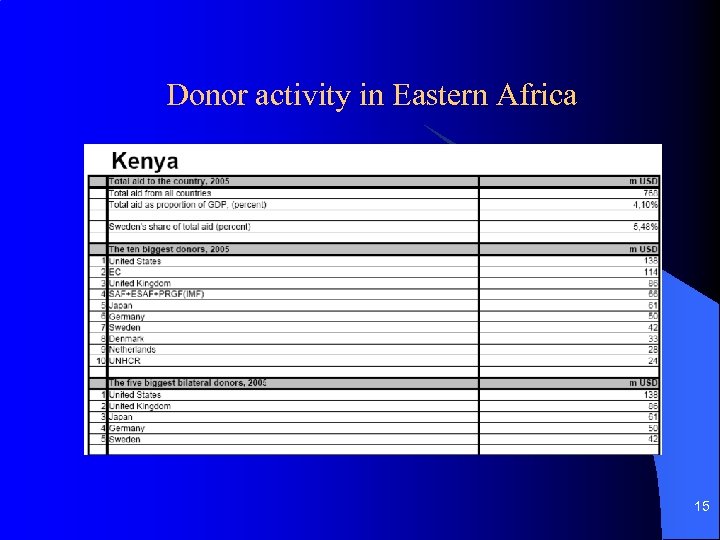 Donor activity in Eastern Africa 15
 16
16
 17
17
 Guide to Resources 18
 THANK YOU! 19