 Скачать презентацию The Ear Hearing and Balance The Ear
6eb60c5fc48914b788a269efc01fb36e.ppt
- Количество слайдов: 20



The Ear Hearing and Balance
The Ear: Hearing and Balance • The three parts of the ear are the inner, outer, and middle ear • The outer and middle ear are involved with hearing • The inner ear functions in both hearing and equilibrium • Receptors for hearing and balance: – Respond to separate stimuli – Are activated independently
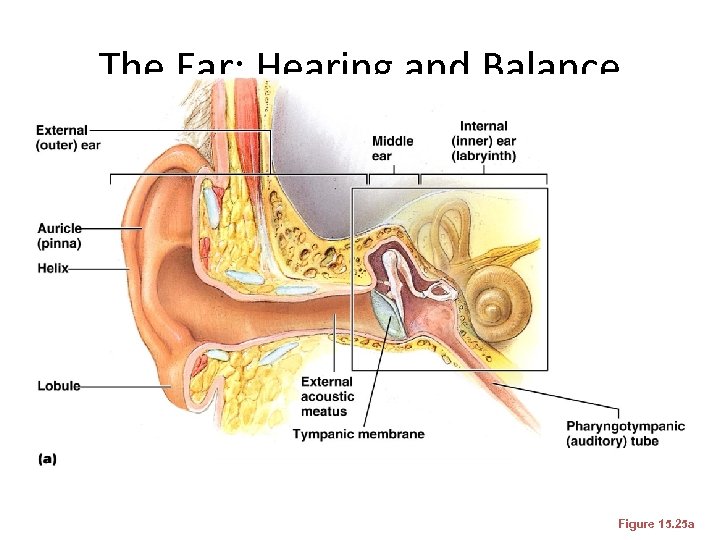
The Ear: Hearing and Balance Figure 15. 25 a
Outer Ear • The auricle (pinna) is composed of: – The helix (rim) – The lobule (earlobe) • External auditory canal – Short, curved tube filled with ceruminous glands
Outer Ear • Tympanic membrane (eardrum) – Thin connective tissue membrane that vibrates in response to sound – Transfers sound energy to the middle ear ossicles – Boundary between outer and middle ears
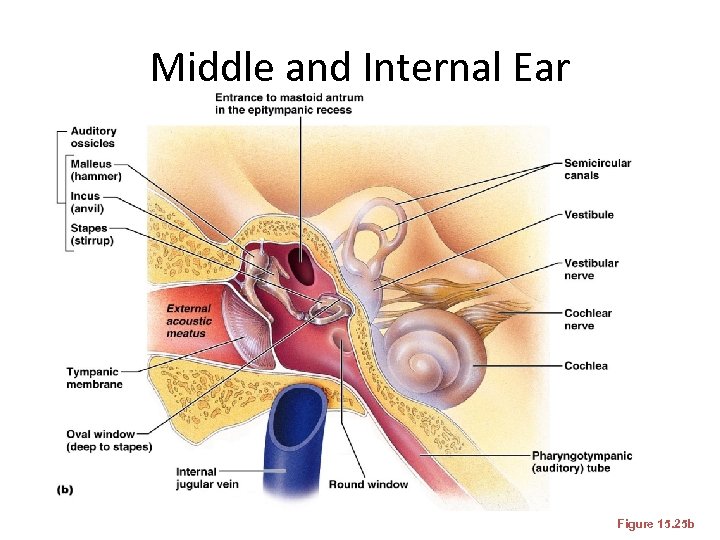
Middle and Internal Ear Figure 15. 25 b
Ear Ossicles • The tympanic cavity contains three small bones: the malleus, incus, and stapes –Transmit vibratory motion of the eardrum to the oval window –Dampened by the tensor tympani and stapedius muscles
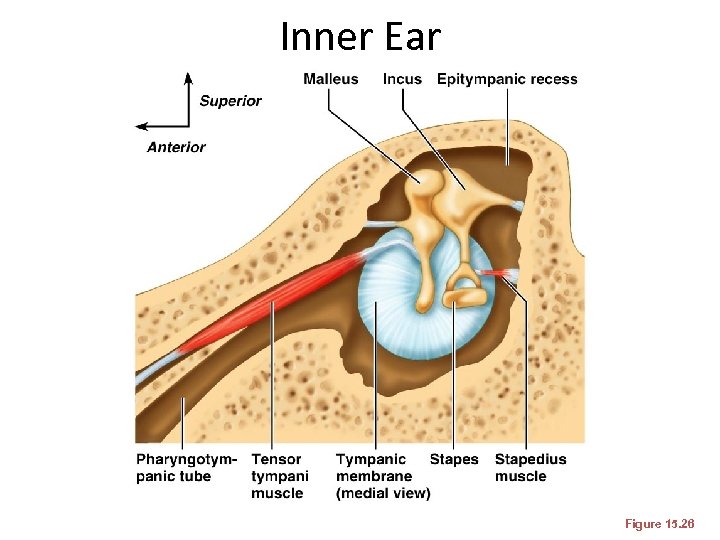
Inner Ear Figure 15. 26
Inner Ear • Bony labyrinth –Contains the vestibule, the cochlea, and the semicircular canals –Filled with perilymph • Membranous labyrinth –Filled with a potassium-rich fluid
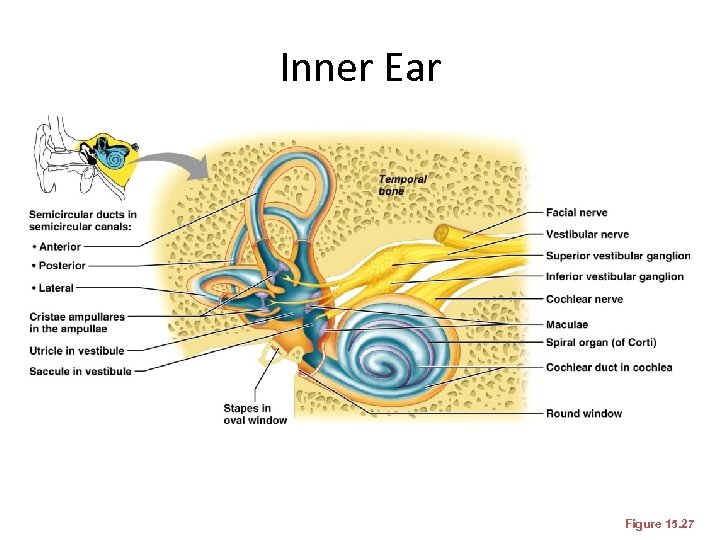
Inner Ear Figure 15. 27
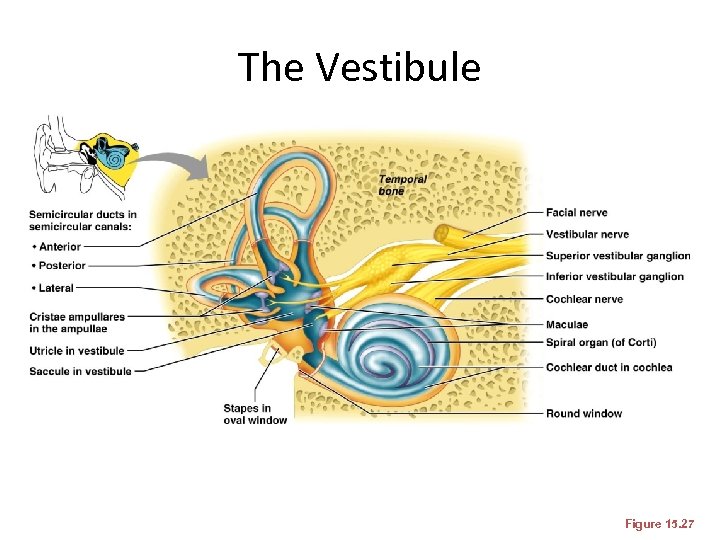
The Vestibule • The central egg-shaped cavity of the bony labyrinth • Suspended in its perilymph are two sacs: the saccule and utricle • The saccule extends into the cochlea
The Vestibule • The utricle extends into the semicircular canals • These sacs: – House equilibrium receptors called maculae – Respond to gravity and changes in the position of the head
The Vestibule Figure 15. 27
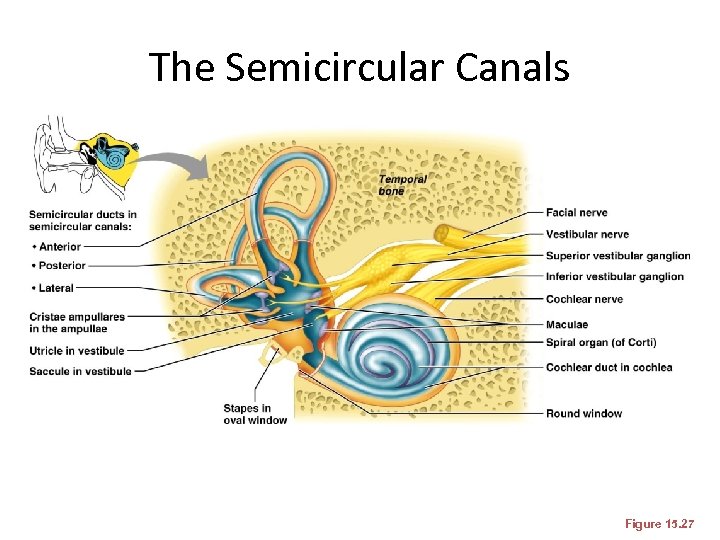
The Semicircular Canals • These receptors respond to angular movements of the head
The Semicircular Canals Figure 15. 27
The Cochlea • A spiral, conical, bony chamber that: –Contains the organ of Corti (hearing receptor)
Sound and Mechanisms of Hearing • Sound eardrum ossicles fluid in the inner ear oval and round windows--> hair cells cochlear nerve brain
Properties of Sound • Sound is: – A pressure disturbance (alternating areas of high and low pressure) originating from a vibrating object – Represented by a sine wave (s shape) in wavelength, frequency, and amplitude
Properties of Sound • Frequency – the number of waves that pass a given point in a given time • Pitch – perception of different frequencies (we hear from 20– 20, 000 Hz)
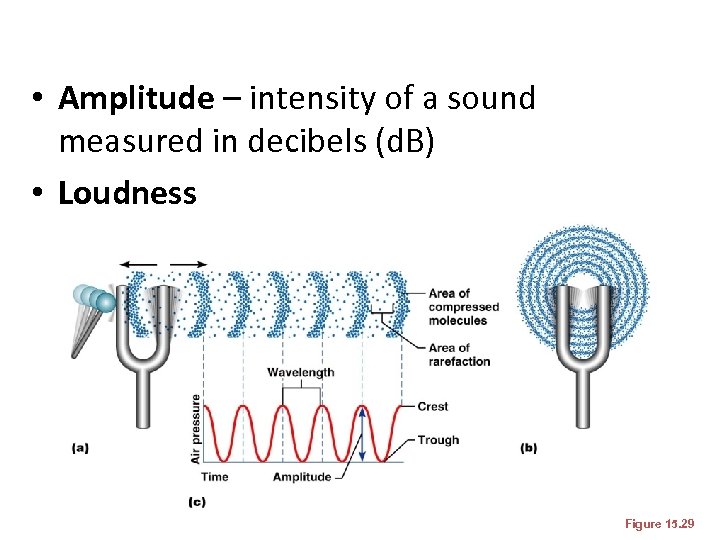
• Amplitude – intensity of a sound measured in decibels (d. B) • Loudness Figure 15. 29
Скачать презентацию The Ear Hearing and Balance The Ear
6eb60c5fc48914b788a269efc01fb36e.ppt