


 Скачать презентацию the dynasty of plantagenets 1154 -1399 HENRY
PowerPoint_THE_MIDDLE_AGES.ppt
- Количество слайдов: 22
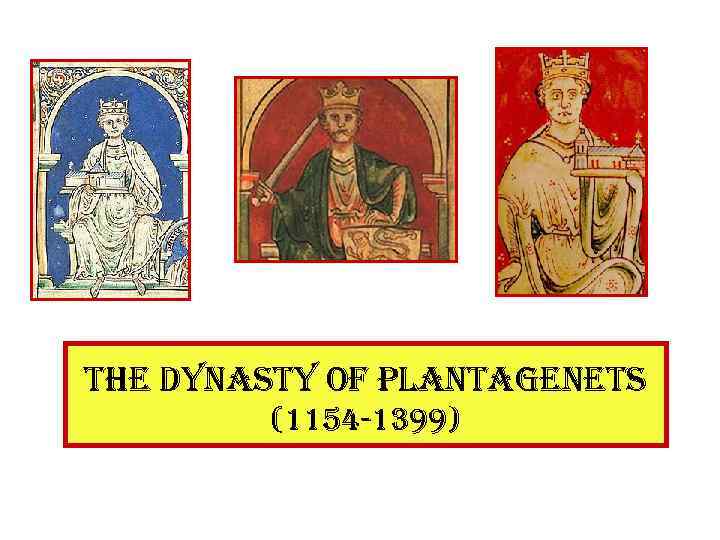 the dynasty of plantagenets (1154 -1399)
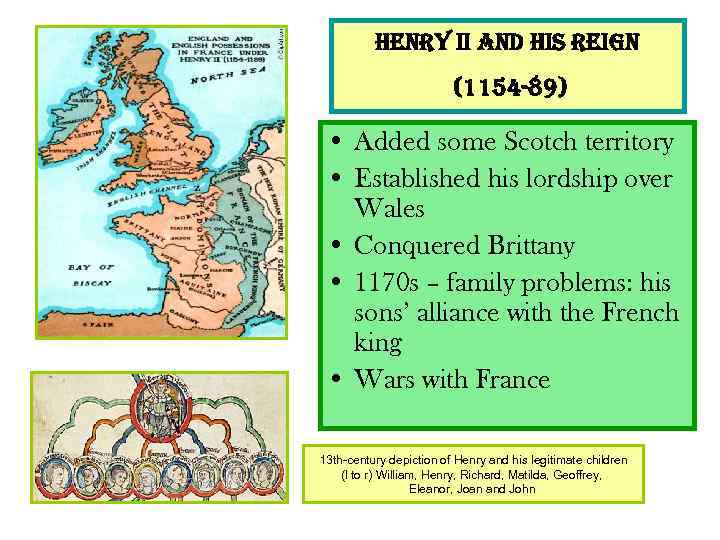 HENRY II AND HIS REIGN (1154 -89) • Added some Scotch territory • Established his lordship over Wales • Conquered Brittany • 1170 s – family problems: his sons’ alliance with the French king • Wars with France 13 th-century depiction of Henry and his legitimate children (l to r) William, Henry, Richard, Matilda, Geoffrey, Eleanor, Joan and John
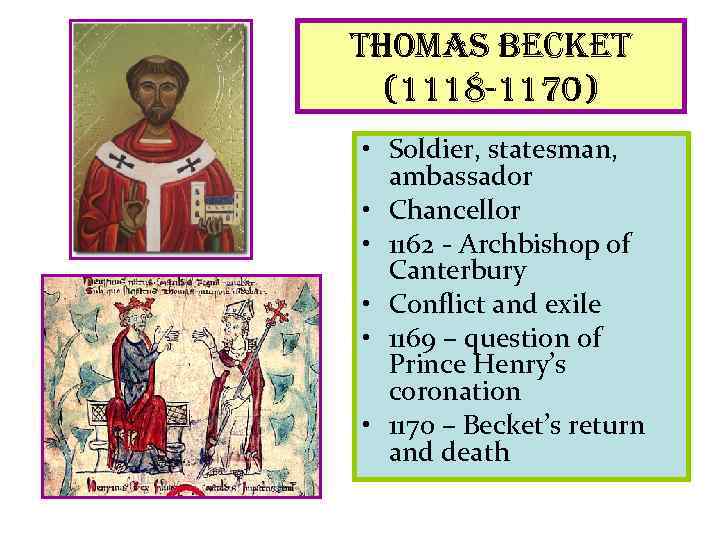 thomas becket (1118 -1170) • Soldier, statesman, ambassador • Chancellor • 1162 - Archbishop of Canterbury • Conflict and exile • 1169 – question of Prince Henry’s coronation • 1170 – Becket’s return and death
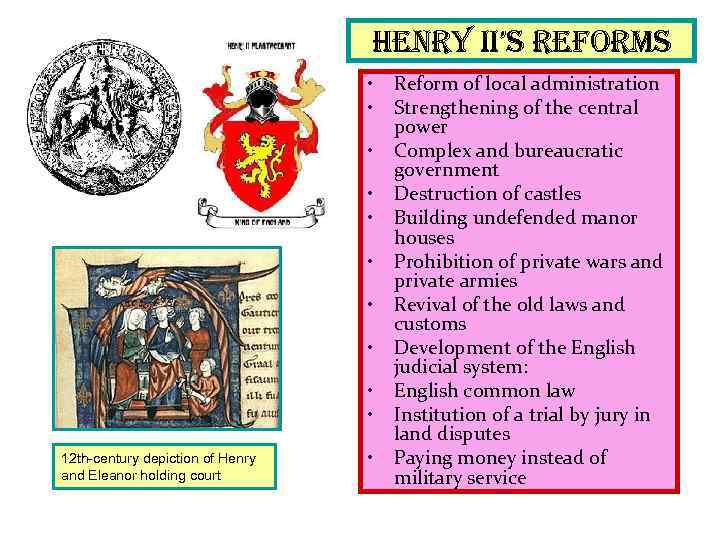 henry ii’s reforms • • • 12 th-century depiction of Henry and Eleanor holding court • Reform of local administration Strengthening of the central power Complex and bureaucratic government Destruction of castles Building undefended manor houses Prohibition of private wars and private armies Revival of the old laws and customs Development of the English judicial system: English common law Institution of a trial by jury in land disputes Paying money instead of military service
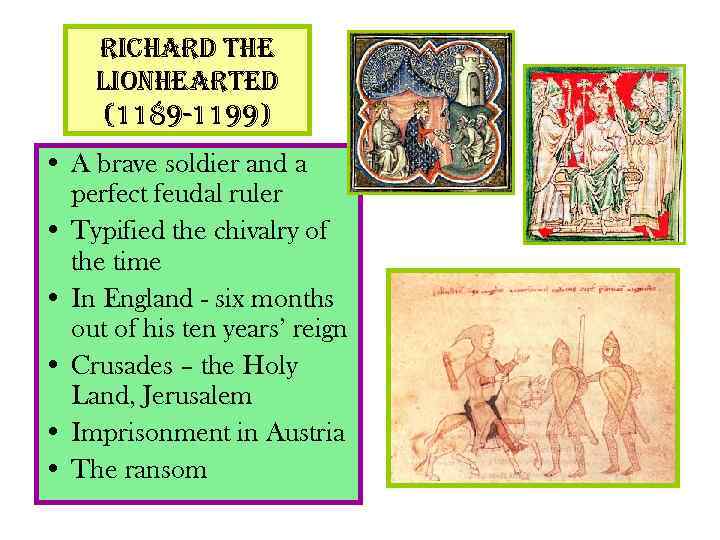 richard the lionhearted (1189 -1199) • A brave soldier and a perfect feudal ruler • Typified the chivalry of the time • In England - six months out of his ten years’ reign • Crusades – the Holy Land, Jerusalem • Imprisonment in Austria • The ransom
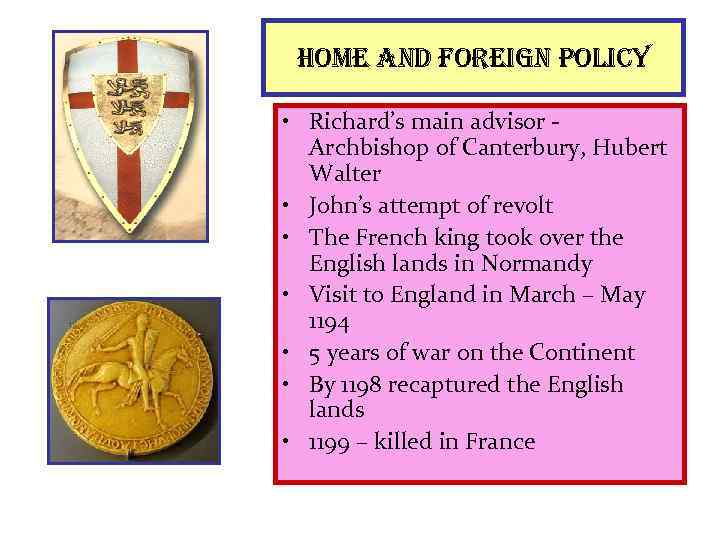 home and foreign policy • Richard’s main advisor Archbishop of Canterbury, Hubert Walter • John’s attempt of revolt • The French king took over the English lands in Normandy • Visit to England in March – May 1194 • 5 years of war on the Continent • By 1198 recaptured the English lands • 1199 – killed in France
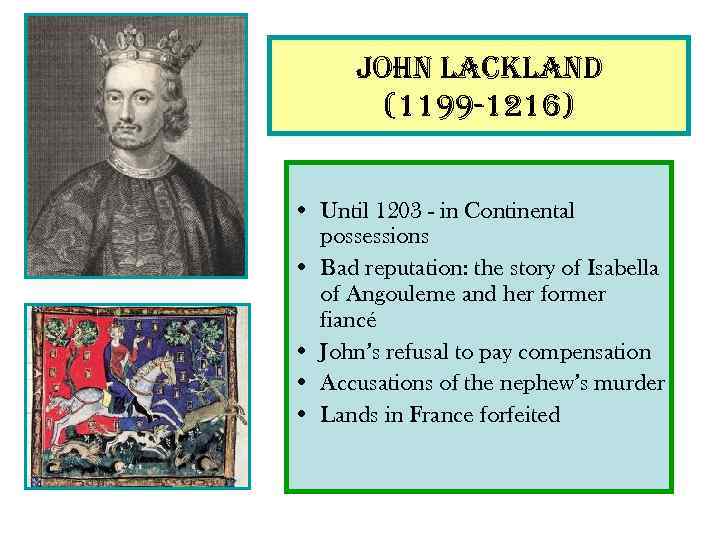 John lackland (1199 -1216) • Until 1203 - in Continental possessions • Bad reputation: the story of Isabella of Angouleme and her former fiancé • John’s refusal to pay compensation • Accusations of the nephew’s murder • Lands in France forfeited
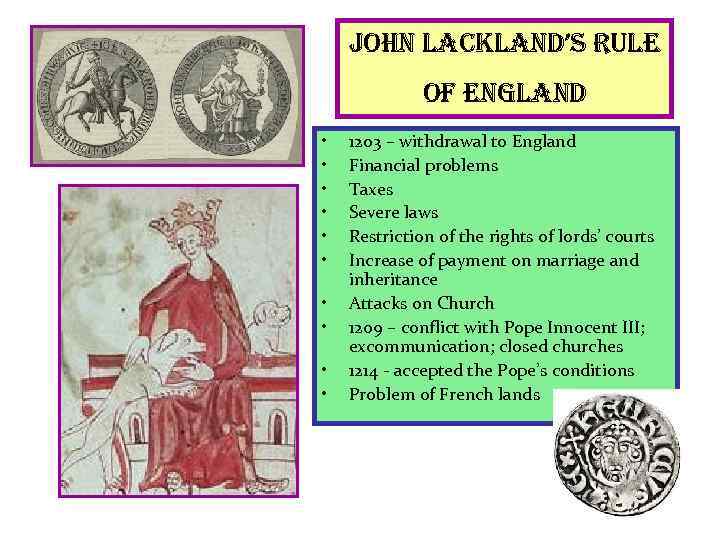 John lackland’s rule of england • • • 1203 – withdrawal to England Financial problems Taxes Severe laws Restriction of the rights of lords’ courts Increase of payment on marriage and inheritance Attacks on Church 1209 – conflict with Pope Innocent III; excommunication; closed churches 1214 - accepted the Pope’s conditions Problem of French lands
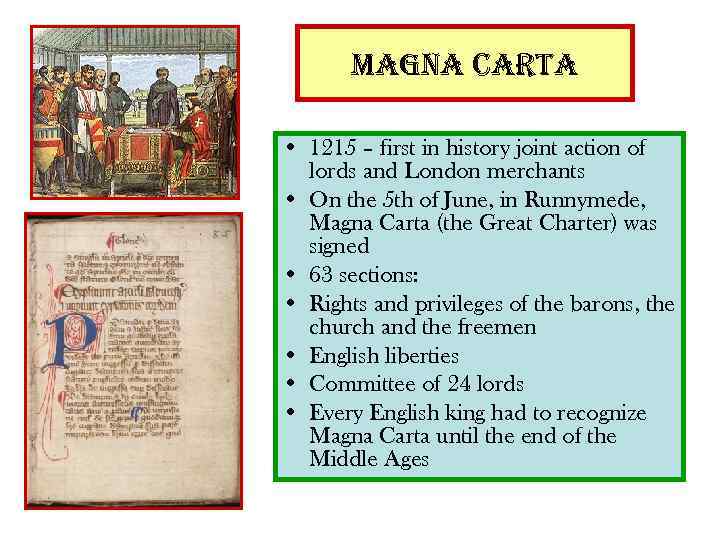 magna carta • 1215 – first in history joint action of lords and London merchants • On the 5 th of June, in Runnymede, Magna Carta (the Great Charter) was signed • 63 sections: • Rights and privileges of the barons, the church and the freemen • English liberties • Committee of 24 lords • Every English king had to recognize Magna Carta until the end of the Middle Ages
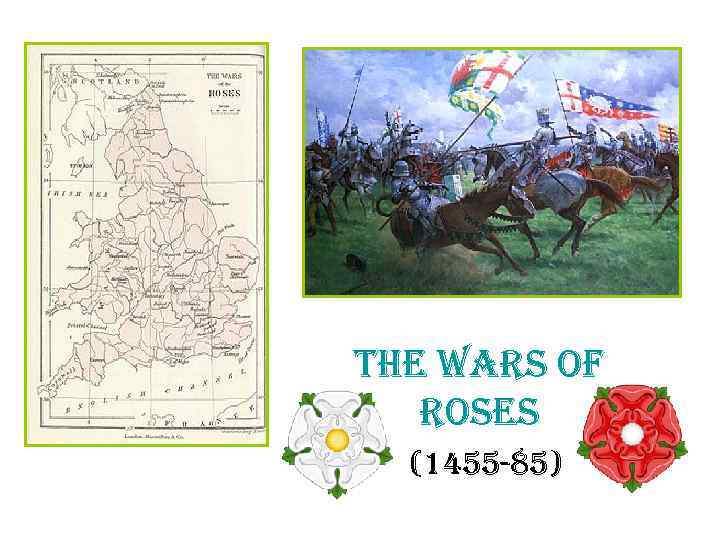 the wars of roses (1455 -85)
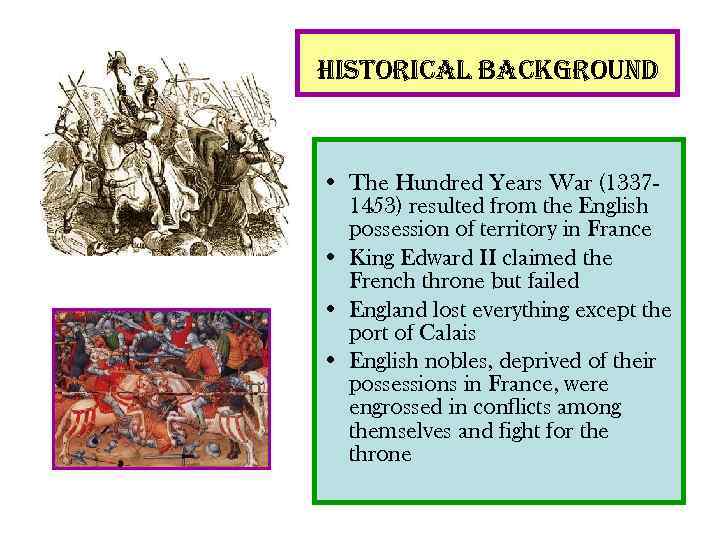 historical background • The Hundred Years War (13371453) resulted from the English possession of territory in France • King Edward II claimed the French throne but failed • England lost everything except the port of Calais • English nobles, deprived of their possessions in France, were engrossed in conflicts among themselves and fight for the throne
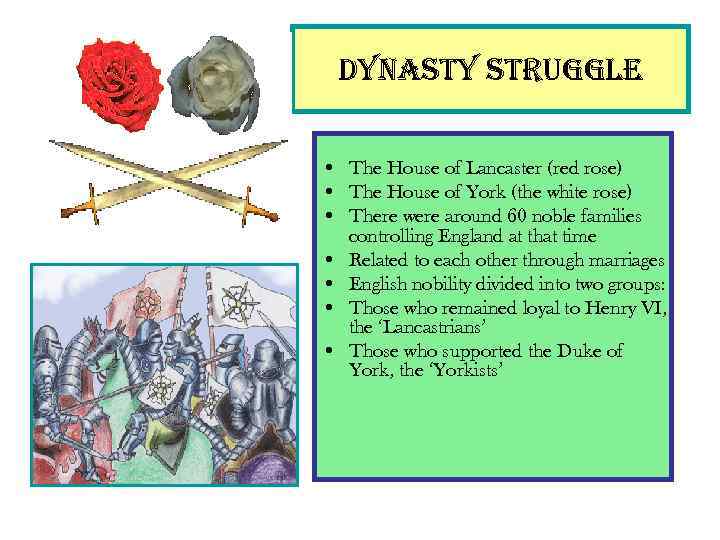 dynasty struggle • The House of Lancaster (red rose) • The House of York (the white rose) • There were around 60 noble families controlling England at that time • Related to each other through marriages • English nobility divided into two groups: • Those who remained loyal to Henry VI, the ‘Lancastrians’ • Those who supported the Duke of York, the ‘Yorkists’
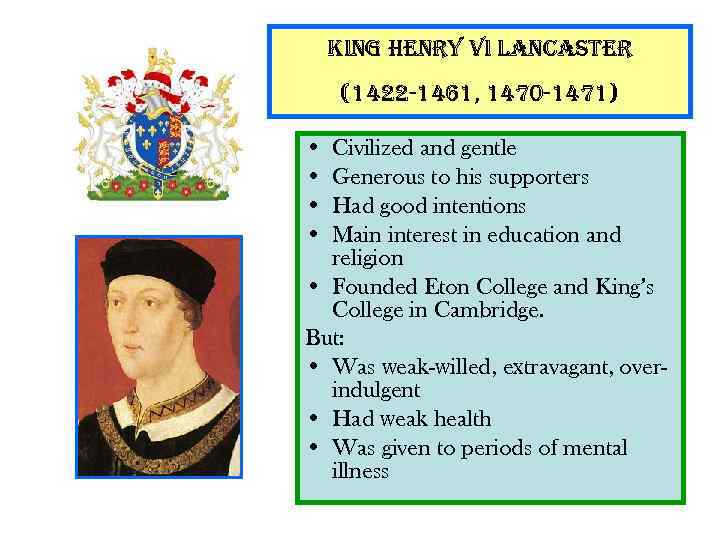 king henry Vi lancaster (1422 -1461, 1470 -1471) • • Civilized and gentle Generous to his supporters Had good intentions Main interest in education and religion • Founded Eton College and King’s College in Cambridge. But: • Was weak-willed, extravagant, overindulgent • Had weak health • Was given to periods of mental illness
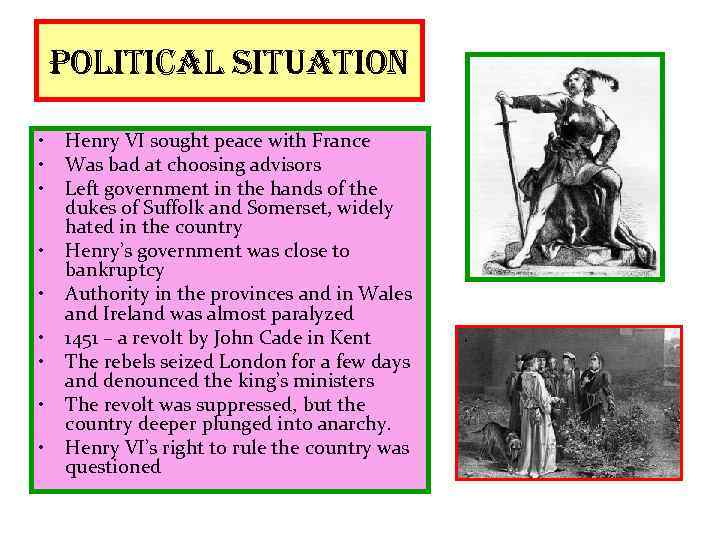 political situation • • • Henry VI sought peace with France Was bad at choosing advisors Left government in the hands of the dukes of Suffolk and Somerset, widely hated in the country Henry’s government was close to bankruptcy Authority in the provinces and in Wales and Ireland was almost paralyzed 1451 – a revolt by John Cade in Kent The rebels seized London for a few days and denounced the king’s ministers The revolt was suppressed, but the country deeper plunged into anarchy. Henry VI’s right to rule the country was questioned
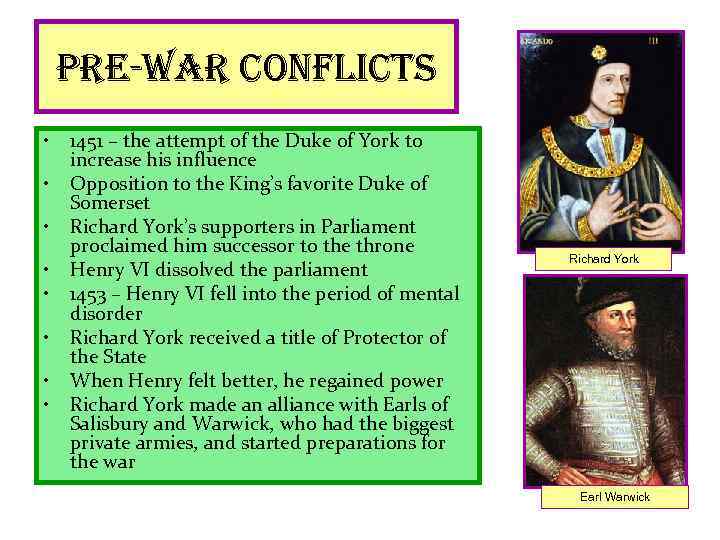 pre-war conflicts • • 1451 – the attempt of the Duke of York to increase his influence Opposition to the King’s favorite Duke of Somerset Richard York’s supporters in Parliament proclaimed him successor to the throne Henry VI dissolved the parliament 1453 – Henry VI fell into the period of mental disorder Richard York received a title of Protector of the State When Henry felt better, he regained power Richard York made an alliance with Earls of Salisbury and Warwick, who had the biggest private armies, and started preparations for the war Richard York Earl Warwick
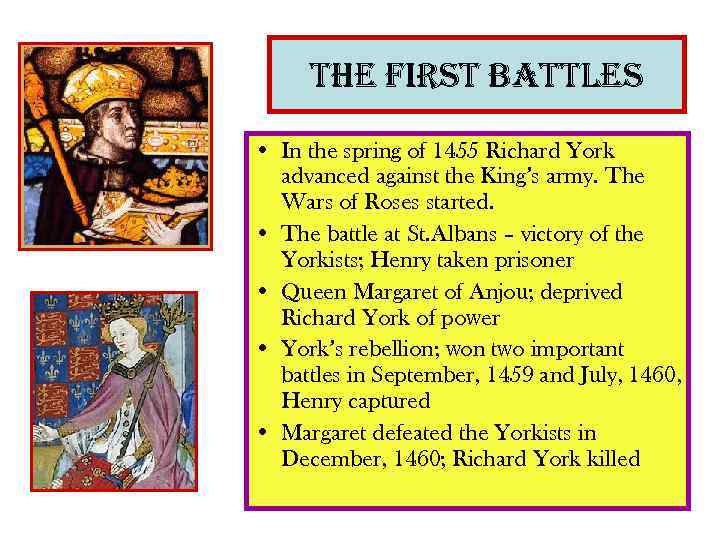 the first battles • In the spring of 1455 Richard York advanced against the King’s army. The Wars of Roses started. • The battle at St. Albans – victory of the Yorkists; Henry taken prisoner • Queen Margaret of Anjou; deprived Richard York of power • York’s rebellion; won two important battles in September, 1459 and July, 1460, Henry captured • Margaret defeated the Yorkists in December, 1460; Richard York killed
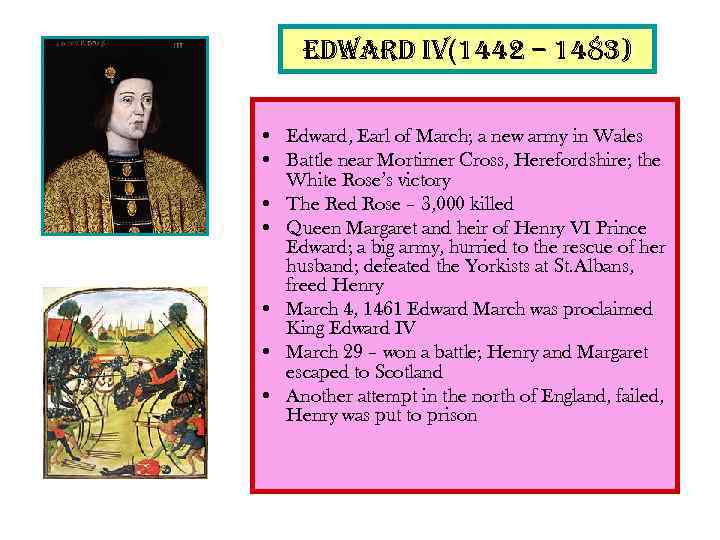 edward i. V(1442 – 1483) • Edward, Earl of March; a new army in Wales • Battle near Mortimer Cross, Herefordshire; the White Rose’s victory • The Red Rose – 3, 000 killed • Queen Margaret and heir of Henry VI Prince Edward; a big army, hurried to the rescue of her husband; defeated the Yorkists at St. Albans, freed Henry • March 4, 1461 Edward March was proclaimed King Edward IV • March 29 – won a battle; Henry and Margaret escaped to Scotland • Another attempt in the north of England, failed, Henry was put to prison
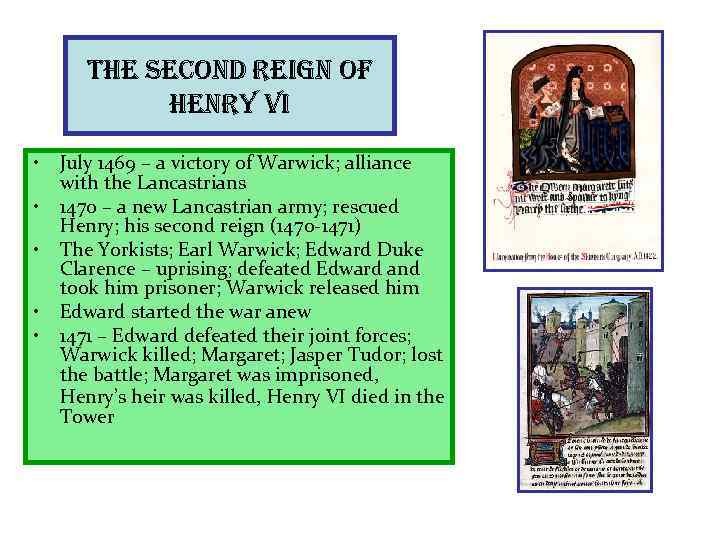 the second reign of henry Vi • • • July 1469 – a victory of Warwick; alliance with the Lancastrians 1470 – a new Lancastrian army; rescued Henry; his second reign (1470 -1471) The Yorkists; Earl Warwick; Edward Duke Clarence – uprising; defeated Edward and took him prisoner; Warwick released him Edward started the war anew 1471 – Edward defeated their joint forces; Warwick killed; Margaret; Jasper Tudor; lost the battle; Margaret was imprisoned, Henry’s heir was killed, Henry VI died in the Tower
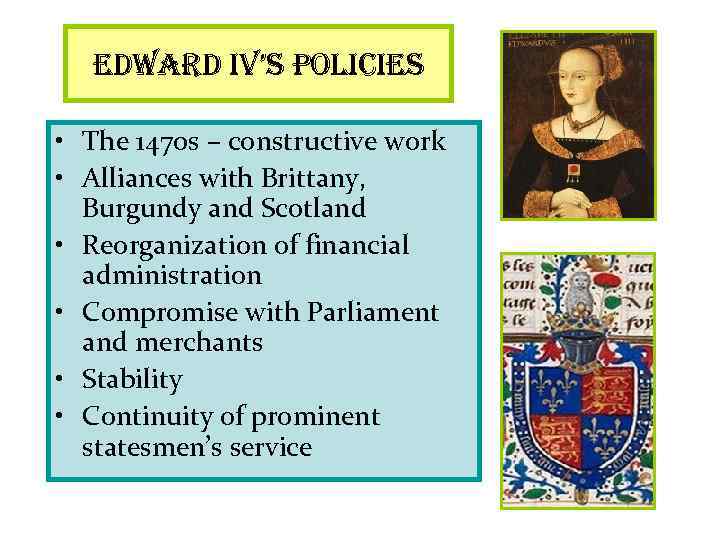 edward i. V’s policies • The 1470 s – constructive work • Alliances with Brittany, Burgundy and Scotland • Reorganization of financial administration • Compromise with Parliament and merchants • Stability • Continuity of prominent statesmen’s service
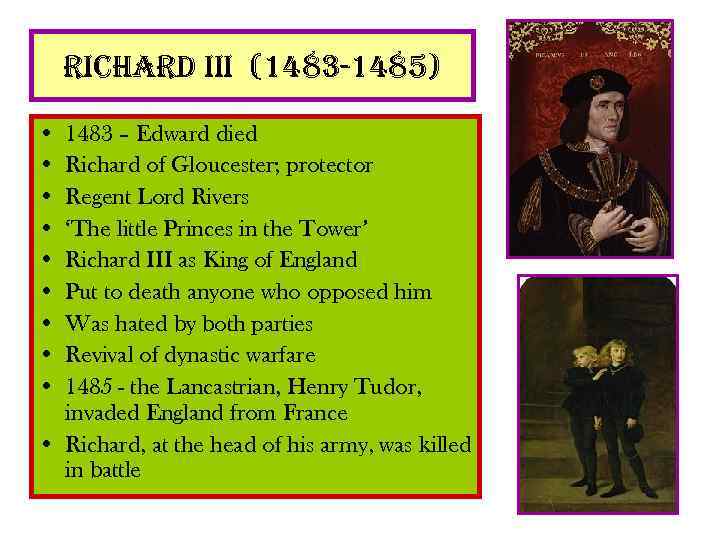 richard iii (1483 -1485) • • • 1483 – Edward died Richard of Gloucester; protector Regent Lord Rivers ‘The little Princes in the Tower’ Richard III as King of England Put to death anyone who opposed him Was hated by both parties Revival of dynastic warfare 1485 - the Lancastrian, Henry Tudor, invaded England from France • Richard, at the head of his army, was killed in battle
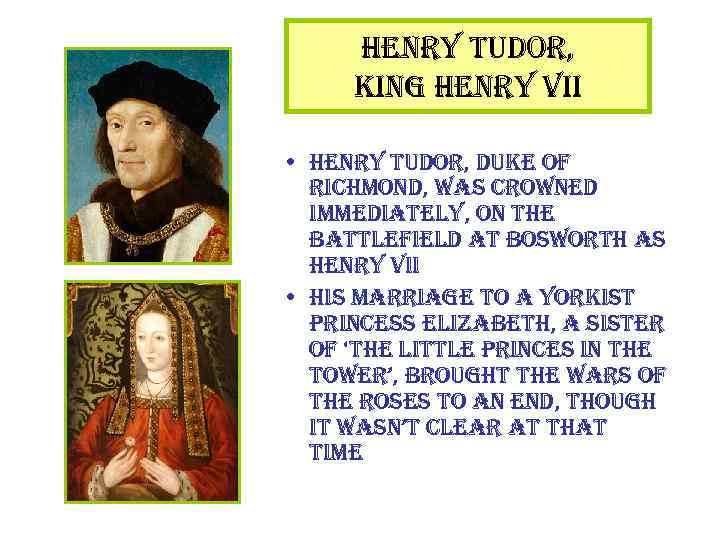 henry tudor, king henry Vii • henry tudor, duke of richmond, was crowned immediately, on the battlefield at bosworth as henry Vii • his marriage to a yorkist princess elizabeth, a sister of ‘the little princes in the tower’, brought the wars of the roses to an end, though it wasn’t clear at that time
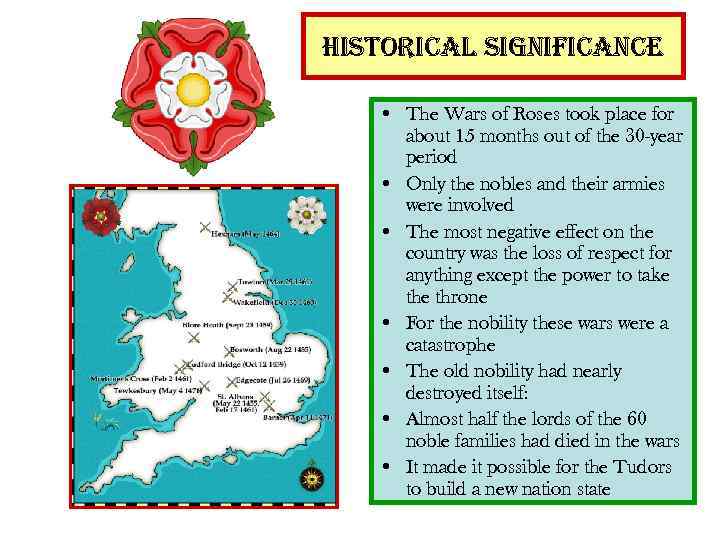 historical significance • The Wars of Roses took place for about 15 months out of the 30 -year period • Only the nobles and their armies were involved • The most negative effect on the country was the loss of respect for anything except the power to take throne • For the nobility these wars were a catastrophe • The old nobility had nearly destroyed itself: • Almost half the lords of the 60 noble families had died in the wars • It made it possible for the Tudors to build a new nation state