 Скачать презентацию The Duty to Investigate Law Enforcement has been
b27be14fbfba57da0c6355b6629d47fb.ppt
- Количество слайдов: 27



The Duty to Investigate Law Enforcement has been called to investigate a family violence matter… Now What?
Approaching the Scene… n Obtain all available information from dispatcher. n Two officer response if possible. n Do not park in front of the residence if possible. n Be on High Alert n High Risk for DV Incidents n Approach with caution.
Entering a private residence n Enter with direct invitation from owner or resident UNLESS: – Probable cause exists to make an arrest – Confrontation in progress – It is necessary to ensure the safety or wellbeing of occupants
Forced Entry n n Appropriate if necessary to protect victims. Determine necessity by: – Personal observation – Physical evidence – Information from dispatcher – Urgency of initial call for help – Dispatcher’s assessment of seriousness of request
Establishing Control at Scene n Restore order as much as possible. n Identify potential weapons in area and take control of weapons used or threatened. n Separate victim and assailant – both sight and sound. n Assess need for medical attention. n Restrain assailant if necessary and remove assailant to patrol car.
Establishing Control at Scene Continued… n Inquire about nature of dispute. n Identify all occupants/witnesses on premises. n Visually check wellbeing of each occupant of the residence. n Separate occupants/witnesses, victim, and accused (sight and sound). n Follow SOP concerning searches and/or obtaining a search warrant for premises.
On-Scene Investigation n n Interview all parties to identify victims and assailants. Don’t forget children – both safety and capacity as witnesses. Special considerations when interviewing child witnesses. Ensure victim’s safety and privacy during interview. Interview assailant; and don’t forget Miranda if in custody. If accused has fled, inquire regarding possible location of assailant.
On-Scene Investigation n n n Always record the incident with a Family Violence Incident Report Record interviews if possible. When interviewing children look for signs of abuse (old and new). If domestic violence occurred in front of children, additional charges are possible. Confer with other officers to determine appropriate action to be taken. Collect and preserve physical evidence. Take photographs.
On-Scene Investigation n n n Encourage victim to seek medical attention. Ask victim about non-visible injuries. Inquire into the safety of the victim and what she feels the safest move would be – especially if assailant is not being arrested. Offer to escort victim and children from the premises and allow them time to pack their things. Give victim information on how to obtain a copy of the incident report. Give any other known information about possible useful resources – shelter, GA Legal Services, crime victim’s compensation.
Who Should Be Arrested? Only the Primary Aggressor! When law enforcement arrives at the scene where a complaint of family violence has been made, the officer shall evaluate the complaint in order to determine who was the PRIMARY AGGRESSOR. O. C. G. A. § 17 -4 -20. 1(b) n This determination should be made EVERY TIME an officer is called to the scene of a family violence act. Sometimes the determination will be very basic and other times the investigation will require more in-depth research. n Once a primary aggressor has been determined, the officer shall not be required to arrest any other person believed to have committed an act of family violence during the incident. O. C. G. A. § 17 -4 -20. 1(b) n
What Criteria Should NOT Be Considered When Making An Arrest Determination… n n n Marital status of parties. Ownership or tenancy rights of either party. Verbal assurances that violence will stop. Claim by accused that the victim provoked or perpetrated the violence. Denial by either party that the abuse occurred when there is evidence of domestic violence No visible injuries Disposition of any previous police calls involving same parties. Speculation that arrest may not lead to prosecution. Racial, social, cultural, political, professional position, or the sexual orientation of the victim or the accused. Victim’s emotional state. Existence or non-existence of a protection order. Whether incident occurred in private place.
Warrant Needed to Make an Arrest? No, an arrest may be made without a warrant if the officer has probable cause to believe that an act of family violence has occurred. (O. C. G. A. § 17 -4 -20) n Investigation was unnecessary where the victim’s on the scene accusations against defendant, along with visible bodily harm to the victim’s face, provided sufficient probable cause to believe that defendant had committed battery. Mc. Cracken v. State, 224 Ga. App. 356 n
Why Not Arrest Both and Allow the Judge to Make the Determination? Empowers the batterer and gives him/her more control. Discourages victims to call law enforcement. Depletes the self-esteem for the victim. Makes it more difficult for victim to escape violent relationship – criminal record can impact victim’s housing, employment, ability to keep children.
“If I have to come back out here, both of you are going to jail. ” n No officer investigating an incident of family violence shall threaten, suggest, or otherwise indicate the arrest of all parties for the purpose of discouraging requests for law enforcement intervention. O. C. G. A. § 17 -4 -20. 1(a)
Who Is the Primary Aggressor? n The Primary Aggressor is the individual posing the most severe threat. n The Primary Aggressor is not necessarily the first individual to engage in assault behavior, but the one with the most ability and inclination to inflict physical injury.
How Do I Determine the Primary Aggressor? n In GA, officers shall consider the following factors in making a primary aggressor determination. – Prior family violence involving either party. – Severity of the injuries inflicted on each party. – Potential for Future Injury – Did one party act in self-defense? § O. C. G. A. § 17 -4 -20. 1(b)(1 -4)
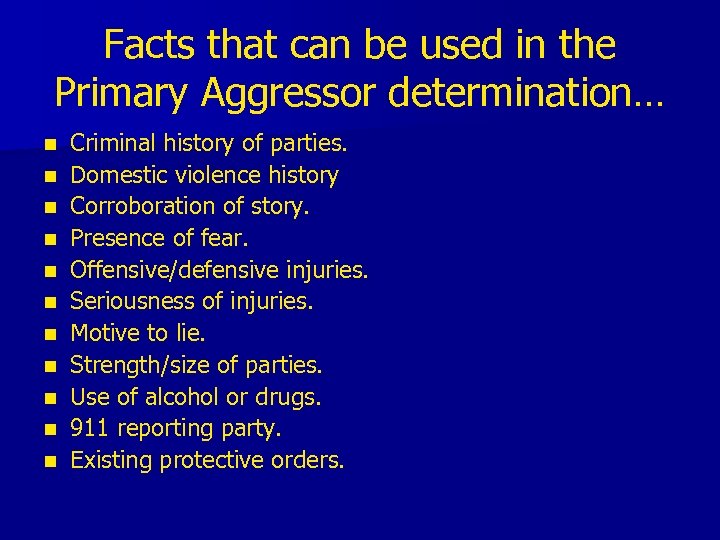
Facts that can be used in the Primary Aggressor determination… n n n Criminal history of parties. Domestic violence history Corroboration of story. Presence of fear. Offensive/defensive injuries. Seriousness of injuries. Motive to lie. Strength/size of parties. Use of alcohol or drugs. 911 reporting party. Existing protective orders.
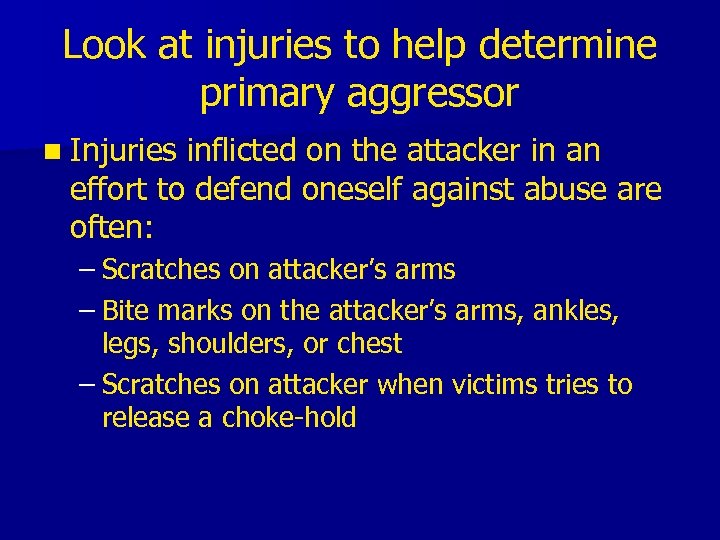
Look at injuries to help determine primary aggressor n Injuries inflicted on the attacker in an effort to defend oneself against abuse are often: – Scratches on attacker’s arms – Bite marks on the attacker’s arms, ankles, legs, shoulders, or chest – Scratches on attacker when victims tries to release a choke-hold
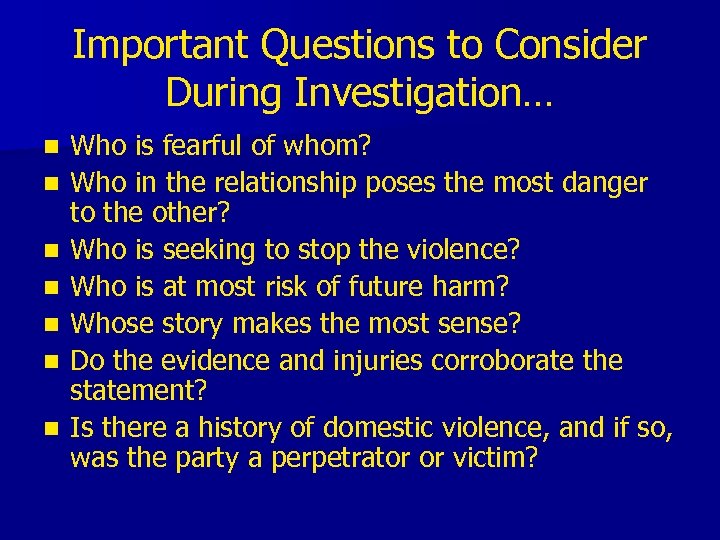
Important Questions to Consider During Investigation… n n n n Who is fearful of whom? Who in the relationship poses the most danger to the other? Who is seeking to stop the violence? Who is at most risk of future harm? Whose story makes the most sense? Do the evidence and injuries corroborate the statement? Is there a history of domestic violence, and if so, was the party a perpetrator or victim?
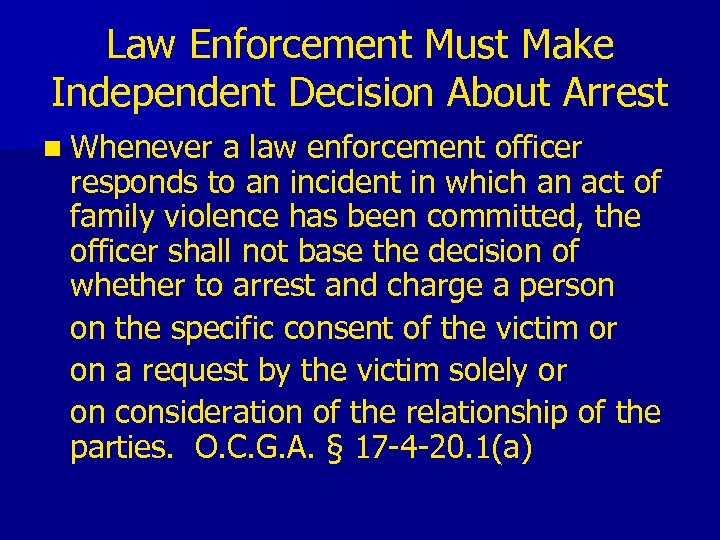
Law Enforcement Must Make Independent Decision About Arrest n Whenever a law enforcement officer responds to an incident in which an act of family violence has been committed, the officer shall not base the decision of whether to arrest and charge a person on the specific consent of the victim or on a request by the victim solely or on consideration of the relationship of the parties. O. C. G. A. § 17 -4 -20. 1(a)
If Arrest Is Made or Warrant Obtained… n Advise victim of what procedure will happen next. n Advise victim that the accused may only remain in jail for a short period of time. n Obtain address and telephone number of an emergency contact for the victim for follow-up. n If there is a language barrier, attempt to arrange for an interpreter.
If No Arrest Will Be Made… n n n Officer should remain neutral. Encourage one party to leave the premises. Primary concern is with maintaining peace and safety for all parties. Do not leave scene until it is under control and likelihood of further violence has been eliminated. Stand by while victim gathers necessities for short term absence from home. Give victim information about local shelter including telephone number.
Once Investigation is Done… n Whenever a law enforcement officer investigates an incident of family violence, whether or not an arrest is made, the officer shall prepare and submit to the supervisor or other designated person a written report of the incident entitled “Family Violence Report. ” n O. C. G. A. § 17 -4 -20. 1(c)
Information Needed for Report Name, Relationship, Date of Birth, and Sex of the parties. Time, place, and date of the incident. Whether children were involved or witnessed incident. Type and extent of the alleged abuse. Existence of substance abuse. Number and types of weapons used. Existence of any prior court orders. Type of police action taken, reasons for determination of primary physical aggressor, and mitigating circumstances for why an arrest was not made. n Was victim apprised of available remedies and services. n n n n
What About the Kids? Only the mother of a child born out of wedlock is entitled to his custody, unless the father legitimates the child. Otherwise, the mother may exercise all parental power over the child. O. C. G. A. § 19 -7 -25 n When determining who should take physical custody of the children after a DV incident has occurred, law enforcement must allow the mother of any unlegitimated children to retain the children until the courts decide otherwise. n If the parties are or have been married or the paternal relationship legitimated, look for any custody order to determine the appropriate custodial parent, including a TPO. n
Written Family Violence Report is Mandatory n Whenever an incident of possible family violence is investigated by police, a written Family Violence Report is mandatory, whether the officer finds the allegations of domestic violence founded or unfounded. n Meagher v. Quick, 264 Ga. App. 639, 643644.
Resources for Victims n Because the investigating officer may be the first person to know of the domestic violence, it is important to be aware of the various resources available for victims in addition to criminal prosecution. n GA Legal Services n Crime Victims Compensation n Crisis Line n Local Safe House
Скачать презентацию The Duty to Investigate Law Enforcement has been
b27be14fbfba57da0c6355b6629d47fb.ppt