


 Скачать презентацию The Dutch Virtual Census of 2001 A New
1e6ac0e5ee0455094f8d24fa5aba4249.ppt
- Количество слайдов: 15
 The Dutch Virtual Census of 2001 A New Approach by Combining Different Sources Eric Schulte Nordholt ECE Census meetings Geneva, 22 -26 November 2004
 Contents • Introduction Census • Data sources • Combining data sources: micro-linkage • Combining sources: micro-integration • Social Statistical Database (SSD) • Census tables • History of the Dutch Census • Comparison with Censuses in other countries • Conclusions 2
 Introduction Census Why a Census ? Statistical information for research and policy purposes What kind of information ? • Size of (sub)population(s) • Demographic and socio-economic characteristics, at national and regional level Gentlemen’s agreement • Eurostat: co-ordinator of EU, accesion and EFTA countries in the 2001 Census Round • Census Table Programme, every 10 years 3
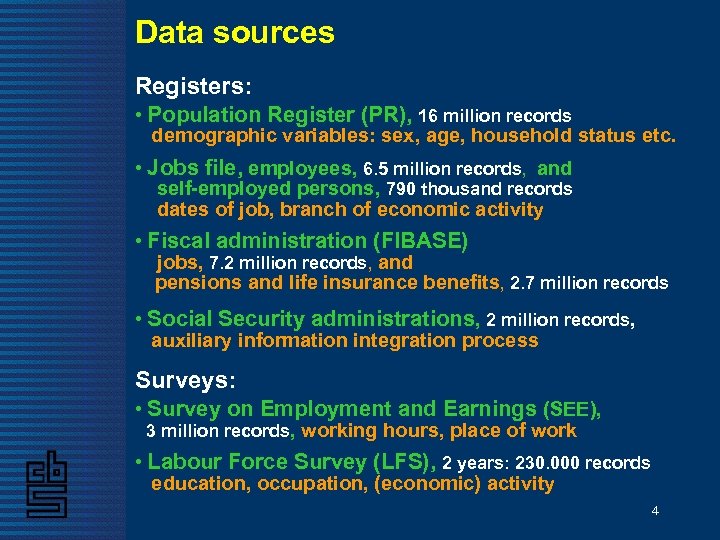 Data sources Registers: • Population Register (PR), 16 million records demographic variables: sex, age, household status etc. • Jobs file, employees, 6. 5 million records, and self-employed persons, 790 thousand records dates of job, branch of economic activity • Fiscal administration (FIBASE) jobs, 7. 2 million records, and pensions and life insurance benefits, 2. 7 million records • Social Security administrations, 2 million records, auxiliary information integration process Surveys: • Survey on Employment and Earnings (SEE), 3 million records, working hours, place of work • Labour Force Survey (LFS), 2 years: 230. 000 records education, occupation, (economic) activity 4
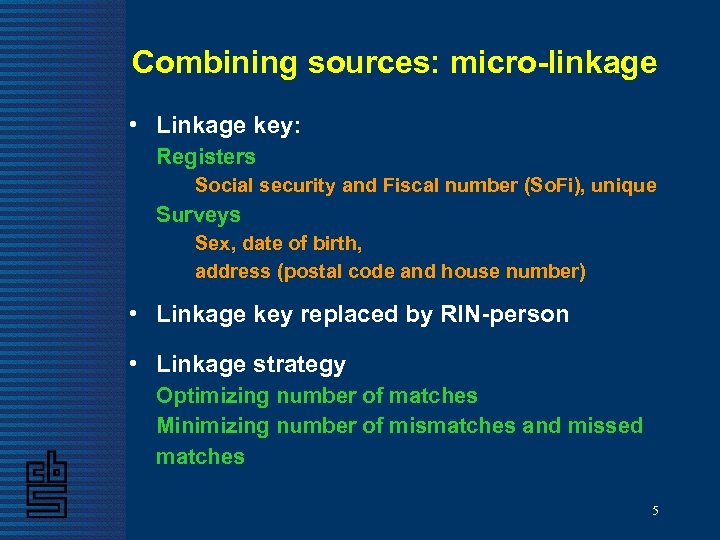 Combining sources: micro-linkage • Linkage key: Registers Social security and Fiscal number (So. Fi), unique Surveys Sex, date of birth, address (postal code and house number) • Linkage key replaced by RIN-person • Linkage strategy Optimizing number of matches Minimizing number of mismatches and missed matches 5
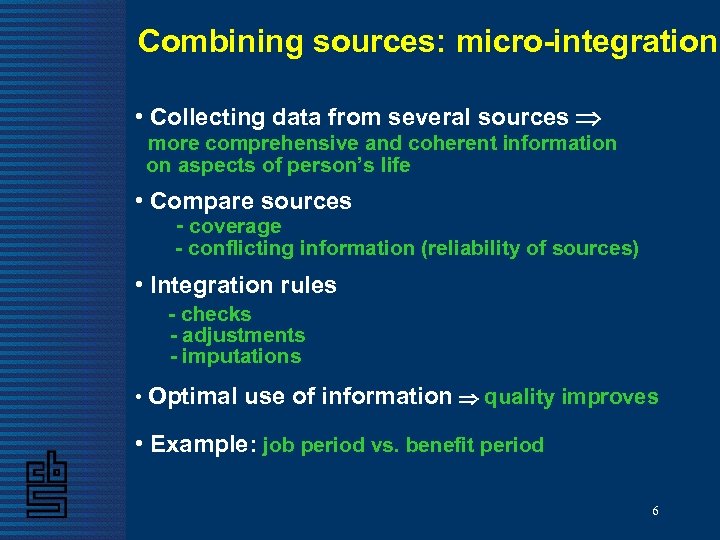 Combining sources: micro-integration • Collecting data from several sources more comprehensive and coherent information on aspects of person’s life • Compare sources - coverage - conflicting information (reliability of sources) • Integration rules - checks - adjustments - imputations • Optimal use of information quality improves • Example: job period vs. benefit period 6
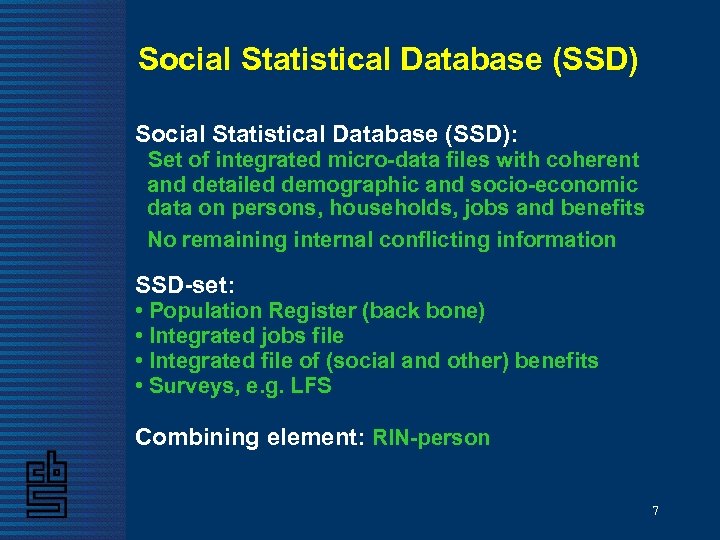 Social Statistical Database (SSD): Set of integrated micro-data files with coherent and detailed demographic and socio-economic data on persons, households, jobs and benefits No remaining internal conflicting information SSD-set: • Population Register (back bone) • Integrated jobs file • Integrated file of (social and other) benefits • Surveys, e. g. LFS Combining element: RIN-person 7
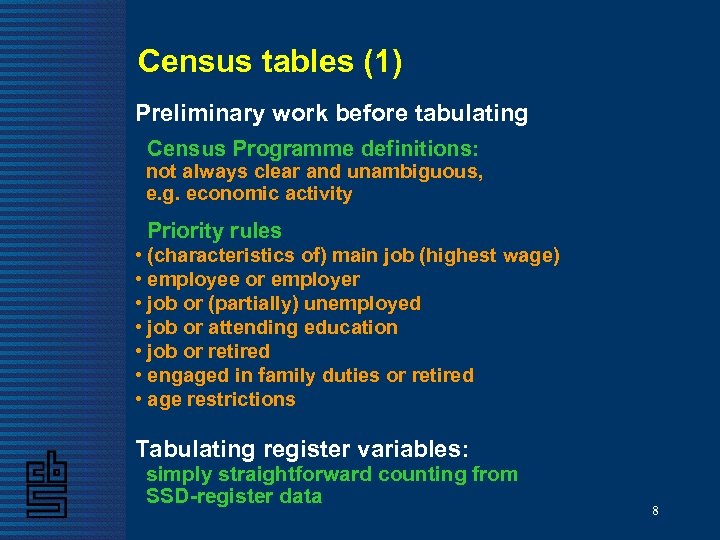 Census tables (1) Preliminary work before tabulating Census Programme definitions: not always clear and unambiguous, e. g. economic activity Priority rules • (characteristics of) main job (highest wage) • employee or employer • job or (partially) unemployed • job or attending education • job or retired • engaged in family duties or retired • age restrictions Tabulating register variables: simply straightforward counting from SSD-register data 8
 Census tables (2) Tabulating survey (and register) variables Mass imputation? • Pro’s: reproducible results • Con’s: danger of oddities in estimates (e. g. high educated baby) Traditional Weighting? • Pro’s: simple, reproducible results (if same micro-data and weights) • Con’s: no overall numerical consistency between survey and register estimates Demand for overall numerical consistency • 1 figure for 1 phenomenon • all tables based on different sources (e. g. surveys) should be mutually consistent 9
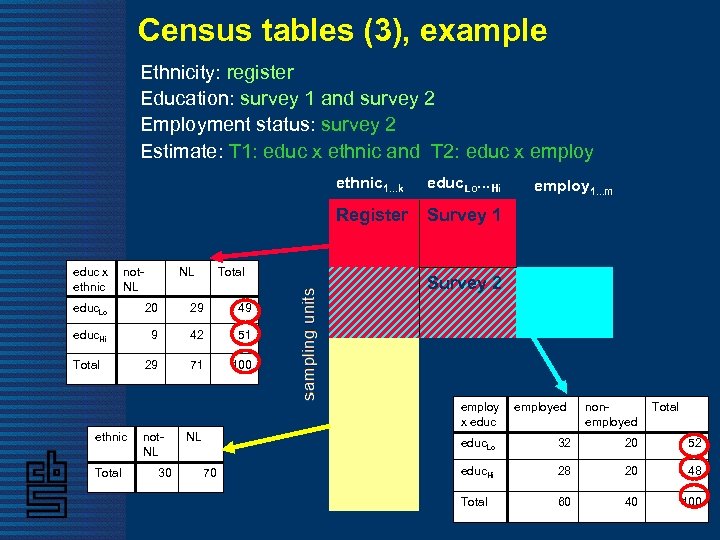 Census tables (3), example Ethnicity: register Education: survey 1 and survey 2 Employment status: survey 2 Estimate: T 1: educ x ethnic and T 2: educ x employ ethnic 1. . . k Register educ x ethnic not. NL NL Total educ. Lo 20 29 9 42 29 71 Survey 2 51 Total Survey 1 employ 1. . . m 49 educ. Hi educ. Lo. . . Hi 100 employ x educ ethnic Total not. NL 30 NL employed nonemployed Total educ. Lo 70 32 20 52 educ. Hi 28 20 48 Total 60 40 10 100
 Census tables (4) Repeated Weighting (RW) : tool to achieve numerical consistency (VRD-software) Basic principles of RW: • estimate table on most reliable source (mostly source with most records, e. g. register) • estimate tables by calibrating on common margins of the current table and tables already estimated (auxiliary information) • repeatedly use of regression estimator: - initial weights (e. g. survey weights) calibrated as minimal as possible - lower variances - no excessive increase of (non-response) bias (as long as cell size>>0) • each table own set of weights 11
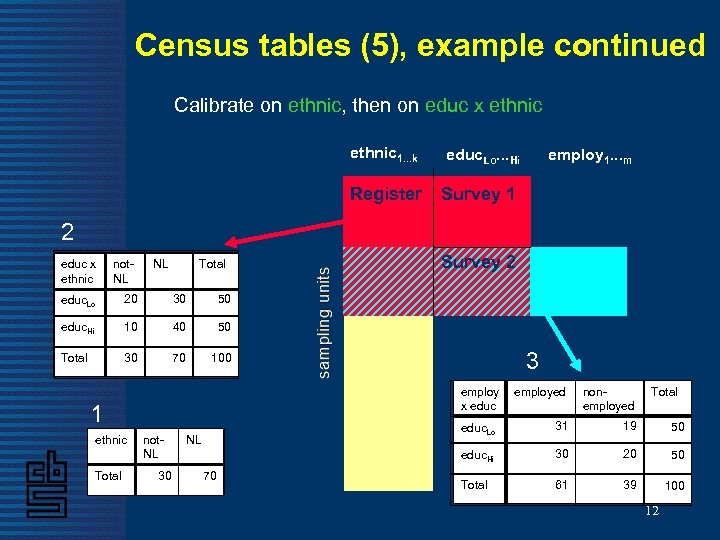 Census tables (5), example continued Calibrate on ethnic, then on educ x ethnic 1. . . k educ. Lo. . . Hi Register Survey 1 employ 1. . . m 2 educ x ethnic not. NL NL Total educ. Lo 20 30 50 educ. Hi 10 40 50 Total 30 70 Survey 2 100 employ x educ Total not. NL 30 70 nonemployed 31 19 50 educ. Hi NL employed educ. Lo 1 ethnic 3 Total 30 20 50 Total 61 39 100 12
 History of the Dutch Census TRADITIONAL CENSUS Ministry of Home Affairs: 1829, 1839, 1849, 1859, 1869, 1879 and 1889 Statistics Netherlands: 1899, 1909, 1920, 1930, 1947, 1960 and 1971 Unwillingness (non-response) and reduction expenses no more Traditional Censuses ALTERNATIVE: VIRTUAL CENSUS 1981 and 1991: Population Register and surveys development 90’s: more registers → 2001: integrated set of registers and surveys, SSD 13
 Comparison with Censuses in other countries Traditional Census (complete or partial enumeration): Most countries (Estonia, Slovenia, Greece and the UK) Mixture of traditional Census and Registers: Some countries (Norway and Switzerland) Entirely or largely register-based Census: A few Nordic countries (Sweden and Finland) Virtual Census: The Netherlands Tables: http: //www. cbs. nl/en/publications/articles/general/census 2001/census-2001. htm Book: http: //www. cbs. nl/en/publications/recent/census-2001/b-572001. htm 14
 Conclusions The Dutch Virtual Census 2001 was successful with its innovative approach: • new source: SSD, integration of registers and surveys (micro-integration remains important) • new methodology for consistent estimation was implemented Pro’s: relatively cheap (cost per inhabitant) and quick Con’s: publication of small subpopulations sometimes difficult or even impossible because of limited information Solutions for Con’s: small area estimation (synthetic estimators) 15