Скачать презентацию The Domestic Power of Legalization U S Support
d63c050274f5181b7f3f258415d88277.ppt
- Количество слайдов: 12
 The (Domestic) Power of Legalization: U. S. Support of WTO Dispute Settlement Alex Thompson Department of Political Science Ohio State University
 PUZZLE Why did the U. S. spearhead dispute settlement reform during the Uruguay Round (1986 -1994)? Theoretical puzzle: – Realism – Bargaining Power – Delegation to IOs – Smith 2000
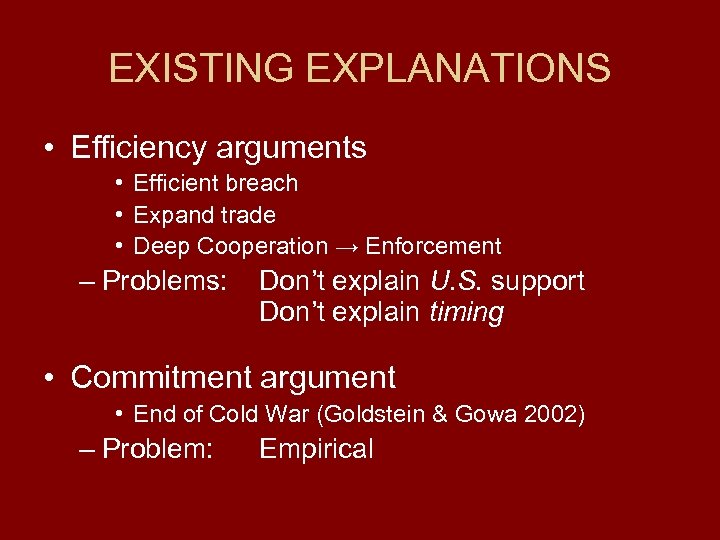 EXISTING EXPLANATIONS • Efficiency arguments • Efficient breach • Expand trade • Deep Cooperation → Enforcement – Problems: Don’t explain U. S. support Don’t explain timing • Commitment argument • End of Cold War (Goldstein & Gowa 2002) – Problem: Empirical
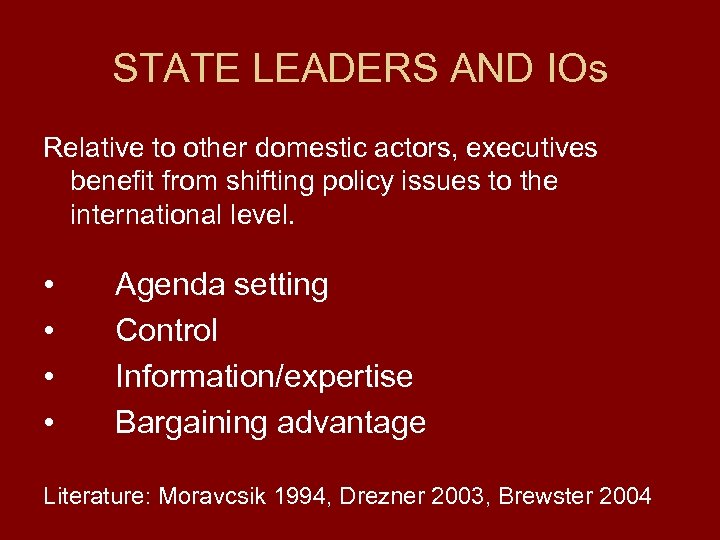 STATE LEADERS AND IOs Relative to other domestic actors, executives benefit from shifting policy issues to the international level. • • Agenda setting Control Information/expertise Bargaining advantage Literature: Moravcsik 1994, Drezner 2003, Brewster 2004
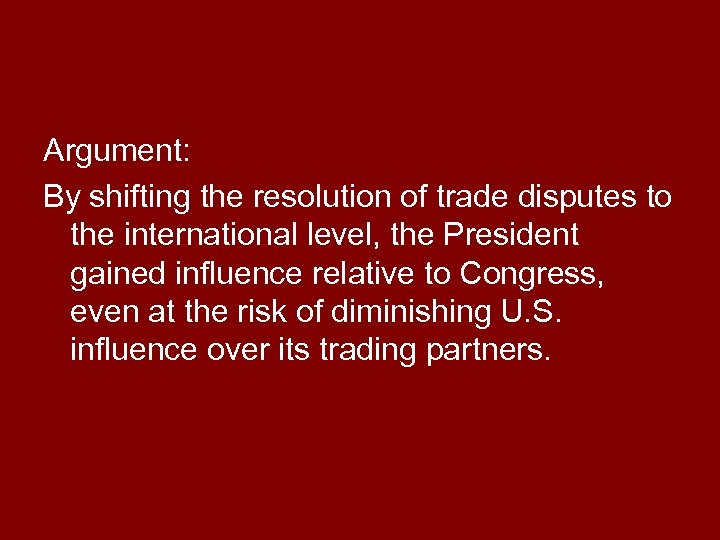 Argument: By shifting the resolution of trade disputes to the international level, the President gained influence relative to Congress, even at the risk of diminishing U. S. influence over its trading partners.
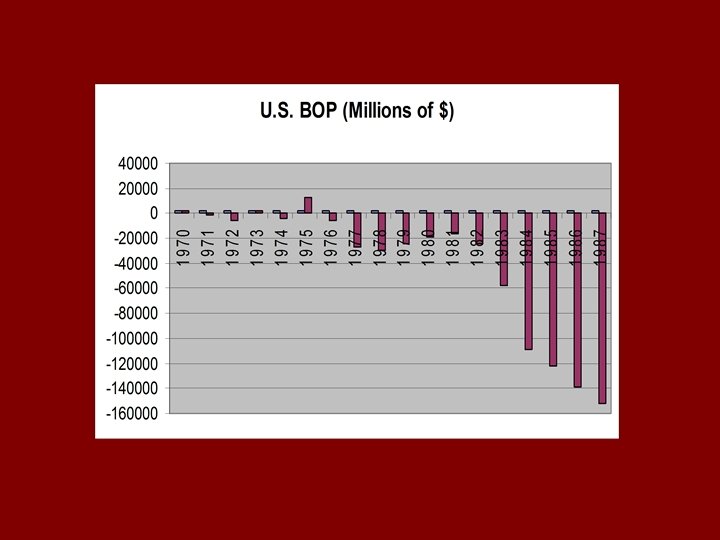
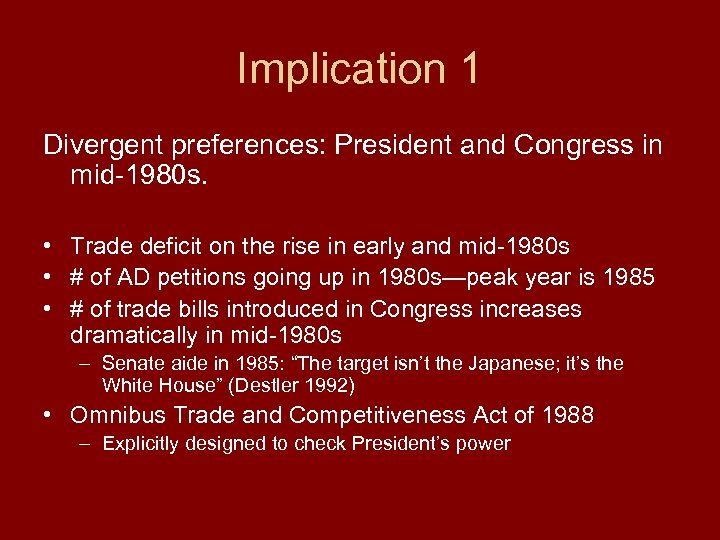 Implication 1 Divergent preferences: President and Congress in mid-1980 s. • Trade deficit on the rise in early and mid-1980 s • # of AD petitions going up in 1980 s—peak year is 1985 • # of trade bills introduced in Congress increases dramatically in mid-1980 s – Senate aide in 1985: “The target isn’t the Japanese; it’s the White House” (Destler 1992) • Omnibus Trade and Competitiveness Act of 1988 – Explicitly designed to check President’s power
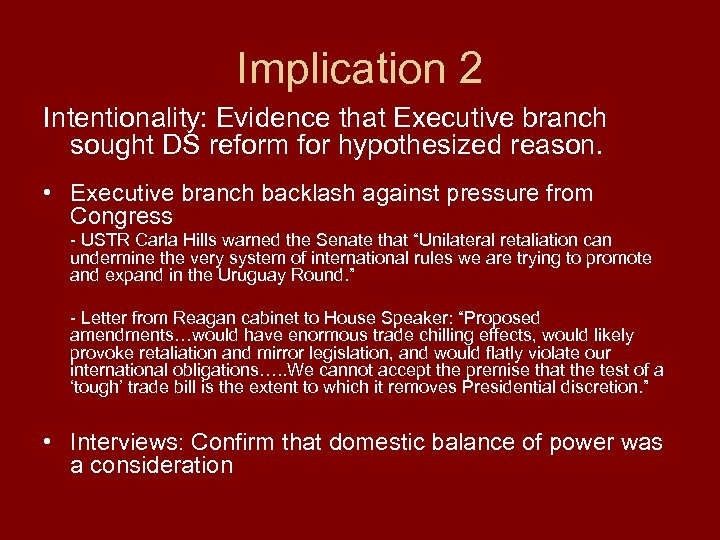 Implication 2 Intentionality: Evidence that Executive branch sought DS reform for hypothesized reason. • Executive branch backlash against pressure from Congress - USTR Carla Hills warned the Senate that “Unilateral retaliation can undermine the very system of international rules we are trying to promote and expand in the Uruguay Round. ” - Letter from Reagan cabinet to House Speaker: “Proposed amendments…would have enormous trade chilling effects, would likely provoke retaliation and mirror legislation, and would flatly violate our international obligations…. . We cannot accept the premise that the test of a ‘tough’ trade bill is the extent to which it removes Presidential discretion. ” • Interviews: Confirm that domestic balance of power was a consideration
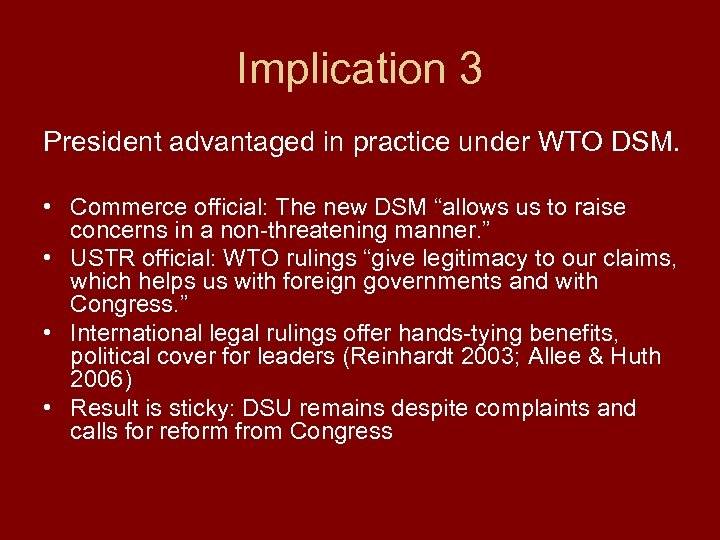 Implication 3 President advantaged in practice under WTO DSM. • Commerce official: The new DSM “allows us to raise concerns in a non-threatening manner. ” • USTR official: WTO rulings “give legitimacy to our claims, which helps us with foreign governments and with Congress. ” • International legal rulings offer hands-tying benefits, political cover for leaders (Reinhardt 2003; Allee & Huth 2006) • Result is sticky: DSU remains despite complaints and calls for reform from Congress
 CONCLUSIONS • Better understanding of an intrinsically important case • Legalization literature too state-centric (Goldstein & Martin 2000) • Domestic politics explanation for why powerful states delegate to IOs