


 Скачать презентацию The Divisive Politics of Slavery I AM GRAY
e7e32312bdd9b04f06e9bac4df437176.ppt
- Количество слайдов: 59
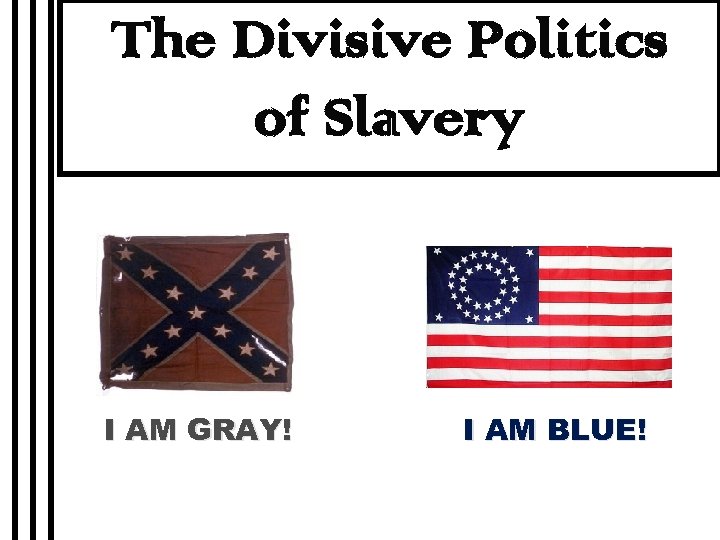 The Divisive Politics of Slavery I AM GRAY! I AM BLUE!
 the industrial north
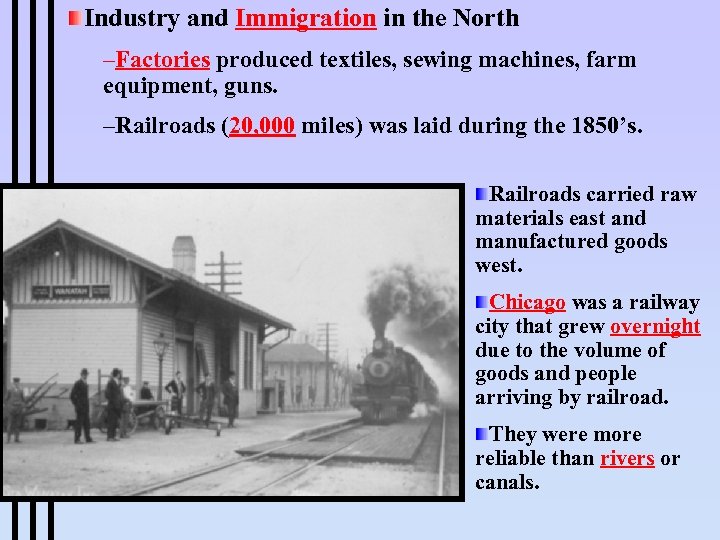 Industry and Immigration in the North –Factories produced textiles, sewing machines, farm equipment, guns. –Railroads (20, 000 miles) was laid during the 1850’s. Railroads carried raw materials east and manufactured goods west. Chicago was a railway city that grew overnight due to the volume of goods and people arriving by railroad. They were more reliable than rivers or canals.
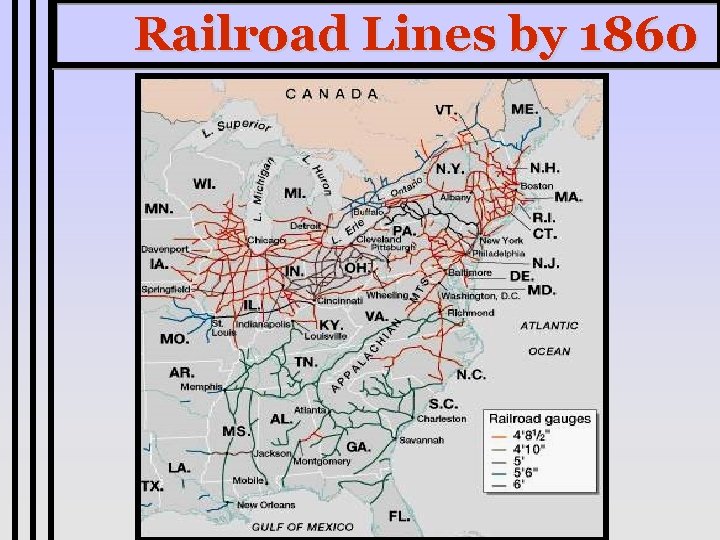 Railroad Lines by 1860
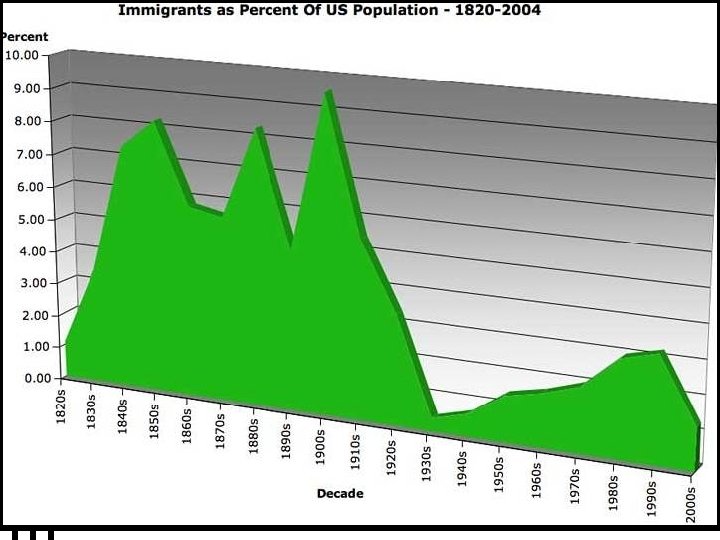
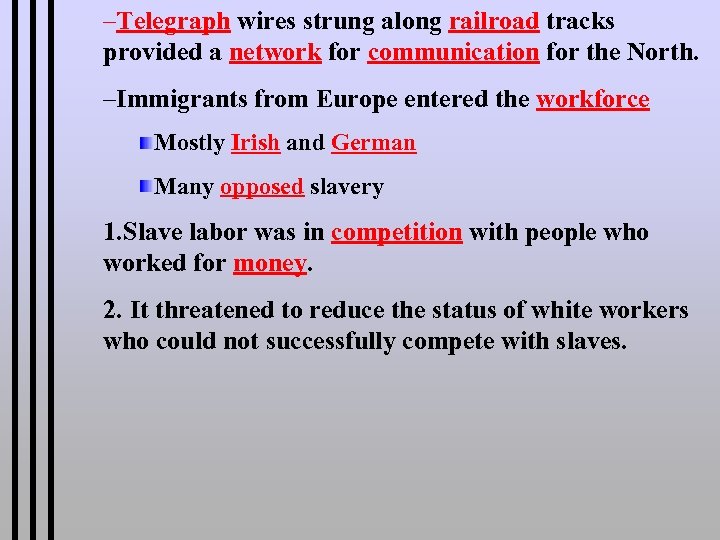 –Telegraph wires strung along railroad tracks provided a network for communication for the North. –Immigrants from Europe entered the workforce Mostly Irish and German Many opposed slavery 1. Slave labor was in competition with people who worked for money. 2. It threatened to reduce the status of white workers who could not successfully compete with slaves.

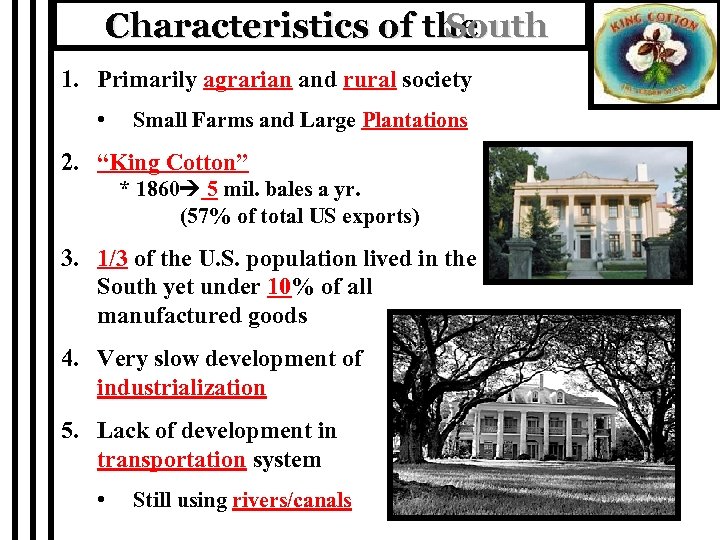 Characteristics of the South 1. Primarily agrarian and rural society • Small Farms and Large Plantations 2. “King Cotton” * 1860 5 mil. bales a yr. (57% of total US exports) 3. 1/3 of the U. S. population lived in the South yet under 10% of all manufactured goods 4. Very slow development of industrialization 5. Lack of development in transportation system • Still using rivers/canals
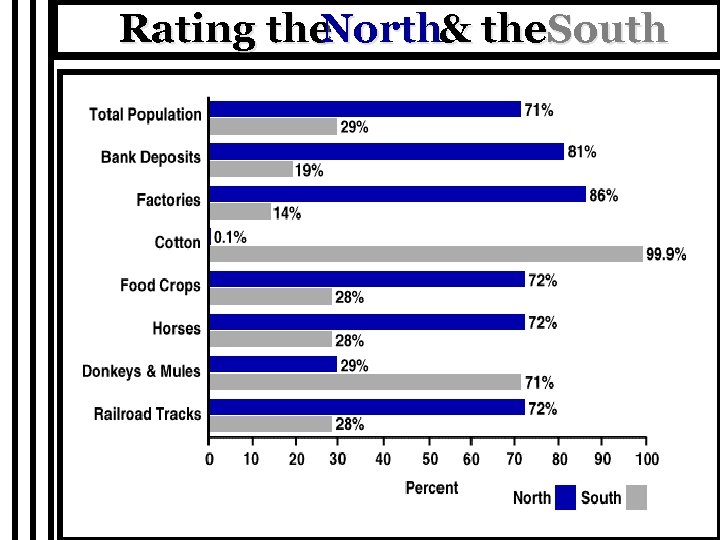 Rating the North& the. South
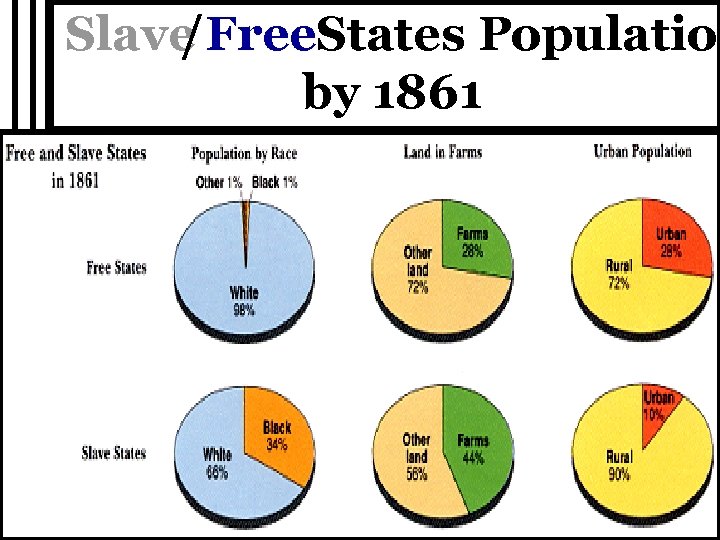 Slave /Free. States Population by 1861
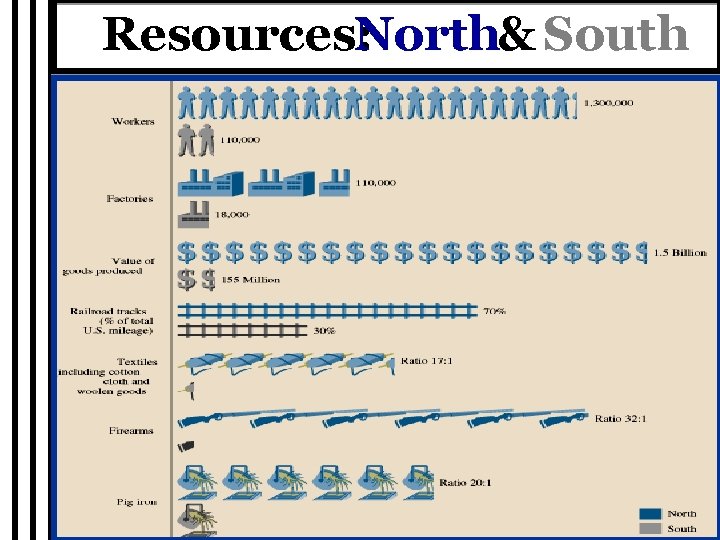 Resources: North& South
![Southern Society (1850) 6, 000 “Slavocracy” [plantation owners] The “Plain Folk” [white farmers] Black](https://present5.com/presentation/e7e32312bdd9b04f06e9bac4df437176/image-12.jpg "Southern Society (1850) 6, 000 “Slavocracy” [plantation owners] The “Plain Folk” [white farmers] Black") Southern Society (1850) 6, 000 “Slavocracy” [plantation owners] The “Plain Folk” [white farmers] Black Freemen Black Slaves 3, 000 Total US Population 23, 000 (9, 250, 000 in the South = 40%) 250, 000
Southern Society (1850) 6, 000 “Slavocracy” [plantation owners] The “Plain Folk” [white farmers] Black Freemen Black Slaves 3, 000 Total US Population 23, 000 (9, 250, 000 in the South = 40%) 250, 000

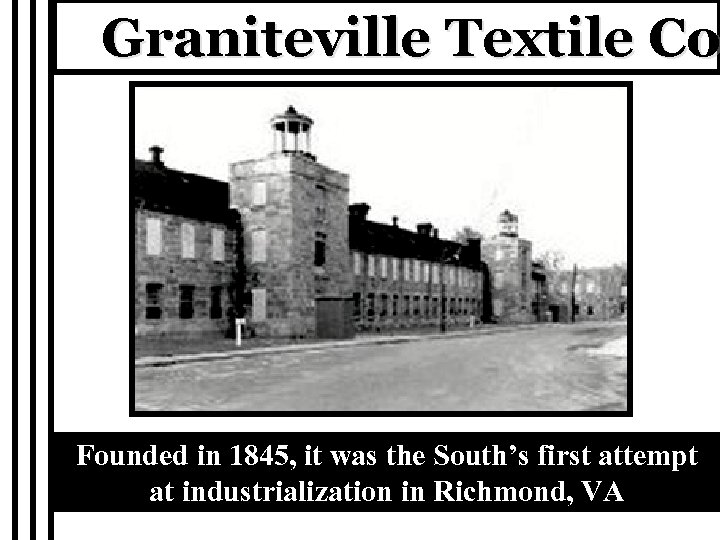 Graniteville Textile Co Founded in 1845, it was the South’s first attempt at industrialization in Richmond, VA
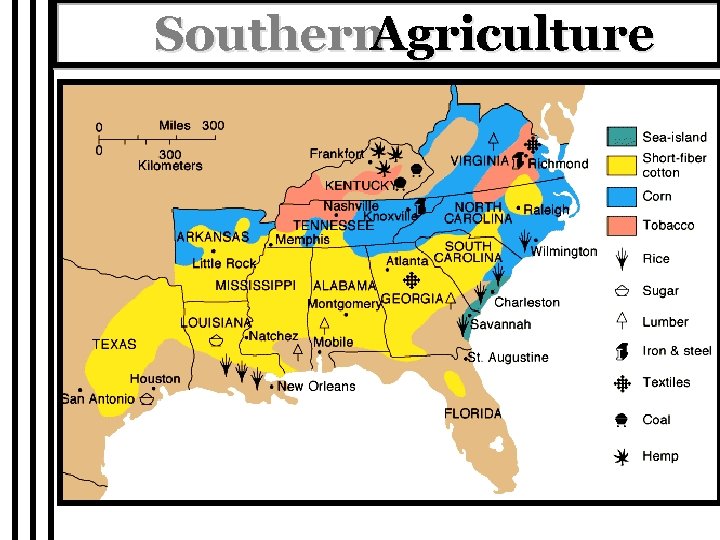 Southern Agriculture
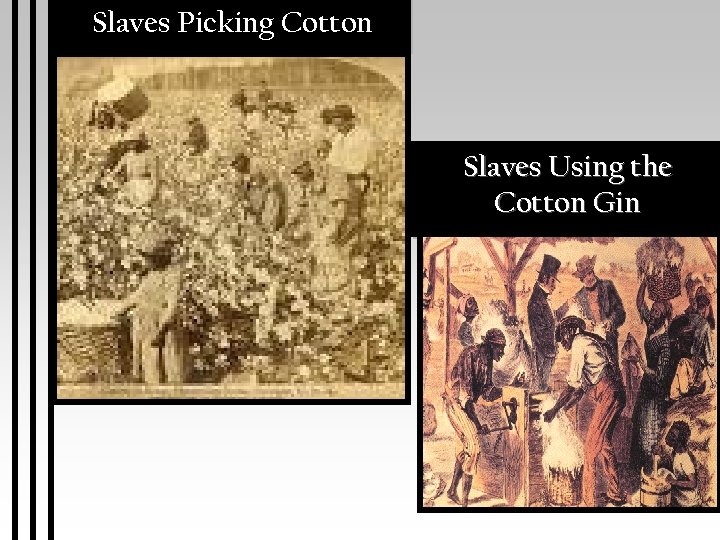 Slaves Picking Cotton Slaves Using the Cotton Gin
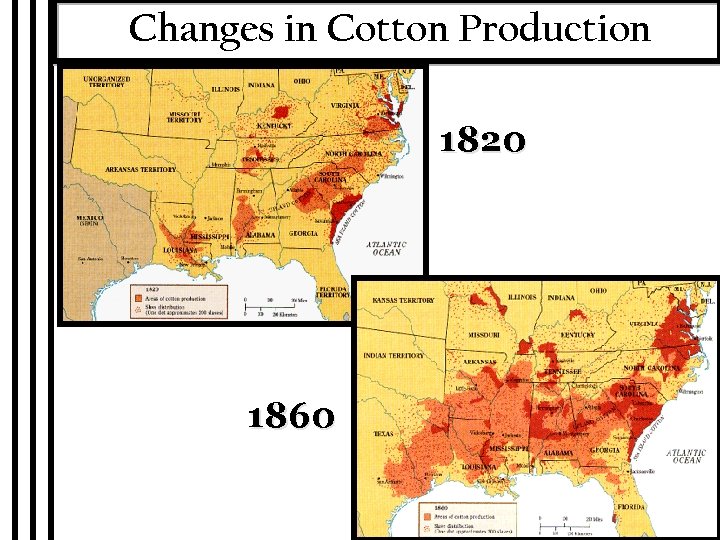 Changes in Cotton Production 1820 1860

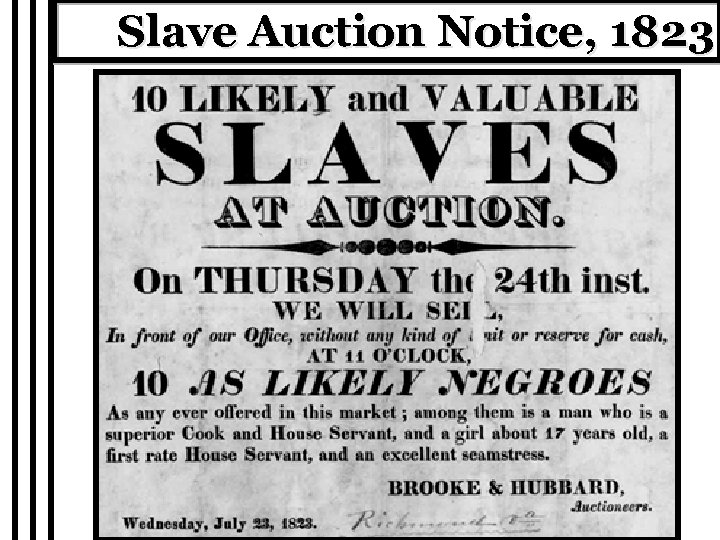 Slave Auction Notice, 1823
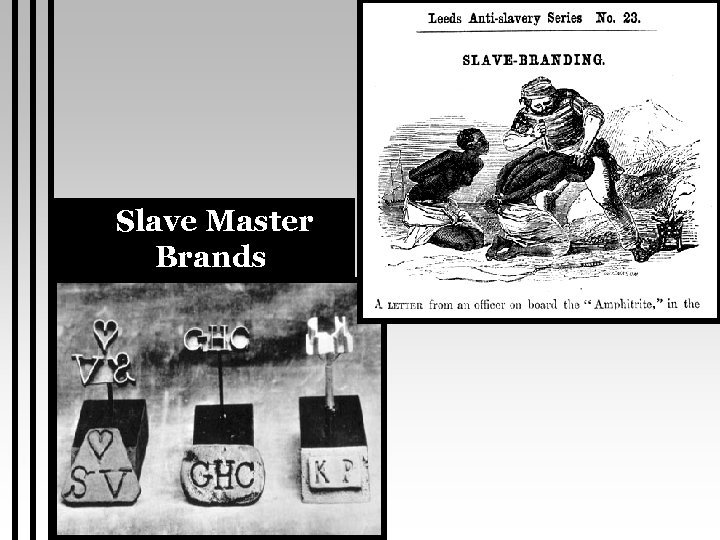 Slave Master Brands
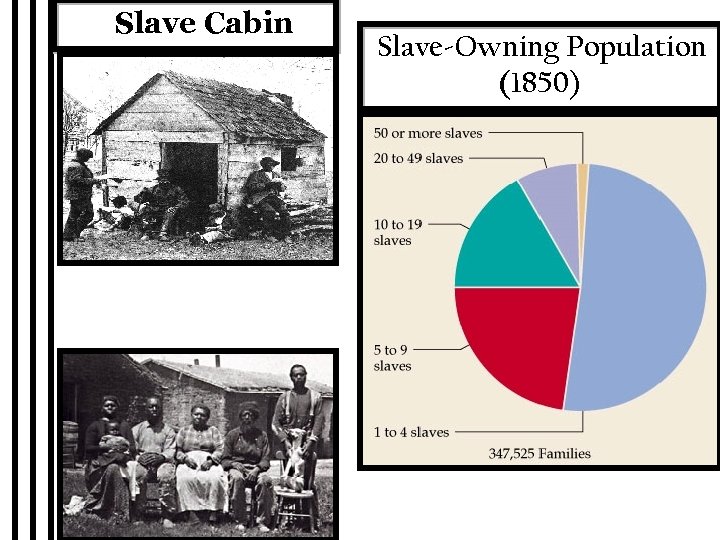 Slave Cabin Slave-Owning Population (1850)
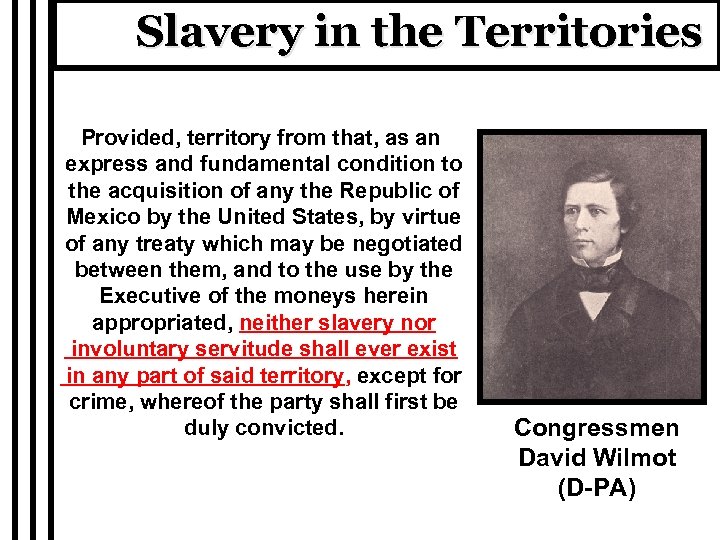 Slavery in the Territories Provided, territory from that, as an express and fundamental condition to the acquisition of any the Republic of Mexico by the United States, by virtue of any treaty which may be negotiated between them, and to the use by the Executive of the moneys herein appropriated, neither slavery nor involuntary servitude shall ever exist in any part of said territory, except for crime, whereof the party shall first be duly convicted. Congressmen David Wilmot (D-PA)
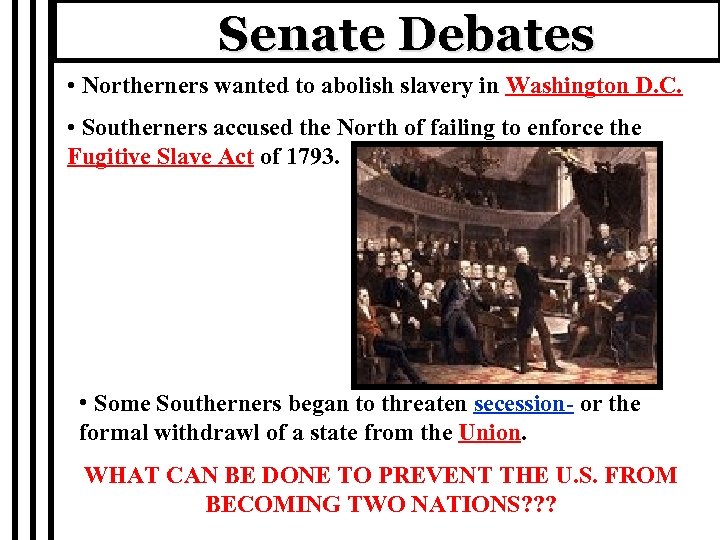 Senate Debates • Northerners wanted to abolish slavery in Washington D. C. • Southerners accused the North of failing to enforce the Fugitive Slave Act of 1793. • Some Southerners began to threaten secession- or the formal withdrawl of a state from the Union. WHAT CAN BE DONE TO PREVENT THE U. S. FROM BECOMING TWO NATIONS? ? ?
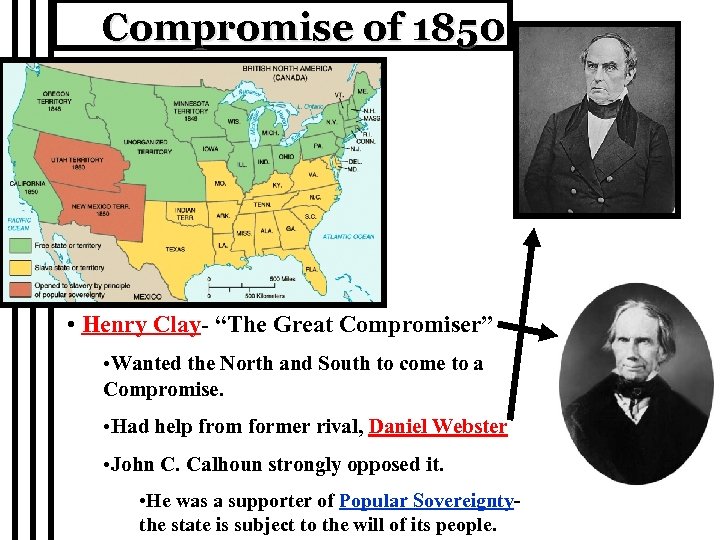 Compromise of 1850 • Henry Clay- “The Great Compromiser” • Wanted the North and South to come to a Compromise. • Had help from former rival, Daniel Webster • John C. Calhoun strongly opposed it. • He was a supporter of Popular Sovereigntythe state is subject to the will of its people.
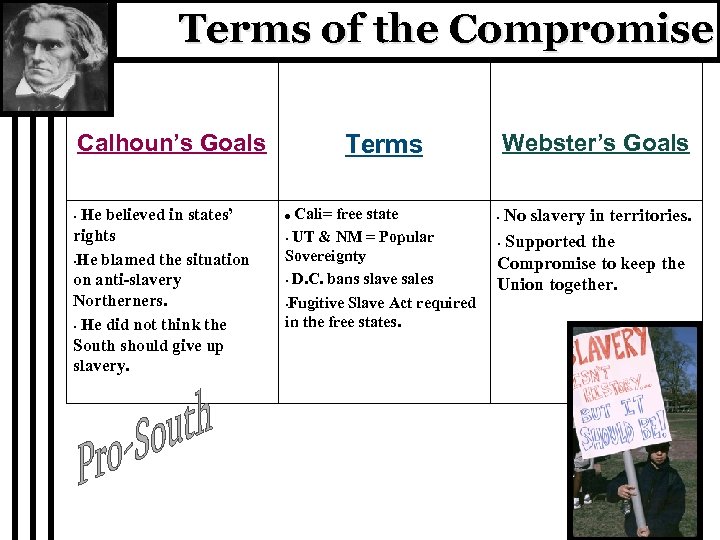 Terms of the Compromise Calhoun’s Goals He believed in states’ rights • He blamed the situation on anti-slavery Northerners. • He did not think the South should give up slavery. • Webster’s Goals Terms Cali= free state • UT & NM = Popular Sovereignty • D. C. bans slave sales • Fugitive Slave Act required in the free states. • No slavery in territories. • Supported the Compromise to keep the Union together. •
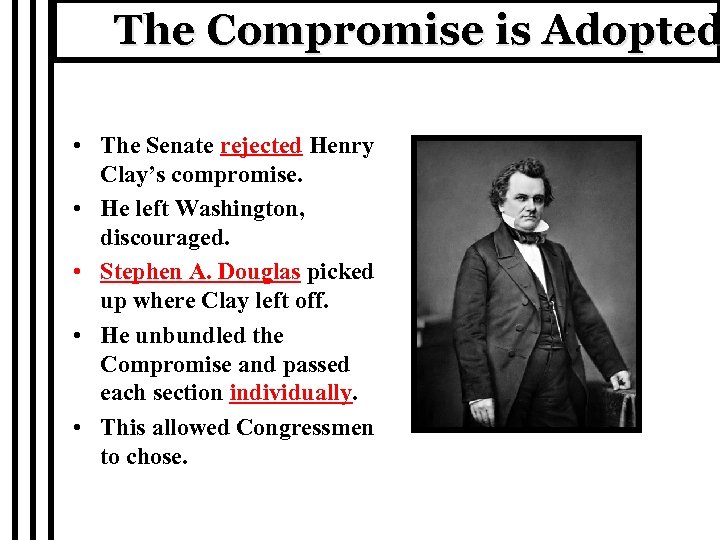 The Compromise is Adopted • The Senate rejected Henry Clay’s compromise. • He left Washington, discouraged. • Stephen A. Douglas picked up where Clay left off. • He unbundled the Compromise and passed each section individually. • This allowed Congressmen to chose.
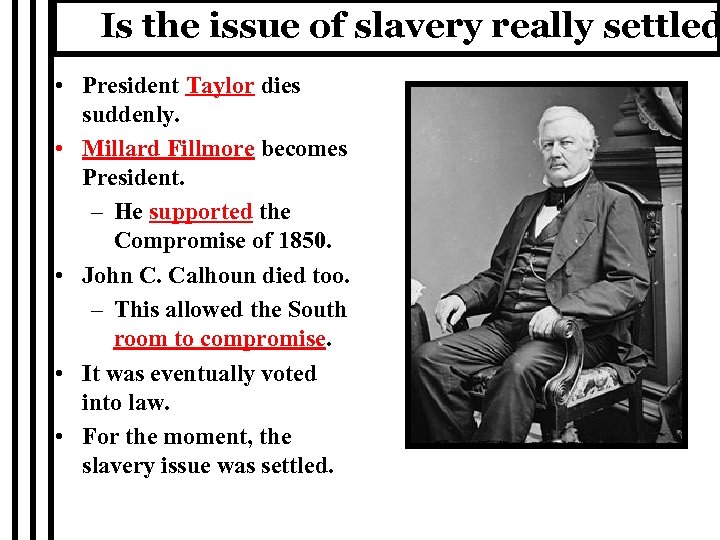 Is the issue of slavery really settled • President Taylor dies suddenly. • Millard Fillmore becomes President. – He supported the Compromise of 1850. • John C. Calhoun died too. – This allowed the South room to compromise. • It was eventually voted into law. • For the moment, the slavery issue was settled.
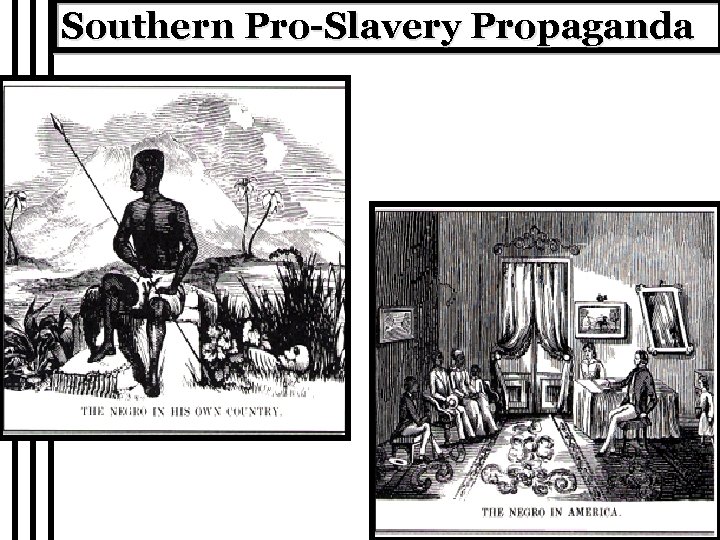 Southern Pro-Slavery Propaganda
 Reasons for the Civil War… s far… 1. 2. 3. 4. 5. 6. Slavery Underground Railroad Uncle Tom’s Cabin Kansas-Nebraska Act “Bleeding Kansas” Dred Scott Court Case
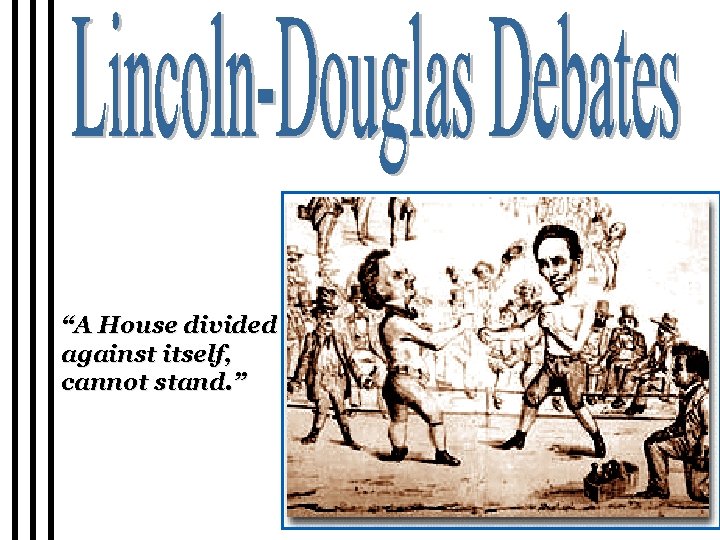 “A House divided against itself, cannot stand. ”
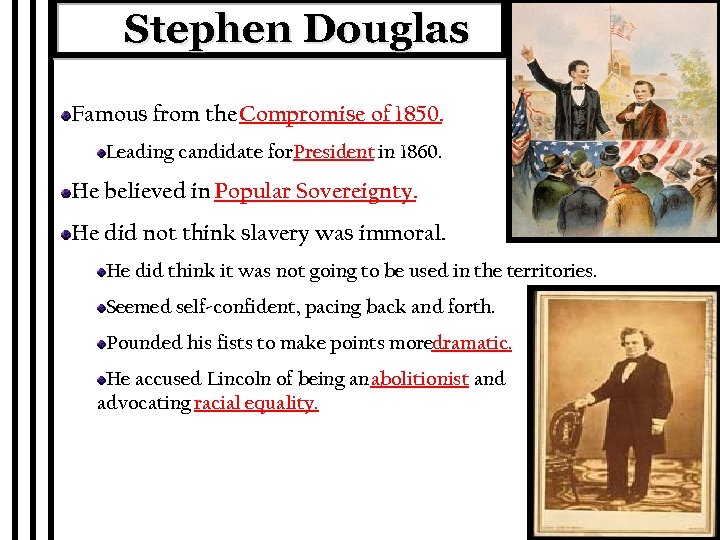 Stephen Douglas Famous from the Compromise of 1850. Leading candidate for President in 1860. He believed in Popular Sovereignty. He did not think slavery was immoral. He did think it was not going to be used in the territories. Seemed self-confident, pacing back and forth. Pounded his fists to make points moredramatic. He accused Lincoln of being an abolitionist and advocating racial equality.
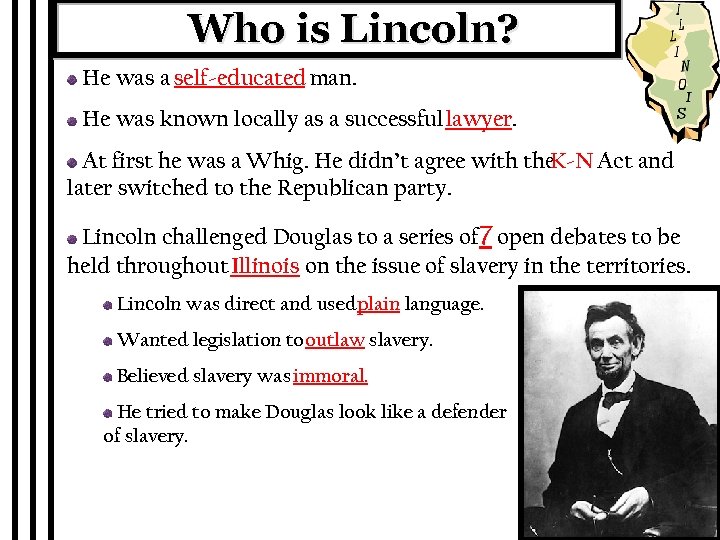 Who is Lincoln? He was a self-educated man. He was known locally as a successful lawyer. At first he was a Whig. He didn’t agree with the K-N Act and later switched to the Republican party. Lincoln challenged Douglas to a series of 7 open debates to be held throughout Illinois on the issue of slavery in the territories. Lincoln was direct and usedplain language. Wanted legislation to outlaw slavery. Believed slavery was immoral. He tried to make Douglas look like a defender of slavery.
 Freeport Doctrine Lincoln asked Douglas a crucial question. Could the settlers of a territory vote to exclude slavery before the territory became a state? Dred Scott decision said NO. Territories couldn’t exclude slavery. So, how did Popular Sovereignty make sense anymore? Douglas said, “Slavery cannot exist a day or an hour anywhere, unless it is supported by local police regulation. He was basically saying that people could get around the Dred Scott decision. Douglas won the Senate seat over Lincoln but his response further separated the North and South.
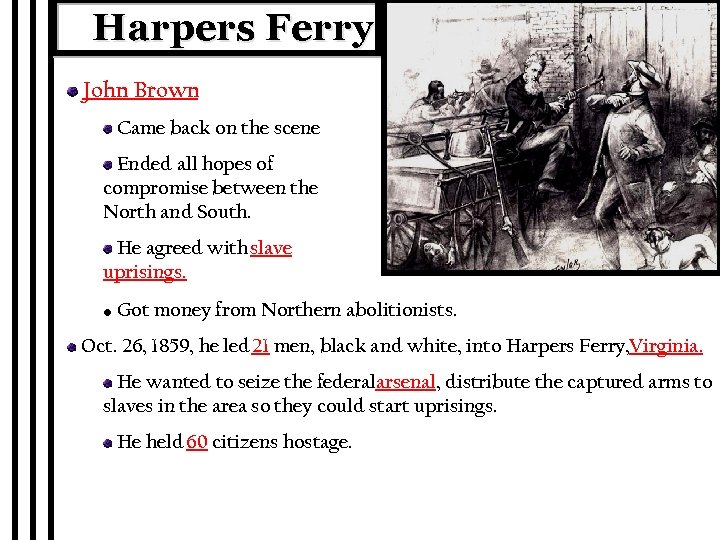 Harpers Ferry John Brown Came back on the scene Ended all hopes of compromise between the North and South. He agreed with slave uprisings. • Got money from Northern abolitionists. Oct. 26, 1859, he led 21 men, black and white, into Harpers Ferry, Virginia. He wanted to seize the federalarsenal, distribute the captured arms to slaves in the area so they could start uprisings. He held 60 citizens hostage.
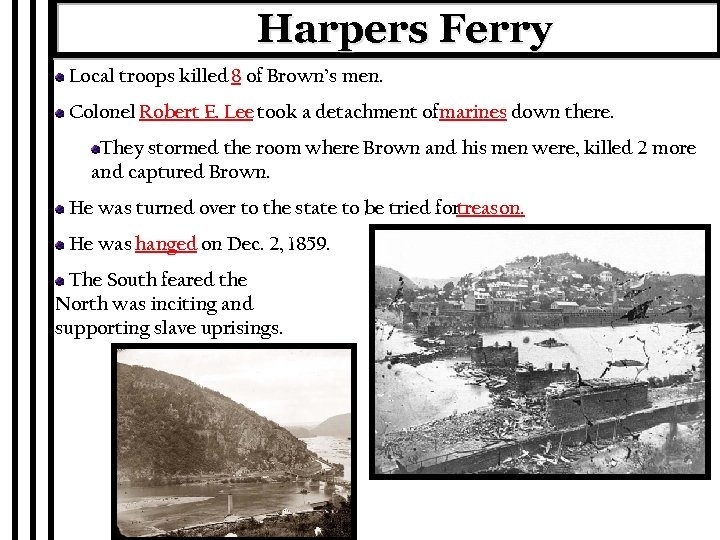 Harpers Ferry Local troops killed 8 of Brown’s men. Colonel Robert E. Lee took a detachment ofmarines down there. They stormed the room where Brown and his men were, killed 2 more and captured Brown. He was turned over to the state to be tried fortreason. He was hanged on Dec. 2, 1859. The South feared the North was inciting and supporting slave uprisings.
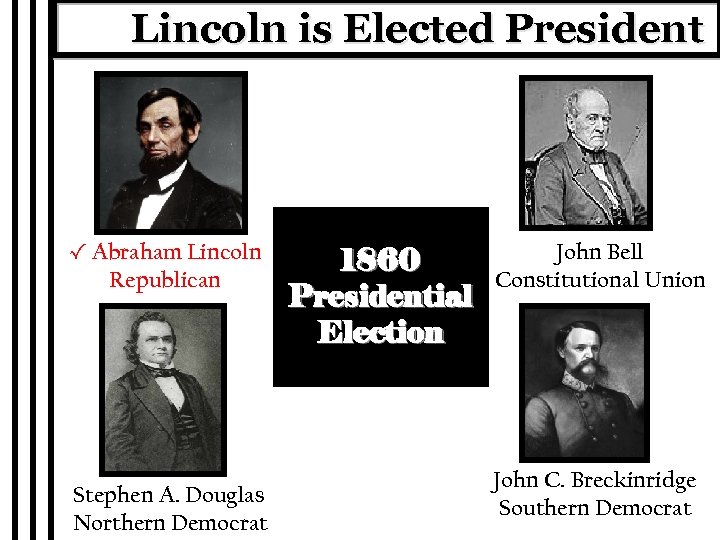 Lincoln is Elected President √ Abraham Lincoln Republican Stephen A. Douglas Northern Democrat 1860 Presidential Election John Bell Constitutional Union John C. Breckinridge Southern Democrat
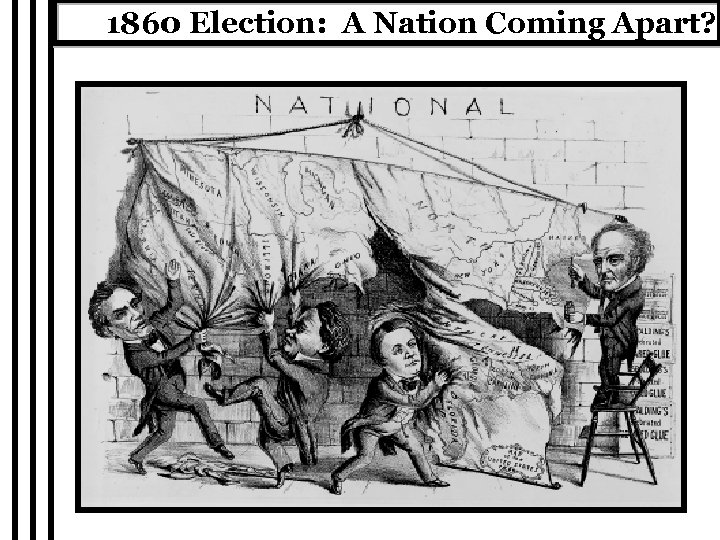 1860 Election: A Nation Coming Apart? !
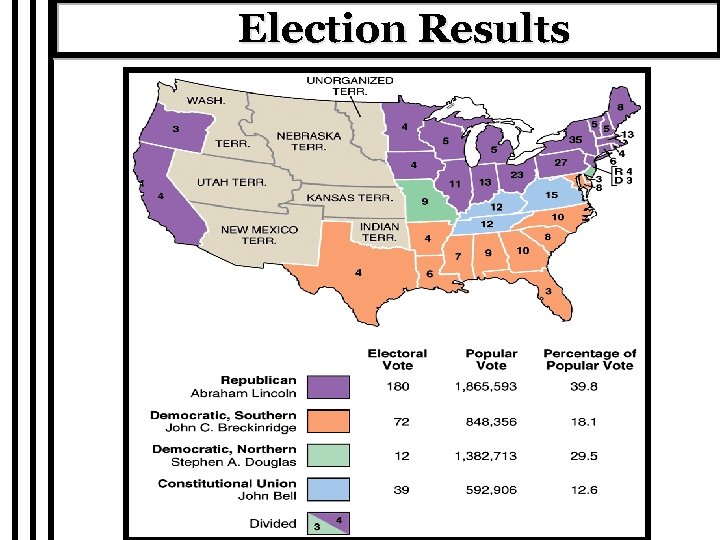 Election Results
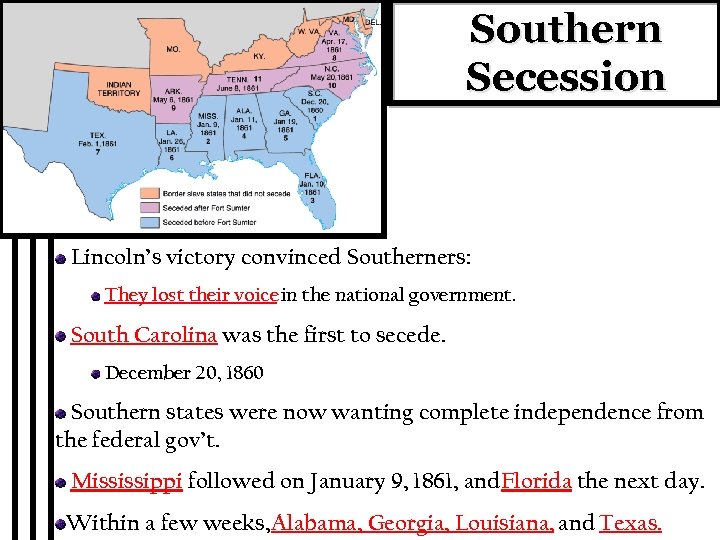 Southern Secession Lincoln’s victory convinced Southerners: They lost their voice in the national government. South Carolina was the first to secede. December 20, 1860 Southern states were now wanting complete independence from the federal gov’t. Mississippi followed on January 9, 1861, and. Florida the next day. Within a few weeks, Alabama, Georgia, Louisiana, and Texas.
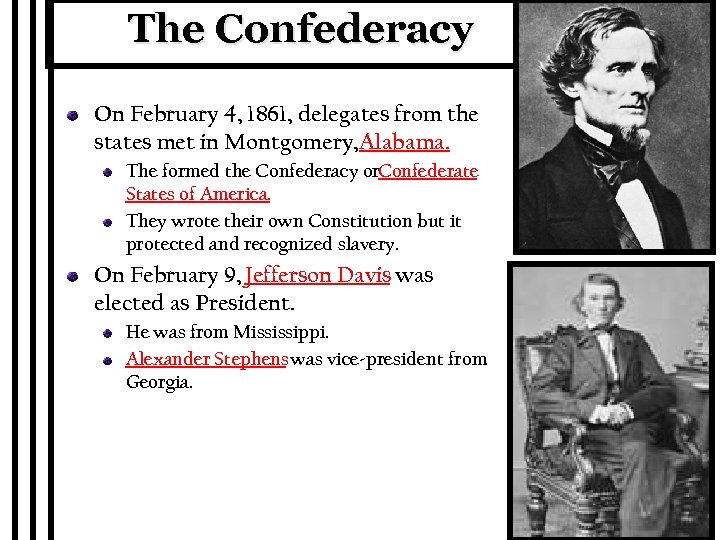 The Confederacy On February 4, 1861, delegates from the states met in Montgomery, Alabama. The formed the Confederacy or. Confederate States of America. They wrote their own Constitution but it protected and recognized slavery. On February 9, Jefferson Davis was elected as President. He was from Mississippi. Alexander Stephens was vice-president from Georgia.
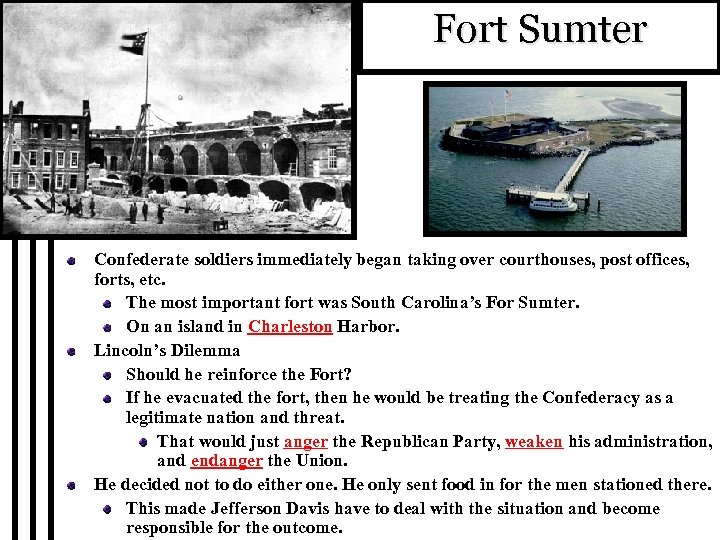 Fort Sumter Confederate soldiers immediately began taking over courthouses, post offices, forts, etc. The most important fort was South Carolina’s For Sumter. On an island in Charleston Harbor. Lincoln’s Dilemma Should he reinforce the Fort? If he evacuated the fort, then he would be treating the Confederacy as a legitimate nation and threat. That would just anger the Republican Party, weaken his administration, and endanger the Union. He decided not to do either one. He only sent food in for the men stationed there. This made Jefferson Davis have to deal with the situation and become responsible for the outcome.
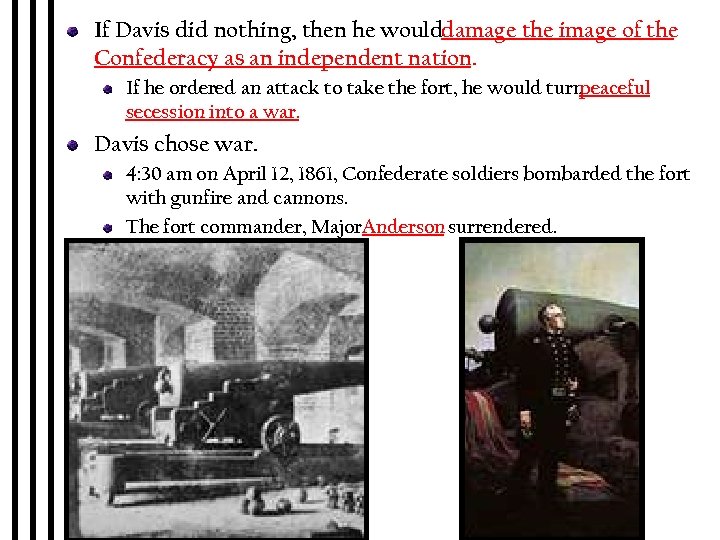 If Davis did nothing, then he woulddamage the image of the Confederacy as an independent nation. If he ordered an attack to take the fort, he would turn peaceful secession into a war. Davis chose war. 4: 30 am on April 12, 1861, Confederate soldiers bombarded the fort with gunfire and cannons. The fort commander, Major. Anderson surrendered.
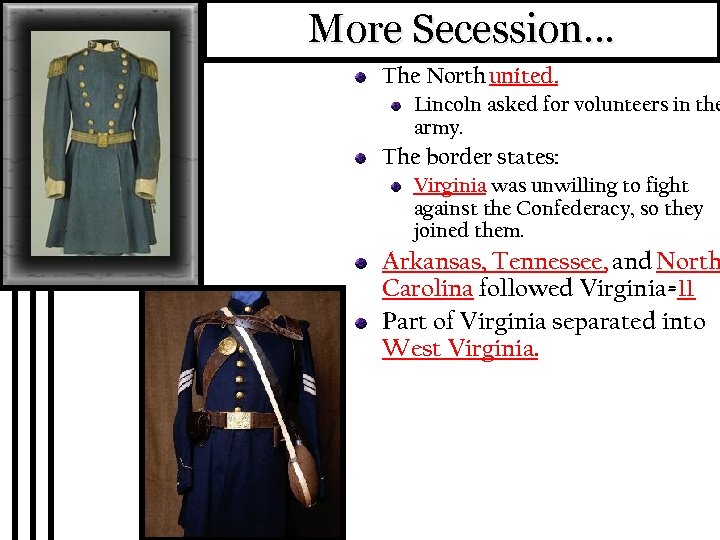 More Secession… The North united. Lincoln asked for volunteers in the army. The border states: Virginia was unwilling to fight against the Confederacy, so they joined them. Arkansas, Tennessee, and North Carolina followed Virginia=11 Part of Virginia separated into West Virginia.
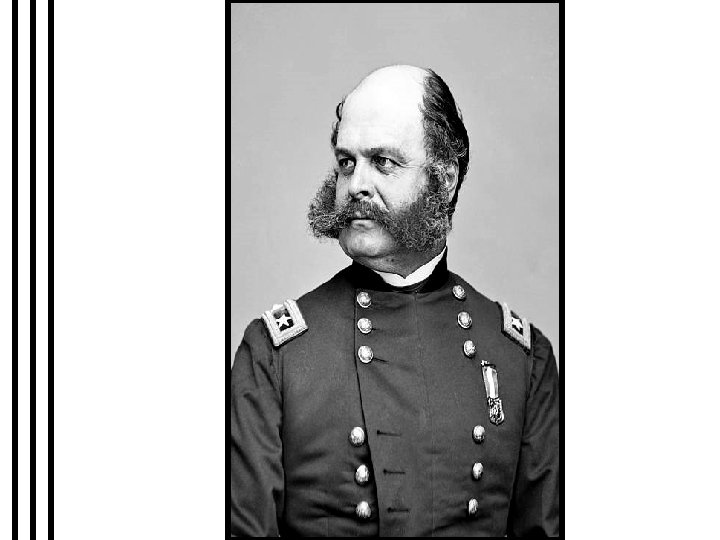
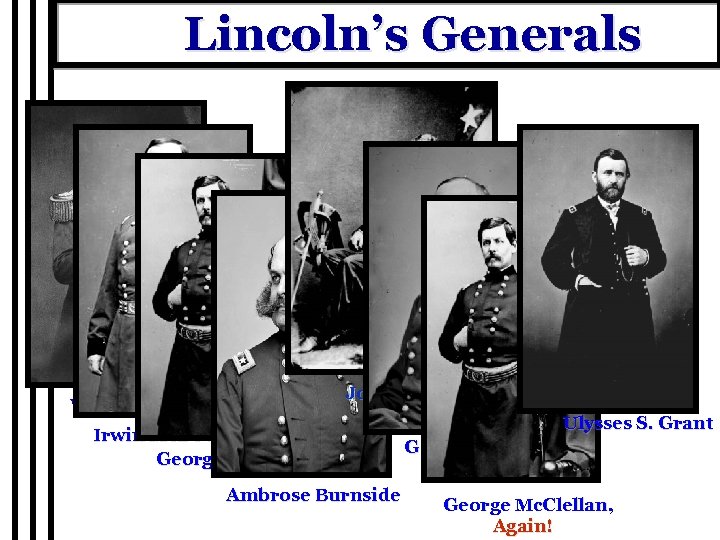 Lincoln’s Generals Joseph Hooker Winfield Scott Irwin Mc. Dowell George Mc. Clellan Ambrose Burnside Ulysses S. Grant George Meade George Mc. Clellan, Again!
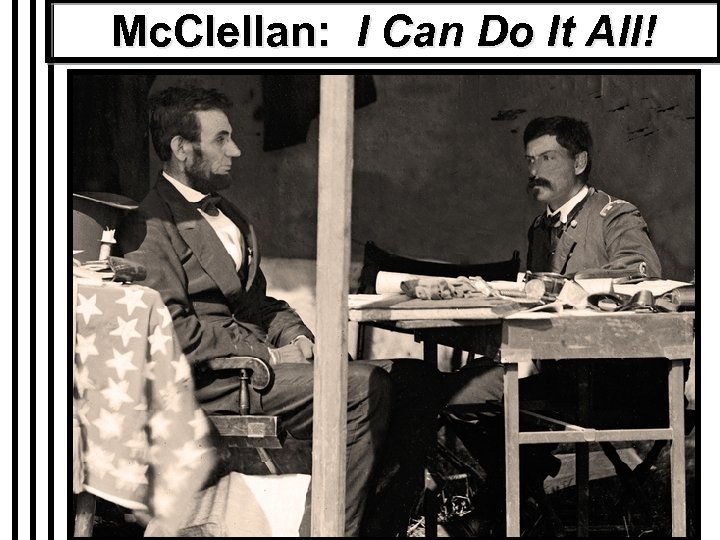 Mc. Clellan: I Can Do It All!
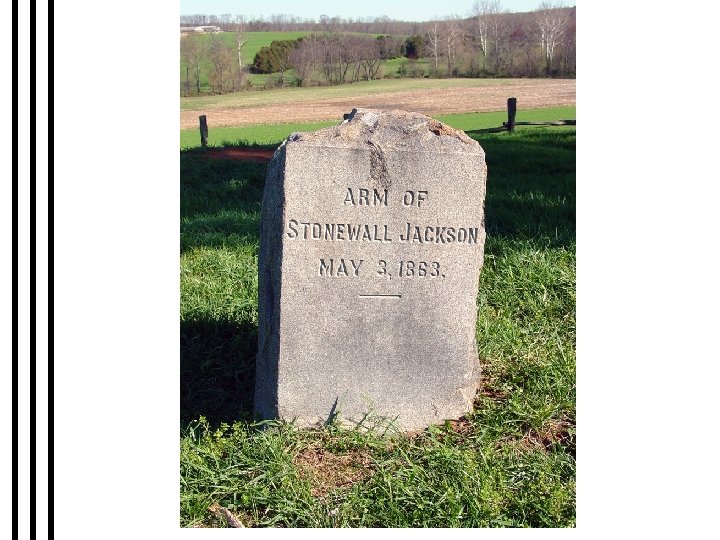
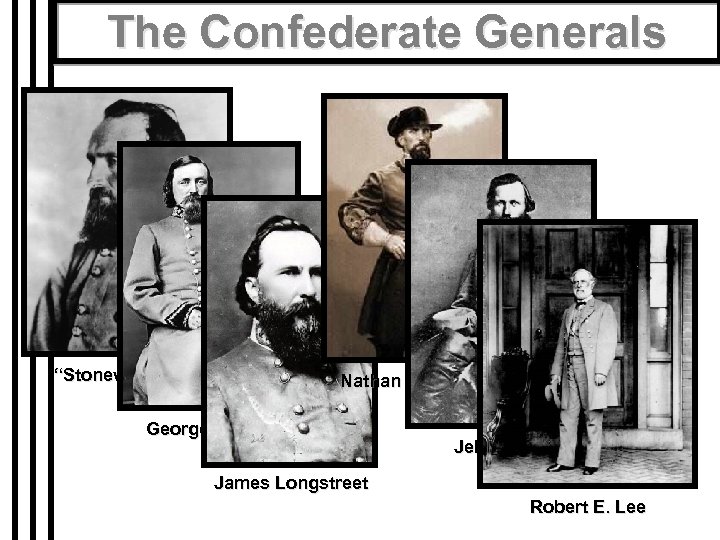 The Confederate Generals “Stonewall” Jackson Nathan Bedford Forrest George Pickett Jeb Stuart James Longstreet Robert E. Lee
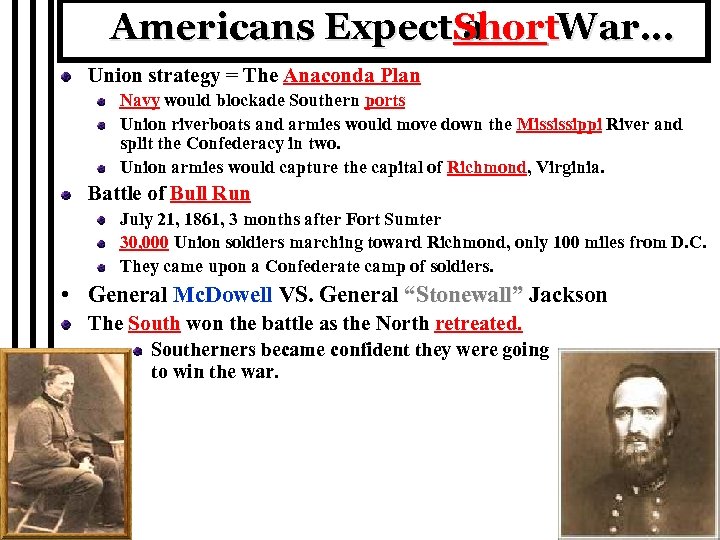 Americans Expect. Short. War… a Union strategy = The Anaconda Plan Navy would blockade Southern ports Union riverboats and armies would move down the Mississippi River and split the Confederacy in two. Union armies would capture the capital of Richmond, Virginia. Battle of Bull Run July 21, 1861, 3 months after Fort Sumter 30, 000 Union soldiers marching toward Richmond, only 100 miles from D. C. They came upon a Confederate camp of soldiers. • General Mc. Dowell VS. General “Stonewall” Jackson The South won the battle as the North retreated. Southerners became confident they were going to win the war.
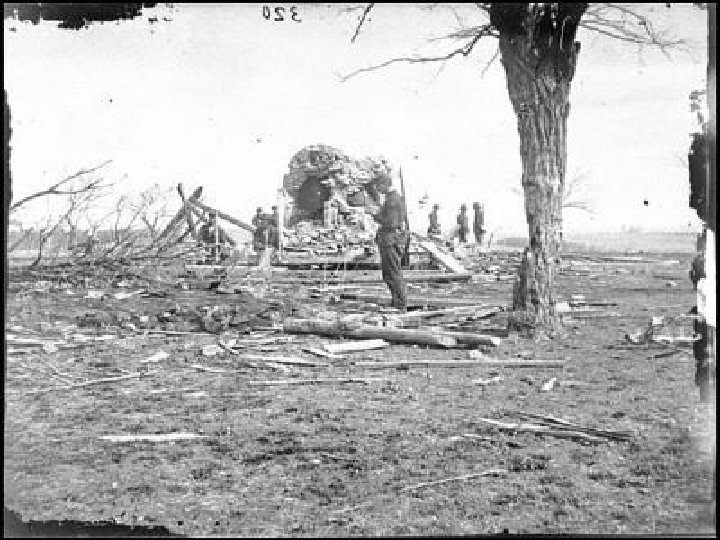
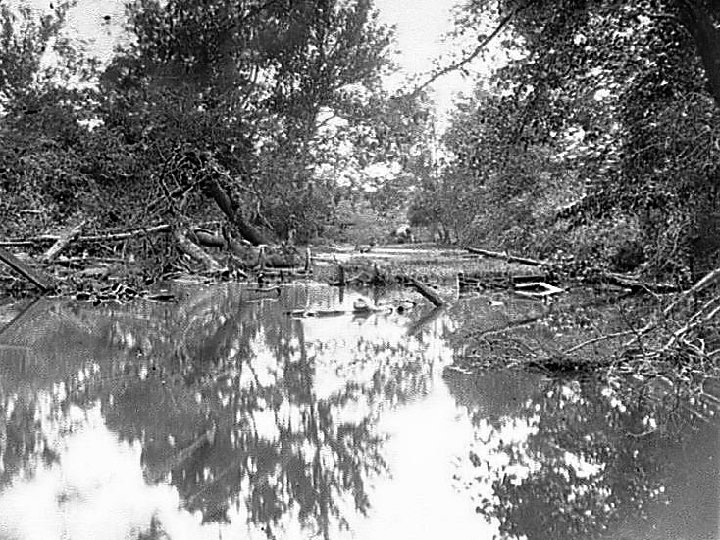
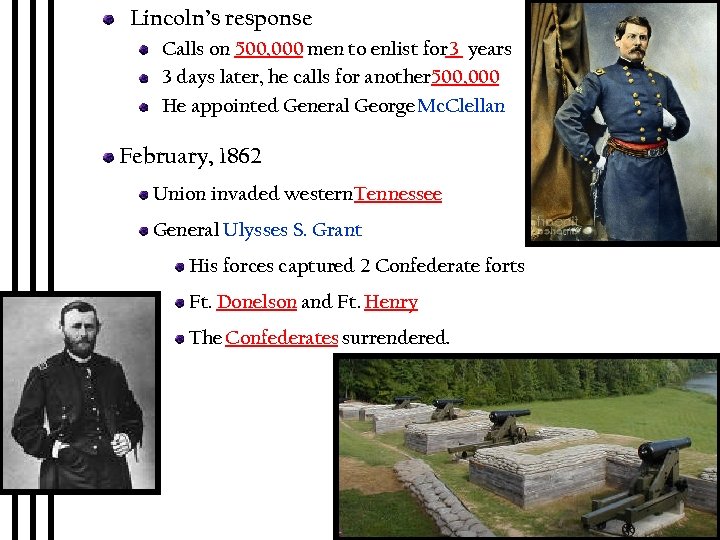 Lincoln’s response Calls on 500, 000 men to enlist for 3 years 3 days later, he calls for another 500, 000 He appointed General George Mc. Clellan February, 1862 Union invaded western Tennessee General Ulysses S. Grant His forces captured 2 Confederate forts Ft. Donelson and Ft. Henry The Confederates surrendered.