 Скачать презентацию The Distributive Impact of the Water Market in
99c377b6c22b517df6b642e2fd9a2141.ppt
- Количество слайдов: 22



The Distributive Impact of the Water Market in Chile: A Case Study in Limarí Province, 1981 - 1997 Donato Romano Department of Agricultural and Resource Economics University of Florence, Italy and Michel Leporati Instituto Nacional de Desarollo Agropecuario Santiago, Chile Published in the Quarterly Journal of International Agriculture vol. 41 (1/2): 141 -58
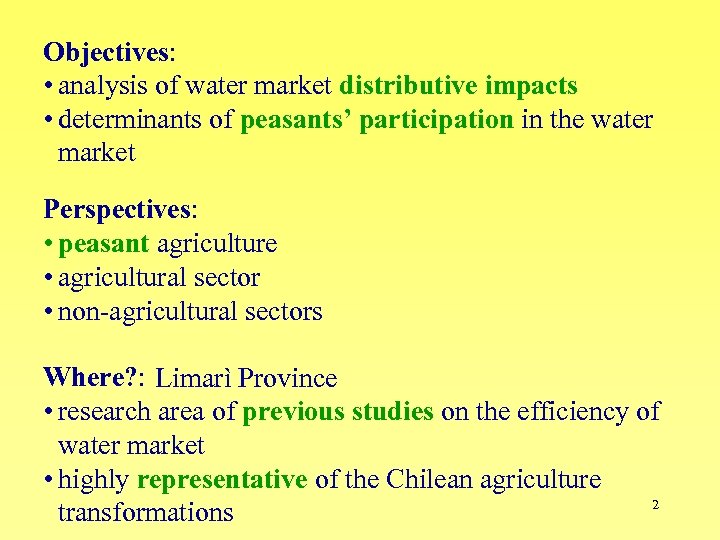
Objectives: • analysis of water market distributive impacts • determinants of peasants’ participation in the water market Perspectives: • peasant agriculture • agricultural sector • non-agricultural sectors Where? : Limarì Province • research area of previous studies on the efficiency of water market • highly representative of the Chilean agriculture 2 transformations
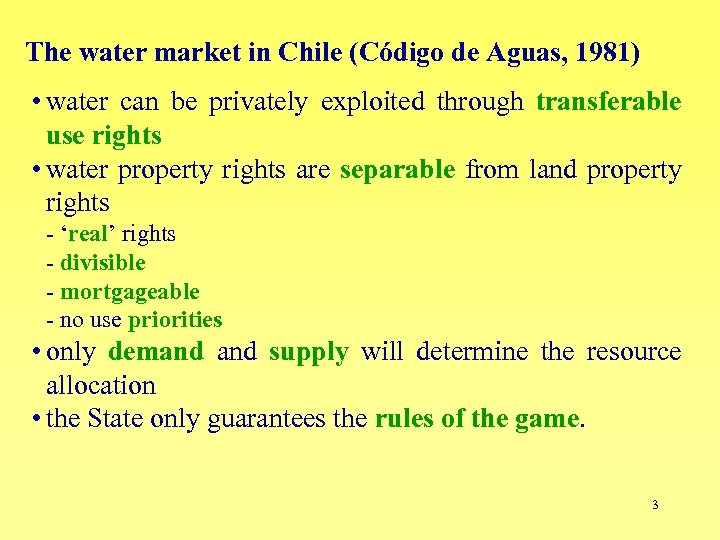
The water market in Chile (Código de Aguas, 1981) • water can be privately exploited through transferable use rights • water property rights are separable from land property rights - ‘real’ rights - divisible - mortgageable - no use priorities • only demand supply will determine the resource allocation • the State only guarantees the rules of the game. 3
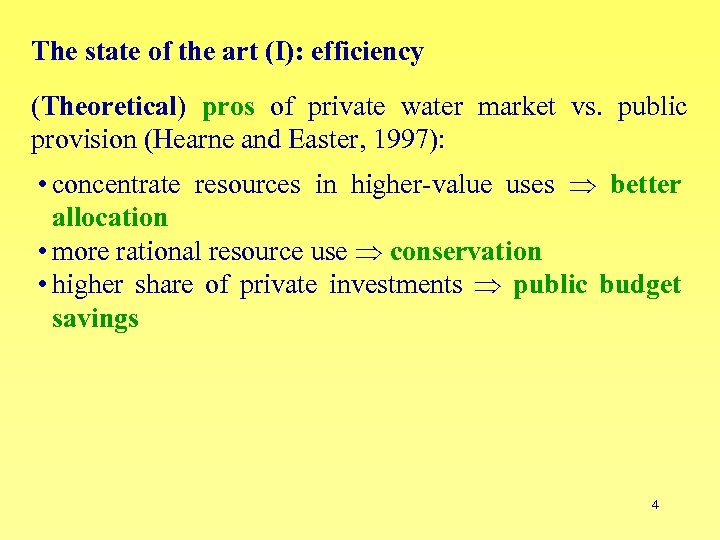
The state of the art (I): efficiency (Theoretical) pros of private water market vs. public provision (Hearne and Easter, 1997): • concentrate resources in higher-value uses better allocation • more rational resource use conservation • higher share of private investments public budget savings 4
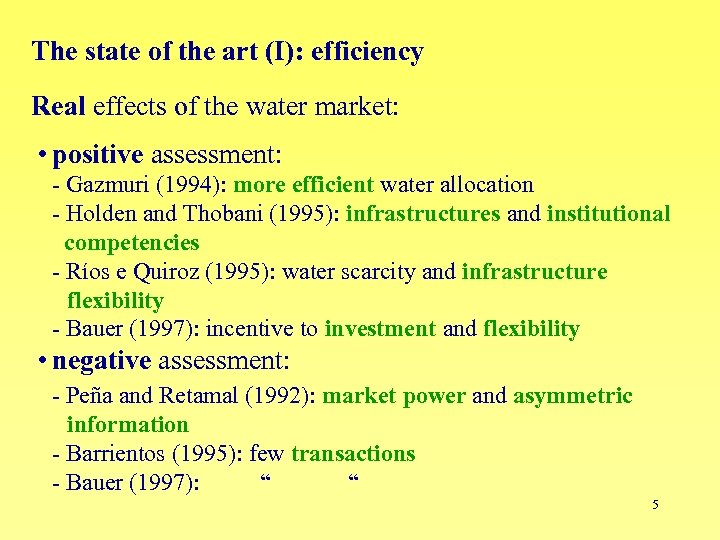
The state of the art (I): efficiency Real effects of the water market: • positive assessment: - Gazmuri (1994): more efficient water allocation - Holden and Thobani (1995): infrastructures and institutional competencies - Ríos e Quiroz (1995): water scarcity and infrastructure flexibility - Bauer (1997): incentive to investment and flexibility • negative assessment: - Peña and Retamal (1992): market power and asymmetric information - Barrientos (1995): few transactions - Bauer (1997): “ 5
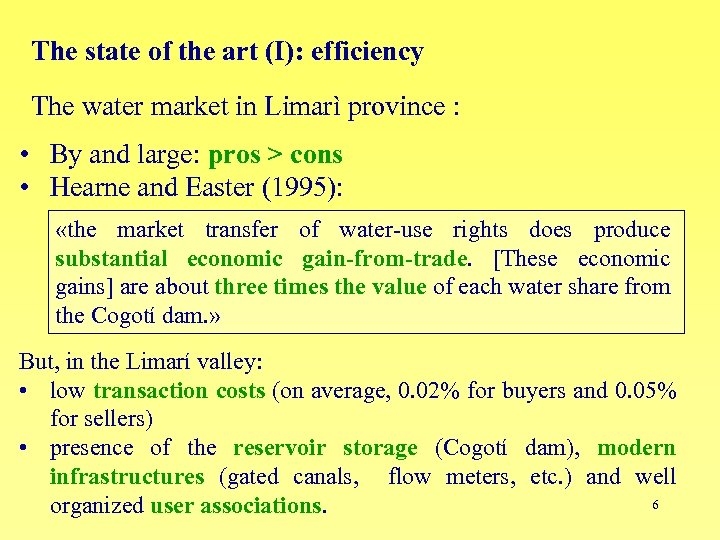
The state of the art (I): efficiency The water market in Limarì province : • By and large: pros > cons • Hearne and Easter (1995): «the market transfer of water-use rights does produce substantial economic gain-from-trade. [These economic gains] are about three times the value of each water share from the Cogotí dam. » But, in the Limarí valley: • low transaction costs (on average, 0. 02% for buyers and 0. 05% for sellers) • presence of the reservoir storage (Cogotí dam), modern infrastructures (gated canals, flow meters, etc. ) and well 6 organized user associations.
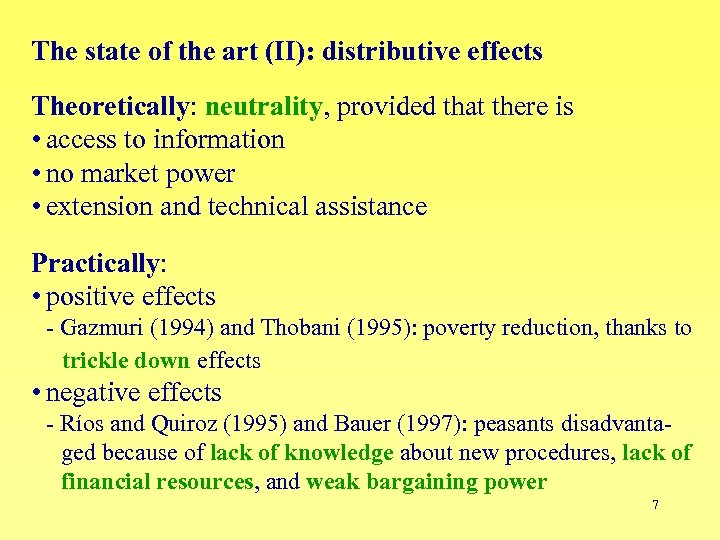
The state of the art (II): distributive effects Theoretically: neutrality, provided that there is • access to information • no market power • extension and technical assistance Practically: • positive effects - Gazmuri (1994) and Thobani (1995): poverty reduction, thanks to trickle down effects • negative effects - Ríos and Quiroz (1995) and Bauer (1997): peasants disadvanta ged because of lack of knowledge about new procedures, lack of financial resources, and weak bargaining power 7
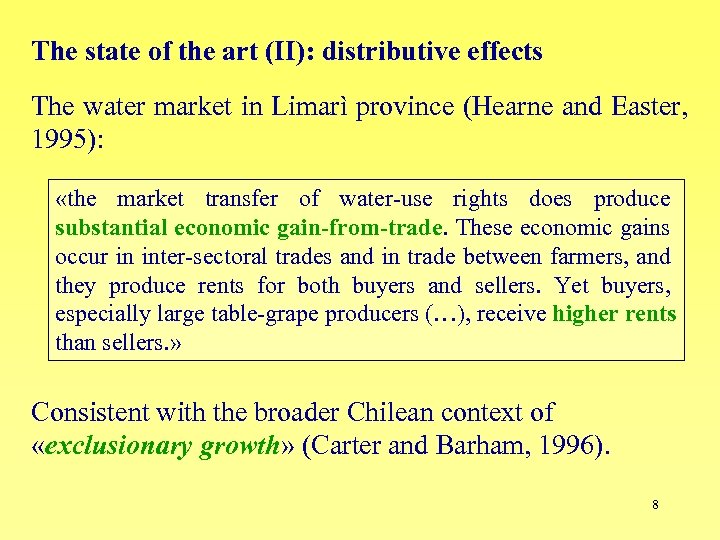
The state of the art (II): distributive effects The water market in Limarì province (Hearne and Easter, 1995): «the market transfer of water-use rights does produce substantial economic gain-from-trade. These economic gains occur in inter-sectoral trades and in trade between farmers, and they produce rents for both buyers and sellers. Yet buyers, especially large table-grape producers (…), receive higher rents than sellers. » Consistent with the broader Chilean context of «exclusionary growth» (Carter and Barham, 1996). 8
The case study (I): market functioning Analysis of all registrations (both original registrations and transfers) of rights among agents which took place between 1981 and 1997 in Limarí Province. Water market is a very active institution in Limarí Province: • total registrations: 1, 367 • yearly average: 80. 4 • corrected yearly average: 39. 3 • market transactions: 84% of total registrations 9
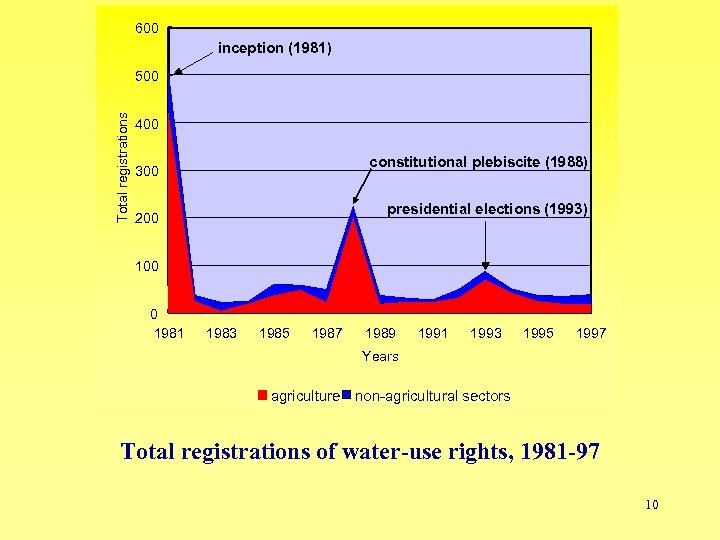
600 inception (1981) Total registrations 500 400 constitutional plebiscite (1988) 300 presidential elections (1993) 200 100 0 1981 1983 1985 1987 1989 1991 1993 1995 1997 Years agriculture non-agricultural sectors Total registrations of water-use rights, 1981 -97 10
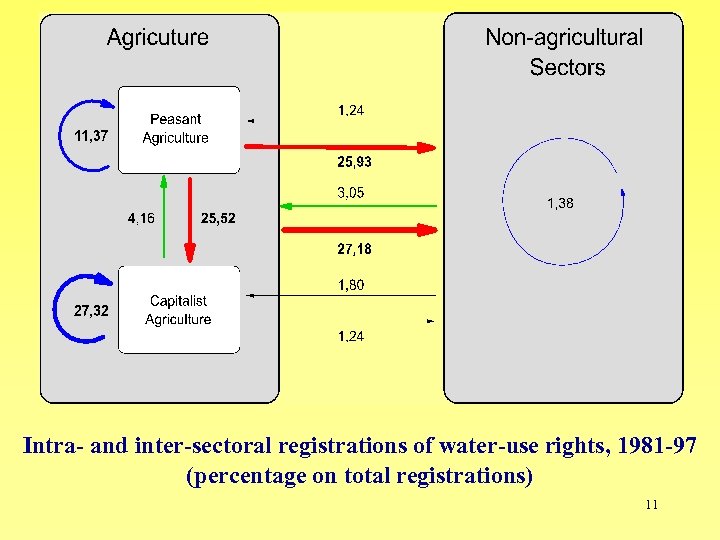
Intra- and inter-sectoral registrations of water-use rights, 1981 -97 (percentage on total registrations) 11
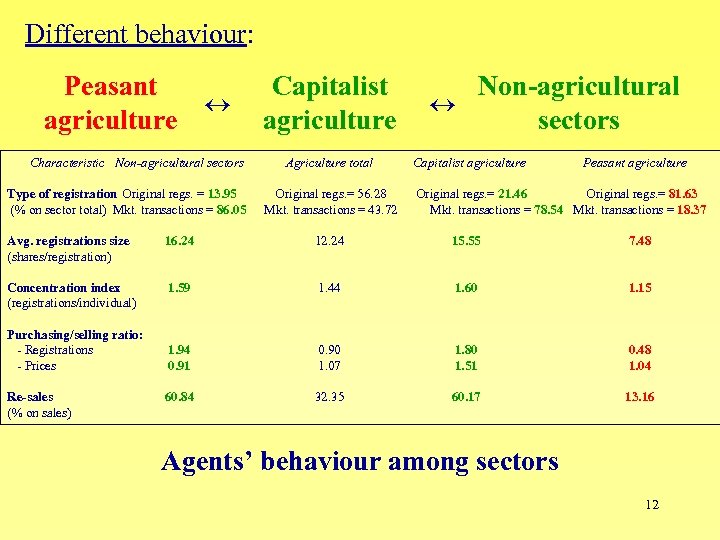
Different behaviour: Peasant agriculture Capitalist agriculture Characteristic Non-agricultural sectors Agriculture total Type of registration Original regs. = 13. 95 (% on sector total) Mkt. transactions = 86. 05 Non-agricultural sectors Capitalist agriculture Peasant agriculture Original regs. = 56. 28 Original regs. = 21. 46 Original regs. = 81. 63 Mkt. transactions = 43. 72 Mkt. transactions = 78. 54 Mkt. transactions = 18. 37 Avg. registrations size (shares/registration) 16. 24 12. 24 15. 55 7. 48 Concentration index (registrations/individual) 1. 59 1. 44 1. 60 1. 15 1. 94 0. 91 0. 90 1. 07 1. 80 1. 51 0. 48 1. 04 60. 84 32. 35 60. 17 13. 16 Purchasing/selling ratio: - Registrations - Prices Re-sales (% on sales) Agents’ behaviour among sectors 12
The case study (I): market functioning Conclusions: • quite far from a perfectly competitive market - market power - access to information? • peasant agriculture dependent 13
The case study (II): distributive effects Evolution of water-use rights among different population quintiles on the period 1981 -97: Gini coefficient Lorenz curves Whole population Peasant agriculture 14
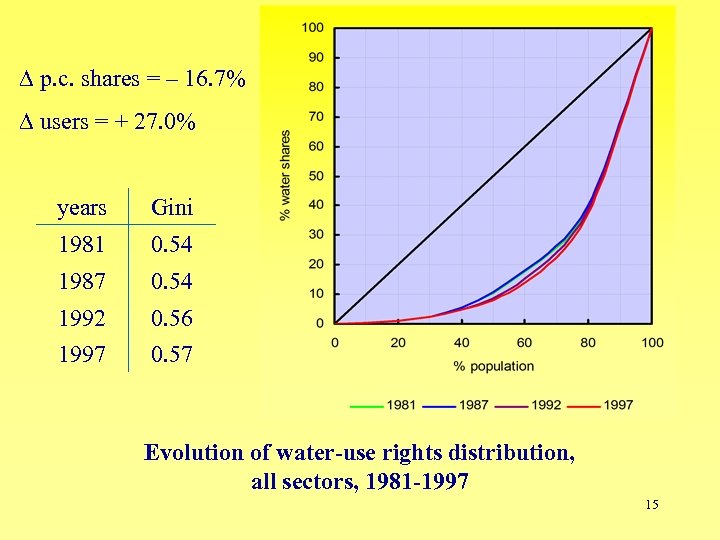
p. c. shares = – 16. 7% users = + 27. 0% years Gini 1981 0. 54 1987 0. 54 1992 0. 56 1997 0. 57 Evolution of water-use rights distribution, all sectors, 1981 -1997 15
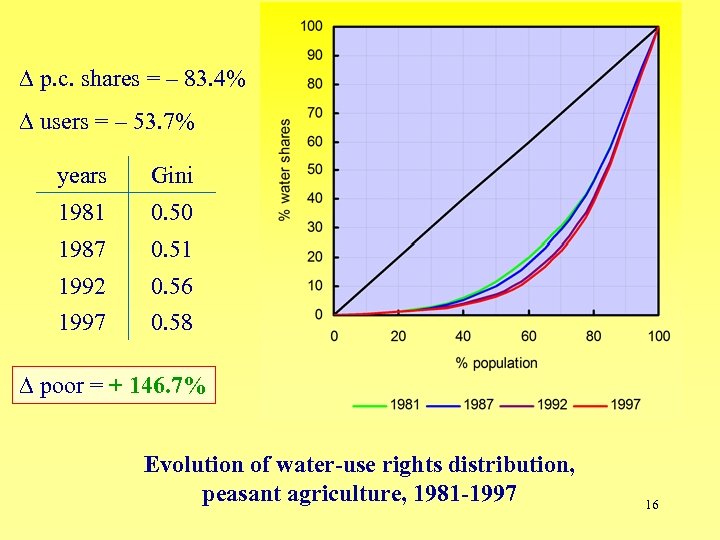
p. c. shares = – 83. 4% users = – 53. 7% years Gini 1981 0. 50 1987 0. 51 1992 0. 56 1997 0. 58 poor = + 146. 7% Evolution of water-use rights distribution, peasant agriculture, 1981 -1997 16
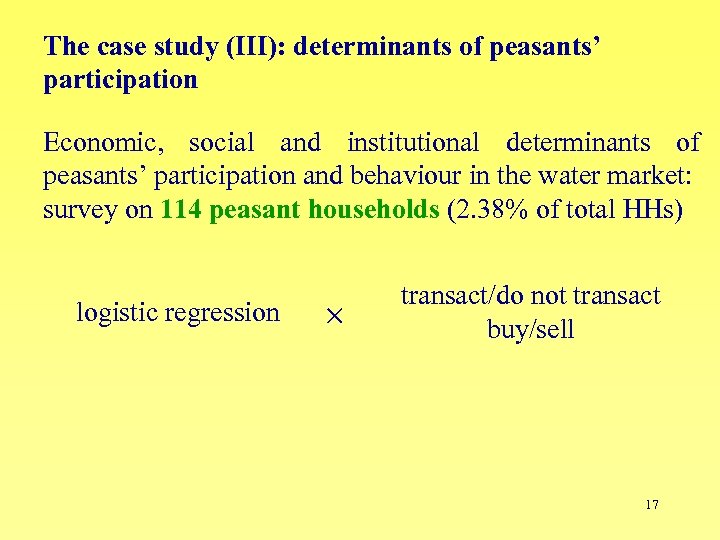
The case study (III): determinants of peasants’ participation Economic, social and institutional determinants of peasants’ participation and behaviour in the water market: survey on 114 peasant households (2. 38% of total HHs) logistic regression transact/do not transact buy/sell 17
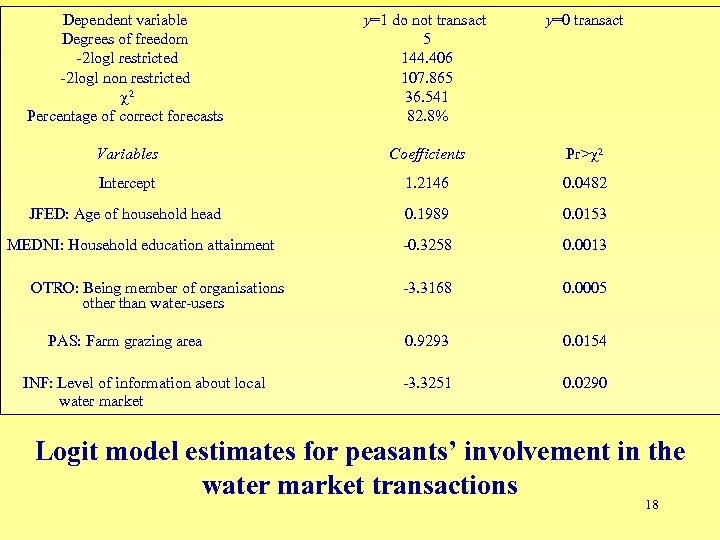
Dependent variable Degrees of freedom -2 logl restricted -2 logl non restricted 2 Percentage of correct forecasts y=1 do not transact 5 144. 406 107. 865 36. 541 82. 8% y=0 transact Variables Intercept Coefficients Pr> 2 1. 2146 0. 0482 JFED: Age of household head 0. 1989 0. 0153 -0. 3258 0. 0013 -3. 3168 0. 0005 0. 9293 0. 0154 -3. 3251 0. 0290 MEDNI: Household education attainment OTRO: Being member of organisations other than water-users PAS: Farm grazing area INF: Level of information about local water market Logit model estimates for peasants’ involvement in the water market transactions 18
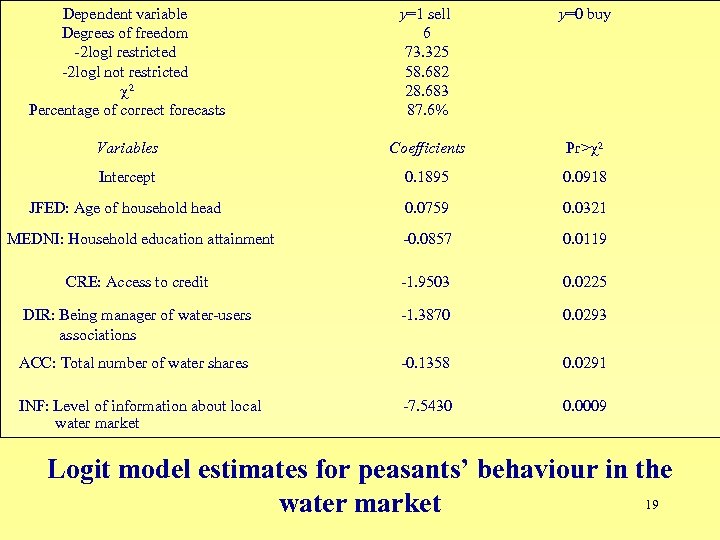
Dependent variable Degrees of freedom -2 logl restricted -2 logl not restricted 2 Percentage of correct forecasts y=1 sell 6 73. 325 58. 682 28. 683 87. 6% y=0 buy Variables Intercept Coefficients Pr> 2 0. 1895 0. 0918 JFED: Age of household head 0. 0759 0. 0321 MEDNI: Household education attainment CRE: Access to credit DIR: Being manager of water-users associations -0. 0857 0. 0119 -1. 9503 0. 0225 -1. 3870 0. 0293 ACC: Total number of water shares -0. 1358 0. 0291 INF: Level of information about local water market -7. 5430 0. 0009 Logit model estimates for peasants’ behaviour in the 19 water market
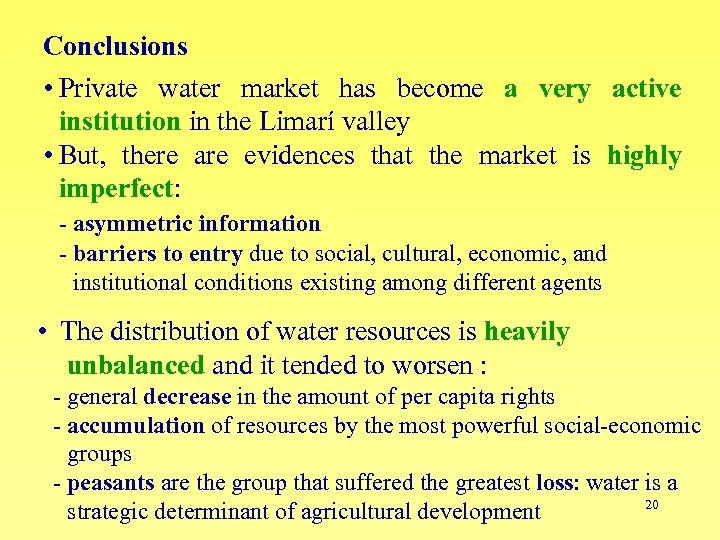
Conclusions • Private water market has become a very active institution in the Limarí valley • But, there are evidences that the market is highly imperfect: - asymmetric information - barriers to entry due to social, cultural, economic, and institutional conditions existing among different agents • The distribution of water resources is heavily unbalanced and it tended to worsen : - general decrease in the amount of per capita rights - accumulation of resources by the most powerful social-economic groups - peasants are the group that suffered the greatest loss: water is a 20 strategic determinant of agricultural development
Conclusions • Determinants affecting peasants’ participation and behaviour in the water market: crucial role of the variables relative to information, education and participation in agricultural organisations and in water users associations potential role of government interventions in: - training of human resources - promotion of adequate and accessible information for the whole population 21
Conclusions • Distribution dynamics influenced by the Government’s abdication from its role as ‘referee’ of the game (consequence of the radically liberalistic environment where the reform was designed and implemented) • The Concertaciòn Governments’ ‘growth with equity’ objective has not been achieved 22
Скачать презентацию The Distributive Impact of the Water Market in
99c377b6c22b517df6b642e2fd9a2141.ppt