


 Скачать презентацию THE DISASTER MEDICINE DEPARTMENT LECTURE 3 The State
90f0f6d91bd5e751e3253db4ca45af69.ppt
- Количество слайдов: 53
 THE DISASTER MEDICINE DEPARTMENT LECTURE 3 The State service of medicine catastrophe as the system of medical provision of the population in extreme situation period. Treatment and evacuating provision Arsen Gudyma, MD, prof. Vasyl Demianenko, MC, as. prof.
 The lecture’s purpose Mastering of the treatment-evacuating provision peculiarities of the population in extraordinary conditions of peace-time
 Key questions 1. The staging principles of an organization of the medical aid for the casualties in mass disaster 2. The Volume of the medical aid for the population on the evacuating stages 3. Algorithms of the medical aid rendering
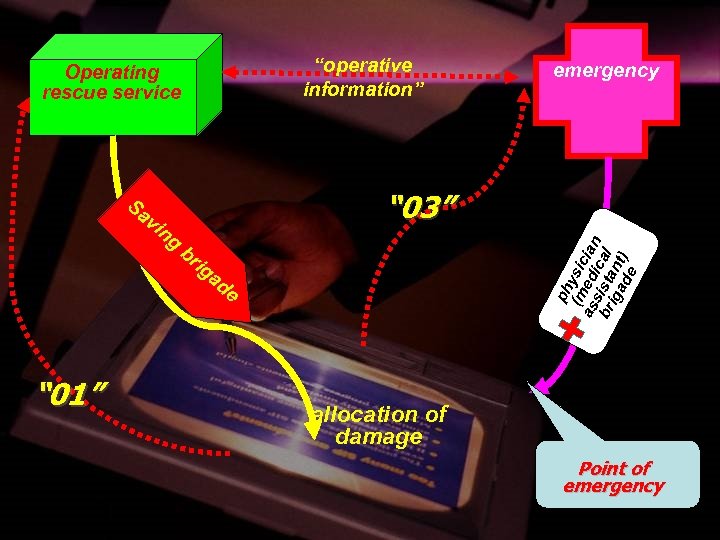 “operative information” Operating rescue service in g “ 03” br ph (m ysic as ed ian s i br ista cal iga nt de ) Sa v ig ad e “ 01” emergency allocation of damage Point of emergency
 Medical units of SSMC 1. Mobile hospitals 2. Mobile brigade 3. Medical brigade of all-time readiness of the first turn 4. Special medical brigade of all-time readiness of the second turn
 Requirements for the personnel of the medical units of the SSMC 1. Must be responsible to required level of the readiness to rendering the first aid for the population in the cause of appearance of the extraordinary situations. 2. Be capable by the health state to perform works in extreme situation. 3. Must be certificated. 4. Must be written in the special list of rescue services. 5. 5. Personnel has right on the warrant of social protection and takes responsibility in accordance with Law of the Ukraine “About rescue services”.
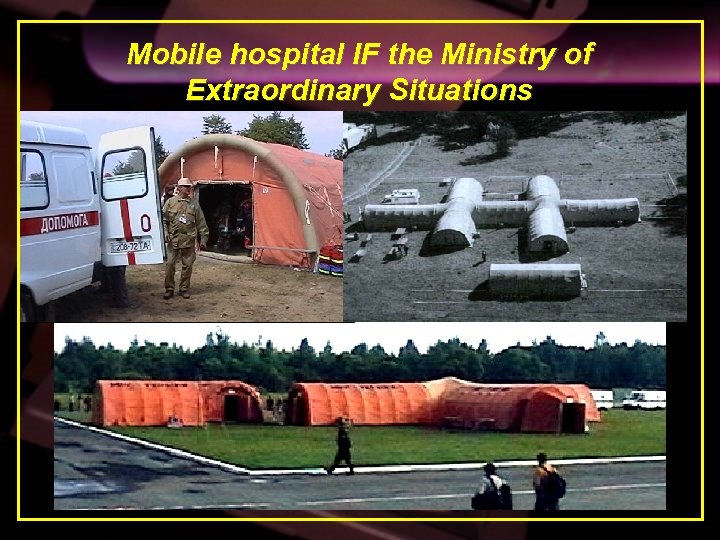 Mobile hospital IF the Ministry of Extraordinary Situations
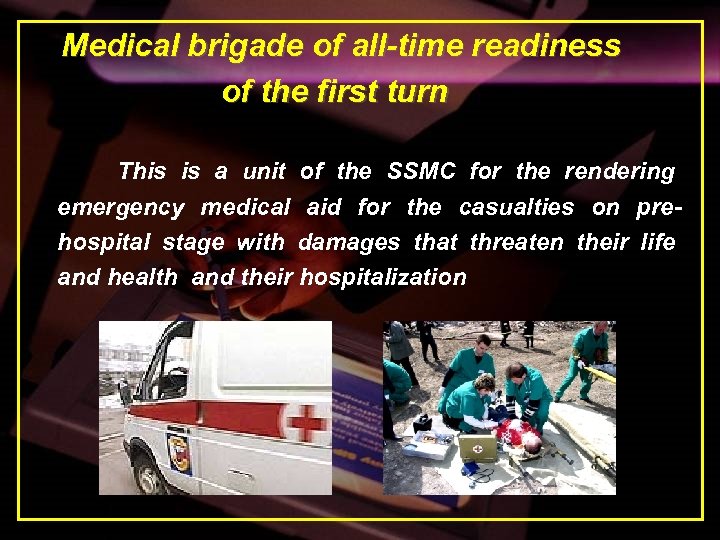 Medical brigade of all-time readiness of the first turn This is a unit of the SSMC for the rendering emergency medical aid for the casualties on prehospital stage with damages that threaten their life and health and their hospitalization
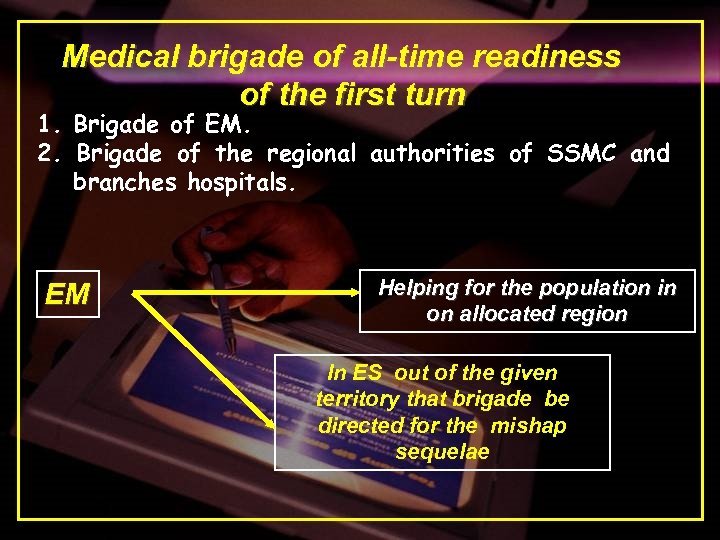 Medical brigade of all-time readiness of the first turn 1. Brigade of EM. 2. Brigade of the regional authorities of SSMC and branches hospitals. EM Helping for the population in on allocated region In ES out of the given territory that brigade be directed for the mishap sequelae
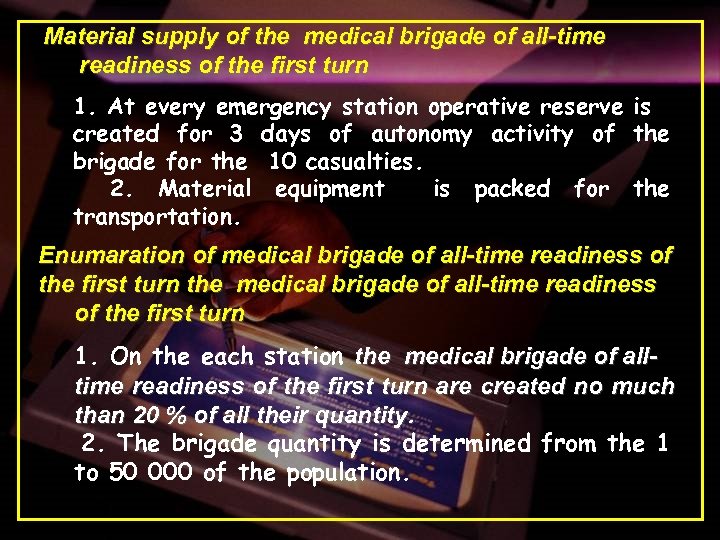 Material supply of the medical brigade of all-time readiness of the first turn 1. At every emergency station operative reserve is created for 3 days of autonomy activity of the brigade for the 10 casualties. 2. Material equipment is packed for the transportation. Enumaration of medical brigade of all-time readiness of the first turn the medical brigade of all-time readiness of the first turn 1. On the each station the medical brigade of alltime readiness of the first turn are created no much than 20 % of all their quantity. 2. The brigade quantity is determined from the 1 to 50 000 of the population.
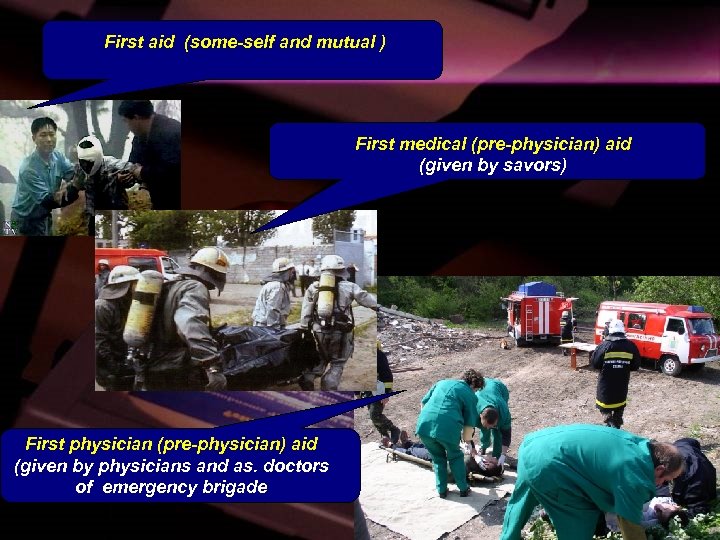
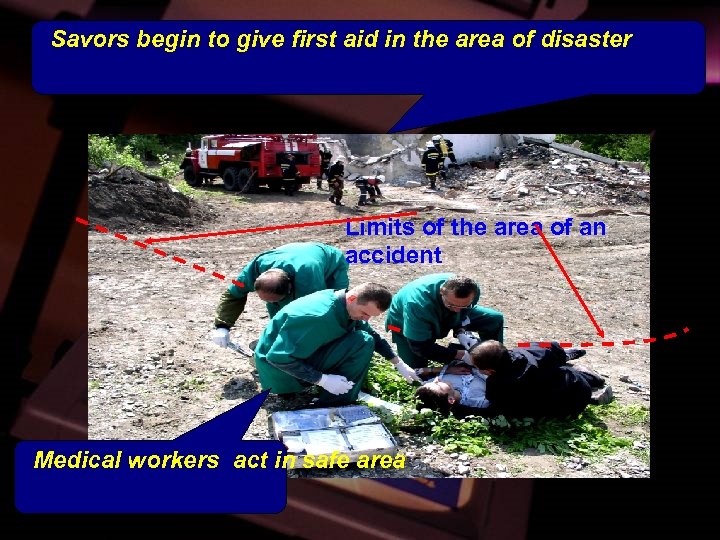
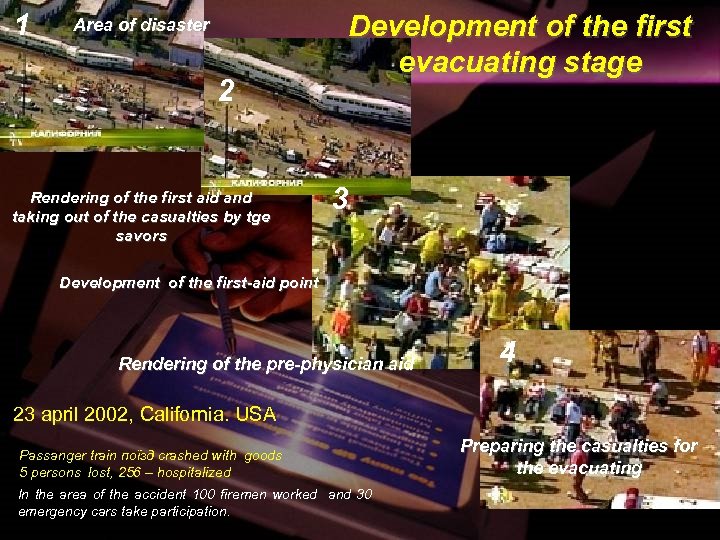
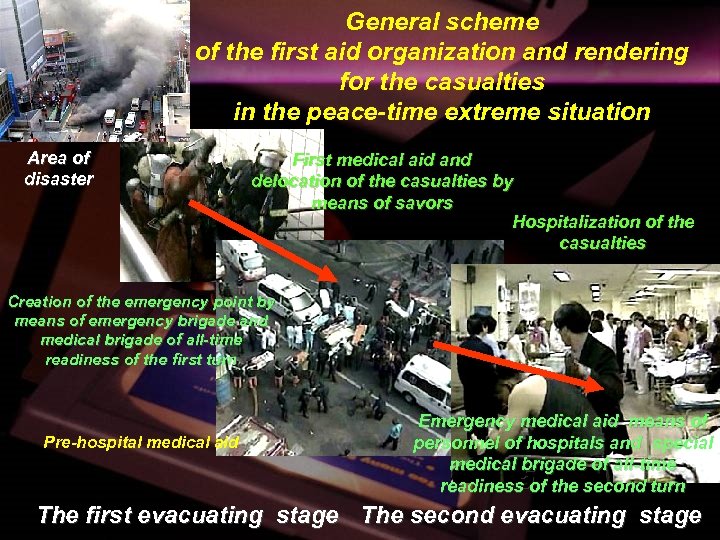 General scheme of the first aid organization and rendering for the casualties in the peace-time extreme situation Area of disaster First medical aid and delocation of the casualties by means of savors Hospitalization of the casualties Creation of the emergency point by means of emergency brigade and medical brigade of all-time readiness of the first turn Pre-hospital medical aid Emergency medical aid means of personnel of hospitals and special medical brigade of all-time readiness of the second turn 5 The first evacuating stage The second evacuating stage
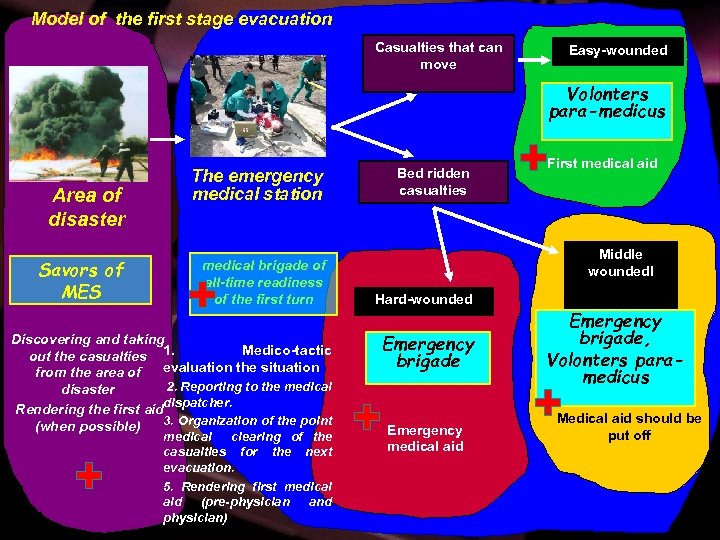 Model of the first stage evacuation Casualties that can move Easy-wounded Volonters para-medicus Area of disaster Savors of MES The emergency medical station medical brigade of all-time readiness of the first turn Discovering and taking Medico-tactic out the casualties 1. evaluation the situation from the area of 2. Reporting to the medical disaster dispatcher. Rendering the first aid 3. Organization of the point (when possible) medical clearing of the casualties for the next evacuation. 5. Rendering first medical aid (pre-physician and physician) Bed ridden casualties First medical aid Middle woundedІ Hard-wounded Emergency brigade Emergency medical aid Emergency brigade, Volonters paramedicus Medical aid should be put off
 First aid (some-self and mutual ) First medical (pre-physician) aid (given by savors) First physician (pre-physician) aid (given by physicians and as. doctors of emergency brigade
 Savors begin to give first aid in the area of disaster Limits of the area of an accident Medical workers act in safe area
 1 Area of disaster 2 Rendering of the first aid and taking out of the casualties by tge savors Development of the first evacuating stage 3 Development of the first-aid point Rendering of the pre-physician aid 4 23 april 2002, California. USA Passanger train поїзд crashed with goods 5 persons lost, 256 – hospitalized In the area of the accident 100 firemen worked and 30 emergency cars take participation. Preparing the casualties for the evacuating
 Common script of the first aid giving for the casualties on the І evacuating stage Фільм
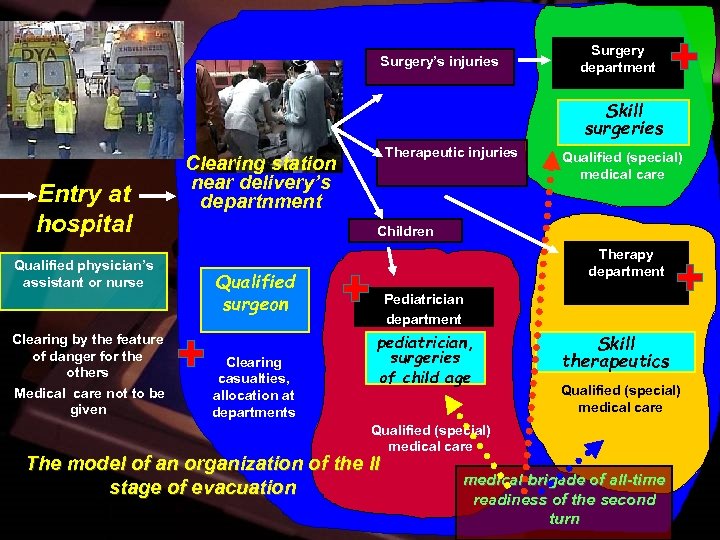 Surgery’s injuries Surgery department Skill surgeries Entry at hospital Qualified physician’s assistant or nurse Clearing by the feature of danger for the others Medical care not to be given Therapeutic injuries Clearing station near delivery’s departnment Qualified (special) medical care Children Therapy department Qualified surgeon Clearing casualties, allocation at departments Pediatrician department pediatrician, surgeries of child age Skill therapeutics Qualified (special) medical care The model of an organization of the ІІ stage of evacuation medical brigade of all-time readiness of the second turn
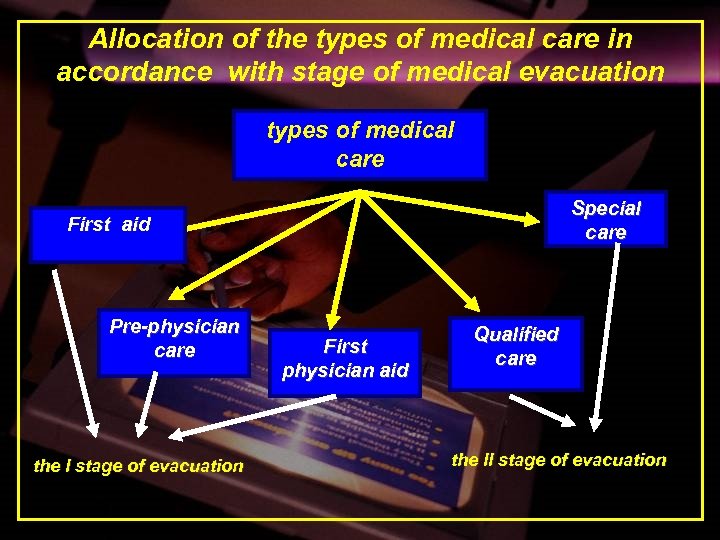 Allocation of the types of medical care in accordance with stage of medical evacuation types of medical care Special care First aid Pre-physician care the І stage of evacuation First physician aid Qualified care the ІІ stage of evacuation
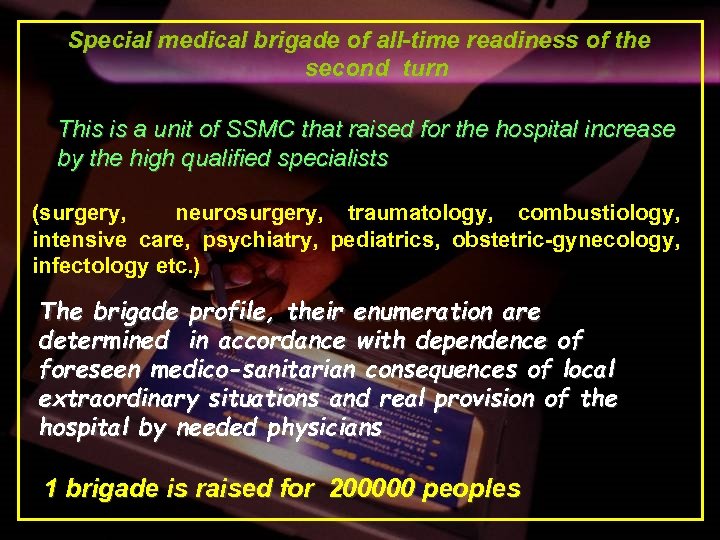 Special medical brigade of all-time readiness of the second turn This is a unit of SSMC that raised for the hospital increase by the high qualified specialists (surgery, neurosurgery, traumatology, combustiology, intensive care, psychiatry, pediatrics, obstetric-gynecology, infectology etc. ) The brigade profile, their enumeration are determined in accordance with dependence of foreseen medico-sanitarian consequences of local extraordinary situations and real provision of the hospital by needed physicians 1 brigade is raised for 200000 peoples
 Special medical brigade of all-time readiness of the second turn are raised in hospitals out of the state These brigade are supplied with the inviolable equipment storage in accordance with expectation for the work during 1 day, (2 days – for regional centre of emergency medical care) 1 brigade is raised for 200000 peoples
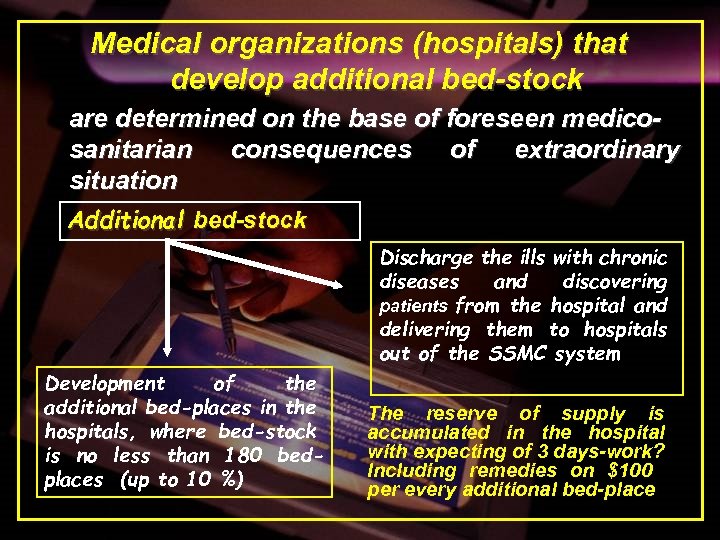 Medical organizations (hospitals) that develop additional bed-stock are determined on the base of foreseen medicosanitarian consequences of extraordinary situation Additional bed-stock Discharge the ills with chronic diseases and discovering patients from the hospital and delivering them to hospitals out of the SSMC system Development of the additional bed-places in the hospitals, where bed-stock is no less than 180 bedplaces (up to 10 %) The reserve of supply is accumulated in the hospital with expecting of 3 days-work? Including remedies on $100 per every additional bed-place
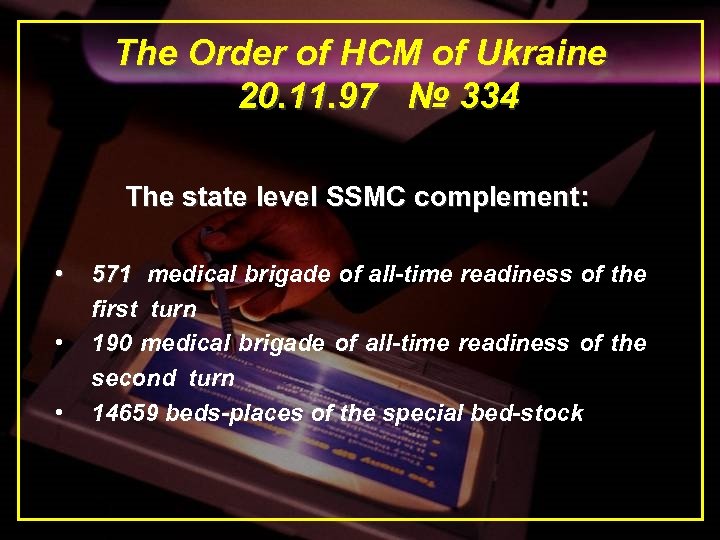 The Order of HCM of Ukraine 20. 11. 97 № 334 The state level SSMC complement: • • • 571 medical brigade of all-time readiness of the first turn 190 medical brigade of all-time readiness of the second turn 14659 beds-places of the special bed-stock
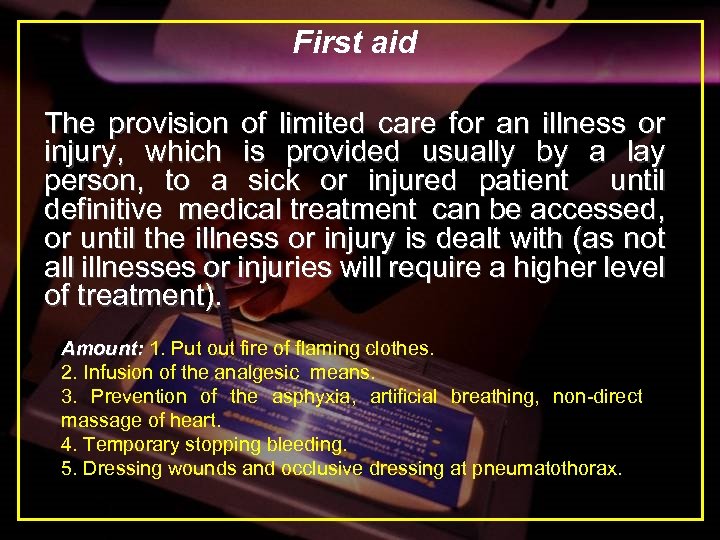 First aid The provision of limited care for an illness or injury, which is provided usually by a lay person, to a sick or injured patient until definitive medical treatment can be accessed, or until the illness or injury is dealt with (as not all illnesses or injuries will require a higher level of treatment). Amount: 1. Put out fire of flaming clothes. 2. Infusion of the analgesic means. 3. Prevention of the asphyxia, artificial breathing, non-direct massage of heart. 4. Temporary stopping bleeding. 5. Dressing wounds and occlusive dressing at pneumatothorax.
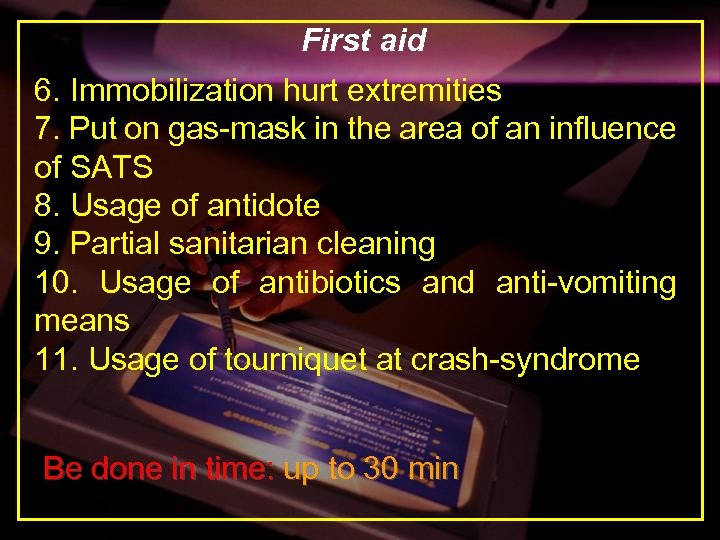 First aid 6. Immobilization hurt extremities 7. Put on gas-mask in the area of an influence of SATS 8. Usage of antidote 9. Partial sanitarian cleaning 10. Usage of antibiotics and anti-vomiting means 11. Usage of tourniquet at crash-syndrome Be done in time: up to 30 min
 First aid • During giving the medical care the casualties in the area of an accident it’s impossible to use one by the once and for all developed set up of medico-evacuating maintenance, as it happens to collide with the large variety of types of accidents, structure of medico-sanitary losses, local conditions. The main moment is only that in a point one of an accident it is impossible to give full first aid the injuries, by virtue of what it is necessary to resort to their evacuation.
 Pre-physician aid Purpose: stopping threaten for the life state and disorders (bleedings, convulsions, heart insult and cardiac activity), wound protection off secondary infecting, immobilization broken bones of extremities, prevention shock-reactions and its treatment. Amount: 1. Removing asphyxia (toilet of the mouth and nose-gullet, putting in an air-conductor, inhalation of the oxygen, artificial apparatus breathing). 2. Controlling for the correctness and necessity the usage of tourniquet in bleeding that prolongs. 3. Injection of analgesic remedies. 4. Improving transport immobilization due to usage of the table means.
 Pre-physician aid • 5. Repeated usage of antidotes in accordance with the indications. • 6. Additional degassing of the open skin surfaces and adjacent areas of clothes. • 7. Worming up the casualties in the law temperature of an air, giving them hot teas and other drinking in the winter time (except of the injured in abdomen).
 Pre-physician aid 8. Infusing in accordance with the indications the symptomatic cardiac-vessel and breathing acting remedies. 9. Washing eyes, mouth and nose in event of the HATS getting in. 10. Lavage of stomach (without cannulation) in event of the HATS getting in. Done in time: 1 -2 h
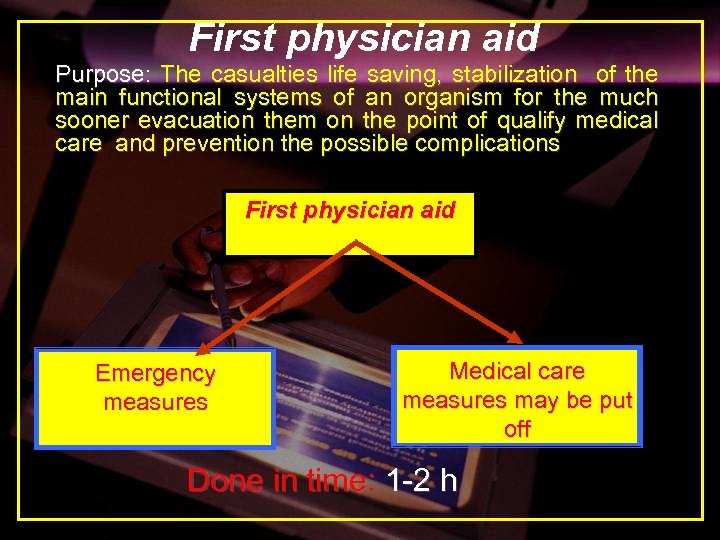 First physician aid Purpose: The casualties life saving, stabilization of the main functional systems of an organism for the much sooner evacuation them on the point of qualify medical care and prevention the possible complications First physician aid Emergency measures Medical care measures may be put off Done in time: 1 -2 h
 Emergency measures of the first aid Amount: 1. Removing asphyxia (exhaustion of mucus and vomits and blood from the high breathing ways, putting in an air-conductor, fixation of tongue, cutting or needlework up strips of the palate tissues and gullet, tracheotomy in accordance with indications, artificial breathing, usage of occlusive dressing at open pneumatothorax, puncture of the pleural cavity or pleurocentesis at external pneumatothorax. 2. Pursue anti-shock measures (transfuse of blood and other solutions at a huge hemorrhage, blocking with novocain solution, usage other analgesics measures and cardiacvessels remedies.
 Emergency measures of the first aid 3. Stopping external bleeding (needlework up the vessels inside of wound or usage of clips on the vessel, control the correctness and necessity the usage of tourniquet in bleeding accordingly with indications. 4. Cutting off the extremities, that is hanging on strip of soft tissues. 5. Catheter or puncture drainage at urine retard. 6. De-sorption of HATS out of the clothes and usage of measures of individual protection of the casualties, that delivered from the area of chemical disaster (partial sanitarian cleaning (degassing) and change the clothes).
 Emergency measures of the first aid 7. Repeated usage of antidotes and anti-vomit medicines and broncho-lytics. 8. Degassing of the polluted with HATS wound. 9. Lavage of the stomach by means of cannulation in event of the HATS getting in. 10. Nonspecific prophylactic and the serum injection in event of threaten appearance bacterial damage (in cause of wreck on microbiological industry).
 Put off first aid measure Amount: : 1. Removal of the недоліків of the first aid and pre-physician care rendering (dressing correction, improving transport immobilization). 2. Changing dressing wound in event of radiation and chemical their pollution. 3. Blocking with novocain solution in event of middle grade of damage. 4. Injection of antibiotics, tetanus prophylaxis of open wounds and burns. 5. Ordering the different symptomatic measures at the events that don’t threaten for the casualties life.
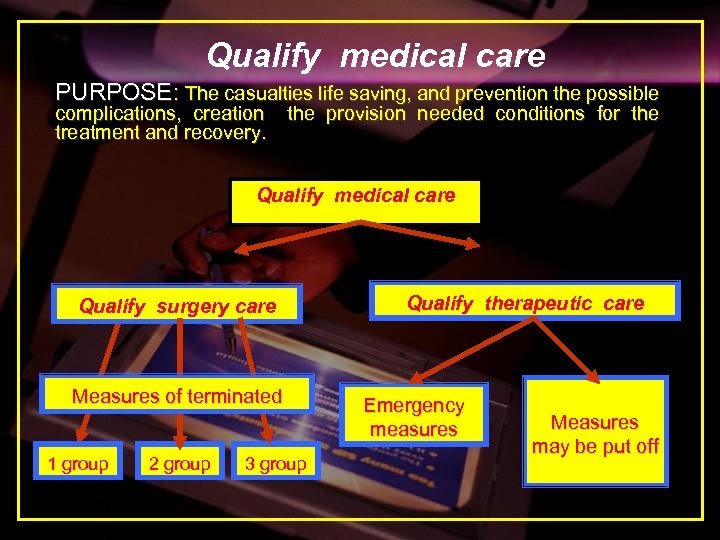 Qualify medical care PURPOSE: The casualties life saving, and prevention the possible complications, creation the provision needed conditions for the treatment and recovery. Qualify medical care Qualify surgery care Measures of terminated 1 group 2 group 3 group Qualify therapeutic care Emergency measures Measures may be put off
 Qualify surgery care 1 group: emergency surgery invasions and other measures, non-perfecting of which may be realized with death at the nearest time Amount: 1. Fight against an asphyxia and restoration the breathing functions. 2. The final stopping of the internal and external bleeding. 3. Complex therapy of sharp blood lost, shock, traumatic intoxication. 4. Treatment of anaerobic infection. 5. Surgical treatment and sewing wounds and opened pneumatothorax, thorasic centesis and valve pneumatothorax. 6. Laparotomy at penetrable wounds and closed trauma of stomach and internal organs damage.
 Qualify surgery care 1 group: emergency surgery invasions and other measures, un-perfecting of which may be realized with death at the nearest time 7. Amputation in event of the open and massive broken extremities. 8. Decompressing the skull at damage of the head added with compression of the brain. 9. Surgery care at long tube bones with intensive damage soft tissues.
 Qualify surgery care 2 group: not done in time care may be resulted with appearance of serious complication. Amount: Surgery wound processing at long tube bones without intensive damage of the soft tissues.
 Qualify surgery care 3 group: Postpone care (due to usage of antibiotics) may not be complicated. Amount: 1. Usage of plastic sews at the wounded face. 2. Ligature teeth tying when jaw case (broken). 3. Primary surgery processing the burns. 4. Primary surgery processing of the soft tissues wounds.
 Qualify therapeutic care Emergency measures Amount: 1. Treatment at toxic burns of the lungs. 2. Complex therapy at acute cardio-pulmonary insufficiency and disorders of the heart rhythm. 3. Antidotal treatment and anti-botulism serum. 4. Administration of the oxygen therapy and artificial breathing in the case of asphyxia. Usage of tranquilising, neuroleptics in the case of an acute exciting. 6. Administration of desensitizing, anti-vomiting, anti-tetanic and broncholytic medicines.
 Qualify therapeutic care Put off emergency care Amount: 1. Vitamin-therapy. 2. Substitutive haemotransfusion. 3. Preventive administration of antibiotics and sulfonamide medicines. 4. Administration of the physiotherapeutic procedures. 5. Usage of the symptomatic medicines.
 Special medical care Contingent of the casualties 1. Casualties with traumatic damages of the spine, head, neck (neurosurgery, ophthalmology, otorhinolaryngology, face-jaw surgery). 2. Casualties with broken tube bones and great joints. 3. Casualties with trauma of the chest, abdomen, pelvis. 4. Burnt. 5. Damaged with radiation. 6. Injuries with SATS. 7. Ills with neurological diseases and psychiatric disorders. 8. Wounded and ill women. 9. Infectious ills.
 Main tasks of the evacuation stage 1. Adoption casualties and ills and their registration. 2. Sanitary cleansing procedures casualties, ills and their things. 3. Emergency medicine care provision in accordance with data evacuating stage. 4. Making casualties ready for the evacuation at the next point. 5. Isolating infectious and psychic ills.
 Every medical worker ought to be ready to supply care for the casualties in the extraordinary conditions of peace- and wartime. The human life is so fragile. . .
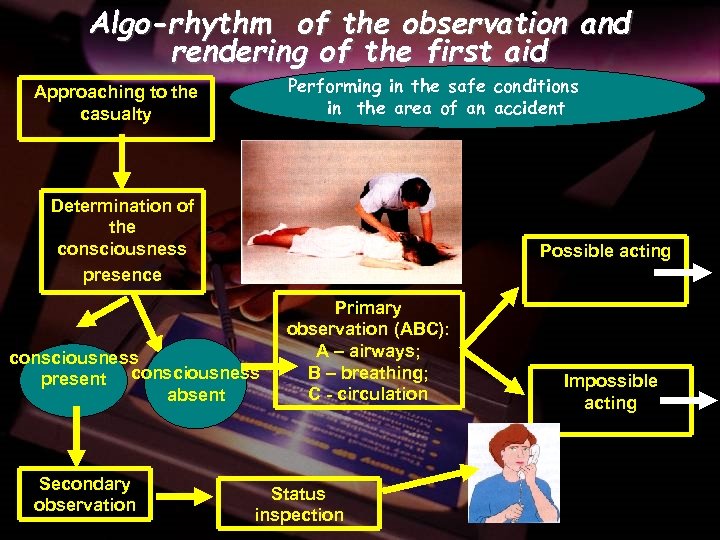 Algo-rhythm of the observation and rendering of the first aid Performing in the safe conditions in the area of an accident Approaching to the casualty Determination of the consciousness presence Possible acting consciousness present consciousness absent Secondary observation Primary observation (АВС): А – airways; В – breathing; С - circulation Status inspection Impossible acting
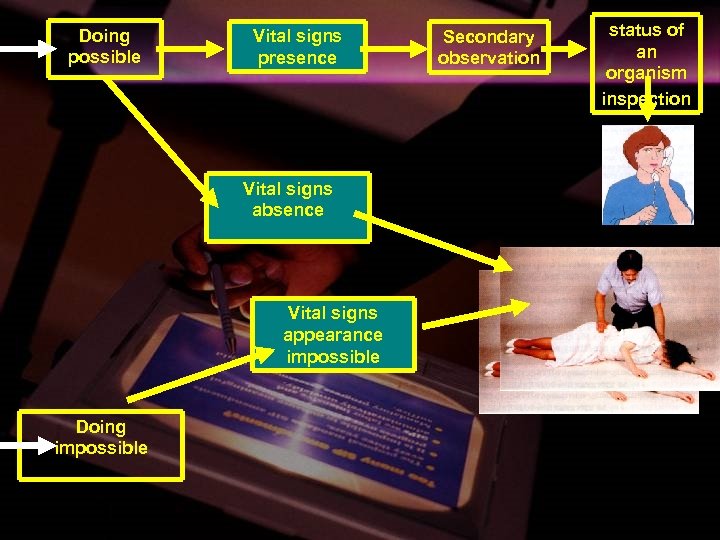 Doing possible Vital signs presence Vital signs absence Vital signs appearance impossible Doing impossible Secondary observation status of an organism inspection
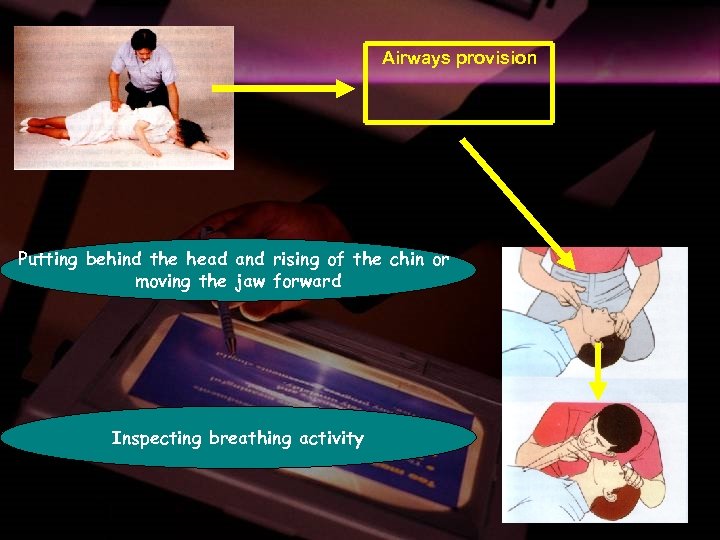 Airways provision Putting behind the head and rising of the chin or moving the jaw forward Inspecting breathing activity
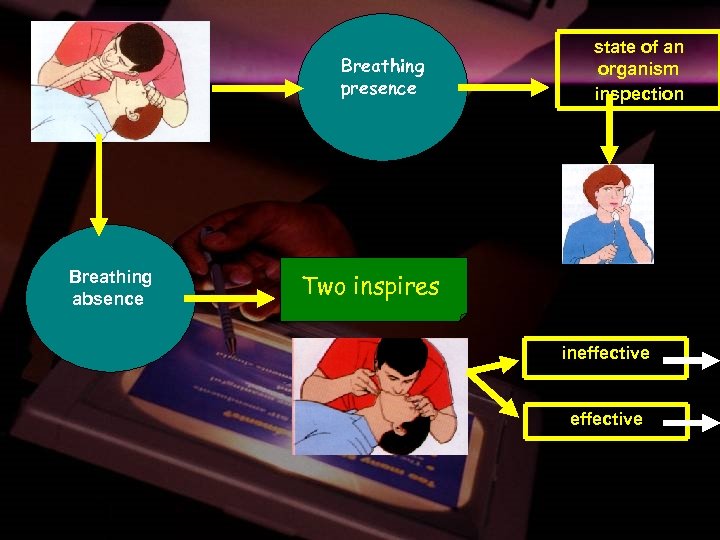 Breathing presence Дихання присутнє Breathing absence state of an organism inspection Two inspires ineffective
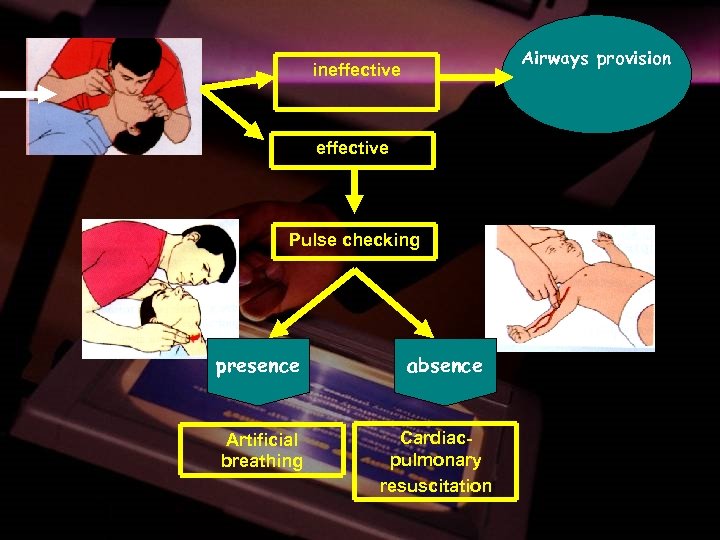 Airways provision ineffective Pulse checking presence Artificial breathing absence Cardiacpulmonary resuscitation
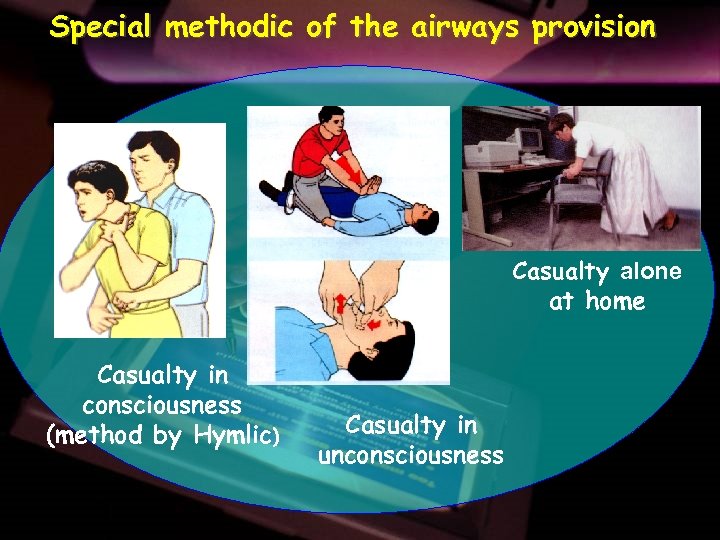 Special methodic of the airways provision Casualty alone at home Casualty in consciousness (method by Hymlic) Casualty in unconsciousness
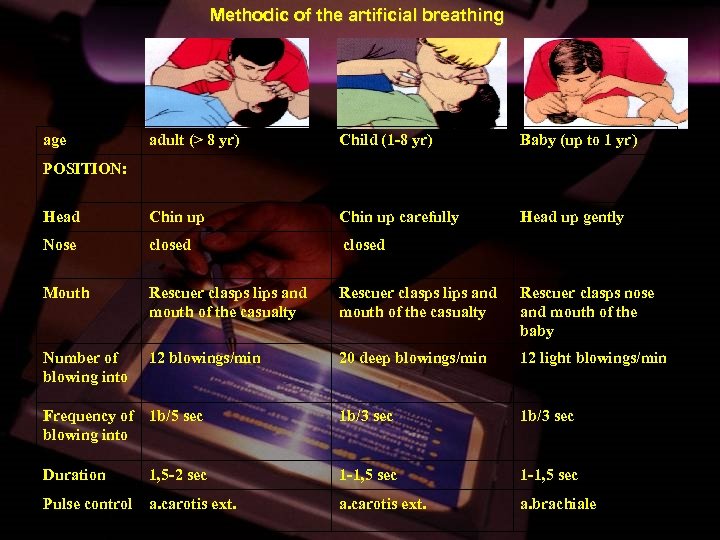 Methodic of the artificial breathing age adult (> 8 yr) Child (1 -8 yr) Baby (up to 1 yr) Head Chin up carefully Head up gently Nose closed Mouth Rescuer clasps lips and mouth of the casualty Rescuer clasps nose and mouth of the baby Number of blowing into 12 blowings/min 20 deep blowings/min 12 light blowings/min Frequency of 1 b/5 sec blowing into 1 b/3 sec Duration 1, 5 -2 sec 1 -1, 5 sec Pulse control a. carotis ext. a. brachiale POSITION:
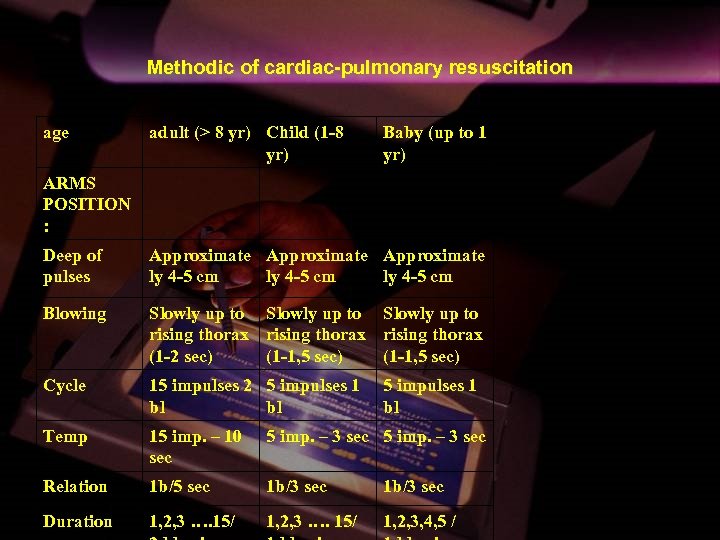 Methodic of cardiac-pulmonary resuscitation age adult (> 8 yr) Child (1 -8 yr) Baby (up to 1 yr) ARMS POSITION : Deep of pulses Approximate ly 4 -5 cm Blowing Slowly up to rising thorax (1 -2 sec) (1 -1, 5 sec) Cycle 15 impulses 2 5 impulses 1 bl bl Temp 15 imp. – 10 sec 5 imp. – 3 sec Relation 1 b/5 sec 1 b/3 sec Duration 1, 2, 3 …. 15/ 1, 2, 3, 4, 5 / 5 impulses 1 bl
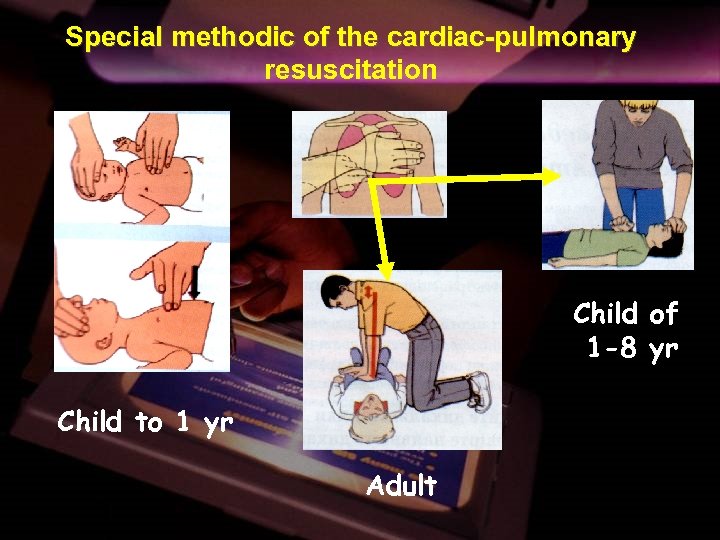 Special methodic of the cardiac-pulmonary resuscitation Child of 1 -8 yr Child to 1 yr Adult
 The end!