


 Скачать презентацию The digital divide how to improve the situation
3f5489e7e981f6f018cfb4b442054c31.ppt
- Количество слайдов: 39
 The digital divide: how to improve the situation ? Vincent Breton Institut des Grilles du CNRS LPC Clermont-Ferrand • Credit: L. Maigne, P. de Vlieger, A. da Costa 1
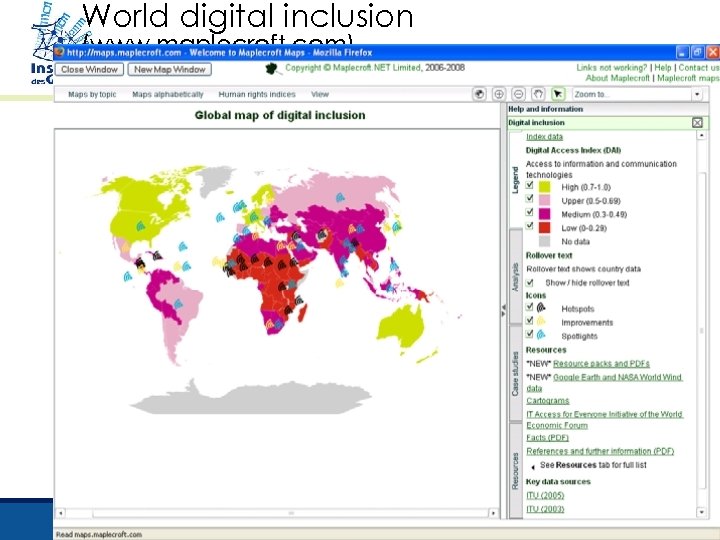 World digital inclusion (www. maplecroft. com)
 Priorities for addressing the digital divide • enable the national research and education communities to connect to the global dedicated research and education network infrastructure • deploy advanced collaborative services on top of the network • integrate national efforts into sustainable regional infrastructures and foster collaboration and interoperability to encourage inclusiveness Conclusions of the Sharing Knowledge Workshop, March 2010, Dead Sea
 • enable the national research and education communities to connect to the global dedicated research and education network infrastructure • deploy advanced collaborative services on top of the network • integrate national efforts into sustainable regional infrastructures and foster collaboration and interoperability to encourage inclusiveness
 Recommendations related to networking • The network connections of the Mediterranean and African countries are improving, but many administrative and political obstacles exist, according to the experience of local researchers • Raising the awareness of the need and impact of telecom regulations reform and enforcement through internal and external channels should be a priority for policy makers in order to develop networks within these regions • exemplary approach of Jordan authorities
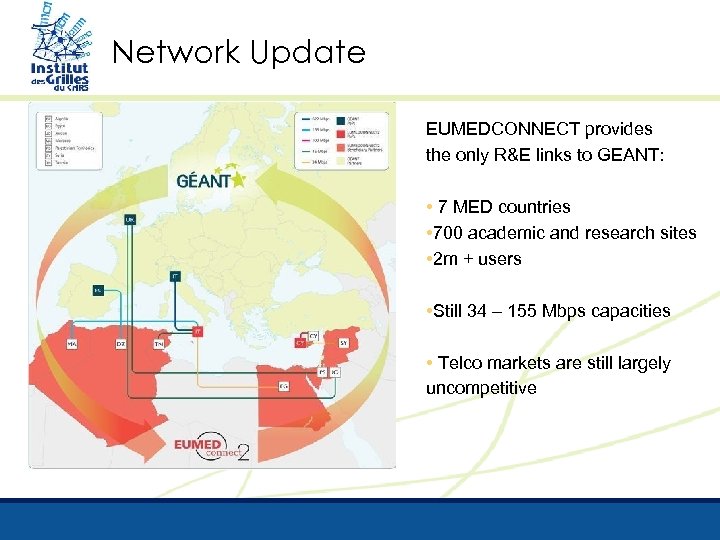 Network Update EUMEDCONNECT provides the only R&E links to GEANT: • 7 MED countries • 700 academic and research sites • 2 m + users • Still 34 – 155 Mbps capacities • Telco markets are still largely uncompetitive
 Priorities identified at Sharing Knowledge Foundation workshop • enable the national research and education communities to connect to the global dedicated research and education network infrastructure • deploy advanced collaborative services on top of the network • integrate national efforts into sustainable regional infrastructures and foster collaboration and interoperability to encourage inclusiveness
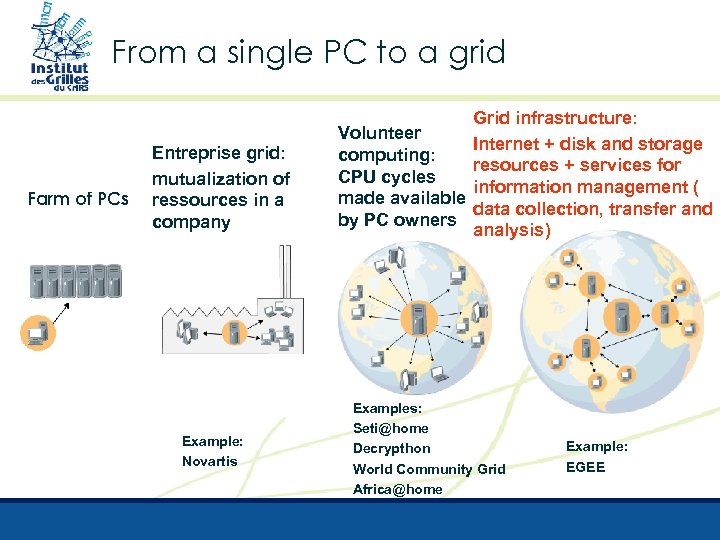 From a single PC to a grid Farm of PCs Entreprise grid: mutualization of ressources in a company Example: Novartis Grid infrastructure: Volunteer Internet + disk and storage computing: resources + services for CPU cycles information management ( made available data collection, transfer and by PC owners analysis) Examples: Seti@home Decrypthon World Community Grid Africa@home Example: EGEE
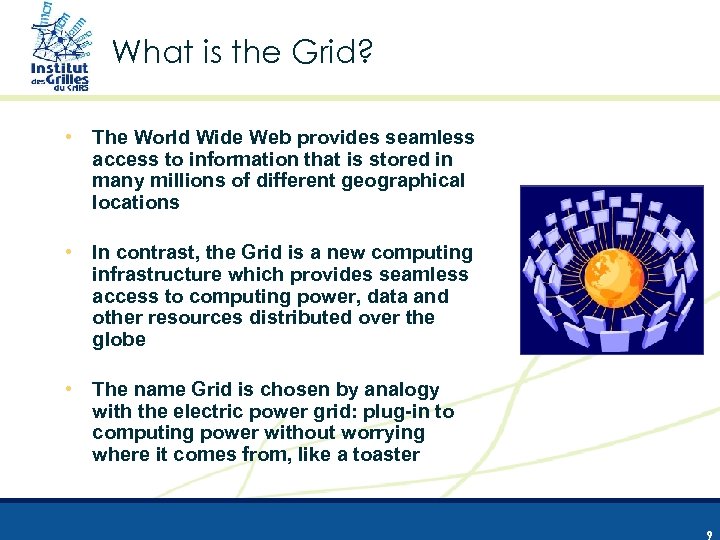 What is the Grid? • The World Wide Web provides seamless access to information that is stored in many millions of different geographical locations • In contrast, the Grid is a new computing infrastructure which provides seamless access to computing power, data and other resources distributed over the globe • The name Grid is chosen by analogy with the electric power grid: plug-in to computing power without worrying where it comes from, like a toaster
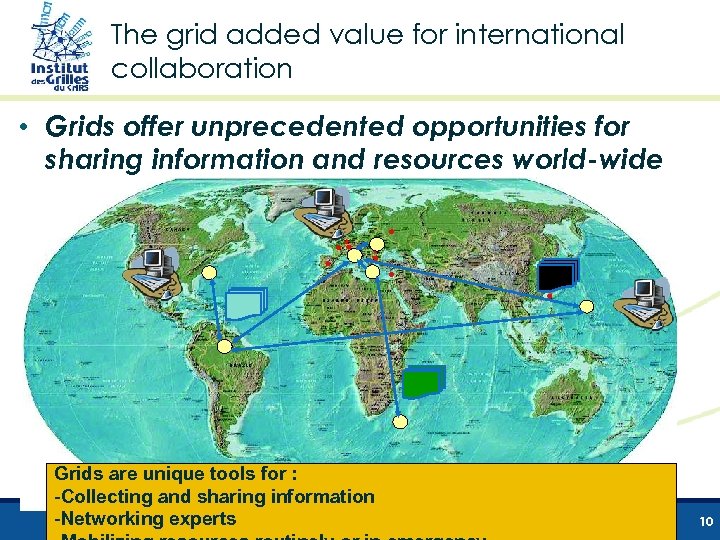 The grid added value for international collaboration • Grids offer unprecedented opportunities for sharing information and resources world-wide Grids are unique tools for : -Collecting and sharing information -Networking experts To change: View -> Header and Footer 10
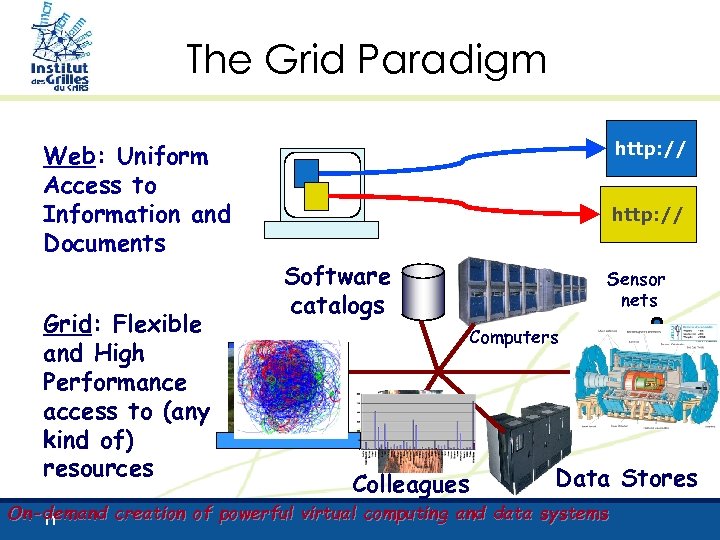 The Grid Paradigm http: // Web: Uniform Access to Information and Documents Grid: Flexible and High Performance access to (any kind of) resources http: // Software catalogs Sensor nets Computers Colleagues Data Stores On-demand creation of powerful virtual computing and data systems 11
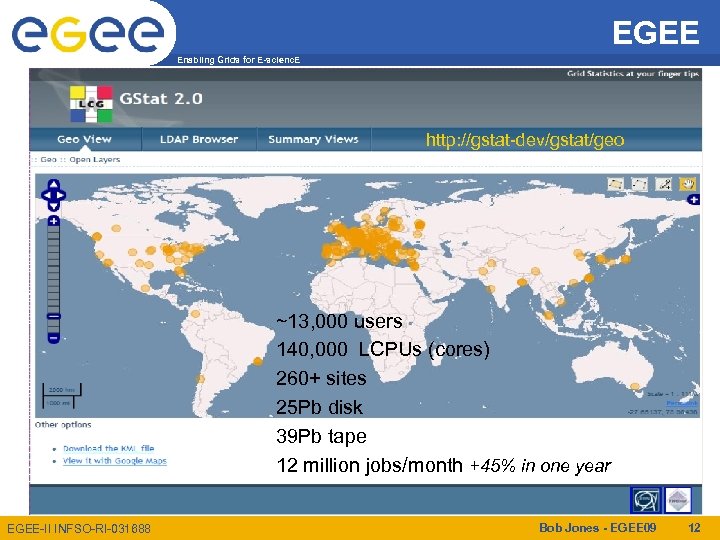 EGEE Enabling Grids for E-scienc. E http: //gstat-dev/gstat/geo ~13, 000 users 140, 000 LCPUs (cores) 260+ sites 25 Pb disk 39 Pb tape 12 million jobs/month +45% in one year EGEE-II INFSO-RI-031688 Bob Jones - EGEE 09 12
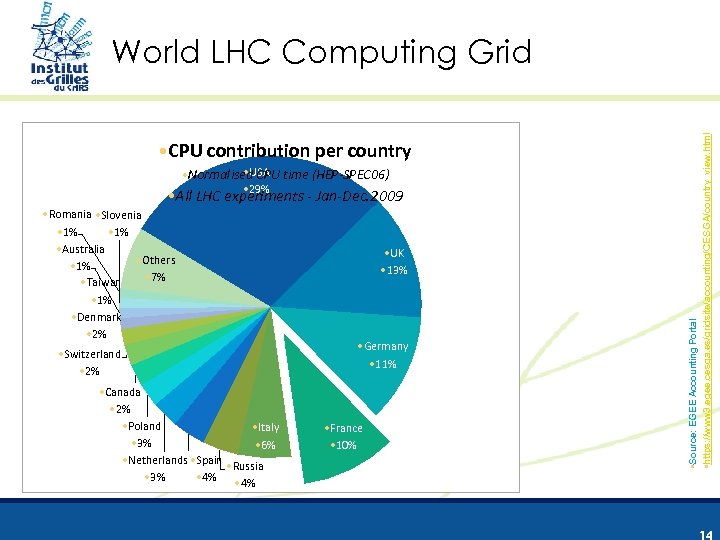 • CPU contribution per country • USA • Normalised CPU time (HEP-SPEC 06) • 29% • All LHC experiments - Jan-Dec. 2009 • Romania • Slovenia • 1% • Australia • Others • 1% • 7% • Taiwan • 1% • Denmark • 2% • Switzerland • 2% • Canada • 2% • Poland • Italy • 3% • 6% • Spain • Netherlands • Russia • 4% • 3% • 4% • UK • 13% • Germany • 11% • France • 10% • Source: EGEE Accounting Portal • https: //www 3. egee. cesga. es/gridsite/accounting/CESGA/country_view. html World LHC Computing Grid
 The French National Grid Initiative • Legal framework: Groupement d’Intérêt Scientifique (Scientific Interest Group) • Partners: Ministère de la Recherche, CNRS, CEA, RENATER, INRIA, INRA, CPU et INSERM • Mandate • Operate a national production grid infrastructure • Foster its adoption by scientific user communities • Develop collaboration between grid users and HPC computer scientists • Community around Grid 5000/ALADDIN research grid • Budget: multiannual dedicated funding from the French Ministry of Research (TGIR program) • 1 M€ in 2010 for equipment and travel funds • Web site: http: //www. france-grilles. org (from May 31 st)
 Are grids only for rich countries ? • Grids are powerful instruments to address digital divide • Clouds are not ! • All grid users access the same services and resources • Requirement: an access point (or User Interface) to the grid • There are two conditions • Network connectivity • Training of local users and administrators 16
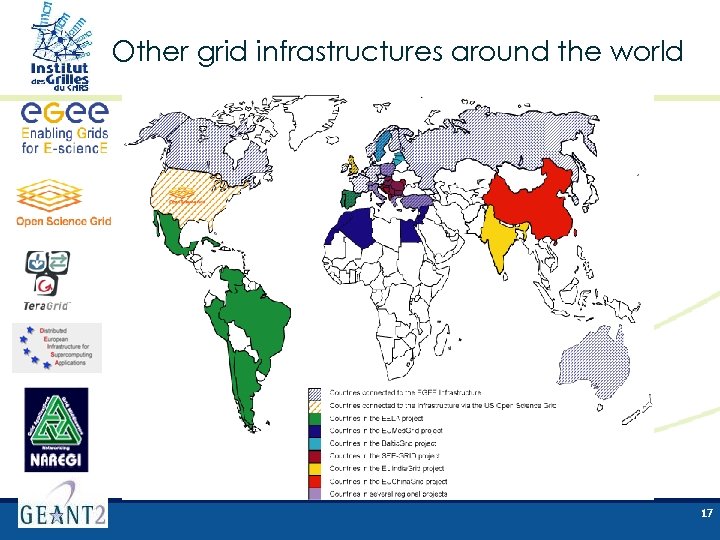 Other grid infrastructures around the world 17
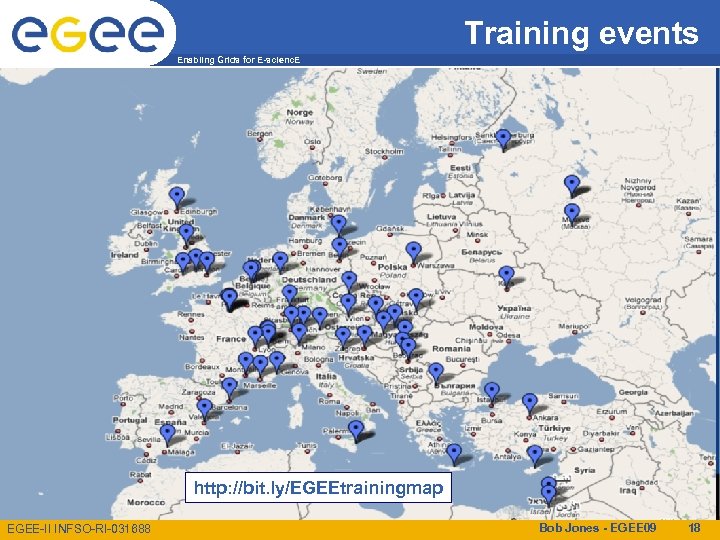 Training events Enabling Grids for E-scienc. E http: //bit. ly/EGEEtrainingmap EGEE-II INFSO-RI-031688 Bob Jones - EGEE 09 18
 The EPIKH Project (www. epikh. eu) • “Exchange Programme to advance e-Infrastructure Know-How” (EPIKH) • EU FP 7 - Marie Curie Actions – People - International Research Staff Exchange Scheme (IRSES) • Consortium “numbers”: • 23 partners; • 18 countries; • 4 continents (Africa, Latin America, Asia, Europe); • 115 persons involved; • >650 researcher-months; • >500 secondments; • Duration: March, 1, 2009 – February, 28, 2013 (48 months) • EC contribution: 1, 188, 000 €
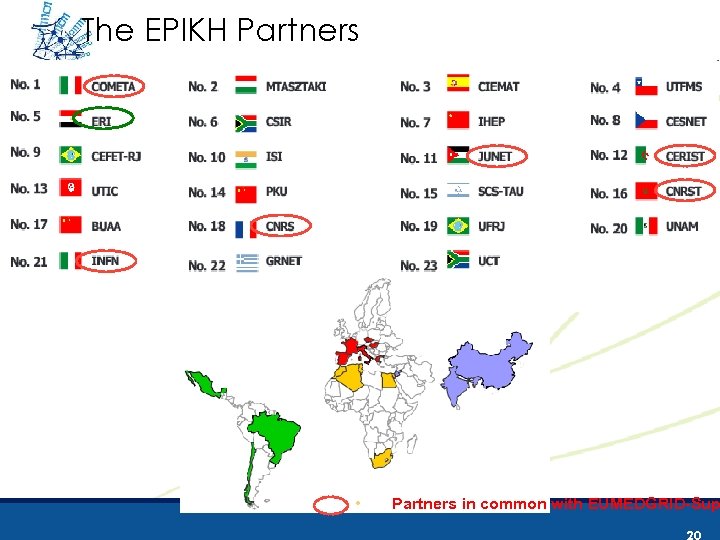 The EPIKH Partners • Partners in common with EUMEDGRID-Sup
 The EPIKH goals • Strategic aims: • Reinforce the impact of e-Infrastructures in scientific research defining and delivering stimulating programme of educational events, including Grid Schools and High Performance Computing courses; • Broaden the engagement in e-Science activities and collaborations both geographically and across disciplines. • Specific actions: • Spreading the knowledge about the “Grid Paradigm” to all potential users: both system administrators and application developers through an extensive training programme; • Easing the access of the trained people to the e-Infrastructures existing in the areas of action of the project; • Fostering the establishment of scientific collaborations among the countries/continents involved in the project.
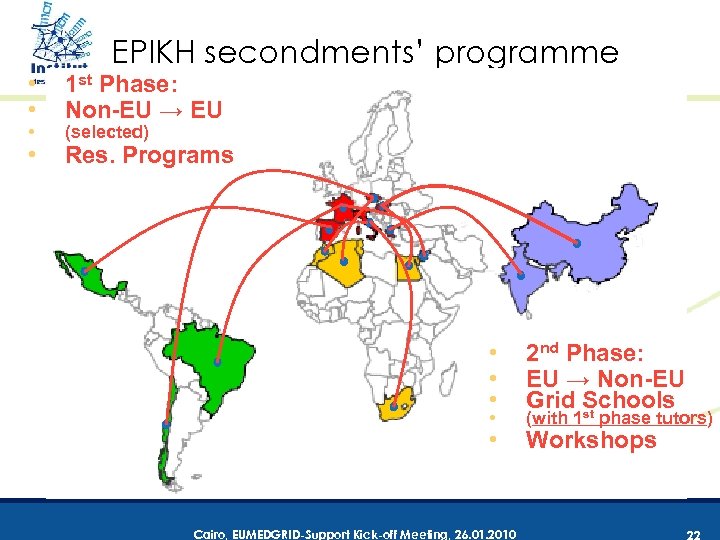 EPIKH secondments’ programme • • 1 st Phase: Non-EU → EU • Res. Programs • (selected) • • • 2 nd Phase: EU → Non-EU Grid Schools st • Workshops • Cairo, EUMEDGRID-Support Kick-off Meeting, 26. 01. 2010 (with 1 phase tutors)
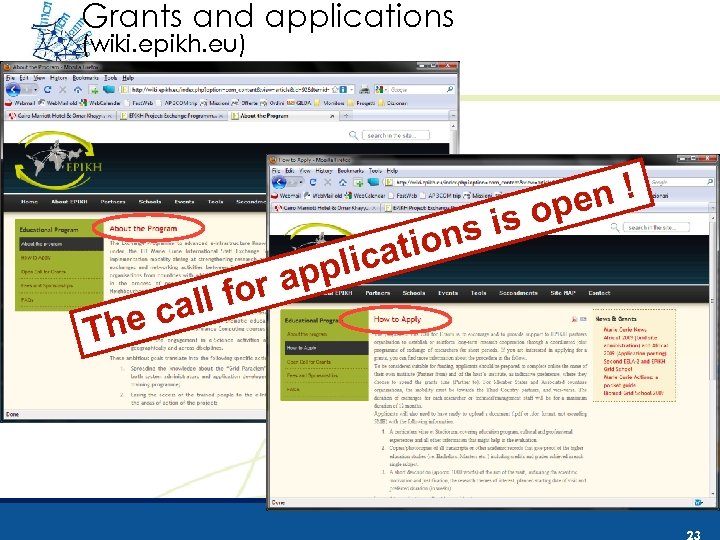 Grants and applications (wiki. epikh. eu) The ll fo ca plic r ap s is tion a n! ope
 Priorities identified at Sharing Knowledge Foundation workshop • enable the national research and education communities to connect to the global dedicated research and education network infrastructure • deploy advanced collaborative services on top of the network • integrate national efforts into sustainable regional infrastructures and foster collaboration and interoperability to encourage inclusiveness
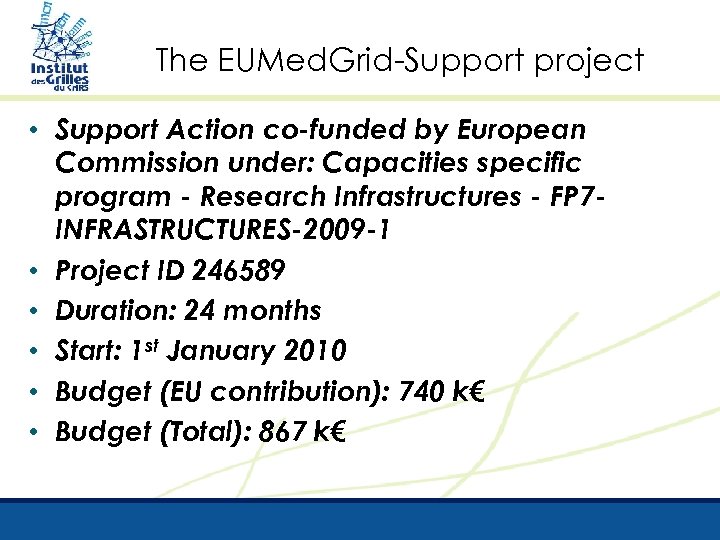 The EUMed. Grid-Support project • Support Action co-funded by European Commission under: Capacities specific program - Research Infrastructures - FP 7 INFRASTRUCTURES-2009 -1 • Project ID 246589 • Duration: 24 months • Start: 1 st January 2010 • Budget (EU contribution): 740 k€ • Budget (Total): 867 k€
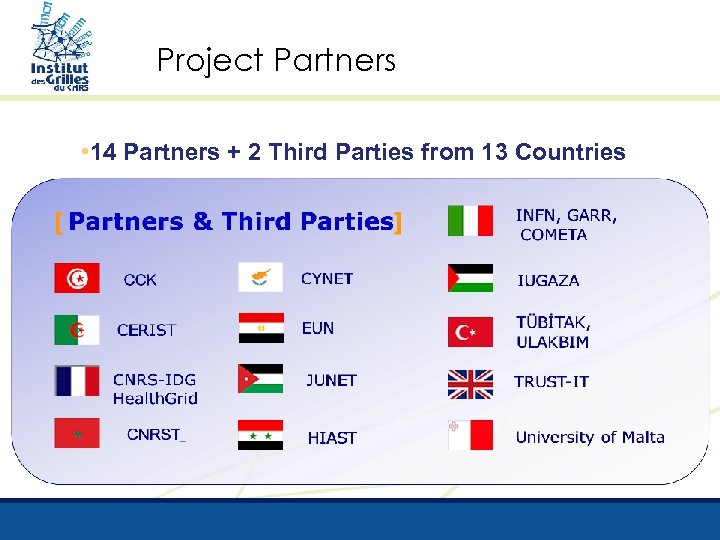 Project Partners • 14 Partners + 2 Third Parties from 13 Countries
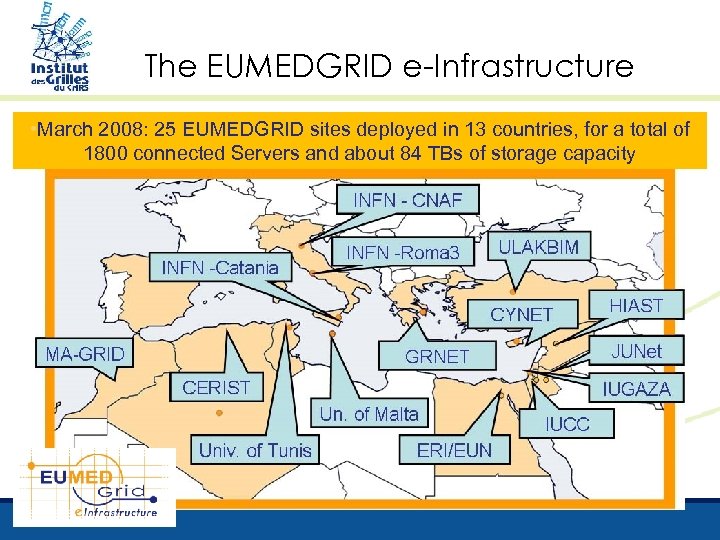 The EUMEDGRID e-Infrastructure • March 2008: 25 EUMEDGRID sites deployed in 13 countries, for a total of 1800 connected Servers and about 84 TBs of storage capacity
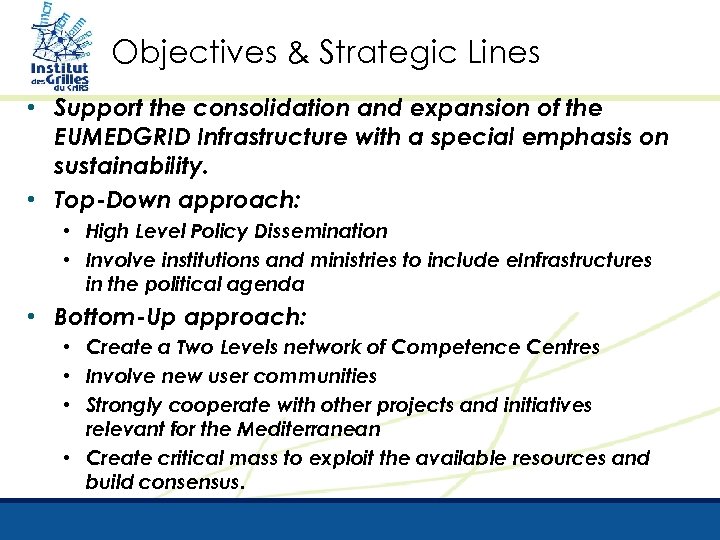 Objectives & Strategic Lines • Support the consolidation and expansion of the EUMEDGRID Infrastructure with a special emphasis on sustainability. • Top-Down approach: • High Level Policy Dissemination • Involve institutions and ministries to include e. Infrastructures in the political agenda • Bottom-Up approach: • Create a Two Levels network of Competence Centres • Involve new user communities • Strongly cooperate with other projects and initiatives relevant for the Mediterranean • Create critical mass to exploit the available resources and build consensus.
 A few examples of scientific collaborations on grids in life sciences
 How grids can help medical development • Improve the ability to undertake health innovation • Strengthen the integration of life science research laboratories in the world community • Provide access to resources • Provide access to bioinformatics services • Contribute to the development and deployment of new drugs and vaccines • Improve collection of epidemiological data for research (modeling, molecular biology) • Improve the deployment of clinical trials on plagued areas • Speed-up drug discovery process (in silico virtual screening) • Improve disease monitoring • Monitor the impact of policies and programs • Monitor drug delivery and vector control • Improve epidemics warning and monitoring system 30
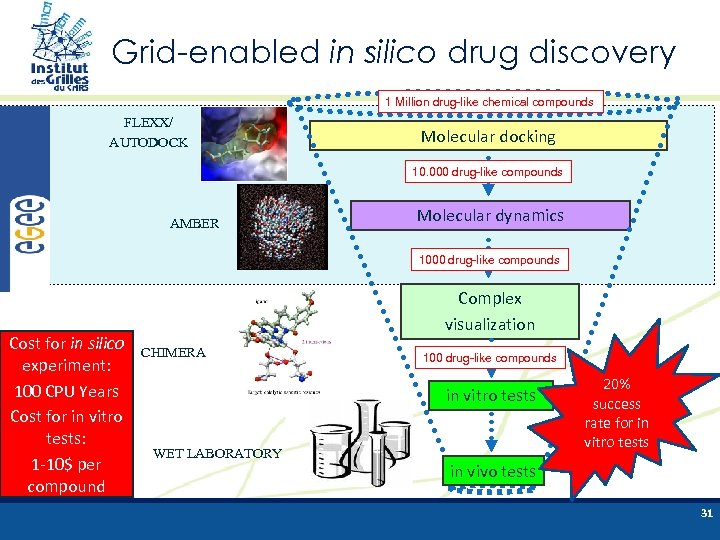 Grid-enabled in silico drug discovery 1 Million drug-like chemical compounds FLEXX/ AUTODOCK Molecular docking 10. 000 drug-like compounds AMBER Molecular dynamics 1000 drug-like compounds Cost for in silico experiment: 100 CPU Years Cost for in vitro tests: 1 -10$ per compound Complex visualization CHIMERA 100 drug-like compounds in vitro tests WET LABORATORY 20% success rate for in vitro tests in vivo tests 31
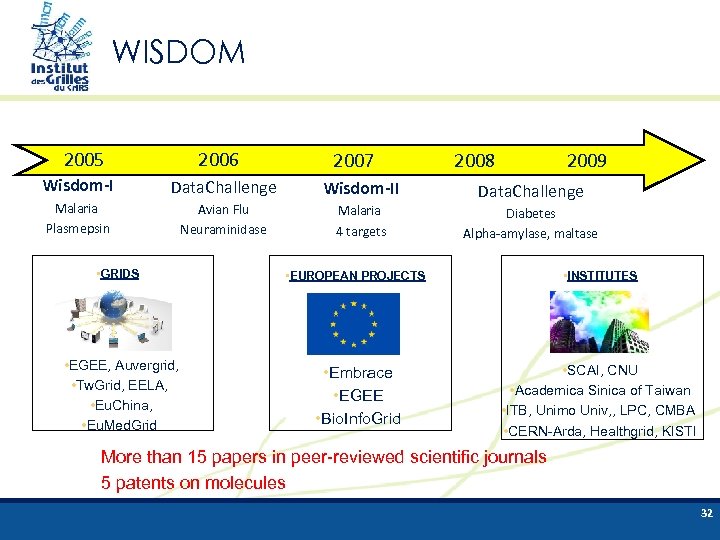 WISDOM 2005 2006 2007 2008 2009 Wisdom-I Data. Challenge Wisdom-II Malaria Plasmepsin Avian Flu Neuraminidase Data. Challenge Malaria 4 targets Diabetes Alpha-amylase, maltase • GRIDS • EGEE, Auvergrid, • Tw. Grid, EELA, • Eu. China, • Eu. Med. Grid • EUROPEAN PROJECTS • INSTITUTES • Embrace • EGEE • Bio. Info. Grid • SCAI, CNU • Academica Sinica of Taiwan • ITB, Unimo Univ, , LPC, CMBA • CERN-Arda, Healthgrid, KISTI More than 15 papers in peer-reviewed scientific journals 5 patents on molecules 32
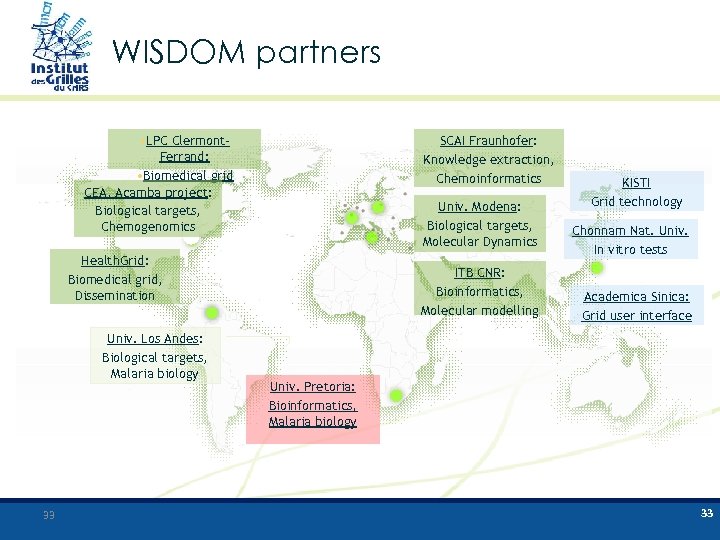 WISDOM partners • LPC Clermont. Ferrand: • Biomedical grid CEA, Acamba project: Biological targets, Chemogenomics SCAI Fraunhofer: Knowledge extraction, Chemoinformatics Univ. Modena: Biological targets, Molecular Dynamics Health. Grid: Biomedical grid, Dissemination Univ. Los Andes: Biological targets, Malaria biology 33 ITB CNR: Bioinformatics, Molecular modelling KISTI Grid technology Chonnam Nat. Univ. In vitro tests Academica Sinica: Grid user interface Univ. Pretoria: Bioinformatics, Malaria biology 33
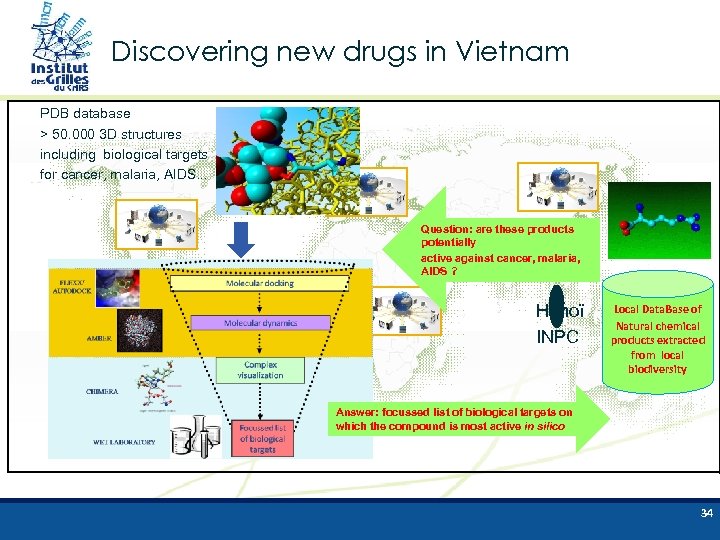 Discovering new drugs in Vietnam PDB database > 50. 000 3 D structures including biological targets for cancer, malaria, AIDS. . . Question: are these products potentially active against cancer, malaria, AIDS ? Hanoï INPC Local Data. Base of Natural chemical products extracted from local biodiversity Answer: focussed list of biological targets on which the compound is most active in silico 34
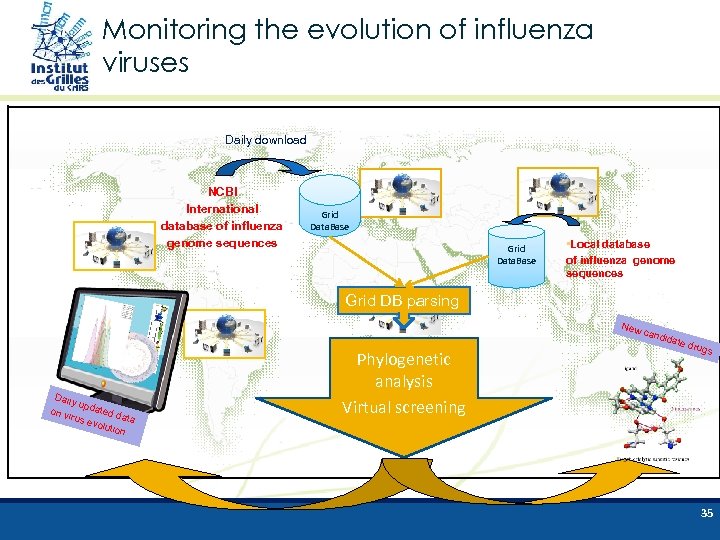 Monitoring the evolution of influenza viruses Daily download NCBI International database of influenza genome sequences Grid Data. Base • Local database of influenza genome sequences Grid DB parsing New Daily upda ted d on v irus ata evol ution Phylogenetic analysis Virtual screening cand idate drug s 35
 Conclusion • Addressing digital divide is a complex task • Important efforts committed by the European Commission in the field of networks and grids • Opportunities to do science differently or at a larger scale using grid infrastructures • High energy physics, Life sciences and health, Earth sciences, Climate change • High Energy Physics can play a leading role as it does in Europe • CNRS will pursue active collaboration with Mediterranean countries • Already active collaborations on grids with african countries (Senegal, South Africa) • Involvment in EUMed. Grid-Support and EPIKH through Institut des Grilles
 joint EUMEDGRID-Support/EPIKH training & dissemination events in Alger • Joint EUMEDGRID-Support/EPIKH School for Grid Site Admnistrators, June, 27 - July, 1, 2010 • http: //agenda. ct. infn. it/conference. Display. py? conf. Id =3202) • Joint EUMEDGRID-Support/EPIKH School for Application Porting, July, 3 -14, 2010 • http: //agenda. ct. infn. it/conference. Display. py? conf. Id =3193) • EPIKH Workshop, July, 15, 2010 • http: //agenda. ct. infn. it/conference. Display. py? conf. Id =329
 Suggestion: an open source toolkit for the modelling of climate change • Background: polemics on climate change • « Last » episod: climategate • Beyond polemics: lack of consistency between existing models • Proposal: build an open source toolkit for the modelling of climate • Added value of the open source approach • Common tool • Transparency • Potential consensus • Grid added value: distributed data collection 38
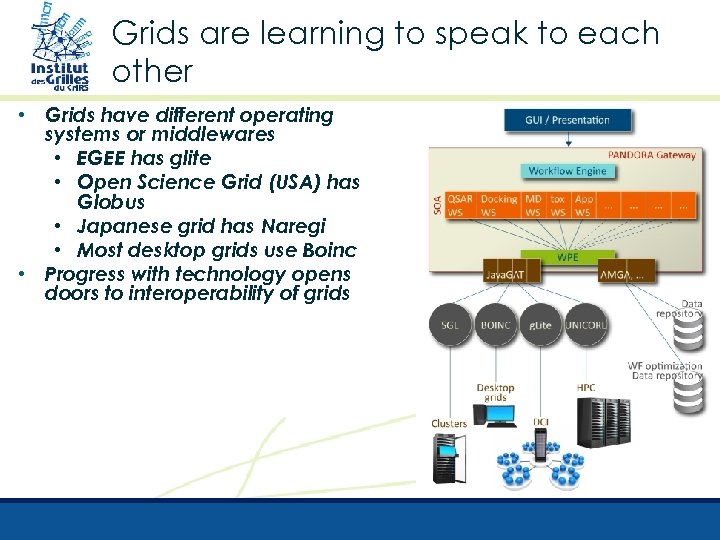 Grids are learning to speak to each other • Grids have different operating systems or middlewares • EGEE has glite • Open Science Grid (USA) has Globus • Japanese grid has Naregi • Most desktop grids use Boinc • Progress with technology opens doors to interoperability of grids
 EPIKH school