 Скачать презентацию The Digestive System Vocabulary Headings Important Info
8f39ab8cca2206a7fb610f269908deee.ppt
- Количество слайдов: 86



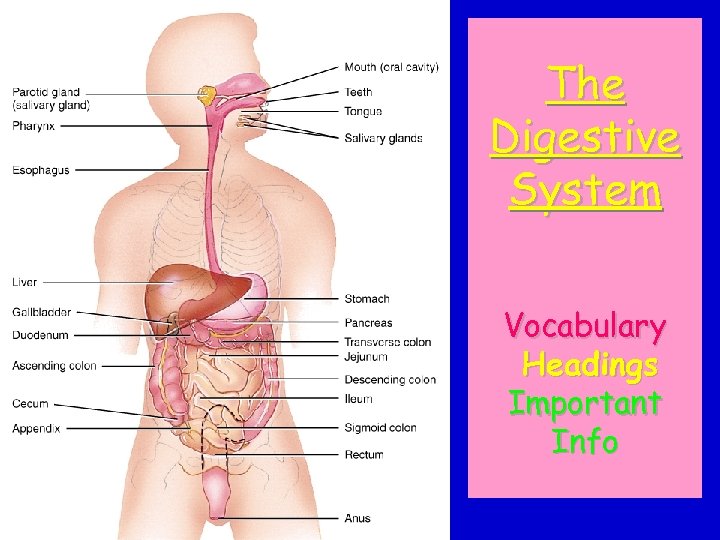
The Digestive System Vocabulary Headings Important Info
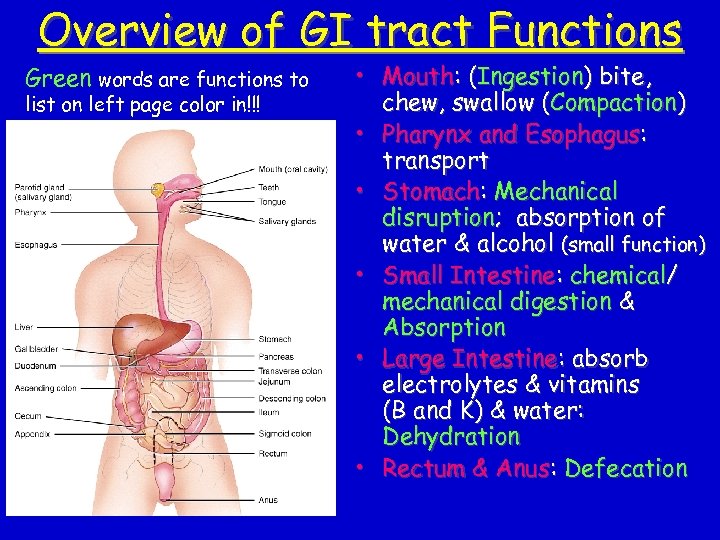
Overview of GI tract Functions Green words are functions to list on left page color in!!! • Mouth: (Ingestion) bite, chew, swallow (Compaction) • Pharynx and Esophagus: transport • Stomach: Mechanical disruption; absorption of water & alcohol (small function) • Small Intestine: chemical/ mechanical digestion & Absorption • Large Intestine: absorb electrolytes & vitamins (B and K) & water: Dehydration • Rectum & Anus: Defecation
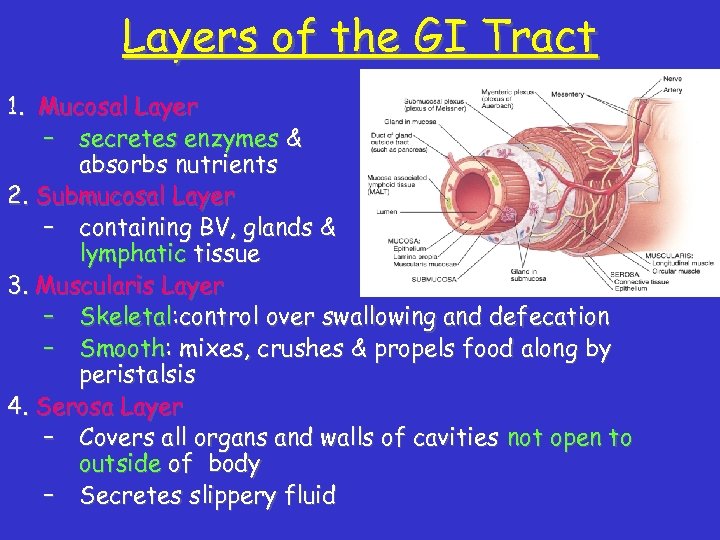
Layers of the GI Tract 1. Mucosal Layer – secretes enzymes & absorbs nutrients 2. Submucosal Layer – containing BV, glands & lymphatic tissue 3. Muscularis Layer – Skeletal: control over swallowing and defecation – Smooth: mixes, crushes & propels food along by peristalsis 4. Serosa Layer – Covers all organs and walls of cavities not open to outside of body – Secretes slippery fluid
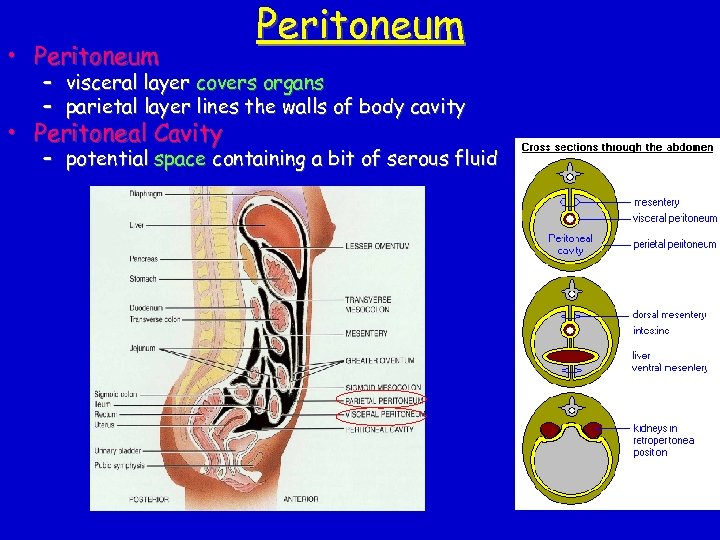
• Peritoneum – visceral layer covers organs – parietal layer lines the walls of body cavity • Peritoneal Cavity – potential space containing a bit of serous fluid
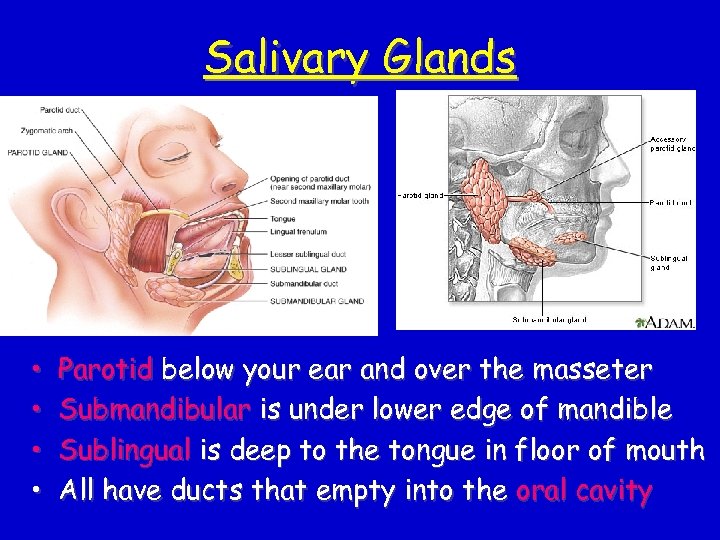
Salivary Glands • • Parotid below your ear and over the masseter Submandibular is under lower edge of mandible Sublingual is deep to the tongue in floor of mouth All have ducts that empty into the oral cavity
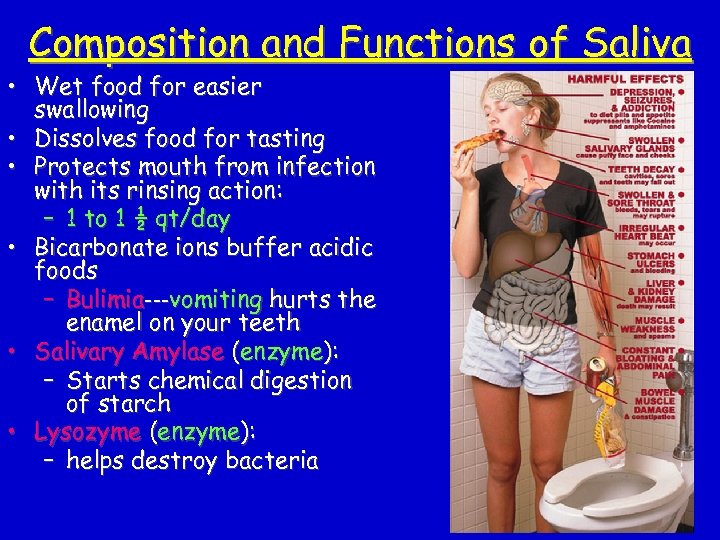
Composition and Functions of Saliva • Wet food for easier swallowing • Dissolves food for tasting • Protects mouth from infection with its rinsing action: – 1 to 1 ½ qt/day • Bicarbonate ions buffer acidic foods – Bulimia---vomiting hurts the enamel on your teeth • Salivary Amylase (enzyme): – Starts chemical digestion of starch • Lysozyme (enzyme): – helps destroy bacteria
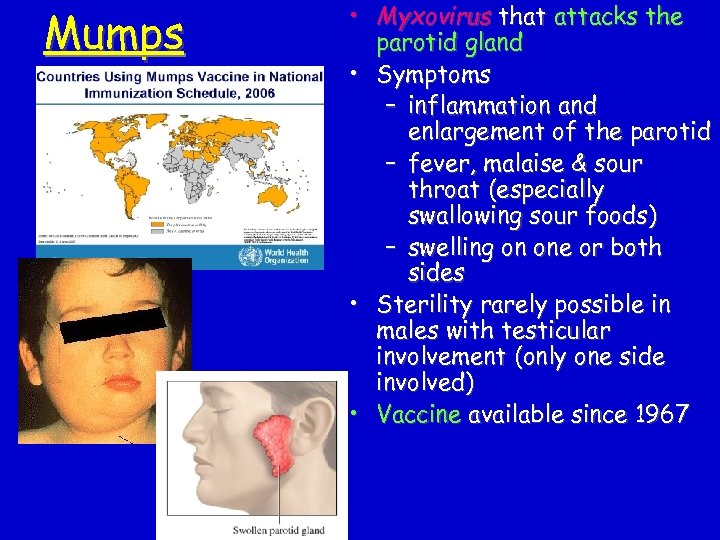
Mumps • Myxovirus that attacks the parotid gland • Symptoms – inflammation and enlargement of the parotid – fever, malaise & sour throat (especially swallowing sour foods) – swelling on one or both sides • Sterility rarely possible in males with testicular involvement (only one side involved) • Vaccine available since 1967
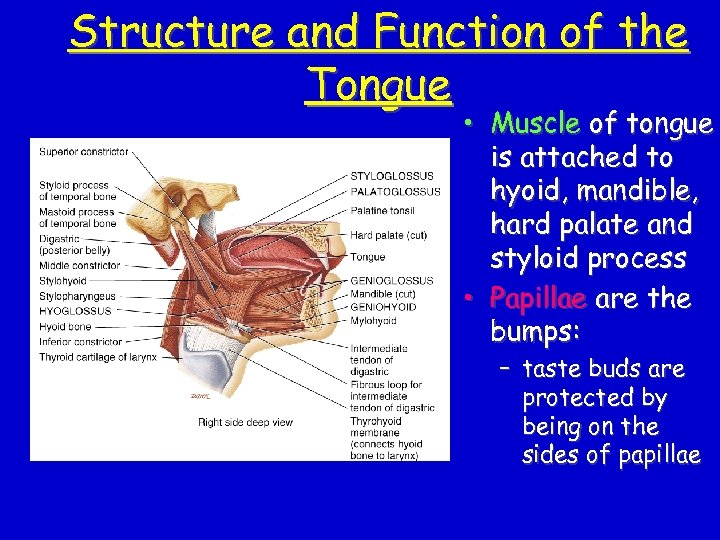
Structure and Function of the Tongue • Muscle of tongue is attached to hyoid, mandible, hard palate and styloid process • Papillae are the bumps: – taste buds are protected by being on the sides of papillae
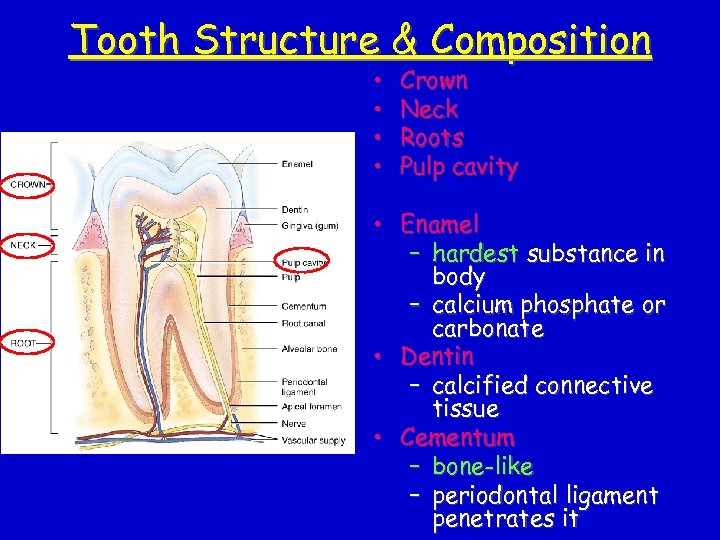
Tooth Structure & Composition • • Crown Neck Roots Pulp cavity • Enamel – hardest substance in body – calcium phosphate or carbonate • Dentin – calcified connective tissue • Cementum – bone-like – periodontal ligament penetrates it
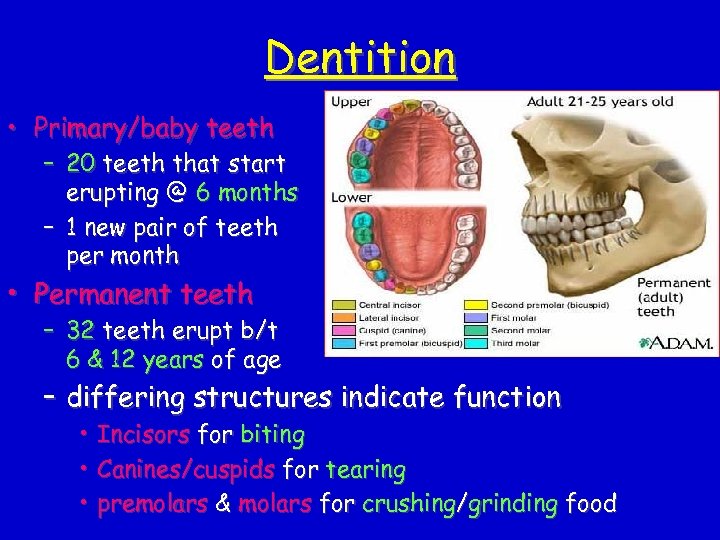
Dentition • Primary/baby teeth – 20 teeth that start erupting @ 6 months – 1 new pair of teeth per month • Permanent teeth – 32 teeth erupt b/t 6 & 12 years of age – differing structures indicate function • Incisors for biting • Canines/cuspids for tearing • premolars & molars for crushing/grinding food
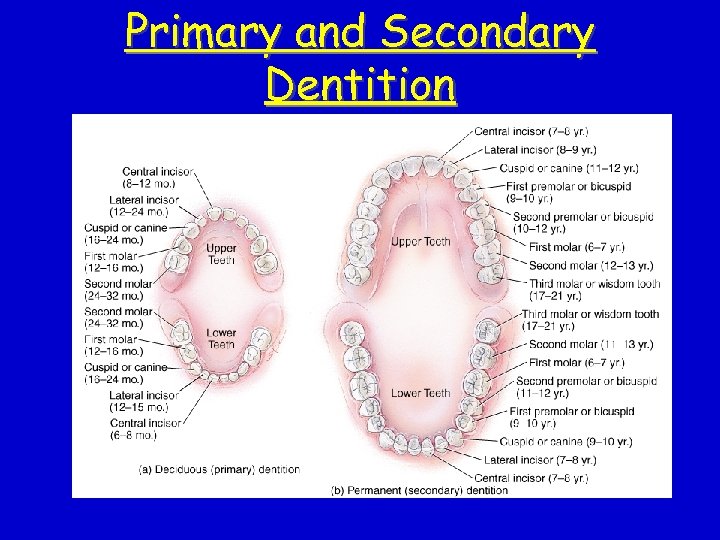
Primary and Secondary Dentition
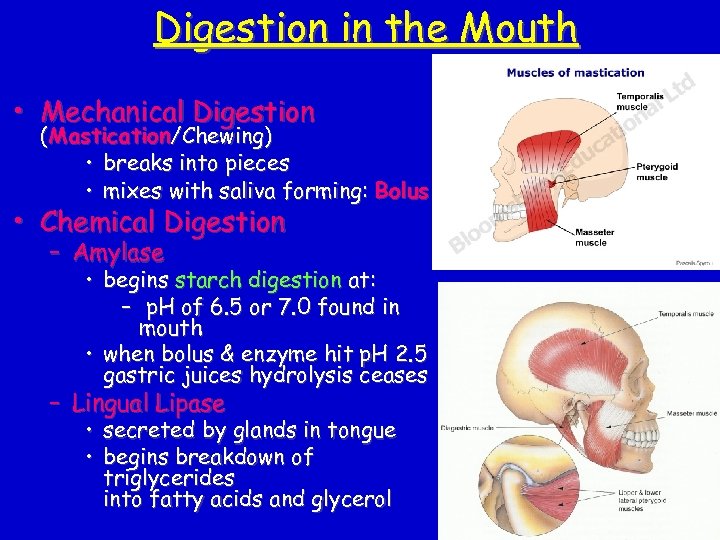
Digestion in the Mouth • Mechanical Digestion (Mastication/Chewing) • breaks into pieces • mixes with saliva forming: Bolus • Chemical Digestion – Amylase • begins starch digestion at: – p. H of 6. 5 or 7. 0 found in mouth • when bolus & enzyme hit p. H 2. 5 gastric juices hydrolysis ceases – Lingual Lipase • secreted by glands in tongue • begins breakdown of triglycerides into fatty acids and glycerol
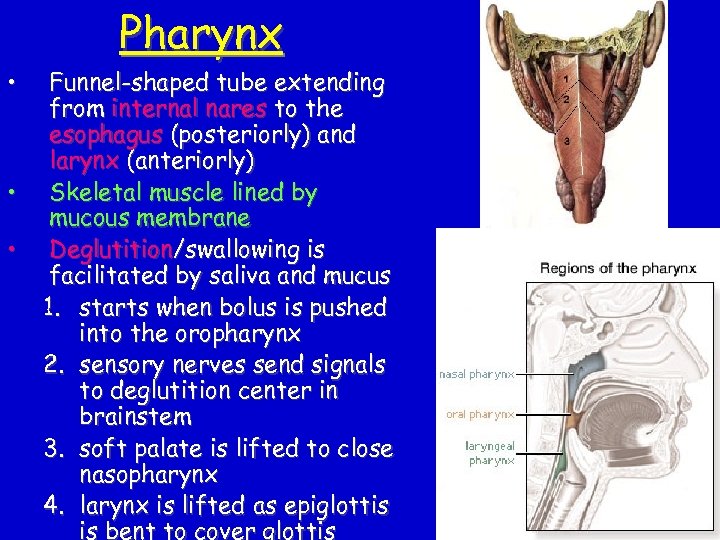
• • • Pharynx Funnel-shaped tube extending from internal nares to the esophagus (posteriorly) and larynx (anteriorly) Skeletal muscle lined by mucous membrane Deglutition/swallowing is facilitated by saliva and mucus 1. starts when bolus is pushed into the oropharynx 2. sensory nerves send signals to deglutition center in brainstem 3. soft palate is lifted to close nasopharynx 4. larynx is lifted as epiglottis is bent to cover glottis
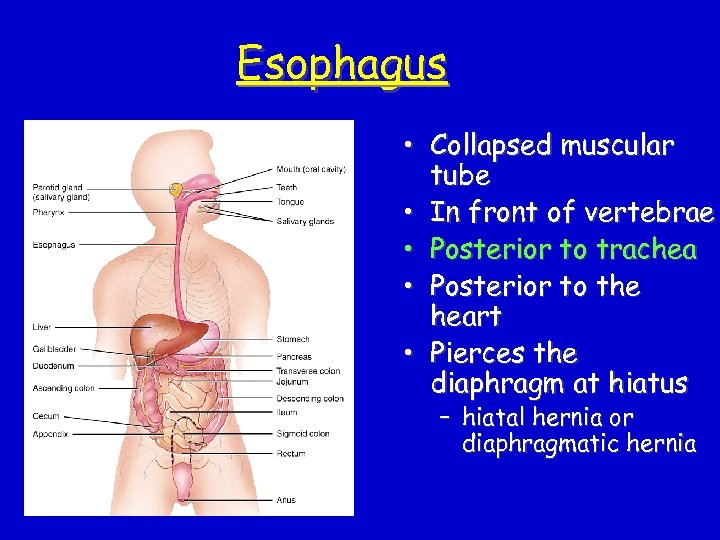
Esophagus • Collapsed muscular tube • In front of vertebrae • Posterior to trachea • Posterior to the heart • Pierces the diaphragm at hiatus – hiatal hernia or diaphragmatic hernia
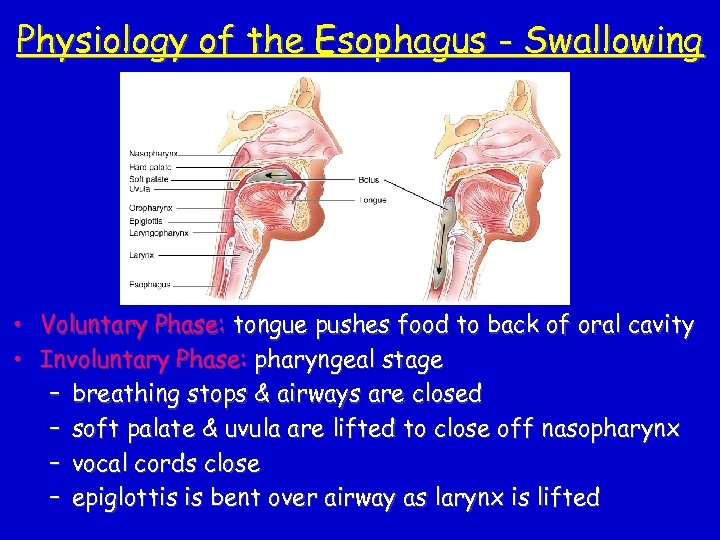
Physiology of the Esophagus - Swallowing • Voluntary Phase: tongue pushes food to back of oral cavity • Involuntary Phase: pharyngeal stage – breathing stops & airways are closed – soft palate & uvula are lifted to close off nasopharynx – vocal cords close – epiglottis is bent over airway as larynx is lifted
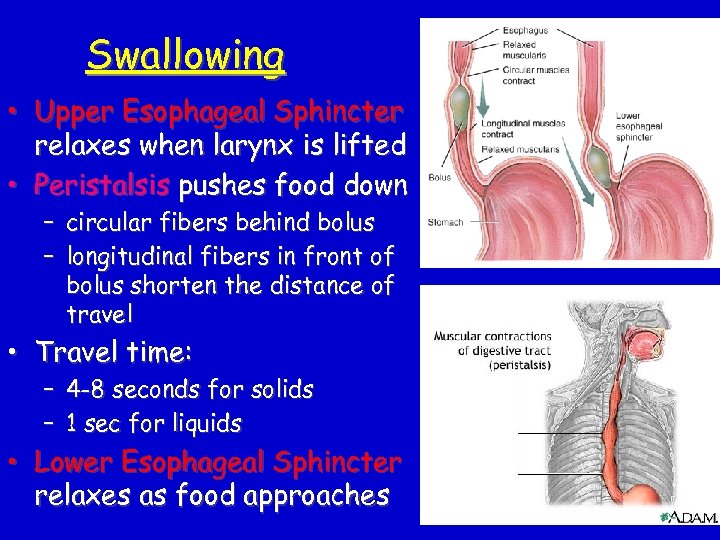
Swallowing • Upper Esophageal Sphincter relaxes when larynx is lifted • Peristalsis pushes food down – circular fibers behind bolus – longitudinal fibers in front of bolus shorten the distance of travel • Travel time: – 4 -8 seconds for solids – 1 sec for liquids • Lower Esophageal Sphincter relaxes as food approaches
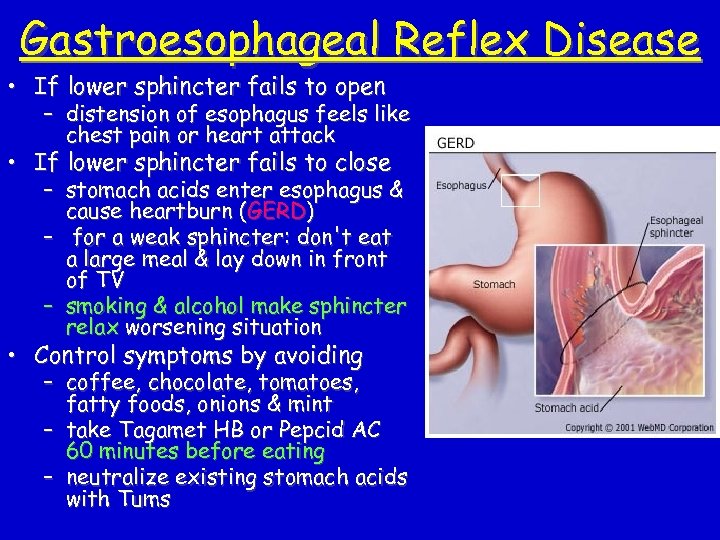
Gastroesophageal Reflex Disease • If lower sphincter fails to open – distension of esophagus feels like chest pain or heart attack • If lower sphincter fails to close – stomach acids enter esophagus & cause heartburn (GERD) – for a weak sphincter: don't eat a large meal & lay down in front of TV – smoking & alcohol make sphincter relax worsening situation • Control symptoms by avoiding – coffee, chocolate, tomatoes, fatty foods, onions & mint – take Tagamet HB or Pepcid AC 60 minutes before eating – neutralize existing stomach acids with Tums
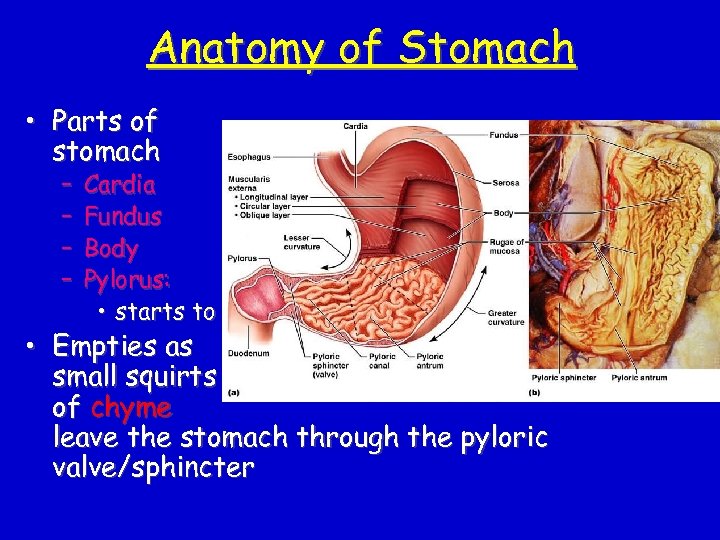
Anatomy of Stomach • Parts of stomach – – Cardia Fundus Body Pylorus: • starts to narrow as approaches Pyloric Sphincter • Empties as small squirts of chyme leave the stomach through the pyloric valve/sphincter
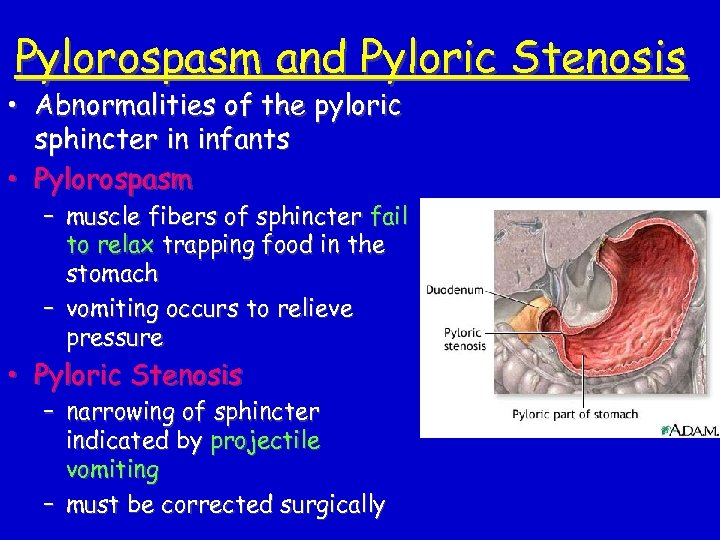
Pylorospasm and Pyloric Stenosis • Abnormalities of the pyloric sphincter in infants • Pylorospasm – muscle fibers of sphincter fail to relax trapping food in the stomach – vomiting occurs to relieve pressure • Pyloric Stenosis – narrowing of sphincter indicated by projectile vomiting – must be corrected surgically
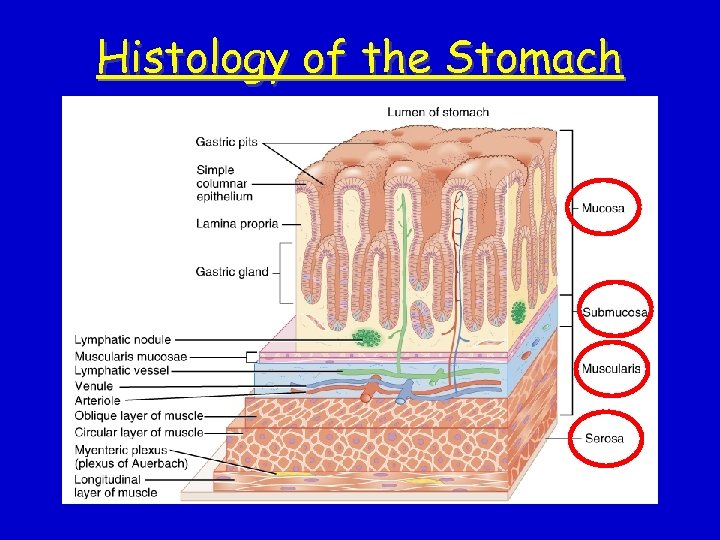
Histology of the Stomach
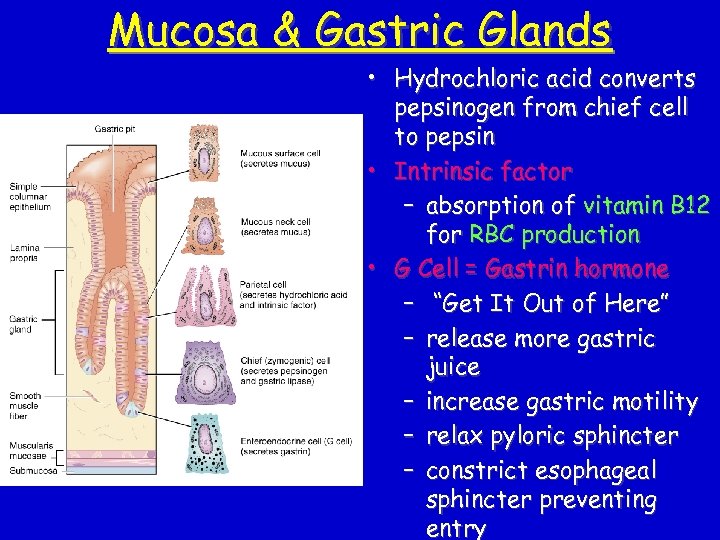
Mucosa & Gastric Glands • Hydrochloric acid converts pepsinogen from chief cell to pepsin • Intrinsic factor – absorption of vitamin B 12 for RBC production • G Cell = Gastrin hormone – “Get It Out of Here” – release more gastric juice – increase gastric motility – relax pyloric sphincter – constrict esophageal sphincter preventing entry
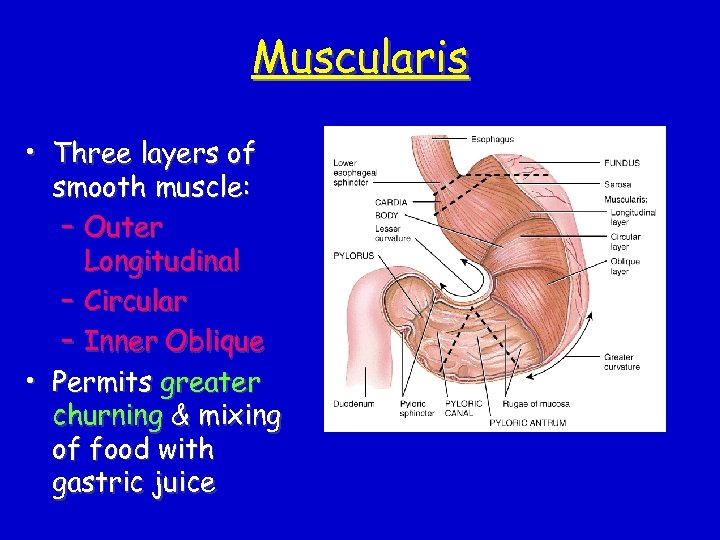
Muscularis • Three layers of smooth muscle: – Outer Longitudinal – Circular – Inner Oblique • Permits greater churning & mixing of food with gastric juice
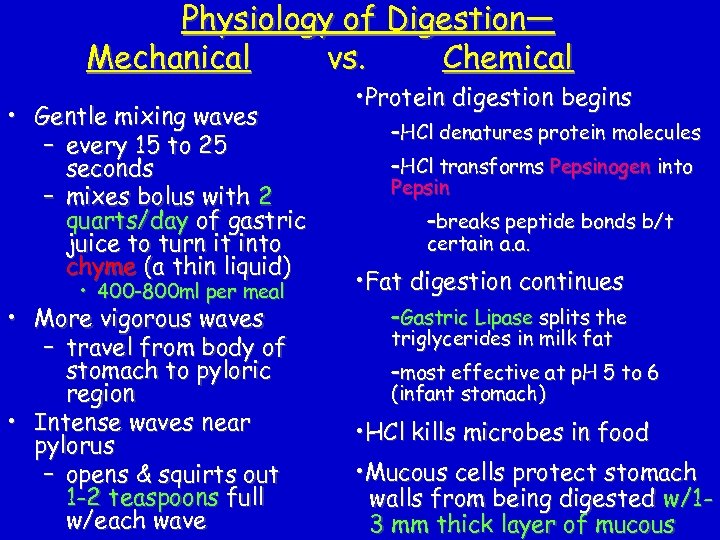
Physiology of Digestion— Mechanical vs. Chemical • Gentle mixing waves – every 15 to 25 seconds – mixes bolus with 2 quarts/day of gastric juice to turn it into chyme (a thin liquid) • 400 -800 ml per meal • More vigorous waves – travel from body of stomach to pyloric region • Intense waves near pylorus – opens & squirts out 1 -2 teaspoons full w/each wave • Protein digestion begins –HCl denatures protein molecules –HCl transforms Pepsinogen into Pepsin –breaks peptide bonds b/t certain a. a. • Fat digestion continues –Gastric Lipase splits the triglycerides in milk fat –most effective at p. H 5 to 6 (infant stomach) • HCl kills microbes in food • Mucous cells protect stomach walls from being digested w/13 mm thick layer of mucous
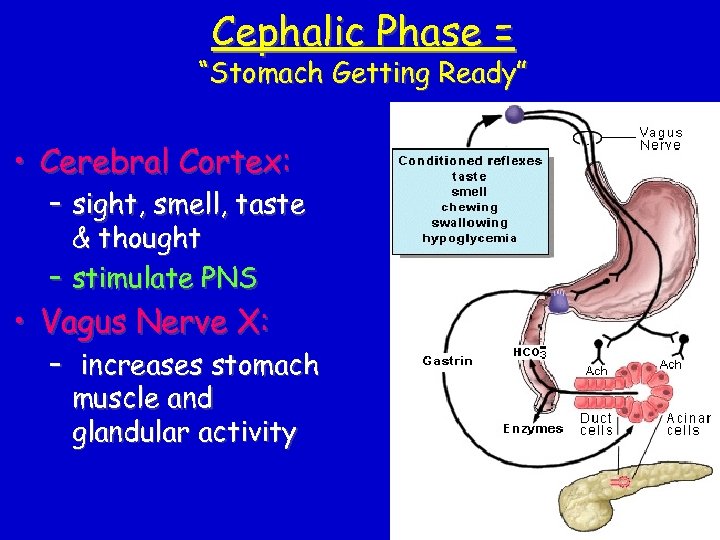
Cephalic Phase = “Stomach Getting Ready” • Cerebral Cortex: – sight, smell, taste & thought – stimulate PNS • Vagus Nerve X: – increases stomach muscle and glandular activity
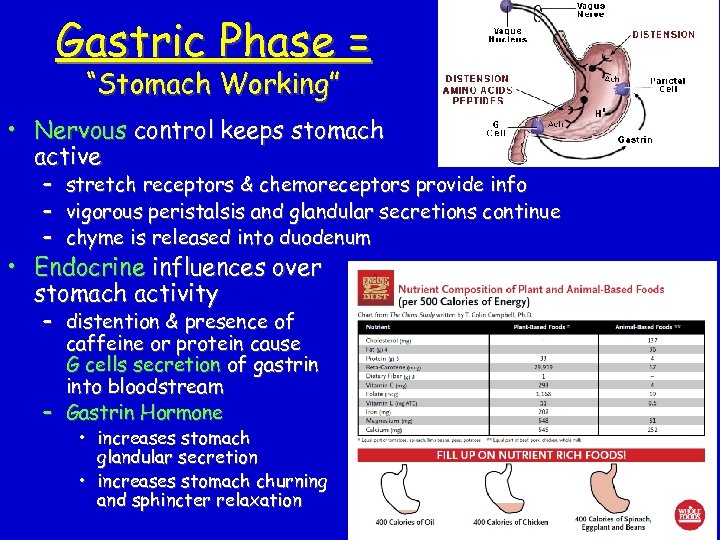
Gastric Phase = “Stomach Working” • Nervous control keeps stomach active – – – stretch receptors & chemoreceptors provide info vigorous peristalsis and glandular secretions continue chyme is released into duodenum • Endocrine influences over stomach activity – distention & presence of caffeine or protein cause G cells secretion of gastrin into bloodstream – Gastrin Hormone • increases stomach glandular secretion • increases stomach churning and sphincter relaxation
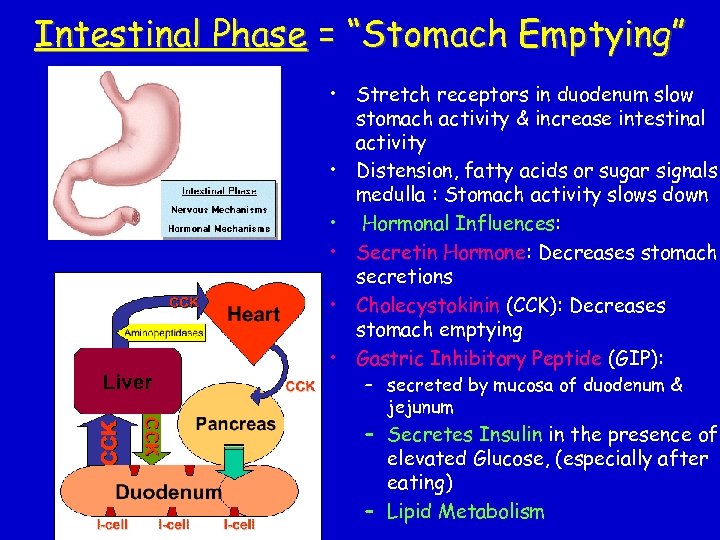
Intestinal Phase = “Stomach Emptying” • Stretch receptors in duodenum slow stomach activity & increase intestinal activity • Distension, fatty acids or sugar signals medulla : Stomach activity slows down • Hormonal Influences: • Secretin Hormone: Decreases stomach secretions • Cholecystokinin (CCK): Decreases stomach emptying • Gastric Inhibitory Peptide (GIP): – secreted by mucosa of duodenum & jejunum – Secretes Insulin in the presence of elevated Glucose, (especially after eating) – Lipid Metabolism
Absorption of Nutrients by the Stomach • • Water especially if it is cold Electrolytes Some drugs (especially aspirin) & alcohol Fat content in the stomach slows the passage of alcohol to the intestine where absorption is more rapid • Gastric mucosal cells contain alcohol dehydrogenase that converts some alcohol to acetaldehyde – more of this enzyme found in males than females • Females have less total body fluid that same size male so end up w/higher blood alcohol levels with same intake of alcohol
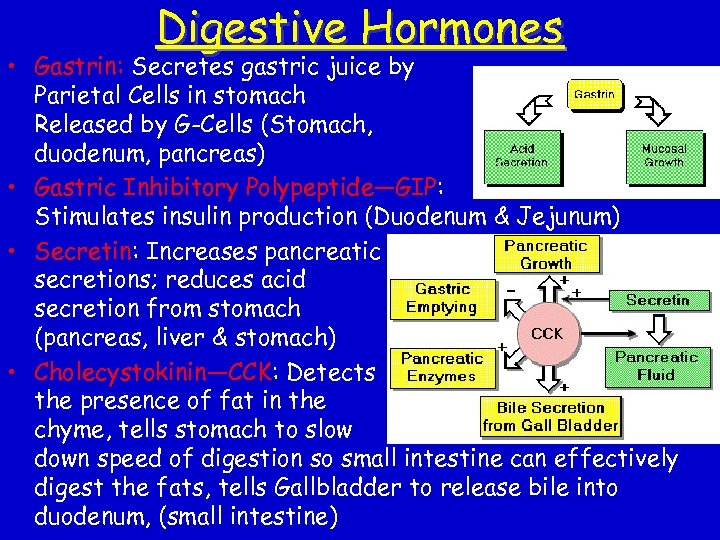
Digestive Hormones • Gastrin: Secretes gastric juice by Parietal Cells in stomach Released by G-Cells (Stomach, duodenum, pancreas) • Gastric Inhibitory Polypeptide—GIP: Stimulates insulin production (Duodenum & Jejunum) • Secretin: Increases pancreatic secretions; reduces acid secretion from stomach (pancreas, liver & stomach) • Cholecystokinin—CCK: Detects the presence of fat in the chyme, tells stomach to slow down speed of digestion so small intestine can effectively digest the fats, tells Gallbladder to release bile into duodenum, (small intestine)
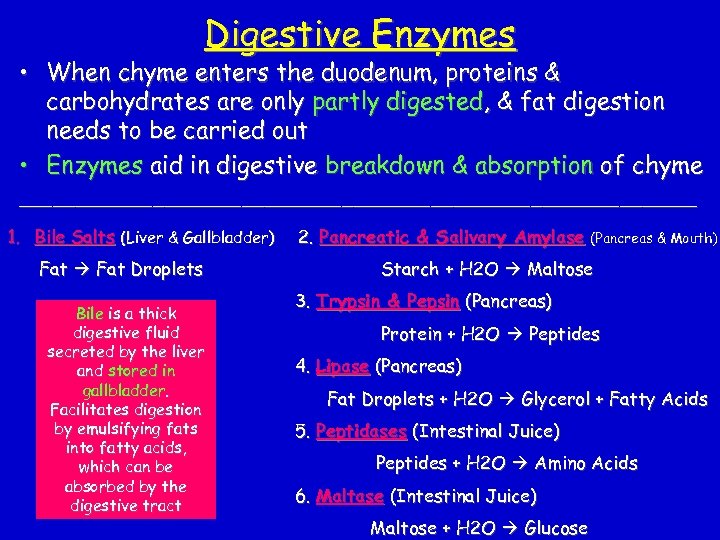
Digestive Enzymes • When chyme enters the duodenum, proteins & carbohydrates are only partly digested, & fat digestion needs to be carried out • Enzymes aid in digestive breakdown & absorption of chyme _______________________________ 1. Bile Salts (Liver & Gallbladder) Fat Droplets Bile is a thick digestive fluid secreted by the liver and stored in gallbladder. Facilitates digestion by emulsifying fats into fatty acids, which can be absorbed by the digestive tract 2. Pancreatic & Salivary Amylase (Pancreas & Mouth) Starch + H 2 O Maltose 3. Trypsin & Pepsin (Pancreas) Protein + H 2 O Peptides 4. Lipase (Pancreas) Fat Droplets + H 2 O Glycerol + Fatty Acids 5. Peptidases (Intestinal Juice) Peptides + H 2 O Amino Acids 6. Maltase (Intestinal Juice) Maltose + H 2 O Glucose
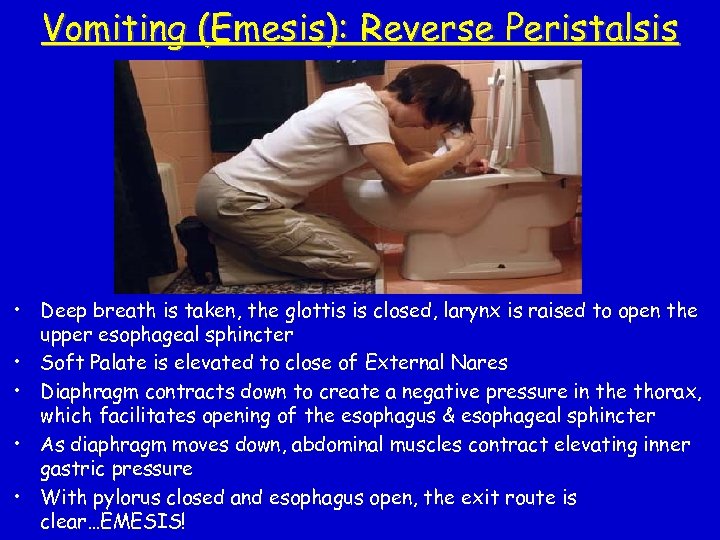
Vomiting (Emesis): Reverse Peristalsis • Deep breath is taken, the glottis is closed, larynx is raised to open the upper esophageal sphincter • Soft Palate is elevated to close of External Nares • Diaphragm contracts down to create a negative pressure in the thorax, which facilitates opening of the esophagus & esophageal sphincter • As diaphragm moves down, abdominal muscles contract elevating inner gastric pressure • With pylorus closed and esophagus open, the exit route is clear…EMESIS!
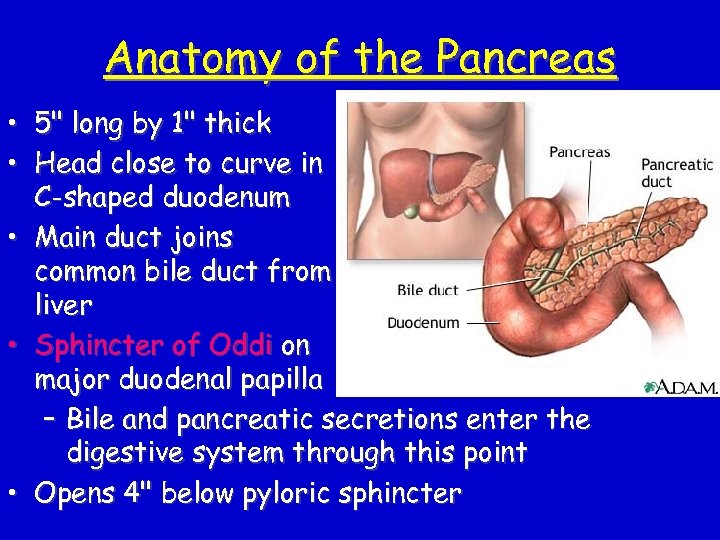
Anatomy of the Pancreas • 5" long by 1" thick • Head close to curve in C-shaped duodenum • Main duct joins common bile duct from liver • Sphincter of Oddi on major duodenal papilla – Bile and pancreatic secretions enter the digestive system through this point • Opens 4" below pyloric sphincter
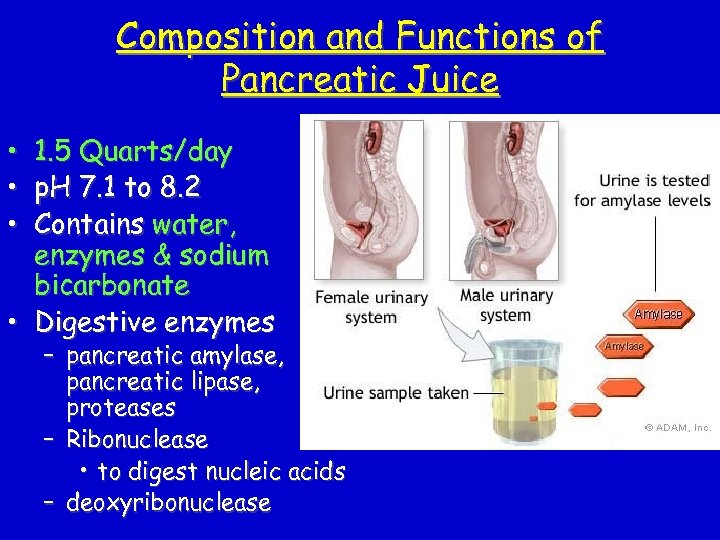
Composition and Functions of Pancreatic Juice • • • 1. 5 Quarts/day p. H 7. 1 to 8. 2 Contains water, enzymes & sodium bicarbonate • Digestive enzymes – pancreatic amylase, pancreatic lipase, proteases – Ribonuclease • to digest nucleic acids – deoxyribonuclease
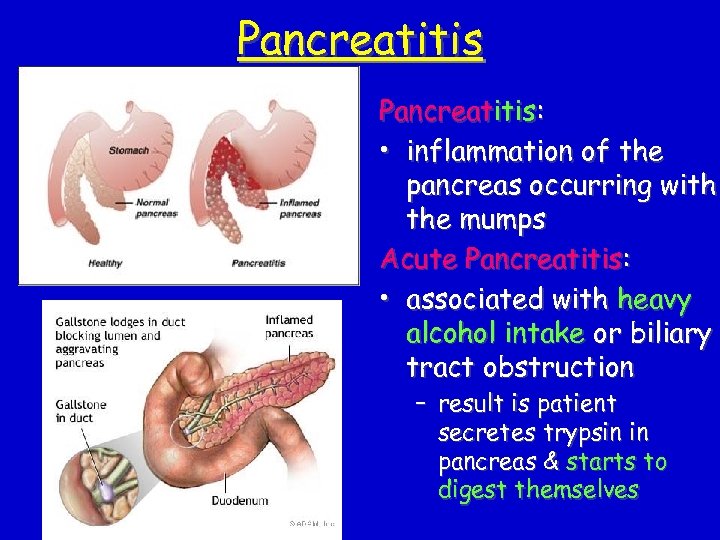
Pancreatitis: • inflammation of the pancreas occurring with the mumps Acute Pancreatitis: • associated with heavy alcohol intake or biliary tract obstruction – result is patient secretes trypsin in pancreas & starts to digest themselves
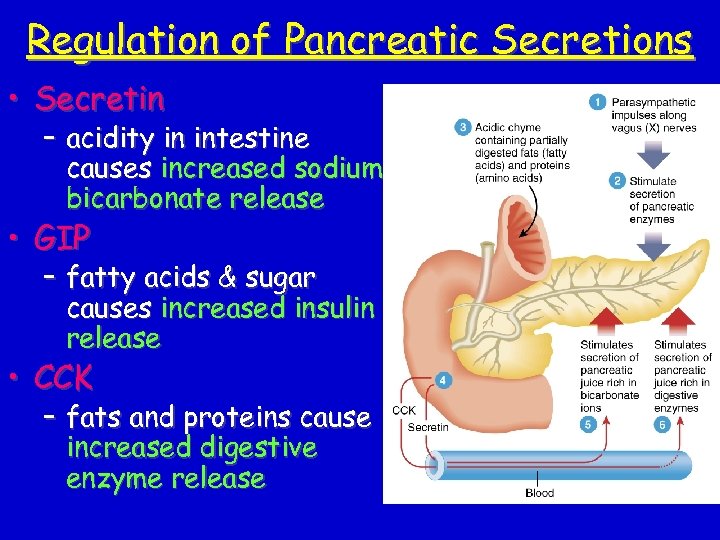
Regulation of Pancreatic Secretions • Secretin – acidity in intestine causes increased sodium bicarbonate release • GIP – fatty acids & sugar causes increased insulin release • CCK – fats and proteins cause increased digestive enzyme release
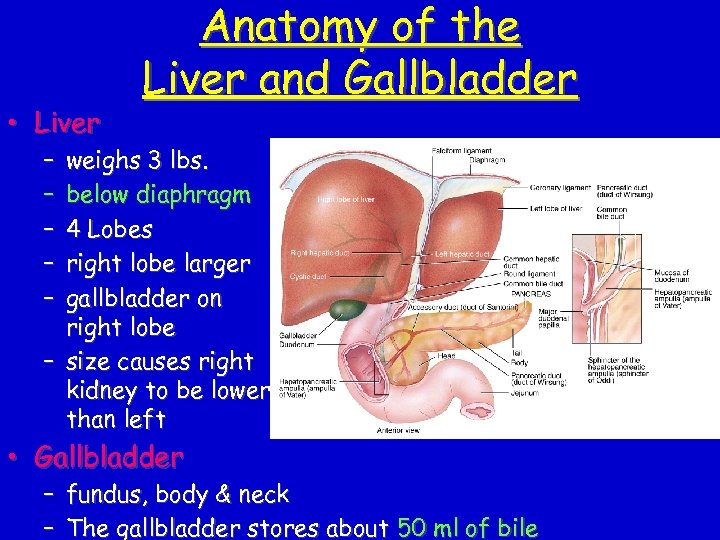
• Liver Anatomy of the Liver and Gallbladder – – – weighs 3 lbs. below diaphragm 4 Lobes right lobe larger gallbladder on right lobe – size causes right kidney to be lower than left • Gallbladder – fundus, body & neck – The gallbladder stores about 50 ml of bile
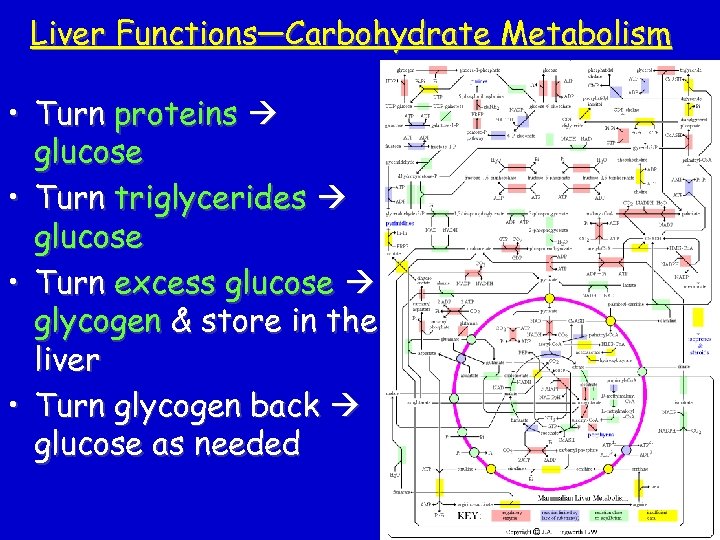
Liver Functions—Carbohydrate Metabolism • Turn proteins glucose • Turn triglycerides glucose • Turn excess glucose glycogen & store in the liver • Turn glycogen back glucose as needed
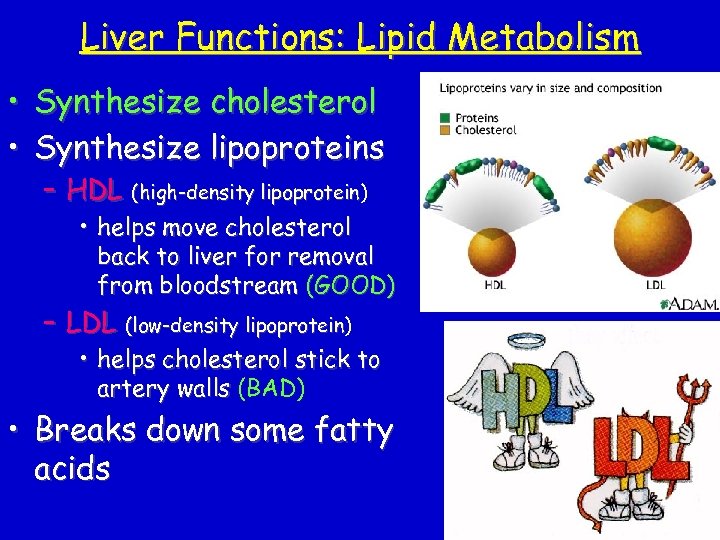
Liver Functions: Lipid Metabolism • Synthesize cholesterol • Synthesize lipoproteins – HDL (high-density lipoprotein) lipoprotein • helps move cholesterol back to liver for removal from bloodstream (GOOD) – LDL (low-density lipoprotein) lipoprotein • helps cholesterol stick to artery walls (BAD) • Breaks down some fatty acids
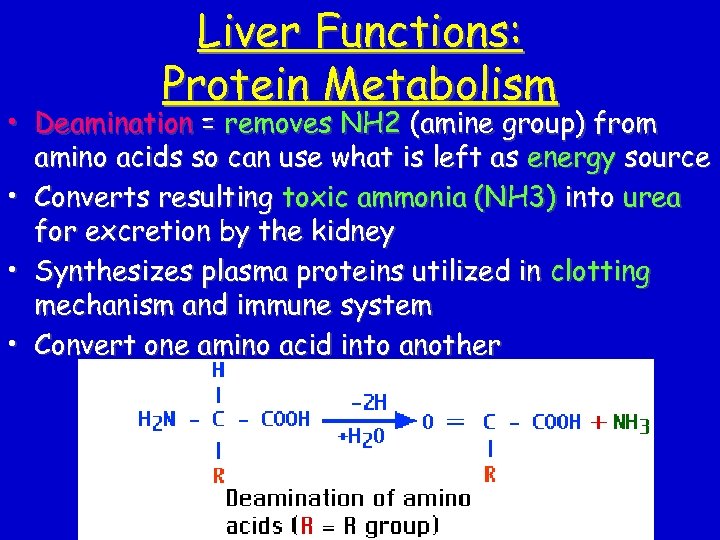
Liver Functions: Protein Metabolism • Deamination = removes NH 2 (amine group) from amino acids so can use what is left as energy source • Converts resulting toxic ammonia (NH 3) into urea for excretion by the kidney • Synthesizes plasma proteins utilized in clotting mechanism and immune system • Convert one amino acid into another
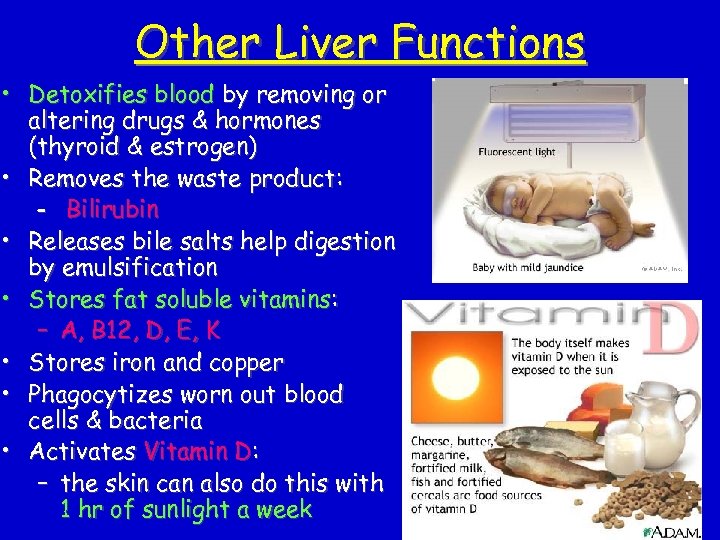
Other Liver Functions • Detoxifies blood by removing or altering drugs & hormones (thyroid & estrogen) • Removes the waste product: – Bilirubin • Releases bile salts help digestion by emulsification • Stores fat soluble vitamins: – A, B 12, D, E, K • Stores iron and copper • Phagocytizes worn out blood cells & bacteria • Activates Vitamin D: – the skin can also do this with 1 hr of sunlight a week
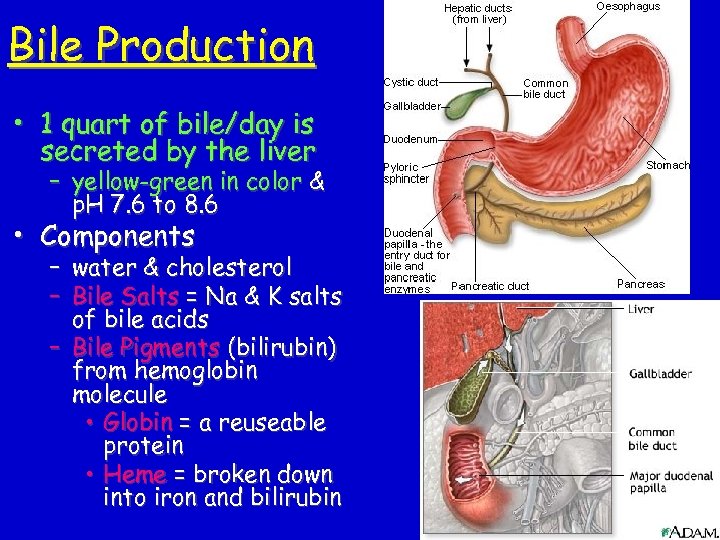
Bile Production • 1 quart of bile/day is secreted by the liver – yellow-green in color & p. H 7. 6 to 8. 6 • Components – water & cholesterol – Bile Salts = Na & K salts of bile acids – Bile Pigments (bilirubin) from hemoglobin molecule • Globin = a reuseable protein • Heme = broken down into iron and bilirubin
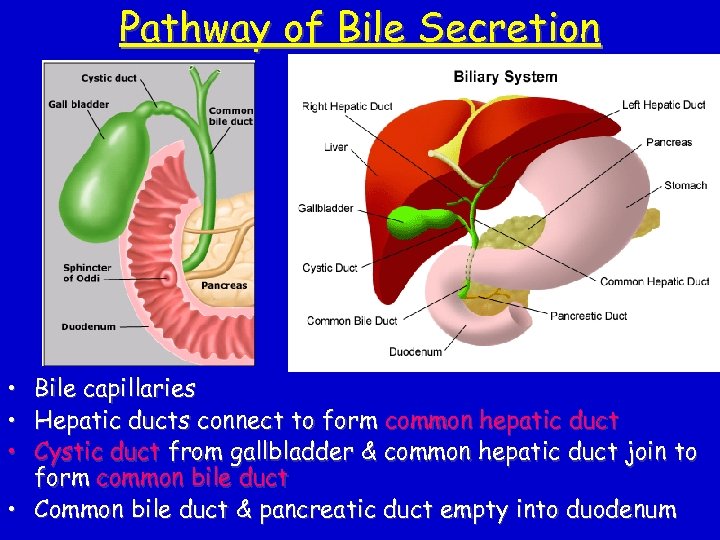
Pathway of Bile Secretion • • • Bile capillaries Hepatic ducts connect to form common hepatic duct Cystic duct from gallbladder & common hepatic duct join to form common bile duct • Common bile duct & pancreatic duct empty into duodenum
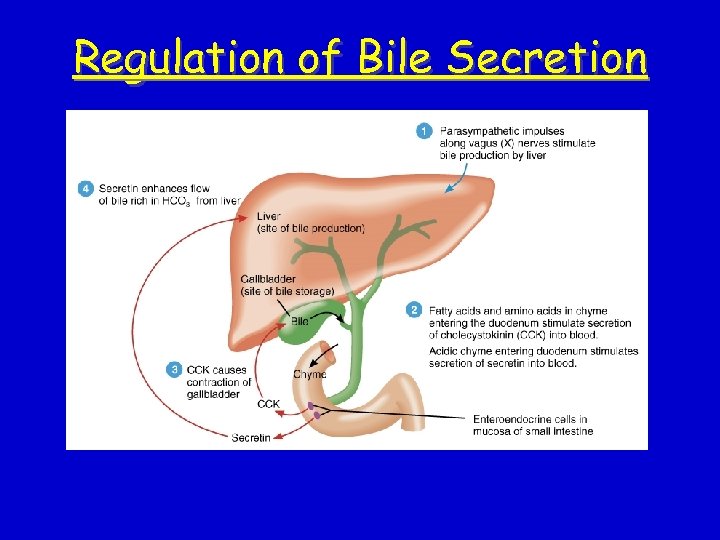
Regulation of Bile Secretion
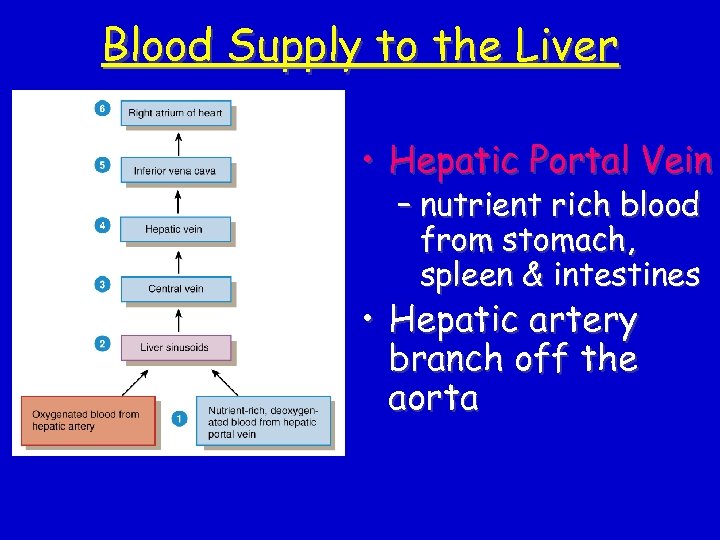
Blood Supply to the Liver • Hepatic Portal Vein – nutrient rich blood from stomach, spleen & intestines • Hepatic artery branch off the aorta
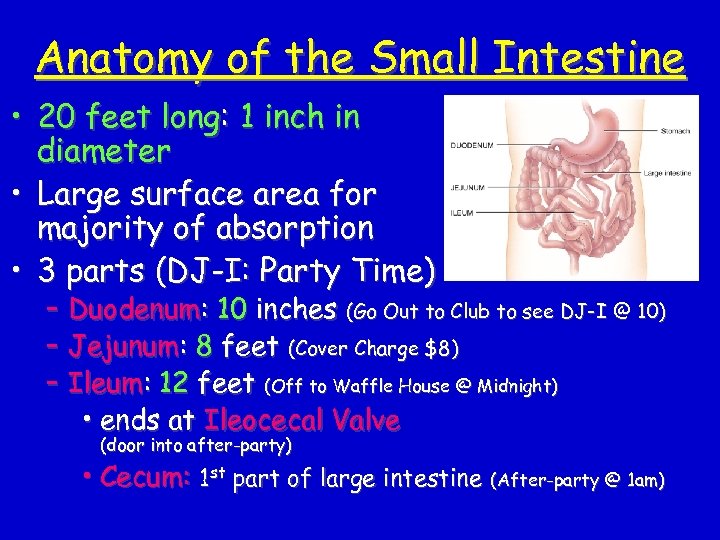
Anatomy of the Small Intestine • 20 feet long: 1 inch in diameter • Large surface area for majority of absorption • 3 parts (DJ-I: Party Time) – Duodenum: 10 inches (Go Out to Club to see DJ-I @ 10) – Jejunum: 8 feet (Cover Charge $8) – Ileum: 12 feet (Off to Waffle House @ Midnight) • ends at Ileocecal Valve (door into after-party) • Cecum: 1 st part of large intestine (After-party @ 1 am)
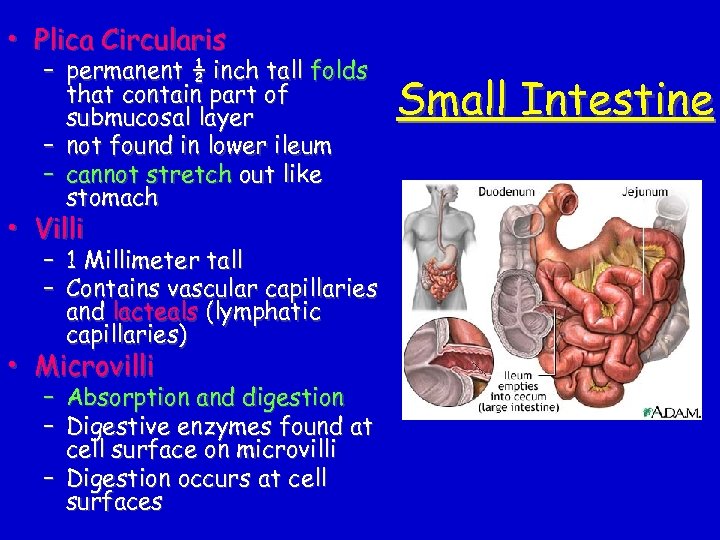
• Plica Circularis – permanent ½ inch tall folds that contain part of submucosal layer – not found in lower ileum – cannot stretch out like stomach • Villi – 1 Millimeter tall – Contains vascular capillaries and lacteals (lymphatic capillaries) • Microvilli – Absorption and digestion – Digestive enzymes found at cell surface on microvilli – Digestion occurs at cell surfaces Small Intestine
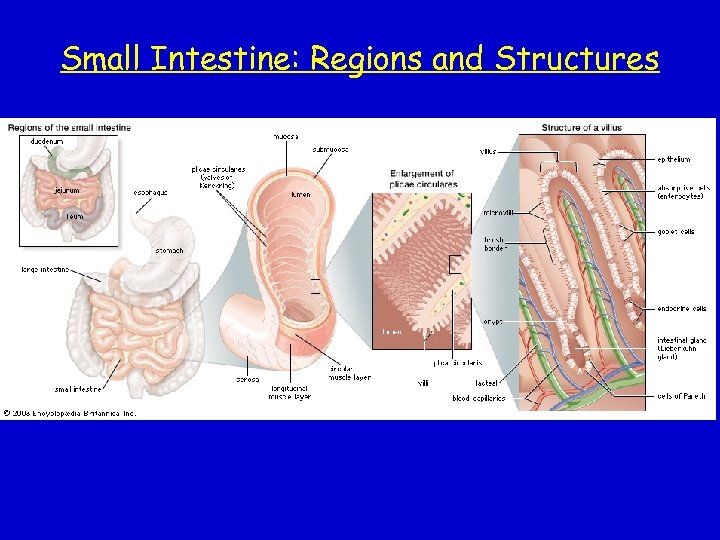
Small Intestine: Regions and Structures
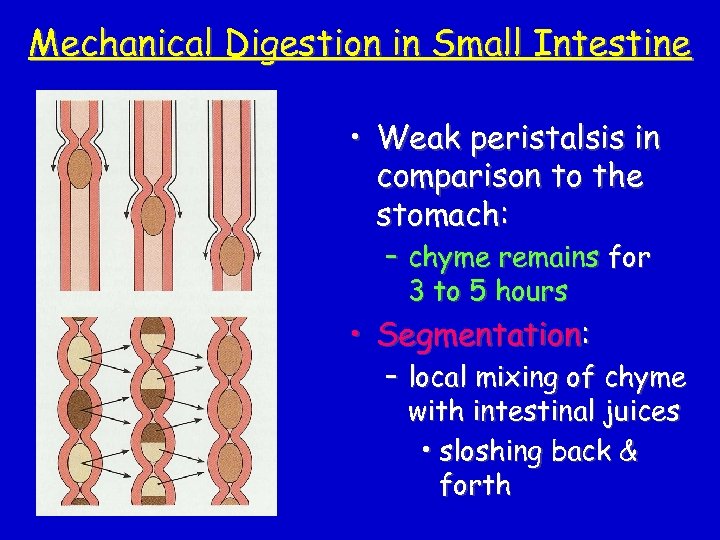
Mechanical Digestion in Small Intestine • Weak peristalsis in comparison to the stomach: – chyme remains for 3 to 5 hours • Segmentation: – local mixing of chyme with intestinal juices • sloshing back & forth
Digestion of Carbohydrates • Mouth: salivary amylase • Esophagus & stomach: nothing happens • Duodenum: pancreatic amylase • Brush Border Enzymes (Maltase, Sucrase & Lactase) turn disaccharides (maltose, sucrose & lactose) to: – produces monosaccharides-fructose, glucose & galactose – lactose intolerance (no enzyme; bacteria ferment sugar)--gas & diarrhea Digestion of Nucleic Acids • Pancreatic juice contains 2 nucleases –ribonuclease which digests RNA –deoxyribonuclease which digests DNA • Nucleotides produced are further digested by brush border enzymes • Absorbed by active transport
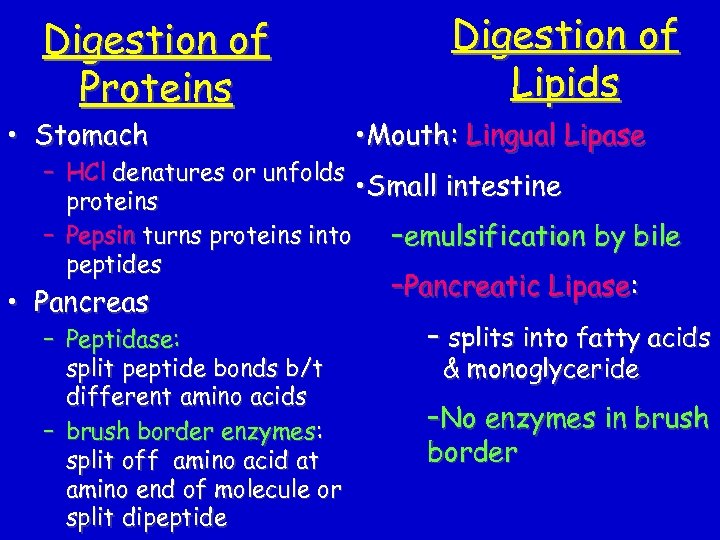
Digestion of Proteins • Stomach Digestion of Lipids • Mouth: Lingual Lipase – HCl denatures or unfolds • Small intestine proteins – Pepsin turns proteins into –emulsification by bile peptides • Pancreas – Peptidase: split peptide bonds b/t different amino acids – brush border enzymes: split off amino acid at amino end of molecule or split dipeptide –Pancreatic Lipase: – splits into fatty acids & monoglyceride –No enzymes in brush border
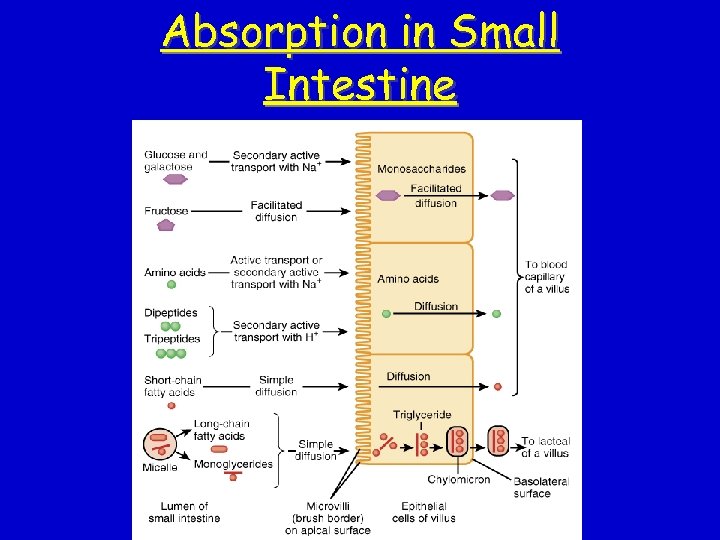
Absorption in Small Intestine
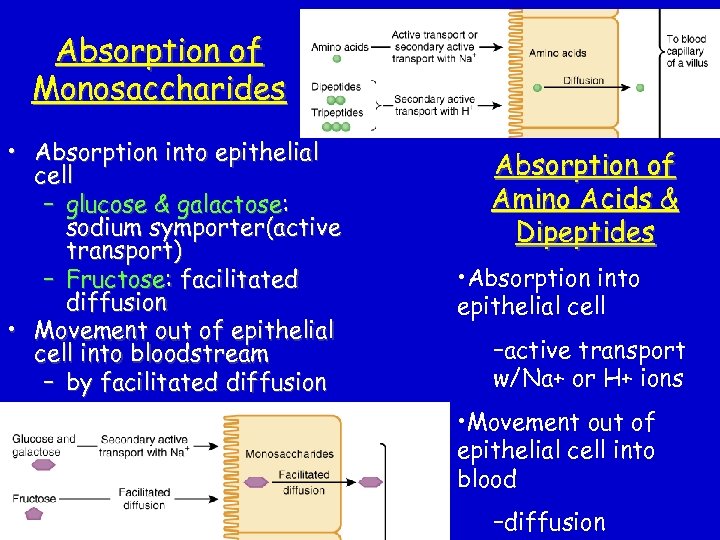
Absorption of Monosaccharides • Absorption into epithelial cell – glucose & galactose: sodium symporter(active transport) – Fructose: facilitated diffusion • Movement out of epithelial cell into bloodstream – by facilitated diffusion Absorption of Amino Acids & Dipeptides • Absorption into epithelial cell –active transport w/Na+ or H+ ions • Movement out of epithelial cell into blood –diffusion
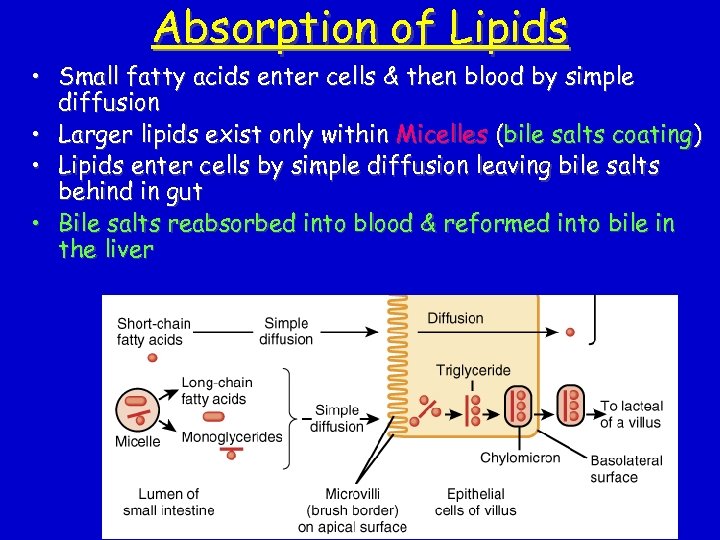
Absorption of Lipids • Small fatty acids enter cells & then blood by simple diffusion • Larger lipids exist only within Micelles (bile salts coating) • Lipids enter cells by simple diffusion leaving bile salts behind in gut • Bile salts reabsorbed into blood & reformed into bile in the liver
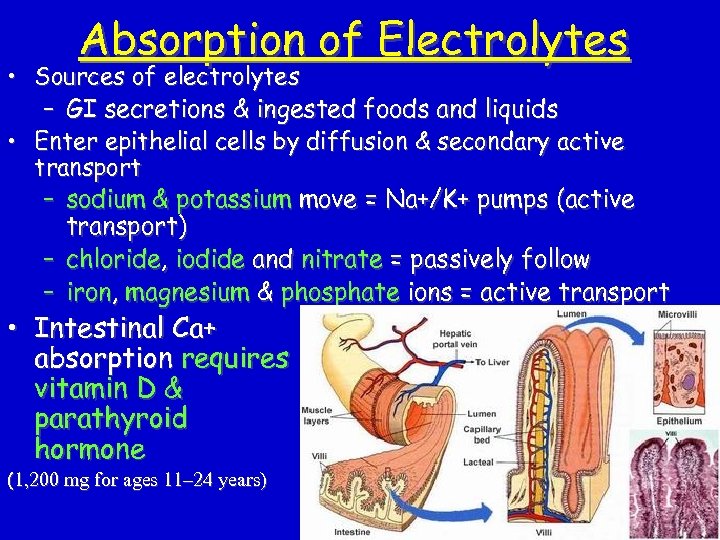
Absorption of Electrolytes • Sources of electrolytes – GI secretions & ingested foods and liquids • Enter epithelial cells by diffusion & secondary active transport – sodium & potassium move = Na+/K+ pumps (active transport) – chloride, iodide and nitrate = passively follow – iron, magnesium & phosphate ions = active transport • Intestinal Ca+ absorption requires vitamin D & parathyroid hormone (1, 200 mg for ages 11– 24 years)
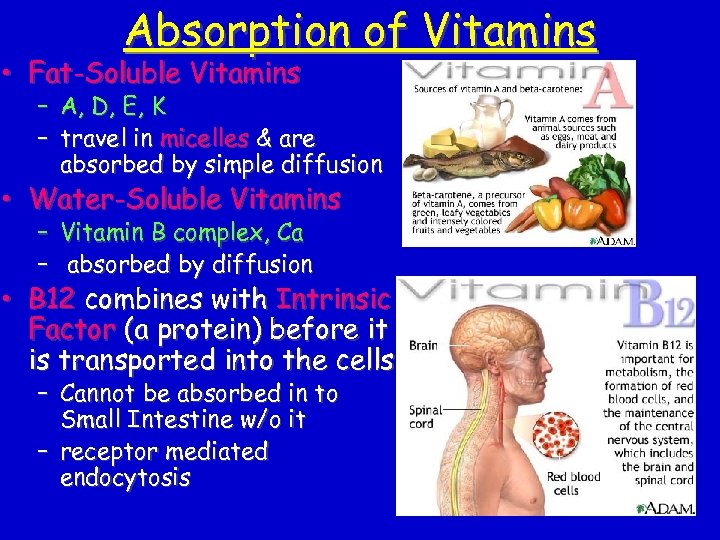
Absorption of Vitamins • Fat-Soluble Vitamins – A, D, E, K – travel in micelles & are absorbed by simple diffusion • Water-Soluble Vitamins – Vitamin B complex, Ca – absorbed by diffusion • B 12 combines with Intrinsic Factor (a protein) before it is transported into the cells – Cannot be absorbed in to Small Intestine w/o it – receptor mediated endocytosis
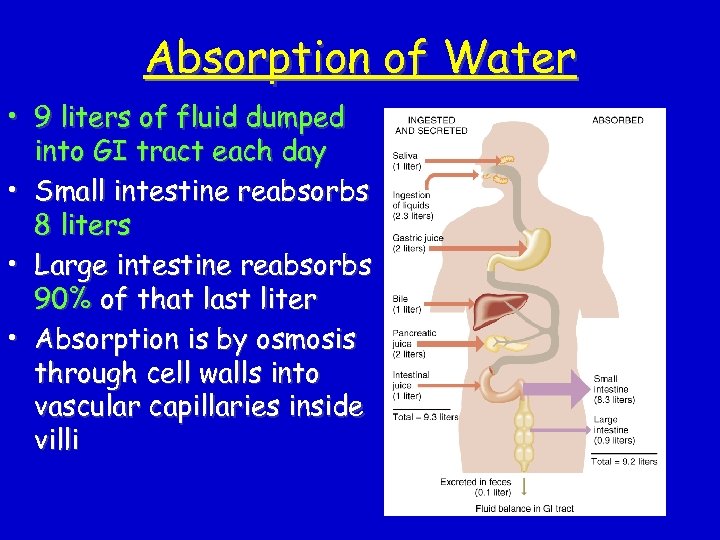
Absorption of Water • 9 liters of fluid dumped into GI tract each day • Small intestine reabsorbs 8 liters • Large intestine reabsorbs 90% of that last liter • Absorption is by osmosis through cell walls into vascular capillaries inside villi
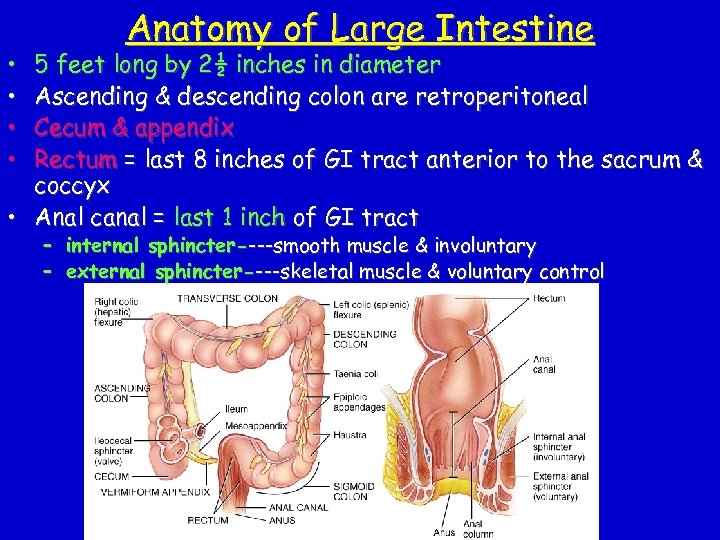
• • Anatomy of Large Intestine 5 feet long by 2½ inches in diameter Ascending & descending colon are retroperitoneal Cecum & appendix Rectum = last 8 inches of GI tract anterior to the sacrum & coccyx • Anal canal = last 1 inch of GI tract – internal sphincter----smooth muscle & involuntary – external sphincter----skeletal muscle & voluntary control
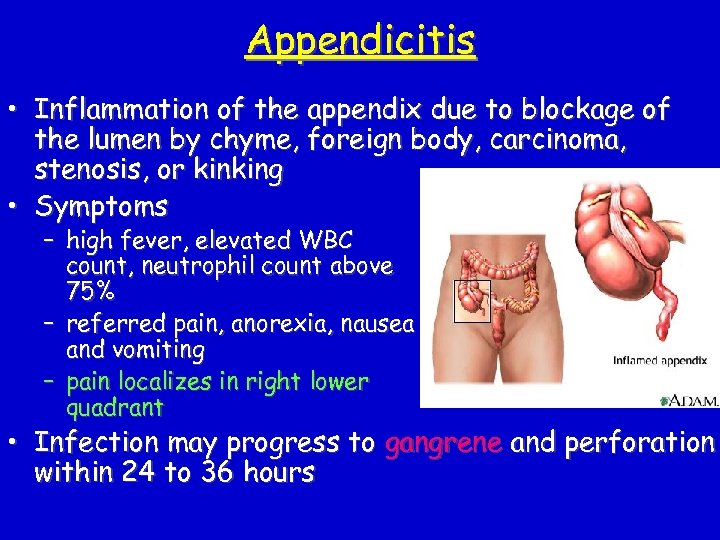
Appendicitis • Inflammation of the appendix due to blockage of the lumen by chyme, foreign body, carcinoma, stenosis, or kinking • Symptoms – high fever, elevated WBC count, neutrophil count above 75% – referred pain, anorexia, nausea and vomiting – pain localizes in right lower quadrant • Infection may progress to gangrene and perforation within 24 to 36 hours
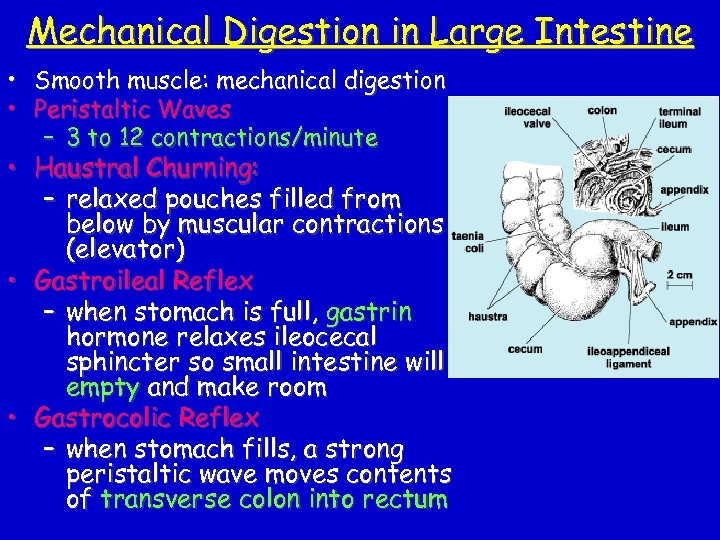
Mechanical Digestion in Large Intestine • Smooth muscle: mechanical digestion • Peristaltic Waves – 3 to 12 contractions/minute • Haustral Churning: – relaxed pouches filled from below by muscular contractions (elevator) • Gastroileal Reflex – when stomach is full, gastrin hormone relaxes ileocecal sphincter so small intestine will empty and make room • Gastrocolic Reflex – when stomach fills, a strong peristaltic wave moves contents of transverse colon into rectum
Total Time for Digestion • • • Mouth = As long as you want Esophagus = 5 -6 sec Stomach = 2 -4 hours Small Intestine = 5 -6 hours Large Intestine = 12 -24 hours Total Time for Digestion= 20 -30 hours • Your Total Corn Time = TBD
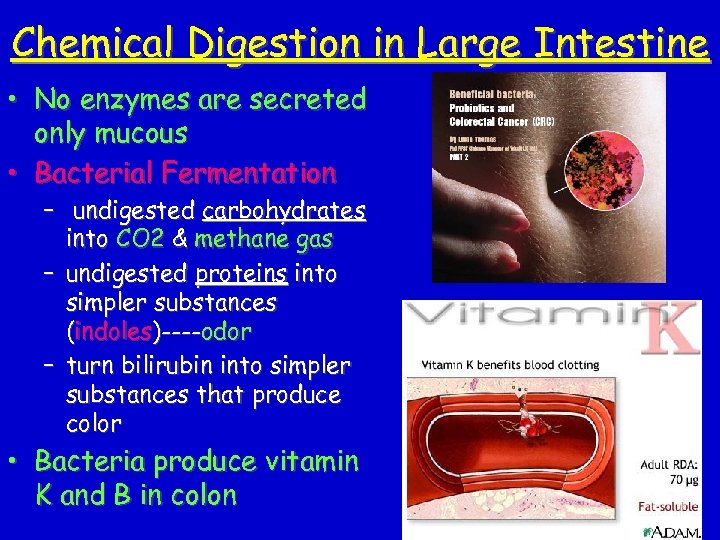
Chemical Digestion in Large Intestine • No enzymes are secreted only mucous • Bacterial Fermentation – undigested carbohydrates into CO 2 & methane gas – undigested proteins into simpler substances (indoles)----odor – turn bilirubin into simpler substances that produce color • Bacteria produce vitamin K and B in colon
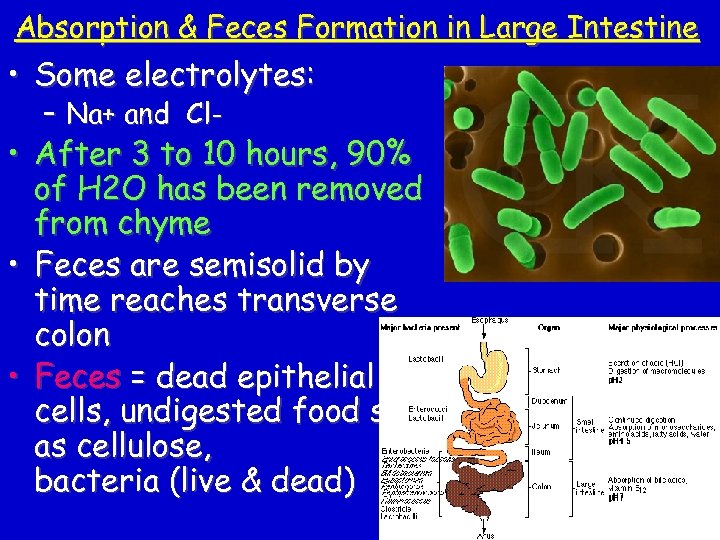
Absorption & Feces Formation in Large Intestine • Some electrolytes: – Na+ and Cl- • After 3 to 10 hours, 90% of H 2 O has been removed from chyme • Feces are semisolid by time reaches transverse colon • Feces = dead epithelial cells, undigested food such as cellulose, bacteria (live & dead)
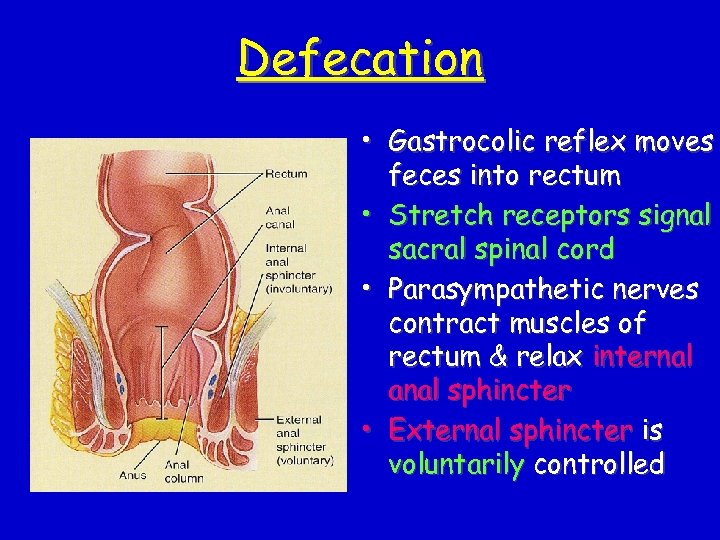
Defecation • Gastrocolic reflex moves feces into rectum • Stretch receptors signal sacral spinal cord • Parasympathetic nerves contract muscles of rectum & relax internal anal sphincter • External sphincter is voluntarily controlled
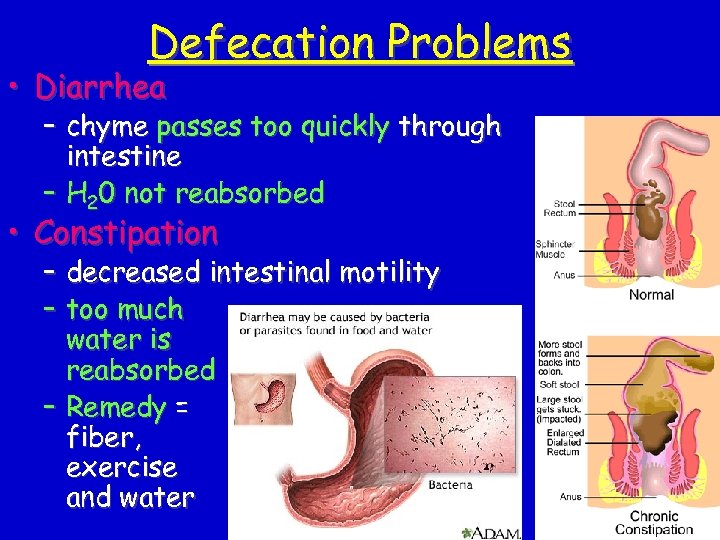
Defecation Problems • Diarrhea – chyme passes too quickly through intestine – H 20 not reabsorbed • Constipation – decreased intestinal motility – too much water is reabsorbed – Remedy = fiber, exercise and water
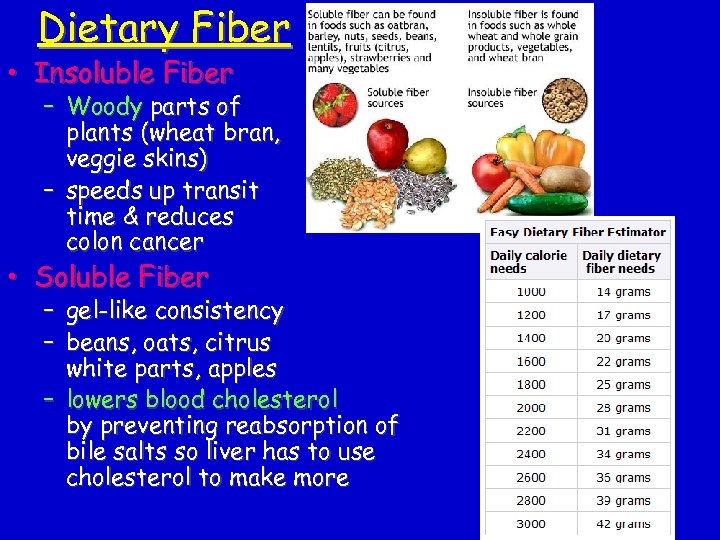
Dietary Fiber • Insoluble Fiber – Woody parts of plants (wheat bran, veggie skins) – speeds up transit time & reduces colon cancer • Soluble Fiber – gel-like consistency – beans, oats, citrus white parts, apples – lowers blood cholesterol by preventing reabsorption of bile salts so liver has to use cholesterol to make more
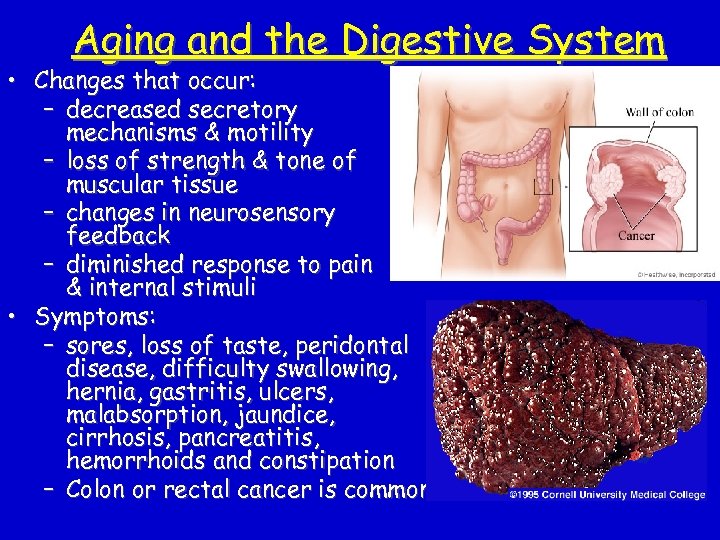
Aging and the Digestive System • Changes that occur: – decreased secretory mechanisms & motility – loss of strength & tone of muscular tissue – changes in neurosensory feedback – diminished response to pain & internal stimuli • Symptoms: – sores, loss of taste, peridontal disease, difficulty swallowing, hernia, gastritis, ulcers, malabsorption, jaundice, cirrhosis, pancreatitis, hemorrhoids and constipation – Colon or rectal cancer is common
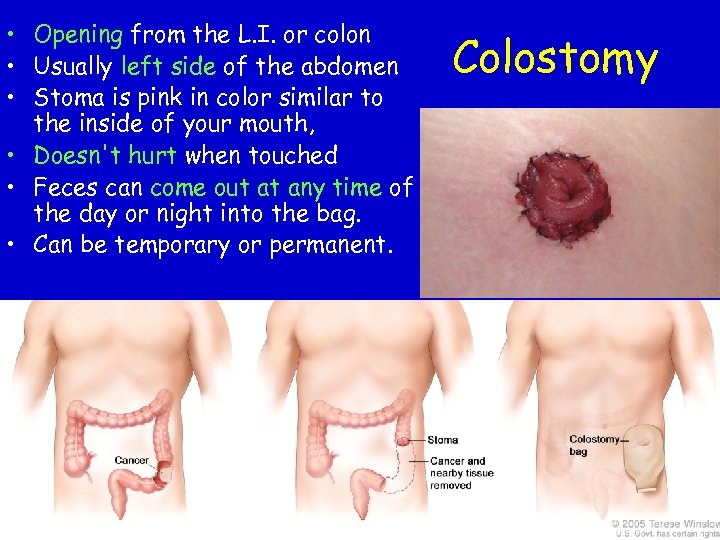
• Opening from the L. I. or colon • Usually left side of the abdomen • Stoma is pink in color similar to the inside of your mouth, • Doesn't hurt when touched • Feces can come out at any time of the day or night into the bag. • Can be temporary or permanent. Colostomy
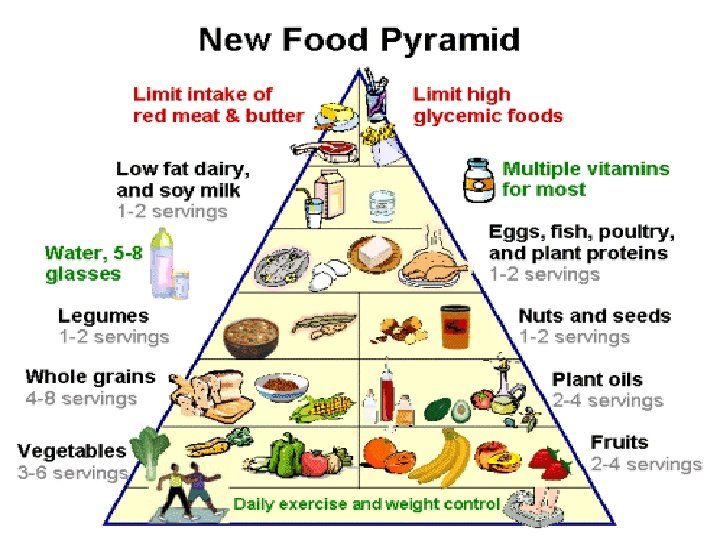
Nutrient: • Substance used by the body for growth, maintenance, and repair
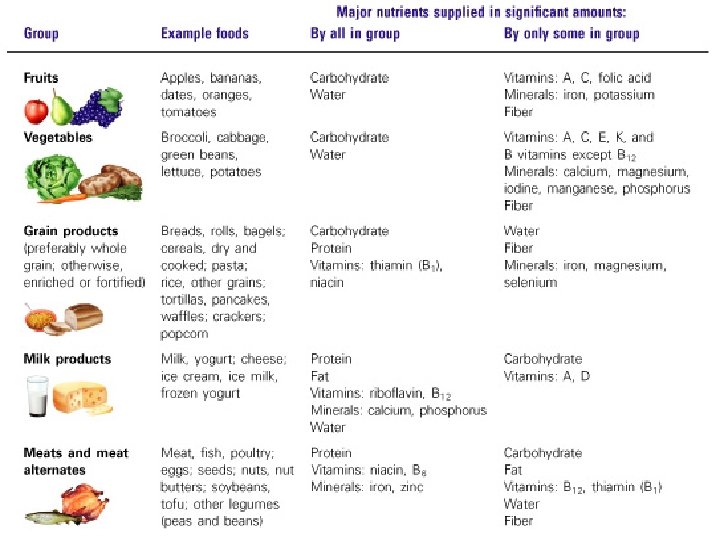
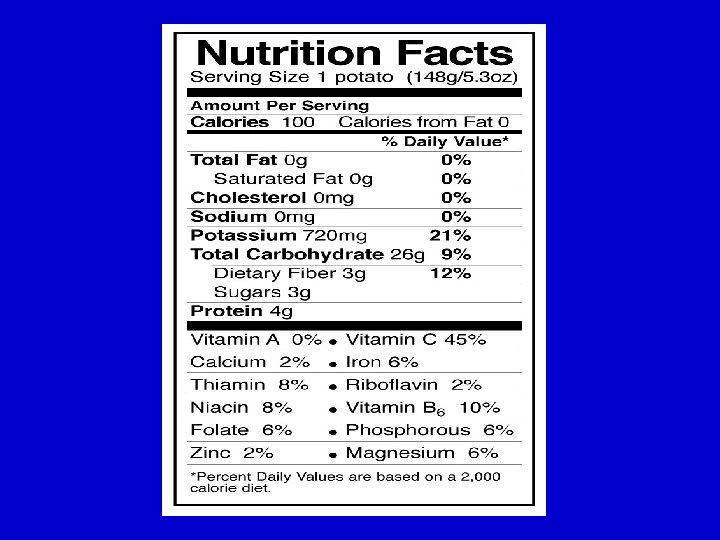
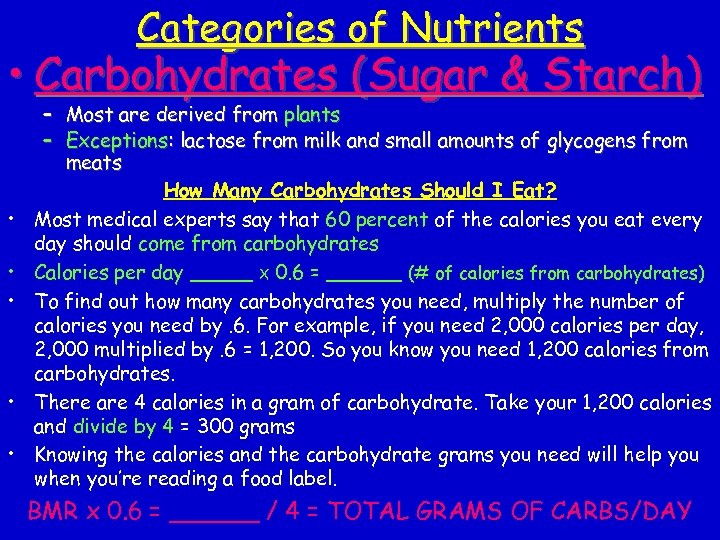
Categories of Nutrients • Carbohydrates (Sugar & Starch) • • • – Most are derived from plants – Exceptions: lactose from milk and small amounts of glycogens from meats How Many Carbohydrates Should I Eat? Most medical experts say that 60 percent of the calories you eat every day should come from carbohydrates Calories per day _____ X 0. 6 = ______ (# of calories from carbohydrates) To find out how many carbohydrates you need, multiply the number of calories you need by. 6. For example, if you need 2, 000 calories per day, 2, 000 multiplied by. 6 = 1, 200. So you know you need 1, 200 calories from carbohydrates. There are 4 calories in a gram of carbohydrate. Take your 1, 200 calories and divide by 4 = 300 grams Knowing the calories and the carbohydrate grams you need will help you when you’re reading a food label. BMR x 0. 6 = ______ / 4 = TOTAL GRAMS OF CARBS/DAY
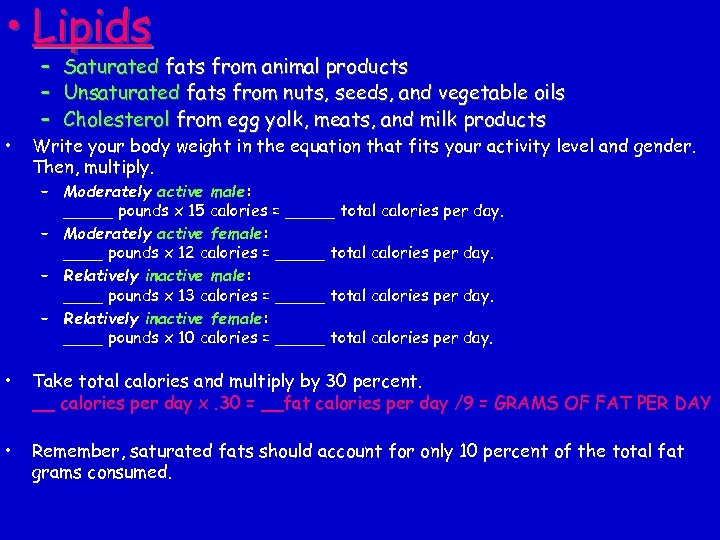
• Lipids • – – – Saturated fats from animal products Unsaturated fats from nuts, seeds, and vegetable oils Cholesterol from egg yolk, meats, and milk products Write your body weight in the equation that fits your activity level and gender. Then, multiply. – Moderately active male: _____ pounds x 15 calories = _____ total calories per day. – Moderately active female: ____ pounds x 12 calories = _____ total calories per day. – Relatively inactive male: ____ pounds x 13 calories = _____ total calories per day. – Relatively inactive female: ____ pounds x 10 calories = _____ total calories per day. • Take total calories and multiply by 30 percent. __ calories per day x. 30 = __fat calories per day /9 = GRAMS OF FAT PER DAY • Remember, saturated fats should account for only 10 percent of the total fat grams consumed.
• Proteins – Complete proteins – contain all essential amino acids • Most are from animal products – Legumes and beans also have proteins, but are incomplete Protein Requirements: • Infants require about 10 grams a day. • Teenage boys need up to 52 grams a day. • Teenage girls need 46 grams a day. • Adult men need about 56 grams a day. • Adult women need about 46 grams a day.
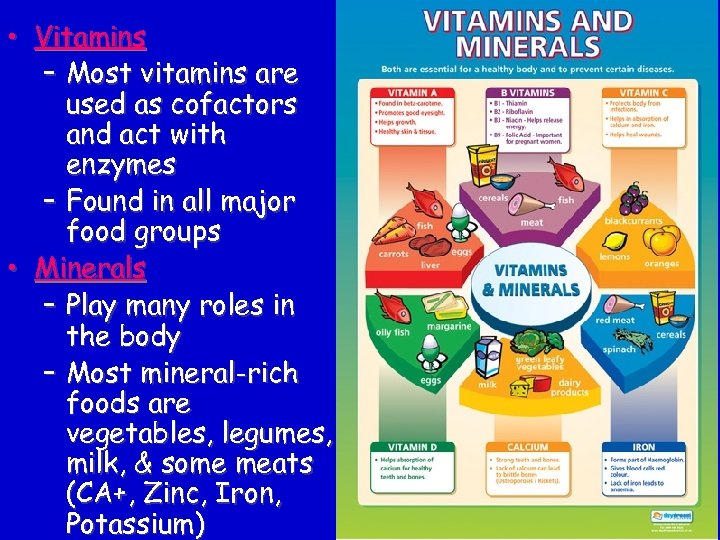
• Vitamins – Most vitamins are used as cofactors and act with enzymes – Found in all major food groups • Minerals – Play many roles in the body – Most mineral-rich foods are vegetables, legumes, milk, & some meats (CA+, Zinc, Iron, Potassium)
Whole Wheat vs. Whole Grain A Quick Quiz 1. Which breads are usually all or mostly whole grain? • (a) whole wheat • (b) multi-grain • (c) rye • (d) pumpernickel
• 1. a. • In theory, multi-grain, rye, and pumpernickel breads can be all or mostly whole grain. In most of the U. S. and Canada, however, only whole wheat bread is.
2. Which grains are whole? • (a) bulgur • (b) quinoa • (c) cous • (d) oatmeal
• 2. b, d. • Quinoa and oatmeal are whole grains. Bulgur and cous sometimes are and sometimes aren't.
3. Which cereals are whole grain? • (a) Total • (b) Product 19 • (c) Special K • (d) Corn Flakes • (e) Shredded Wheat • (f) Cream of Wheat
• 3. a. • Total, Product 19, and Special K have healthy reputations. • Of the three, only Total is whole grain
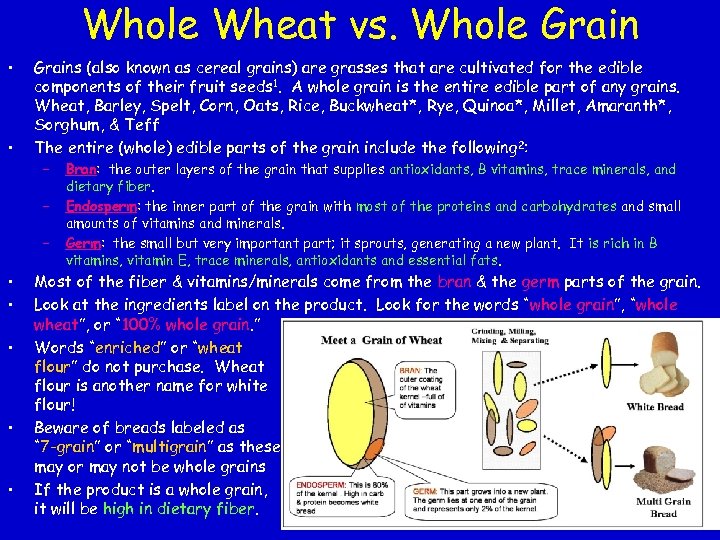
Whole Wheat vs. Whole Grain • • Grains (also known as cereal grains) are grasses that are cultivated for the edible components of their fruit seeds 1. A whole grain is the entire edible part of any grains. Wheat, Barley, Spelt, Corn, Oats, Rice, Buckwheat*, Rye, Quinoa*, Millet, Amaranth*, Sorghum, & Teff The entire (whole) edible parts of the grain include the following 2: – – – • • • Bran: the outer layers of the grain that supplies antioxidants, B vitamins, trace minerals, and dietary fiber. Endosperm: the inner part of the grain with most of the proteins and carbohydrates and small amounts of vitamins and minerals. Germ: the small but very important part; it sprouts, generating a new plant. It is rich in B vitamins, vitamin E, trace minerals, antioxidants and essential fats. Most of the fiber & vitamins/minerals come from the bran & the germ parts of the grain. Look at the ingredients label on the product. Look for the words “whole grain”, “whole wheat”, or “ 100% whole grain. ” Words “enriched” or “wheat flour” do not purchase. Wheat flour is another name for white flour! Beware of breads labeled as “ 7 -grain” or “multigrain” as these may or may not be whole grains If the product is a whole grain, it will be high in dietary fiber.
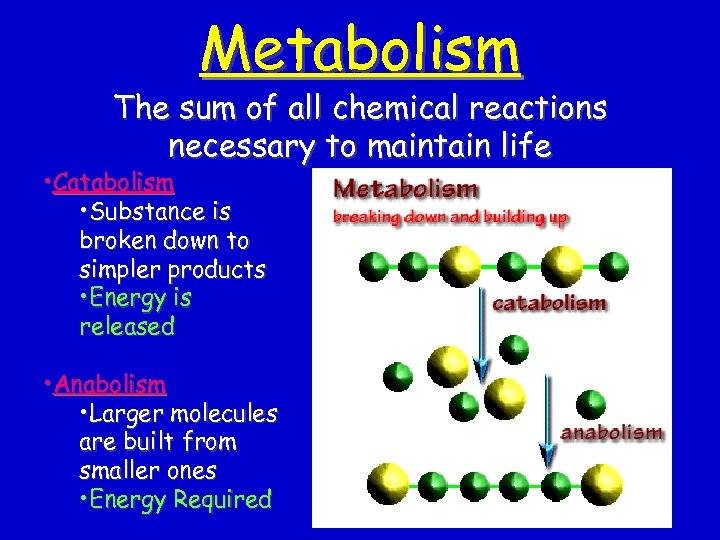
Metabolism The sum of all chemical reactions necessary to maintain life • Catabolism • Substance is broken down to simpler products • Energy is released • Anabolism • Larger molecules are built from smaller ones • Energy Required
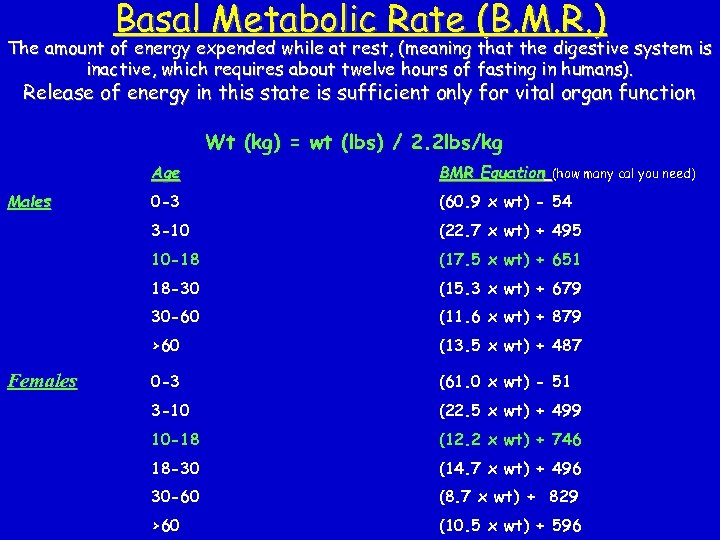
Basal Metabolic Rate (B. M. R. ) The amount of energy expended while at rest, (meaning that the digestive system is inactive, which requires about twelve hours of fasting in humans). Release of energy in this state is sufficient only for vital organ function Wt (kg) = wt (lbs) / 2. 2 lbs/kg Age (60. 9 x wt) - 54 (22. 7 x wt) + 495 10 -18 (17. 5 x wt) + 651 18 -30 (15. 3 x wt) + 679 30 -60 (11. 6 x wt) + 879 >60 Females 0 -3 3 -10 Males BMR Equation (how many cal you need) (13. 5 x wt) + 487 0 -3 (61. 0 x wt) - 51 3 -10 (22. 5 x wt) + 499 10 -18 (12. 2 x wt) + 746 18 -30 (14. 7 x wt) + 496 30 -60 (8. 7 x wt) + 829 >60 (10. 5 x wt) + 596
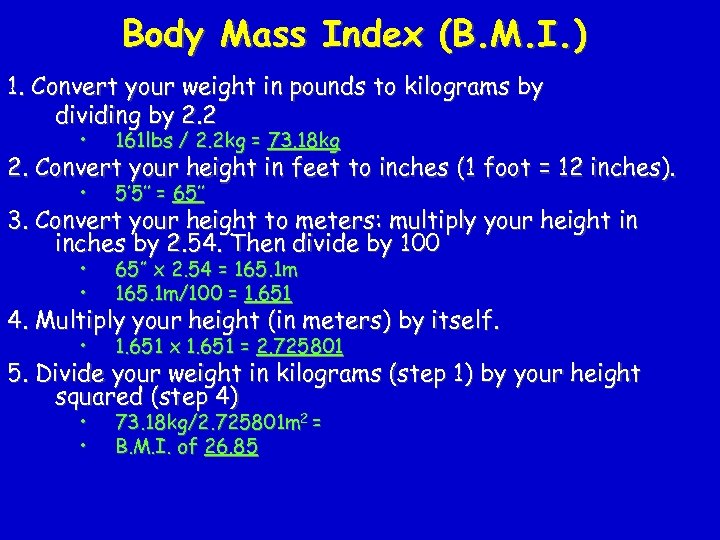
Body Mass Index (B. M. I. ) 1. Convert your weight in pounds to kilograms by dividing by 2. 2 • 161 lbs / 2. 2 kg = 73. 18 kg • 5’ 5’’ = 65’’ • • 65’’ x 2. 54 = 165. 1 m/100 = 1. 651 • 1. 651 x 1. 651 = 2. 725801 • • 73. 18 kg/2. 725801 m 2 = B. M. I. of 26. 85 2. Convert your height in feet to inches (1 foot = 12 inches). 3. Convert your height to meters: multiply your height in inches by 2. 54. Then divide by 100 4. Multiply your height (in meters) by itself. 5. Divide your weight in kilograms (step 1) by your height squared (step 4)
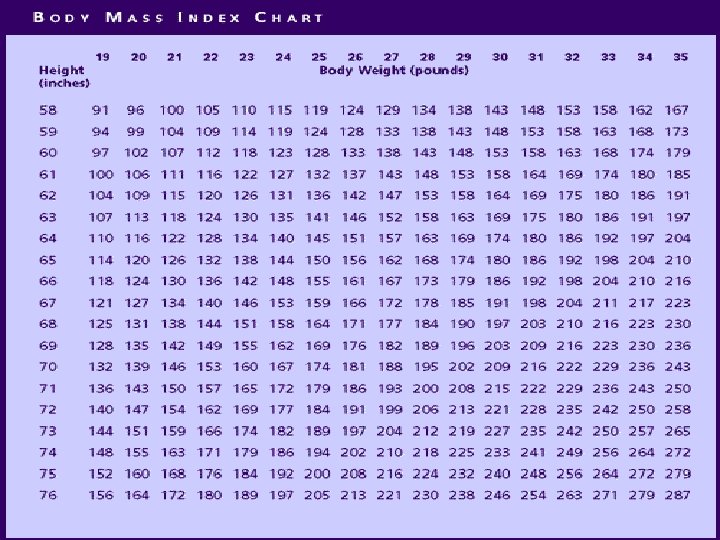
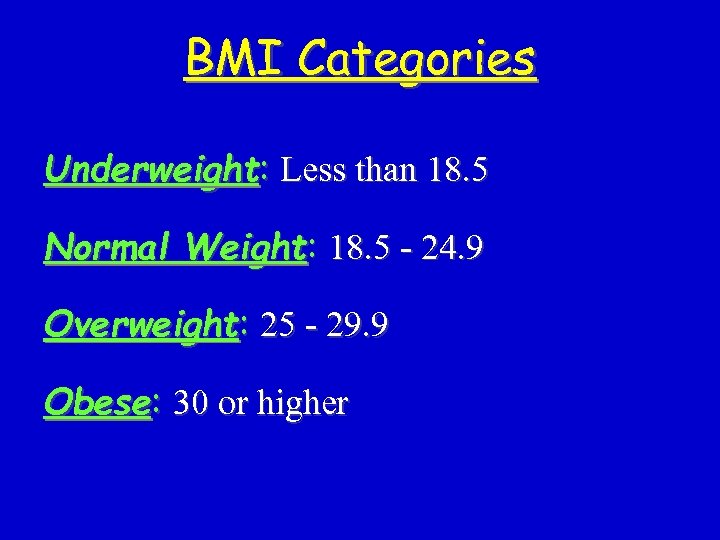
BMI Categories Underweight: Less than 18. 5 Normal Weight: 18. 5 - 24. 9 Overweight: 25 - 29. 9 Obese: 30 or higher
Скачать презентацию The Digestive System Vocabulary Headings Important Info
8f39ab8cca2206a7fb610f269908deee.ppt