


 Скачать презентацию THE DEVELOPMENT OF GINGER VALUE CHAIN IN NIGERIA
57e005184f3e86ad547deaeb947ebe14.ppt
- Количество слайдов: 18
 THE DEVELOPMENT OF GINGER VALUE CHAIN IN NIGERIA PRESENTED BY MR. ABDULLAHI KUDU MAMMAN Regional Coordinator, North West Regional Office Nigerian Export Promotion Council Kano ORGANISED BY TAK INTEGRATED AGRICULTURE SOLUTIONS LIMITED (TAK-IASL) HELD AT HOTEL SEVENTEEN, KADUNA STATE 25 th July, 2017 1
 Outline § § § Introduction What is Ginger Value Chain Where we are Where we want to be? How to get there Ginger Production and Marketing Stages Ginger Harvest Process Post harvest handling. Boosting Ginger production Challenges Recommendation Conclusion
 What is a value chain? A value chain “describes the full range of activities that are required to bring a product or service from conception, through the intermediary phases of production, delivery to final consumers, and final disposal after use. ” This includes design, production, marketing, distribution and support services leading up to consumption (and often beyond, when recycling processes are considered). These activities can be contained within a single firm or divided among different firms, as well as within a single geographical location or spread over wider areas. The term ‘value chain’ refers to the fact that value is added to preliminary products through combination with other resources (for example tools, manpower, knowledge and skills, other raw materials or preliminary products). .
 What? Value chains can be local, national or global, linking rural producers with traders and consumers worldwide. They can, for instance, link rural areas with big retailers or supermarket chains in major cities as well as export markets.
 Where we are § Nigeria is among the major producers and suppliers of dried split ginger into the world market. § Nigeria is the fifth largest producer of ginger in the world after India, China, Nepal and Indonesia (7. 8 % 0 f the world production) § Nigeria is the third largest of exporter after China and India (supplying 9. 6 % of the total world export) § World trade in ginger is estimated at US$160 million on annual basis according to ITC. § Nigeria exports value of dried split ginger stood at about US$16 million (N 5, 920, 000 ) on annual basis. (@370 to $) § India is the largest producer and exporter to more than 50 countries accounting for more than 34. 6% of world production.
 Where we are § Nigeria major buyers of dried split ginger includes; India, United kingdom, USA, Netherlands, Saudi Arabia, United Arab Emirate, China, Japan. § China and India had become keen buyers of Nigerian ginger of late as both countries had been consuming more of their own crops in fresh form and were having to turn elsewhere to cover their requirements for the dried material. § Chinese and Indian buyers were in Nigeria buying quite heavily at the beginning of the season.
 Ginger Production in Kaduna § Ginger types for commercial production in Southern Kaduna; ü Tafin Giwa: produced and processed mostly in Jaba Local government of Kaduna state with brighter colour. ü Yatsun Biri: Usually black or dark variety. § Ginger production commences around may/June. § Harvest starts from late October to November. § The Marketing season commences from November and continues up till April / May of the following year. § Ginger production cost analysis ü Labour 50 – 51% ü Planting Materials 30%
 Present challenges § § § Lack of organized market information system. Inadequate warehouses for large buyer to store their stock. Lack of cleaning and drying centres in the ginger producing areas. Ginger sun drying is done on the highways and this affect the quality. Production records not available and this affect planning. Yield per hectre/acre can not be ascertain. Inadequate extension services to farmer. Lack of value addition. Inadequate training for the farmers on new farming techniques High cost of transportation. Ginger processing is done manually due to lack of technology.
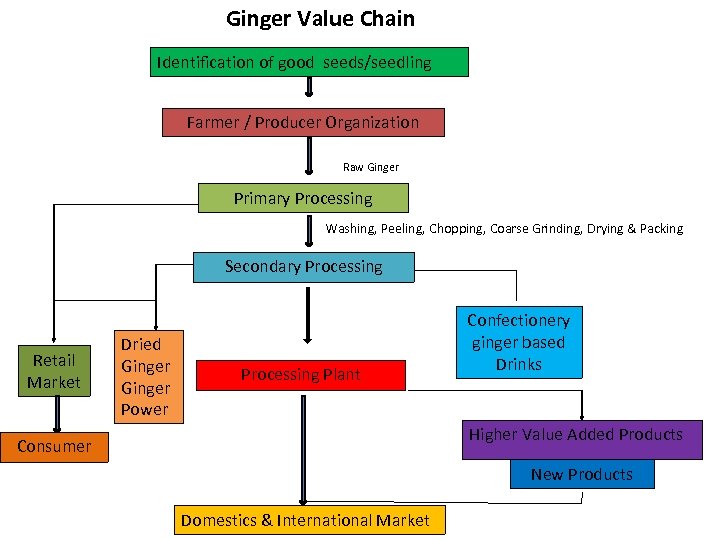 Ginger Value Chain Identification of good seeds/seedling Farmer / Producer Organization Raw Ginger Primary Processing Washing, Peeling, Chopping, Coarse Grinding, Drying & Packing Secondary Processing Retail Market Dried Ginger Power Processing Plant Confectionery ginger based Drinks Higher Value Added Products Consumer New Products Domestics & International Market
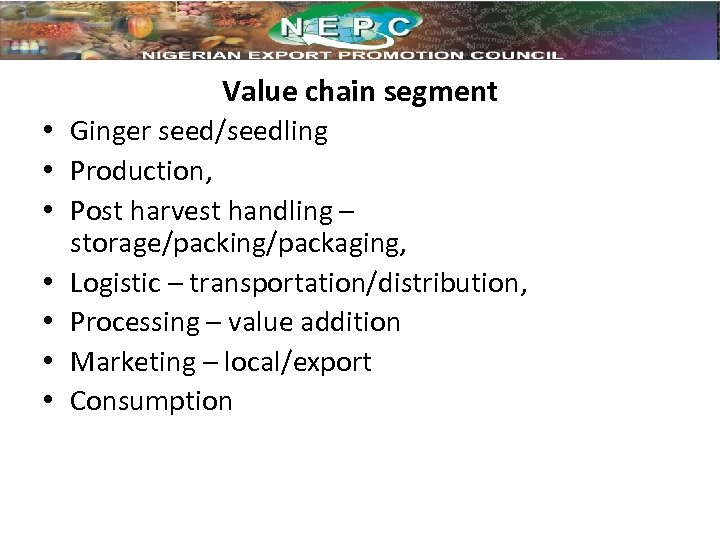 Value chain segment • Ginger seed/seedling • Production, • Post harvest handling – storage/packing/packaging, • Logistic – transportation/distribution, • Processing – value addition • Marketing – local/export • Consumption
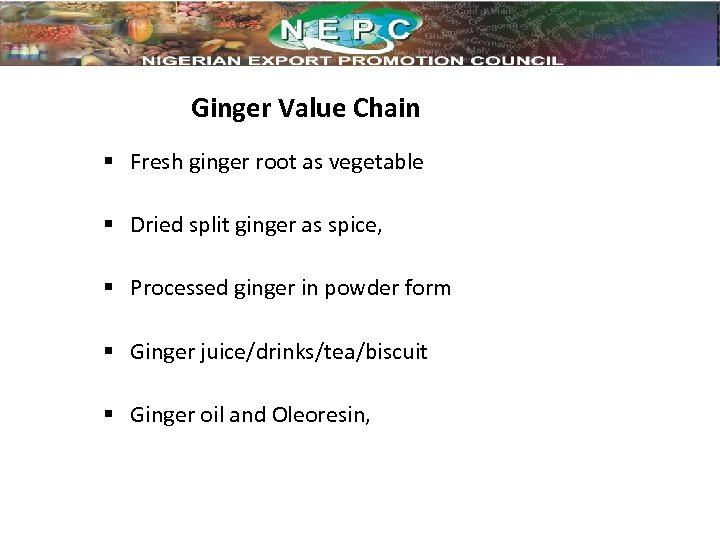 Ginger Value Chain § Fresh ginger root as vegetable § Dried split ginger as spice, § Processed ginger in powder form § Ginger juice/drinks/tea/biscuit § Ginger oil and Oleoresin,
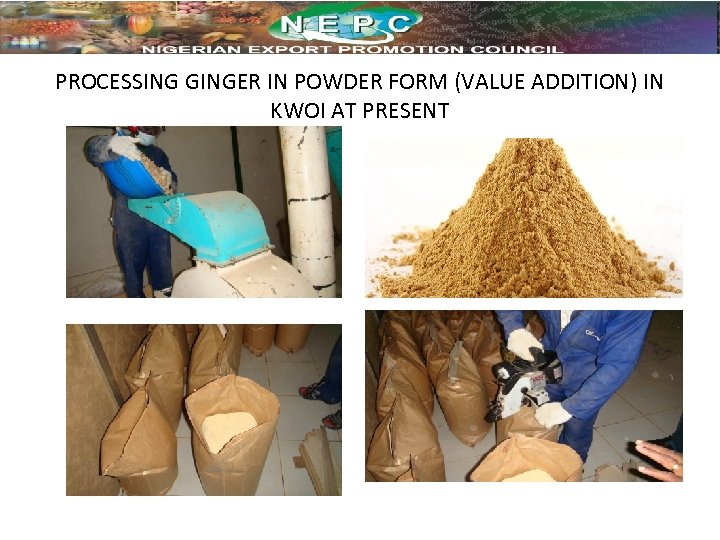 PROCESSING GINGER IN POWDER FORM (VALUE ADDITION) IN KWOI AT PRESENT
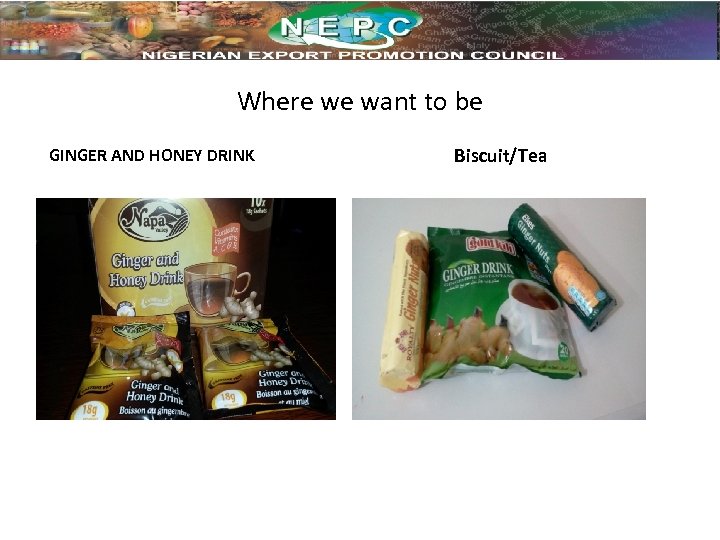 Where we want to be GINGER AND HONEY DRINK Biscuit/Tea
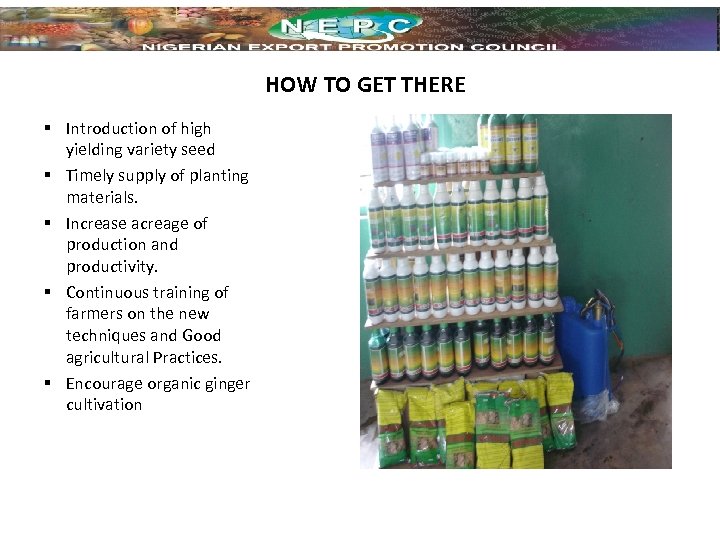 HOW TO GET THERE § Introduction of high yielding variety seed § Timely supply of planting materials. § Increase acreage of production and productivity. § Continuous training of farmers on the new techniques and Good agricultural Practices. § Encourage organic ginger cultivation
 RECOMENDATIONS ü Distribution of high yielding seeds varieties to farmers. ü Providing handholding facilities to farmers through the provision of expertise. ü Providing minimum price guarantees to farmers. ü Continues sensitization workshop on the best farming practices. ü Identifying and mobilizing farmers for participations in the programme ü Working closely with the relevant research institute to develop and promote new high yielding varieties and modern farming techniques. ü Establishing quality parameters to guide the production and marketing of ginger.
 Cont’d: Recommendation § The issue of packing/packaging need to be addressed by both the farmers, merchants and exporters. New bags should be use for export and must be standardised according to the exporters/ importer’s requirement. § Use of old bags by the farmers and merchants should be discouraged. Exporters after buying ginger, they shoud buy new bags for packing and this resulted in additional cost to the exporters. § Increase acreage of production and productivity. § Encourage organic ginger cultivation. § The Government of Kaduna state should as a matter of urgency declare southern Kaduna as Ginger Production and Processing Zone.
 Conclusion § Ginger is an important economic in Nigeria. § The Federal, State and Local Governments should support the crops to enhance its economic and social value to the affected communities. § It is important to identify distortions in various Products value chain activities with a view to intervening by the relevant stakeholders, ie Government, NGOs, Multinational companies etc. § Value addition will help farmers to improve their income, increase production and make farming more rewarding while also more employment opportunities is created. § Value chain helps also to identify various gaps that will create investment opportunities in both upstream and downstream sectors. § Over 80% of Nigeria’s Non Oil exports comes from Raw and semi processed Agricultural and solid mineral products. § There is urgent need to add value.
 THANK YOU www. nepc. gov. ng 18