 Скачать презентацию The development of a new production capability for
177c6a14c7877de92d82c4a4aec87f1f.ppt
- Количество слайдов: 18



The development of a new production capability for 211 At Jerry Nolen, John Greene, Martin Alcorta, Bradley Micklich, Shaofei Zhu, Chithra Nair, and Irshad Ahmad, Physics Division Samuel Baker, Environment, Safety, & Quality Assurance Division Argonne National Laboratory Chin-Tu Chen, Sean S. H. Cheng, Leuwei Lo, and Patrick Michael, Department of Radiology Anhui Wu, Muriel Lainé, and Geoffrey Green, the Ben May Department for Cancer Research University of Chicago Michael Zalutsky, Duke University and University of Chicago Health physics support: Fred Monette, Gordon Johnson, and Angel Garcia The 8 th International Symposium on Targeted Alpha Therapy This work was supported by the U. S. Department of Energy, Office of Nuclear Physics, under Contract No. DE-AC 02 -06 CH 11357.
US Nuclear Science Advisory Committee Isotopes Panel Accelerator-Based Production of Medical Isotopes 2
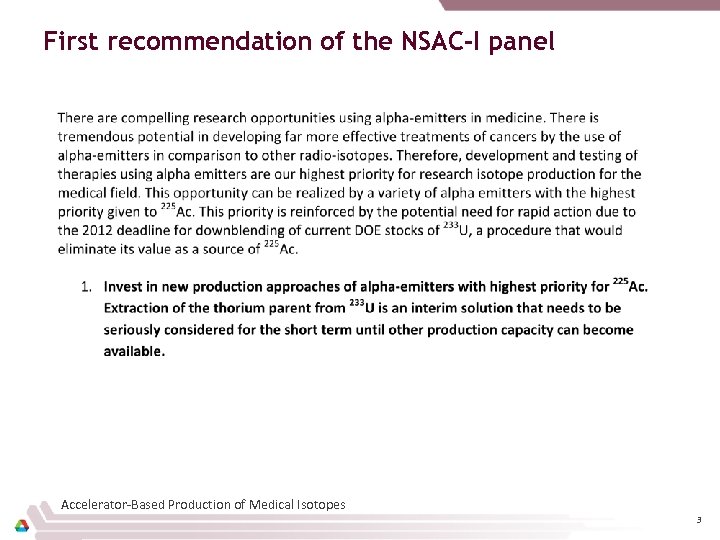
First recommendation of the NSAC-I panel Accelerator-Based Production of Medical Isotopes 3
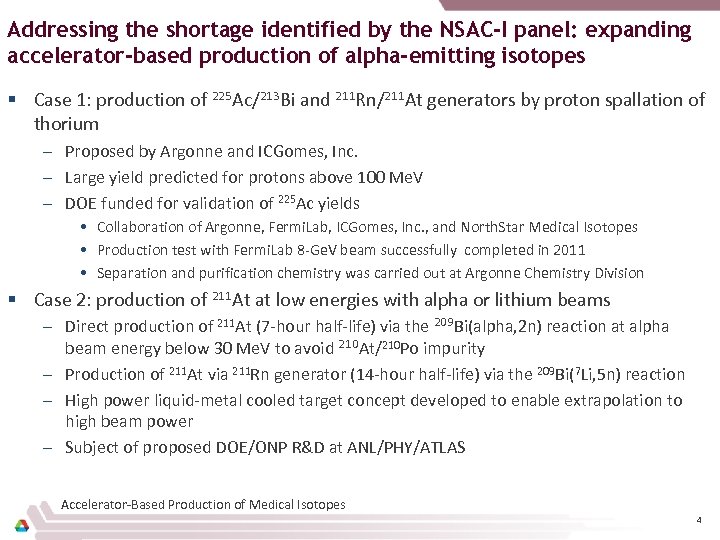
Addressing the shortage identified by the NSAC-I panel: expanding accelerator-based production of alpha-emitting isotopes § Case 1: production of 225 Ac/213 Bi and 211 Rn/211 At generators by proton spallation of thorium – Proposed by Argonne and ICGomes, Inc. – Large yield predicted for protons above 100 Me. V – DOE funded for validation of 225 Ac yields • Collaboration of Argonne, Fermi. Lab, ICGomes, Inc. , and North. Star Medical Isotopes • Production test with Fermi. Lab 8 -Ge. V beam successfully completed in 2011 • Separation and purification chemistry was carried out at Argonne Chemistry Division § Case 2: production of 211 At at low energies with alpha or lithium beams – Direct production of 211 At (7 -hour half-life) via the 209 Bi(alpha, 2 n) reaction at alpha beam energy below 30 Me. V to avoid 210 At/210 Po impurity – Production of 211 At via 211 Rn generator (14 -hour half-life) via the 209 Bi(7 Li, 5 n) reaction – High power liquid-metal cooled target concept developed to enable extrapolation to high beam power – Subject of proposed DOE/ONP R&D at ANL/PHY/ATLAS Accelerator-Based Production of Medical Isotopes 4
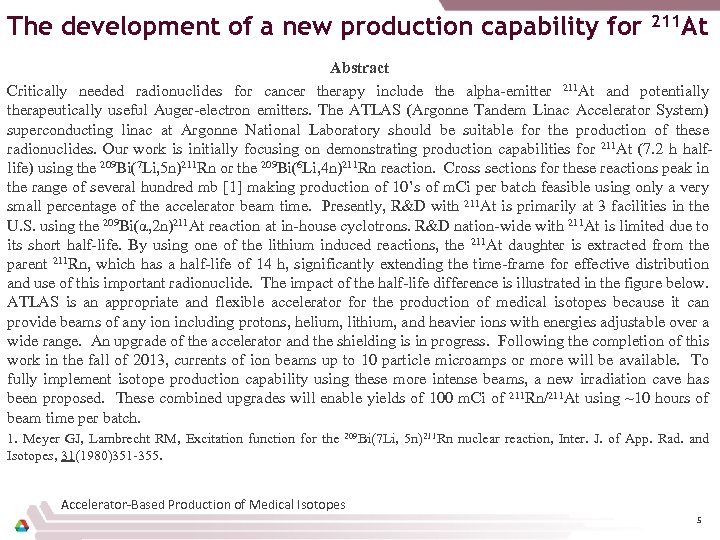
The development of a new production capability for 211 At Abstract Critically needed radionuclides for cancer therapy include the alpha-emitter 211 At and potentially therapeutically useful Auger-electron emitters. The ATLAS (Argonne Tandem Linac Accelerator System) superconducting linac at Argonne National Laboratory should be suitable for the production of these radionuclides. Our work is initially focusing on demonstrating production capabilities for 211 At (7. 2 h halflife) using the 209 Bi(7 Li, 5 n)211 Rn or the 209 Bi(6 Li, 4 n)211 Rn reaction. Cross sections for these reactions peak in the range of several hundred mb [1] making production of 10’s of m. Ci per batch feasible using only a very small percentage of the accelerator beam time. Presently, R&D with 211 At is primarily at 3 facilities in the U. S. using the 209 Bi(α, 2 n)211 At reaction at in-house cyclotrons. R&D nation-wide with 211 At is limited due to its short half-life. By using one of the lithium induced reactions, the 211 At daughter is extracted from the parent 211 Rn, which has a half-life of 14 h, significantly extending the time-frame for effective distribution and use of this important radionuclide. The impact of the half-life difference is illustrated in the figure below. ATLAS is an appropriate and flexible accelerator for the production of medical isotopes because it can provide beams of any ion including protons, helium, lithium, and heavier ions with energies adjustable over a wide range. An upgrade of the accelerator and the shielding is in progress. Following the completion of this work in the fall of 2013, currents of ion beams up to 10 particle microamps or more will be available. To fully implement isotope production capability using these more intense beams, a new irradiation cave has been proposed. These combined upgrades will enable yields of 100 m. Ci of 211 Rn/211 At using ~10 hours of beam time per batch. 1. Meyer GJ, Lambrecht RM, Excitation function for the Isotopes, 31(1980)351 -355. 209 Bi(7 Li, 5 n)211 Rn nuclear reaction, Inter. J. of App. Rad. and Accelerator-Based Production of Medical Isotopes 5
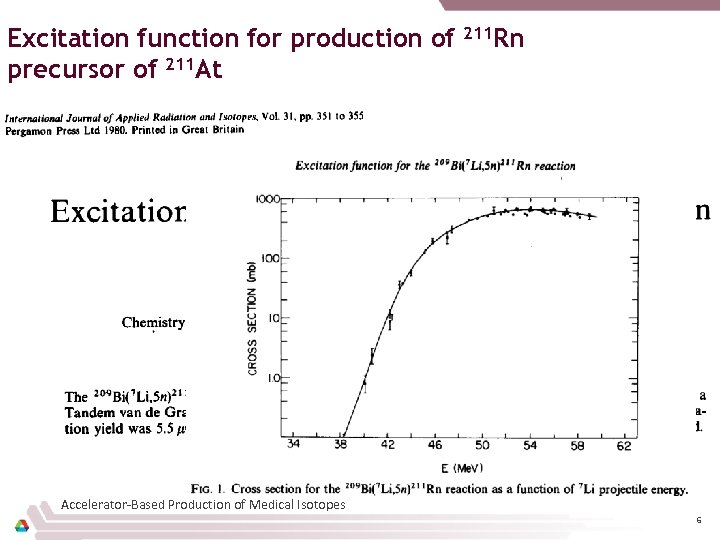
Excitation function for production of precursor of 211 At 211 Rn Accelerator-Based Production of Medical Isotopes 6
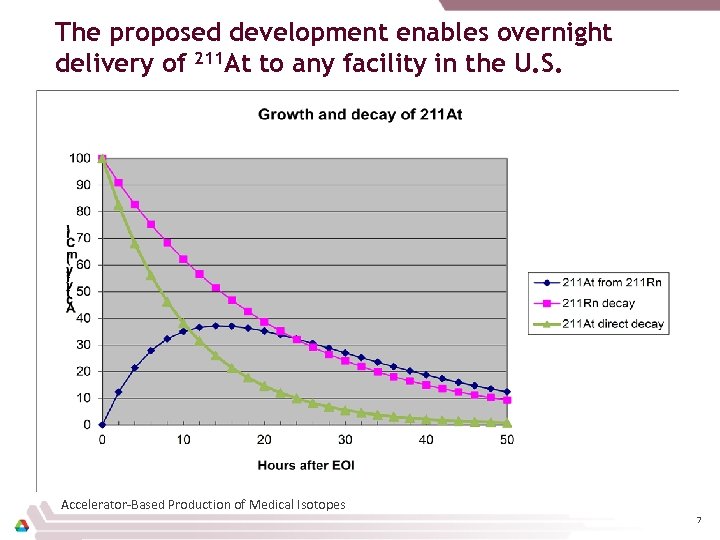
The proposed development enables overnight delivery of 211 At to any facility in the U. S. Accelerator-Based Production of Medical Isotopes 7
Alpha vs. lithium advantages/disadvantages § Alpha Cross section gives larger initial activity L Target must be dissolved each run L Dry distillation or wet extraction § Lithium 14 hour half-life > useful yield 1 -3 days after production Continuous extraction of 211 Rn from the target Simple physical extraction of 211 At from the “generator” § R&D on lithium method in collaboration with Michael Zalutsky (Duke & Chicago) with interested users at Univ. Chicago Comprehensive Cancer Center Accelerator-Based Production of Medical Isotopes 8
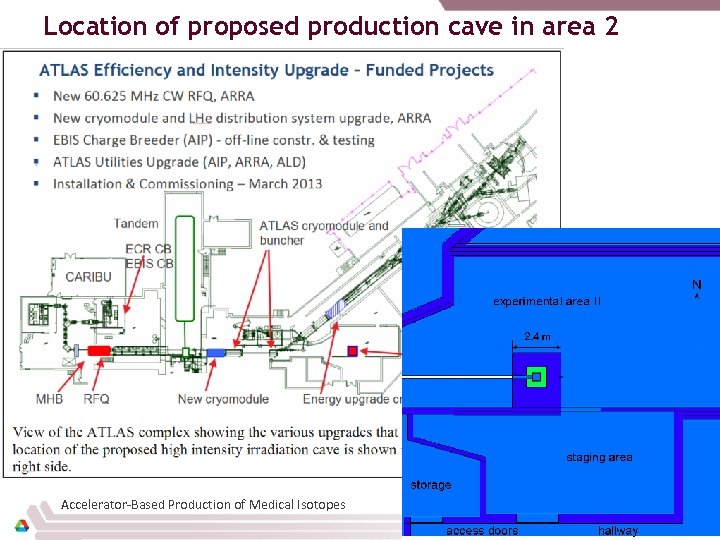
Location of proposed production cave in area 2 Accelerator-Based Production of Medical Isotopes 9
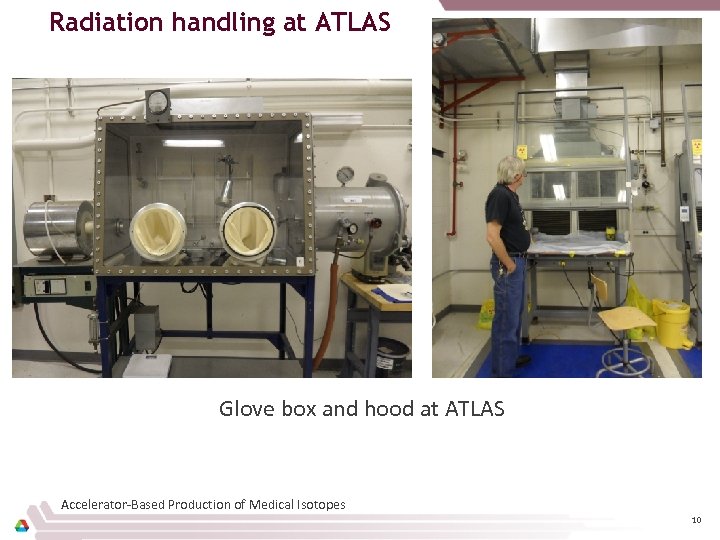
Radiation handling at ATLAS Glove box and hood at ATLAS Accelerator-Based Production of Medical Isotopes 10
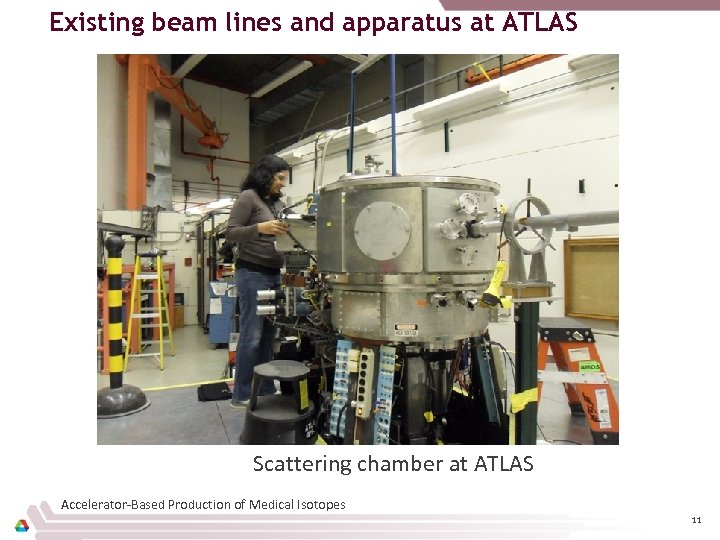
Existing beam lines and apparatus at ATLAS Scattering chamber at ATLAS Accelerator-Based Production of Medical Isotopes 11
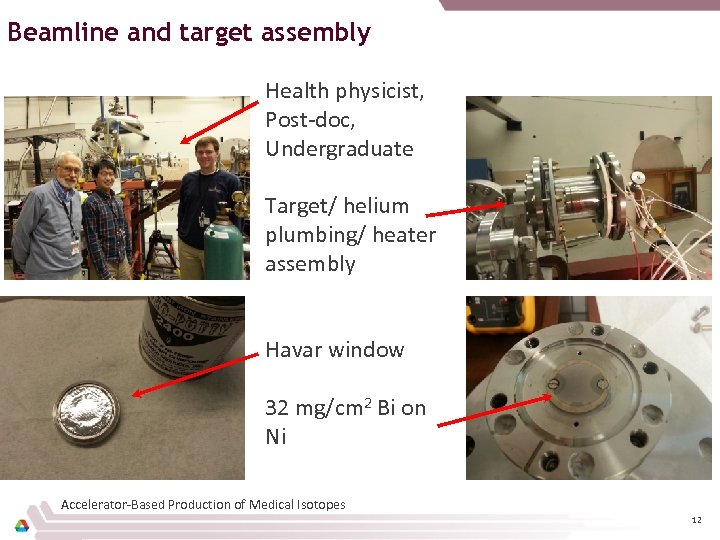
Beamline and target assembly Health physicist, Post-doc, Undergraduate Target/ helium plumbing/ heater assembly Havar window 32 mg/cm 2 Bi on Ni Accelerator-Based Production of Medical Isotopes 12
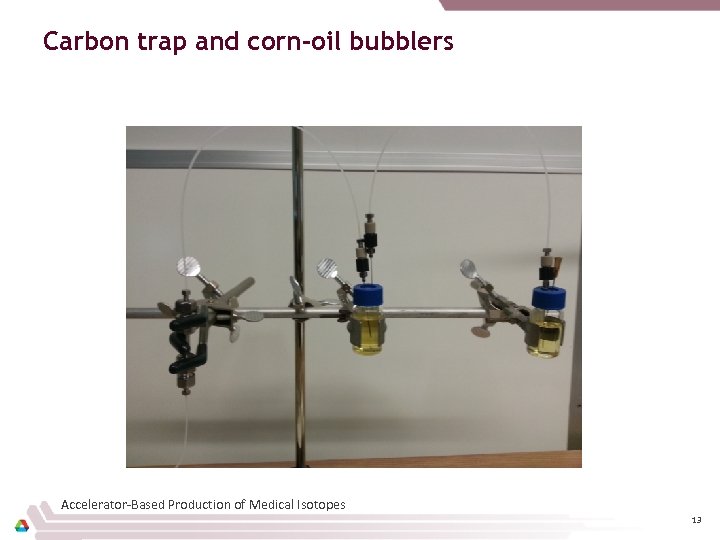
Carbon trap and corn-oil bubblers Accelerator-Based Production of Medical Isotopes 13
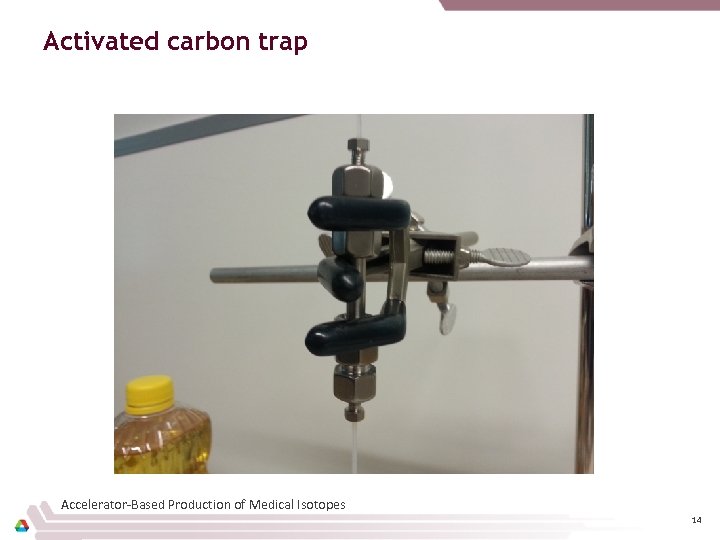
Activated carbon trap Accelerator-Based Production of Medical Isotopes 14
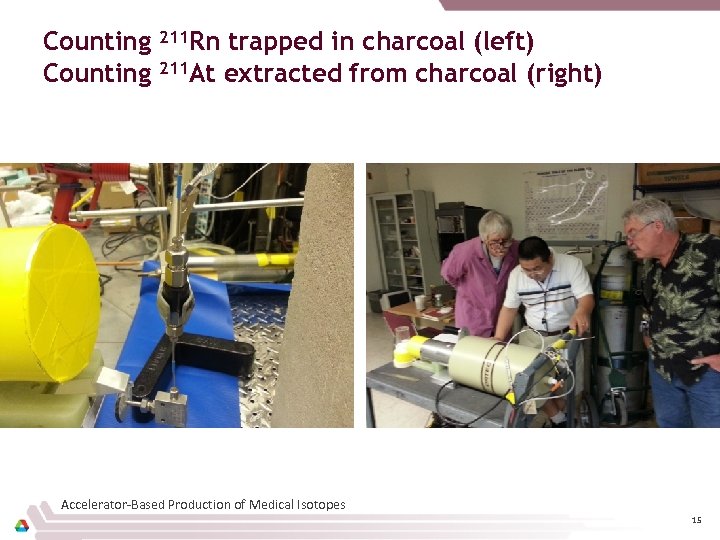
Counting 211 Rn trapped in charcoal (left) 211 At extracted from charcoal (right) Accelerator-Based Production of Medical Isotopes 15
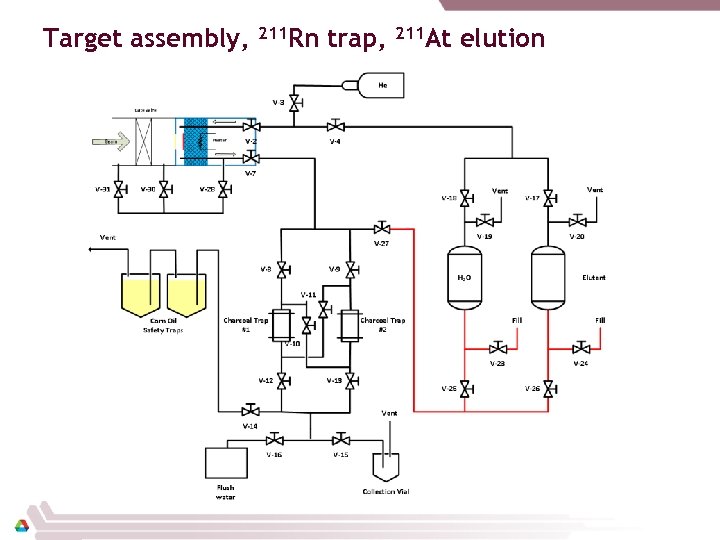
Target assembly, 211 Rn trap, 211 At elution
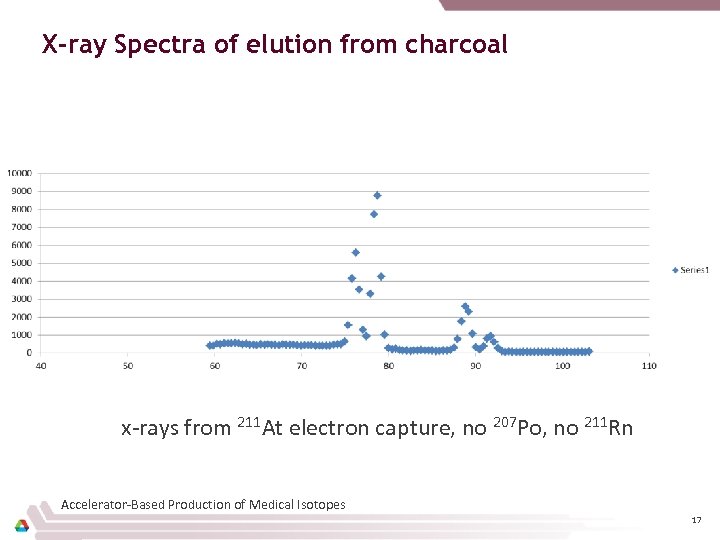
X-ray Spectra of elution from charcoal x-rays from 211 At electron capture, no 207 Po, no 211 Rn Accelerator-Based Production of Medical Isotopes 17
Summary § Clinically useful quantities of the alpha emitter 211 At can be produced with low energy light ions at the upgraded ANL/PHY ATLAS facility using small fraction of the annual beam time § The production via the 211 Rn/211 At generator approach can greatly extend the national availability of this isotope by effectively doubling its life-time § R&D of this alternative method began recently with a test run at ATLAS § Next step to use RGA to measure continuous release of Xe from hot, solid Bi Accelerator-Based Production of Medical Isotopes 18
Скачать презентацию The development of a new production capability for
177c6a14c7877de92d82c4a4aec87f1f.ppt