 Скачать презентацию The development of a business benefits case for
3df098da7eb8daf71a636bc6564c9300.ppt
- Количество слайдов: 10



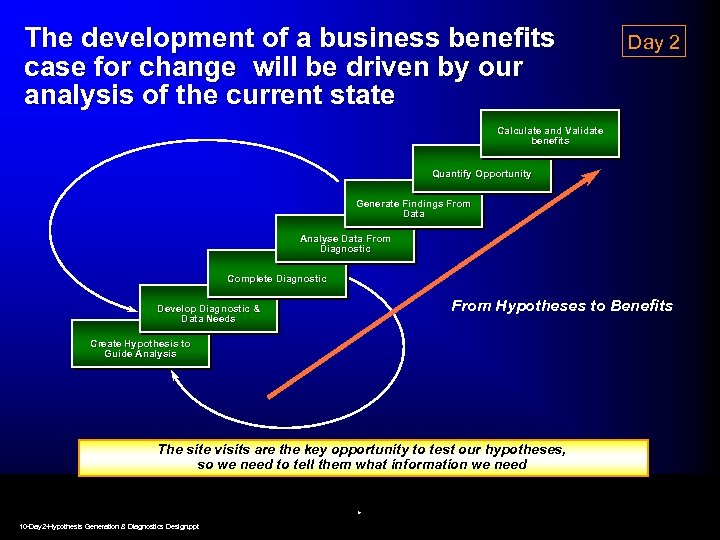
The development of a business benefits case for change will be driven by our analysis of the current state Day 2 Calculate and Validate benefits Quantify Opportunity Generate Findings From Data Analyse Data From Diagnostic Complete Diagnostic From Hypotheses to Benefits Develop Diagnostic & Data Needs Create Hypothesis to Guide Analysis The site visits are the key opportunity to test our hypotheses, so we need to tell them what information we need * 10 -Day 2 -Hypothesis Generation & Diagnostics Design. ppt
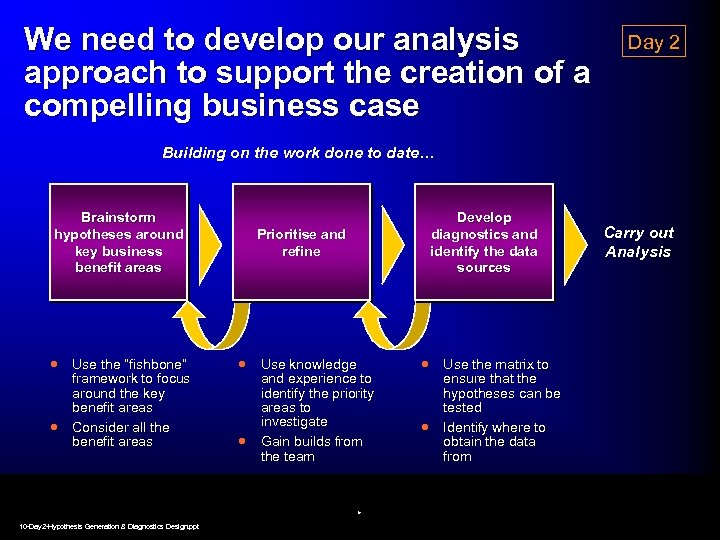
We need to develop our analysis approach to support the creation of a compelling business case Day 2 Building on the work done to date… Brainstorm hypotheses around key business benefit areas · · Use the “fishbone” framework to focus around the key benefit areas Consider all the benefit areas Develop diagnostics and identify the data sources Prioritise and refine · · Use knowledge and experience to identify the priority areas to investigate Gain builds from the team * 10 -Day 2 -Hypothesis Generation & Diagnostics Design. ppt · · Use the matrix to ensure that the hypotheses can be tested Identify where to obtain the data from Carry out Analysis
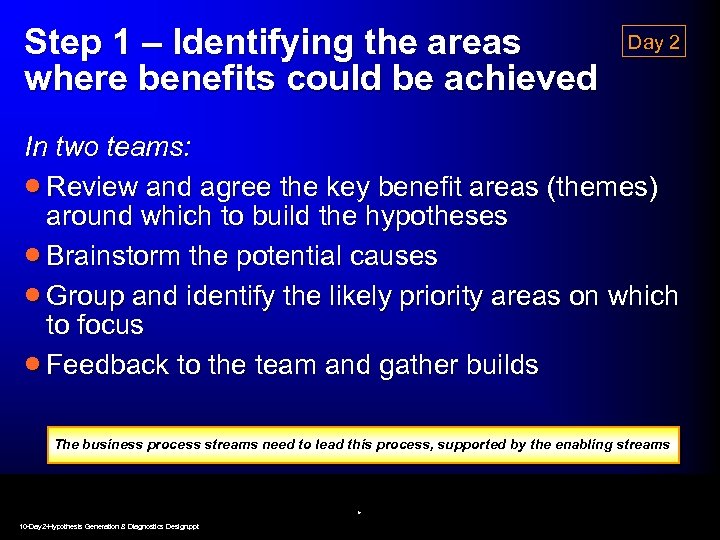
Step 1 – Identifying the areas where benefits could be achieved Day 2 In two teams: · Review and agree the key benefit areas (themes) around which to build the hypotheses · Brainstorm the potential causes · Group and identify the likely priority areas on which to focus · Feedback to the team and gather builds The business process streams need to lead this process, supported by the enabling streams * 10 -Day 2 -Hypothesis Generation & Diagnostics Design. ppt
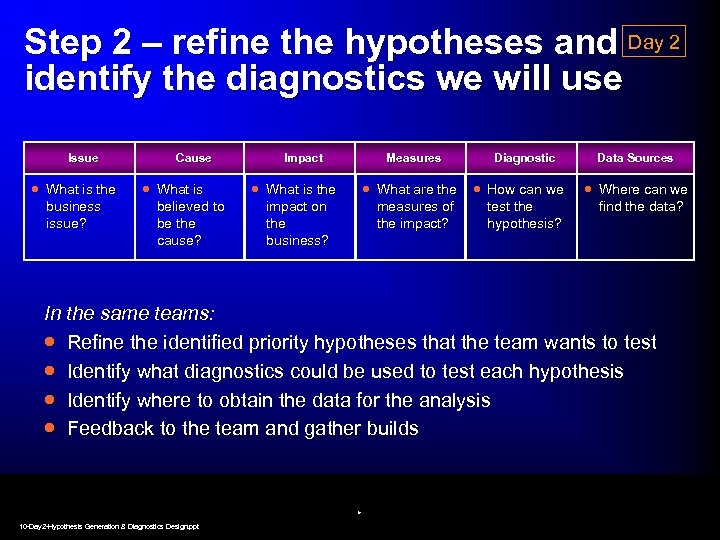
Step 2 – refine the hypotheses and Day 2 identify the diagnostics we will use Issue · What is the business issue? Cause · What is believed to be the cause? Impact · Measures · What is the impact on the business? What are the measures of the impact? Diagnostic · How can we test the hypothesis? Data Sources · Where can we find the data? In the same teams: · Refine the identified priority hypotheses that the team wants to test · Identify what diagnostics could be used to test each hypothesis · Identify where to obtain the data for the analysis · Feedback to the team and gather builds * 10 -Day 2 -Hypothesis Generation & Diagnostics Design. ppt
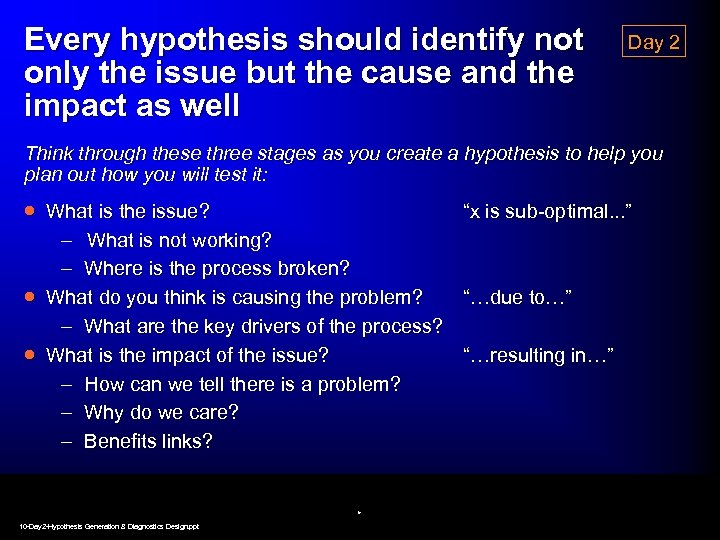
Every hypothesis should identify not only the issue but the cause and the impact as well Day 2 Think through these three stages as you create a hypothesis to help you plan out how you will test it: · · · What is the issue? “x is sub-optimal. . . ” – What is not working? – Where is the process broken? What do you think is causing the problem? “…due to…” – What are the key drivers of the process? What is the impact of the issue? “…resulting in…” – How can we tell there is a problem? – Why do we care? – Benefits links? * 10 -Day 2 -Hypothesis Generation & Diagnostics Design. ppt
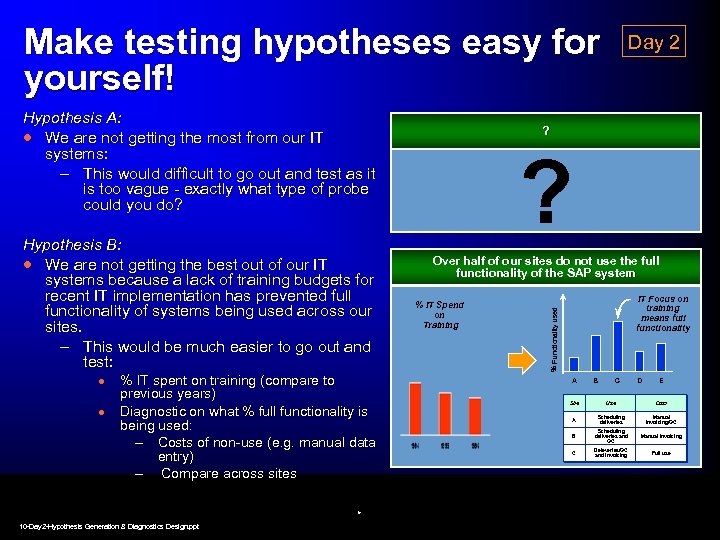
Make testing hypotheses easy for yourself! Hypothesis A: · We are not getting the most from our IT systems: – This would difficult to go out and test as it is too vague - exactly what type of probe could you do? · · % IT spent on training (compare to previous years) Diagnostic on what % full functionality is being used: – Costs of non-use (e. g. manual data entry) – Compare across sites * 10 -Day 2 -Hypothesis Generation & Diagnostics Design. ppt ? ? Over half of our sites do not use the full functionality of the SAP system % IT Spend on Training IT Focus on training means full functionality % Functionality used Hypothesis B: · We are not getting the best out of our IT systems because a lack of training budgets for recent IT implementation has prevented full functionality of systems being used across our sites. – This would be much easier to go out and test: Day 2 A B C D E Site Use Cost A Scheduling deliveries Manual Invoicing/QC B Scheduling deliveries and QC Manual invoicing C Deleveries/QC and invoicing Full use
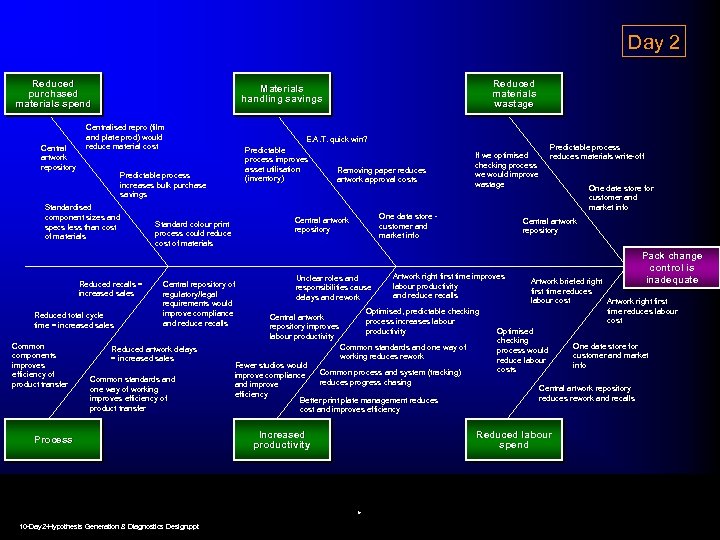
Day 2 Reduced purchased materials spend Central artwork repository Centralised repro (film and plate prod) would reduce material cost E. A. T. quick win? Predictable process improves asset utilisation Removing paper reduces (inventory) artwork approval costs Predictable process increases bulk purchase savings Standardised component sizes and specs less than cost of materials Reduced recalls = increased sales Reduced total cycle time = increased sales Common components improves efficiency of product transfer Reduced materials wastage Materials handling savings Central repository of regulatory/legal requirements would improve compliance and reduce recalls Reduced artwork delays = increased sales Common standards and one way of working improves efficiency of product transfer Process One data store customer and market info Central artwork repository Standard colour print process could reduce cost of materials Unclear roles and responsibilities cause delays and rework One date store for customer and market info Pack change control is inadequate Artwork right first time improves labour productivity and reduce recalls Common standards and one way of working reduces rework Fewer studios would Common process and system (tracking) improve compliance reduces progress chasing and improve efficiency Better print plate management reduces cost and improves efficiency Increased productivity Predictable process reduces materials write-off Central artwork repository Optimised, predictable checking process increases labour productivity Central artwork repository improves labour productivity Artwork briefed right first time reduces labour cost Artwork right first time reduces labour cost Optimised checking One date store for process would customer and market reduce labour info costs Central artwork repository reduces rework and recalls Reduced labour spend * 10 -Day 2 -Hypothesis Generation & Diagnostics Design. ppt If we optimised checking process we would improve wastage
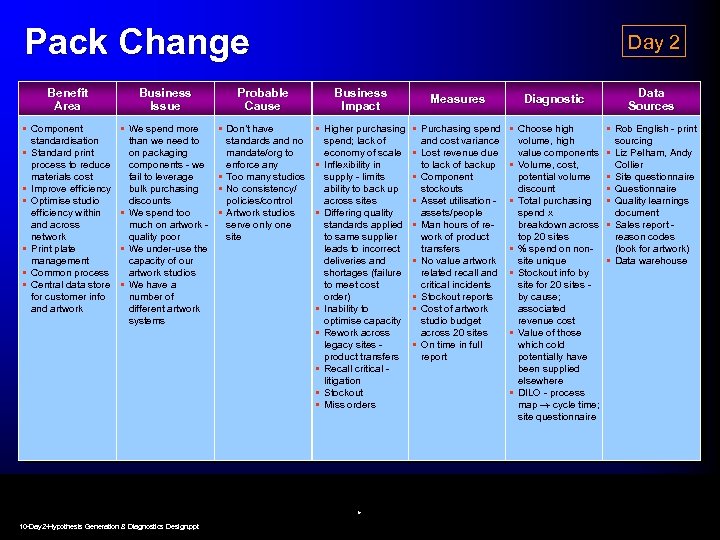
Pack Change Day 2 Benefit Area Business Issue Probable Cause Business Impact • Component standardisation • Standard print process to reduce materials cost • Improve efficiency • Optimise studio efficiency within and across network • Print plate management • Common process • Central data store for customer info and artwork • We spend more than we need to on packaging components - we fail to leverage bulk purchasing discounts • We spend too much on artwork quality poor • We under-use the capacity of our artwork studios • We have a number of different artwork systems • Don’t have standards and no mandate/org to enforce any • Too many studios • No consistency/ policies/control • Artwork studios serve only one site • Higher purchasing spend; lack of economy of scale • Inflexibility in supply - limits ability to back up across sites • Differing quality standards applied to same supplier leads to incorrect deliveries and shortages (failure to meet cost order) • Inability to optimise capacity • Rework across legacy sites product transfers • Recall critical litigation • Stockout • Miss orders * 10 -Day 2 -Hypothesis Generation & Diagnostics Design. ppt Measures Diagnostic • Purchasing spend and cost variance • Lost revenue due to lack of backup • Component stockouts • Asset utilisation assets/people • Man hours of rework of product transfers • No value artwork related recall and critical incidents • Stockout reports • Cost of artwork studio budget across 20 sites • On time in full report • Choose high volume, high value components • Volume, cost, potential volume discount • Total purchasing spend x breakdown across top 20 sites • % spend on nonsite unique • Stockout info by site for 20 sites by cause; associated revenue cost • Value of those which cold potentially have been supplied elsewhere • DILO - process map cycle time; site questionnaire Data Sources • Rob English - print sourcing • Liz Pelham, Andy Collier • Site questionnaire • Quality learnings document • Sales report reason codes (look for artwork) • Data warehouse
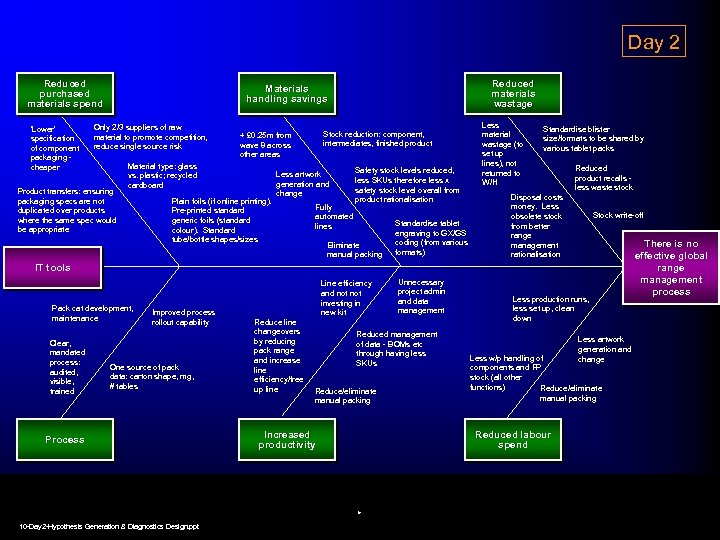
Day 2 Reduced purchased materials spend ‘Lower’ specification of component packaging cheaper Reduced materials wastage Materials handling savings Only 2/3 suppliers of raw material to promote competition, reduce single source risk Product transfers: ensuring packaging specs are not duplicated over products where the same spec would be appropriate Stock reduction: component, intermediates, finished product + £ 0. 25 m from wave 8 across other areas Material type: glass vs. plastic; recycled cardboard Plain foils (if online printing). Pre-printed standard generic foils (standard colour). Standard tube/bottle shapes/sizes Less artwork generation and change Fully automated lines Safety stock levels reduced, less SKUs therefore less x safety stock level overall from product rationalisation Eliminate manual packing Standardise tablet engraving to GX/GS coding (from various formats) Less material wastage (to set up lines), not returned to W/H Standardise blister size/formats to be shared by various tablet packs Reduced product recalls less waste stock Disposal costs money. Less obsolete stock from better range management rationalisation Stock write-off IT tools Pack cat development, maintenance Clear, mandated process: audited, visible, trained Improved process rollout capability One source of pack data: carton shape, mg, # tables Process Line efficiency and not investing in new kit Reduce line changeovers by reducing pack range and increase line efficiency/free up line Reduced management of data - BOMs etc through having less SKUs Reduce/eliminate manual packing Increased productivity Less production runs, less set up, clean down Less artwork generation and change Less w/p handling of components and FP stock (all other functions) Reduce/eliminate manual packing Reduced labour spend * 10 -Day 2 -Hypothesis Generation & Diagnostics Design. ppt Unnecessary project admin and data management There is no effective global range management process
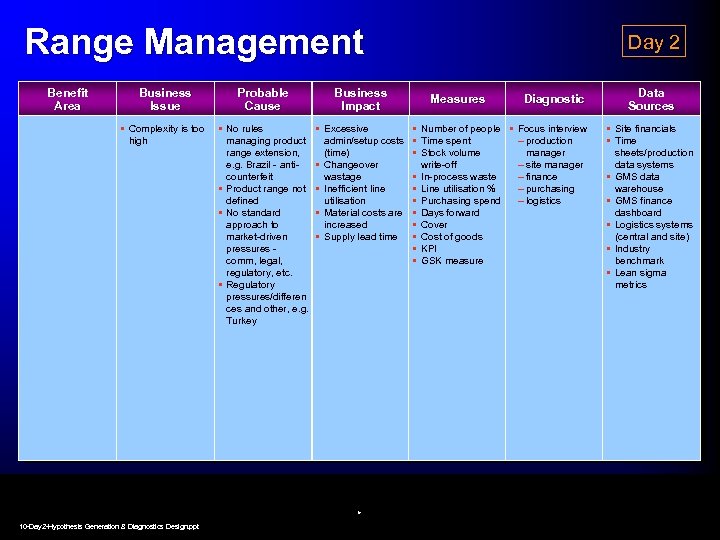
Range Management Benefit Area Business Issue Probable Cause Business Impact • Complexity is too high • No rules managing product range extension, e. g. Brazil - anticounterfeit • Product range not defined • No standard approach to market-driven pressures comm, legal, regulatory, etc. • Regulatory pressures/differen ces and other, e. g. Turkey • Excessive admin/setup costs (time) • Changeover wastage • Inefficient line utilisation • Material costs are increased • Supply lead time * 10 -Day 2 -Hypothesis Generation & Diagnostics Design. ppt Day 2 Measures Diagnostic • Number of people • Focus interview • Time spent – production • Stock volume manager write-off – site manager • In-process waste – finance • Line utilisation % – purchasing • Purchasing spend – logistics • Days forward • Cover • Cost of goods • KPI • GSK measure Data Sources • Site financials • Time sheets/production data systems • GMS data warehouse • GMS finance dashboard • Logistics systems (central and site) • Industry benchmark • Lean sigma metrics
Скачать презентацию The development of a business benefits case for
3df098da7eb8daf71a636bc6564c9300.ppt