 Скачать презентацию The Developing Person Through Childhood and Adolescence by
f0b62131ba8d33f512f36a18e88b37e6.ppt
- Количество слайдов: 34



The Developing Person Through Childhood and Adolescence by Kathleen Stassen Berger Seventh Edition Chapter 1 Introduction Slides prepared by Kate Byerwalter, Ph. D. , Grand Rapids Community College
Science of Human Development n The study of human development: ¨ Seeks to understand how and why people change and remain the same over time. ¨ Is a science ¨ Studies all kinds of people ¨ Studies change over time Berger: The Developing Person Through Childhood and Adolescence, 7 th Edition, Chapter 1
Continuity and Discontinuity n Continuity refers to characteristics that are stable over time (e. g. , biological sex). n Discontinuity refers to characteristics unlike those than came before (e. g. , speaking a new language, quitting a drug). Berger: The Developing Person Through Childhood and Adolescence, 7 th Edition, Chapter 1
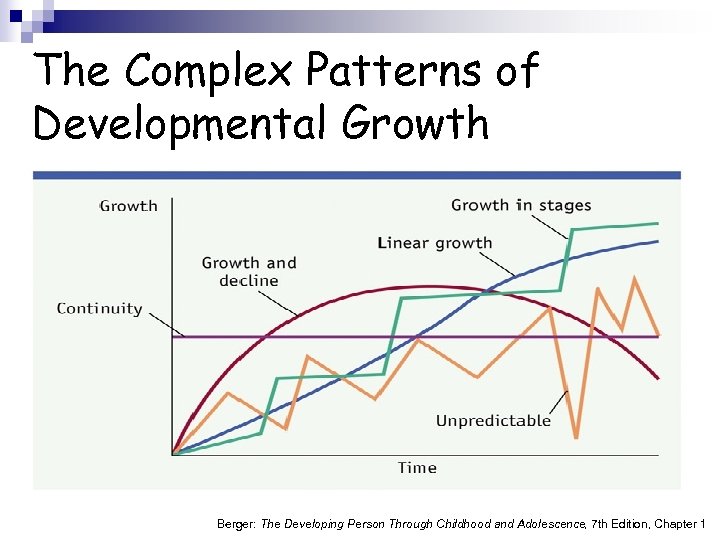
The Complex Patterns of Developmental Growth Berger: The Developing Person Through Childhood and Adolescence, 7 th Edition, Chapter 1
Five Characteristics of Development Multidirectional n Multicontextual n Multicultural n Multidisciplinary n Plasticity n PHOTODISC Berger: The Developing Person Through Childhood and Adolescence, 7 th Edition, Chapter 1
More About Change Over Time n Butterfly effect ¨ Sometimes a small event may culminate in a major event (e. g. , one alcoholic drink at the wrong time during pregnancy). n No effect ¨ Sometimes what seems to be a large event has little long-term impact (e. g. , children in war-torn Bosnia). Berger: The Developing Person Through Childhood and Adolescence, 7 th Edition, Chapter 1
Contexts of Development n HISTORICAL ¨ In what ways do you differ from your grandparents? Great grandparents? ¨ Cohort: group of people of the same age ¨ Social constructions create “shoulds” (e. g. , ages one “should” marry) Berger: The Developing Person Through Childhood and Adolescence, 7 th Edition, Chapter 1
Contexts of Development n SOCIOECONOMIC STATUS (SES) ¨A combination of income and other factors (parental education, occupation, etc. ). ¨ The impact of SES depends on many factors. Berger: The Developing Person Through Childhood and Adolescence, 7 th Edition, Chapter 1
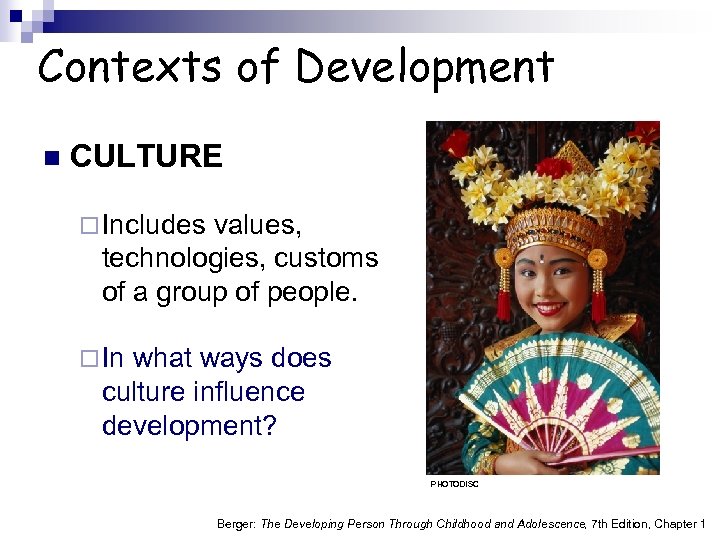
Contexts of Development n CULTURE ¨ Includes values, technologies, customs of a group of people. ¨ In what ways does culture influence development? PHOTODISC Berger: The Developing Person Through Childhood and Adolescence, 7 th Edition, Chapter 1
An Example of Culture and Development n Co-sleeping: children sleep with parents n Research in this area has found varying results ¨ e. g. : Children who co-sleep do develop independence, but are less likely to sleep through the night. Berger: The Developing Person Through Childhood and Adolescence, 7 th Edition, Chapter 1
Three Domains of Development n Biosocial = brain and body n Cognitive = thought processes, perceptual abilities, language n Psychosocial = emotions, personality, interpersonal relationships Berger: The Developing Person Through Childhood and Adolescence, 7 th Edition, Chapter 1
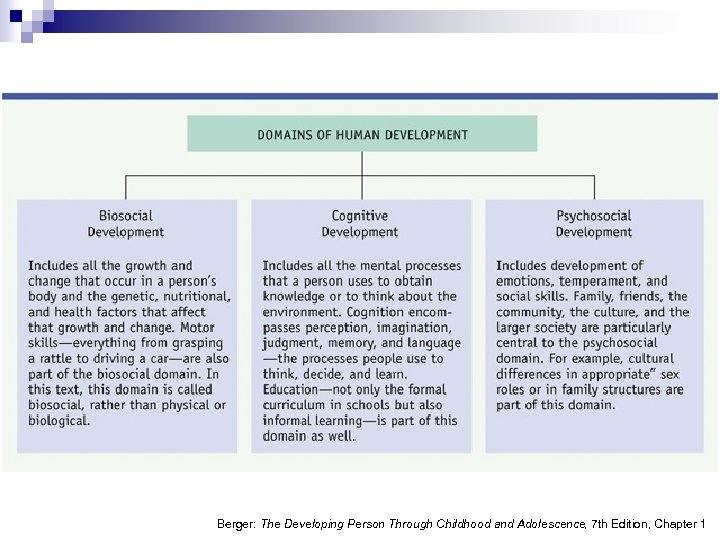
Berger: The Developing Person Through Childhood and Adolescence, 7 th Edition, Chapter 1
Interaction of Developmental Domains n Research continues to highlight that development is complex–the 3 domains interact. n Research examples: amygdala activity, depression, violence, social skills, etc. Berger: The Developing Person Through Childhood and Adolescence, 7 th Edition, Chapter 1
What is “plasticity”? n Plasticity refers to the fact that human traits can be molded into different forms, and yet people maintain a durability of identity. n It means that some aspects of development have the capacity for change, others may not…. Berger: The Developing Person Through Childhood and Adolescence, 7 th Edition, Chapter 1
Resilience─An Example of the Complexity of Development n Resilience: the ability to overcome severe threats to development ¨ e. g. : The impact of poverty is lessened by supportive schools, families, neighborhoods, a stable residence, and by the child’s personality. Berger: The Developing Person Through Childhood and Adolescence, 7 th Edition, Chapter 1
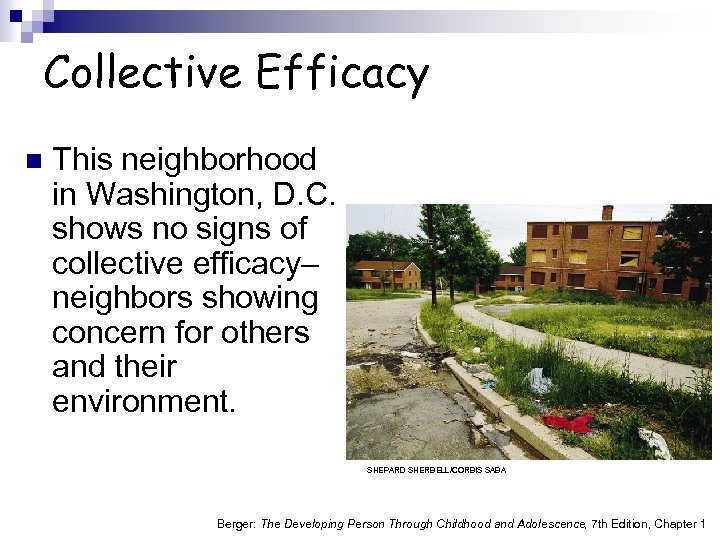
Collective Efficacy n This neighborhood in Washington, D. C. shows no signs of collective efficacy– neighbors showing concern for others and their environment. SHEPARD SHERBELL/CORBIS SABA Berger: The Developing Person Through Childhood and Adolescence, 7 th Edition, Chapter 1
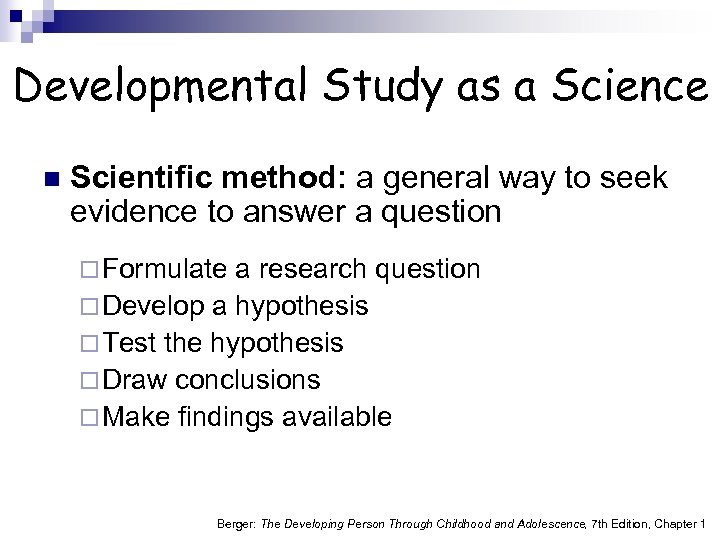
Developmental Study as a Science n Scientific method: a general way to seek evidence to answer a question ¨ Formulate a research question ¨ Develop a hypothesis ¨ Test the hypothesis ¨ Draw conclusions ¨ Make findings available Berger: The Developing Person Through Childhood and Adolescence, 7 th Edition, Chapter 1
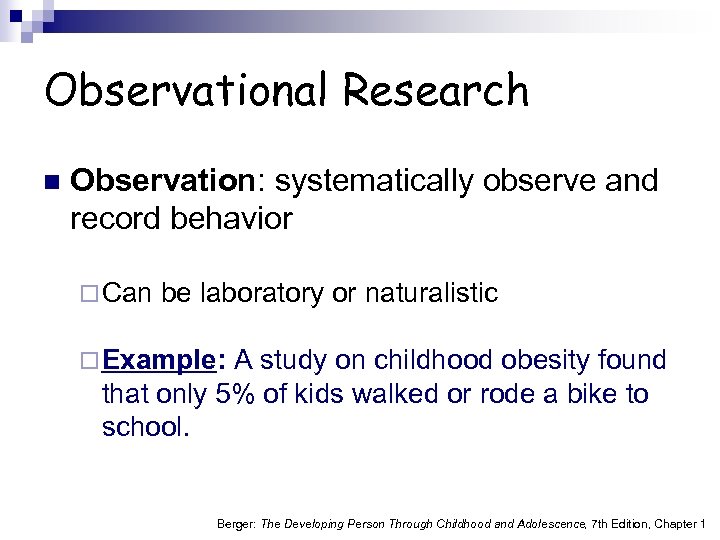
Observational Research n Observation: systematically observe and record behavior ¨ Can be laboratory or naturalistic ¨ Example: A study on childhood obesity found that only 5% of kids walked or rode a bike to school. Berger: The Developing Person Through Childhood and Adolescence, 7 th Edition, Chapter 1
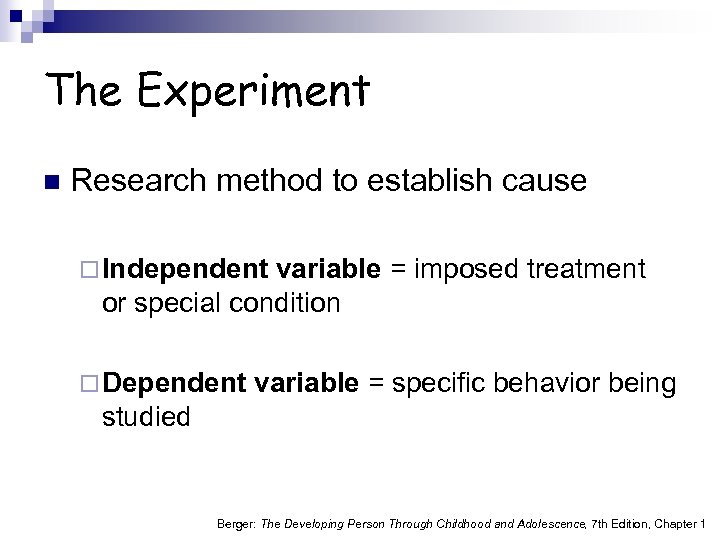
The Experiment n Research method to establish cause ¨ Independent variable = imposed treatment or special condition ¨ Dependent variable = specific behavior being studied Berger: The Developing Person Through Childhood and Adolescence, 7 th Edition, Chapter 1
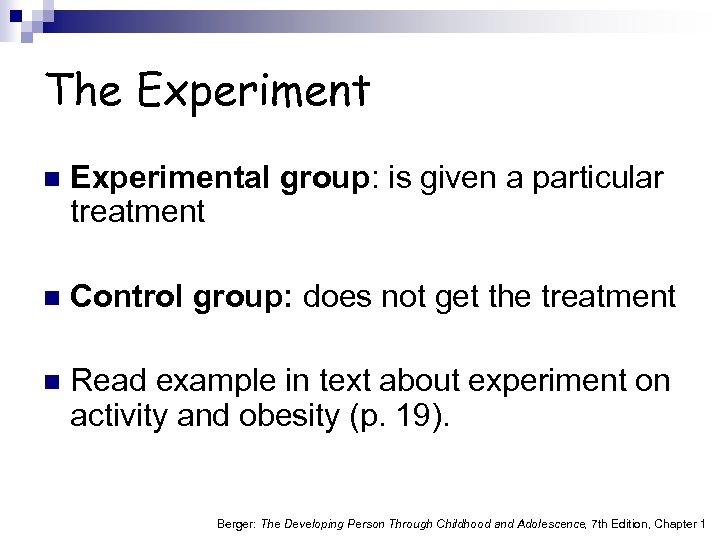
The Experiment n Experimental group: is given a particular treatment n Control group: does not get the treatment n Read example in text about experiment on activity and obesity (p. 19). Berger: The Developing Person Through Childhood and Adolescence, 7 th Edition, Chapter 1
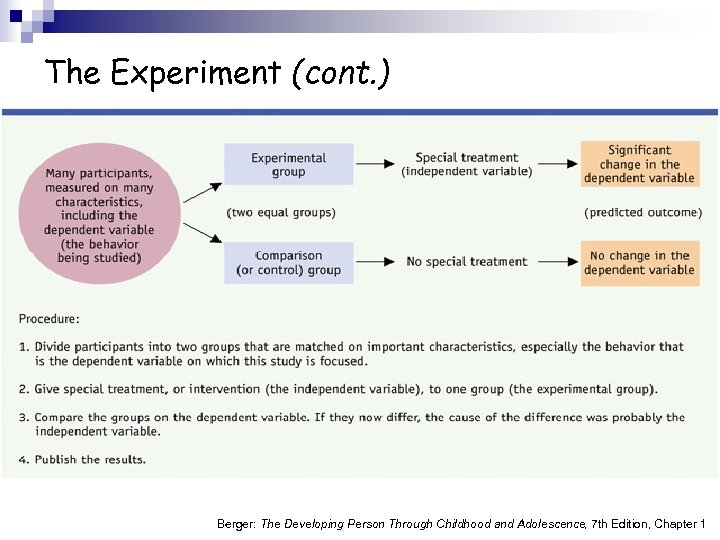
The Experiment (cont. ) Berger: The Developing Person Through Childhood and Adolescence, 7 th Edition, Chapter 1
Other Methods n Survey = information collected from personal interviews, questionnaires, etc. ¨ Problems include representativeness of group, and phrasing of questions n Case study = intensive study of one individual or situation Berger: The Developing Person Through Childhood and Adolescence, 7 th Edition, Chapter 1
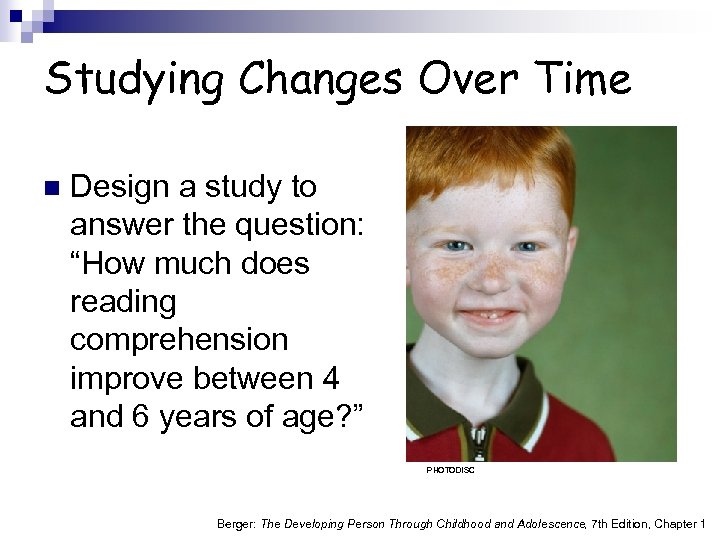
Studying Changes Over Time n Design a study to answer the question: “How much does reading comprehension improve between 4 and 6 years of age? ” PHOTODISC Berger: The Developing Person Through Childhood and Adolescence, 7 th Edition, Chapter 1
Studying Changes Over Time n Cross-sectional research: groups differ in age but share other important characteristics (ethnicity, SES). n Longitudinal research studies individuals over a long period of time. ¨ Advantage is studying the same people ¨ Problems include; people drop out, participants learn goals of study, is costly Berger: The Developing Person Through Childhood and Adolescence, 7 th Edition, Chapter 1
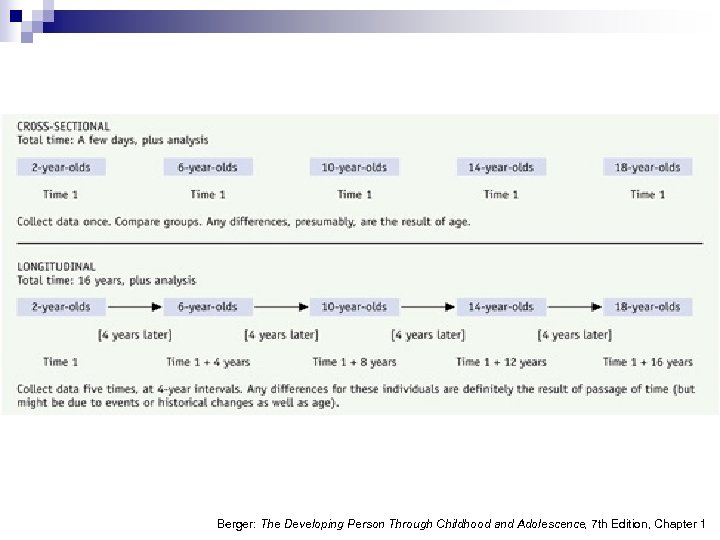
Berger: The Developing Person Through Childhood and Adolescence, 7 th Edition, Chapter 1
Studying Changes Over Time n Cross-sequential research studies several groups of people of different ages, then follows those groups longitudinally. Berger: The Developing Person Through Childhood and Adolescence, 7 th Edition, Chapter 1
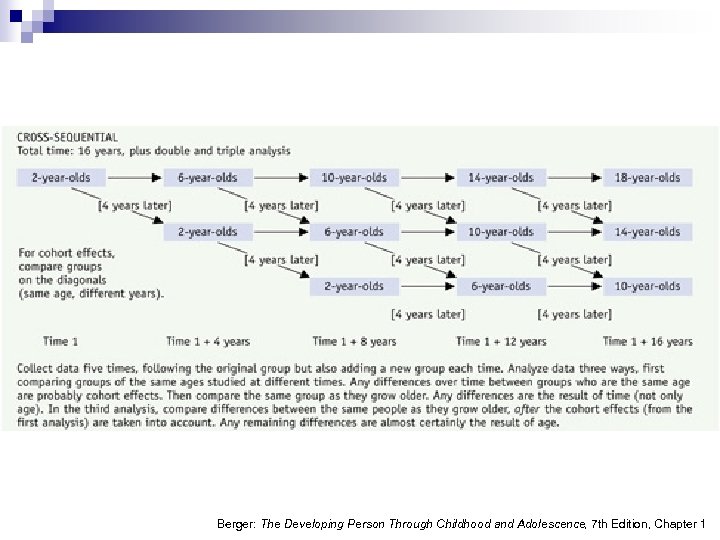
Berger: The Developing Person Through Childhood and Adolescence, 7 th Edition, Chapter 1

Ecological-Systems Approach n Developed by Urie Bronfenbrenner, this approach suggests that a person should be considered in all the contexts and interactions in his/her life. Berger: The Developing Person Through Childhood and Adolescence, 7 th Edition, Chapter 1
Correlations n A correlation indicates the degree of relationship between two variables. n Positive correlation: the variables increase or decrease together. ¨ Example: The more hours you work, the more money you will be paid. Berger: The Developing Person Through Childhood and Adolescence, 7 th Edition, Chapter 1
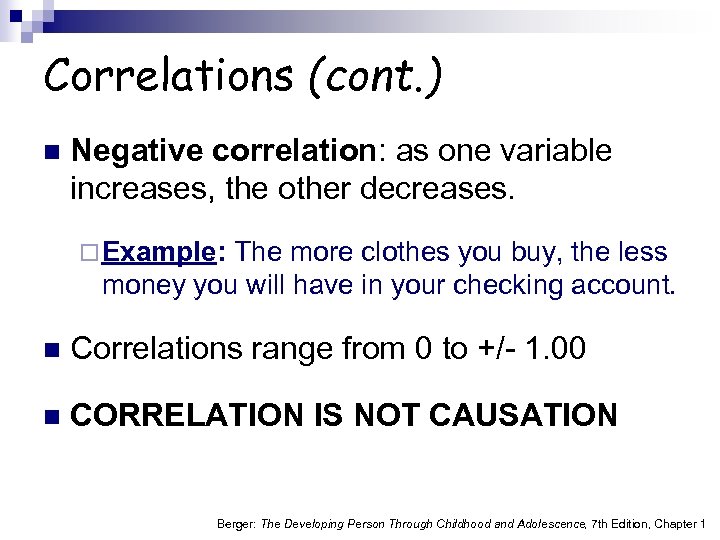
Correlations (cont. ) n Negative correlation: as one variable increases, the other decreases. ¨ Example: The more clothes you buy, the less money you will have in your checking account. n Correlations range from 0 to +/- 1. 00 n CORRELATION IS NOT CAUSATION Berger: The Developing Person Through Childhood and Adolescence, 7 th Edition, Chapter 1
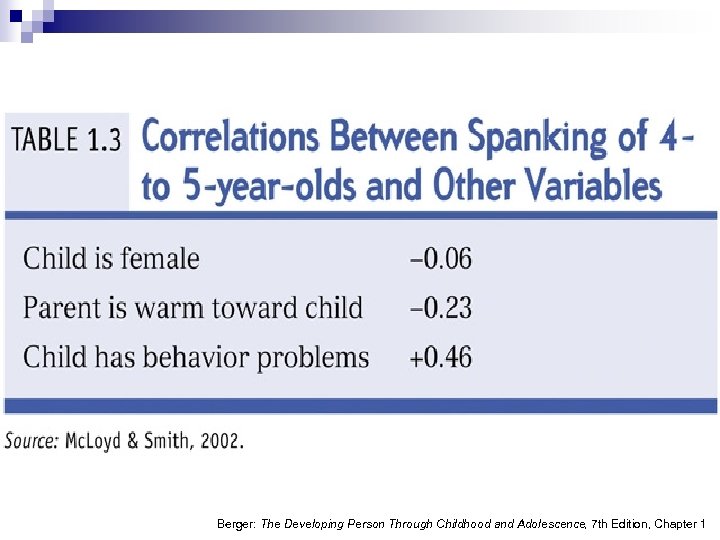
Berger: The Developing Person Through Childhood and Adolescence, 7 th Edition, Chapter 1
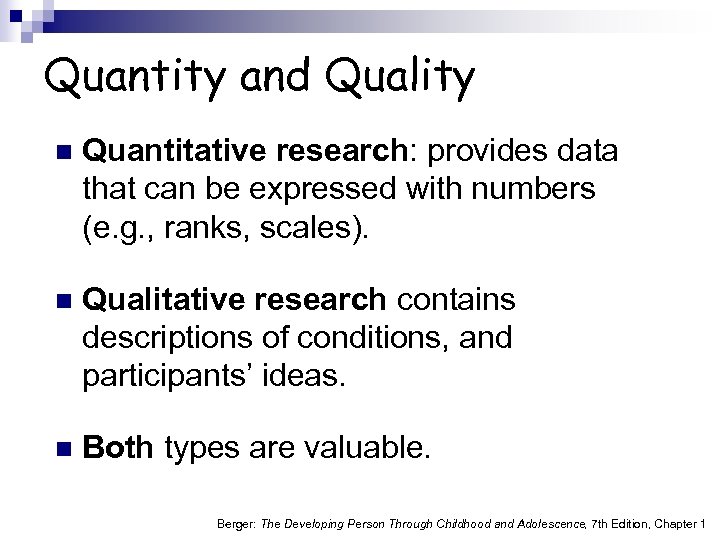
Quantity and Quality n Quantitative research: provides data that can be expressed with numbers (e. g. , ranks, scales). n Qualitative research contains descriptions of conditions, and participants’ ideas. n Both types are valuable. Berger: The Developing Person Through Childhood and Adolescence, 7 th Edition, Chapter 1
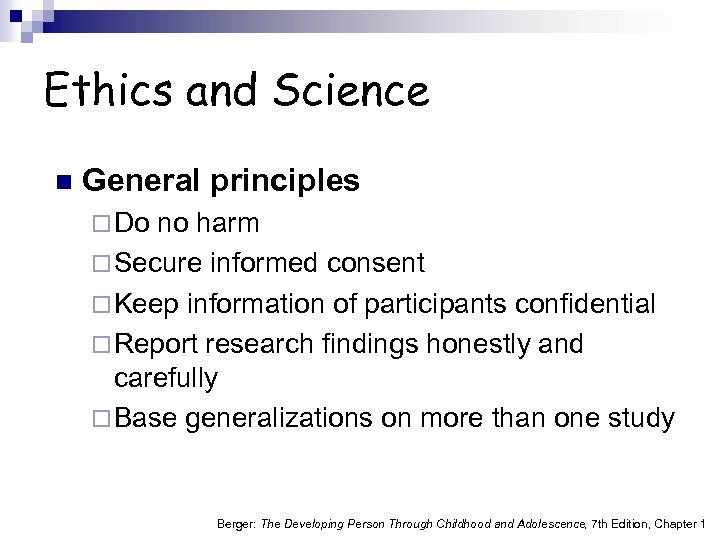
Ethics and Science n General principles ¨ Do no harm ¨ Secure informed consent ¨ Keep information of participants confidential ¨ Report research findings honestly and carefully ¨ Base generalizations on more than one study Berger: The Developing Person Through Childhood and Adolescence, 7 th Edition, Chapter 1
What Should We Study? n Are scientists studying issues that are crucial to human development? n Part of ethics is making sure we choose topics of importance to children and to all people. Berger: The Developing Person Through Childhood and Adolescence, 7 th Edition, Chapter 1
Скачать презентацию The Developing Person Through Childhood and Adolescence by
f0b62131ba8d33f512f36a18e88b37e6.ppt