


 Скачать презентацию The Dev DET EUVIF Program a FP 7 project
acdf8bd8954061b9e970bbbff20596ef.ppt
- Количество слайдов: 16
 The Dev. DET/EUVIF Program: a FP 7 project CHIPP Workshop on detector R&D Geneva, 11 -12 June 2008 Daniel Haas DPNC Genève DEPARTEMENT DE PHYSIQUE NUCLEAIRE ET CORPUSCULAIRE
 DANIEL HAAS, CHIPP WORKSHOP GENEVA, JUNE 2008 Outline • • RECFA and the FP 7 program IAs: Integrating Activities (ex I 3) The Dev. DET proposal EUVIF - European Vertical Integration Facility – General Idea – Key Workpackages – Some Tasks and their proposed implementations • Final Remarks DEPARTEMENT DE PHYSIQUE NUCLEAIRE ET CORPUSCULAIRE Page 2
 DANIEL HAAS, CHIPP WORKSHOP GENEVA, JUNE 2008 RECFA and the FP 7 • A Detector R&D planning group for FP 7 – set up by RECFA in Sep 2007 (lead by N. Mc. Cubbin and S. Stapnes) – members from LC, LHC, neutrinos, flavour factories, ESGARD, CERN and DESY – To coordinate the IA applications to maximise the chances – Aim for a small number (one) good proposal(s) allowing the European community to be correctly represented in them – Follow the example of ESGARD for accelerator R&D coordination DEPARTEMENT DE PHYSIQUE NUCLEAIRE ET CORPUSCULAIRE Page 3
 DANIEL HAAS, CHIPP WORKSHOP GENEVA, JUNE 2008 Integrating Activities • What are IAs (Integrating Activities)? – … provide a wider and more efficient access to and use of, the existing research infrastructures… – Integrating Activities also aim to structure better and integrate, on a European scale, the way research infrastructures operate • Already used successfully in FP 6 – EUDET: ILC Detector R&D network – CARE: accelerator R&D • BUT a rigid structure: Need to include 3 different kinds of workpackages: – Networking – foster collaboration – Transnational access – allow access to facilities – Joint Research Activities – develop the facilities DEPARTEMENT DE PHYSIQUE NUCLEAIRE ET CORPUSCULAIRE Page 4
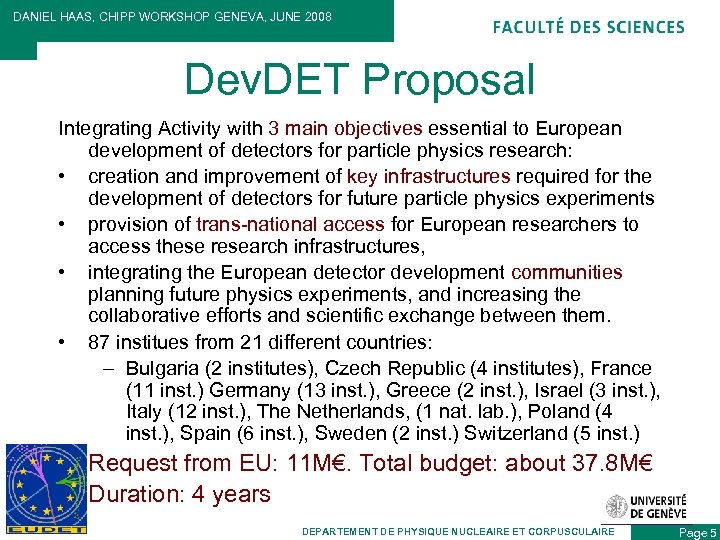 DANIEL HAAS, CHIPP WORKSHOP GENEVA, JUNE 2008 Dev. DET Proposal Integrating Activity with 3 main objectives essential to European development of detectors for particle physics research: • creation and improvement of key infrastructures required for the development of detectors for future particle physics experiments • provision of trans-national access for European researchers to access these research infrastructures, • integrating the European detector development communities planning future physics experiments, and increasing the collaborative efforts and scientific exchange between them. • 87 institues from 21 different countries: – Bulgaria (2 institutes), Czech Republic (4 institutes), France (11 inst. ) Germany (13 inst. ), Greece (2 inst. ), Israel (3 inst. ), Italy (12 inst. ), The Netherlands, (1 nat. lab. ), Poland (4 inst. ), Spain (6 inst. ), Sweden (2 inst. ) Switzerland (5 inst. ) • Request from EU: 11 M€. Total budget: about 37. 8 M€ • Duration: 4 years DEPARTEMENT DE PHYSIQUE NUCLEAIRE ET CORPUSCULAIRE Page 5
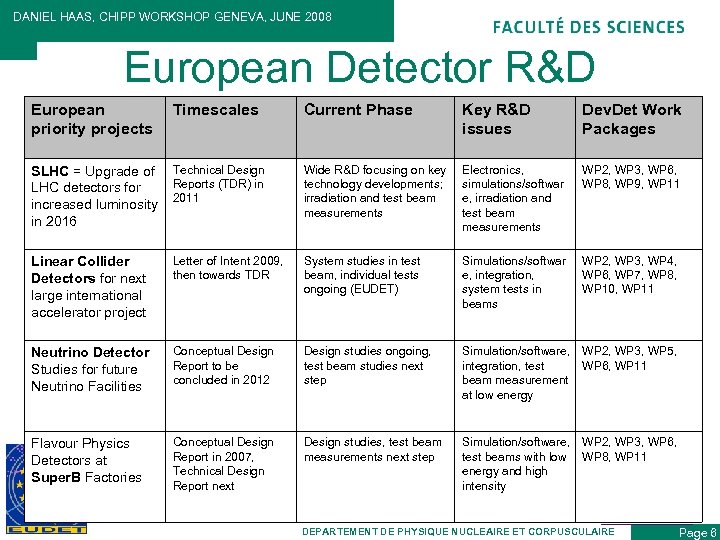 DANIEL HAAS, CHIPP WORKSHOP GENEVA, JUNE 2008 European Detector R&D European priority projects Timescales Current Phase Key R&D issues Dev. Det Work Packages SLHC = Upgrade of LHC detectors for increased luminosity in 2016 Technical Design Reports (TDR) in 2011 Wide R&D focusing on key technology developments; irradiation and test beam measurements Electronics, simulations/softwar e, irradiation and test beam measurements WP 2, WP 3, WP 6, WP 8, WP 9, WP 11 Linear Collider Detectors for next large international accelerator project Letter of Intent 2009, then towards TDR System studies in test beam, individual tests ongoing (EUDET) Simulations/softwar e, integration, system tests in beams WP 2, WP 3, WP 4, WP 6, WP 7, WP 8, WP 10, WP 11 Neutrino Detector Studies for future Neutrino Facilities Conceptual Design Report to be concluded in 2012 Design studies ongoing, test beam studies next step Simulation/software, integration, test beam measurement at low energy WP 2, WP 3, WP 5, WP 6, WP 11 Flavour Physics Detectors at Super. B Factories Conceptual Design Report in 2007, Technical Design Report next Design studies, test beam measurements next step Simulation/software, test beams with low energy and high intensity WP 2, WP 3, WP 6, WP 8, WP 11 DEPARTEMENT DE PHYSIQUE NUCLEAIRE ET CORPUSCULAIRE Page 6
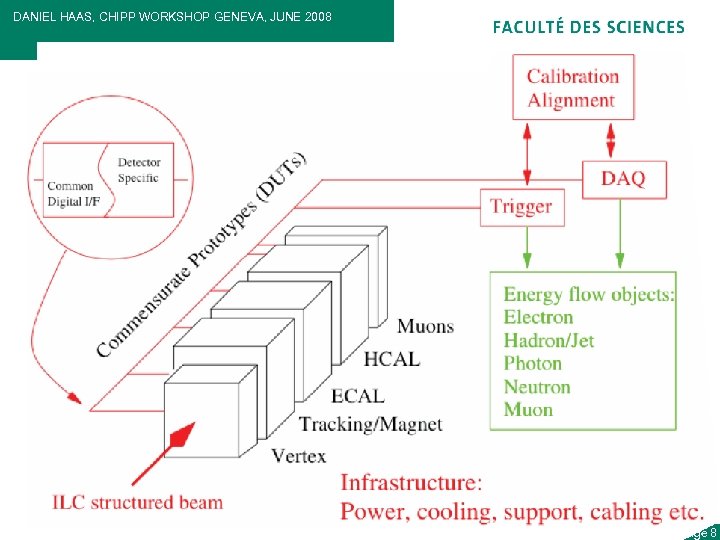
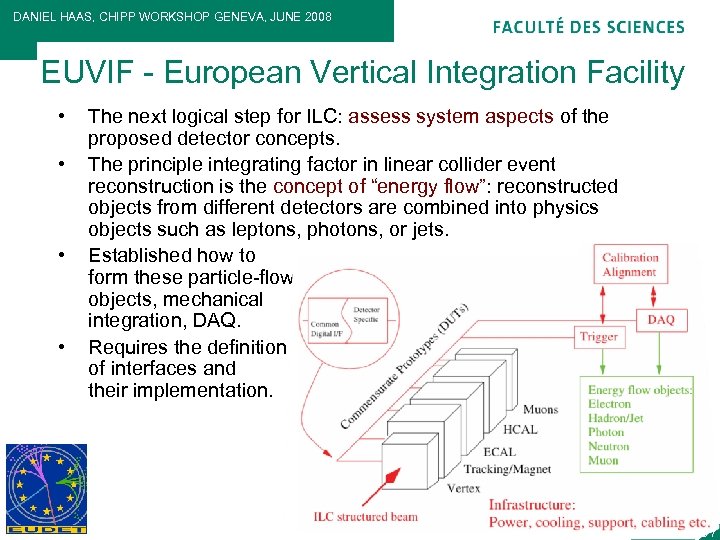 DANIEL HAAS, CHIPP WORKSHOP GENEVA, JUNE 2008 EUVIF - European Vertical Integration Facility • • The next logical step for ILC: assess system aspects of the proposed detector concepts. The principle integrating factor in linear collider event reconstruction is the concept of “energy flow”: reconstructed objects from different detectors are combined into physics objects such as leptons, photons, or jets. Established how to form these particle-flow objects, mechanical integration, DAQ. Requires the definition of interfaces and their implementation. DEPARTEMENT DE PHYSIQUE NUCLEAIRE ET CORPUSCULAIRE Page 7
 DANIEL HAAS, CHIPP WORKSHOP GENEVA, JUNE 2008 DEPARTEMENT DE PHYSIQUE NUCLEAIRE ET CORPUSCULAIRE Page 8
 Linked to existing ILC community
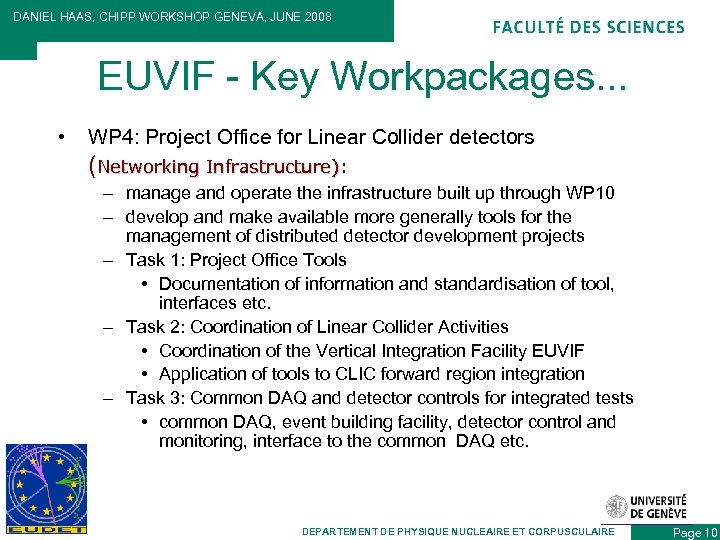 DANIEL HAAS, CHIPP WORKSHOP GENEVA, JUNE 2008 EUVIF - Key Workpackages. . . • WP 4: Project Office for Linear Collider detectors (Networking Infrastructure): – manage and operate the infrastructure built up through WP 10 – develop and make available more generally tools for the management of distributed detector development projects – Task 1: Project Office Tools • Documentation of information and standardisation of tool, interfaces etc. – Task 2: Coordination of Linear Collider Activities • Coordination of the Vertical Integration Facility EUVIF • Application of tools to CLIC forward region integration – Task 3: Common DAQ and detector controls for integrated tests • common DAQ, event building facility, detector control and monitoring, interface to the common DAQ etc. DEPARTEMENT DE PHYSIQUE NUCLEAIRE ET CORPUSCULAIRE Page 10
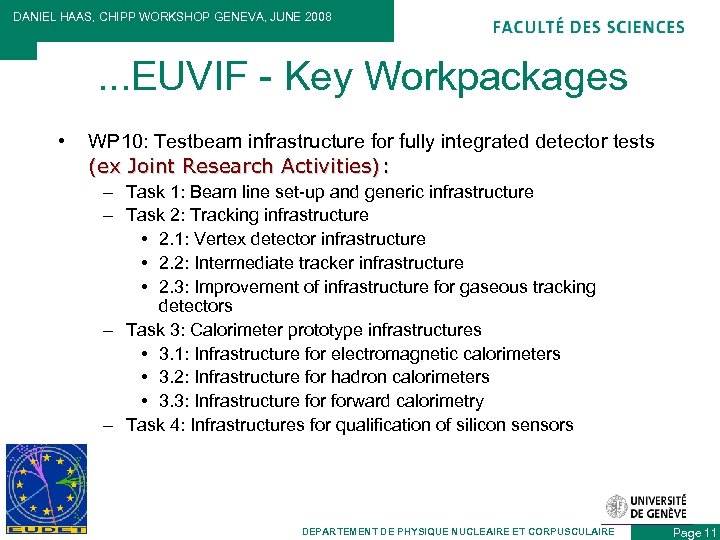 DANIEL HAAS, CHIPP WORKSHOP GENEVA, JUNE 2008 . . . EUVIF - Key Workpackages • WP 10: Testbeam infrastructure for fully integrated detector tests (ex Joint Research Activities): – Task 1: Beam line set-up and generic infrastructure – Task 2: Tracking infrastructure • 2. 1: Vertex detector infrastructure • 2. 2: Intermediate tracker infrastructure • 2. 3: Improvement of infrastructure for gaseous tracking detectors – Task 3: Calorimeter prototype infrastructures • 3. 1: Infrastructure for electromagnetic calorimeters • 3. 2: Infrastructure for hadron calorimeters • 3. 3: Infrastructure forward calorimetry – Task 4: Infrastructures for qualification of silicon sensors DEPARTEMENT DE PHYSIQUE NUCLEAIRE ET CORPUSCULAIRE Page 11
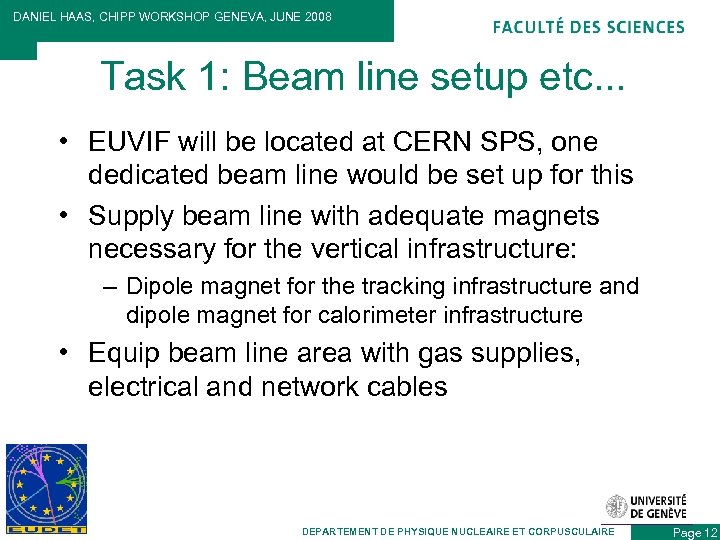 DANIEL HAAS, CHIPP WORKSHOP GENEVA, JUNE 2008 Task 1: Beam line setup etc. . . • EUVIF will be located at CERN SPS, one dedicated beam line would be set up for this • Supply beam line with adequate magnets necessary for the vertical infrastructure: – Dipole magnet for the tracking infrastructure and dipole magnet for calorimeter infrastructure • Equip beam line area with gas supplies, electrical and network cables DEPARTEMENT DE PHYSIQUE NUCLEAIRE ET CORPUSCULAIRE Page 12
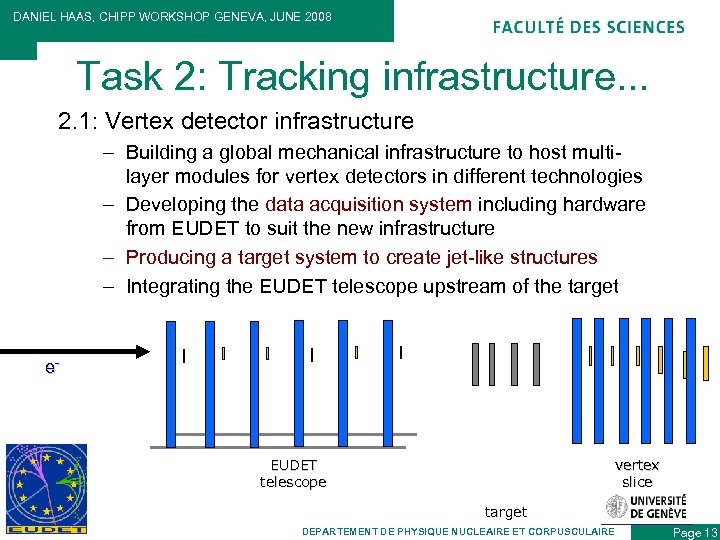 DANIEL HAAS, CHIPP WORKSHOP GENEVA, JUNE 2008 Task 2: Tracking infrastructure. . . 2. 1: Vertex detector infrastructure – Building a global mechanical infrastructure to host multilayer modules for vertex detectors in different technologies – Developing the data acquisition system including hardware from EUDET to suit the new infrastructure – Producing a target system to create jet-like structures – Integrating the EUDET telescope upstream of the target e- EUDET telescope vertex slice target DEPARTEMENT DE PHYSIQUE NUCLEAIRE ET CORPUSCULAIRE Page 13
 DANIEL HAAS, CHIPP WORKSHOP GENEVA, JUNE 2008 . . . Task 2: Tracking infrastructure 2. 2: Intermediate tracker infrastructure – – Lightweight structures for both module carrier and overall support Prototype silicon modules with minimized material consumption Overall support structure for modules/ladders arranged in layers Improving the existing EUDET readout chip and developing a frontend hybrid prototype suitable for testing silicon sensors with conventional (wire-bonding) or novel (bump-bonding) techniques – Integration of the front-end electronics developed in EUDET into the central DAQ system (see WP 4) 2. 3: Improvement of infrastructure for gaseous tracking detectors – Providing the EUDET TPC infrastructures for combined tests of the particle flow concept – Develop and provide readout software – Integration into DAQ and slow-control system DEPARTEMENT DE PHYSIQUE NUCLEAIRE ET CORPUSCULAIRE Page 14
 DANIEL HAAS, CHIPP WORKSHOP GENEVA, JUNE 2008 Task 3: Calorimeter prototype infrastructure 3. 1: Infrastructure for electromagnetic calorimeters – Develop facility for mechanical and system integration – Develop facility for optimization and test of silicon readout sensors – Develop facility for the test and characterization of readout systems 3. 2: Infrastructure for hadron calorimeters – Develop facility for mechanical and system integration – Develop facility for the optimization of Si. PM micro-structures and on-wafer sensor tests – Develop facility for the characterization of packaged sensors and integrated scintillator systems – Develop facility for the test and characterization of readout and calibration systems 3. 3: Infrastructure forward calorimetry – Design and prototyping of a flexible tungsten absorber structure for beam tests including a laser position monitoring – Development of a prototype of a multi-channel readout system including fully instrumented sensor planes, FE ASICS and high throughput transmission lines to link the FE electronics to the common DAQ DEPARTEMENT DE PHYSIQUE NUCLEAIRE ET CORPUSCULAIRE Page 15
 DANIEL HAAS, CHIPP WORKSHOP ZÜRICH, SEP 2006 Final Remarks • Proposal was submitted February 29 th to the EC • Outcome to be expected for this summer. Start of Dev. DET January 1 st 2009, EUVIF January 1 st 2010 (no overlap with EUDET allowed) • 11 MEUR sounds a lot, but distributed on 87 institutes incl. 3263 person months gives very small amounts for each group – E. g each institute participating in the vertex infrastructure of EUVIF -<0. 25 FTE per year • Did it anyway: – Within EUDET collaboration building effect was very positive – Want to continue this way! • Will keep European ILC community alive with this support and commitment! DEPARTEMENT DE PHYSIQUE NUCLEAIRE ET CORPUSCULAIRE Page 16