


 Скачать презентацию The Detection and Tracking of Satellite Image Features
a917c02f57320aec87345ae8f5cdc435.ppt
- Количество слайдов: 36
 The Detection and Tracking of Satellite Image Features Associated with Extreme Physical Events for Sensor Web Targeting Observing AIST-QRS-06 -0026 ESTO Interim Review Principle Investigator: Co-Investigator: John F Moses, GSFC Code 586 Data Systems Liping Di, George Mason University CSISS Wayne Feltz, U of Wisconsin SSEC/CIMSS Jason Brunner, U of Wisconsin SSEC/CIMSS Robert Rabin, National Severe Storms Laboratory
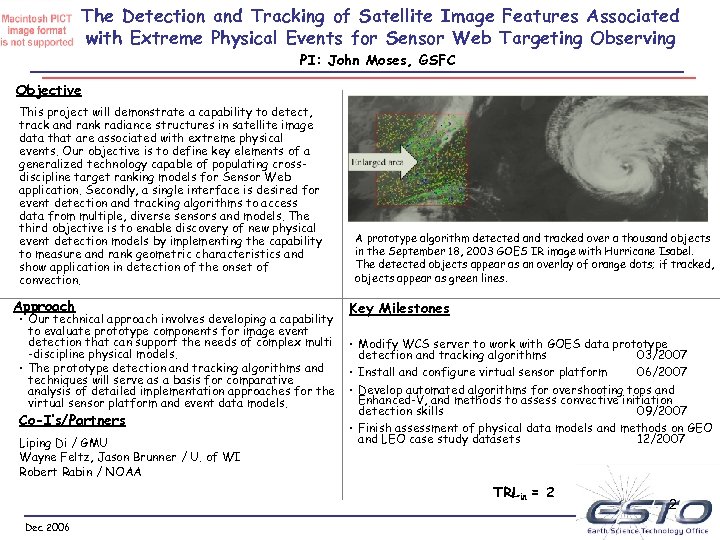 The Detection and Tracking of Satellite Image Features Associated with Extreme Physical Events for Sensor Web Targeting Observing PI: John Moses, GSFC Objective This project will demonstrate a capability to detect, track and rank radiance structures in satellite image data that are associated with extreme physical events. Our objective is to define key elements of a generalized technology capable of populating crossdiscipline target ranking models for Sensor Web application. Secondly, a single interface is desired for event detection and tracking algorithms to access data from multiple, diverse sensors and models. The third objective is to enable discovery of new physical event detection models by implementing the capability to measure and rank geometric characteristics and show application in detection of the onset of convection. Approach • Our technical approach involves developing a capability to evaluate prototype components for image event detection that can support the needs of complex multi -discipline physical models. • The prototype detection and tracking algorithms and techniques will serve as a basis for comparative analysis of detailed implementation approaches for the virtual sensor platform and event data models. Co-I’s/Partners Liping Di / GMU Wayne Feltz, Jason Brunner / U. of WI Robert Rabin / NOAA A prototype algorithm detected and tracked over a thousand objects in the September 18, 2003 GOES IR image with Hurricane Isabel. The detected objects appear as an overlay of orange dots; if tracked, objects appear as green lines. Key Milestones • Modify WCS server to work with GOES data prototype detection and tracking algorithms 03/2007 • Install and configure virtual sensor platform 06/2007 • Develop automated algorithms for overshooting tops and Enhanced-V, and methods to assess convective initiation detection skills 09/2007 • Finish assessment of physical data models and methods on GEO and LEO case study datasets 12/2007 TRLin = 2 Dec 2006 2
 Detector Project Objectives and Goals • • Principle area of research: Data model for detection of structured radiance events in remote sensor images Basis: case histories and best practices for discovering satellite image ‘features’ associated with extreme physical events – Using principles for discovery of physical structures and their relations to extreme phenomena • Data Model Extensions – Incorporate geostationary and low earth orbit data structures utilizing WCS and WFS platforms – Examine implications of alternate data models for detection • Cross-Correlation methods • Contour Integral methods – Extend to radiance field structures by instrument • Proof of Concept Demonstrations – Feature selection & ranking methods • Enhanced-V • Convective Initiation – Tracking and Winds forecasts – Storm event reports for determining missed events and false alarm rates 3
 Detector Project Formulation • • • Web Service Studies (GMU) Science Case Studies (Uof. Wisc) Cross-Correlation methods (Uof. Wisc) Contour Integral methods (GSFC) Tracking (NSSL) 4
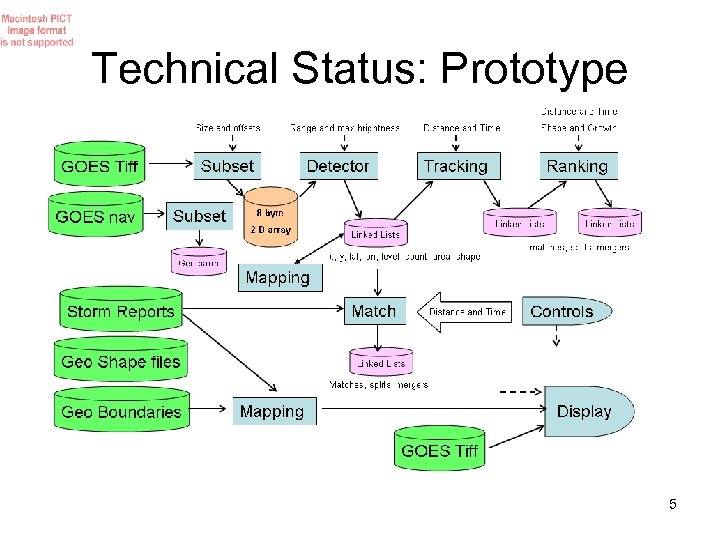 Technical Status: Prototype 5
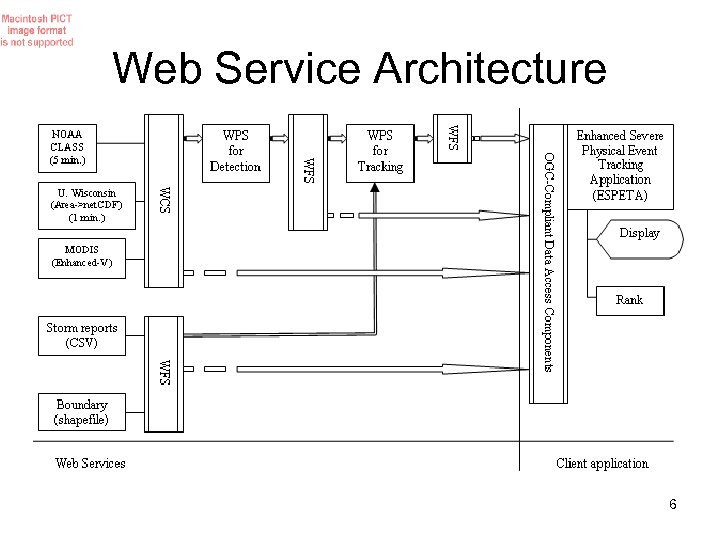 Web Service Architecture 6
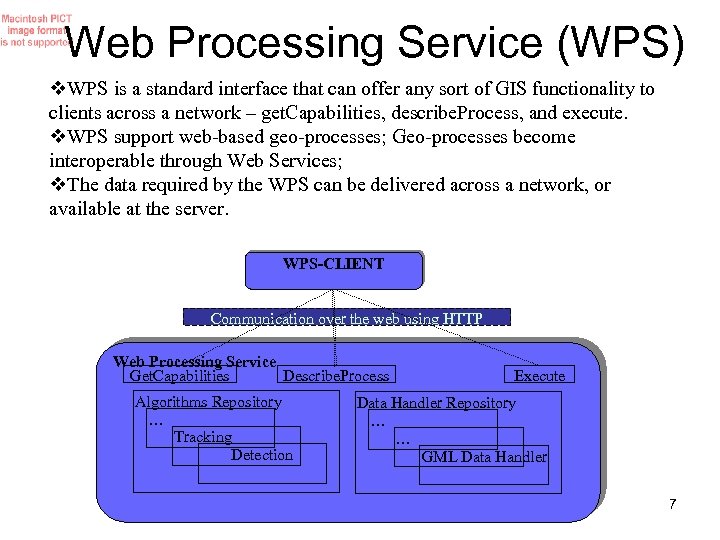 Web Processing Service (WPS) v. WPS is a standard interface that can offer any sort of GIS functionality to clients across a network – get. Capabilities, describe. Process, and execute. v. WPS support web-based geo-processes; Geo-processes become interoperable through Web Services; v. The data required by the WPS can be delivered across a network, or available at the server. WPS-CLIENT Communication over the web using HTTP Web Processing Service Get. Capabilities Describe. Process WPS Algorithms Repository … Tracking Detection Execute Data Handler Repository … … GML Data Handler 7
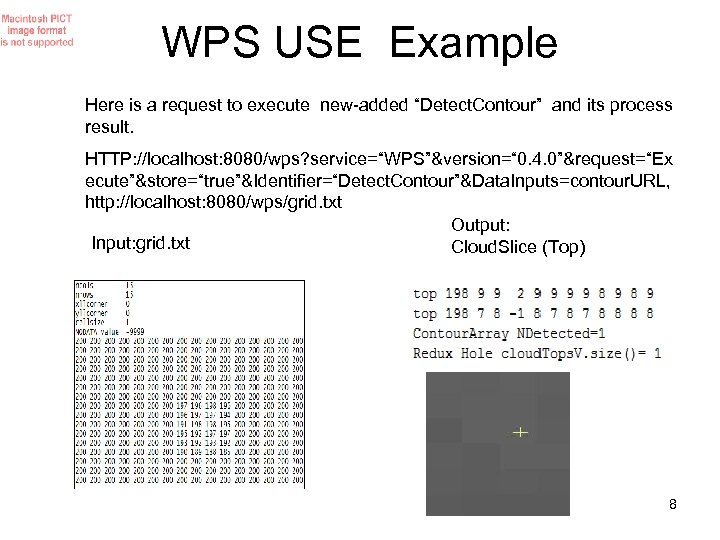 WPS USE Example Here is a request to execute new-added “Detect. Contour” and its process result. HTTP: //localhost: 8080/wps? service=“WPS”&version=“ 0. 4. 0”&request=“Ex ecute”&store=“true”&Identifier=“Detect. Contour”&Data. Inputs=contour. URL, http: //localhost: 8080/wps/grid. txt Output: Input: grid. txt Cloud. Slice (Top) 8
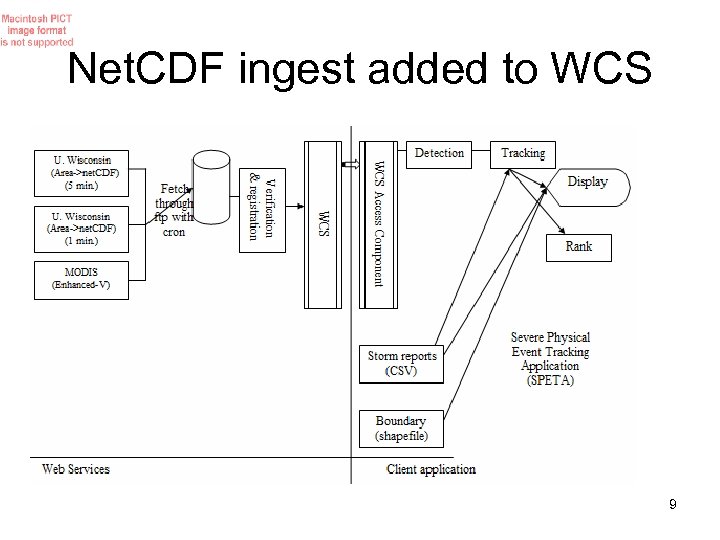 Net. CDF ingest added to WCS 9
 GMU Web Coverage Service v WCS is a standard interface that supports the networked access to multi-dimensional and multi-temporal geospatial data v WCS provides intact geospatial data products encoded in HDFEOS, NITF, Geo. TIFF, and net. CDF (soon) to meet the requirements of client-side rendering, multi-source integration and analysis, and inputs to scientific models and other clients beyond simple viewers. v WCS Operations include: Get. Capabilities Describe. Coverage Get. Coverage v Current repository: serving 1199 products and 24 GB data for all four test cases acquired from U of Wisc. 10
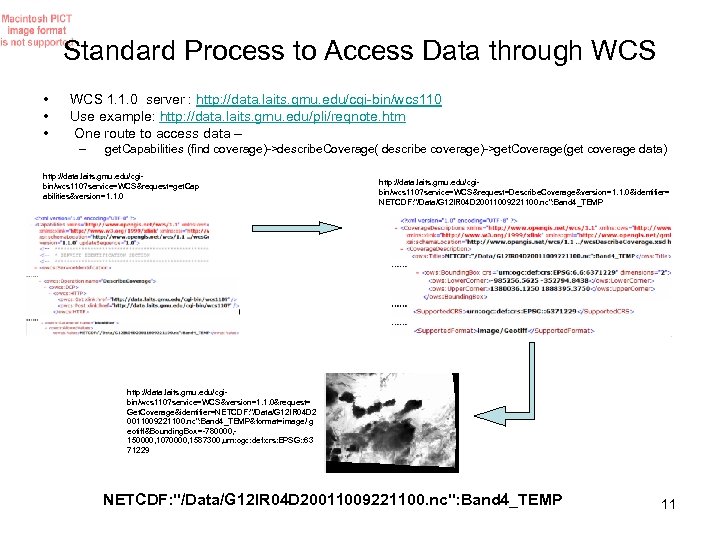 Standard Process to Access Data through WCS • • • WCS 1. 1. 0 server : http: //data. laits. gmu. edu/cgi-bin/wcs 110 Use example: http: //data. laits. gmu. edu/pli/reqnote. htm One route to access data – – get. Capabilities (find coverage)->describe. Coverage( describe coverage)->get. Coverage(get coverage data) http: //data. laits. gmu. edu/cgibin/wcs 110? service=WCS&request=get. Cap abilities&version=1. 1. 0 http: //data. laits. gmu. edu/cgibin/wcs 110? service=WCS&request=Describe. Coverage&version=1. 1. 0&identifier= NETCDF: "/Data/G 12 IR 04 D 20011009221100. nc": Band 4_TEMP http: //data. laits. gmu. edu/cgibin/wcs 110? service=WCS&version=1. 1. 0&request= Get. Coverage&identifier=NETCDF: "/Data/G 12 IR 04 D 2 0011009221100. nc": Band 4_TEMP&format=image/ g eotiff&Bounding. Box=-780000, 150000, 1070000, 1587300, urn: ogc: def: crs: EPSG: : 63 71229 NETCDF: "/Data/G 12 IR 04 D 20011009221100. nc": Band 4_TEMP 11
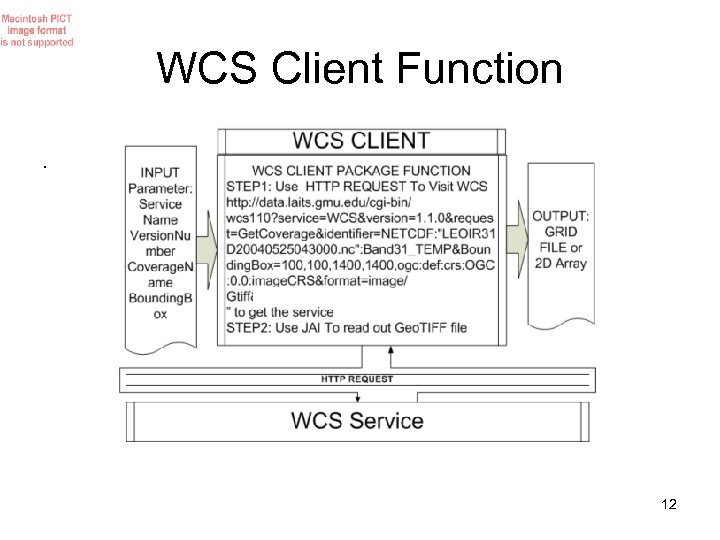 WCS Client Function. 12
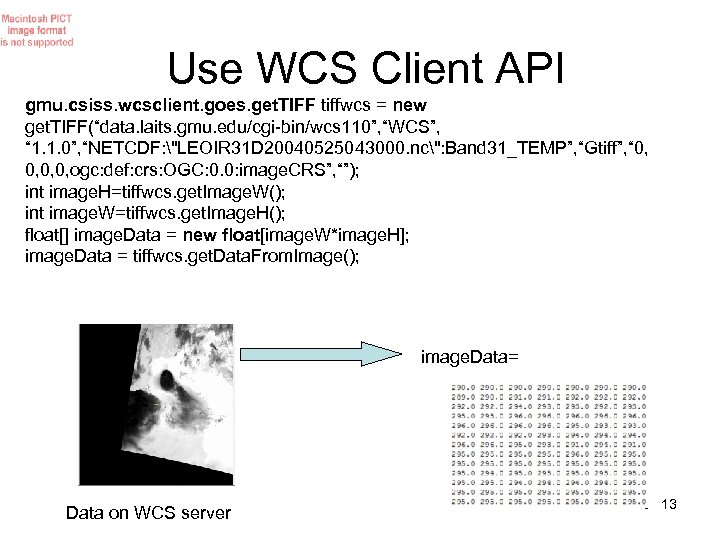 Use WCS Client API gmu. csiss. wcsclient. goes. get. TIFF tiffwcs = new get. TIFF(“data. laits. gmu. edu/cgi-bin/wcs 110”, “WCS”, “ 1. 1. 0”, “NETCDF: "LEOIR 31 D 20040525043000. nc": Band 31_TEMP”, “Gtiff”, “ 0, 0, ogc: def: crs: OGC: 0. 0: image. CRS”, “”); int image. H=tiffwcs. get. Image. W(); int image. W=tiffwcs. get. Image. H(); float[] image. Data = new float[image. W*image. H]; image. Data = tiffwcs. get. Data. From. Image(); image. Data= Data on WCS server 13
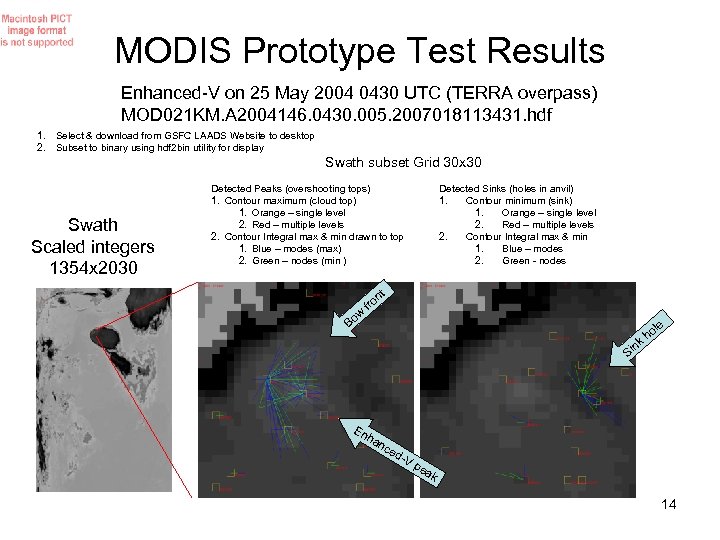 MODIS Prototype Test Results Enhanced-V on 25 May 2004 0430 UTC (TERRA overpass) MOD 021 KM. A 2004146. 0430. 005. 2007018113431. hdf 1. Select & download from GSFC LAADS Website to desktop 2. Subset to binary using hdf 2 bin utility for display Swath subset Grid 30 x 30 Swath Scaled integers 1354 x 2030 Detected Peaks (overshooting tops) 1. Contour maximum (cloud top) 1. Orange – single level 2. Red – multiple levels 2. Contour Integral max & min drawn to top 1. Blue – modes (max) 2. Green – nodes (min ) Detected Sinks (holes in anvil) 1. Contour minimum (sink) 1. Orange – single level 2. Red – multiple levels 2. Contour Integral max & min 1. Blue – modes 2. Green - nodes w Bo nt fro Si En ha nc ed -V nk le ho pe ak 14
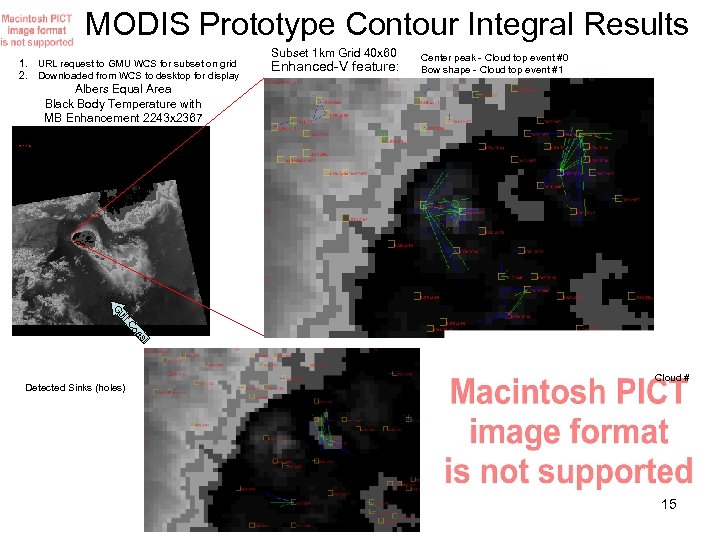 MODIS Prototype Contour Integral Results 1. URL request to GMU WCS for subset on grid 2. Downloaded from WCS to desktop for display Subset 1 km Grid 40 x 60 Enhanced-V feature: Center peak - Cloud top event #0 Bow shape - Cloud top event #1 Albers Equal Area Black Body Temperature with MB Enhancement 2243 x 2367 Detected Peaks (tops) 1. Contour maximum (cloud top) 1. Orange – single level 2. Red – multiple levels 2. Contour Integral max & min 1. Drawn from 2. Blue – modes (max) 3. Green – nodes (min) st oa f. C ul G Detected Sinks (holes) Cloud # 15
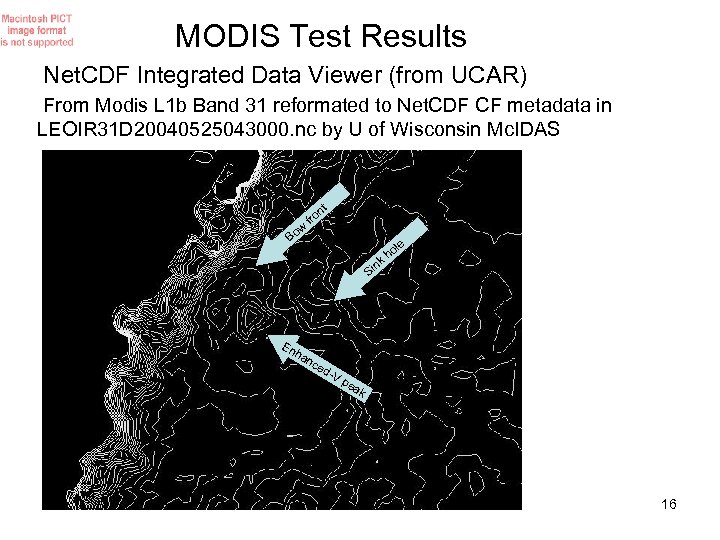 MODIS Test Results Net. CDF Integrated Data Viewer (from UCAR) From Modis L 1 b Band 31 reformated to Net. CDF CF metadata in LEOIR 31 D 20040525043000. nc by U of Wisconsin Mc. IDAS nt w Bo fro e k n Si En ha nc ed -V l ho pe ak 16
 Technical Status: Case Studies • Translated priority GOES and MODIS IR product metadata and coordinate system information into Net. CDF Climate and Forecast standard and passed through to WCS – Assigned metadata, including domain corner lat/lon and subsatellite point – Remapped MODIS and GOES to Albers Conic Equal Area 1 km grid using Vis. AD tools and software (U of Wisc SSEC CIMSS) – Adding AVHRR navigation capability (U of Wisc SSEC) – Considered alternate data and software options with GSFC GOES Project and with NOAA CLASS involving significantly more development effort • Selected MODIS and GOES IR rapid scan for detecting the Enhanced V and the onset of convection 17
 Technical Status: Pearson Correlation Matrices • Developed fabricated matrix to best represent what the enhanced-V feature looks like in the imagery • Three different matrices were developed – based on results of quantitative parameters of enhanced-V features from 2003 and 2004 enhanced-V seasons (total of 450 cases looked at) (Brunner et al. 2007) • GIF images of fabricated enhanced-Vs were created in Paint Shop Pro and Jython code was used to create matrix of brightness temperature values from GIF image (assigned each RGB color value in GIF image to a brightness temperature) • Mean/Median Enhanced-V Fabricated Matrix (30 X 30 pixel matrix MOD 3 A) • Maximum Enhanced-V Fabricated Matrix (50 X 50 pixel matrix MOD 3 B) • Minimum Enhanced-V Fabricated Matrix (15 X 15 pixel matrix MOD 3 C) 18
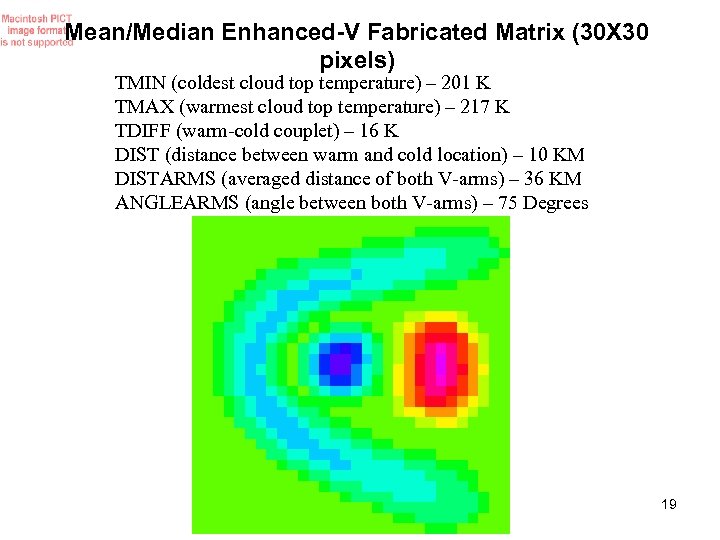 Mean/Median Enhanced-V Fabricated Matrix (30 X 30 pixels) TMIN (coldest cloud top temperature) – 201 K TMAX (warmest cloud top temperature) – 217 K TDIFF (warm-cold couplet) – 16 K DIST (distance between warm and cold location) – 10 KM DISTARMS (averaged distance of both V-arms) – 36 KM ANGLEARMS (angle between both V-arms) – 75 Degrees 19
 Enhanced-V Algorithm Inputs • Mc. IDAS AREA file of Low Earth Orbit (LEO) satellite data (currently set up to input 150 X 150 pixel region), given a line/elem value in image as upper left point of desired region (line/elem/brightness temperature value at each pixel in region is input) • Enhanced-V Fabricated Matrix of brightness temperatures (have three different versions), ASCII file of brightness temperatures in matrix 20
 Enhanced-V Algorithm Statistical Correlation Code: Output * Algorithm takes 150 X 150 pixel region and steps through this region one pixel at a time while comparing 10. 7 micron brightness temperatures to a fabricated enhanced-V matrix of brightness temperatures (looks for a similar pattern in brightness temperature values) * ASCII output file of line/elem/correlation value at every pixel * ASCII filtered output file of line/elem/correlation value of all pixels that exceed a certain correlation value threshold (such as >= 0. 5 for example) 21
 LEO Enhanced-V Proof of Concept Test Cases • Three Advanced Very High Resolution Radiometer (AVHRR) enhanced-V cases were selected to test the enhanced-V statistical correlation algorithm * Case 1: 25 May 2004 0424 UTC over Oklahoma * Case 2: 10 May 2004 0042 UTC over South Dakota/Nebraska/Iowa border * Case 3: 6 May 2003 2218 UTC over northeastern Oklahoma • The enhanced-V cases are East-West oriented enhanced-Vs and the enhanced-V fabricated matrices are East-West oriented (“simple” case) • In addition, a null case was used to test the enhanced-V algorithm for thunderstorms (no enhanced-V features though) over southwest Kansas on 10 May 2004 at 0042 UTC; Desired outcome is no detects of enhanced-V features for the null case 22
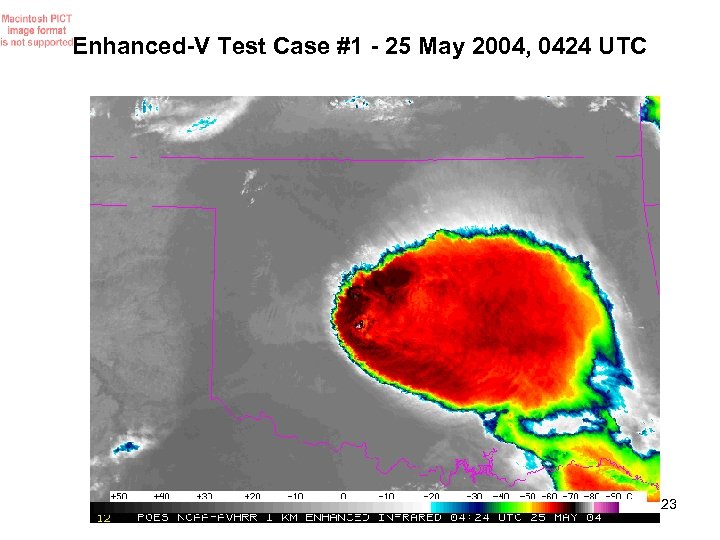 Enhanced-V Test Case #1 - 25 May 2004, 0424 UTC 23
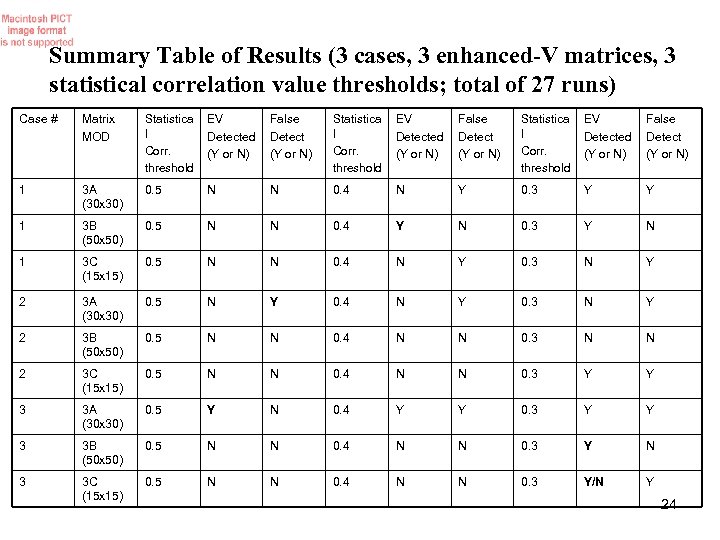 Summary Table of Results (3 cases, 3 enhanced-V matrices, 3 statistical correlation value thresholds; total of 27 runs) Case # Matrix MOD Statistica l Corr. threshold EV Detected (Y or N) False Detect (Y or N) 1 3 A (30 x 30) 0. 5 N N 0. 4 N Y 0. 3 Y Y 1 3 B (50 x 50) 0. 5 N N 0. 4 Y N 0. 3 Y N 1 3 C (15 x 15) 0. 5 N N 0. 4 N Y 0. 3 N Y 2 3 A (30 x 30) 0. 5 N Y 0. 4 N Y 0. 3 N Y 2 3 B (50 x 50) 0. 5 N N 0. 4 N N 0. 3 N N 2 3 C (15 x 15) 0. 5 N N 0. 4 N N 0. 3 Y Y 3 3 A (30 x 30) 0. 5 Y N 0. 4 Y Y 0. 3 Y Y 3 3 B (50 x 50) 0. 5 N N 0. 4 N N 0. 3 Y N 3 3 C (15 x 15) 0. 5 N N 0. 4 N N 0. 3 Y/N Y 24
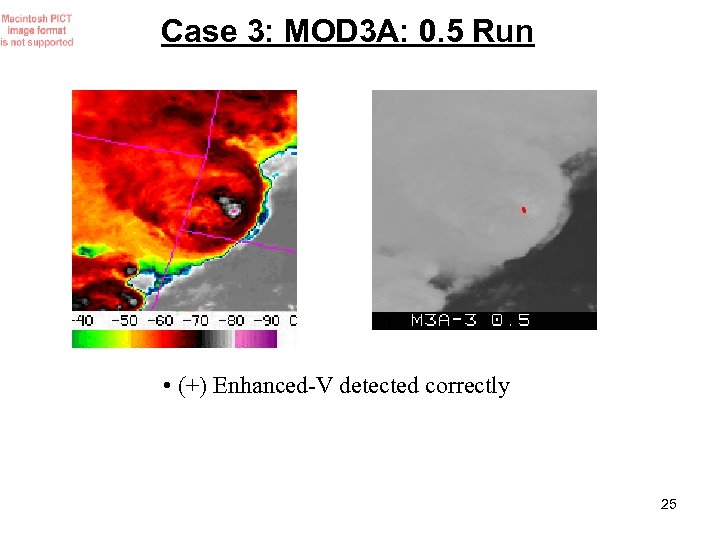 Case 3: MOD 3 A: 0. 5 Run • (+) Enhanced-V detected correctly 25
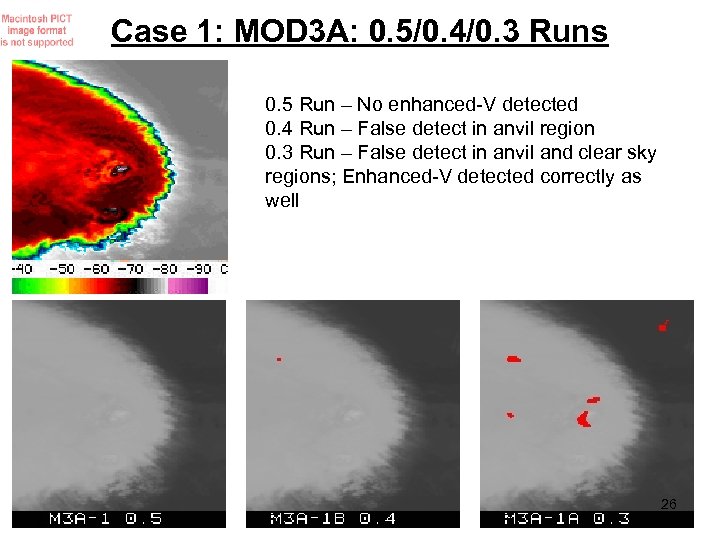 Case 1: MOD 3 A: 0. 5/0. 4/0. 3 Runs 0. 5 Run – No enhanced-V detected 0. 4 Run – False detect in anvil region 0. 3 Run – False detect in anvil and clear sky regions; Enhanced-V detected correctly as well 26
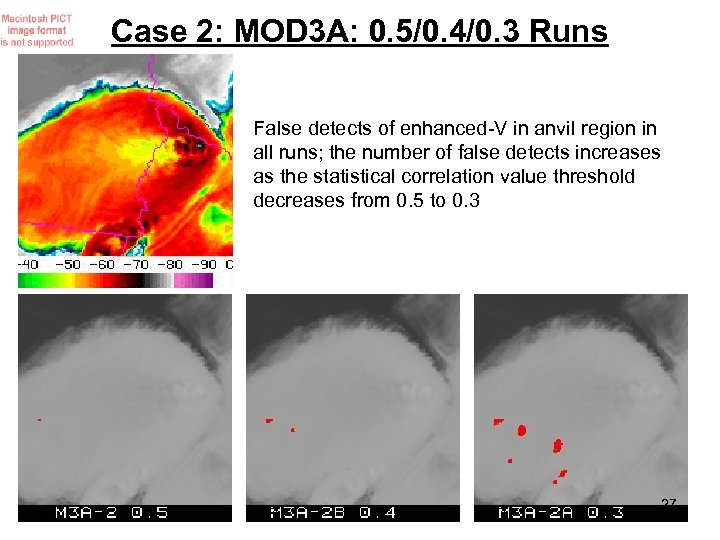 Case 2: MOD 3 A: 0. 5/0. 4/0. 3 Runs False detects of enhanced-V in anvil region in all runs; the number of false detects increases as the statistical correlation value threshold decreases from 0. 5 to 0. 3 27
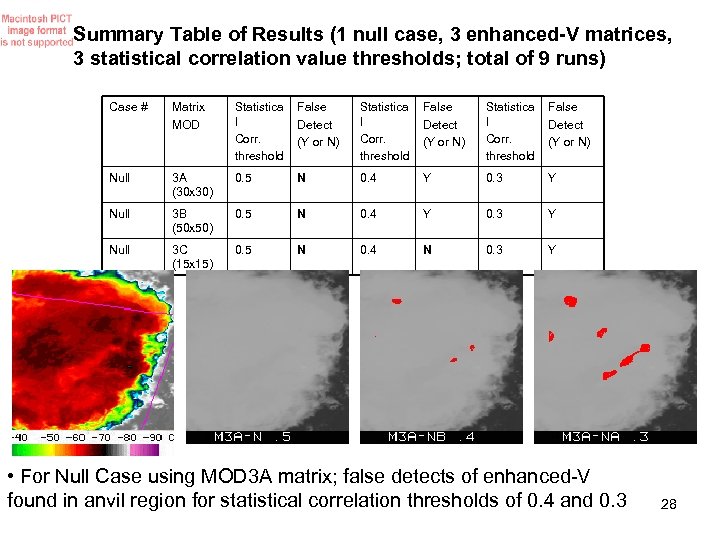 Summary Table of Results (1 null case, 3 enhanced-V matrices, 3 statistical correlation value thresholds; total of 9 runs) Case # Matrix MOD Statistica l Corr. threshold False Detect (Y or N) Null 3 A (30 x 30) 0. 5 N 0. 4 Y 0. 3 Y Null 3 B (50 x 50) 0. 5 N 0. 4 Y 0. 3 Y Null 3 C (15 x 15) 0. 5 N 0. 4 N 0. 3 Y • For Null Case using MOD 3 A matrix; false detects of enhanced-V found in anvil region for statistical correlation thresholds of 0. 4 and 0. 3 28
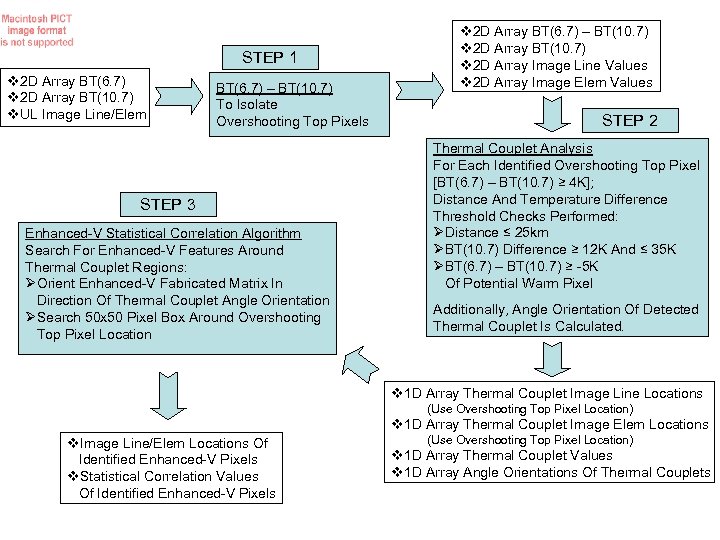 STEP 1 v 2 D Array BT(6. 7) v 2 D Array BT(10. 7) v. UL Image Line/Elem BT(6. 7) – BT(10. 7) To Isolate Overshooting Top Pixels STEP 3 Enhanced-V Statistical Correlation Algorithm Search For Enhanced-V Features Around Thermal Couplet Regions: ØOrient Enhanced-V Fabricated Matrix In Direction Of Thermal Couplet Angle Orientation ØSearch 50 x 50 Pixel Box Around Overshooting Top Pixel Location v 2 D Array BT(6. 7) – BT(10. 7) v 2 D Array Image Line Values v 2 D Array Image Elem Values STEP 2 Thermal Couplet Analysis For Each Identified Overshooting Top Pixel [BT(6. 7) – BT(10. 7) ≥ 4 K]; Distance And Temperature Difference Threshold Checks Performed: ØDistance ≤ 25 km ØBT(10. 7) Difference ≥ 12 K And ≤ 35 K ØBT(6. 7) – BT(10. 7) ≥ -5 K Of Potential Warm Pixel Additionally, Angle Orientation Of Detected Thermal Couplet Is Calculated. v 1 D Array Thermal Couplet Image Line Locations (Use Overshooting Top Pixel Location) v 1 D Array Thermal Couplet Image Elem Locations v. Image Line/Elem Locations Of Identified Enhanced-V Pixels v. Statistical Correlation Values Of Identified Enhanced-V Pixels (Use Overshooting Top Pixel Location) v 1 D Array Thermal Couplet Values v 1 D Array Angle Orientations Of Thermal Couplets
 MODIS Test Cases for Revised Enhanced-V Algorithm/Pre. Processing (Using Methodology in Process Flow Chart on Previous Slide) Case 1: 25 May 2004 0430 UTC (TERRA overpass) * Enhanced-V over Oklahoma Case 2: 7 April 2006 1702 UTC (TERRA overpass) * Numerous enhanced-Vs over Tennessee and Kentucky Case 3: 7 April 2006 1842 UTC (AQUA overpass) * Numerous enhanced-Vs over Tennessee and Kentucky Case 4: 12 October 2001 overpasses * Enhanced-Vs over southern Plains, during GOES-12 SRSO Test period Case 5: 24 April 2007 overpasses * Enhanced-V over southwest Texas that was associated with Eagle Pass killer tornado Case 6: 9 October 2001 overpasses * Enhanced-Vs over southern and central Plains, during GOES-12 SRSO Test period Case 7: 10 May 2006 overpasses * Numerous enhanced-Vs over Texas and Gulf Coast, during GOES-12 RSO 30
 Upcoming Conference Presentations/Publications • An oral presentation will be given at the upcoming Joint EUMETSAT/AMS Satellite Conference in Amsterdam on the enhanced-V detection algorithm work • Peer-reviewed paper entitled “A Quantitative Analysis of the Enhanced-V Feature in Relation to Severe Weather” has been accepted for publication in Weather and Forecasting 31
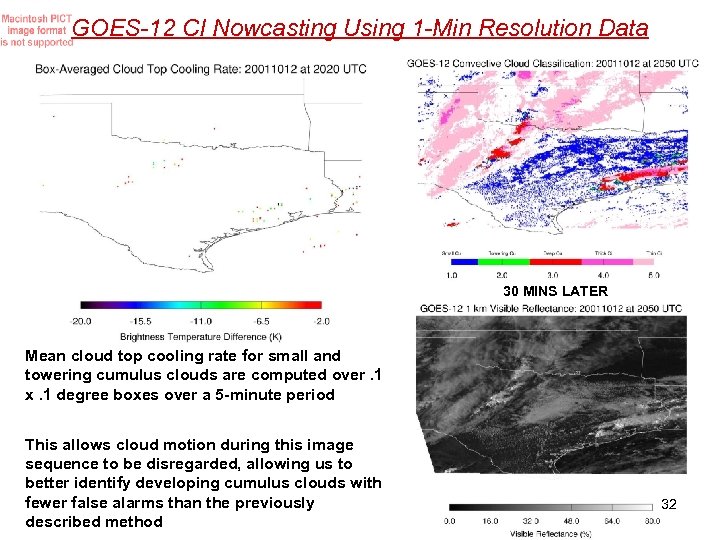 GOES-12 CI Nowcasting Using 1 -Min Resolution Data 30 MINS LATER Mean cloud top cooling rate for small and towering cumulus clouds are computed over. 1 x. 1 degree boxes over a 5 -minute period This allows cloud motion during this image sequence to be disregarded, allowing us to better identify developing cumulus clouds with fewer false alarms than the previously described method 32
 Cooperation and Follow-on • The objective overshooting top and enhanced-V algorithm may satisfy future GOES-R Advanced Baseline Imager (ABI) requirement • Thunderstorm feature detection is complementing NASA Advanced Satellite Aviation-weather Product (ASAP) research toward improving airline safety through use of satellite data • Overshooting top detection will also provide possible signal of turbulent atmosphere which can be integrated into the NOAA Aviation Weather Center Graphical Turbulence Guidance (GTG) next generation product, used operationally by NOAA and FAA 33
 Milestone Status 34
 Cost and Schedule Status • One Year funding: $382, 913 • Direct for NASA GSFC PI • GMU/U of Wisc Grants, NSSL agreement • Commitments $316 k Jan 2007 • Cumulative Obligations: $316 k Mar 2007 • The project is currently spending below the plan due to accumulation of short delays: – – – Setup grants and awards Data source/format Temporary loss of the lead engineer at GMU Location of GMU processing facility $20 K equipment purchase delayed until August 35
 Cost and Schedule Status 36