


 Скачать презентацию The Design Space for NSIS Signaling Protocols Henning
ce81c6ffaecee46d4904ec79096e4758.ppt
- Количество слайдов: 23
 The Design Space for NSIS Signaling Protocols Henning Schulzrinne Columbia University hgs@cs. columbia. edu NSIS working group interim meeting February 2003, New York City
 Overview • My NSIS assumptions • “Transport” layer • Peer node discovery
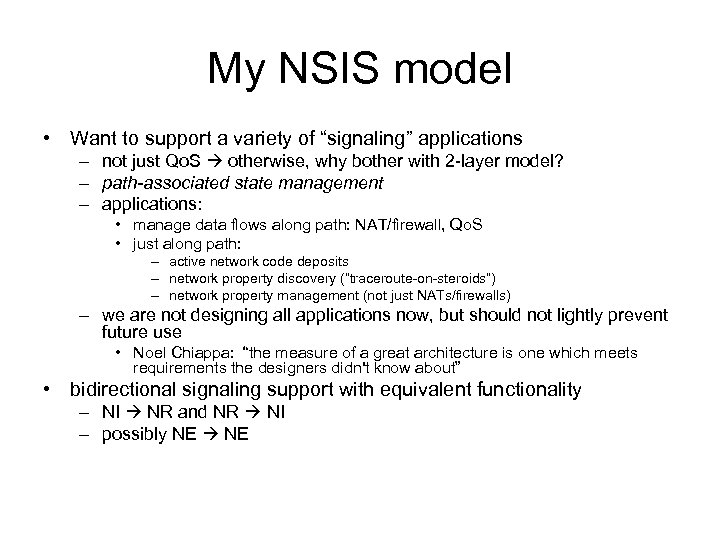 My NSIS model • Want to support a variety of “signaling” applications – not just Qo. S otherwise, why bother with 2 -layer model? – path-associated state management – applications: • manage data flows along path: NAT/firewall, Qo. S • just along path: – active network code deposits – network property discovery (“traceroute-on-steroids”) – network property management (not just NATs/firewalls) – we are not designing all applications now, but should not lightly prevent future use • Noel Chiappa: “the measure of a great architecture is one which meets requirements the designers didn't know about” • bidirectional signaling support with equivalent functionality – NI NR and NR NI – possibly NE
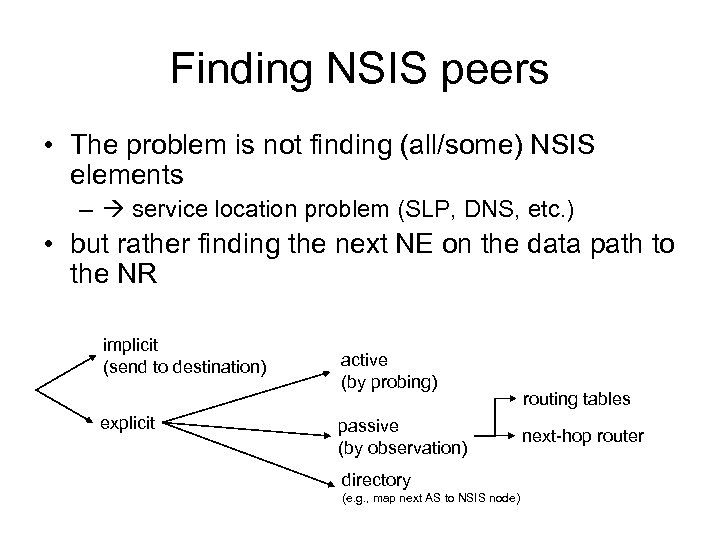 Finding NSIS peers • The problem is not finding (all/some) NSIS elements – service location problem (SLP, DNS, etc. ) • but rather finding the next NE on the data path to the NR implicit (send to destination) explicit active (by probing) passive (by observation) directory (e. g. , map next AS to NSIS node) routing tables next-hop router
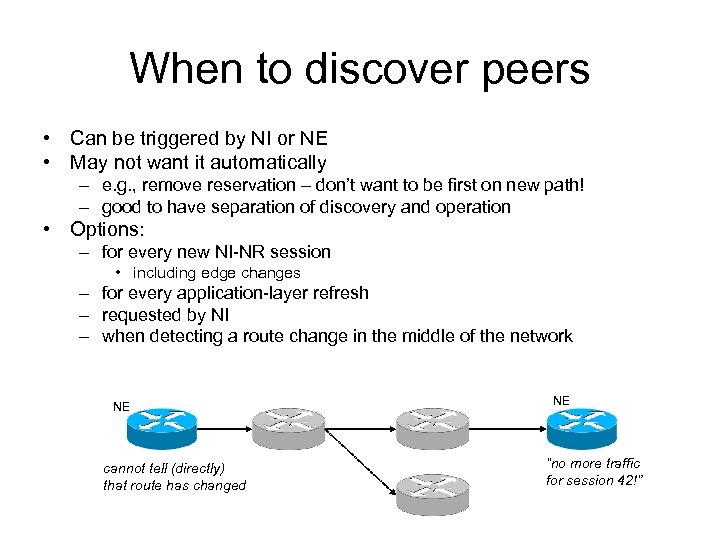 When to discover peers • Can be triggered by NI or NE • May not want it automatically – e. g. , remove reservation – don’t want to be first on new path! – good to have separation of discovery and operation • Options: – for every new NI-NR session • including edge changes – for every application-layer refresh – requested by NI – when detecting a route change in the middle of the network NE cannot tell (directly) that route has changed NE “no more traffic for session 42!”
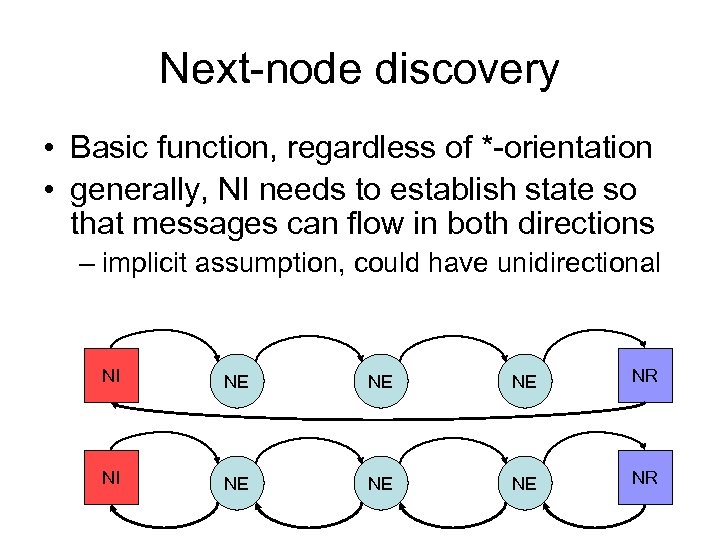 Next-node discovery • Basic function, regardless of *-orientation • generally, NI needs to establish state so that messages can flow in both directions – implicit assumption, could have unidirectional NI NE NE NE NR
 Next-node discovery • Next-node discovery probably causes operational distinction between path-coupled and path-decoupled • path-coupled: – one of the routers downstream – unless every data packet is a signaling packet, always only guess at coupling! • path-decoupled: – some server in next AS – anything else make (interdomain) sense?
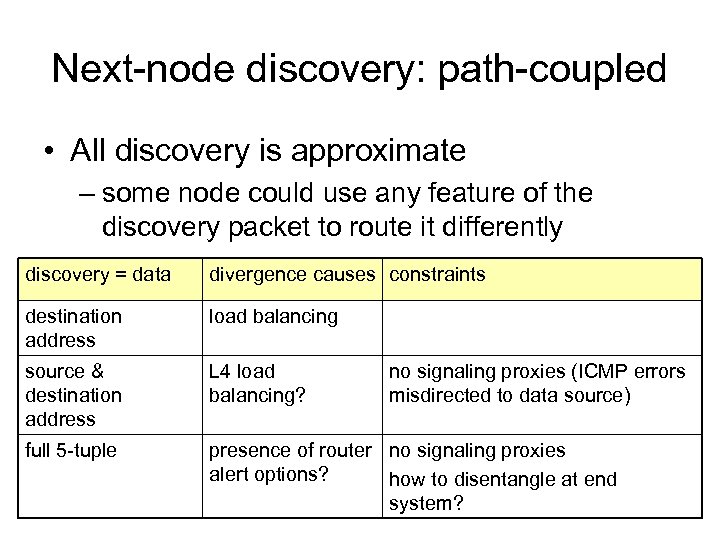 Next-node discovery: path-coupled • All discovery is approximate – some node could use any feature of the discovery packet to route it differently discovery = data divergence causes constraints destination address load balancing source & destination address L 4 load balancing? full 5 -tuple presence of router no signaling proxies alert options? how to disentangle at end system? no signaling proxies (ICMP errors misdirected to data source)
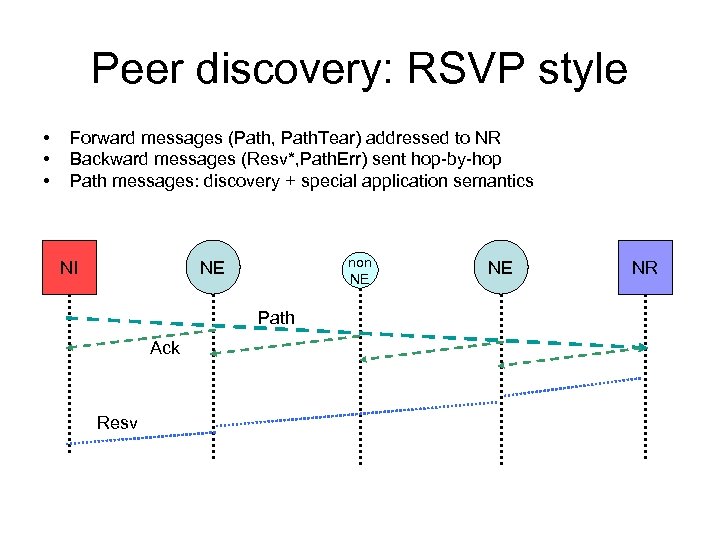 Peer discovery: RSVP style • • • Forward messages (Path, Path. Tear) addressed to NR Backward messages (Resv*, Path. Err) sent hop-by-hop Path messages: discovery + special application semantics NI non NE NE Path Ack Resv NE NR
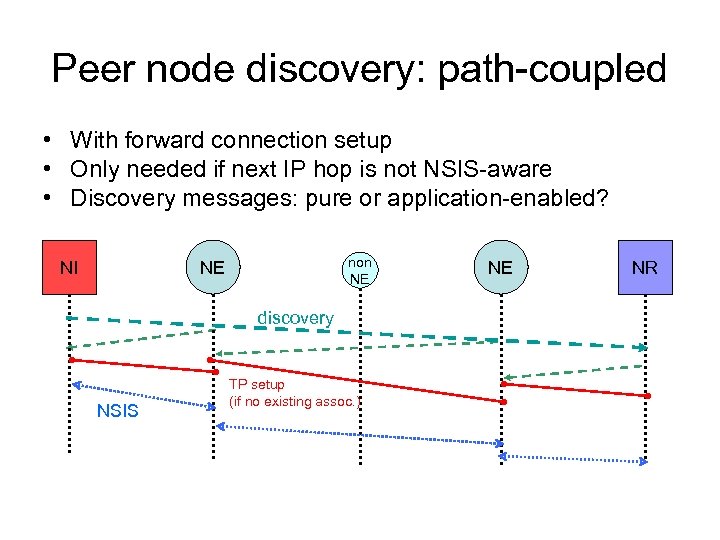 Peer node discovery: path-coupled • With forward connection setup • Only needed if next IP hop is not NSIS-aware • Discovery messages: pure or application-enabled? NI non NE NE discovery NSIS TP setup (if no existing assoc. ) NE NR
 Transport requirements • Signaling transport users may require large data volumes: – active network code – signed objects (easily several k. B long if selfcontained; standard cert is ~5 k. B) – objects with authentication tokens (OSP, …) – diagnostics accumulating data • Signaling applications may have high rates: – DOS attacks – automated retry after reservation failure (“redial”) – odd routing (load balancing over backup link)
 Lower and upper layers • Do all nodes process all NSIS messages? • “omnivorous”: – all messages, even unknown signaling protocols – e. g. , firewalls – depends on what information is common • common flow identification? • “vegetarians”: – only things they know and can understand
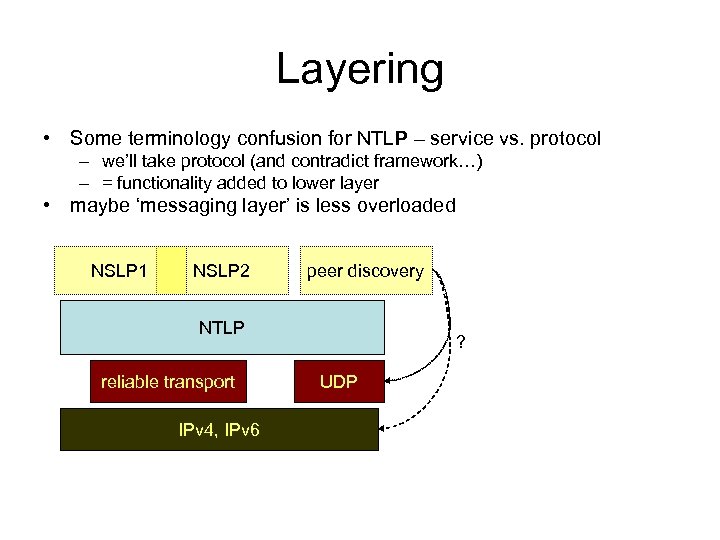 Layering • Some terminology confusion for NTLP – service vs. protocol – we’ll take protocol (and contradict framework…) – = functionality added to lower layer • maybe ‘messaging layer’ is less overloaded NSLP 1 NSLP 2 peer discovery NTLP reliable transport IPv 4, IPv 6 ? UDP
 Reliability • Most signaling applications require that end systems have reasonable assurance that state was established – if it wasn’t important, why bother sending message to begin with ? – often, modestly time-critical: • human factors call setup latency • economic fast and reliable teardown • RSVP discovered later staged refresh timer (RFC 2961)
 Reliability options (1) • End-to-end retransmission – NI retransmits until confirmation by NR L L L simple – only requires NI state deals with node failures usually, no good RTT estimate flying blind doesn’t work well for NR-initiated messages node processing (incl. AAA) adds delay variability RTT very unpredictable • Hop-by-hop below NTLP – – share congestion state between sessions better RTT estimate re-use transport optimizations such as SACK inappropriate services? mandates explicit discovery (see later)
 Reliability options (2) • Hop-by-hop by NTLP per session can use implicit discovery – RFC 2916 – simple exponential back-off: no windowing, no SACK bad for long-delay pipes – timer estimation difficult • often few messages for one NSIS session • must only have transport semantics • Hop-by-hop by NSLP – diversity of needs vs. cost • what does a feature cost if not used/needed? – what’s left for NTLP in that case?
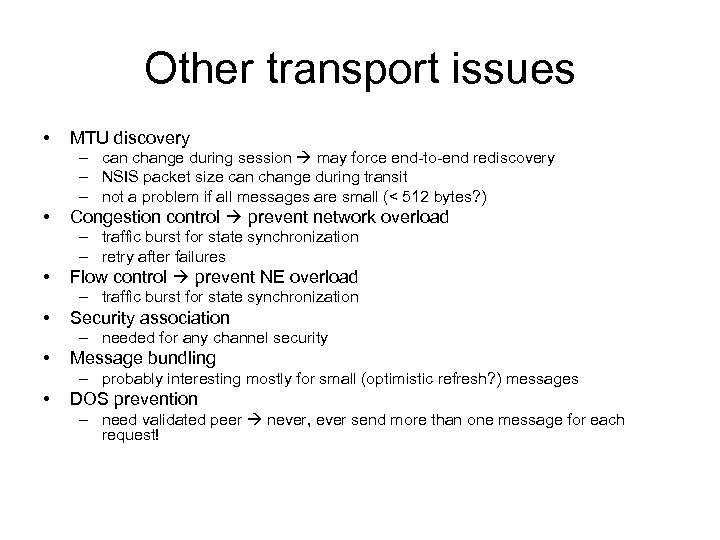 Other transport issues • MTU discovery – can change during session may force end-to-end rediscovery – NSIS packet size can change during transit – not a problem if all messages are small (< 512 bytes? ) • Congestion control prevent network overload – traffic burst for state synchronization – retry after failures • Flow control prevent NE overload – traffic burst for state synchronization • Security association – needed for any channel security • Message bundling – probably interesting mostly for small (optimistic refresh? ) messages • DOS prevention – need validated peer never, ever send more than one message for each request!
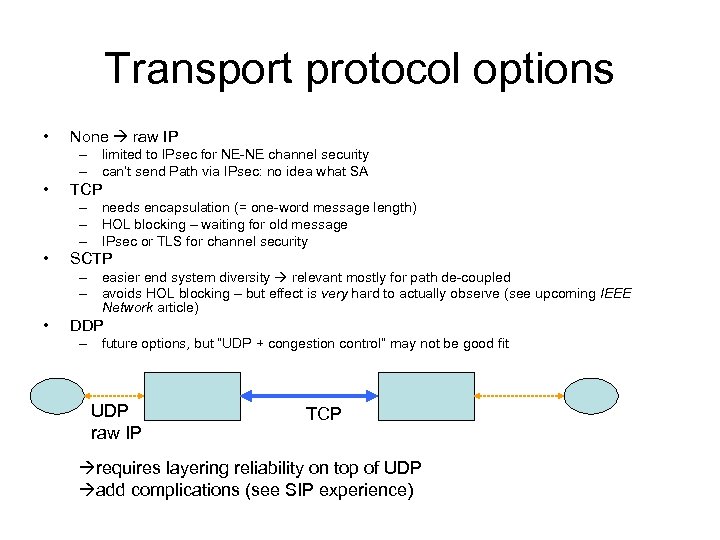 Transport protocol options • None raw IP – limited to IPsec for NE-NE channel security – can’t send Path via IPsec: no idea what SA • TCP – needs encapsulation (= one-word message length) – HOL blocking – waiting for old message – IPsec or TLS for channel security • SCTP – easier end system diversity relevant mostly for path de-coupled – avoids HOL blocking – but effect is very hard to actually observe (see upcoming IEEE Network article) • DDP – future options, but “UDP + congestion control” may not be good fit UDP raw IP TCP requires layering reliability on top of UDP add complications (see SIP experience)
 Transport (non-)issues • “But x. P is stateful and we want soft-state” – existence of transport association should not be coupled to NTLP or NSLP state lifetime – loss of transport does not signify anything (except maybe a reboot of the peer) – primarily an optimization issue: state maintenance vs. state establishment overhead • Multicast – Each branch can have own transport session – In RSVP, only Path* are multicast • End-to-end principle – not clear what the “ends” are here – each NE is not just forwarding, but processing and modifying messages – explicitly noted for performance enhancement • Number of associations per node – limited by select(), but not poll()
 Transport (non-)issues • State overhead – information about next/previous hop has to be somewhere… • Transport header overhead – most messages are likely >> 40 bytes • Transport implementation overhead – Conceivable end systems and routers already implement IP, UDP, TCP • TCP needed for DIAMETER, SNMP in routers • TCP on any reasonable mobile device (HTTP, SMTP, POP, IMAP, …) – Less clear for SCTP
 Identifiers • Need identifiers for each logical association/session – know whether this path has been traversed before • need discovery or not – pass to correct upper layer handler • SIP lesson: do not overload identifiers
 Identifiers should be… • globally unique – otherwise, they’ll have to be combined with something else • not depend on host addresses – NI and NR may change during session (mobility) – NAT and RFC 1918 -uniqueness issues – RSVP SENDER_TEMPLATE and SESSION object • constrains applications • hard to match (multiple formats) • same session has different identifiers along a path hard to manage • • probably not depend on globally unique host identifier (MAC) address constant length – easy to parse and compare • cryptographically random – not sufficient for security, but often helps to prevent long-distance session stealing attacks – can often avoid a complicated hash function
 Packet format issues • Variations on type/length/value • Type can be – externally described (RSVP) • meaning (“destination address”, “flowspec”) • format (IPv 4 or IPv 6) – internally described • implied (DIAMETER) • internal discriminator